
Canine behavioral problems and their effect on relinquishment of the Jindo dog
6
0
0
전체 글
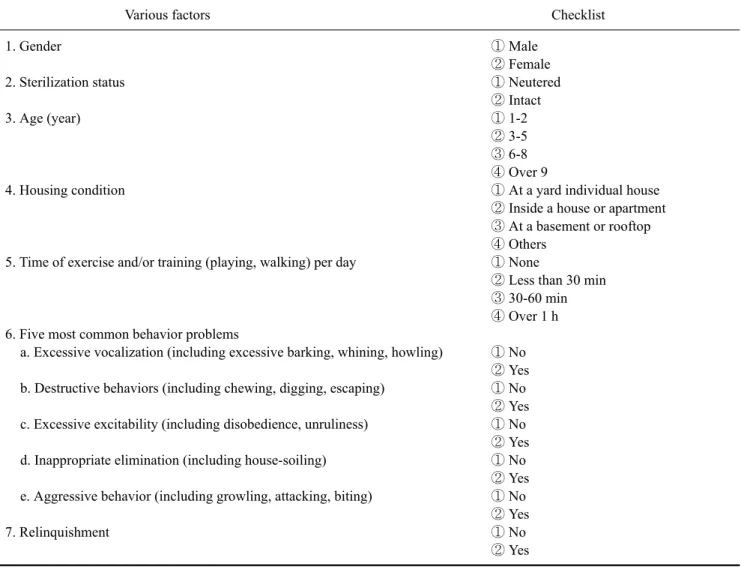
(2) 346 Young-Mee Kim et al.. Undesirable or inappropriate canine behavior in domestic dogs causes great distress in owners, and is likely to destroy the owner-dog bond [3]. Furthermore, behavior problems represent the single most serious risk factor of pet relinquishment, and approximately 50% owners give up their dogs because of canine behavior problems [14,16]. A study on canine behavior problems in Seoul also determined that relinquishment and abandonment was significantly associated with demonstration of behavior problems [8]. This study was aimed to evaluate the reasons of relinquishment of the Jindo dog regarding behavior problems and association with various factors such as the dog’s gender, sterilization status, age, housing condition, and amount of exercise and/or training per day. Additionally, the five most common behavior problems such as ‘excessive vocalization’, ‘destructive behavior’, ‘excessive excitability’, ‘inappropriate elimination’, and ‘aggressive behavior’ were evaluated in the Jindo dog.. Materials and Methods Subjects The study was carried out by a survey using the questionnaire ‘Canine Behavior Problems of the Jindo dog’. The questionnaire was distributed to people of the four provinces (Seoul, Incheon, Gyeonggi, and Chungnam) in Korea. Six researchers were recruited to administer this survey and asked people whether they currently owned a Jindo dog or had previously owned one within the past 10 years. The subjects were selected from public places like schools, public parks, hospitals, and markets. In order to avoid biased results, Jindo dog breeders and kennel club members were excluded. One hundred and eighty-nine questionnaires were successfully completed. Anonymity was guaranteed to all respondents.. Table 1. Checklist of the ‘Canine Behavior Problems of the Jindo dogs’ questionnaire Various factors 1. Gender 2. Sterilization status 3. Age (year). 4. Housing condition. 5. Time of exercise and/or training (playing, walking) per day. 6. Five most common behavior problems a. Excessive vocalization (including excessive barking, whining, howling) b. Destructive behaviors (including chewing, digging, escaping) c. Excessive excitability (including disobedience, unruliness) d. Inappropriate elimination (including house-soiling) e. Aggressive behavior (including growling, attacking, biting) 7. Relinquishment. Checklist ① Male ② Female ① Neutered ② Intact ① 1-2 ② 3-5 ③ 6-8 ④ Over 9 ① At a yard individual house ② Inside a house or apartment ③ At a basement or rooftop ④ Others ① None ② Less than 30 min ③ 30-60 min ④ Over 1 h ① No ② Yes ① No ② Yes ① No ② Yes ① No ② Yes ① No ② Yes ① No ② Yes.
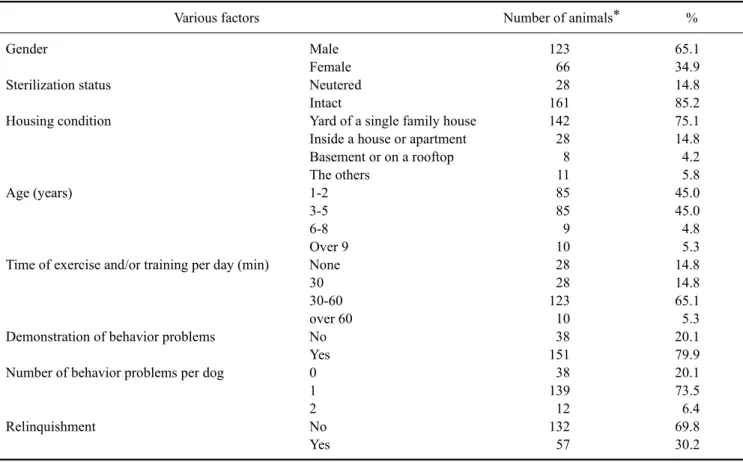
(3) Canine behavior problems of the Jindo dog 347. The ‘Canine Behavior Problem of the Jindo dog’ questionnaire General information about various factors upon Jindo dog which participated in this study were collected such as gender, sterilization status, age, housing condition, and time of exercise and/or training per day (Table 1). The study participants were asked about time devoted to activities related to exercising and/or training the Jindo dog such as playing and walking, but time spent simply being together with the owners without any exercise and/or training was excluded. The owners were also asked whether they had actual experience in relinquishing Jindo dogs and/or whether they were seriously considering relinquishing their pet. The selection of five most common behavior problems such as ‘excessive vocalization’ (including excessive barking, whining, and howling), ‘destructive behavior’ (including chewing, digging, and escaping), ‘excessive excitability’ (including disobedience and unruliness), ‘inappropriate elimination’ (including house-soiling), and ‘aggressive behavior’ (including growling, attacking, and biting) was based on previous studies [1,3,9,14-16]. Statistical analysis Pearson’s chi-squared test was used to evaluate the. association between demonstration of behavior problems and various factors such as gender, sterilization status, age, housing condition, and time of exercise and/or training per day. Association with pet relinquishment and various factors was also assessed by this analysis. All statistical analyses were performed using statistical analysis software (SPSS-version 15.0; SPSS, USA) with p < 0.05 considered as statistically significant.. Results General demographic information One hundred eighty-nine surveys were completed and there were approximately twice as many male (65.1%) than female (34.9%). The majority was intact (85.2%). The number of Jindo dogs younger than 2 years old (45%) and 3∼5 years old (45%) were equally distributed, but a few were over 9 years of age (5.3%). The mean age was 3.0 years with a range of 1 to 10 years. The majority of Jindo dogs were housed in a yard of an individual house (75.1%). Over 65% of the dogs spent approximately 30∼60 min per day exercising and/or training, but it was noted that 14.8% of dogs were provided no time for daily exercise or training (Table 2).. Table 2. General demographic information Various factors Gender Sterilization status Housing condition. Age (years). Time of exercise and/or training per day (min). Demonstration of behavior problems Number of behavior problems per dog. Relinquishment *Total number: 189.. Male Female Neutered Intact Yard of a single family house Inside a house or apartment Basement or on a rooftop The others 1-2 3-5 6-8 Over 9 None 30 30-60 over 60 No Yes 0 1 2 No Yes. Number of animals*. %. 123 66 28 161 142 28 8 11 85 85 9 10 28 28 123 10 38 151 38 139 12 132 57. 65.1 34.9 14.8 85.2 75.1 14.8 4.2 5.8 45.0 45.0 4.8 5.3 14.8 14.8 65.1 5.3 20.1 79.9 20.1 73.5 6.4 69.8 30.2.
(4) 348 Young-Mee Kim et al.. Five most common behavior problems A total 151 of 189 dogs had behavior problems (79.9%) and 38 dogs did not have behavior problems (20.1%) (Table 2). Among 151 dogs, 139 dogs showed single behavior problem (92.1%). They were ‘excessive excitability’ (46.8%), ‘excessive vocalization’ (30.2%), ‘inappropriate elimination’ (17.3%), ‘destructive behavior’ (4.3%), and ‘aggressive behavior’ (1.4%), respectively. In addition, 12 dogs showed two concurrent behavior problems (7.9%) (Table 2). Seven Jindo dogs (58.3%) showed excessive excitability and excessive vocalization, three dogs (25%) showed excessive vocalization and inappropriate elimination, and two dogs (16.7%) showed excessive vocalization and destructive behavior, concurrently. Relinquishment of Jindo dogs Fifty-seven Jindo dogs (30.2%) in the survey were associated with relinquishment. Fourteen dogs had actually been relinquished by their owners, and 43 owners stated that they were seriously considering relinquishing their pet Jindo dogs (Table 2). Despite the finding that Jindo dogs associated with relinquishment were reported to have more than one behavior problem, relinquishment was not significantly associated with demonstration of behavior problems (p = 0.267). Additionally, each of the five most common behavior problems did not significantly affect the rate of relinquishment (Table 3). Jindo dog relinquishment was not significantly associated with some factors such as behavior problems per dog (p = 0.315), sterilization status (p = 1.000), housing condition (p = 0.281), or age (p = 0.342).. Table 3. Differences of p-values for the degree of association with relinquishment and various factors, and with the five most common behavior problems Various factors. Dog relinquishment (p-value). Gender Sterilization status Age (years) Housing condition Time of exercise and/or training per day Demonstration of behavior problems Number of behavior problems per dog Excessive vocalization Destructive behavior Excessive excitability Inappropriate elimination Aggressive behavior *p <0.05.. 0.049* 1.000 0.342 0.281 0.007* 0.267 0.315 0.303 0.300 0.325 0.202 0.356. Discussion Canine behavior problems are collectively the single greatest risk factor of relinquishment of dogs according to many studies [1,8,9,14,15]. We therefore hypothesized that the relinquishment of Jindo dogs would be related to behavior problems. Thus, the questionnaires in our study mainly asked about the behavior problems of the Jindo dog, and the purpose of this study was to evaluate effects of behavior problems on Jindo dog relinquishment. Our results indicated that behavior problems were not a significant risk factor of the relinquishment of Jindo dogs. Consequently, the causes of relinquishment might be affected by some other factors except behavior problems. In general, the age of the dog is significantly associated with behavior problems and relinquishment, and younger than two years old tend to show more behavior problem [8,14,15]. However, we found that age did not affect the appearance of behavior problems and subsequent relinquishment of the Jindo dog. Typically, sterilization status is a risk factor for behavior problems [4] and over 50% dogs showing behavior problems are intact males [9]. Nevertheless, sterilization status was not significantly associated with behavior problems in the Jindo dog. Mondelli et al. [12] found that male dogs showing behavior problem are at great risk for being returned to a rescue shelter. However, this study determined that there was no association between gender and demonstration of behavior problems. In the Jindo dog, the demonstration of behavior problems was not significantly affected by gender, but relinquishment was significantly associated with gender. It was noted that the dogs associated with relinquishment were all intact males while no female were associated with relinquishment. No study has been performed about gender-based preference of dog adoption in Korea. Nevertheless, it seems that Koreans tend to prefer females because of animal’s temperament and ability to produce offspring. Thus, female Jindo dogs are about 30∼ 50% more expensive than males in the Korean pet market. This may influence the gender differences in relinquishment frequency. According to previous studies, there is no significant association between housing conditions, demonstration of behavior problems, and relinquishment [18], however having a house with a yard, garden, or a terrace is very important for better management of dogs and can influence the length of the adoption period [13]. In another study, the relinquishment is significantly associated with time dedicated to exercising and/or training per day in Korea [8]. In this study, Jindo dogs that were provided with insufficient time for exercise and/or training per day were likely to be at risk of relinquishment(p < 0.05). Dogs are social animals which needed complex animate or inanimate stimulation such as social contact, playing,.
(5) Canine behavior problems of the Jindo dog 349. walking, and training [17,18]. Play and exercise sessions should be a part of the daily routine, and insufficient play or stimulation can be an underlying cause for many behavior problems. If dogs are not provided with sufficient mental and/or physical stimulations, they are less trainable and showing behavior problem which results in relinquishment [9,14]. As a high-energetic hunting breed, the Jindo dog requires sufficient exercise and/or training to consume its abundant energy. This will also contribute to strengthening the owner-dog bond and prevent relinquishment. When people are interested to adopt a dog as a pet, they consider appearance and behavior characteristics of the dog breed. To live a better life with their own pet and prevent relinquishment, it is important to understand the innate behavior characteristics of dog breed and the potential causes of relinquishment. All breed of dog has their own behavior characteristics, and it could be developed into unwanted behavior problems when environment does not satisfy animals’ needs. Most of the dog breed has potential behavior problems, for better understandings of Jindo dogs, we evaluated behavior problems based on owner’s survey. In this study, the behavior problem most frequently demonstrated by the Jindo dog was ‘excessive excitability’. This problem is common among dogs with abundant energy, and is often seen in hunting or working breeds [11]. If environmental stimuli and/or sufficient exercise and training are limited, the Jindo dog is likely to show ‘excessive excitability’. ‘Excessive vocalization’ as the second most behavior problem of the Jindo dog also represented a large portion of reported behavior problems, and many owners complain about ‘excessive vocalization’ to behaviorists. In general, ‘excessive vocalization’ is associated with older dogs, insufficient environmental stimuli, and ‘hyperactivity’ without any medical reasons [1]. In the Jindo dog, age was not significantly associated with the demonstration of ‘excessive vocalization’. However, it was hypothesized that ‘excessive vocalization’ might be related with ‘excessive excitability’ in the Jindo dog. Excessive vocalization and excitability might be induced by hyper-sensitivity to social stimuli such as novel objects, other animals, sounds, and unfamiliar people. Kim et al. [6] reported that the daily socialization program applied to Jindo dog puppies from the 7th to 13th week after birth shows significant effects not on social reactions towards humans and other dogs or fearful reactions towards social stimuli, but on playful reactions towards novel stimuli and other dogs. In order to minimize the Jindo dogs’ sensitivity to various stimuli and make them more sociable and friendly toward people, especially unfamiliar men, many trials are being conducted to apply socialization programs starting from an early age [6]. Quite a few Jindo dogs have been described as demonstrating ‘aggressive behavior’ because ‘aggressive behavior’ towards people might lead to death or serious. injuries, and this behavior problem is considered to be the most serious behavioral-related reason for relinquishment and euthanasia [2,14,16]. Dog bites have received much attention as a public danger as well as a current major public health issue [13]. The Jindo dog originated from an isolated island with a harsh environment. To survive under these conditions, they had to be energetic, watchful, alert, fearless, loyal, and obedient. Since owners have tried to maintain these original qualities [10], it is well-known that the typical Jindo dog generally gives its devotion whole-heartedly to its owner, but seems to resent being touched by individuals it does not know and will not show affection towards a stranger [6,10]. Some subjective descriptions of Jindo dog temperament have been reported, and they indicate that dogs of this breed, as a rule, are not friendly towards strangers [10]. For these reasons, the Jindo dog is suitable for being a watchdog and hunting dog. These are the Jindo dog’s basic characteristics, so owner rarely recognize then as behavior problems per se. However, the dog’s characteristics can be risk factors for relinquishment [10]. The survey research is one of the limited methods, therefore more detailed questionnaires or various research methods would be needed for future studies for better understandings of Jindo dogs. In conclusion, canine behavior problems known collectively as the single most serious risk factor for relinquishment was not significantly associated with relinquishment of the Jindo dog.. Acknowledgments This study was supported by the Research Institute for Veterinary Science, Seoul National University.. References 1. Beaver BV. Canine Behavior: A Guide for Veterinarians. 1st ed. pp. 267-287, Saunders, Philadelphia, 1999. 2. Cameron DB. Canine dominance-associated aggression: concepts, incidence, and treatment in a private behavior practice. Appl Anim Behav Sci 1997, 52, 265-274. 3. Campbell WE. Behavior Problems in Dogs. pp. 256-270, BehavioRx Systems, Grants Pass, 1999. 4. Hsu Y, Severinghaus LL, Serpell JA. Dog keeping in Taiwan: its contribution to the problem of free-roaming dogs. J Appl Anim Welf Sci 2003, 6, 1-23. 5. Kim KS, Jeong HW, Park CK, Ha JH. Suitability of AFLP markers for the study of genetic relationships among Korean native dogs. Genes Genet Syst 2001, 76, 243-250. 6. Kim YK, Lee SS, Oh SI, Kim JS, Suh EH, Houpt KA, Lee HC, Lee HJ, Yeon SC. Behavioral reactivity of Jindo dogs socialized at an early age compared with non-socialized dogs. J Vet Med Sci 2010, 72, 405-410. 7. Kim YK, Lee SS, Oh SI, Kim JS, Suh EH, Houpt KA, Lee HC, Lee HJ, Yeon SC. Behavioural reactivity of the Korean.
(6) 350 Young-Mee Kim et al.. 8.. 9. 10. 11. 12.. 13.. native Jindo dog varies with coat colour. Behav Processes 2010, 84, 568-572. Kim YM, Abd El-Aty AM, Hwang SH, Lee JH, Lee SM. Risk factors of relinquishment regarding canine behavior problems in South Korea. Berl Munch Tierarztl Wochenschr 2009, 122, 1-7. Landsberg GM, Hunthausen WM, Ackerman L. Handbook of Behavior Problems of the Dog and Cat. pp. 1-14, Saunders, New York, 2003. Lee CG, Lee JI, Lee CY, Sun SS. A review of the Jindo, Korean native dog. Asian-Aust J Anim Sci 2000, 13, 381389. Lindsay SR. Handbook of Applied Dog Behavior and Training. pp. 147-157, Iowa State University Press, Ames, 2001. Mondelli F, Prato Previde E, Verga M, Levi D, Magistrelli S, Valsecchi P. The bond that never developed: adoption and relinquishment of dogs in a rescue shelter. J Appl Anim Welf Sci 2004, 7, 253-266. Overall KL, Love M. Dog bites to humans--demography,. 14. 15.. 16.. 17. 18.. epidemiology, injury, and risk. J Am Vet Med Assoc 2001, 218, 1923-1934. Patronek GJ, Glickman LT, Beck AM, McCabe GP, Ecker C. Risk factors for relinquishment of dogs to an animal shelter. J Am Vet Med Assoc 1996, 209, 572-581. Salman MD, Hutchison J, Ruch-Gallie R, Kogan L, New JC Jr, Kass PH, Scarlett JM. Behavioral reasons for relinquishment of dogs and cats to 12 shelters. J Appl Anim Welf Sci 2000, 3, 93-106. Segurson SA, Serpell JA, Hart BL. Evaluation of a behavioral assessment questionnaire for use in the characterization of behavioral problems of dogs relinquished to animal shelters. J Am Vet Med Assoc 2005, 227, 17551761. Wells DL. A review of environmental enrichment for kenneled dogs, Canis familiaris. Appl Anim Behav Sci 2004, 85, 307-317. Wells DL, Hepper PG. Prevalence of behaviour problems reported by owners of dogs purchased from an animal rescue shelter. Appl Anim Behav Sci 2000, 69, 55-65..
(7)
수치

관련 문서
Therefore, in this study, the conditions and problems of wind instrument programs of various junior high schools in the Gwangju region were analyzed
This dissertation is composed of 6 chapters. ChapterⅠ deals with the purpose and the methods of this study. ChapterⅡ refers the methods and the problems of
Objectives: This study aimed to investigate the relationship between job stress and turnover intention of employed opticians and to investigate the mediating effect of burnout
As a result of deriving the problems of each stop through the purpose of the study, informability was satisfied with the essential conditions to achieve the objectives that
First, for the degree of emotional and behavioral problems of specialized vocational high school students, the highest level was withdrawal/depression, followed
The purpose of the present study was to evaluate the effect of Tisseel™, used as an adjunct to tooth ash and plaster of Paris mixture, on the early healing of surgically
80) “Dogs at large : Injury to any person or damage to any property by a dog while at large shall be the full responsibility of the dog owner or person or persons responsible
This study was conducted to develop and evaluate the effects of a posture management program based on the theory of planned behavior (TPB) which was
