• 검색 결과가 없습니다.

Thoracic Endovascular Aortic Repair with the Chimney Technique for Blunt Traumatic Pseudoaneurysm of the Aortic Arch in a No-Option Patient

N/A
N/A
Protected

Academic year: 2022

Share "Thoracic Endovascular Aortic Repair with the Chimney Technique for Blunt Traumatic Pseudoaneurysm of the Aortic Arch in a No-Option Patient"

Copied!
4
0
0

로드 중.... (전체 텍스트 보기)

전체 글

(1)

Yonsei Med J http://www.eymj.org Volume 54 Number 1 January 2013 258

Case Report http://dx.doi.org/10.3349/ymj.2013.54.1.258

pISSN: 0513-5796, eISSN: 1976-2437 Yonsei Med J 54(1):258-261, 2013

Thoracic Endovascular Aortic Repair with the Chimney Technique for Blunt Traumatic Pseudoaneurysm of the Aortic

Arch in a No-Option Patient

Won Ho Kim, 1 * Jin Ho Choi, 2 * Sang Hyun Park, 1 Yu Jeong Choi, 1 Kyung Tae Jeong, 1 Sun Chang Park, 1 and Sahng Lee 1

Divisions of

1

Cardiology and

2

Chest Surgery, Eulji University Hospital, Eulji University School of Medicine, Daejeon, Korea.

Received: August 5, 2011 Revised: October 1, 2011 Accepted: October 13, 2011 Corresponding author: Dr. Sahng Lee, Division of Cardiology, Eulji University Hospital, Eulji University School of Medicine,

1306 Dunsan-2 dong, Seo-gu, Daejeon 302-799, Korea.

Tel: 82-42-611-3083, Fax: 82-42-611-3083 E-mail: [email protected]

*Won Ho Kim and Jin Ho Choi contributed equally to this work.

∙ The authors have no financial conflicts of interest.

© Copyright:

Yonsei University College of Medicine 2013 This is an Open Access article distributed under the terms of the Creative Commons Attribution Non- Commercial License (http://creativecommons.org/

licenses/by-nc/3.0) which permits unrestricted non- commercial use, distribution, and reproduction in any medium, provided the original work is properly cited.

A 42-year-old man was involved in a motor vehicle collision. Imaging studies re- vealed the presence of a post-traumatic aortic pseudo-aneurysm (about 34×26 cm) arising from the descending thoracic aorta at the level of the left subclavian artery (LSA), prone to rupture. Thoracic endovascular aneurysm repair (TEVAR) was the only feasible option due to his poor overall medical status. In this case, LSA needed to be covered in order to extend the proximal landing zone. Eventually, modified TEVAR was successfully performed by means of the chimney technique to pre- serve flow to the LSA and to prevent flow into the pseudoaneurysmal sac.

Key Words: Thoracic endovascular aneurysm repair, chimney technique

INTRODUCTION

Pseudoaneurysm after trauma is an out-pouching of the blood vessel, resulting from a deficiency in the tunica media and intima. The risk of rupture is high, and surgery has traditionally been recommended in all patients with thoracic aortic pseudoaneurysm irrespective of symptom status.

1

Thoracic endovascular aneu- rysm repair (TEVAR) is an alternative to open surgery for patients with the signifi- cant risk of surgery,

2,3

however, the lack of adequate landing zones for stent grafts, and close proximity to supra-aortic branches make effective and safe delivery of endovascular therapy technically challenging. We describe a case of successful TEVAR with the chimney technique for blunt traumatic pseudoaneurysm of the aortic arch in a no-option patient.

CASE REPORT

A 42-year-old man was involved in a motor vehicle collision. On arrival, he was

hypotensive and tachycardic. Further diagnostic work-up revealed multiple inju-

ries including suspected intra-peritoneal hemorrhage, and multiple pelvic bone

fracture. A computed tomography (CT) scan showed the presence of a post-trau-

(2)

Chimney Technique, Pseudoaneurysm

Yonsei Med J http://www.eymj.org Volume 54 Number 1 January 2013 259

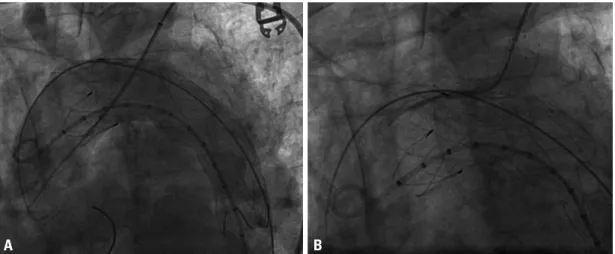
tail catheter via right femoral access in the ascending aorta, a Thoracic SEAL stent graft (S&G Bio Tech CO., Seong- nam, Korea) made of 34-30 mm tapered diameter and 110 mm length was deployed. The landmark for stent graft placement was the origin of the left common carotid artery (CCA). Next, the chimney stent was deployed in the LSA (Fig. 2). Completion angiography revealed widely patent LSA and left CCA, exclusive of the pseudoaneurysm with- out evidence of endoleak. Then, the left CFA was closed with preformed knots of two sutures of closure devices. A follow-up CT performed after 7 days indicated no proximal endoleak with complete exclusion of the thoracic aortic pseudoaneurysm, as well as free flow into the LSA and left CCA (Fig. 3).

DISCUSSION

TEVAR is difficult and problematic when the aortic arch is involved. Because the main challenge lies in maintaining blood flow to the vital supra-aortic branches while the arch is being covered by the stent graft, combined stent-grafting and surgery with extra-anatomic bypass grafts could be an excellent approach in such cases.

4,5

However, these tech- niques also obviate the need for an open surgical approach and are not suitable for urgent cases. Thoracic aortic pseu- doaneruysm is a rare and potentially fatal problem.

6

A per- fused pseudoaneurysm may partially clot and organize with a fibrous wall potentially evolving into a large pseudoaneu- rysm which is prone to rupture.

7

In our patient, TEVAR re- matic aortic pseudo-aneurysm (about 34×26 cm) arising

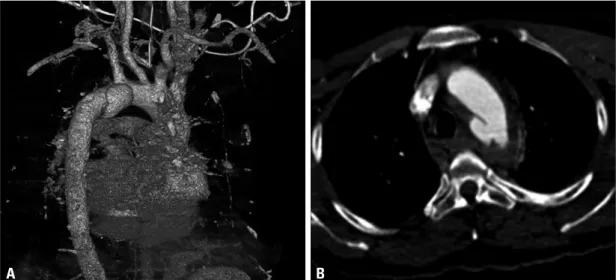
from the descending thoracic aorta (DTA). The neck was located immediately after the origin of the left subclavian artery (LSA) on the lesser curvature of the aorta (Fig. 1).

Because of his poor overall medical status, difficulty of maintaining low blood pressure, and suspected coagulopa- thy, TEVAR remained the only feasible option. But, the presence of an inadequate proximal landing zone was an important limiting for endovasucular repair. LSA needed to be covered in order to extend the proximal landing zone, im- prove fixation and achieve an adequate seal. Therefore, mod- ified TEVAR was planned by means of the chimney tech- nique to preserve flow to the LSA and to prevent flow into the pseudoaneurysmal sac. Thus, left common femoral artery (CFA) was prepared with the preclosing technique using two closure devices (ProGlide, Abbott Vascular Devices, Red- wood, CA, USA) in an off-label fashion by deploying the de- vices before insertion of the 18 Fr sheath (UltimumTM EV, St. Jude, Minnetonka, MN, USA). For the chimney tech- nique of the LSA, the left brachial artery was punctured with a 7-F sheath, and the chimney stent- SMART-Control stent (Cordis; Johnson & Johnson Medical, Miami, FL, USA) of 10 mm diameter and 40 mm in length was delivered in ad- vance into the LSA, with a short segment protruding into the aortic arch lumen. For TEVAR, the diameter of the en- doluminal graft was based on the diameter of the true lu- men-aortic arch and the healthy aorta just before the lesion with an oversizing of about 10-20% to permit adequate proximal seal and fixation. With injection contrast medium for visualizing the position of the stent graft with a 5 F pig-

Fig. 1. Pseudoaneurysm and its relationship with surrounding structures. (A) Saccular pseudoaneurysm was noted just distal to the ori- fice of the LSA on the lesser curvature of the aorta on the three-dimensional reconstruction image of the CT. (B) Axial CT scan showed the presence of a post-traumatic aortic pseudo-aneurysm (about 34×26 cm) arising from the DTA at the level of the LSA. LSA, left subcla- vian artery; CT, computed tomography; DTA, descending thoracic aorta.

A B

(3)

Won Ho Kim, et al.

Yonsei Med J http://www.eymj.org Volume 54 Number 1 January 2013 260

ostium. Since then, it has been used for preservation of vital supra aortic branches during TEVAR.

14,15

For the chimney device type, a covered stent graft would seem to provide a better seal than a bare stent. However, Feng, et al.

16

state that covered stent grafts offer no additional benefits, except that a long channel is required for the branch. Few data are available concerning the superiority and matching of differ- ent chimney devices. We, therefore, believe that any type of chimney device, readily available in any interventional suite, can be used to form the chimney. Also, our team be- lieves that self-expanding stent also has sufficient crush re- sistance and remains open after placement.

To our knowledge, this is the first report to show that trau- matic aortic arch pseudoaneurysm after blunt trauma with intra-peritoneal hemorrhage and multiple bone fractures was successfully treated by TEVAR with chimney technique.

Long term results are needed before this technique can wide- mained the only feasible option. The main challenge was

that intentional covering of the LSA needed to extend the proximal landing zone and achieve an adequate seal. A few studies report that intentional coverage of the LSA without revascularization is not associated with additional morbidi- ty, whereas many studies report a higher incidence of post- operative arm ischemia and posterior circulation strokes compared with patients who did not undergo intentional coverage.

8-10

We, therefore, aimed to perform the chimney technique, which is based on previously reported intention- al LSA.

11,12

The chimney device is defined as a bare or cov- ered stent graft that is implanted parallel to the main aortic stent graft and extends into an over-stented vital side branch in order to preserve its perfusion.

11

The chimney technique was originally introduced by Greenberg, et al.,

13

who used renal stents to depress the proximal edge of stent-graft fab- ric that protruded a few millimeters above the renal artery

Fig. 2. Endograft deployment resulted in near-total coverage of the LSA (A), followed by retrograde chimney stenting of the LSA origin via the trans-brachial approach (B). The landmark for stent graft placement was the origin of the left CCA. Note that the chimney stent was delivered in advance into the LSA, with protruding into the aortic arch lumen. LSA, left subclavian artery; CCA, common carotid artery.

Fig. 3. 7 days follow-up CT showing good device morphology and no leakage, patent left CCA, LSA (A), and complete exclusion of the tho- racic aortic pseudoaneurysm (B). CT, computed tomography; CCA, common carotid artery; LSA, left subclavian artery.

A

A

B

B

(4)

Chimney Technique, Pseudoaneurysm

Yonsei Med J http://www.eymj.org Volume 54 Number 1 January 2013 261 8. Woo EY, Carpenter JP, Jackson BM, Pochettino A, Bavaria JE, Szeto WY, et al. Left subclavian artery coverage during thoracic endovascular aortic repair: a single-center experience. J Vasc Surg 2008;48:555-60.

9. Peterson BG, Eskandari MK, Gleason TG, Morasch MD. Utility of left subclavian artery revascularization in association with en- doluminal repair of acute and chronic thoracic aortic pathology. J Vasc Surg 2006;43:433-9.

10. Reece TB, Gazoni LM, Cherry KJ, Peeler BB, Dake M, Matsu- moto AH, et al. Reevaluating the need for left subclavian artery revascularization with thoracic endovascular aortic repair. Ann Thorac Surg 2007;84:1201-5.

11. Sugiura K, Sonesson B, Akesson M, Björses K, Holst J, Malina M.

The applicability of chimney grafts in the aortic arch. J Cardiovasc Surg (Torino) 2009;50:475-81.

12. Ohrlander T, Sonesson B, Ivancev K, Resch T, Dias N, Malina M.

The chimney graft: a technique for preserving or rescuing aortic branch vessels in stent-graft sealing zones. J Endovasc Ther 2008;15:427-32.

13. Greenberg RK, Clair D, Srivastava S, Bhandari G, Turc A, Hamp- ton J, et al. Should patients with challenging anatomy be offered endovascular aneurysm repair? J Vasc Surg 2003;38:990-6.

14. Criado FJ. A percutaneous technique for preservation of arch branch patency during thoracic endovascular aortic repair (TE- VAR): retrograde catheterization and stenting. J Endovasc Ther 2007;14:54-8.

15. Hiramoto JS, Schneider DB, Reilly LM, Chuter TA. A double- barrel stent-graft for endovascular repair of the aortic arch. J En- dovasc Ther 2006;13:72-6.

16. Feng R, Zhao Z, Bao J, Wei X, Wang L, Jing Z. Double-chimney technology for treating secondary type I endoleak after endovas- cular repair for complicated thoracic aortic dissection. J Vasc Surg 2011;54:212-5.

ly be applied. However, it seems to be an alternative treat- ment option in urgent-traumatic pseudoaneruysm, and can be used in rescue procedures to salvage aortic side branches over-stented during TEVAR.

REFERENCES

1. Alla VM, Suryanarayana PG, Thambidorai SK. Thoracic aortic pseudoaneurysm following noncardiovascular surgery: a rare complication that can mimic common chest emergencies. South Med J 2010;103:1186-8.

2. Chaikof EL, Mutrie C, Kasirajan K, Milner R, Chen EP, Veeras- wamy RK, et al. Endovascular repair for diverse pathologies of the thoracic aorta: an initial decade of experience. J Am Coll Surg 2009;208:802-16.

3. Kpodonu J, Wheatley GH 3rd, Ramaiah VG, Rodriguez-Lopez JA, Strumpf RK, Diethrich EB. Endovascular repair of an ascend- ing aortic pseudoaneurysm with a septal occluder device: mid- term follow-up. Ann Thorac Surg 2008;85:349-51.

4. Shim WH. Hybrid approach for complex thoracic aortic patholo- gy. Korean Circ J 2010;40:368-9.

5. Kang WC, Shin EK, Ahn TH, Lee KH, Moon CI, Han SH, et al.

Combined open and endovascular repair for aortic arch pathology.

Korean Circ J 2010;40:399-404.

6. Razzouk A, Gundry S, Wang N, Heyner R, Sciolaro C, Van Ars- dell G, et al. Pseudoaneurysms of the aorta after cardiac surgery or chest trauma. Am Surg 1993;59:818-23.

7. Bizzarri F, Mattia C, Ricci M, Chirichilli I, Santo C, Rose D, et al.

Traumatic aortic arch false aneurysm after blunt chest trauma in a

motocross rider. J Cardiothorac Surg 2008;3:23.

수치

Fig. 1. Pseudoaneurysm and its relationship with surrounding structures. (A) Saccular pseudoaneurysm was noted just distal to the ori- ori-fice of the LSA on the lesser curvature of the aorta on the three-dimensional reconstruction image of the CT
Fig. 2. Endograft deployment resulted in near-total coverage of the LSA (A), followed by retrograde chimney stenting of the LSA origin via  the trans-brachial approach (B)

참조

관련 문서

After stent graft implantation became a standard procedure for infra-renal abdominal aortic aneurysm, the number of cas- es of thoracic endovascular aortic repair

To prevent contrast medium-induced nephropathy and spinal cord ische- mia caused by a simultaneous endovascular procedure, a saccular aneurysm of the descending thoracic aorta was

A Giant Pseudo-Aneurysm on the Anastomosis Site for a Redo Bentall Operation due to Behçet Disease Treated by Thoracic Endovascular Aortic Aneurysm Repair with a Custom-Made

To allow a minimally invasive surgery, a hybrid aortic stent-grafting procedure was performed, consisting of a left subclavian artery (LSCA) debranching procedure combined with

Thoracic aortogram following thoracic endovascular aortic repair shows a delayed filling of the aneurysmal sac with blood flow from the left seventh intercostal artery, suggesting

Here, we introduce a novel technique based on a normal bifurcated stent graft to great abdominal aortic aneurysm (AAA) with bilateral CIA aneurysms and unilateral external