• 검색 결과가 없습니다.

Early Experiences with the Endovascular Repair of Ruptured Descending Thoracic Aortic Aneurysm

N/A
N/A
Protected

Academic year: 2021

Share "Early Experiences with the Endovascular Repair of Ruptured Descending Thoracic Aortic Aneurysm"

Copied!
7
0
0

로드 중.... (전체 텍스트 보기)

전체 글

(1)

ISSN: 2233-601X (Print) ISSN: 2093-6516 (Online)

Department of Thoracic and Cardiovascular Surgery, SMG-SNU Boramae Medical Center

This article was presented at the 2015 Hybrid Aortic Live Symposium, H-ALIVE.

Received: November 30, 2015, Revised: February 12, 2016, Accepted: February 12, 2016, Published online: April 5, 2016

Corresponding author: Jae-Sung Choi, Department of Thoracic and Cardiovascular Surgery, SMG-SNU Boramae Medical Center, 20 Boramae-ro 5-gil, Dongjak-gu, Seoul 07061, Korea

(Tel) 82-2-870-2293 (Fax) 82-2-870-3864 (E-mail) [email protected]

C

The Korean Society for Thoracic and Cardiovascular Surgery. 2016. All right reserved.

CC

This is an open access article distributed under the terms of the Creative Commons Attribution Non-Commercial License (http://creative- commons.org/licenses/by-nc/4.0) which permits unrestricted non-commercial use, distribution, and reproduction in any medium, provided the original work is properly cited.

Early Experiences with the Endovascular Repair of Ruptured Descending Thoracic Aortic Aneurysm

Jae-Sung Choi, M.D., Ph.D., Se Jin Oh, M.D., Yong Won Sung, M.D., Hyun Jong Moon, M.D., Jung Sang Lee, M.D., Ph.D.

Background: The aim of this study was to report our early experiences with the endovascular repair of ruptured descending thoracic aortic aneurysms (rDTAAs), which are a rare and life-threatening condition. Methods: Among 42 patients who underwent thoracic endovascular aortic repair (TEVAR) between October 2010 and September 2015, five patients (11.9%) suffered an rDTAA. Results: The mean age was 72.4±5.1 years, and all patients were male. Hemoptysis and hemothorax were present in three (60%) and two (40%) patients, respectively. Hypovolemic shock was noted in three patients who underwent emergency operations. A hybrid operation was performed in three patients. The mean operative time was 269.8±72.3 minutes. The mean total length of aortic coverage was 186.0±49.2 mm. No 30-day mortality occurred. Stroke, delirium, and atrial fibrillation were observed in one patient each. Paraplegia did not occur. Endoleak was found in two patients (40%), one of whom underwent an early and successful reintervention. During the mean follow-up period of 16.8±14.8 months, two patients died; one cause of death was a persistent type 1 endoleak and the other cause was unknown. Conclusion: TEVAR for rDTAA was associated with favorable early mortality and morbidity outcomes. However, early reintervention should be considered if persistent endoleak occurs.

Key words: 1. Aneurysm 2. Aorta 3. Rupture 4. Stents

INTRODUCTION

Ruptured thoracic aortic aneurysms rarely occur, but once they develop, the overall mortality is so high that the number of deaths caused by these ruptures is not trivial. The in- cidence of this condition has been estimated as only five per 100,000 [1], but it has been reported to cause 179 per 100,000 deaths [2]. Approximately 30% of thoracic aortic

ruptures have been reported to be localized in the descending

aorta [1]. Thoracic endovascular aortic repair (TEVAR) with

or without a hybrid procedure is a particularly attractive ther-

apeutic option for ruptured descending thoracic aortic aneur-

ysm (rDTAA). Favorable results have been reported in many

cases of the total or hybrid endovascular management of in-

tact DTAA over the more than 20 years that have passed

since the first report of a successful early outcome of

http://dx.doi.org/10.5090/kjtcs.2016.49.2.73

(2)

TEVAR for DTAA [3]. Moreover, the current literature has shown that the early morbidity and mortality associated with this condition can be improved with endovascular repair rath- er than traditional open repair [4-6]. However, the currently available data are limited to a small series of cases involving TEVAR performed to treat rDTAA, so the outcomes cannot be considered conclusive. In the present study, we evaluated the early clinical results of patients with rDTAA managed with TEVAR performed at a single center, with the expect- ation that our results will contribute to the further elucidation of the outcomes of endovascular repair as a treatment for this rare but life-threatening condition.

METHODS

The study protocol was reviewed by the institutional re- view board of SMG-SNU Boramae Medical Center in Korea (IRB approval number: 26-2015-135) and was approved as a minimal-risk retrospective study that did not require informed patient consent.

1) Patients

From October 2010 to September 2015, 42 patients under- went TEVAR with or without a hybrid procedure for various aortic pathologies at our institution. Among them, seven pa- tients suffered a thoracic aortic rupture. The most frequent cause of the rupture was DTAA, which developed in the five patients who were the subjects of this study. The other two patients, who experienced a blunt traumatic aortic injury and a pseudoaneurysm that developed at the proximal anastomosis site of a previously performed thoracoabdominal aortic repair, respectively, were excluded. Since TEVAR was first in- troduced for the management of rDTAA at our institution in May 2012, the procedure has been a first-line treatment mo- dality for rDTAA. Rupture was defined as the presence of extravasation around the aorta that manifested as hemoptysis, hemothorax, and/or mediastinal hematoma on computed to- mography (CT) imaging. The presence of only a contained mediastinal hematoma was defined as a contained rupture.

2) Endovascular techniques

We routinely performed CT angiography to assess the ana-

tomical suitability of TEVAR. All endovascular repairs were performed under general anesthesia and guided by a vascular C-arm in the operating room. Although we usually considered spinal drainage before TEVAR when it was necessary for the coverage length of the aorta to exceed 200 mm, allowing the distal end of the endograft to reach the celiac axis, no pa- tients in this study underwent preemptive spinal drainage. For access, an inguinal oblique incision was made, and purse string sutures were placed at the common femoral artery to control bleeding at the puncture site. We used a single stent graft brand, SEAL Thoracic Stent Graft (S&G Biotech Inc., Seongnam, Korea), which was made of nitinol wire and poly- ester fabric. The diameter of the stent graft was 20% larger than the proximal and distal landing zones of the native aorta. If the diameter difference between the proximal and distal landing zones was relatively large, we chose a tapered stent graft. The length of the landing zone had to be at least 15 mm to avoid endoleak and graft migration. When it was necessary to expand the landing zone, we performed a pre- emptive right common carotid artery (RCCA) to left common carotid artery (LCCA) bypass and/or a LCCA to left sub- clavian artery (LSA) bypass. During emergency operations, we usually first covered the LSA ostium to obtain a more proximal landing zone and then evaluated the necessity of LSA revascularization. Accurate deployment and endoleaks were assessed by completion angiography, and we defined the absence of type I or III endoleak as procedural success. All patients were admitted to the intensive care unit (ICU) fol- lowing TEVAR for postoperative care. CT angiography was routinely performed in all patients before discharge.

3) Follow-up and statistics

We reviewed patients’ electronic medical records and, if

necessary, interviewed patients or their families by phone. No

patient was lost to follow-up. Routine follow-up CT angiog-

raphy was conducted six months after discharge and then

annually. However, in patients who exhibited untreated endo-

leak, CT angiography was conducted monthly. We inves-

tigated late mortality and aortic events, such as aortic re-

intervention, re-rupture, newly appeared endoleak, and retro-

grade aortic dissection. Since our study included only five

participants, the clinical data are shown as either frequencies

(3)

Table 1. Preoperative baseline characteristics and clinical presen- tation (N=5)

Characteristic Value

Age (yr) 72.4±5.1

Male 5

Comorbidities

Hypertension 4

Hyperlipidemia 1

Diabetes mellitus 0

Smoking 2

Chronic obstructive pulmonary disease 1

Coronary artery disease 1

Cerebrovascular accident 1

Chronic kidney disease (>2) 3

Stage 2 1

Stage 3 1

Stage 4 0

Stage 5 1

Prior cardiac surgery 0

Prior aortic intervention 1

Presentation

Hoarseness 3

Hemoptysis 3

Hemomediastinum 0

Hemothorax 2

Associated dissection 0

Hypovolemic shock 3

Aneurysm diameter (mm) 62.7±18.4

Saccular aneurysm 1

Values are presented as mean±standard deviation or number.

or mean±standard deviation.

RESULTS

1) Characteristics of patients and operations

During the study period, five patients underwent endovas- cular repair with TEVAR for rDTAA. The characteristics of the patients are summarized in Table 1. The mean age was 72.4±5.1 years, and all the patients were male. Most patients had hypertension (n=4) and at least stage 2 chronic kidney disease (n=3). None of the patients were diabetic. The mean diameter of the DTAA was 62.7±18.4 mm. Hemoptysis and hemothorax were present in three (60%) and two (40%) pa- tients, respectively. The maximum diameter of the aortic aneurysm was 62.7±18.4 mm. Hypovolemic shock was ob-

served in three patients who underwent emergency surgery.

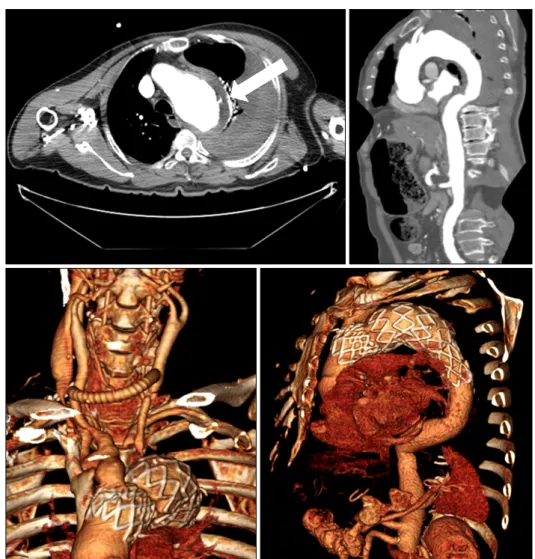
Hybrid TEVAR was performed in three patients: an emer- gency RCCA to LCCA bypass with double ligation of the proximal LCCA followed by zone 1 deployment of the stent graft (Fig. 1); a double transposition procedure (transposition of the LCCA onto the innominate artery, along with trans- position of the LSA onto the transposed LCCA) under hemi- sternotomy followed by zone 1 deployment of the stent graft;

and a left carotid to LSA bypass with an 8-mm Dacron graft followed by zone 2 deployment of a stent graft. The other two rDTAA patients were treated by isolated TEVAR. One of them suffered retroesophageal hematoma caused by a de- layed type III endoleak that developed two years after com- bined TEVAR and endovascular abdominal aortic aneurysm repair (EVAR). The other patient suffered a distal DTAA.

The mean operation time was 269.8±72.3 minutes. One pa- tient who was treated with emergency isolated TEVAR to ad- dress a distal DTAA rupture experienced an access problem.

His bilateral common iliac arteries were so narrowed that the stent graft device could not be advanced through them.

However, there was not enough time for surgical exposure of the iliac artery and anastomosis for the access conduit; there- fore, we dilated the right iliac artery with a 7-mm balloon catheter to successfully deliver the stent graft. The total length of aortic coverage was 186.0±49.2 mm. Revasculariza- tion of the LSA was performed in 66.7% of the patients who underwent LSA coverage (Table 2).

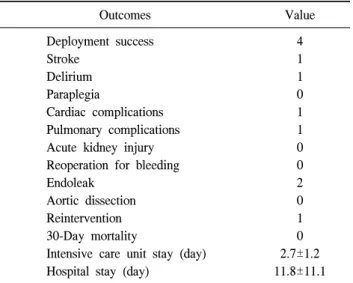
2) Early outcomes

Table 3 shows the postoperative morbidity and early mor-

tality outcomes in this study. Stroke, delirium, and atrial fi-

brillation were each diagnosed in one patient. Paraplegia did

not occur. Acute respiratory distress syndrome (ARDS) devel-

oped in one patient who presented with a tension hemothorax

preoperatively. Technical success was achieved in four pa-

tients (80%). A single case of type I endoleak was found on

completion angiography, but the endoleak was so faint that

we decided to wait and observe subsequent developments

without any further adjunctive procedures, with the expect-

ation that the endoleak would disappear. However, post-

operative CT angiography revealed a persistent endoleak, and

it was addressed by a successful reintervention before

(4)

Fig. 1. (A, B) Preoperative CT an- giography shows a ruptured (white arrow) descending thoracic aortic aneurysm with mediastinal shift due to a large hemothorax. (C, D) Six- month follow-up CT angiography shows the carotid to carotid artery bypass with ligation of the left com- mon carotid artery followed by zone 1 deployment of the stent graft. CT, computed tomography.

Table 2. Characteristics of the operations (N=5)

Characteristics of the operations Value

Operation time (min) 269.8±72.3

Access problem 1

Graft brand

S&G 5

Maximum graft diameter (mm) 42.0±6.1

Total graft length (mm) 186.0±49.2

Hybrid procedure 3

Coverage of the left subclavian artery 3

With revascularization 2

Coverage of the common carotid artery 2 Values are presented as mean±standard deviation or number.

discharge. Another endoleak was thought to be type III. In fact, this endoleak was not observed on completion angiog- raphy but was instead identified on CT angiography per-

formed at a later point. This endoleak was considered re- current because the rupture was associated with a delayed type III endoleak, which developed two years after a combined TEVAR and EVAR procedure. No 30-day mortality was observed. The average length of the ICU stay was 2.7±1.2 days, while the mean hospital stay was 11.8±11.1 days.

3) Late outcomes

During the mean follow-up period of 16.8±14.8 months,

none of the patients developed a new endoleak, but two pa-

tients (40%) died, including the patient who had suffered the

recurrent endoleak. When he visited our outpatient department

after discharge, reintervention was strongly recommended, but

was rejected by the patient. Approximately 3.5 months fol-

lowing discharge, he presented to the emergency department

in cardiac arrest. We assumed that the cause of the cardiac

(5)

Table 3. Early outcomes of the endovascular repair of ruptured descending thoracic aortic aneurysms

Outcomes Value

Deployment success 4

Stroke 1

Delirium 1

Paraplegia 0

Cardiac complications 1

Pulmonary complications 1

Acute kidney injury 0

Reoperation for bleeding 0

Endoleak 2

Aortic dissection 0

Reintervention 1

30-Day mortality 0

Intensive care unit stay (day) 2.7±1.2

Hospital stay (day) 11.8±11.1

Values are presented as mean±standard deviation or number.

arrest was a rerupture associated with the persistent endoleak.

The other patient died seven months after discharge and had undergone successful endovascular repair without post- operative complications except for transient atrial fibrillation.

He rejected a six-month follow-up via CT angiography. The cause of his late death was not able to be determined in a phone interview.

DISCUSSION

We described and evaluated the outcomes of five cases of the endovascular repair of rDTAA, which is a quite rare and life-threatening condition. All patients who underwent TEVAR survived and were discharged, but two patients died within a year thereafter. In one case, persistent type III endo- leak resulted in early rerupture of the DTAA.

Few data are available regarding the overall prognosis of rDTAA. Johansson et al. [1] reported that 54% of patients with ruptured thoracic aortic aneurysm died within six hours after the onset of their symptoms, and only 41% of patients were alive upon arrival to the hospital arrival. The overall mortality rate was more than 95%, and in their series, 30%

of patients had an rDTAA.

The conventional open repair of rDTAA has been asso- ciated with high mortality rates, ranging from 22% to 45%

[7-11]. According to a recently published United States pop- ulation-based analysis [11], TEVAR rates for rDTAA in- creased steeply from 0.1 per million in 2005 to 0.7 per mil- lion in 2008, while open repair rates were stagnant during the same period. The operative mortality rate was more than 50%

in 1998 but significantly decreased to 23.4% in 2008 due to the introduction of endovascular repair (odds ratio, 0.41;

p=0.001). TEVAR with or without a hybrid debranching pro- cedure can offer prompt sealing of the rupture site to prevent hypovolemic shock and avoid aortic cross-clamping and thoracotomy. These advantages over open repair may play an important role in the recently published improved results.

Jonker et al. [4] identified 224 patients with rDTAA through a systemic review of all studies and databases published since 1995 and found that TEVAR was associated with a sig- nificantly lower 30-day mortality rate in comparison with open repair (19% versus 33%; odds ratio, 2.15). This result agreed with the outcomes of a multicenter study that included 87 patients from seven referral centers. Hypovolemic shock was present in 21.8% of the patients, and the 30-day mortal- ity rate was 18.4%. In a small but recent series that included 23 patients, 21.7% were in shock before surgery, and the 30-day mortality rate was greatly reduced to 4.3%; however, the in-hospital mortality rate was 21.7% [6].

The clinical presentation has been found to be closely re- lated to the prognosis of the endovascular repair of rDTAA.

Hypovolemic shock and hemothorax have been reported to be strong predictors of early mortality [5,6]. Hypovolemic shock at presentation indicates that excessive blood loss can result in systemic hypoperfusion with ischemic multi-organ injuries.

In our study, all patients with hemothorax (n=2) were in hy- povolemic shock, and one of them, who presented with ten- sion hemothorax, suffered postoperative ARDS despite com- plete intrathoracic decompression via thoracic drainage.

Tension hemothorax and tension hemomediastinum can cause

ventilatory failure and secondary esophageal necrosis, which

is thought to be caused by an acutely elevated intrathoracic

or mediastinal pressure [6,12,13]. Of the three patients who

presented with hemoptysis in this study, one patient suffered

from postoperative delirium and transient atrial fibrillation. In

addition, three patients complained of hoarseness before de-

scending thoracic aortic rupture. We think that hoarseness

(6)

may be a risk factor for aortic rupture, though little is known about the association between hoarseness and rDTAA. No paraplegia was observed, but one stroke occurred post- operatively due to interruption of the left posterior inferior cerebellar artery (PICA). Although stroke developed in the patient who underwent covering of the LSA with a stent graft without revascularization, the association between PICA-re- lated stroke and simple occlusion of the LSA is not clear [14]. In practice, it is not easy to routinely revascularize the LSA when emergency or urgent TEVAR is required for life-threatening rDTAA. Therefore, revascularization should be performed on an individualized basis for this subset of pa- tients who require coverage of the LSA [15]. Based upon limited data, the incidence rates of paraplegia after the endo- vascular repair of rDTAA have been reported to range from 3.1% to 8.7%. The incidence rates of periprocedural stroke have been reported to range from 4.1% to 26.1% [4-6]. These results are encouraging, considering that the incidence rates of paraplegia and stroke after open repair have been reported to be as high as 12.5% and 25%, respectively [8,16].

However, the current evidence supporting the superiority of TEVAR is too limited to recommend choosing endovascular management as the first line of therapy for rDTAA, as it is based on small case series. In addition, endovascular manage- ment has inherent problems that should be addressed during follow-up, including endoleak, endograft infection with or without fistula, and retrograde aortic dissection. In this study, one case of type I endoleak, which was found during com- pletion angiography, was addressed with early reintervention, while another case of type III endoleak, belatedly found upon CT angiography, led to a late death. In reality, urgent or emergency situations caused by rDTAA may not allow for the optimal selection of a stent-graft device because the large amount of blood loss may reduce the aortic diameter; even though the aortic sizing may be accurate, an adequately sized endograft may not be immediately available. Therefore, the rate of endograft-related complications tends to increase in patients with rDTAA. A recent meta-analysis found the rates of endoleak and endograft-related complications to be 63%

and 59%, respectively. At some point during follow-up, a type I endoleak developed in 10% of patients, and 4.6% of the patients with available follow-up data died of endog-

raft-related complications [4]. Early outcome results of a smaller series of rDTAA patients likewise showed high rates of endoleak of approximately 18% [5,6].

In conclusion, the rare cases of rDTAA that have been re- paired using endovascular techniques showed favorable early mortality and morbidity outcomes. However, endograft-related complications, such as endoleaks, should be addressed in the early stage of follow-up. Although the endovascular repair of rDTAA in our study was successful, and no complications were observed, continued surveillance of these patients is imperative.

CONFLICT OF INTEREST

No potential conflict of interest relevant to this article was reported.

ACKNOWLEDGMENTS

This study was supported by a Grant of the Samsung Vein Clinic Network (Daejeon, Anyang, Cheongju, Cheonan; Fund No. KTCS04-044).

REFERENCES

1. Johansson G, Markstrom U, Swedenborg J. Ruptured thora- cic aortic aneurysms: a study of incidence and mortality rates. J Vasc Surg 1995;21:985-8.

2. Svensjo S, Bengtsson H, Bergqvist D. Thoracic and thor- acoabdominal aortic aneurysm and dissection: an inves- tigation based on autopsy. Br J Surg 1996;83:68-71.

3. Dake MD, Miller DC, Semba CP, Mitchell RS, Walker PJ, Liddell RP. Transluminal placement of endovascular stent-grafts for the treatment of descending thoracic aortic aneurysms. N Engl J Med 1994;331:1729-34.

4. Jonker FH, Trimarchi S, Verhagen HJ, Moll FL, Sumpio BE, Muhs BE. Meta-analysis of open versus endovascular repair for ruptured descending thoracic aortic aneurysm. J Vasc Surg 2010;51:1026-32, 1032.e1-1032.e2.

5. Jonker FH, Verhagen HJ, Lin PH, et al. Outcomes of endo- vascular repair of ruptured descending thoracic aortic aneurysms. Circulation 2010;121:2718-23.

6. Minami T, Imoto K, Uchida K, et al. Thoracic endovascular aortic repair for ruptured descending thoracic aortic aneurysm. J Card Surg 2015;30:163-9.

7. Schermerhorn ML, Giles KA, Hamdan AD, Dalhberg SE,

(7)

Hagberg R, Pomposelli F. Population-based outcomes of open descending thoracic aortic aneurysm repair. J Vasc Surg 2008;48:821-7.

8. Barbato JE, Kim JY, Zenati M, et al. Contemporary results of open repair of ruptured descending thoracic and thor- acoabdominal aortic aneurysms. J Vasc Surg 2007;45:667-76.

9. Girardi LN, Krieger KH, Altorki NK, Mack CA, Lee LY, Isom OW. Ruptured descending and thoracoabdominal aort- ic aneurysms. Ann Thorac Surg 2002;74:1066-70.

10. Crawford ES, Hess KR, Cohen ES, Coselli JS, Safi HJ.

Ruptured aneurysm of the descending thoracic and thor- acoabdominal aorta: analysis according to size and treatment.

Ann Surg 1991;213:417-25.

11. Kilic A, Shah AS, Black JH 3rd, et al. Trends in repair of intact and ruptured descending thoracic aortic aneurysms in the United States: a population-based analysis. J Thorac Cardiovasc Surg 2014;147:1855-60.

12. Minatoya K, Okita Y, Tagusari O, Imakita M, Yutani C,

Kitamura S. Transmural necrosis of the esophagus secondary to acute aortic dissection. Ann Thorac Surg 2000;69:1584-6.

13. Park NH, Kim JH, Choi DY, et al. Ischemic esophageal ne- crosis secondary to traumatic aortic transection. Ann Thorac Surg 2004;78:2175-8.

14. Sugiura T, Imoto K, Uchida K, et al. Evaluation of the ver- tebrobasilar system in thoracic aortic surgery. Ann Thorac Surg 2011;92:568-70.

15. Matsumura JS, Lee WA, Mitchell RS, et al. The Society for Vascular Surgery Practice guidelines: management of the left subclavian artery with thoracic endovascular aortic repair. J Vasc Surg 2009;50:1155-8.

16. Minatoya K, Ogino H, Matsuda H, Sasaki H, Yagihara T, Kitamura S. Replacement of the descending aorta: recent outcomes of open surgery performed with partial car- diopulmonary bypass. J Thorac Cardiovasc Surg 2008;136:

431-5.

수치

Table 1. Preoperative baseline characteristics and clinical presen- presen-tation (N=5) Characteristic Value Age  (yr) 72.4±5.1 Male 5 Comorbidities Hypertension 4 Hyperlipidemia 1 Diabetes  mellitus 0 Smoking 2
Fig. 1. (A, B) Preoperative CT an- an-giography shows a ruptured (white  arrow) descending thoracic aortic  aneurysm with mediastinal shift due  to a large hemothorax
Table 3. Early outcomes of the endovascular repair of ruptured  descending thoracic aortic aneurysms

참조

관련 문서

1 John Owen, Justification by Faith Alone, in The Works of John Owen, ed. John Bolt, trans. Scott Clark, "Do This and Live: Christ's Active Obedience as the

The aim of this study was to provide a optimal drug therapy which secures effectiveness and safeness in elderly patients by analyzing polypharmacy and the

The 2nd, The score of the ability of beginning, continuing and conducting the activity and ability of overcoming the aversion experiences, which are the subordinate elements of

Therefore, this study aims to reveal the educational value of modern early childhood learners' emotional cultivation and to present a method of art

In this study we will survey the changes in DNA repair factors during aging in rat, including mismatch repair (MMR), base excision repair (BER), and double-strand break

The aim of this study was to determine the serum levels of the prohormone form of hepcidin, pro-hepcidin, and its relations with iron status and its

The aim of this work was to prepare tenoxicam-ethanolamine salt with improved physicochemical properties, to compare the flux of tenoxicam and

The aim of this study was not only to compare the differences of ego-resilience between students with high experience and students with low experience in