INTRODUCTION
Blunt traumatic aortic rupture (TAR) has traditionally been treated with early open surgical repair. Recently, endovascu- lar stent-grafting of TAR has been described as a less invasive and possibly more favorable option.
CASE REPORT
A 73-yr-old woman presented with multiple trauma and chest pain after a traffic accident. Traumatic aortic injury was suggested by a chest radiography, which showed mediastinal widening and left pleural effusion. A spiral computed tomog- raphy (CT) scan revealed an extraluminal hematoma in the distal aortic arch with a contained aortic rupture (Fig. 1). Fur- ther examination showed no other aortic lesions. However, the patient had concomitant comminuted fractures in the right tibia, left femur, and the radius bilaterally, which required surgery. Surgery for the TAR was therefore delayed for about 1 month to allow orthopedic postoperative recovery. To allow a minimally invasive surgery, a hybrid aortic stent-grafting procedure was performed, consisting of a left subclavian artery (LSCA) debranching procedure combined with proximal des-
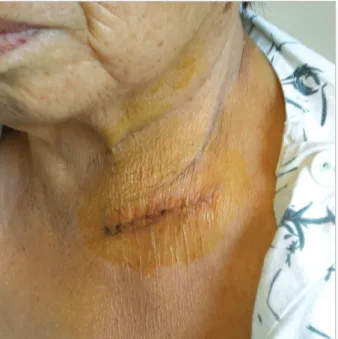
cending thoracic aortic stenting. Median sternotomy for the debranching procedure was avoided by transposing the LSCA to the left common carotid artery (LCCA) through a 5 cm left supraclavicular incision. The LSCA and LCCA were dis- sected and freed from their surrounding attachments after moderate systemic heparinization with an intravenous (IV) of 5,000 IU. The proximal LSCA was clamped and transect- ed, and the proximal stump was closed with a continuous running suture of 4-0 polypropylene. The LCCA was partially clamped and opened longitudinally, and the transected dis- tal portion of the LSCA was attached in an end-to-side man- ner. The wound was closed in layers. The patient later recov- ered full neurologic function without deficits. On postoper- ative day 5, the interventional radiologist inserted a thoracic aortic stent percutaneously using the Seldinger technique.
The common femoral artery was punctured under local anes- thesia. A 5F-calibrated angiographic catheter was advanced into the aortic arch via the contralateral common femoral artery to determine the morphology and extent of the aortic rup- ture (Fig. 2A). The delivery system was advanced under flu- oroscopy after IV injection of 5,000 IU heparin until the tip reached the origin of the LCCA. Finally a SEAL�endopros- thesis (S & G Biotech, Korea) was inserted into the aortic arch to complete the procedure. A series of aortograms were per-
142
Yang Gi Ryu1, Suk Jung Choo2, Ju Yong Lim2, Hyun Ki Yoon3, and Cheol Hyun Chung2
Department of Thoracic and Cardiovascular Surgery1, Guro Hospital, Korea University Medical Center, Seoul;
Departments of Thoracic and Cardiovascular Surgery2, Interventional Radiology3, Asan Medical Center, University of Ulsan, College of Medicine, Seoul, Korea
Address for correspondence Cheol Hyun Chung, M.D.
Department of Thoracic and Cardiovascular Surgery, Asan Medical Center, 388-1 Pungnap-dong, Songpa-gu, Seoul 138-736, Korea Tel : +82.2-3010-3580, Fax : +82.2-3010-6989 E-mail : [email protected]
J Korean Med Sci 2010; 25: 142-4 ISSN 1011-8934
DOI: 10.3346/jkms.2010.25.1.142
Hybrid Procedure for a Traumatic Aortic Rupture Consisting of
Endovascular Repair and Minimally Invasive Arch Vessel Transposition without Sternotomy
Emergency surgical repair for acute traumatic aortic ruptures has been associated with a high peri-procedural mortality rate. Endovascular stent-grafting, as a less invasive procedure, has shown encouraging results. This report describes a patient with a short landing zone, who was treated by transposing the supra-aortic branch without sternotomy, followed by covered stent-grafting with an extended proximal bare portion to enhance fixation.
Key Words : Aorta; Wounds and Injuries; Stent-graft
ⓒ 2010 The Korean Academy of Medical Sciences.
This is an Open Access article distributed under the terms of the Creative Commons Attribution Non-Commercial License (http://creativecommons.org/licenses/by-nc/3.0) which permits unrestricted non-commercial use, distribution, and reproduction in any medium, provided the original work is properly cited.
Received : 9 May 2008 Accepted : 28 July 2008
Endovascular Repair of Traumatic Aortic Rupture 143
formed during deployment to ensure accurate proximal and distal positioning. The proximal bare stent was placed pre- cisely in the middle of the ascending aorta, allowing free blood flow to both arch vessels. Intraoperative angiography was used for post-procedural assessment of stent-graft positioning and endoleak (Fig. 2B). An in-hospital thoracic CT scan on post- operative day 12 (Fig. 2C) showed successful exclusion of the rupture site, with no any signs of endoleak or graft-related complications. At the first visit to the out-patient department, the patient was doing well and showed good healing of the supraclavicular incisional wound (Fig. 3).
DISCUSSION
Emergency open thoracotomy for traumatic aortic ruptures is associated with a peri-procedural mortality rate ranging
between 17% and 21%, and a paraplegia rate as high as 7%
(1, 2), due mainly to the large proportion of patients who present with multiple concomitant co-morbid conditions.
Although delaying surgical repair of TAR may overcome the high mortality and morbidity risks associated with emergen- cy surgery, delaying open surgery has been found to have an in-hospital mortality risk of 2-5% (3, 4). Recent results have suggested that endovascular stent-grafting may be a viable,
‘minimally invasive’ alternative, which can achieve the same results as emergency open thoracotomy but with lower mor- tality and morbidity risks (5-7). Endovascular stent-grafting, however, has several drawbacks that may limit its broader application. For example, most TARs occur at the aortic isth- mus level, so the proximal landing zone in these patients is usually short. Furthermore, obligate coverage of the LSCA ostium is often required to achieve complete sealing of the rupture site, so it may cause ischemia or thrombosis (8, 9).
Fig. 1. Preoperative CT scan showing an extraluminal hematoma of the distal aortic arch containing an aortic rupture.
Fig. 2. (A) Pre-procedural an- giogram after debranching of the left subclavian artery, show- ing free blood flow to both arch vessels and the morphology and extent of the rupture site. Post- procedural angiogram (B) and CT scan (C) after stent-graft pla- cement, showing complete ex- clusion of the rupture site and good apposition of the endopro- sthesis, without endoleak around the stent-graft.
A B C
Fig. 3. Left supraclavicular wound.
144 Y.G. Ryu, S.J. Choo, J.Y. Lim, et al.
Proximal fixation was enhanced in our patient by deploying a graft with an extended bare proximal portion. This approach could ensure adequate anchorage without aortic arch branch occlusion, even in patients with short landing zones. Further- more, by transposing the LSCA onto the LCCA through the small supraclavicular incision, a full sternotomy could be avo- ided while preserving blood flow to the LSCA. Occlusion of the LSCA during unprotected stent insertion is frequently regarded as inconsequential.
In summary, this report presents our first experience with hybrid TAR, combining supra-aortic branch transposition with endovascular stent-grafting. Currently available tech- niques for stent-grafting of the descending aorta, combined with minimally invasive debranching procedures, may lead to the further development of safe and effective strategies that will avoid the high risks associated with conventional open surgery.
REFERENCES
1. Rousseau H, Dambrin C, Marcheix B, Richeux L, Mazerolles M, Cron C, Watkinson A, Mugniot A, Soula P, Chabbert V, Canevet G, Roux D, Massabuau P, Meites G, Tran Van T, Otal P. Acute traumat- ic aortic rupture: a comparison of surgical and stent graft repair. J Thorac Cardiovasc Surg 2005; 129: 1050-5.
2. Kuhne CA, Ruchholtz S, Voggenreiter G, Eggebrecht H, Paffrath T, Waydhas C, Nast-Kolb D, AG Polytrauma DGU. Traumatic aortic injuries in severely injured patients. Unfallchirurg 2005; 108: 279-87.
3. Jahromi AS, Kazemi K, Safar HA, Doobay B, Cina CS. Traumatic aortic rupture of the thoracic aorta: cohort study and systematic review. J Vasc Surg 2001; 34: 1029-34.
4. von Oppell UO, Dunne TT, De Groot MK, Zilla P. Traumatic aor- tic rupture: twenty-year metaanalysis of mortality and risk of para- plegia. Ann Thorac Surg 1994; 58: 585-93.
5. Morgan R, Loosemore T, Belli AM. Endovascular repair of con- tained rupture of the thoracic aorta. Cardiovasc Intervent Radiol 2002; 25: 291-4.
6. Wellons ED, Milner R, Solis M, Levitt A, Rosenthal D. Stent-graft repair of traumatic aortic disruptions. J Vasc Surg 2004; 40: 1095- 100.
7. Buz S, Zipfel B, Mulahasanovic S, Pasic M, Weng Y, Hetzer R. Con- ventional surgical repair and endovascular treatment of acute trau- matic aortic rupture. Eur J Cardiothorac Surg 2008; 33: 143-9.
8. Doss M, Wood JP, Balzer J, Martens S, Deschka H, Moritz A. Emer- gency endovascular interventions for acute thoracic aortic rupture:
four-year follow-up. J Thorac Cardiovasc Surg 2005; 129: 645-51.
9. Buth J, Harris PL, Hobo R, van Eps R, Cuypers P, Duijm L, Tielbeek X. Neurologic complications associated with endovascular repair of thoracic aortic pathology: Incidence and risk factors. A study from the European Collaborators on Stent/Graft Techniques for Aortic Ane- urysm Repai (EUROSTAR) registry. J Vasc Surg 2007; 46: 1103-10.