• 검색 결과가 없습니다.

Two-Stage Endovascular Repair for Concurrent Penetrating Atherosclerotic Ulcers of the Thoracic and Abdominal Aorta

N/A
N/A
Protected

Academic year: 2021

Share "Two-Stage Endovascular Repair for Concurrent Penetrating Atherosclerotic Ulcers of the Thoracic and Abdominal Aorta"

Copied!
4
0
0

로드 중.... (전체 텍스트 보기)

전체 글

(1)

Korean J Thorac Cardiovasc Surg 2013;46:365-368 □ Case Report □ http://dx.doi.org/10.5090/kjtcs.2013.46.5.365 ISSN: 2233-601X (Print) ISSN: 2093-6516 (Online)

− 365 −

1

Department of Thoracic and Cardiovascular Surgery, Kangbuk Samsung Hospital, Sungkyunkwan University School of Medicine;

2

Department of Surgery, Yeungnam University College of Medicine,

3

Department of Radiology, Keimyung University Dongsan Medical Center, Keimyung University School of Medicine,

4

Department of Thoracic and Cardiovascular Surgery, CHA Gumi Medical Center, CHA University College of Medicine

Received: October 8, 2012, Revised: May 14, 2013, Accepted: May 20, 2013

Corresponding author: Joon Hyuk Kong, Department of Thoracic and Cardiovascular Surgery, Kangbuk Samsung Hospital, Sungkyunkwan University School of Medicine, 29 Saemunan-ro, Jongno-gu, Seoul 110-746, Korea

(Tel) 82-2-2001-2150 (Fax) 82-2-2001-2148 (E-mail) [email protected]

C

The Korean Society for Thoracic and Cardiovascular Surgery. 2013. All right reserved.

CC
This is an open access article distributed under the terms of the Creative Commons Attribution Non-Commercial License (http://creative- commons.org/licenses/by-nc/3.0) which permits unrestricted non-commercial use, distribution, and reproduction in any medium, provided the original work is properly cited.

Two-Stage Endovascular Repair for Concurrent Penetrating Atherosclerotic Ulcers of the Thoracic and Abdominal Aorta

Joon Hyuk Kong, M.D., Ph.D.

1

, Kang Seok Baek, M.D.

1

, Woo Hyung Kwun, M.D.

2

, Young Hwan Kim, M.D.

3

, Duk-Sil Kim, M.D.

4

, Sung-Wan Kim, M.D.

4

We report a case of concurrent saccular aneurysms caused by a penetrating atherosclerotic ulcer of the thoracic and abdominal aorta that were successfully treated by staged endovascular repair. Even though surgical open re- pair or endovascular repair is the treatment option, use of endovascular repair is now accepted as an alternative treatment to surgery in selected patients. To prevent contrast medium-induced nephropathy and spinal cord ische- mia caused by a simultaneous endovascular procedure, a saccular aneurysm of the descending thoracic aorta was excluded by stent graft, followed by the placement of a bifurcated stent graft in the infrarenal abdominal aorta one month later.

Key words: 1. Aortic aneurysm 2. Endovascular procedures 3. Contrast media

4. Spinal cord ischemia

CASE REPORT

A 66-year-old man was transferred to our hospital for the treatment of two asymptomatic saccular aneurysms caused by a penetrating atherosclerotic ulcer in the descending thoracic aorta and the infrarenal abdominal aorta. All of the laboratory data were within normal range except serum creatinine. The level of serum creatinine was slightly high at 1.5 mg/dL. A computerized tomography (CT) scan demonstrated that a saccular aneurysm measuring 60 mm in the longest diameter in the descending thoracic aorta was at the level of the 9th thoracic vertebra, and the other saccular aneurysm measuring

55 mm in the longest diameter in the infrarenal abdominal aorta was at the level of the 3rd lumbar vertebra (Fig. 1). We decided to perform staged endovascular repair on this patient in order to prevent contrast-induced nephropathy by reducing the total amount of contrast material administered, and to pre- vent paraplegia that could occur if the long segment of the aorta were covered with a stent graft in one session. In addi- tion, we tried to avoid the risk of rupture while waiting for the second endovascular procedure by decreasing the interval time between the staged procedures.

During the first stage, a 34×100 mm stent-graft, a self-ex-

pandable custom-made type (S&G Biotech Inc., Seongnam,

(2)

Joon Hyuk Kong, et al

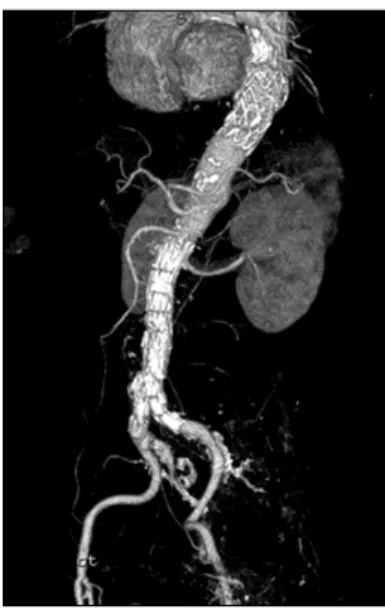
− 366 − Fig. 1. A computerized tomography angiogram shows a saccular thoracic aortic aneurysm (arrowhead) and another saccular abdomi- nal aneurysm (arrow) in the left oblique view.

Fig. 3. A ten-month follow-up computerized tomography angiogram demonstrated the patency of both stent-grafts with no evidence of thrombus or endoleak.

Fig. 2. During the first stage, a 34×100 mm stent-graft, a self-ex- pandable custom-made type was deployed along the thoracic saccular aneurysm. An additional same-sized stent-graft (arrow) was used because of a wind-sock effect (arrowhead).

Korea), was deployed along the thoracic saccular aneurysm and spinal fluid drainage was performed to prevent para- plegia. Additional 36×80 mm stent-graft was used because of a wind-sock effect (Fig. 2). During this procedure, 200 mL of nonionic and iso-osmolar contrast medium iodixanol (Visipa-

que; Nycomed Imaging AS, Oslo, Norway) was used. In the second stage, one month later, Zenith stent-grafts (Cook Inc., Minneapolis, MN, USA) were placed from the saccular ab- dominal aneurysm to both common iliac arteries, thereby ex- cluding the aneurysm from circulation. During this second stage, 240 mL of iodixanol (Visipaque, Nycomed Imaging AS) was used. Perioperative cerebrospinal fluid drainage was performed to prevent spinal cord ischemia (SCI). The patient presented no perioperative deterioration of renal function or paraplegia. A ten-month follow-up CT angiogram showed both stent-grafts were patent with no evidence of thrombus, endoleak, aneurysm growth, or complications derived from the procedure (Fig. 3). Two-stage endovascular repair may therefore be used to successfully treat separate saccular thora- cic and abdominal aortic aneurysms without any deterioration of renal function or paraplegia.

DISCUSSION

Simultaneous multiple aortic aneurysms still pose a number

of problems in deciding on proper treatment. Historically,

multilevel aortic surgery was performed simultaneously or in

stages. Although a staged operation could decrease the proce-

dure-related mortality, the rupture of a residual aneurysm

(3)

Two-Stage Endovascular Repair

− 367 − could occur while waiting for the second operation [1]. Since the advent of endovascular repair, several authors have as- serted the effectiveness of simultaneous placement of separate stent grafts without a greater risk of serious procedure-related complications than with surgical repair [2,3]. However, there might be two drawbacks to one-stage endovascular repair in multilevel aortic disease. One is the potential for contrast me- dium-induced nephropathy, which is associated with the total dose of administration and preexisting impairment of renal function. The other concern is a high risk of post-procedure paraplegia by covering the long segment of the aorta with stent grafts. Therefore, in deciding on a simultaneous or stag- ed endovascular procedure in the uncommon case of synchro- nous and separate saccular aneurysms of the thoracic and ab- dominal aorta, many factors should be taken into account, in- cluding the general status, surgical anatomy, and the disease entity.

As the surgical anatomy in this case was amenable to en- dovascular repair, endovascular repair was attempted. We considered simultaneous or staged endovascular treatment.

However, we were concerned about the potential for contrast medium-induced nephropathy (CMIN) due to the large amount of contrast media (CM) needed and about the high risk of post-procedural paraplegia given the need to cover the long segment of the aorta with a stent-graft during a simulta- neous endovascular procedure. A two-stage endovascular treatment was thus favored.

CMIN is the third most common cause of hospital-acquired acute renal failure, and in half the cases it occurs after in- vasive cardiovascular procedures [4]. Various factors may be involved in identifying an increased risk of CMIN, including impairment of renal function preceding CM administration, hypovolemia and/or dehydration, the amount of CM, and pre- vious medication, among others. Although the most frequently used test in the clinical evaluation of glomerular function is the serum creatinine level, elderly patients often experience a truly significant decrease in the glomerular filtration rate (GFR) despite apparently normal serum creatinine values be- cause of the reduced total muscular mass typical of old age [5]. The serum creatinine level and GFR of this patient were 1.3 mg/dL and 60 mL/min/1.73 m

2

, respectively (Modifica- tion of Diet in Renal Disease Study Equation). There cur-

rently are parameters for estimating the maximum volume of CM to prevent CMIN. It has been reported that the max- imum dose of CM to administer to a patient is (5 mL×the number of kilograms of body weight [maximum 300 mL]) divided by the serum creatinine level (expressed in mg/dL).

A correction factor of 1.5 should be considered for new CM with lower osmolality [6]. The maximum dose of CM for this patient by this equation was 250 mL. A more precise equation has been suggested which calculates the ratio be- tween the CM dose (in grams of iodine) and the estimated GFR (I-dose/GFR ratio). At a mean I-dose/GFR ratio=1, the regression line indicates a 10% risk of a serum creatinine rise

≥20% to 25% from baseline values because the study shows a linear correlation between the I-dose/GFR ratio and the fre- quency of CM-induced damage [7]. The dose of CM for this patient was 200 mL when the I-dose/GFR ratio was 1.0. If simultaneous endovascular treatment of the thoracic and ab- dominal aortic aneurysms had been done for this patient, the I-dose/GFR would have been 2.44 and the risk of CM-in- duced damage would have been raised to about 50%.

Endovascular treatment avoids aortic cross clamping and its consequences. However, SCI after endovascular aortic repair is a serious complication. In open repair of thoracic aortic pathologies, aortic cross clamping may alter spinal cord blood perfusion and a number of ancillary techniques have been published [8]. Even in endovascular stent-graft repair of iso- lated descending thoracic aortic aneurysms, SCI remains a se- rious complication with a reported frequency that ranges from 0% to 12.0% and several factors can increase the risk of SCI.

These factors include previous abdominal aortic aneurysm re- pair, aortic occlusion, long stent-graft, perioperative hypo- tension, and cerebrospinal fluid drainage [9,10]. According to the aortic map proposed by Ishimaru [11], at least 4 zone numbers from T8 to T11 in the thoracic aorta and 4 zone numbers from L2 to L5 in the abdominal aorta should be ex- cluded with this patient. The length of the deployed stent- graft was expected to be at least 8 zone numbers. The length of the stent-graft is one of the risk factors for SCI and prior abdominal aortic aneurysm repair may produce a greater risk of SCI by a possible compromise of the pelvic and hypo- gastric collateral that supply the anterior spinal artery [12,13].

To reduce the risk of CMIN and SCI, a two-stage endovas-

(4)

Joon Hyuk Kong, et al

− 368 − cular procedure was planned for the case presented here; the first stage involved thoracic endovascular aortic repair and the second involved abdominal endovascular aortic repair.

CONFLICT OF INTEREST

No potential conflict of interest relevant to this article was reported.

REFERENCES

1. Gloviczki P, Pairolero P, Welch T, et al. Multiple aortic aneurysms: the results of surgical management. J Vasc Surg 1990;11:19-27.

2. Wolf YG, Zarins CK, Rubin GD, Fogarty TJ. Concomitant endovascular repair of descending thoracic and abdominal aortic aneurysm. Circulation 2000;102:E36.

3. Castelli P, Caronno R, Piffaretti G, et al. Endovascular re- pair for concomitant multilevel aortic disease. Eur J Cardio- thorac Surg 2005;28:478-82.

4. Detrenis S, Meschi M, Bertolini L, Savazzi G. Contrast me- dium administration in the elderly patient: is advancing age an independent risk factor for contrast nephropathy after an- giographic procedures? J Vasc Interv Radiol 2007;18:177- 85.

5. Meschi M, Detrenis S, Musini S, Strada E, Savazzi G. Facts

and fallacies concerning the prevention of contrast me- dium-induced nephropathy. Crit Care Med 2006;34:2060-8.

6. Cigarroa RG, Lange RA, Williams RH, Hillis LD. Dosing of contrast material to prevent contrast nephropathy in patients with renal disease. Am J Med 1989;86(6 Pt 1):649-52.

7. Nyman U, Almen T, Aspelin P, Hellstrom M, Kristiansson M, Sterner G. Contrast-medium-Induced nephropathy corre- lated to the ratio between dose in gram iodine and estimated GFR in ml/min. Acta Radiol 2005;46:830-42.

8. Chiesa R, Melissano G, Marrocco-Trischitta MM, Civilini E, Setacci F. Spinal cord ischemia after elective stent-graft re- pair of the thoracic aorta. J Vasc Surg 2005;42:11-7.

9. Kawaharada N, Morishita K, Kurimoto Y, et al. Spinal cord ischemia after elective endovascular stent-graft repair of the thoracic aorta. Eur J Cardiothorac Surg 2007;31:998-1003.

10. Hnath JC, Mehta M, Taggert JB, et al. Strategies to improve spinal cord ischemia in endovascular thoracic aortic repair:

outcomes of a prospective cerebrospinal fluid drainage protocol. J Vasc Surg 2008;48:836-40.

11. Ishimaru S. Endografting of the aortic arch. J Endovasc Ther 2004;11 Suppl 2:II62-71.

12. Weiss SJ, Hogan MS, McGarvey ML, Carpenter JP, Cheung AT. Successful treatment of delayed onset paraplegia after suprarenal abdominal aortic aneurysm repair. Anesthesiolo- gy 2002;97:504-6.

13. Peppelenbosch N, Cuypers PW, Vahl AC, Vermassen F,

Buth J. Emergency endovascular treatment for ruptured ab-

dominal aortic aneurysm and the risk of spinal cord

ischemia. J Vasc Surg 2005;42:608-14.

수치

Fig. 2. During the first stage, a 34×100 mm stent-graft, a self-ex- self-ex-pandable custom-made type was deployed along the thoracic  saccular aneurysm

참조

관련 문서

As a result of the thermal conduction analysis, a cooling zone is formed on the surface of the welding metal along the arc by a cooling medium, compared

In this study, 1st and 2nd pilot studies was accomplished for revising evaluation standards and as a result, the procedure for implementing mathematics

In contrast, Chiropractic has shown better result than sports massage in the range of motion of the shoulder joint, Thoracic Scapular rhythm test, and the

(A) Before repair of RCT shows fatty degeneration of supraspinatus (stage 2) and infraspinatus (stage 3) muscle and atrophy (Grade 2) (B) After 18months later

treat wide wide wide wide necked necked necked necked aneurysms aneurysms aneurysms aneurysms that that that that selection selection selection selection of of

• To compare this neural activity with MI of a human with spinal cord injury, MN performed a step tracking, ‘center-out’ task using the neural

In this study the various modification of configurations of piston crown and spray impingement was attempted to attain a geometry that realize the two

qRT-PCR for VSMC synthetic phenotype protein, cellular retinol binding protein 1(CRBP-1) and connexin 43, from thoratic aorta showed that CRBP-1 expression was increased by 70%