Korean Circulation Journal
Introduction
With a lower complication rate and satisfactory results, thoracic endovascular therapy has become a suitable alternative treatment for thoracic aneurysm.
1) However, complications of the procedure including stroke, spinal cord ischemia or myocardial infarction are still in existence, leading problematic sequelae.
2) A protein S defi- ciency is a well known genetic tendency to the venous thrombo- embolism.
3) It can also be the risk factors for arterial occlusive dis- eases including coronary artery occlusion.
4)5) However, it is not ge- nerally concerned as a procedural risk factor for endovascular treat- ment, thus special preparation for this thrombophilic disorder is not usually achieved during the peri-procedural period. In this report, we describe a rare case of peri-procedural thrombotic occlusion of
Print ISSN 1738-5520 • On-line ISSN 1738-5555
Acute ST Elevated Myocardial Injury due to Coronary Thrombosis during Thoracic Endovascular Aortic Repair in Patient with Protein S Deficiency
Tae-Hoon Kim, MD, Young-Soo Oh, MD, Moon-Yong Eom, MD, Young-Lee Jung, MD, Hyun-A Cho, MD, Woong Choi, MD, and Won-Heum Shim, MD
Division of Cardiology, Department of Internal Medicine, Sejong General Hospital, Bucheon, Korea
A 71-year-old woman who had suffered from pulmonary thromboembolism with deep vein thrombosis for 12 years presented the hospital with a huge thoracic aortic aneurysm. During thoracic endovascular therapy, she had a sudden coronary artery occlusion without having organized stenosis or plaque rupture even under the dual antiplatelet treatment and heparinization. She turned out to be having a protein S deficiency. A procedure related thrombotic adverse event in patient with protein S deficiency is very rare, so we report a case with litera- ture review. (Korean Circ J 2014;44(6):429-433)
KEY WORDS: Protein S deficiency; Endovascular procedures; Coronary thrombosis; Aortic aneurysm, thoracic.
Received: November 11, 2013 Revision Received: December 9, 2013 Accepted: December 18, 2013
Correspondence: Won-Heum Shim, MD, Division of Cardiology, Sejong General Hospital, 28 Hohyeon-ro 489beon-gil, Sosa-gu, Bucheon 422-711, Korea
Tel: 82-32-340-1101, Fax: 82-32-349-3005 E-mail: [email protected]
• The authors have no financial conflicts of interest.
This is an Open Access article distributed under the terms of the Creative Commons Attribution Non-Commercial License (http://creativecommons.
org/licenses/by-nc/3.0) which permits unrestricted non-commercial use, distribution, and reproduction in any medium, provided the original work is properly cited.
coronary artery during thoracic endovascular aortic repair (TEVAR) in protein S deficiency and a literature review.
Case
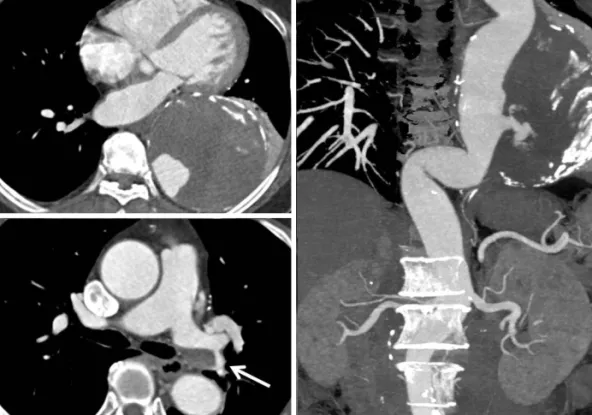
A 71 year-old woman who did not have a history of smoking was admitted to our hospital for treatment of the thoracic aortic aneu- rysm. She underwent a radical hysterectomy with bilateral salpingo oophorectomy in 1996 due to stage Ib of cervical cancer. She has also had a medical history of anticoagulation due to the pulmonary thromboembolism with deep vein thrombosis in both legs since 2001. However, she had quit her medication for 1 month without doctor’s permission prior to this admission. There was a 11 cm di- ameter of thoracic aortic aneurysm containing mural thrombus with contrast leakage at the descending aorta on pre-procedural CT (Fig.
1A and B). A chronic eccentric embolism on the left pulmonary ar-
tery was also found in the CT angiography (Fig. 1C). An echocardiog-
raphy indicated normal systolic function of the left ventricle without
any intra-cardiac thrombi. On laboratory study, her anti-phospholip-
id IgG antibody and the tumor markers of CEA and CA19-9 were
within the normal value. A protein C antigen level of the patient was
also normal, but the protein S antigen was lower at 44.2% (normal
range; 60–150%). Since the size of the patient’s aneurysm was very
large despite the absence of any symptoms, there might have been
a risk of aortic rupture. Therefore, we planned TEVAR for her aneu-
rysm.