INTRODUCTION
Hepatocellular carcinoma (HCC) is one of the most
Efficacy and Safety of Radiofrequency Ablation Combined with Transcatheter Arterial
Chemoembolization for Hepatocellular Carcinomas Compared with Radiofrequency Ablation Alone:
A Time-to-Event Meta-Analysis
Xin Wang, PhD, Yanan Hu, PhD, Mudan Ren, MD, Xinlan Lu, PhD, Guifang Lu, PhD, Shuixiang He, PhD
All authors: Department of Gastroenterology, First Affiliated Hospital of Xi’an Jiaotong University, Xi’an, Shaanxi Province 710061, China
Objective: To compare the efficacy and safety of combined radiofrequency ablation (RFA) and transcatheter arterial chemoembolization (TACE) with RFA alone for hepatocellular carcinomas (HCC).
Materials and Methods: Randomized controlled trial (RCT) studies that compared the clinical or oncologic outcomes of combination therapy of TACE and RFA versus RFA for the treatment of HCC were identified through literature searches of electronic databases (Pubmed, Embase, Cochrane Library, China Biology Medicine disc, China National Knowledge Infrastructure, and Google Scholar). Hazard ratios (HRs) or odds ratios (ORs) with their corresponding 95% confidence interval (CI) were combined as the effective value to assess the summary effects. The strength of evidence was rated by the Grading of Recommendations Assessment, Development, and Evaluation system.
Results: Six RCTs with 534 patients were eligible for inclusion in this meta-analysis. The meta-analysis showed that the combination of TACE and RFA is associated with a significantly longer overall survival (HR = 0.62, 95% CI: 0.49–0.78, p <
0.001) and recurrence-free survival (HR = 0.55, 95% CI: 0.40–0.76, p < 0.001) in contrast with RFA monotherapy. The seemingly higher incidence of major complications in the combination group compared with RFA group did not reach statistical significance (OR = 1.17, 95% CI: 0.39–3.55, p = 0.78).
Conclusion: In patients with HCC, the combination of TACE and RFA is associated with significantly higher overall survival and recurrence-free survival, as compared with RFA monotherapy, without significant difference in major complications.
Index terms: Transcatheter arterial chemoembolization; Radiofrequency ablation; Hepatocellular carcinomas; Meta-analysis
Received March 15, 2015; accepted after revision September 8, 2015.
Corresponding author: Shuixiang He, PhD, Department of Gastroenterology, First Affiliated Hospital of Xi’an Jiaotong University, 277 Yanta West Rood, Xi’an, Shaanxi Province 710061, China.
• Tel: (8629) 85323560 • Fax: (8629) 85323560
• E-mail: [email protected]
This is an Open Access article distributed under the terms of the Creative Commons Attribution Non-Commercial License (http://creativecommons.org/licenses/by-nc/3.0) which permits unrestricted non-commercial use, distribution, and reproduction in any medium, provided the original work is properly cited.
Korean J Radiol 2016;17(1):93-102
common malignant tumors and a leading cause of cancer- related deaths worldwide. According to the latest statistics, 782500 new cases of HCC were diagnosed in 2012 and 745500 of them died with severe prognosis of a median overall survival time of less than a year after diagnosis and an overall survival of less than 5% (1). These data indicated that HCC is a serious health threat to human populations worldwide. Furthermore, < 30% of diagnosed HCC are suitable for curative therapies, such as surgical resection, liver transplantation, ethanol injection and radiofrequency ablation (RFA) (2). Because of the high recurrence rate and cancer mortality, the prognosis of HCC patients is even more discouraging.
Radiofrequency ablation has been widely accepted as an
pISSN 1229-6929 · eISSN 2005-8330
effective curative therapy for small HCC and is reportedly the most effective percutaneous ablation technique because of the higher survival rates (3, 4). The complete response induced by RFA can provide a survival rate that is comparable to hepatic resection (5). Nevertheless, owing to the limited coagulative necrosis induced by RFA alone, the therapeutic effect of RFA in larger HCCs is unsatisfactory (6, 7). To deal with this problem and obtain a larger therapeutic region, many complementary therapies have been used in combination with RFA. Transcatheter arterial chemoembolization (TACE) is also widely used for unresectable HCC such as AsHCC, a type of malignant tumor with hypervascularity, due to its superiority over other therapies such as good tolerability, repeatability and precise targeting, especially for the intermediate-stage HCC (8, 9).
However, RFA and TACE have their own limitations. RFA is suitable for small tumors and it is difficult to achieve complete response in tumors > 5 cm. Furthermore, due to incomplete embolization or tumor angiogenesis, complete necrosis is barely induced by TACE alone. The combined use of TACE with RFA was previously reported and has shown a synergistic effect on ablation of HCC (10-13). Thus, the combination therapy reduces the local progression rate and leads to an improvement of both, the overall and the recurrence-free survival rate in HCC patients. Numerous studies have focused on whether TACE combined with RFA is more effective than RFA monotherapy, but the concluding evidence from these studies is difficult to apply in clinical practice due to conflicting outcomes and poor quality (14- 17). On the other hand, combining data from suitable and eligible studies by meta-analysis has the advantage of reducing random error and obtaining precise estimates for clinical interventions. Hence, we performed this meta- analysis to compare the efficacy and safety of combined RFA and TACE with RFA alone for HCC.
MATERIALS AND METHODS
Literature Search
A comprehensive literature search was conducted in Pubmed, Embase, Cochrane Library, Chinese Biomedical Database (CBM), CNKI, and Google Scholar from their inception years to February 13, 2015 to identify relevant reports. The following combinations of search terms was used: (“hepatocellular carcinoma” or “hepatic cancer” or
“hepatoma” or “liver cancer” or “liver tumor” or “cancer of liver” or “tumor of liver”) and (“transcatheter
arterial chemoembolization” or “TACE” or
“hepatic artery chemoembolization” or “transarterial chemotherapy embolization” or “transhepatic arterial chemoembolization” or “transarterial chemoembolization”) and (“radiofrequency ablation” or “RFA”). Besides,
“randomized controlled trails” or “RCT” was used. References cited in the relevant systematic reviews or meta-analyses were also checked for any potential, eligible studies. No other limits were imposed on this search.
Inclusion and Exclusion Criteria
All randomized controlled trials (RCT) comparing combination therapy of TACE and RFA versus RFA
monotherapy for HCC and reporting at least one of the main outcomes analyzed in this meta-analysis were included, irrespective of the etiology of liver disease, differences in viral hepatitis, or cirrhotic status. Duplicates, letters to the editor, as well as studies that mixed other effective interventions in either treatment group or control group were excluded. Additionally, studies with inappropriate random method such as randomized according to admission date, admission number, birth date or patient preference were also excluded.
Data Extraction and Quality Assessment
Two authors independently screened the titles, abstracts and full texts to determine whether they met the inclusion criteria; the data was extracted from the eligible studies and assessed for quality. Discrepancies were resolved by discussion or by another author. The extracted contents included general study information (such as title, publication year, authors and country), characteristics of participants and diseases, interventions (such as patients’
age and sex, type of study, sample size, interventions, Child-Pugh stage, tumor size, tumor stage, length of follow- up) and outcomes (overall survival, recurrence-free survival, major complications).
The methodological quality of the included studies was evaluated using the risk of bias tool suggested by the Cochrane Handbook for Systematic Reviews of Interventions (18). In addition, to evaluate the quality of evidence from the pooled results, the Grading of Recommendations Assessment, Development, and Evaluation system (GRADE system) was employed (19).
Statistical Analysis
For the time-to-event endpoints (overall survival,
recurrence-free survival), hazard ratio (HR) with its corresponding 95% confidence interval (CI) were combined as the effective value to assess the summary effects.
The HRs and their 95% CIs were extracted explicitly from the included articles or calculated from the available numerical data using methods reported by Parmar et al.
(20). A spreadsheet developed by Tierney et al. (21) was used to perform the calculations. In addition, for major complications, odds ratio (OR) with the 95% CI was
calculated using the Mantel-Haenszel method. The chi-square (χ2) was first calculated to assess the heterogeneity of the included studies and the degree of statistical heterogeneity was measured using I-squared statistics. The fixed-effect model was used to pool the results when p > 0.05 and I2 <
50%, indicating no substantial heterogeneity; otherwise, the random-effect model was applied (22). Furthermore, Begg’s funnel plot was used to assess publication bias and sensitivity analyses were performed to determine the stability of the pooled effects. We excluded individual studies sequentially to ensure that no single study would be solely responsible for the significance of any result.
All p values were 2-tailed, and p values of < 0.05 were regarded as significant. Statistical analyses were performed using Review Manager Software (RevMan 5.2; Cochrane Collaboration, Oxford, UK).
RESULTS
Study Selection and Characteristics
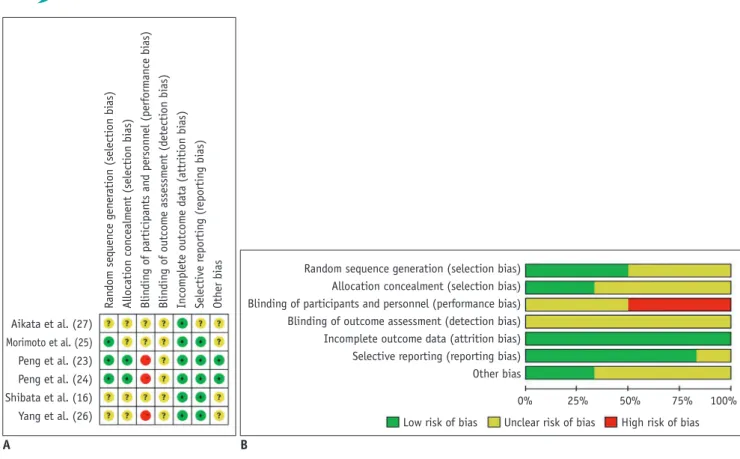
The search strategy initially resulted in a total of 563 studies. After screening the titles or abstracts, and retrieving for full texts when needed, 9 RCTs (16, 17, 23-29) met the inclusion criteria. However, 3 of these studies were excluded, of which, 1 was retracted from JAMA (29) and the other 2 had inappropriate random method (17, 28). Finally, the remaining 6 RCTs (16, 23-27) published between 2005 and 2013 with 534 patients were analyzed in this meta- analysis. The key characteristics of the 6 RCTs were outlined in Table 1. The risks of bias in these included RCTs were shown in Figure 1. Notably, double-blind techniques were often impractical because of the nature of the treatments and their possible adverse effects.
Overall Survival
All 6 RCTs including 534 patients provided overall survival information (16, 23-27). The result of the heterogeneity
test was p = 0.650/I2 = 0%, indicating no heterogeneity Table 1. Baseline Characteristics of RCTs Included in Meta-Analysis No. of Age, yrGenderTumor Size, cmChild-Pugh ClassLength of Follow-UpChemotherapy StudyYearCountryTreament Patients(Mean ± SD)(M/F)(Mean ± SD)(A/B/C)(Months)Used in TACE TACE + RFA9453.3 ± 11.075/193.47 ± 1.4490/4/047.5 ± 11.3Peng et al. Carboplatin 300 mg, epirubicin 2013China (23) 50 mg, and mitomycin 8 mgRFA alone9555.3 ± 13.371/243.39 ± 1.3590/5/047.0 ± 12.9 TACE + RFA6957.5 ± 10.060/92.1 ± 0.560/9/039.2 ± 21.1Peng et al. Carboplatin 300 mg, epirubicin 2012China (24) 50 mg, and mitomycin C 8 mgRFA alone7055.1 ± 9.555/152.1 ± 0.459/11/033.6 ± 24.9 TACE + RFA1970 (57–78)15/43.6 ± 0.718/1/030 (12–46)Morimoto Epirubicin hydrochloride 2010Japan et al. (25) (30–50 mg per body surface)RFA alone1873 (48–84)12/63.7 ± 0.616/2/032 (15–46) TACE + RFA4667.2 ± 8.931/151.7 ± 0.632/14/030.4 ± 14.0Shibata Epirubicin hydrochloride 2009Japan et al. (16) 20–30 mgRFA alone4369.8 ± 8.033/101.6 ± 0.533/10/030.4 ± 14.0 TACE + RFA2459.1 ± 11.418/66.6 ± 0.611/5/1-Yang et al.Epirubicin 30–50 mg 2008China (26) hydroxycamptothecin 15–20 mgRFA alone1261.0 ± 10.48/45.2 ± 0.48/6/1- TACE + RFA21--< 3--Aikata et al. 2006JapanCisplatinum (27)RFA alone23--< 3-- RCTs = randomized controlled trials, RFA = radiofrequency ablation, SD = standard deviation, TACE = transcatheter arterial chemoembolizaton
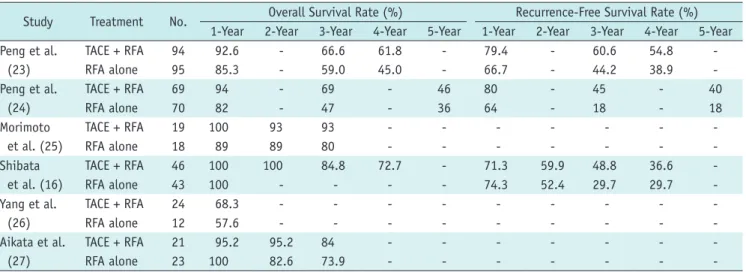
in overall survival between the studies. Therefore, the fixed-effect model was applied to pool the results. The cumulative overall survival in the TACE-RFA combined group was significantly longer than the RFA alone group (HR = 0.62, 95% CI: 0.49–0.78, p < 0.001) (Fig. 2). The specific information of overall survival in the first 5 years was summarized in Table 2.
Recurrence-Free Survival
Information on recurrence-free survival was available for 3 RCTs (16, 23, 24) with a total of 417 patients. Of the 4 studies, there was no obvious heterogeneity between studies (p = 0.500/I2 = 0%), thus the random-effect model was applied to pool the results. The meta-analysis demonstrated that RFA plus TACE therapy was associated with a significantly higher recurrence-free survival than RFA
Aikata et al. (27) Morimoto et al. (25) Peng et al. (23) Peng et al. (24) Shibata et al. (16) Yang et al. (26)
Random sequence generation (selection bias) Allocation concealment (selection bias) Blinding of participants and personnel (performance bias) Blinding of outcome assessment (detection bias) Incomplete outcome data (attrition bias) Selective reporting (reporting bias) Other bias
0% 25% 50% 75% 100%
Low risk of bias Unclear risk of bias High risk of bias Random sequence generation (selection bias)
Allocation concealment (selection bias) Blinding of participants and personnel (performance bias) Blinding of outcome assessment (detection bias) Incomplete outcome data (attrition bias) Selective reporting (reporting bias) Other bias
Fig. 1. Assessment of risk of bias in this meta-analysis.
A. Summary of risk of bias for each trial assessed by Cochrane Collaboration’s tool. B. Risk of bias graph about each risk of bias item presented as percentages across all included studies.
A B
Fig. 2. Comparative OS in response to combination of RFA and TACE vs. RFA alone for HCC. All 6 randomized controlled trials including 534 patients provided OS information. Cumulative OS in TACE-RFA combined group was significantly longer than RFA alone group. CI = confidence interval, HCC = hepatocellular carcinomas, OS = overall survival, RFA = radiofrequency ablation, SE = standard error, TACE = transcatheter arterial chemoembolizaton
Study or subgroup
Log
(hazard ratio) SE Weight (%)
Hazard ratio IV, fixed, 95% CI Aikata et al. (27) -0.02 0.34 12.5 0.98 (0.50, 1.91) Morimoto et al. (25) -0.32 0.36 11.1 0.73 (0.36, 1.47) Peng et al. (23) -0.6 0.19 39.9 0.55 (0.38, 0.80) Peng et al. (24) -0.49 0.24 25.0 0.61 (0.38, 0.98) Shibata et al. (16) -0.39 0.6 4.0 0.68 (0.21, 2.19) Yang et al. (26) -0.89 0.44 7.4 0.41 (0.17, 0.97)
Total (95% CI) 100.0 0.62 (0.49, 0.78)
Heterogeneity: chi2 = 3.32, df = 5 (p = 0.65); I2 = 0%
Test for overall effect: Z = 4.02 (p < 0.0001) 0.2 0.5 1 2 5 Favours (TACE + RFA) Favours (RFA alone)
Hazard ratio IV, fixed, 95% CI
monotherapy (HR = 0.55, 95% CI: 0.40–0.76, p < 0.001) (Fig. 3). The specific information of recurrence-free survival in the first 5 years was summarized in Table 2.
Major Complications
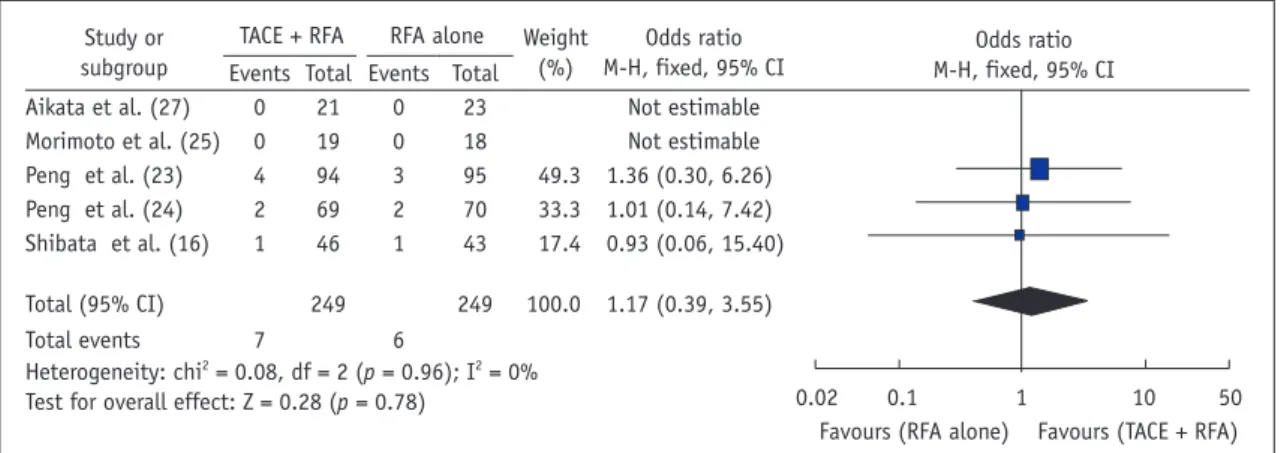
Five RCTs (16, 23-25, 27) with 498 patients investigated major complications. The result of the heterogeneity test was p = 0.960/I2 = 0%, indicating no heterogeneity between the studies. Hence, the fixed-effect model was used. The meta-analysis indicated that the combination group had a higher incidence of major complications, as compared with the monotherapy group, but the difference between these 2 groups was not statistically significant (OR = 1.17, 95% CI: 0.39–3.55, p = 0.78) (Fig. 4). The relevant data on complications reported in the RCTs were shown in Table 3.
Evidence of the Critical Outcomes
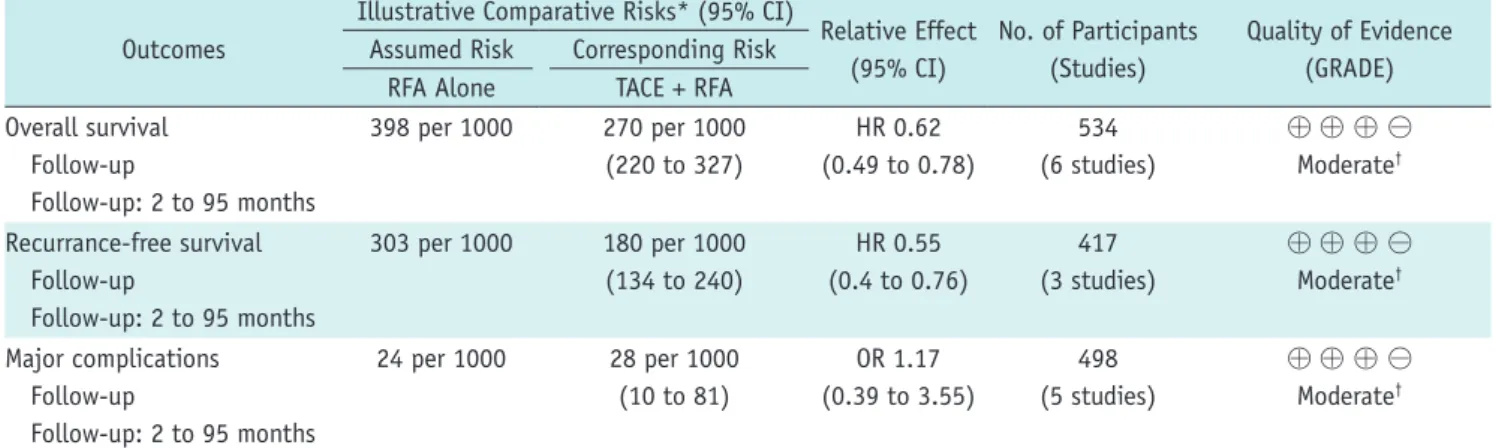
The GRADE system was used to synthesize and rate the evidence for the outcomes, and the quality of evidence was
summarized in Table 4. As a consequence of risk of bias, the overall quality of evidence for those outcomes was of moderate quality. Hence, further research is likely to have an important impact on the confidence in the estimate of effect and may change the current estimate.
Sensitivity Analysis and Publication Bias
Sensitivity analysis by sequential exclusion of individual studies did not alter the corresponding pooled results (Table 5). Hence, the results in this meta-analysis were validated as relatively stable and credible. The publication bias in this meta-analysis was assessed using funnel plot. All 6 eligible RCTs reported relative data on overall survival. The bilateral symmetry shaped funnel plot of overall survival indicated a lack of publication bias (Fig. 5).
DISCUSSION
Comparative effectiveness of RFA combined with TACE
Table 2. Prognosis Information Reported in Randomized Controlled Trials Included in Meta-Analysis
Study Treatment No. Overall Survival Rate (%) Recurrence-Free Survival Rate (%) 1-Year 2-Year 3-Year 4-Year 5-Year 1-Year 2-Year 3-Year 4-Year 5-Year Peng et al.
(23)
TACE + RFA 94 92.6 - 66.6 61.8 - 79.4 - 60.6 54.8 -
RFA alone 95 85.3 - 59.0 45.0 - 66.7 - 44.2 38.9 -
Peng et al.
(24)
TACE + RFA 69 94 - 69 - 46 80 - 45 - 40
RFA alone 70 82 - 47 - 36 64 - 18 - 18
Morimoto et al. (25)
TACE + RFA 19 100 93 93 - - - - - - -
RFA alone 18 89 89 80 - - - - - - -
Shibata et al. (16)
TACE + RFA 46 100 100 84.8 72.7 - 71.3 59.9 48.8 36.6 -
RFA alone 43 100 - - - - 74.3 52.4 29.7 29.7 -
Yang et al.
(26)
TACE + RFA 24 68.3 - - - - - - - - -
RFA alone 12 57.6 - - - - - - - - -
Aikata et al.
(27)
TACE + RFA 21 95.2 95.2 84 - - - - - - -
RFA alone 23 100 82.6 73.9 - - - - - - -
RFA = radiofrequency ablation, TACE = transcatheter arterial chemoembolizaton
Fig. 3. Comparative RFS in response to combination of RFA and TACE vs. RFA alone for HCC. Meta-analysis demonstrated that RFA plus TACE therapy was associated with significantly higher RFS than that RFA monotherapy. CI = confidence interval, HCC = hepatocellular carcinoma, RFA = radiofrequency ablation, RFS = recurrence-free survival, SE = standard error, TACE = transcatheter arterial chemoembolizaton
Study or subgroup
Log
(hazard ratio) SE Weight (%)
Hazard ratio IV, fixed, 95% CI Peng et al. (23) -0.55 0.22 53.3 0.58 (0.37, 0.89) Peng et al. (24) -0.87 0.31 26.8 0.42 (0.23, 0.77) Shibata et al. (16) -0.33 0.36 19.9 0.72 (0.36, 1.46)
Total (95% CI) 100.0 0.55 (0.40, 0.76)
Heterogeneity: chi2 = 1.37, df = 2 (p = 0.50); I2 = 0%
Test for overall effect: Z = 3.69 (p = 0.0002) 0.1 0.2 0.5 1 2 5 10 Favours (TACE + RFA) Favours (RFA alone)
Hazard ratio IV, fixed, 95% CI
vs. RFA alone for HCC has been addressed by numerous investigations but remains a controversial problem.
However, most of the evidence from these studies is weak due to research methodology, small sample size or lack of concordance (14-16, 18, 30, 31). We performed a meta- analysis that included published RCTs to date, in order to obtain more precise estimates and define the effect of clinical interventions more precisely. The meta-analysis showed that the combination of TACE and RFA tends to be associated with significantly higher overall survival and recurrence-free survival than RFA monotherapy in
the treatment of HCC. However, there appears to be no significant differences between the combination of TACE and RFA and the RFA monotherapy, in terms of major complication. Despite the moderate overall quality of evidence for the outcomes due to risk of bias, it is notable that double-blind techniques were often impractical because of the nature of the treatments and their possible adverse effects.
Complete necrosis is reportedly achieved in more than 90% of small HCC nodules after RFA (32). Unfortunately, the effect of RFA is not optimistic for medium and large tumors, Fig. 4. Comparison of major complications in response to combination of RFA and TACE vs. RFA alone for HCC. Meta-analysis indicated that combination group had higher incidence of major complications, as compared with monotherapy group, but difference between these 2 groups had no statistical significance. CI = confidence interval, HCC = hepatocellular carcinoma, RFA = radiofrequency ablation, TACE = transcatheter arterial chemoembolizaton
Study or subgroup
TACE + RFA RFA alone Weight (%)
Odds ratio M-H, fixed, 95% CI Events Total Events Total
Aikata et al. (27) 0 21 0 23 Not estimable
Morimoto et al. (25) 0 19 0 18 Not estimable
Peng et al. (23) 4 94 3 95 49.3 1.36 (0.30, 6.26) Peng et al. (24) 2 69 2 70 33.3 1.01 (0.14, 7.42) Shibata et al. (16) 1 46 1 43 17.4 0.93 (0.06, 15.40)
Total (95% CI) 249 249 100.0 1.17 (0.39, 3.55)
Total events 7 6
Heterogeneity: chi2 = 0.08, df = 2 (p = 0.96); I2 = 0%
Test for overall effect: Z = 0.28 (p = 0.78) 0.02 0.1 1 10 50 Favours (RFA alone) Favours (TACE + RFA)
Odds ratio M-H, fixed, 95% CI
Table 3. Relevant Data on Complications Reported in RCTs
Study Major Complications* Minor Complications*
TACE + RFA RFA Alone TACE + RFA RFA Alone
Peng et al. (23) Bile duct stenosis (n = 1), gastric hemorrhage (n = 1), severe ascites (n = 1), severe pleural effusion (n = 1)
Abdominal infection (n = 1), small intestinal obstruction (n = 1), severe pleural effusion (n = 1)
Pain (n = 57), fever (n = 33), vomiting (n = 44), mild ascites (n = 4), mild pleural effusion (n = 2), skin burn (n = 1)
Pain (n = 51), fever (n = 26), vomiting (n = 29), mild ascites (n = 4), mild pleural effusion (n = 1), skin burn (n = 1)
Peng et al. (24) Moderate ascites (n = 1), liver failure (n = 1)
Severe ascites (n = 1), persistent jaundice (n = 1)
Fever (n = 27), pain required analgesics (n = 29), vomiting (n = 21)
Fever (n = 22), pain required analgesics (n = 25), vomiting (n = 2)
Morimoto et al. (25) 0 0 Pain (n = 1), other minor
complications (n = 1)
Pain (n = 5), other minor complications (n = 2) Shibata et al. (16) Segmental hepatic
infarction (n = 1)
Pseudoaneurysm and subcapsular hemorrhage (n = 1)
- -
Aikata et al. (27) 0 0 - -
*Major complications were defined as those that necessitated therapy with hospitalization or involved permanent adverse sequelae, including death. All other complications were considered to be minor. RCTs = randomized controlled trials, RFA = radiofrequency ablation, TACE = transcatheter arterial chemoembolizaton
and local tumor progression frequently occurs in some HCC nodules in which RFA treatment is considered complete and technically successful. RFA and TACE in combination show synergistic effects; furthermore, TACE prior to RFA is beneficial for several reasons. Firstly, TACE can improve the effect of RFA thermal coagulation through reducing the cooling effect of hepatic blood flow. Secondly, TACE can lead to ischemic edema, which may enlarge the area of tumor necrosis induced by RFA. Thirdly, TACE can reduce the portal venous flow by filling the peripheral portal vein around the tumor, and prevent HCC patients from the portal vein invasion (33-35). Consequently, RFA can provide a better prognosis for HCC patients with the coordinated effects of TACE.
Of the RCTs included in our meta-analysis, Shibata et
al. (16) showed that combined RFA and TACE have overall survival rates and recurrence-free survival rates that are equivalent to RFA alone in patients with HCCs ≤ 3 cm. They concluded that the addition of TACE to RFA for HCCs ≤ 3 cm might not be necessary. Aikata et al. (27) also reported no significant difference in overall survival between the 2 groups in patients with HCCs < 3 cm. Morimoto et al.
(25) showed identical overall survival in the combination treatment group among patients with intermediate- sized (3.1–5.0 cm) HCCs. At the same time, Peng et al.
(23, 24) reported a positive result in overall survival and Table 4. Strength of Evidence for Combination of RFA and TACE in Patients with HCC Compared with RFA Alone
Outcomes
Illustrative Comparative Risks* (95% CI)
Relative Effect (95% CI)
No. of Participants (Studies)
Quality of Evidence (GRADE) Assumed Risk Corresponding Risk
RFA Alone TACE + RFA
Overall survival Follow-up
Follow-up: 2 to 95 months
398 per 1000 270 per 1000 (220 to 327)
HR 0.62 (0.49 to 0.78)
534 (6 studies)
⊕ ⊕ ⊕ ⊖ Moderate†
Recurrance-free survival Follow-up
Follow-up: 2 to 95 months
303 per 1000 180 per 1000 (134 to 240)
HR 0.55 (0.4 to 0.76)
417 (3 studies)
⊕ ⊕ ⊕ ⊖ Moderate†
Major complications Follow-up
Follow-up: 2 to 95 months
24 per 1000 28 per 1000 (10 to 81)
OR 1.17 (0.39 to 3.55)
498 (5 studies)
⊕ ⊕ ⊕ ⊖ Moderate†
GRADE Working Group grades of evidence. High quality: further research is very unlikely to change our confidence in estimate of effect. Moderate quality: further research is likely to have important impact on our confidence in estimate of effect and may change estimate. Low quality: further research is very likely to have important impact on our confidence in estimate of effect and is likely to change estimate. Very low quality: we are very uncertain about estimate. *Basis for assumed risk (e.g., median control group risk across studies) is provided in footnotes. Corresponding risk (and its 95% CI) is based on assumed risk in comparison group and relative effect of intervention (and its 95% CI), †Unclear allocation concealment and random sequence generation, lack of blinding. CI = confidence interval, GRADE = Grading of Recommendations Assessment, Development, and Evaluation, HCC = hepatocellular carcinoma, HR = hazard ratio, OR = odds ratio, RFA = radiofrequency ablation, TACE = transcatheter arterial chemoembolizaton
Table 5. Results of Sensitivity Analysis by Sequentially Excluding Individual Studies
Omitted Study HR (95% CI) P I2 (%)
None 0.62 (0.49, 0.78) < 0.0001 0
Aikata et al. (27) 0.58 (0.45, 0.74) < 0.0001 0 Morimoto et al. (25) 0.61 (0.47, 0.78) < 0.0001 0 Peng et al. (24) 0.62 (0.47, 0.81) 0.0005 0 Peng et al. (23) 0.67 (0.49, 0.90) 0.009 0 Shibata et al. (16) 0.62 (0.48, 0.78) < 0.0001 0 Yang et al. (26) 0.64 (0.50, 0.81) 0.0003 0 Forest plots for this sensitivity analysis are provided as online Supplementary Materials (in the online-only Data Supplement). CI
= confidence interval, HR = hazard ratio
Fig. 5. Funnel plot of publication bias for OS. All 6 eligible randomized controlled trials reported relative data on OS. Funnel plot of OS shaped with bilateral symmetry indicated lack of publication bias. OS = overall survival, SE = standard error
0 0.2 0.4 0.6 0.8 1
SE (log [hazard ratio])
0.2 0.5 1 2 5 Hazard ratio
recurrence-free survival among patients with HCCs < 5 cm or 7 cm. These different conclusions may be derived from different tumor size, etiologies of liver disease, multiple tumor lesions, liver function or some other reasons. None of these studies prompted significant difference in major complications between the combination of TACE and RFA and the RFA monotherapy.
Several previous meta-analyses showed the efficacy of TACE combined with RFA, as compared with RFA alone in patients with HCC (33, 36-42). Unfortunately, HRs were under-used in these meta-analyses when assessing time-to- event outcome such as overall survival and recurrence-free survival. Furthermore, the previous meta-analyses failed to consider that time-to-event outcomes have the following 2 important aspects i.e., event occurrence and the time at which the event occurs. ORs measure only the number of events but take no account of time of occurrence. Therefore, they are less appropriate for analyzing time-to-event outcomes, and can pose additional problems in a meta- analysis of time-to-event outcomes (21). We conducted the meta-analysis using HRs, which are considered to be the most appropriate method. The HRs summarizes the difference between 2 Kaplan-Meier curves and represents the overall reduction in the risk of death on treatment, as compared to control over the follow-up period (20, 43).
Specifically, the HR is the odds that the time of survival is longer in patients treated with combined RFA and TACE, as compared to patients treated with RFA only. This implies that the time to the endpoint was increased by the addition of TACE. Furthermore, the GRADE system was applied to assess the quality of evidence summarized in our article and grade strength of recommendations for clinical scientists, which also failed to be used widely and properly in previous studies. Another difference from previous meta-analyses, was the inclusion of RCTs alone, in our article. Thus, the conclusions of the current meta-analysis were valid.
Our meta-analysis had some limitations. Firstly, the heterogeneity of the included studies caused by the inclusion criteria, the etiological factors of HCC, or other reasons might influence the consistency of effects and cause between-study heterogeneity, despite the lack of statistical evidence. Secondly, the safety of the combination of RFA and TACE was not fully assessed due to insufficient data obtained from the included studies, hence, only major complications were analyzed. Thirdly, we included studies that were available only in the abstract form (27), and the reported data may not be as accurate and complete as those
reported in the corresponding full text publication.
In conclusion, this meta-analysis suggested that the combination of TACE and RFA is associated with significantly higher overall survival and recurrence-free survival than RFA monotherapy in the patients with HCC without significant difference in major complication between them. These results need to be validated in RCTs with better quality and larger sample sizes.
Supplementary Materials
The online-only Data Supplement is available with this article at http://dx.doi.org/10.3348/kjr.2016.17.1.93.
REFERENCES
1. Torre LA, Bray F, Siegel RL, Ferlay J, Lortet-Tieulent J, Jemal A.
Global cancer statistics, 2012. CA Cancer J Clin 2015;65:87- 108
2. Sangiovanni A, Del Ninno E, Fasani P, De Fazio C, Ronchi G, Romeo R, et al. Increased survival of cirrhotic patients with a hepatocellular carcinoma detected during surveillance.
Gastroenterology 2004;126:1005-1014
3. Shiina S, Teratani T, Obi S, Sato S, Tateishi R, Fujishima T, et al. A randomized controlled trial of radiofrequency ablation with ethanol injection for small hepatocellular carcinoma.
Gastroenterology 2005;129:122-130
4. Lencioni R. Loco-regional treatment of hepatocellular carcinoma. Hepatology 2010;52:762-773
5. N’Kontchou G, Mahamoudi A, Aout M, Ganne-Carrié N, Grando V, Coderc E, et al. Radiofrequency ablation of hepatocellular carcinoma: long-term results and prognostic factors in 235 Western patients with cirrhosis. Hepatology 2009;50:1475- 1483
6. Livraghi T, Goldberg SN, Lazzaroni S, Meloni F, Ierace T, Solbiati L, et al. Hepatocellular carcinoma: radio- frequency ablation of medium and large lesions. Radiology 2000;214:761-768
7. McGhana JP, Dodd GD 3rd. Radiofrequency ablation of the liver: current status. AJR Am J Roentgenol 2001;176:3-16 8. Idée JM, Guiu B. Use of Lipiodol as a drug-delivery system for
transcatheter arterial chemoembolization of hepatocellular carcinoma: a review. Crit Rev Oncol Hematol 2013;88:530-549 9. Maluccio MA, Covey AM, Porat LB, Schubert J, Brody LA,
Sofocleous CT, et al. Transcatheter arterial embolization with only particles for the treatment of unresectable hepatocellular carcinoma. J Vasc Interv Radiol 2008;19:862-869
10. Min JH, Lee MW, Cha DI, Jeon YH, Shin SW, Cho SK, et al.
Radiofrequency ablation combined with chemoembolization for intermediate-sized (3-5 cm) hepatocellular carcinomas under dual guidance of biplane fluoroscopy and
ultrasonography. Korean J Radiol 2013;14:248-258
11. Takaki H, Yamakado K, Uraki J, Nakatsuka A, Fuke H, Yamamoto N, et al. Radiofrequency ablation combined with chemoembolization for the treatment of hepatocellular carcinomas larger than 5 cm. J Vasc Interv Radiol 2009;20:217-224
12. Chang NK, Shin SS, Kim JW, Kim HJ, Jeong YY, Heo SH, et al. Effect of ultrasound-guided radiofrequency ablation in incompletely treated hepatocellular carcinoma after transcatheter arterial chemoembolization. Korean J Radiol 2012;13 Suppl 1:S104-S111
13. Kim JW, Shin SS, Kim JK, Choi SK, Heo SH, Lim HS, et al.
Radiofrequency ablation combined with transcatheter arterial chemoembolization for the treatment of single hepatocellular carcinoma of 2 to 5 cm in diameter: comparison with surgical resection. Korean J Radiol 2013;14:626-635
14. Hu YQ. Radiofrequency ablation and transcatheter arterial chemoembolization in primary hepatic carcinoma. Contemp Med 2011;17:39-40
15. Tiong L, Maddern GJ. Systematic review and meta-analysis of survival and disease recurrence after radiofrequency ablation for hepatocellular carcinoma. Br J Surg 2011;98:1210-1224 16. Shibata T, Isoda H, Hirokawa Y, Arizono S, Shimada K, Togashi
K. Small hepatocellular carcinoma: is radiofrequency ablation combined with transcatheter arterial chemoembolization more effective than radiofrequency ablation alone for treatment?
Radiology 2009;252:905-913
17. Kang CB, Xu HB, Wang SL, Rui JA. Treatment of large
hepatoma by TACE in combination with RFA. Zhonghua Gandan Waike Zazhi 2007;13:828-830
18. Higgins JP, Altman DG, Gøtzsche PC, Jüni P, Moher D, Oxman AD, et al. The Cochrane Collaboration’s tool for assessing risk of bias in randomised trials. BMJ 2011;343:d5928
19. Guyatt GH, Oxman AD, Vist GE, Kunz R, Falck-Ytter Y, Alonso- Coello P, et al. GRADE: an emerging consensus on rating quality of evidence and strength of recommendations. BMJ 2008;336:924-926
20. Parmar MK, Torri V, Stewart L. Extracting summary statistics to perform meta-analyses of the published literature for survival endpoints. Stat Med 1998;17:2815-2834
21. Tierney JF, Stewart LA, Ghersi D, Burdett S, Sydes MR.
Practical methods for incorporating summary time-to-event data into meta-analysis. Trials 2007;8:16
22. Higgins JPT, Green S. Cochrane Handbook for Systematic Reviews of Interventions Version 5.0.2. The Cochrane Collaboration Web site. http://www.cochrane-handbook.org.
Published September 2009
23. Peng ZW, Zhang YJ, Chen MS, Xu L, Liang HH, Lin XJ, et al. Radiofrequency ablation with or without transcatheter arterial chemoembolization in the treatment of hepatocellular carcinoma: a prospective randomized trial. J Clin Oncol 2013;31:426-432
24. Peng ZW, Zhang YJ, Liang HH, Lin XJ, Guo RP, Chen MS.
Recurrent hepatocellular carcinoma treated with sequential transcatheter arterial chemoembolization and RF ablation versus RF ablation alone: a prospective randomized trial.
Radiology 2012;262:689-700
25. Morimoto M, Numata K, Kondou M, Nozaki A, Morita S, Tanaka K. Midterm outcomes in patients with intermediate-sized hepatocellular carcinoma: a randomized controlled trial for determining the efficacy of radiofrequency ablation combined with transcatheter arterial chemoembolization. Cancer 2010;116:5452-5460
26. Yang P, Liang M, Zhang Y, Shen B. Clinical application of a combination therapy of lentinan, multi-electrode RFA and TACE in HCC. Adv Ther 2008;25:787-794
27. Aikata H, Shirakawa H, Takaki S, Uka K, Miki D, Yamashina K, et al. Radiofrequency ablation combined with transcatheter arterial chemoembolization for small hepatocellular carcinomas. Hepatology 2006;44:494A
28. Lin JJ, Wu W, Jiang XF, Jin XJ, Lu LJ, Bao LW. [Clinical outcomes of radiofrequency ablation combined with transcatheter arterial chemoembolization for the treatment of hepatocellular carcinoma: a single-center experience].
Zhonghua Zhong Liu Za Zhi 2013;35:144-147
29. Cheng BQ, Jia CQ, Liu CT, Fan W, Wang QL, Zhang ZL, et al.
Chemoembolization combined with radiofrequency ablation for patients with hepatocellular carcinoma larger than 3 cm: a randomized controlled trial. JAMA 2008;299:1669-1677 30. Shen SQ, Xiang JJ, Xiong CL, Wu SM, Zhu SS. Intraoperative
radiofrequency thermal ablation combined with portal vein infusion chemotherapy and transarterial chemoembolization for unresectable HCC. Hepatogastroenterology 2005;52:1403- 1407
31. Wang YB, Chen MH, Yan K, Yang W, Dai Y, Yin SS. [Quality of life of primary hepatocellular carcinoma patients after radiofrequency ablation]. Ai Zheng 2005;24:827-833 32. Shibata T, Shibata T, Maetani Y, Isoda H, Hiraoka M.
Radiofrequency ablation for small hepatocellular carcinoma:
prospective comparison of internally cooled electrode and expandable electrode. Radiology 2006;238:346-353 33. Jiang G, Xu X, Ren S, Wang L. Combining transarterial
chemoembolization with radiofrequency ablation for hepatocellular carcinoma. Tumour Biol 2014;35:3405-3408 34. Goldberg SN, Girnan GD, Lukyanov AN, Ahmed M, Monsky WL,
Gazelle GS, et al. Percutaneous tumor ablation: increased necrosis with combined radio-frequency ablation and intravenous liposomal doxorubicin in a rat breast tumor model. Radiology 2002;222:797-804
35. Seki T, Tamai T, Nakagawa T, Imamura M, Nishimura A, Yamashiki N, et al. Combination therapy with transcatheter arterial chemoembolization and percutaneous microwave coagulation therapy for hepatocellular carcinoma. Cancer 2000;89:1245-1251
36. Ni JY, Liu SS, Xu LF, Sun HL, Chen YT. Meta-analysis of radiofrequency ablation in combination with transarterial chemoembolization for hepatocellular carcinoma. World J Gastroenterol 2013;19:3872-3882
37. Lu Z, Wen F, Guo Q, Liang H, Mao X, Sun H. Radiofrequency ablation plus chemoembolization versus radiofrequency ablation alone for hepatocellular carcinoma: a meta-analysis
of randomized-controlled trials. Eur J Gastroenterol Hepatol 2013;25:187-194
38. Kong QF, Jiao JB, Chen QQ, Li L, Wang DG, Lv B. Comparative effectiveness of radiofrequency ablation with or without transarterial chemoembolization for hepatocellular carcinoma.
Tumour Biol 2014;35:2655-2659
39. Yan S, Xu D, Sun B. Combination of radiofrequency ablation with transarterial chemoembolization for hepatocellular carcinoma: a meta-analysis. Dig Dis Sci 2012;57:3026-3031 40. Yan S, Xu D, Sun B. Combination of radiofrequency ablation
with transarterial chemoembolization for hepatocellular carcinoma: a meta-analysis. Dig Dis Sci 2013;58:2107-2113
41. Wang W, Shi J, Xie WF. Transarterial chemoembolization in combination with percutaneous ablation therapy in unresectable hepatocellular carcinoma: a meta-analysis. Liver Int 2010;30:741-749
42. Liu Z, Gao F, Yang G, Singh S, Lu M, Zhang T, et al.
Combination of radiofrequency ablation with transarterial chemoembolization for hepatocellular carcinoma: an up-to- date meta-analysis. Tumour Biol 2014;35:7407-7413 43. Spruance SL, Reid JE, Grace M, Samore M. Hazard ratio in
clinical trials. Antimicrob Agents Chemother 2004;48:2787- 2792