INTRODUCTION
Hepatocellular carcinoma (HCC) is the sixth most common cancer and the third most frequent cause of cancer deaths (1,
Radiofrequency Ablation Combined with Transcatheter Arterial Chemoembolization Therapy Versus Surgical
Resection for Hepatocellular Carcinoma within the Milan Criteria: A Meta-Analysis
Wei-dong Wang, MD
1, Li-hua Zhang, MD
2, Jia-Yan Ni, MD
1, Xiong-ying Jiang, MD
1, Dong Chen, MD
1, Yao-ting Chen, PhD
1, Hong-liang Sun, PhD
1, Jiang-hong Luo, BSc
1, Lin-feng Xu, PhD
11Department of Interventional Radiology, Sun Yat-sen Memorial Hospital, Sun Yat-sen University, Guangzhou 510120, China; 2Guangdong Women an Children Hospital, Guangzhou Medical University, Guangzhou 511400, China
Objective: To meta-analytically compare combined transarterial chemoembolization (TACE) plus radiofrequency ablation (RFA) and surgical resection (SR) for the treatment of hepatocellular carcinoma (HCC) within the Milan criteria.
Materials and Methods: PubMed, Medline, Embase, and Cochrane Library were searched for studies comparing these two therapies that were published between January 2006 and August 2017. Overall survival rate (OS), recurrence-free survival rate (RFS), major complications and the average length of hospital stay were compared between these two therapies. Meta- analytic pooled odds ratio (OR) was calculated using TACE plus RFA as the base category.
Results: Seven case-control studies and one randomized trial were identified. Meta-analytic results revealed that, compared with SR, TACE plus RFA had significantly higher 1-year OS (OR for survival = 0.50, p = 0.009) and lower major complications (OR = 1.88, p = 0.02) after therapy. Three studies reported on the length of hospital stay. The average length ± standard deviation reported in individual studies for SR and TACE plus RFA groups was 19.8 ± 8.4 days and 7.4 ± 2.2 days, respectively; 18.7 ± 4.9 days and 11.5 ± 6.9 days, respectively; and 16.6 ± 6.7 days and 8.5 ± 4.1 days, respectively (p <
0.0001 for all studies). Three or 5-year OS and 1-, 3-, or 5-year RFS did not significantly differ between the two therapies.
Conclusion: Combined TACE plus RFA may be an alternative to SR for the treatment of patients with HCC within Milan the criteria.
Non-randomized design in most of the original studies was a limitation.
Keywords: Radiofrequency ablation; Transarterial chemoembolization; Surgical resection; Hepatocellular carcinoma; Meta- analysis
Received July 6, 2017; accepted after revision January 15, 2018.
Corresponding author: Lin-feng Xu, PhD, Department of Interventional Radiology, Sun Yat-sen Memorial Hospital, Sun Yat- sen University, No. 107 Yanjiang Road West, Guangzhou 510120, China.
• Tel: (8620) 34070680 • Fax: (8620) 34070680
• E-mail: [email protected]
This is an Open Access article distributed under the terms of the Creative Commons Attribution Non-Commercial License (https://creativecommons.org/licenses/by-nc/4.0) which permits unrestricted non-commercial use, distribution, and reproduction in any medium, provided the original work is properly cited.
2). Asian patients account for 80% of HCC victims worldwide (3). According to current treatment guidelines curative therapy such as: liver transplantation, surgical resection (SR) and radiofrequency ablation (RFA) are the mainstays of treatment for HCC within the Milan criteria (defined as one HCC nodule < 5.0 cm or a maximum of three nodules < 3.0 cm). Among these, liver transplantation remains the ideal option at earlier stages, yet this choice is greatly limited by the shortage of organ donors. SR might improve the patient’s survival benefit (5-year survival > 70.0%) (4), but only 15−20% of patients with HCC are candidates for surgery because of either underlying chronic liver disease resulting in poor hepatic reserve or a multifocal distribution of tumor nodules (5, 6). RFA is considered a viable alternative to
Korean J Radiol 2018;19(4):613-622pISSN 1229-6929 · eISSN 2005-8330
required to fulfill the following inclusion criteria: 1) study design: the trials had to have comparative data on clinical efficacy or safety of TACE plus RFA treatment with SR in the treatment of HCC within the Milan criteria (defined as one HCC nodule < 5.0 cm or a maximum of three nodules <
3.0 cm); 2) characteristics of patients: trials were required to have relatively integrated basic characteristics of enrolled patients such as; age, percentage of males, trial design, tumor size, tumor number, Child-Pugh class, and Eastern Cooperative Oncology Group performance status;
3) outcomes: reported at least one item of the results of OS or RFS or the average length of hospital stay or major complications (which was defined as an event that led to substantial morbidity and disability, increased the level of care, hospital admission, or substantially lengthened hospital stay); 4) year of publication: from January 2006 to August 2017. The exclusion criteria were reviews without original data, expert opinions, abstracts, editorials, letters, case reports, and studies lacking control groups.
Data Extraction
Data extraction was independently conducted by two reviewers utilizing a standardized approach, with any disagreements settled by a discussion of the respective study data and adjudicated by a third reviewer. From each study, the following data was extracted: publication details (name of the first author, year of publication, and country) and study characteristics (study design, average age, percentage of men, treatment, tumor size, Child-Pugh grade, OS, RFS, and major complications). Major complications were defined as an event that led to substantial morbidity and disability, increased level of care required, resulted in hospital admission, or substantially lengthened the hospital stay. All other complications were considered minor.
Statistical Analyses
To obtain an overall comparison of the efficacy of TACE plus RFA versus that of SR, standard meta-analysis techniques were used. All analyses were performed on dichotomous outcomes. We analyzed dichotomous variables using the estimation of odds ratios (OR) with a 95.0%
confidence interval (CI). Pooled OR with 95% CI were calculated with TACE plus RFA as the base category using either the fixed-effects model or the random-effects model.
For each meta-analysis, the chi-squared (χ
2) and I
2tests were first calculated to assess the heterogeneity of the included trials. p < 0.05 or I
2> 50.0% were considered SR in patients with early HCC, especially those who have
impaired liver function (7). For patients with a tumor < 3.0 cm in diameter, ablation is an efficient and safe treatment that provides overall survival rate (OS) similar to those achieved with SR. However, with increasing tumor size (3.0−5.0 cm), local tumor progression from incomplete ablation is a negative prognostic factor in patients with HCC treated with RFA (8-10).
Transarterial chemoembolization (TACE), as a palliative therapy, has been widely accepted for the treatment for HCC. Some studies (11, 12) have shown that TACE can increase the therapeutic effect of RFA, especially in large HCCs. The data from a previous meta-analysis indicates that the combination of TACE and RFA is more effective than RFA monotherapy in the treatment of patients with HCC (13, 14). However, whether the combination treatment of TACE plus RFA can achieve better results compared with SR for HCC within the Milan criteria is still uncertain.
Some studies have suggested the effectiveness of TACE plus RFA was associated with better recurrence-free survival rate (RFS) and OS than SR in HCC (15), while other studies reported opposite results (16, 17). Still other studies found that TACE plus RFA is safe and as effective as SR for patients with HCC (18-22). This study was to meta-analytically compare combined TACE plus RFA and SR for treatment of HCC within the Milan criteria.
MATERIALS AND METHODS
Retrieval of Published Studies
This meta-analysis was conducted according to the Preferred Reporting Items for Systematic Reviews and Meta-analyses statement. To identify relevant studies, we comprehensively searched PubMed, Embase, Web of Science, and Cochrane Library from January 2006 to August 2017.
We used a combination of the terms such as “hepatocellular carcinoma” or “liver cancer,” “surgical resection” or
“hepatectomy,” “radiofrequency ablation” and “transarterial chemoembolization.” A limit was set on randomized controlled trials (RCTs), cohort studies, or case-control studies that were designed to the compare clinical efficacy and safety of TACE plus RFA with those of SR for HCC within the Milan criteria. Language restrictions were not imposed in this search.
Inclusion and Exclusion Criteria
To be enrolled in this meta-analysis, clinical studies were
significant. For p > 0.05 or I
2< 50.0%, the assumption of homogeneity was deemed invalid and the random-effects model was used; otherwise, data were assessed using the fixed-effects model. The quality of the case-control studies was evaluated according to the Newcastle-Ottawa scales.
The quality of the RCTs was evaluated according to the revised Jadad’s scale (23, 24). Statistical analysis was performed using the Review Manager (ver. 5.2) from the Cochrane Collaboration (http://ims.cochrane.org/revman).
Results were deemed significant at a p < 0.05.
RESULTS
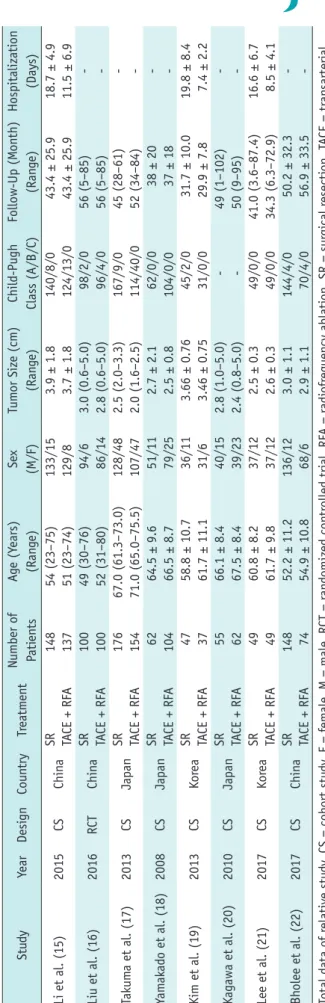
Our search yielded 64 studies. After reviewing each abstract or original publication and extracting data from the publications, seven case-control studies and one RCT were included in our meta-analysis (15-22) that comprised 1502 patients, of which 785 were treated with SR and 717 with TACE plus RFA. The flow diagram of the article selection process is shown in Figure 1. The baseline characteristics of the trials, included in the meta-analysis, are listed in Table 1.
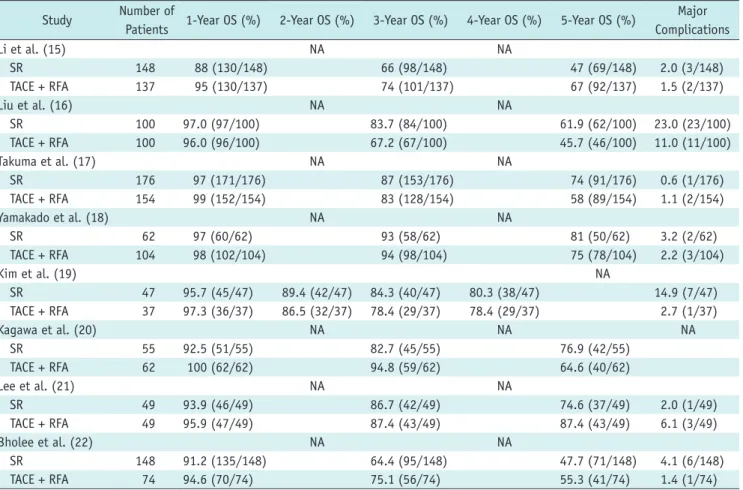
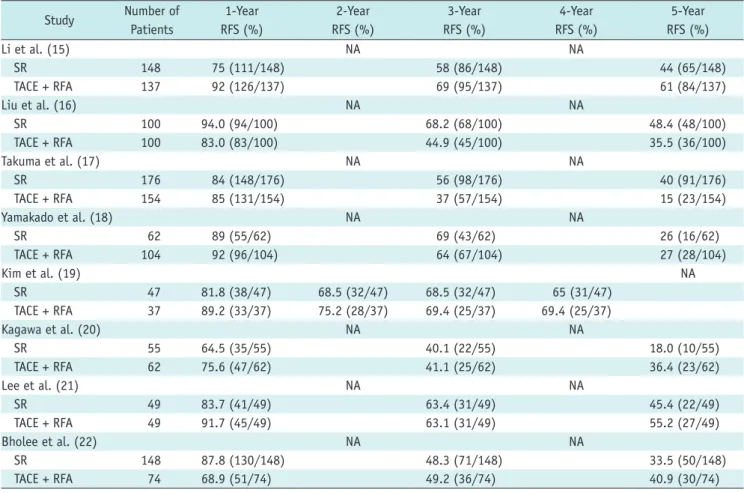
The OS, RFS, and major complications of the patients in all the included trials are summarized in Tables 2 and 3.
Study Quality
The quality of the case-control studies was evaluated according to the Newcastle-Ottawa scales. The quality of the
Records identified through database searching n = 64
Records after duplicates removed n = 2
Full-text articles assessed for eligibility n = 62
Studies included in qualitative synthesis (meta-analysis) n = 8
Full-text articles excluded because of study design without dealing with SR versus RFA + TACE for HCC within Milan criteria
n = 54
Fig. 1 Flow diagram of article selection process. HCC =
hepatocellular carcinoma, RFA = radiofrequency ablation, SR = surgical
resection, TACE = transarterial chemoembolization Table 1. Characteristics of Included Studies Number of Age (Years)SexTumor Size (cm)Child-Pugh Follow-Up (Month)Hospitalization StudyYearDesignCountryTreatment Patients (Range)(M/F)(Range)Class (A/B/C)(Range)(Days) SR148 54 (23–75)133/153.9 ± 1.8140/8/0 43.4 ± 25.918.7 ± 4.9 Li et al. (15)2015CSChina TACE + RFA137 51 (23–74)129/83.7 ± 1.8124/13/0 43.4 ± 25.911.5 ± 6.9 SR100 49 (30–76) 94/63.0 (0.6–5.0) 98/2/056 (5–85)- Liu et al. (16)2016RCTChina TACE + RFA100 52 (31–80) 86/142.8 (0.6–5.0) 96/4/056 (5–85)- SR17667.0 (61.3–73.0)128/482.5 (2.0–3.3)167/9/045 (28–61)- Takuma et al. (17)2013CSJapan TACE + RFA15471.0 (65.0–75.5)107/472.0 (1.6–2.5)114/40/052 (34–84)- SR6264.5 ± 9.6 51/112.7 ± 2.1 62/0/0 38 ± 20- Yamakado et al. (18)2008CSJapan TACE + RFA10466.5 ± 8.7 79/252.5 ± 0.8104/0/0 37 ± 18- SR4758.8 ± 10.7 36/113.66 ± 0.76 45/2/0 31.7 ± 10.019.8 ± 8.4 Kim et al. (19)2013CSKorea TACE + RFA3761.7 ± 11.1 31/63.46 ± 0.75 31/0/0 29.9 ± 7.8 7.4 ± 2.2 SR5566.1 ± 8.4 40/152.8 (1.0–5.0)- 49 (1–102)- Kagawa et al. (20)2010CSJapan TACE + RFA6267.5 ± 8.4 39/232.4 (0.8–5.0)- 50 (9–95)- SR4960.8 ± 8.2 37/122.5 ± 0.3 49/0/041.0 (3.6–87.4)16.6 ± 6.7 Lee et al. (21)2017CSKorea TACE + RFA4961.7 ± 9.8 37/122.6 ± 0.3 49/0/034.3 (6.3–72.9) 8.5 ± 4.1 SR14852.2 ± 11.2136/123.0 ± 1.1144/4/0 50.2 ± 32.3- Bholee et al. (22)2017CSChina TACE + RFA7454.9 ± 10.8 68/62.9 ± 1.1 70/4/0 56.9 ± 33.5- Total data of relative study. CS = cohort study, F = female, M = male, RCT = randomized controlled trial, RFA = radiofrequency ablation, SR = surgical resection, TACE = transarterial chemoembolization
RCTs was evaluated according to the revised Jadad’s scale.
All seven case-control studies had five to seven points, the RCT had four points.
Overall Survival Rate
Eight studies reported data on the 1.0-year OS and there was no significant heterogeneity among these six studies (χ
21- year= 3.43, I
1-year2= 0.0%, P
1-year= 0.84); thus, the fixed-effects model was used to pool the results. Meta-analysis displayed that the combination of TACE plus RFA was associated with a higher 1.0-year OS compared with that of SR (OR 1.0-year = 0.50, 95% CI: 0.30−0.84, p = 0.009) (Fig. 2).
There were eight and seven studies that reported data for 3.0- and 5.0-year OS, respectively, and based on the results of tests for heterogeneity among the trials (χ
23-year= 18.62, I
3-year2= 62.0%, P
3-year= 0.009; χ
25-year= 22.48, I
5-year2= 73.0%,
P
5-year= 0.001), the random-effects model was used to pool
the results. Meta-analysis showed there was no significant difference between the TACE plus RFA and SR on 3.0- and 5.0-year OS (OR
3-year= 0.95, 95% CI: 0.59−1.52, p = 0.82;
OR
5-year= 0.91, 95% CI: 0.58−1.43, p = 0.68) (Figs. 3, 4).
Recurrence-Free Survival Rate
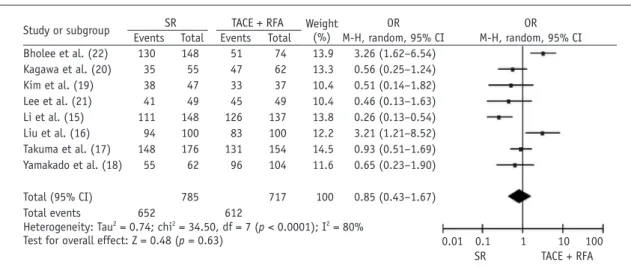
There were eight, eight, and seven studies that reported data on 1.0-, 3.0-, and 5.0-year RFS, respectively. Based on the results of tests for heterogeneity between trials (χ
21-year= 34.50, I
1-year2= 80.0%, P
1-year< 0.0001; χ
23-year= 21.65, I
3-year2= 68.0%, P
3-year= 0.003; χ
25-year= 62.25, I
5-year2= 90.0%, P
5- year< 0.00001), the random-effects model was used to pool the results. The meta-analysis showed that there was no significant difference between the TACE plus RFA and SR on 1.0-, 3.0-, and 5.0-year RFS (OR
1-year= 0.85, 95% CI: 0.43−1.67, p = 0.63; OR
3-year= 1.22, 95% CI: 0.83−1.79, p = 0.32; OR
5-year= 1.00, 95% CI: 0.47−2.12, p = 1.00) (Figs. 5-7).
Major Complications
There were seven studies that reported the comparative data for major complications. Based on the results of the test for heterogeneity between trials (χ
2= 5.94, I
2= 0.0%, p = 0.43), the fixed-effects model was used to pool the results in the analysis of major complications. Meta-analysis data and forest plots indicated that SR was associated with significantly higher complications than TACE plus RFA
Table 2. OS of Patients in Included Studies Study Number of
Patients 1-Year OS (%) 2-Year OS (%) 3-Year OS (%) 4-Year OS (%) 5-Year OS (%) Major Complications
Li et al. (15) NA NA
SR 148 88 (130/148) 66 (98/148) 47 (69/148) 2.0 (3/148)
TACE + RFA 137 95 (130/137) 74 (101/137) 67 (92/137) 1.5 (2/137)
Liu et al. (16) NA NA
SR 100 97.0 (97/100) 83.7 (84/100) 61.9 (62/100) 23.0 (23/100)
TACE + RFA 100 96.0 (96/100) 67.2 (67/100) 45.7 (46/100) 11.0 (11/100)
Takuma et al. (17) NA NA
SR 176 97 (171/176) 87 (153/176) 74 (91/176) 0.6 (1/176)
TACE + RFA 154 99 (152/154) 83 (128/154) 58 (89/154) 1.1 (2/154)
Yamakado et al. (18) NA NA
SR 62 97 (60/62) 93 (58/62) 81 (50/62) 3.2 (2/62)
TACE + RFA 104 98 (102/104) 94 (98/104) 75 (78/104) 2.2 (3/104)
Kim et al. (19) NA
SR 47 95.7 (45/47) 89.4 (42/47) 84.3 (40/47) 80.3 (38/47) 14.9 (7/47)
TACE + RFA 37 97.3 (36/37) 86.5 (32/37) 78.4 (29/37) 78.4 (29/37) 2.7 (1/37)
Kagawa et al. (20) NA NA NA
SR 55 92.5 (51/55) 82.7 (45/55) 76.9 (42/55)
TACE + RFA 62 100 (62/62) 94.8 (59/62) 64.6 (40/62)
Lee et al. (21) NA NA
SR 49 93.9 (46/49) 86.7 (42/49) 74.6 (37/49) 2.0 (1/49)
TACE + RFA 49 95.9 (47/49) 87.4 (43/49) 87.4 (43/49) 6.1 (3/49)
Bholee et al. (22) NA NA
SR 148 91.2 (135/148) 64.4 (95/148) 47.7 (71/148) 4.1 (6/148)
TACE + RFA 74 94.6 (70/74) 75.1 (56/74) 55.3 (41/74) 1.4 (1/74)
NA = not applicable, OS = overall survival rate
therapy (OR = 1.88, 95% CI: 1.10−3.22, p = 0.02) (Fig. 8).
Average Length of Hospital Stay
Three studies reported on the average length of hospital stay as follows for the SR group vs. the combined therapy group: 19.8 ± 8.4 days vs. 7.4 ± 2.2 days (p < 0.0001); 18.7
± 4.9 days vs. 11.5 ± 6.9 days (p < 0.0001); and 16.6 ± 6.7 days vs. 8.5 ± 4.1 days (p < 0.0001), respectively.
DISCUSSION
Surgical resection remains the best treatment choice for
Table 3. RFS of Patients in Included StudiesStudy Number of Patients
1-Year RFS (%)
2-Year RFS (%)
3-Year RFS (%)
4-Year RFS (%)
5-Year RFS (%)
Li et al. (15) NA NA
SR 148 75 (111/148) 58 (86/148) 44 (65/148)
TACE + RFA 137 92 (126/137) 69 (95/137) 61 (84/137)
Liu et al. (16) NA NA
SR 100 94.0 (94/100) 68.2 (68/100) 48.4 (48/100)
TACE + RFA 100 83.0 (83/100) 44.9 (45/100) 35.5 (36/100)
Takuma et al. (17) NA NA
SR 176 84 (148/176) 56 (98/176) 40 (91/176)
TACE + RFA 154 85 (131/154) 37 (57/154) 15 (23/154)
Yamakado et al. (18) NA NA
SR 62 89 (55/62) 69 (43/62) 26 (16/62)
TACE + RFA 104 92 (96/104) 64 (67/104) 27 (28/104)
Kim et al. (19) NA
SR 47 81.8 (38/47) 68.5 (32/47) 68.5 (32/47) 65 (31/47)
TACE + RFA 37 89.2 (33/37) 75.2 (28/37) 69.4 (25/37) 69.4 (25/37)
Kagawa et al. (20) NA NA
SR 55 64.5 (35/55) 40.1 (22/55) 18.0 (10/55)
TACE + RFA 62 75.6 (47/62) 41.1 (25/62) 36.4 (23/62)
Lee et al. (21) NA NA
SR 49 83.7 (41/49) 63.4 (31/49) 45.4 (22/49)
TACE + RFA 49 91.7 (45/49) 63.1 (31/49) 55.2 (27/49)
Bholee et al. (22) NA NA
SR 148 87.8 (130/148) 48.3 (71/148) 33.5 (50/148)
TACE + RFA 74 68.9 (51/74) 49.2 (36/74) 40.9 (30/74)
RFS = recurrence-free survival rate
Study or subgroup SR TACE + RFA Weight
(%) OR OR
Events Total Events Total M-H, fixed, 95% CI M-H, fixed, 95% CI Bholee et al. (22) 135 148 70 74 18.7 0.59 (0.19–1.89)
Kagawa et al. (20) 51 55 62 62 10.8 0.09 (0.00–1.74)
Kim et al. (19) 45 47 36 37 3.9 0.63 (0.05–7.17)
Lee et al. (21) 46 49 47 49 6.6 0.65 (0.10–4.09)
Li et al. (15) 130 148 130 137 37.4 0.39 (0.16–0.96)
Liu et al. (16) 97 100 96 100 6.6 1.35 (0.29–6.18)
Takuma et al. (17) 171 176 152 154 10.5 0.45 (0.09–2.35) Yamakado et al. (18) 60 62 102 104 5.6 0.59 (0.08–4.28)
Total (95% CI) 785 717 100 0.50 (0.30–0.84)
Total events 735 695
Heterogeneity: chi2 = 3.43, df = 7 (p = 0.84); I2 = 0%
Test for overall effect: Z = 2.63 (p = 0.009) 0.01 0.1 1 10 100
SR TACE + RFA
Fig. 2 Meta-analysis of 1-year OS results. CI = confidence interval, M-H = Mantel-Haenszel, OR = odds ratio, OS = overall survival ratio
patients with early stage HCC. As new imaging techniques and technology advance, imaging-guided therapies for liver cancer have undergone rapid developments because of their
efficacy and minimal invasiveness. RFA is considered a viable alternative to SR in patients with early HCC. However, whether SR or RFA is the better alternative treatment
Study or subgroup SR TACE + RFA Weight
(%) OR OR
Events Total Events Total M-H, random, 95% CI M-H, random, 95% CI Bholee et al. (22) 95 148 56 74 15.8 0.58 (0.31–1.08)
Kagawa et al. (20) 45 55 59 62 7.9 0.23 (0.06–0.88)
Kim et al. (19) 40 47 29 37 9.8 1.58 (0.51–4.84)
Lee et al. (21) 42 49 43 49 9.4 0.84 (0.26–2.70)
Li et al. (15) 98 148 101 137 17.5 0.70 (0.42–1.16)
Liu et al. (16) 84 100 67 100 15.2 2.59 (1.31–5.09)
Takuma et al. (17) 153 176 128 154 16.1 1.35 (0.74–2.48) Yamakado et al. (18) 58 62 98 104 8.2 0.89 (0.24–3.28)
Total (95% CI) 785 717 100 0.95 (0.59–1.52)
Total events 615 581
Heterogeneity: Tau2 = 0.27, chi2 = 18.62, df = 7 (p = 0.009); I2 = 62%
Test for overall effect: Z = 0.23 (p = 0.82) 0.01 0.1 1 10 100
SR TACE + RFA
Fig. 3 Meta-analysis of 3-year OS results.
Study or subgroup SR TACE + RFA Weight
(%)
OR OR
Events Total Events Total M-H, random, 95% CI M-H, random, 95% CI Bholee et al. (22) 71 148 41 74 15.6 0.74 (0.42–1.30)
Kagawa et al. (20) 42 55 40 62 12.4 1.78 (0.79–4.00)
Lee et al. (21) 37 49 43 49 9.6 0.43 (0.15–1.26)
Li et al. (15) 69 148 92 137 16.7 0.43 (0.26–0.69)
Liu et al. (16) 62 100 46 100 15.6 1.92 (1.09–3.37)
Takuma et al. (17) 91 176 89 154 17.3 0.78 (0.51–1.21) Yamakado et al. (18) 50 62 78 104 12.9 1.39 (0.64–3.00)
Total (95% CI) 738 680 100 0.91 (0.58–1.43)
Total events 422 429
Heterogeneity: Tau2 = 0.26; chi2 = 22.48, df = 6 (p = 0.001); I2 = 73%
Test for overall effect: Z = 0.42 (p = 0.68) 0.01 0.1 1 10 100
SR TACE + RFA
Fig. 4 Meta-analysis of 5-year OS results.
Study or subgroup SR TACE + RFA Weight
(%) OR OR
Events Total Events Total M-H, random, 95% CI M-H, random, 95% CI Bholee et al. (22) 130 148 51 74 13.9 3.26 (1.62–6.54)
Kagawa et al. (20) 35 55 47 62 13.3 0.56 (0.25–1.24)
Kim et al. (19) 38 47 33 37 10.4 0.51 (0.14–1.82)
Lee et al. (21) 41 49 45 49 10.4 0.46 (0.13–1.63)
Li et al. (15) 111 148 126 137 13.8 0.26 (0.13–0.54)
Liu et al. (16) 94 100 83 100 12.2 3.21 (1.21–8.52)
Takuma et al. (17) 148 176 131 154 14.5 0.93 (0.51–1.69) Yamakado et al. (18) 55 62 96 104 11.6 0.65 (0.23–1.90)
Total (95% CI) 785 717 100 0.85 (0.43–1.67)
Total events 652 612
Heterogeneity: Tau2 = 0.74; chi2 = 34.50, df = 7 (p < 0.0001); I2 = 80%
Test for overall effect: Z = 0.48 (p = 0.63) 0.01 0.1 1 10 100
SR TACE + RFA
Fig. 5 Meta-analysis of 1-year RFS results. RFS = recurrence-free survival rate
for small HCC is still controversial (25-28). Incomplete ablation is one of the main obstacles that greatly hinder the effectiveness of RFA for HCC. The reasons are first, for
the tumor with a large size or irregular shape, it is often difficult to determine the ideal ablated margin. Second, the mechanical limits of RFA and the target temperature
Study or subgroup SR TACE + RFA Weight
(%) OR OR
Events Total Events Total M-H, random, 95% CI M-H, random, 95% CI Bholee et al. (22) 71 148 36 74 13.7 0.97 (0.56–1.70)
Kagawa et al. (20) 22 55 25 62 11.3 0.99 (0.47–2.07)
Kim et al. (19) 32 47 25 37 9.2 1.02 (0.41–2.57)
Lee et al. (21) 31 49 31 49 10.3 1.00 (0.44–2.27)
Li et al. (15) 86 148 95 137 14.7 0.61 (0.38–1.00)
Liu et al. (16) 68 100 45 100 13.5 2.60 (1.46–4.62)
Takuma et al. (17) 98 176 57 154 15.3 2.14 (1.37–3.33) Yamakado et al. (18) 43 62 67 104 12.1 1.25 (0.64–2.45)
Total (95% CI) 785 717 100 1.22 (0.83–1.79)
Total events 451 381
Heterogeneity: Tau2 = 0.20; chi2 = 21.65, df = 7 (p = 0.003); I2 = 68%
Test for overall effect: Z = 1.00 (p = 0.32) 0.01 0.1 1 10 100
SR TACE + RFA
Fig. 6 Meta-analysis of 3-year RFS results.
Study or subgroup SR TACE + RFA Weight
(%) OR OR
Events Total Events Total M-H, random, 95% CI M-H, random, 95% CI Bholee et al. (22) 50 148 30 74 14.6 0.75 (0.42–1.33)
Kagawa et al. (20) 10 55 23 62 13.3 0.38 (0.16–0.89)
Lee et al. (21) 22 49 27 49 13.6 0.66 (0.30–1.47)
Li et al. (15) 65 148 84 137 15.1 0.49 (0.31–0.79)
Liu et al. (16) 48 100 36 100 14.7 1.64 (0.93–2.89)
Takuma et al. (17) 91 176 23 154 14.8 6.10 (3.58–10.39) Yamakado et al. (18) 16 62 28 104 14.0 0.94 (0.46–1.93)
Total (95% CI) 738 680 100 1.00 (0.47–2.12)
Total events 302 251
Heterogeneity: Tau2 = 0.92; chi2 = 62.25, df = 6 (p < 0.00001); I2 = 90%
Test for overall effect: Z = 0.00 (p = 1.00) 0.01 0.1 1 10 100
SR TACE + RFA
Fig. 7 Meta-analysis of 5-year RFS results.
Study or subgroup SR TACE + RFA Weight
(%) OR OR
Events Total Events Total M-H, fixed, 95% CI M-H, fixed, 95% CI
Bholee et al. (22) 6 148 1 74 6.4 3.80 (0.36–26.11)
Kim et al. (19) 7 47 1 37 4.8 6.30 (0.74–53.71)
Lee et al. (21) 1 49 3 49 14.7 0.32 (0.03–3.18)
Li et al. (15) 3 148 2 137 10.2 1.40 (0.23–8.49)
Liu et al. (16) 23 100 11 100 42.4 2.42 (1.11–5.28)
Takuma et al. (17) 1 176 2 154 10.6 0.43 (0.04–4.84) Yamakado et al. (18) 2 62 3 104 10.9 1.12 (0.18–6.91)
Total (95% CI) 730 655 100 1.88 (1.10–3.22)
Total events 43 23
Heterogeneity: chi2 = 5.94, df = 6 (p = 0.43); I2 = 0%
Test for overall effect: Z = 2.30 (p = 0.02) 0.01 0.1 1 10 100
SR TACE + RFA
Fig. 8 Meta-analysis of major complication results.
for ablation cannot be easily reached because of the “heat sink” effect of blood vessels, especially large vessels within or around the tumor. There could exist microscopic vascular invasion and satellites around the HCC. Local tumor progression caused by incomplete ablation is a negative prognostic factor (29-32) for achieving a larger ablated zone and complete necrosis of HCC. However the combination of interventional therapies was designed for clinical practice.
One such strategy is TACE plus RFA. TACE is regional therapy that treats HCC by obstructing tumor vessels and providing regional chemotherapy. TACE might reduce the heat- sink effect of large vessels adjacent to HCC, resulting in a considerable increase in the ablation zone. TACE might also be effective in treating undetected micrometastases adjacent to the main tumor. In addition, edematous change in the tumor and its surrounding area induced by ischemia and inflammation after TACE, is expected to enlarge the tumor necrosis area during the RFA procedure (33-35).
Thus, combining TACE with RFA is expected to reduce local progression. However, some studies consider that TACE is not necessary when RFA can completely ablate the tumor. It might increase the occurrence of adverse events (36, 37).
Whether sequential treatment of TACE plus RFA can achieve therapeutic effects better or similar to SR is still uncertain (15-22). A meta-analysis is a suitable method by which to resolve this conflict.
Guo et al.’s meta-analysis (38) showed that TACE plus RFA is safe and as effective as SR for patients with early stage HCC. However, that meta-analysis comprised only four studies. Hence, we created this meta-analysis to include more new studies to further compare the effectiveness of the two therapies and reach a more valid conclusion.
Our meta-analysis data revealed that TACE plus RFA had significantly better effectiveness on 1.0-year OS. The major complications after the combined therapy were significantly lower than those after SR. There was no significant
difference between the combined therapy and the SR on the 3.0- and 5.0-year OS and the 1.0-, 3.0-, and 5.0-year RFS. In addition, TACE plus RFA therapy might shorten the length of the hospital stay. Thus, we believe that TACE plus RFA has been shown to be minimally invasive and safe in treating patients with HCC within the Milan criteria, that it is a viable choice of treatment. With further research on the topic and the progress in technology scholars have reached new conclusions. In particular, Liu and colleagues’
RCT (16), which is regarded as the most efficient and high- level evidence for clinical research, contributes quite a bit
to the final result. For these reasons, we draw a conclusion different from that reached in Guo et al.’s study (38).
This study had several limitations. The included studies were mostly case-control studies with only one RCT, which could lead to selection bias. In addition, because of the lack of sufficient data, we were unable to perform subgroup analyses to compare the effect of TACE plus RFA and SR on patients with different disease statuses (such as < 3.0 cm HCC or 3.0–5.0 cm HCC). The inclusion criteria bias of the included studies might also affect the obvious consistency of the effects, cause between-study heterogeneity and finally influence the entire quality of our study. However, the overall quality of the studies included in this meta- analysis was detected and judged to be high. Therefore, we can determine the studies included in the meta-analysis are strong evidences to support our results. In the future, more RCTs should be enrolled to provide additional evidence.
In conclusions, combined TACE plus RFA may be an alternative to SR for the treatment of patients with HCC within the Milan criteria. Non-randomized design, in most of the original studies, was a limitation.
REFERENCES
1. Forner A, Llovet JM, Bruix J. Hepatocellular carcinoma. Lancet 2012;379:1245-1255
2. Ferlay J, Shin HR, Bray F, Forman D, Mathers C, Parkin DM.
Estimates of worldwide burden of cancer in 2008: GLOBOCAN 2008. Int J Cancer 2010;127:2893-2917
3. Han KH, Kudo M, Ye SL, Choi JY, Poon RT, Seong J, et al. Asian consensus workshop report: expert consensus guideline for the management of intermediate and advanced hepatocellular carcinoma in Asia. Oncology 2011;81 Suppl 1:158-164
4. Hsu CY, Hsia CY, Huang YH, Su CW, Lin HC, Lee PC, et al.
Selecting an optimal staging system for hepatocellular carcinoma: comparison of 5 currently used prognostic models.
Cancer 2010;116:3006-3014
5. Bruix J, Sherman M; American Association for the Study of Liver Diseases. Management of hepatocellular carcinoma: an update. Hepatology 2011;53:1020-1022
6. European Association For The Study Of The Liver; European Organisation For Research And Treatment Of Cancer.
EASL-EORTC clinical practice guidelines: management of hepatocellular carcinoma. J Hepatol 2012;56:908-943 7. Lam VW, Ng KK, Chok KS, Cheung TT, Yuen J, Tung H, et al.
Risk factors and prognostic factors of local recurrence after radiofrequency ablation of hepatocellular carcinoma. J Am Coll Surg 2008;207:20-29
8. Minami Y, Kudo M. Radiofrequency ablation of
hepatocellular carcinoma: a literature review. Int J Hepatol
2011;2011:104685
9. Pompili M, Saviano A, de Matthaeis N, Cucchetti A, Ardito F, Federico B, et al. Long-term effectiveness of resection and radiofrequency ablation for single hepatocellular carcinoma
≤3 cm. Results of a multicenter Italian survey. J Hepatol 2013;59:89-97
10. Fang Y, Chen W, Liang X, Li D, Lou H, Chen R, et al.
Comparison of long-term effectiveness and complications of radiofrequency ablation with hepatectomy for small hepatocellular carcinoma. J Gastroenterol Hepatol 2014;29:193-200
11. Peng ZW, Zhang YJ, Chen MS, Xu L, Liang HH, Lin XJ, et al. Radiofrequency ablation with or without transcatheter arterial chemoembolization in the treatment of hepatocellular carcinoma: a prospective randomized trial. J Clin Oncol 2013;31:426-432
12. Morimoto M, Numata K, Kondo M, Moriya S, Morita S, Maeda S, et al. Radiofrequency ablation combined with transarterial chemoembolization for subcapsular hepatocellular carcinoma:
a prospective cohort study. Eur J Radiol 2013;82:497-503 13. Ni JY, Liu SS, Xu LF, Sun HL, Chen YT. Transarterial
chemoembolization combined with percutaneous
radiofrequency ablation versus TACE and PRFA monotherapy in the treatment for hepatocellular carcinoma: a meta-analysis.
J Cancer Res Clin Oncol 2013;139:653-659
14. Wang X, Hu Y, Ren M, Lu X, Lu G, He S. Efficacy and safety of radiofrequency ablation combined with transcatheter arterial chemoembolization for hepatocellular carcinomas compared with radiofrequency ablation alone: a time-to-event meta- analysis. Korean J Radiol 2016;17:93-102
15. Li S, Zhang L, Huang ZM, Wu PH. Transcatheter arterial chemoembolization combined with CT-guided percutaneous thermal ablation versus hepatectomy in the treatment of hepatocellular carcinoma. Chin J Cancer 2015;34:254-263 16. Liu H, Wang ZG, Fu SY, Li AJ, Pan ZY, Zhou WP, et al.
Randomized clinical trial of chemoembolization plus radiofrequency ablation versus partial hepatectomy for hepatocellular carcinoma within the Milan criteria. Br J Surg 2016;103:348-356
17. Takuma Y, Takabatake H, Morimoto Y, Toshikuni N, Kayahara T, Makino Y, et al. Comparison of combined transcatheter arterial chemoembolization and radiofrequency ablation with surgical resection by using propensity score matching in patients with hepatocellular carcinoma within Milan criteria.
Radiology 2013;269:927-937
18. Yamakado K, Nakatsuka A, Takaki H, Yokoi H, Usui M, Sakurai H, et al. Early-stage hepatocellular carcinoma: radiofrequency ablation combined with chemoembolization versus
hepatectomy. Radiology 2008;247:260-266
19. Kim JW, Shin SS, Kim JK, Choi SK, Heo SH, Lim HS, et al.
Radiofrequency ablation combined with transcatheter arterial chemoembolization for the treatment of single hepatocellular carcinoma of 2 to 5 cm in diameter: comparison with surgical resection. Korean J Radiol 2013;14:626-635
20. Kagawa T, Koizumi J, Kojima S, Nagata N, Numata M,
Watanabe N, et al.; Tokai RFA Study Group. Transcatheter arterial chemoembolization plus radiofrequency ablation therapy for early stage hepatocellular carcinoma: comparison with surgical resection. Cancer 2010;116:3638-3644
21. Lee HJ, Kim JW, Hur YH, Shin SS, Heo SH, Cho SB, et al.
Combined therapy of transcatheter arterial chemoembolization and radiofrequency ablation versus surgical resection for single 2-3 cm hepatocellular carcinoma: a propensity-score matching analysis. J Vasc Interv Radiol 2017;28:1240-1247.e3 22. Bholee AK, Peng K, Zhou Z, Chen J, Xu L, Zhang Y, et
al. Radiofrequency ablation combined with transarterial chemoembolization versus hepatectomy for patients with hepatocellular carcinoma within Milan criteria: a retrospective case-control study. Clin Transl Oncol 2017;19:844-852
23. Stang A. Critical evaluation of the Newcastle-Ottawa scale for the assessment of the quality of nonrandomized studies in meta-analyses. Eur J Epidemiol 2010;25:603-605
24. Oremus M, Oremus C, Hall GB, McKinnon MC; ECT & Cognition Systematic Review Team. Inter-rater and test-retest reliability of quality assessments by novice student raters using the Jadad and Newcastle-Ottawa Scales. BMJ Open 2012;2. pii:
e001368
25. Feng K, Yan J, Li X, Xia F, Ma K, Wang S, et al. A randomized controlled trial of radiofrequency ablation and surgical resection in the treatment of small hepatocellular carcinoma.
J Hepatol 2012;57:794-802
26. Wang JH, Wang CC, Hung CH, Chen CL, Lu SN. Survival comparison between surgical resection and radiofrequency ablation for patients in BCLC very early/early stage hepatocellular carcinoma. J Hepatol 2012;56:412-418 27. Feng Q, Chi Y, Liu Y, Zhang L, Liu Q. Efficacy and safety
of percutaneous radiofrequency ablation versus surgical resection for small hepatocellular carcinoma: a meta-analysis of 23 studies. J Cancer Res Clin Oncol 2015;141:1-9
28. Kim JM, Kang TW, Kwon CH, Joh JW, Ko JS, Park JB, et al. Single hepatocellular carcinoma ≤ 3 cm in left lateral segment: liver resection or radiofrequency ablation? World J Gastroenterol 2014;20:4059-4065
29. Ke S, Ding XM, Kong J, Gao J, Wang SH, Cheng Y, et al. Low temperature of radiofrequency ablation at the target sites can facilitate rapid progression of residual hepatic VX2 carcinoma.
J Transl Med 2010;8:73
30. Roayaie S, Obeidat K, Sposito C, Mariani L, Bhoori S, Pellegrinelli A, et al. Resection of hepatocellular cancer
≤2 cm: results from two Western centers. Hepatology 2013;57:1426-1435
31. Shibata T, Isoda H, Hirokawa Y, Arizono S, Shimada K, Togashi K. Small hepatocellular carcinoma: is radiofrequency ablation combined with transcatheter arterial chemoembolization more effective than radiofrequency ablation alone for treatment?
Radiology 2009;252:905-913
32. Kim JH, Won HJ, Shin YM, Kim SH, Yoon HK, Sung KB, et al. Medium-sized (3.1-5.0 cm) hepatocellular carcinoma:
transarterial chemoembolization plus radiofrequency ablation versus radiofrequency ablation alone. Ann Surg Oncol
2011;18:1624-1629
33. Morimoto M, Numata K, Kondou M, Nozaki A, Morita S, Tanaka K. Midterm outcomes in patients with intermediate-sized hepatocellular carcinoma: a randomized controlled trial for determining the efficacy of radiofrequency ablation combined with transcatheter arterial chemoembolization. Cancer 2010;116:5452-5460
34. Veltri A, Moretto P, Doriguzzi A, Pagano E, Carrara G, Gandini G. Radiofrequency thermal ablation (RFA) after transarterial chemoembolization (TACE) as a combined therapy for unresectable non-early hepatocellular carcinoma (HCC). Eur Radiol 2006;16:661-669
35. Yang W, Chen MH, Wang MQ, Cui M, Gao W, Wu W, et al. Combination therapy of radiofrequency ablation and transarterial chemoembolization in recurrent hepatocellular carcinoma after hepatectomy compared with single treatment.
Hepatol Res 2009;39:231-240
36. Siriapisith T, Siwasattayanon P, Tongdee T. Radiofrequency ablation alone versus radiofrequency ablation combined with chemoembolization in unresectable hepatocellular carcinoma.
J Med Assoc Thai 2012;95:430-436
37. Li JX, Wu H, Huang JW, Zeng Y. The influence on liver function after transcatheter arterial chemoembolization combined with percutaneous radiofrequency ablation in patients with hepatocellular carcinoma. J Formos Med Assoc 2012;111:510-515
38. Guo W, He X, Li Z, Li Y. Combination of transarterial chemoembolization (TACE) and radiofrequency ablation (RFA) vs. surgical resection (SR) on survival outcome of early hepatocellular carcinoma: a meta-analysis.
Hepatogastroenterology 2015;62:710-714