http://e-nrp.org
Dietary evaluation of a low-iodine diet in Korean thyroid cancer patients preparing for radioactive iodine therapy in an iodine-rich region
Dal Lae Ju
1, Young Joo Park
2, Hee-Young Paik
3, Min-Ji Kim
4, Seonyeong Park
5, Kyong Yeun Jung
6, Tae Hyuk Kim
2,7, Hun Sung Choi
2,8and Yoon Ju Song
4§1Department of Food Service and Nutrition Care, Seoul National University Hospital, Seoul, 03080, Korea
2Department of Internal Medicine, Seoul National University College of Medicine, Seoul, 03080, Korea
3Department of Food and Nutrition, Seoul National University, Seoul, 08826, Korea
4Major of Food and Nutrition, School of Human Ecology, The Catholic University of Korea, 43 Jibong-ro, Wonmi-gu, Bucheon-si, Gyeonggi 14662, Korea
5Department of Internal Medicine, Seoul National University Hospital Biomedical Research Institute, Seoul, 03080, Korea
6Department of Internal Medicine, Eulji University Hospital, Seoul, 01830, Korea
7Department of Internal Medicine, Thyroid Center, Samsung Medical Center, Seoul, 06351, Korea
8Department of Internal Medicine, Kangwon National University Hospital, Chuncheon, 24289, Korea
BACKGROUND/OBJECTIVES: Despite the importance of a low-iodine diet (LID) for thyroid cancer patients preparing for radioactive iodine (RAI) therapy, few studies have evaluated dietary intake during LID. This study evaluated the amount of dietary iodine intake and its major food sources during a typical diet and during LID periods for thyroid cancer patients preparing for RAI therapy, and examined how the type of nutrition education of LID affects iodine intake.
SUBJECTS/METHODS: A total of 92 differentiated thyroid cancer patients with total thyroidectomy were enrolled from Seoul National University Hospital. All subjects completed three days of dietary records during usual and low-iodine diets before
131
I administration.
RESULTS: The median iodine intake was 290 μg/day on the usual diet and 63.2 μg/day on the LID. The major food groups during the usual diet were seaweed, salted vegetables, fish, milk, and dairy products and the consumption of these foods decreased significantly during LID. The mean energy intake on the LID was 1,325 kcal, which was 446 kcal lower than on the usual diet (1,771 kcal). By avoiding iodine, the intake of most other nutrients, including sodium, was significantly reduced during LID (P < 0.005). Regarding nutritional education, intensive education was more effective than a simple education at reducing iodine intake.
CONCLUSION: Iodine intake for thyroid cancer patients was significantly reduced during LID and was within the recommended amount. However, the intake of most other nutrients and calories was also reduced. Future studies are needed to develop a practical dietary protocol for a LID in Korean patients.
Nutrition Research and Practice 2016;10(2):167-174; doi:10.4162/nrp.2016.10.2.167; pISSN 1976-1457 eISSN 2005-6168
Keywords: Low-iodine diet, thyroid cancer, radioactive iodine therapy, iodine intake, dietary record
INTRODUCTION
6)The incidence of thyroid cancer in Korea increased by about 22.3% per year between 1993 and 2012 [1]. Many studies have focused on the initial management of differentiated thyroid cancer (DTC); radioactive iodine (RAI) therapy eliminates micros- copic residual tissues after thyroidectomy and decreases the recurrence of thyroid cancer [2,3]. For successful RAI therapy in DTC patients following a total thyroidectomy, patients must increase their thyroid-stimulating hormone (TSH) levels and deplete the whole body iodine pool through a low-iodine diet
(LID)[4].
Regarding dietary iodine guidelines for LID, the American Thyroid Association recommends restricting dietary iodine intake to less than 50 μg daily for 1-2 weeks before RAI therapy [2], while the Korean Thyroid Association recommends restric- ting intake to less than 100 μg daily due to the iodine-rich diet commonly eaten in Korea [5].
According to a recent systematic review of RAI therapy [6], the most commonly recommended dietary iodine intake was 50 μg per day, with the duration ranging widely from 5 days to 4 weeks. Most studies have estimated the dietary iodine
This study was supported by the Research Fund, 2015 of The Catholic University of Korea.
§Corresponding Author: YoonJu Song, Tel. 82-2-2164-4681, Fax, 82-2-2164-6583, Email. [email protected] Received: August 13, 2015, Revised: September 30, 2015, Accepted: October 28, 2015
This is an Open Access article distributed under the terms of the Creative Commons Attribution Non-Commercial License (http://creativecommons.org/licenses/by-nc/3.0/) which permits unrestricted non-commercial use, distribution, and reproduction in any medium, provided the original work is properly cited.
levels using urinary iodine measurements because urinary iodine excretion is considered a marker of recent iodine intake [7] and have analyzed studies conducted in different countries.
According to a report on global and regional iodine status, iodine intake levels differ by region. Koreans were classified as having ‘more than adequate’ iodine intake [8]. Since Korea is a peninsula surrounded by sea on three sides, the consumption of seafood and seaweed is high, and the Korean population is presumed to have an iodine-rich diet [9]. Based on recent studies of dietary iodine intake, the median iodine level in Korean adults was as high as 375.4 μg per day, and that 65.6%
of the iodine came from seaweed, 18.0% from salted vegetables, and 4.8% from fish [10]. Compared to other countries, the median dietary iodine intake from two 24-h dietary records was 123 μg per day (25
th-75
thpercentile, 27-211) for UK women [11], and the average iodine intake for US adults ranged from 138 to 353 μg/day [12]. Both of the latter studies reported that milk, eggs, and dairy products were the major sources of dietary iodine. This indicates that iodine intake and its dietary sources vary by region.
Besides, the recommended dietary iodine levels or duration of LID differ by region. Even within one region such as Korea, the protocol for LID differs across hospitals. Only a few studies have reported compliance with a LID with RAI outcomes. Sohn et al. [13] reported that excessive urinary iodine (> 250 μg/gCr) was associated with poor RAI ablation outcomes [13]. Yoo et al. [14] reported little difference between a less strict LID and a very strict LID . The less strict LID restricted seafood, iodized salt, egg yolk, dairy products, processed meat, instant prepared meals, and multi-vitamins. In addition to these foods, the very strict LID restricted rice, freshwater fish, spinach, and soybean products. Although the efforts to improve compliance have been made, no studies examined the type of nutrition education for LID.
It may be very challenging to restrict iodine intake for a LID in iodine-rich areas. Korean thyroid cancer patients often have difficulty maintaining a LID. According to Moon et al. [15] , patients often misunderstand that LID is a low-salt diet because foods containing sea salt and seasonings are restricted. Therefore, nutrition education is important to improve compliance with LID.
Along with nutrition education, a more practical dietary strategy would be helpful. To develop practical dietary guide- lines for LID, it is necessary to quantify dietary iodine intake levels or its major food sources. It is very difficult to assess the usual iodine intake due to considerable day-to-day variation.
The majority of studies have based iodine intake on food- frequency questionnaires containing certain food items [16,17], but these studies are limited in their ability to quantify dietary intake [7]. Imaeda et al. [18] reported the usual iodine intake and the major food sources of iodine using 7 days of weighed dietary records from Japanese adults.
In order to elucidate the appropriate dietary iodine levels and duration of LID for the Korean population, a thorough exami- nation of dietary iodine levels and its major food sources in the Korean population and an evaluation of ablation efficacy by dietary iodine intake levels are needed. This study evaluated the amount of dietary iodine intake and its major food sources during a typical diet and during LID periods for thyroid cancer
patients preparing for RAI therapy, and examined how the type of nutrition education of LID affects iodine intake.
SUBJECTS AND METHODS Subjects and study design
Ninety-six patients with DTC preparing for their first round of RAI therapy (low-RAI dose, 1.1 GBq) were prospectively enrolled between October 2013 and February 2015 at Seoul National University Hospital. Patients who met the inclusion criteria of this study were aged 20 years or older, had newly diagnosed DTC, and had recently undergone total or near-total thyroidectomy. The study excluded patients who had been treated with contrast agents within the previous 2 months, alcoholics, drug addicts, and patients who were receiving dialysis treatment or who had any of the following diseases: psychotic depression, bipolar disorder, schizophrenia, liver failure, liver cirrhosis, and chronic renal failure. Out of 96 eligible subjects, three withdrew consent, and one did not complete any dietary records, so the final sample size was 92 patients (19 men and 73 women). For treatment, 77 patients stopped levothyroxine (LT4) therapy four weeks prior to RAI, then received liothyronine (T3) for two weeks, followed by T3 withdrawal before
131I-whole- body scintigraphy (WBS). The other 15 patients continued LT4 replacement therapy, and rhTSH (Thyrogen
™) was injected twice: two days and one day before
131I administration. All patients maintained a LID two weeks before
131I administration and until WBS. WBS was performed after three days. A low dose of radioiodine (1.1 GBq) was used for remnant ablation due to the diminished chance of side effects.
The Institutional Review Board (IRB) of Seoul National University College of Medicine reviewed and approved the protocol for this study (H-1308-066-513). Research participants gave signed, informed consent, which was confirmed by the IRB, after receiving an explanation of the study purpose.
Low-iodine diet (LID) and education type
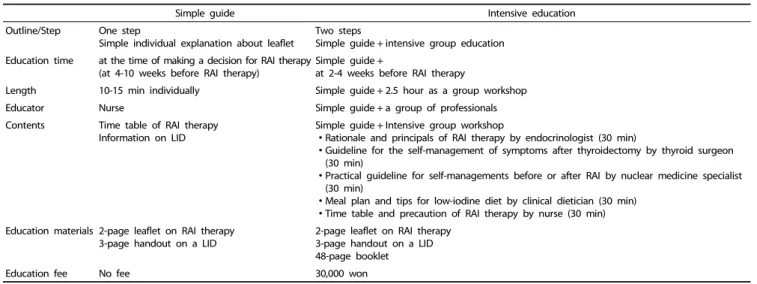
The LID was implemented with the goal of limiting iodine intake to less than 100 μg day, corresponding to the Korean Thyroid Association guidelines. Once a subject decided to undergo RAI therapy, a nurse provided general education for RAI, which consisted of an introduction to RAI and information about LID; this took 10 to 15 minutes and used a leaflet. As most information on the LID is given in a 3-page handout with no detailed explanation, we labeled this group the ‘simple guide’ group.
The patients were also able to choose an additional intensive education program for a fee. This consisted of a 2.5-hour group workshop that included 30 minutes of LID education by a clinical dietician. We labeled this group the ‘intensive education’
group. The scheme of the education program is presented in Table 1.
The dietary guidelines for the LID used in this study are presented in Table 2.
Dietary assessment
To assess the patients’ diets during usual and LID periods,
three-day diet records were collected. The diet records included
Simple guide Intensive education Outline/Step One step
Simple individual explanation about leaflet
Two steps
Simple guide + intensive group education Education time at the time of making a decision for RAI therapy
(at 4-10 weeks before RAI therapy)
Simple guide +
at 2-4 weeks before RAI therapy
Length 10-15 min individually Simple guide + 2.5 hour as a group workshop
Educator Nurse Simple guide + a group of professionals
Contents Time table of RAI therapy Information on LID
Simple guide + Intensive group workshop
∙Rationale and principals of RAI therapy by endocrinologist (30 min)
∙Guideline for the self-management of symptoms after thyroidectomy by thyroid surgeon (30 min)
∙Practical guideline for self-managements before or after RAI by nuclear medicine specialist (30 min)
∙Meal plan and tips for low-iodine diet by clinical dietician (30 min)
∙Time table and precaution of RAI therapy by nurse (30 min) Education materials 2-page leaflet on RAI therapy
3-page handout on a LID
2-page leaflet on RAI therapy 3-page handout on a LID 48-page booklet
Education fee No fee 30,000 won
Table 1. A comparison of the dietary guideline for low-iodine diet (LID) to prepare the radioactive iodine (RAI) therapy
Food group Recommendations
Allowed Restricted
Grains Rice, flour, potatoes and sweet potatoes without peel Noodles, stock including anchovy, kelp, etc.
Bread/confectionery including milk and egg yolks
Nuts Nuts (unseasoned)
Meat/Fish/Legumes Beef, pork, chicken, egg white, soymilk, tofu with chemical coagulants such as calcium chloride (Meat intake is restricted less than 120 g/day)
All seafood including fish, crab, shrimp, clams, and oysters Processed meat
Salted fish
Egg yolks or whole eggs
Tofu with natural coagulant (bittern)
Vegetables/Fruits Most vegetables and fruits All seaweed including sea mustard, laver, green algae, kelp
Salted vegetables including sea salt, salted fish, and salted fish extract Canned/bottled processed food
Concentrated vegetables/fruits
Milk Milk and dairy products
Oils Vegetable oils Mayonnaise
Seasonings Refined salt, sugar, vinegar, catsup, red pepper, ground pepper, mustard
Sea salt, imported ionized salt,
Soy sauce, soybean paste and red pepper paste that contain sea salt
Others Coffee, tea Chocolate
Foods and drugs containing red food dyes Iodine-containing vitamins, and food supplements Table 2. Dietary guidelines for a low-iodine diet for Korean thyroid cancer patients preparing for radioactive iodine therapy
two weekdays and one weekend day. The food record booklet was designed to be entirely self-administered, and contained written instructions to help the patient record the relevant details of all foods and beverages consumed, as well as an example of a correctly completed record.
Energy and nutrient intakes, except for iodine, were estimated using a Diet Evaluation System (DES) [19]. Iodine intake was calculated using the database recently established by Han et al. [10] and modified for this study. In total, 813 food items appeared in this study. Among those items, 282 items matched the analytical values in the database, values for 368 items were imputed to substituted or calculated values, and 163 items were assigned a value of zero. The coverage of iodine intake in this study was 93.8%.
Urinary iodine excretion
For urinary iodine analysis, spot urine was collected twice.
The first sample was collected at a regular medical check-up
during the usual diet period, and the second sample was collected prior to
131I administration after two weeks of LID.
Urinary iodine concentration was analyzed by the Sandell- Kolthoff method using an ammonium persulfate digestion, creatinine was measured using the Jaffe method, and both were analyzed using a microplate reader (Beckman Coulter AU 5800).
The results are expressed as iodine/creatinine (μg/gCr). Only 78 patients provided both urine samples.
Assessment of other variables
Height and weight were measured during the usual diet
period at a regular medical check-up, and again after two weeks
of LID, prior to
131I administration. Body Mass Index (BMI) was
calculated as the ratio of weight (kg) divided by height squared
(m
2). Age at diagnosis, sex, surgery method, histopathologic
information, and the method of TSH elevation were obtained
from medical records.
Total (n = 92)
Education type for LID Simple guide
(n = 49) Intensive Education
(n = 43) P-value*
Sex, n (%) Men 19 (20.7) 14 (28.6) 5 (11.6)
0.045
Women 73 (79.3) 35 (71.4) 38 (88.4)
Age at diagnosis (yrs) 44.2 ± 11.6 42.8 ± 11.7 45.7 ± 11.4 0.225
BMI (kg/m2) 23.5 ± 3.5 23.4 ± 3.5 23.7 ± 3.5 0.608
Histology, n (%)
Papillary 89 (96.7) 46 (100) 40 (93.0)
0.060
Follicular 3 (3.3) 0 (0) 3 (7.0)
Tumor size (cm) 1.35 ± 1.05 1.21 ± 0.94 1.50 ± 1.17 0.180
BRAF mutation, n (%) 56 (60.9) 28 (57.1) 28 (65.1) 0.697
Multiplicity, n (%) 40 (43.5) 22 (44.9) 18 (41.9) 0.845
Bilateral, n (%) 12 (13.0) 7 (14.3) 5 (11.9) 0.738
Extrathyroid extension, n (%)
microscopic 48 (52.2) 25 (51.0) 23 (53.5)
0.811
gross 13 (14.1) 8 (16.3) 5 (11.6)
Lymph node metastasis, n (%)
0.858
N1a (central) 46 (50.0) 25 (51.0) 21 (48.8)
N1b (lateral) 0 (0.0) 0 (0.0) 0 (0.0)
Method of TSH elevation, n (%)
0.091
Thyroid hormone withdrawal 77 (82.8) 44 (89.8) 33 (76.7)
Injection of rhTSH 15 (16.1) 5 (10.2) 10 (23.3)
Data are expressed as the Mean ± SD.
*P-value was obtained by t-test for continuous variables and χ2 test for categorical variables.
BMI, body mass index; BRAF, B-Raf proto-oncogene serine/threonine kinase; TSH, thyroid-stimulating hormone; rhTSH, recombinant human thyroid-stimulating hormone Table 3. General characteristics of the Korean thyroid cancer patients
Statistical analysis
All statistical analyses were conducted using SAS software, version 9.4 (SAS Institute, Cary, North Carolina, USA). Categorical variables were tested by the χ
2test, and continuous variables were tested by the t-test. A paired t-test was conducted to examine the differences in dietary intake between the usual diet and LID in the same individual. Iodine intake during the LID period was compared using a generalized linear model (GLM) by the type of nutritional education received after adjusting for age, sex, and energy intake. All statistical tests were two-sided, and P-value of < 0.05 were considered significant.
RESULTS
Patient characteristics
Patient characteristics are summarized in Table 2. Data from a total of 92 patients (19 men, 73 women, age 44.2 ± 11.6 years) were analyzed; 96.7% had papillary carcinomas, and 50% had lymph node metastases at initial presentation. All patients received a low-dose (1.1 GBq) of
131I ablation after TSH stimulation by thyroid hormone withdrawal (n = 77) or injection of rhTSH (n = 15) with 2 weeks of LID. Aside from sex differences, patient characteristics did not differ between simple and intensive education groups as illustrated in Table 3.
Iodine intake and urinary concentration
Fig. 1 shows the iodine intake and iodine/creatinine ratio in spot urine samples for the usual and low-iodine diets. Iodine
intake was significantly lower during the LID period than during the usual intake period (P < 0.001). The median iodine intake levels for usual diet and LID were 290 and 63.2 μg/day, respectively. Due to reduced dietary intake, the urinary iodine/
creatinine ratio was significantly lower during LID than during the usual diet. A total of 73 out of 92 (79.3%) patients met the guidelines established by the Korean Thyroid Association (iodine intake < 100 μg/day during the LID period).
Food and iodine intake according to food groups
Table 4 shows the intake of food and iodine according to
food groups. Seaweed was the largest contributor to iodine
intake during the usual diet period, followed by salted vegeta-
bles, fish, and milk. Although the daily intake of vegetables,
fruits, and beverages were more than 100 g, the iodine content
of these was low (as little as 5.5, 12.3 and 4.1 μg per day). The
iodine intake from seasonings including salt, soy sauce, soy
paste and red pepper paste was only 2.4 μg per day, and their
degree of contribution to total iodine intake was very low. In
accordance with the guidelines, fewer subjects consumed
sugars, legumes, salted vegetables, egg yolks, fish, seaweeds,
milk, processed foods, and beverages including alcohol during
the LID compared to the usual diet. By contrast, more consumed
mushrooms, egg whites, and others (including oral nutrition
supplements). Compared to usual intake, the intake of grains,
sugar, sweets, legumes, salted vegetables, meat, eggs, fish, milk
and dairy products, seasonings, and processed foods was
reduced during the LID period. Although the intake of potatoes,
vegetables, mushrooms, fruits, egg whites, and others
(a) Iodine intake
(b) Urinary iodine
Fig. 1. The iodine intake and urinary iodine during usual and low-iodine diet periods among Korean thyroid cancer patients. (a) Iodine intake, (b) Urinary iodine/Creatinine ratio in spot-urine. Q1: 25th percentile, Q3: 75th percentile, Box: Q3-Q1 (Inter-quartile range), ◇: mean, ■: extreme value. ■: 2 extreme values are clipped on the box plot (a). ■: 3 extreme values are clipped on the box plot (b). †P-value obtained using a paired t-test to compare the usual and low-iodine diets.
Food group
No. of subjects reporting
consumption P-value* Food consumption (g/day)
P-value† Iodine intake (μg/day)
P-value†
Usual LID Usual LID Usual LID
Grain and its products 92 91 0.316 413.6 ± 128.7 373.4 ± 155.9 0.006 23.5 ± 22.3 6.0 ± 4.4 < 0.001
Potatoes 82 83 0.809 76.2 ± 73.3 154.8 ± 114.9 < 0.001 2.0 ± 1.9 3.9 ± 2.9 < 0.001
Sugar and sweets 89 80 0.015 14.3 ± 11.7 6.9 ± 6.1 < 0.001 0.5 ± 0.5 0.2 ± 0.3 < 0.001
Legumes 81 42 < 0.001 62.3 ± 70.7 54.2 ± 50.7 0.004 8.1 ± 8.6 6.3 ± 6.7 < 0.001
Nuts and seeds 83 77 0.189 16.7 ± 35.8 21.3 ± 38.0 0.569 0.6 ± 1.1 0.7 ± 1.0 0.849
Vegetables 92 92 - 219.8 ± 136.4 299.9 ± 156.9 < 0.001 5.5 ± 2.6 7.3 ± 4.3 < 0.001
Salted vegetables 89 30 < 0.001 75.8 ± 37.8 67.9 ± 60.7 < 0.001 89.6 ± 55.5 45.1 ± 43.4 < 0.001
Mushrooms 49 77 < 0.001 33.5 ± 28.6 50.0 ± 37.0 < 0.001 1.9 ± 1.7 2.9 ± 2.2 < 0.001
Fruits 89 89 1.000 248.3 ± 192.3 354.8 ± 235.8 < 0.001 12.3 ± 10.8 17.2 ± 12.1 < 0.001
Meat and its products 89 86 0.305 136.3 ± 91.5 107.2 ± 66.6 0.001 25.5 ± 21.6 20.8 ± 19.8 0.050
Eggs 81 28 < 0.001 43.4 ± 25.2 19.9 ± 16.1 < 0.001 19.4 ± 11.2 8.7 ± 7.2 < 0.001
Egg whites 4 40 < 0.001 20.2 ± 11.6 56.6 ± 34.3 < 0.001 6.6 ± 3.7 18.8 ± 11.6 < 0.001
Fishes 91 35 < 0.001 74.9 ± 78.9 5.6 ± 10.4 < 0.001 57.7 ± 57.0 6.8 ± 5.1 < 0.001
Seaweeds 65 4 < 0.001 5.6 ± 11.7 6.1 ± 5.7 0.001 660.3 ± 2012.8 144.7 ± 5.7 0.011
Milk and dairy products 62 7 < 0.001 153.1 ± 104.3 44.9 ± 75.1 < 0.001 54.5 ± 39.4 13.1 ± 24.7 < 0.001
Oils 92 91 0.316 11.7 ± 6.3 9.5 ± 4.7 0.002 0.2 ± 0.1 0.1 ± 0.1 0.113
Beverages 81 61 0.001 205.8 ± 222.4 170.9 ± 116.2 0.001 4.1 ± 4.1 4.4 ± 3.5 0.052
Seasonings 92 91 0.316 35.0 ± 16.1 22.4 ± 14.0 < 0.001 2.4 ± 1.4 1.4 ± 1.1 < 0.001
Processed foods 19 0 < 0.001 76.0 ± 78.9 - 0.001 2.3 ± 4.7 - 0.049
Others 10 21 0.030 58.6 ± 83.1 209.7 ± 109.8 < 0.001 0.0 ± 0.0 0.0 ± 0.0 0.327
The total number of subjects was 92.
Data are expressed as the Mean ± SD.
*P-value was obtained from a χ2 test between usual and low-iodine diet.
†P-value was obtained from a paired t-test between usual and low-iodine diet.
Table 4. Iodine intake from food groups during the usual and low-iodine diet (LID) periods using 3-day dietary records of Korean thyroid cancer patients
significantly increased during LID, the iodine intake from these sources was less than 10 μg.
Energy and nutrient intake
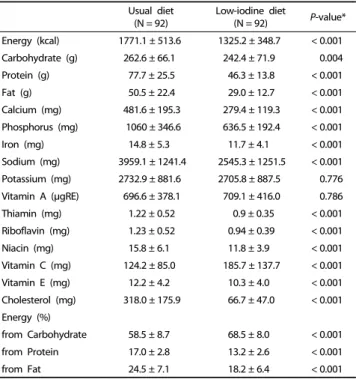
The changes in energy and nutrient intake between usual and low-iodine diet were assessed. Table 5 shows the intake of energy and nutrients during usual and low-iodine diets. The
mean level of energy intake during the LID period was 1,325
kcal, which was 446 kcal lower than the intake during the usual
diet (1,771 kcal). The intake levels of most nutrients, including
sodium, were significantly lower during LID compared to the
usual diet (P < 0.005). Potassium and vitamin A intake did not
differ between the two diet periods, but vitamin C intake was
higher during LID than during the usual diet (P < 0.001). During
Usual diet (N = 92)
Low-iodine diet
(N = 92) P-value*
Energy (kcal) 1771.1 ± 513.6 1325.2 ± 348.7 < 0.001 Carbohydrate (g) 262.6 ± 66.1 242.4 ± 71.9 0.004 Protein (g) 77.7 ± 25.5 46.3 ± 13.8 < 0.001
Fat (g) 50.5 ± 22.4 29.0 ± 12.7 < 0.001
Calcium (mg) 481.6 ± 195.3 279.4 ± 119.3 < 0.001 Phosphorus (mg) 1060 ± 346.6 636.5 ± 192.4 < 0.001
Iron (mg) 14.8 ± 5.3 11.7 ± 4.1 < 0.001
Sodium (mg) 3959.1 ± 1241.4 2545.3 ± 1251.5 < 0.001 Potassium (mg) 2732.9 ± 881.6 2705.8 ± 887.5 0.776 Vitamin A (μgRE) 696.6 ± 378.1 709.1 ± 416.0 0.786 Thiamin (mg) 1.22 ± 0.52 0.9 ± 0.35 < 0.001 Riboflavin (mg) 1.23 ± 0.52 0.94 ± 0.39 < 0.001
Niacin (mg) 15.8 ± 6.1 11.8 ± 3.9 < 0.001
Vitamin C (mg) 124.2 ± 85.0 185.7 ± 137.7 < 0.001 Vitamin E (mg) 12.2 ± 4.2 10.3 ± 4.0 < 0.001 Cholesterol (mg) 318.0 ± 175.9 66.7 ± 47.0 < 0.001 Energy (%)
from Carbohydrate 58.5 ± 8.7 68.5 ± 8.0 < 0.001 from Protein 17.0 ± 2.8 13.2 ± 2.6 < 0.001
from Fat 24.5 ± 7.1 18.2 ± 6.4 < 0.001
Data are expressed as the Mean ± SD.
*Mean values were tested using a paired t-test between usual and low-iodine diets Table 5. Nutrient intake based on three days of dietary records during usual and low-iodine diet periods among Korean thyroid cancer patients
Type of education for LID Simple guide
(n = 49)
Intensive education (n = 43) P-value Iodine (μg)
0.040*
Mean ± SD
(Median) 82.7 ± 57.3
(63.9) 68.1 ± 28.8
(61.9) Iodine Levels, n (%)
< 50 μg 10 (20.4) 12 (27.9)
0.186†
50-100 μg 26 (53.1) 26 (60.5)
> 100 μg 13 (26.5) 5 (11.6)
*Mean values were tested using the GLM model after adjusting for age, sex, method of TSH elevation, and energy intake between simple and intensive education groups.
†Distribution was tested using the χ2 test between simple guide and intensive education groups.
Table 6. Comparison of iodine intake by the type of education for the low-iodine diet period among Korean thyroid cancer patients
the LID period, the percentage of energy from carbohydrates significantly increased, whereas intake from proteins and fats significantly decreased compared to the usual diet period.
Iodine intake by type of nutrition education during low-iodine diet The energy and nutrient intake during LID was also compared between the two educational groups. After adjusting for age, sex, method of TSH elevation, and energy intake, the intake of energy and all nutrients except iodine were not different between groups. Iodine intake was significantly lower in the intensive education group (P = 0.040) (Table 6).
DISCUSSION
We evaluated iodine intake and its major food sources during the usual diet and LID for 92 patients who had undergone thyroidectomy and were receiving RAI therapy.
In this study, the median iodine intake was 290.4 μg per day on the usual diet, which was reduced considerably during the LID diet to 63.2 μg, which met the Korean Thyroid Association recommendations of less than 100 μg per day. We also measured the urinary iodine excretion as a secondary measure of dietary iodine in a subpopulation. The median urinary iodine/ creatinine ratio of the 78 patients with urine samples was reduced to 21 μg/gCr per day during LID, and 68 patients (88.5%) achieved levels lower than the recommended 100 μg/gCr (data not shown).
In terms of urinary iodine levels, previous studies [20,21] have suggested that an acceptable reduction of the urinary iodine concentration is less than 100 μg/gCr, and this was achieved in 71% and 70% of the patients during the 2-week LID in both studies. Compared to these results, the patients in this study successfully restricted dietary iodine intake. When comparing the dietary iodine intake with Japanese adults who are regarded as having similar iodine intake levels, the median iodine intake in Japan was 312 μg for men and 413 μg for women, values that were slightly higher than our results for Koreans (290 μg per day). Considering that the patients in our study had thyroid cancer, the dietary iodine intake values seem comparable.
Despite the importance of LID for RAI therapy, it is very difficult to restrict dietary iodine intake for LID, particularly in iodine-rich areas such as Korea. Moon et al. [15] reported that thyroid cancer patients are able to successfully select foods low in iodine and avoid foods high in iodine, but that patients are much less able to prepare low-iodine meals. Although condi- ments containing refined slat instead of sea salt are allowed, patients avoid using main seasonings such as soy sauce, soybean paste, and red pepper paste.
By avoiding dietary iodine intake, most patients also end up reducing their intake of other nutrients and energy. Our study also showed that energy and nutrient intake decreased during LID compared to a usual diet. Moreover, BMI decreased significantly after two weeks of LID (data not shown). These results indicate that more practical dietary strategies that maintain the intake of other nutrients while reducing iodine intake should be explored for Korean patients.
The most interesting finding of this study was that intensive nutrition education was more effective compared to a simple guide at increasing compliance with a LID. Choi et al. [22]
reported that most patients could achieve iodine levels below recommendations after two weeks of stringent LID and advice from a specialized nutritionist. Chung [23] suggested that if patients are adequately educated, and if their compliance is regularly monitored, one week of LID may be sufficient prior to RAI therapy, even in an iodine-rich areas.
Due to a lack of relevant data for the Korean population, there
is no standard LID protocol in Korea. Regarding food group
consumption during LID, subjects increased their consumption
of potatoes, nuts, vegetables, fruits, and egg whites. These
findings agree with the results of Moon et al. [15] , who also
found that self-efficacy related to consuming various fruits and vegetables, to choosing potatoes and sweet potatoes for snacks, and restricting the consumption of eggs, milk, milk products, and processed foods was rated highly.
Our results also showed that patients avoided foods with high iodine contents. All the patients in our study tried to use refined salt instead of sea salt in accordance with the LID guidelines.
In addition, the patients consumed various vegetables, and sought fruit, baked potatoes and sweet potatoes for snacks.
Using these foods with simple recipes showed high self-efficacy.
By contrast, the significant reduction in the intake of sodium, sugar, oils and seasonings implies that the patients cooked less frequently than they did during their usual diets. Difficulties related to cooking, and misunderstanding LID as a low-sodium diet, may cause patients to stop cooking. To counteract this, clinical dieticians should educate patients on how to cook while complying with a LID, and what seasonings to use.
In this study, the contribution of seasonings for usual iodine intake was very low (only 2.4 μg per day), so limiting sea salt and seasonings containing sea salt would have very little effect on overall iodine intake. This result may be useful for the development of more practical dietary guidelines for LID, including the practical strategy of avoiding consuming stock made by stewing anchovies or kelp, which contributes much more to iodine intake than seasonings.
Our study has several limitations. First, the iodine database for common Korean foods is still incomplete. Our iodine database was mainly based on analytical values determined by the Korean Food and Drug Administration (KFDA). These values, for a total of 455 foods, were determined through inductively coupled plasma mass spectrometry (ICP-MS) [24]. However, for seasonings such as soybean paste and red pepper paste, the type of salt was not specified, and only mean iodine content of sea salt, soy sauce, soybean paste, and red pepper paste were reported. The values for iodine content per 100 g for these foods are 1.83, 1.80, 14.4, and 8.03 μg, respectively. Since the type of salt is very important for thyroid cancer patients, the iodine database should be updated. Second, iodine intake was assessed using three days of dietary records. Since dietary intake was self-administered, nutrient intake, including iodine, may have been underestimated due to the high burden of keeping dietary records. Third, we measured urinary iodine levels, although not in all patients. In addition, the time period of dietary assessment was not matched to the urinary assessment, because they reported 3-day dietary records. Therefore, we used urinary iodine levels as a secondary measurement. Fourth, the type of nutrition education for LID could not be randomized because the patients paid for the intensive education. Finally, the side effects of LID, including hyponatremia were not investigated.
Previous studies have reported cases of severe hyponatremia associated with hypothyroidism induced by pretreatment of
131I therapy, such as LID and withdrawal of thyroid hormones [25-28].
Nevertheless, to our knowledge, this study was the first study to examine iodine intake during LID in a Korean population, and we were able to identify the major foods that contribute to iodine intake, which may be useful for developing future LID guidelines specifically for Korean thyroid cancer patients.
In conclusion, iodine intake was significantly reduced during LID, but the intake of almost all other nutrients also decreased due to the difficulties associated with maintaining a LID. Future studies are needed to develop a practical protocol for LID in order to maintain the intake of other nutrients while reducing iodine intake.
REFERENCES
1. Jung KW, Won YJ, Kong HJ, Oh CM, Cho H, Lee DH, Lee KH. Cancer statistics in Korea: incidence, mortality, survival, and prevalence in 2012. Cancer Res Treat 2015;47:127-41.
2. American Thyroid Association (ATA) Guidelines Taskforce on Thyroid Nodules and Differentiated Thyroid Cancer, Cooper DS, Doherty GM, Haugen BR, Kloos RT, Lee SL, Mandel SJ, Mazzaferri EL, McIver B, Pacini F, Schlumberger M, Sherman SI, Steward DL, Tuttle RM. Revised American Thyroid Association management guidelines for patients with thyroid nodules and differentiated thyroid cancer. Thyroid 2009;19:1167-214.
3. Kim TY, Kim WG, Kim WB, Shong YK. Current status and future perspectives in differentiated thyroid cancer. Endocrinol Metab (Seoul) 2014;29:217-25.
4. Yi KH, Park YJ, Koong SS, Kim JH, Na DG, Ryu JS, Park SY, Park IA, Baek CH, Shong YK, Lee YD, Lee J, Lee JH, Chung JH, Jung CK, Choi SH, Cho BY. Revised Korean Thyroid Association management guidelines for patients with thyroid nodules and thyroid cancer.
J Korean Soc Radiol 2011;64:389-416.
5. Kim WB, Seok JW, Kim MH, Kim BI, Park YJ, Lee KE, Lee SM, Lee YS, Jung KH, Jo YS, Cheon GJ, Chung JH, Kang SJ. Korean Thyroid Association guidelines for patients undergoing radioiodine therapy for differentiated thyroid cancers (First edition, 2012). J Korean Thyroid Assoc 2013;6:12-25.
6. Sawka AM, Ibrahim-Zada I, Galacgac P, Tsang RW, Brierley JD, Ezzat S, Goldstein DP. Dietary iodine restriction in preparation for radioactive iodine treatment or scanning in well-differentiated thyroid cancer: a systematic review. Thyroid 2010;20:1129-38.
7. Rohner F, Zimmermann M, Jooste P, Pandav C, Caldwell K, Raghavan R, Raiten DJ. Biomarkers of nutrition for development--iodine review. J Nutr 2014;144:1322S-1342S.
8. Zimmermann MB, Andersson M. Update on iodine status worldwide.
Curr Opin Endocrinol Diabetes Obes 2012;19:382-7.
9. Lee HS, Min H. Iodine intake and tolerable upper intake level of iodine for Koreans. Korean J Nutr 2011;44:82-91.
10. Han MR, Ju DL, Park YJ, Paik HY, Song Y. An iodine database for common Korean foods and the association between iodine intake and thyroid disease in Korean adult. Int J Thyroidol. Forthcoming 2015.
11. Bath SC, Sleeth ML, McKenna M, Walter A, Taylor A, Rayman MP.
Iodine intake and status of UK women of childbearing age recruited at the University of Surrey in the winter. Br J Nutr 2014;112:1715-23.
12. Murray CW, Egan SK, Kim H, Beru N, Bolger PM. US Food and Drug Administration's Total Diet Study: dietary intake of perchlorate and iodine. J Expo Sci Environ Epidemiol 2008;18:571-80.
13. Sohn SY, Choi JY, Jang HW, Kim HJ, Jin SM, Kim SW, Suh S, Hur KY, Kim JH, Chung JH, Kim SW. Association between excessive urinary iodine excretion and failure of radioactive iodine thyroid ablation in patients with papillary thyroid cancer. Thyroid 2013;
23:741-7.
14. Yoo ID, Kim SH, Seo YY, Oh JK, O JH, Chung SK. The success rate of initial 131I ablation in differentiated thyroid cancer: comparison between less strict and very strict low iodine diets. Nucl Med Mol Imaging 2012;46:34-40.
15. Moon JA, Yoo CH, Kim MH, Lee SM, Oh YJ, Ryu YH, Lee YS, Chang HS, Park CS, Lee KE. Knowledge, self-efficacy, and perceived barriers on the low-iodine diet among thyroid cancer patients preparing for radioactive iodine therapy. Clin Nutr Res 2012;1:13-22.
16. Kim JY, Kim KR. Dietary iodine intake and urinary iodine excretion in patients with thyroid diseases. Yonsei Med J 2000;41:22-8.
17. Kim EH, Choi TI, Park YK. Dietary iodine intake and the association with subclinical thyroid dysfunction in male workers. Korean J Nutr 2012;45:218-28.
18. Imaeda N, Kuriki K, Fujiwara N, Goto C, Tokudome Y, Tokudome S. Usual dietary intakes of selected trace elements (Zn, Cu, Mn, I, Se, Cr, and Mo) and biotin revealed by a survey of four-season 7-consecutive day weighed dietary records in middle-aged Japanese dietitians. J Nutr Sci Vitaminol (Tokyo) 2013;59:281-8.
19. Jung HJ, Lee SE, Kim D, Noh H, Song S, Kang M, Song Y, Paik HY.
Development and feasibility of a web-based program 'Diet Evaluation System (DES)' in urban and community nutrition survey in Korea. Korean J Health Promot 2013;13:107-15.
20. Park JT 2nd, Hennessey JV. Two-week low iodine diet is necessary for adequate outpatient preparation for radioiodine rhTSH scanning in patients taking levothyroxine. Thyroid 2004;14:57-63.
21. Tomoda C, Uruno T, Takamura Y, Ito Y, Miya A, Kobayashi K,
Matsuzuka F, Amino N, Kuma K, Miyauchi A. Reevaluation of stringent low iodine diet in outpatient preparation for radioiodine examination and therapy. Endocr J 2005;52:237-40.
22. Choi JH, Kim HI, Park JW, Song EH, Ko BJ, Cheon GJ, Kim BI. Analysis of urine iodine excretion decrease by two-week stringent low iodine diet for remnant thyroid ablation with radioactive iodine in Korean patients with thyroid cancer; prospective study. Nucl Med Mol Imaging 2008;42:375-82.
23. Chung JH. Low iodine diet for preparation for radioactive iodine therapy in differentiated thyroid carcinoma in Korea. Endocrinol Metab (Seoul) 2013;28:157-63.
24. Kang TS, Lee JH, Leem D, Seo IW, Lee YJ, Yoon TH, Lee JH, Lee YJ, Kim YJ, Kim SG. Monitoring of Iodine in Foods for Estimation of Dietary Intake. Cheongwon: National Institute of Food and Drug Safety Evaluation; 2012.
25. Nozu T, Yoshida Y, Ohira M, Okumura T. Severe hyponatremia in association with I(131) therapy in a patient with metastatic thyroid cancer. Intern Med 2011;50:2169-74.
26. Krishnamurthy VR, McDougall IR. Severe hyponatremia: a danger of low-iodine diet. Thyroid 2007;17:889-92.
27. Kaewput C, Pusuwan P. Severe hyponatremia: a comorbidity with I131 therapy in a patient with papillary thyroid cancer. J Med Assoc Thai 2014.97:886-90.
28. Kim SK, Yun GY, Kim KH, Park SK, Choi HY, Ha SK, Park HC. Severe hyponatremia following radioactive iodine therapy in patients with differentiated thyroid cancer. Thyroid 2014;24:773-7.