DOI 10.3349/ymj.2008.49.1.129
Purpose: To compare the clinical outcome and complica- tions following total knee arthroplasty (TKA) in diabetic and non-diabetic patients, and to identify diabetes-related risk factors for negative outcomes. Materials and Methods: 222 primary TKAs in patients with diabetes were evaluated using Knee Society scores and Hospital for Special Surgery score.
Postoperative complications were reviewed retrospectively.
The mean follow-up was 53.2 months. The effect of diabetes- related factors and comparison with a matched control group were analyzed statistically. Results: Significant improvements were noted in all the scores after TKA (p < 0.05). There was no statistical difference in clinical sores between the diabetic and non-diabetic patients. In multivariate analysis associating age, gender and body mass index with pain and knee score at the latest follow-up, the average knee scores in normal and overweight group were found to be significantly higher than those in the obese group. The diabetic patients had an increased overall incidence of postoperative complications (17.6%) compared with the control group (8.1%) (p < 0.05).
Particularly, the rate of wound complications such as skin necrosis, bulla formation or erythema with drainage was higher in the diabetic group (p < 0.05). Diabetes-related factors did not influence the incidence of complications. Associated diseases were the only significant risk factors correlated with wound complications and meniscal bearing dislodgement.
Conclusion: Patients with diabetes can benefit from TKA, even though diabetic patients are at an increased risk for overall postoperative and wound complications. Preoperative factors such as obesity and associated diseases may adversely affect the clinical outcome of TKA in diabetic patients.
Key Words: Diabetes mellitus, total knee arthroplasty, clinical outcome, complication, risk factor
INTRODUCTION
The prevalence of diabetes is rising as the elderly population increases. In Koreans, the age- adjusted prevalence of diabetes is 7.6%, cor- responding to 2.7 million with diabetes. The prevalence of diabetes increases with age and reaches its peak in the oldest age-group; in population of 60 - 69 years of age the prevalence of diabetes is about 20%.
1Diabetes has been known to adversely affect the musculoskeletal system, to delay collagen syn- thesis,
2,3and to impair wound healing
4and phagocytosis.
5These factors may lead to higher risks of various infections and poorer wound healing after any surgical procedure. Some studies have shown an altered bone and mineral metabolism in diabetic animals and humans,
6-10and the fracture healing process may be delayed by this condition.
11-14Theoretically, these effects could contribute to prosthesis loosening in total joint replacement.
Total knee arthroplasty (TKA) is one of the most frequently performed orthopaedic opera- tions in the elderly population. As TKA in diabetic patients has become more common, it has received increasing attention. Some authors have reported an increased rate of deep infection in diabetic patients,
15-18while others have raised concerns over wound complications.
16-19The aim of our present study was to compare the clinical outcome and complications following TKA in a consecutive series of diabetic and non- diabetic patients, and to identify diabetes-related risk factors for negative outcomes.
Factors Affecting Outcome after Total Knee Arthroplasty in Patients with Diabetes Mellitus
Hong Kyo Moon,
1Chang Dong Han,
1Ick Hwan Yang,
1and Bong Soo Cha
2Departments of
1Orthopaedic Surgery,
2Internal Medicine, Severance Hospital, Yonsei University College of Medicine, Seoul, Korea.
Received May 14, 2007 Accepted August 31, 2007
Reprint address: requests to Dr. Chang Dong Han, Department of Orthopaedic Surgery, Severance Hospital, Yonsei University College of Medicine, 250 Seongsanno, Seodaemun-gu, Seoul 120- 752, Korea. Tel: 82-2-2228-2180, Fax: 82-2-363-1139, E-mail:
[email protected]
MATERIALS AND METHODS Patient characteristics
Between 1995 and 2004, 1581 primary TKA procedures were performed at our institution.
Surgery was performed by one senior author. In this consecutive series, 222 primary TKAs (14%) in 171 patients with diabetes were available with a minimum follow-up period of 2 years. Only patients with osteoarthritis were included in the current study. The medical records of these patients were reviewed in detail to assess the demographic and medical features of each patient (Table 1). The study included 155 women (203 TKAs) and 16 men (19 TKAs) with a mean age of 67.6 years (range, 50 - 86 years) at the time of operation. Fifty-one patients had bilateral staged TKA. The mean duration of follow-up was 53.2 months (range, 24 - 132 months). Nine patients (5.3%) had previous knee procedures before de- finitive TKA; 5 received arthroscopic debridement, 1 high tibial osteotomy and 3 open reduction and internal fixation for distal femur or proximal tibial
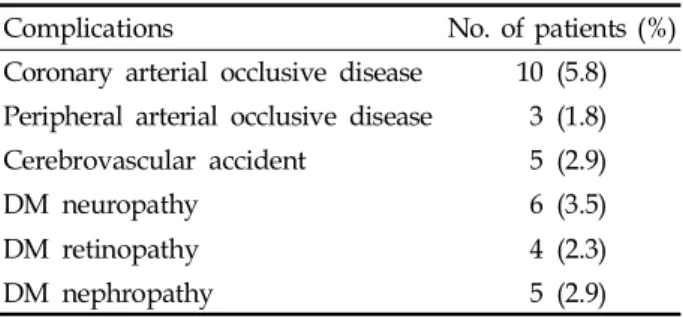
fracture. To identify diabetes-related factors that affect the outcome after TKA, several diabetes associated variables were investigated, including duration of diabetes, the number of major systemic complications of diabetes, body mass index (BMI) and glycosylated hemoglobin values (HbA1c). Twenty-four patients (31 knees; 14%) were treated with insulin, and 147 patients (191 knees; 86%) were treated with oral hypogly- cemics. The mean time from the onset of diabetes to the time of surgery was 7.6 years (range, 1 - 30 years). Twenty-nine patients (37 knees; 17%) had major systemic complications of diabetes at the time of surgery. Twenty-five patients (32 knees) had one complication, and four patients (5 knees) had two complications. The distribution of com- plications from diabetes is listed in Table 2. Table 3 shows associations with various diseases; the most common was hypertension associated with 148 knees (66.7%). Body mass index (BMI) is the ratio of weight to height, calculated by dividing the weight by the square of the height (kg/m
2).
Patients were divided into three categories based on their BMI: individuals with a BMI of 20 - 25 Table 1. Demographic Data
Gender (No. of patients, %)
Male 16 (9.4%)
Female 155 (90.6%)
Age (mean, range) 67.6 yrs (50 - 86)
Follow-up period (mean, range) 53 months (24 - 132)
Type of treatment (No. of patients, %)
Insulin 24 (14%)
Oral hypoglycemics 147 (86%)
Duration of diabetes (mean, range) 7.6 yrs (1 - 30)
Number of complications of diabetes (No. of patients)
0 142
1 25
2 4
Body mass index (BMI) (mean, range) 26.5 kg/m
2(18.9 - 36.9)
Normal 74 knees (33.3%)
Overweight 119 knees (53.6%)
Obese 29 knees (13.1%)
Glycosylated hemoglobin value (HbA1c) (mean, range) 7.5% (4.4 - 12.2)
Previous knee surgery (No. of knees)
Arthroscopic debridement 5
High tibial osteotomy 1
Open reduction and internal fixation 3
are considered normal weight; 25 - 30 overweight;
and > 30 obese.
20-22In the present study, the mean BMI was 26.5 kg/m
2(range, 18.9 - 36.9). Seventy- four knees (33.3%) were associated with normal weight, 119 knees (53.6%) with overweight and 29 knees (13.1%) with obese. HbA
1cis a useful index of blood glucose control over a period of 4 - 5 weeks.
23-25HbA
1cvalues, taken within 1 month before TKA to evaluate diabetes, were available for 185 knees with a mean HbA
1cof 7.51% (range, 4.40 - 12.20). Antibiotic prophylaxis and a tour- niquet were used in all patients. Prophylaxis for thromboembolism was not performed. All knees were approached through a standard medial parapatellar incision, and all patients received cefuroxime-impregnated cement (1 g of cefuroxime in 40 g of CMW) with mobile bearing low contact stress total knee system (Depuy, Warsaw, IN, USA). Full weight bearing ambulation and range of motion exercises were started on the first postoperative day.
Clinical evaluation
All the patients were identified only by the sequential number of TKA while administering
rating scores and complications to stay blind to the patient’s status as either a diabetes or control subjects. Patients were preoperatively evaluated according to the Knee Society clinical scoring system and then postoperatively at 6 weeks, 6 months, 1 year, and yearly thereafter.
26Values for knee and function score were obtained to assess prosthetic knee and patient function separately.
Pain score was also obtained from the knee scores comprising pain, range of motion and stability.
Ratings of 90 - 100 were considered excellent, 80 - 89 good, 70 - 79 fair, and less than 70 poor. We also evaluated Hospital for Special Surgery (HSS) knee-rating scores.
27Knees with a rating of 85 or more were designated as excellent, 70 - 84 good, 60 - 69 fair, and less than 60 poor. Perioperative and postoperative complications were noted retrospectively for all patients. Complications in- cluded wound complications, superficial or deep infection, meniscal bearing dislodgement, peri- prosthetic fracture, deep vein thrombosis (DVT), peroneal nerve palsy and other medical compli- cations. Wound complications were defined as marginal skin necrosis, bulla formation or wound erythema with drainage that persisted longer than usual. To avoid observational bias, only the cases were determined to be adopted of which hospital stay was prolonged at least two days or more for wound management or additional use of intravenous antibiotics. Patients were clinically screened for DVT and it was confirmed with Doppler ultrasonography when diagnosis was suspicious.
Control group
To compare the outcome after TKA in diabetic patients with that of non-diabetic patients, a randomized matching with controls was done from the same series using computer generated matching process. Non-diabetic patients were matched one to one with diabetic patients, based on the following criteria:
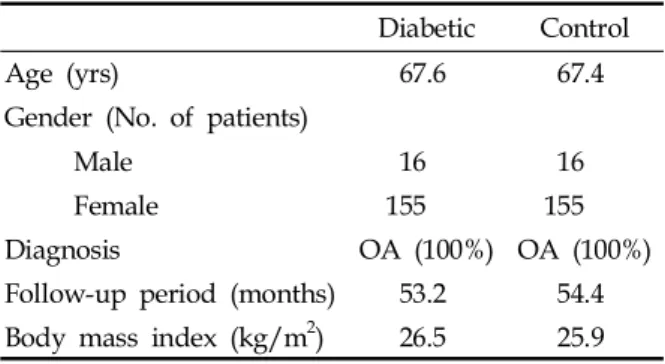
17,19(1) age at surgery (within 5 years), (2) gender, (3) diagnosis of arthritis, (4) length of follow-up period (within 1 year), (5) implant design, and (6) BMI (same BMI category). Characteristics of the control and diabetic groups are compared in Table 4. There were no statistical differences in any of the Table 3. Associated Diseases
Diseases No. of knees (%)
Hypertension 148 (66.7)
Hypothyroidism 1 (0.5)
Parkinsonism 2 (0.9)
Congestive heart failure 4 (1.8)
Cushing syndrome 10 (4.5)
Nephrotic syndrome 1 (0.5)
Liver cirrhosis 1 (0.5)
Table 2. Preoperative Systemic Complications Associated with Diabetes Mellitus
Complications No. of patients (%)
Coronary arterial occlusive disease 10 (5.8) Peripheral arterial occlusive disease 3 (1.8) Cerebrovascular accident 5 (2.9)
DM neuropathy 6 (3.5)
DM retinopathy 4 (2.3)
DM nephropathy 5 (2.9)
Table 5. Average Knee Society Scores
Score Diabetic status Preoperative Last follow-up
Knee Yes 50 ± 16 92 ± 12
No 52 ± 17 92 ± 10
Pain Yes 22 ± 10 45 ± 9
No 23 ± 10 45 ± 8
Function Yes 47 ± 14 74 ± 20
No 50 ± 13 74 ± 20
Table 6. Average Hospital for Special Surgery Scores Diabetic status Preoperative Last follow-up
Yes 66 ± 10 89 ± 10
No 66 ± 11 89 ± 9
matching criteria between the two groups.
Statistical assessment
Univariate analyses were performed to idenfity significant preoperative factors of the measured outcome. P values less than 0.05 were considered significant. The paired t-test was performed to determine whether there was a significant impro- vement in the clinical scores after TKA. Clinical scores were compared with those of the control group using the Student's t-test. Overall and individual complication rates were compared with the chi-square test. The relationship between clinical scores and continuous variables, such as duration of diabetes, BMI and the value of HbA
1c, were analyzed using the Pearson correlation coefficients test. In addition, analysis of variance (ANOVA) was used when the com- parison was performed with respect to BMI subgroups. However, in a number of major systemic complications of diabetes, the samples of group "2" did not fulfill the normality test, therefore, they were correlated with the clinical scores using the Kruskal-Wallis test as a nonparametric test. The chi-square test was used to analyze the effect of diabetes-related factors on complication rates.
Once possibly significant predictors of outcome had been identified by this method, multivariate analysis was carried out to identify any predictors that would independently alter outcome. Computation was performed with the Statistical Analysis System (SAS Institute, Cary, North Carolina, USA).
RESULTS Clinical results
In the diabetic group, the average preoperative Knee Society knee score was 50 ± 16, and the average pain and function scores were 22 ± 10 and 47 ± 14, respectively. There was a significant improvement in all the scores (p < 0.0001) after TKA. At the latest follow-up, knee, pain, and function scores had increased to 92 ± 12, 45 ± 9 and 74 ± 20, respectively (Table 5). There was also improvement in the HSS score from 66 ± 10 to 89
± 10 (p < 0.0001) (Table 6). The control group also showed a significant improvement in the Knee Society scores and HSS score (Tables 5 and 6). At the latest follow-up examination, there was no pain in 112 knees (50.5%), mild pain in 102 (45.9%), moderate pain in 6 (2.7%) and severe pain in 2 (0.9%). One hundred and seventy seven (79.7%) knees were rated excellent, 21 (9.5%) good, 16 (7.2%) fair, and 8 (3.6%) poor according to the Knee Society rating scale.
There were no statistically significant differ- ences in the average preoperative Knee Society knee, pain and function scores between the diabetic and control groups (p > 0.05). Likewise, there were no statistical differences in the average postoperative knee, pain, and function scores between the two groups (Table 5). There were no significant differences in the average preoperative Table 4. Comparison of Diabetic and Control Groups
Diabetic Control
Age (yrs) 67.6 67.4
Gender (No. of patients)
Male 16 16
Female 155 155
Diagnosis OA (100%) OA (100%)
Follow-up period (months) 53.2 54.4
Body mass index (kg/m
2) 26.5 25.9
OA, osteoarthritis.
and postoperative HSS score between the two groups (Table 6).
Univariate analysis suggested that age, gender and BMI might affect the clinical outcomes. A significant relationship between other predictors and clinical outcomes could not be detected (p >
0.05). However, associated diseases and the number of diabetic complications were related with pre- operative pain scores. For the number of diabetic complications, the median value was 10 for group 2, 20 for group 1, and 30 for group 0 (p = 0.0035), and 30 in patients without associated diseases, 20 with hypertension, 20 with congestive heart failure, and 15 with Cushing syndrome (p = 0.0096).
Dividing the BMI into 3 subgroups, the mean postoperative pain score was 44 ± 6 in the normal weight group, 46 ± 7 in the overweight group, and 41 ± 14 in the obese group (p = 0.0182). The mean postoperative knee score was 92 ± 10 in the normal weight group, 94 ± 8 in overweight group, and 86
± 24 in obese group (p = 0.0109). Multivariate analysis associating age, gender and BMI with the pain and knee score at the latest follow-up was performed. Once the analysis was carried out, the differences in the knee scores were all significant, whereas only the difference in the pain score was significant between the overweight and obese groups.
Postoperative complications
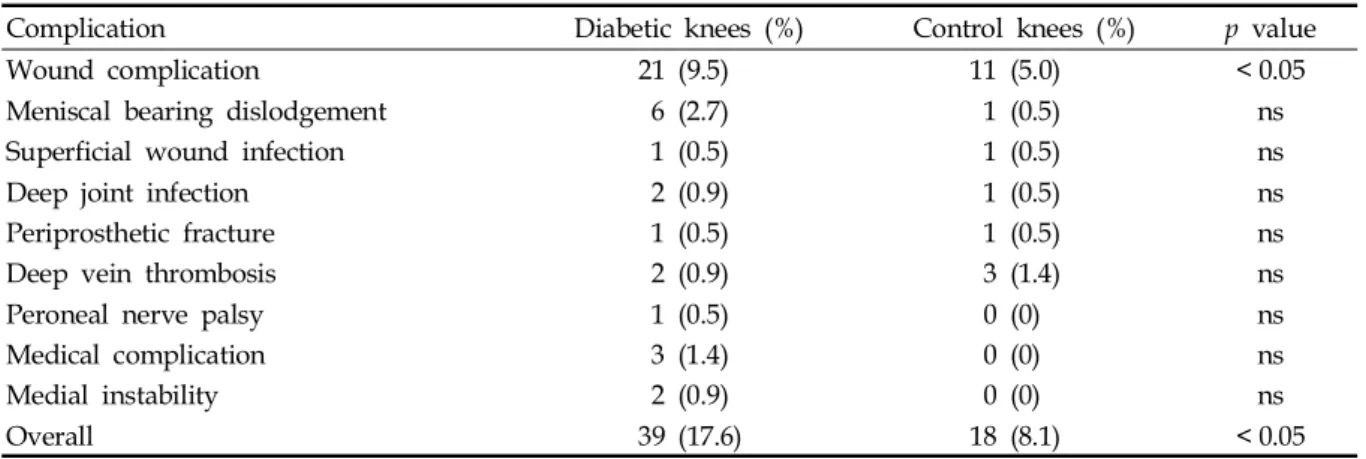
The diabetic group had an increased overall incidence of postoperative complications com- pared with the matched control group (17.6% vs.
8.1%; p = 0.0029). The rate of wound complications was significantly higher in patients with diabetes than in patients without diabetes (9.5% vs. 5.0%;
p = 0.0461). The rate of dislodgement was 2.7% in diabetic versus 0.5% in non-diabetics and was found to be not significantly different (p = 0.0585).
The rates of other complications were not statisti- cally different (Table 7). Peroneal nerve palsy, serious medical complications and medial instability were not observed in the control group.
Six meniscal bearing dislodgements occurred postoperatively at an average of 18.8 months (range, 2 - 48) and were treated with meniscal bearing exchange. One each superficial wound infection occurred in the both groups, and they were treated with debridement of the wound and intravenous antibiotics. Two deep infections (0.9%) occurred in the diabetic group, whereas one deep infection (0.5%) in the control group.
The deep infections in the diabetic group occurred 11 weeks and 33 months postoperatively, and the causative microorganisms were methicillin-resistant coagulase negative streptococcus and Escherichia coli, respectively. The deep infection in the control group occurred 36 months postoperatively, and the causative organism was Acinetobacter baumannii.
These infections were treated with debridement of the joint and intravenous antibiotics, and the infected implants were retrieved and replaced with an antibiotic impregnated cement spacer.
Definitive revisional total knee arthroplasty was performed 6 months later. Clinical features of the diabetic patients with deep infection are listed in Table 8. The patients were diagnosed as diabetes
Table 7. Postoperative Complications
Complication Diabetic knees (%) Control knees (%) p value
Wound complication 21 (9.5) 11 (5.0) < 0.05
Meniscal bearing dislodgement 6 (2.7) 1 (0.5) ns
Superficial wound infection 1 (0.5) 1 (0.5) ns
Deep joint infection 2 (0.9) 1 (0.5) ns
Periprosthetic fracture 1 (0.5) 1 (0.5) ns
Deep vein thrombosis 2 (0.9) 3 (1.4) ns
Peroneal nerve palsy 1 (0.5) 0 (0) ns
Medical complication 3 (1.4) 0 (0) ns
Medial instability 2 (0.9) 0 (0) ns
Overall 39 (17.6) 18 (8.1) < 0.05
ns, not significant.
one year before surgery and had no complication of diabetes preoperatively. One diabetic patient with peroneal nerve palsy underwent electrical stimulation therapy and showed recovery of ankle dorsiflexion 3 weeks postoperatively and big toe extension one year postoperatively. There were no perioperative mortalities in our series.
DISCUSSION
A few studies evaluated the effect of diabetes on outcome following TKA. Serna et al. investi- gated the effect of various diagnosis, the use of cement versus cementless fixation, preoperative deformity, the number of prior surgeries, patient weight greater than 80 kg, and Chanley functional class, and suggested the necessity to examine the degree of glucose control in terms of its effect on the final outcome. To our best knowledge, the cur- rent study is the first attempt to examine the effect of diabetes-related factors (duration of diabetes, number of complications of diabetes, body mass index, HbA
1cvalue, type of treatment of diabetes, dose of insulin) on the clinical ratings and the incidence of postoperative complications rates.
In the present study, there was a significant improvement in HSS and Knee Society scores between preoperative and postoperative values for both control and diabetic groups, and these improvements of the scores were associated with pain relief and reflected changes in walking distance and gait aids. In diabetic patients, sensory and autonomic neuropathy can exist at subclinical levels,
28and the resulting loss of pain perception may contribute to higher Knee Society
knee and pain scores in patients with diabetes. In addition, combined chronic complications of diabetes and medical comorbidities may have an adverse effect on the function and mobility of patients. These ideas are supported by Meding et al.,
29who reported higher knee and pain scores and lower function scores in patients with diabetes. Papagelopoulos et al.
19also reported lower function scores in diabetic patients; whereas the Knee Society knee score and HSS scores were lower in patients with diabetes in their series.
Likewise, Serna et al.
17reported lower HSS scores in patients with diabetes. Those authors recognized that diabetes might influence clinical outcome.
However, the influence of diabetes-related factors on clinical outcome was not addressed in their study. We demonstrated that there was no dif- ference in clinical scores between the diabetic and non-diabetic patients, and univariate analysis revealed that BMI was the single significant diabetes-related predictor on clinical outcome. It appears, therefore, that the lower knee score in the obese group is largely due to the lower pain score. Low postoperative pain scores have been attributed to the increased rates of postoperative patellofemoral symptoms among obese patients.
30-32