The Modifi ed Static Spacers Using Antibiotic- Impregnated Cement Rod in Two-Stage Revision
for Infected Total Knee Arthroplasty
Juhyung Yoo, MD, Seungyup Lee, MD*, Changdong Han, MD*, Jihoon Chang, MD
Department of Orthopedic Surgery, National Health Insurance Corporation Ilsan Hospital, Goyang,
*Department of Orthopedic Surgery, Yonsei University College of Medicine, Seoul, Korea
Technical Note
Clinics in Orthopedic Surgery 2011;3:245-248 • http://dx.doi.org/10.4055/cios.2011.3.3.245Copyright © 2011 by Th e Korean Orthopaedic Association
Th is is an Open Access article distributed under the terms of the Creative Commons Attribution Non-Commercial License (http://creativecommons.org/licenses/by-nc/3.0) which permits unrestricted non-commercial use, distribution, and reproduction in any medium, provided the original work is properly cited.
Clinics in Orthopedic Surgery • pISSN 2005-291X eISSN 2005-4408 Received May 10, 2010; Accepted Sepember 16, 2010
Correspondence to: Jihoon Chang, MD
Department of Orthopedic Surgery, National Health Insurance Corporation Ilsan Hospital, 1232 Baekseok 1-dong, Ilsandong-gu, Goyang 410-719, Korea
Tel: +82-31-900-0228, Fax: +82-31-900-0343 Email: [email protected]
Deep prosthetic infection following total knee arthroplasty (TKA) is an uncommon yet undesirable clinical and eco- nomical outcome for patients and orthopedic surgeons.
Many treatment options have been reported and the optimal method varies by the extent of infection and the patient’s underlying medical condition.1,2) Among the ex- isting methods, two-stage reimplantation with intravenous antibiotics for the time interval has an excellent success rate and is currently the most commonly accepted stan- dard management.3,4) A cement spacer can be used in this technique to maintain knee stability, to prevent shortening of the extensor mechanism and the ligament, capsular re- traction and to reduce pain. A static or mobile articulating spacer is used for these purposes.
Each spacer has advantages and disadvantages. In maintaining a stable knee, the static spacer reduces the lev-
el of pain during the period between the two procedures (interval period). In addition, the static spacer technique is easier to complete than the mobile spacer technique. Th e static spacer is unstable, however, and maintains the limb in a malaligned position, which causes bone loss and lower range of motion following reimplantation.5) The advan- tage of a mobile articulating spacer is preservation of knee motion before reimplantation. Several reports showed improved range of knee motion following reimplantation.
The mobile spacer technique is costly and complicated however, and causes intra-operative sterilization chal- lenges as it uses the previous prosthesis as a cement tem- plate and produces cement wear debris from the cement- cement surface.6-10)
We report the application of the static spacer tech- nique using a novel antibiotic-impregnated cement rod for the treatment of infected TKA. The technique conferred better rigidity and stability and less bone loss compared to the conventional static spacer. Normal anatomic align- ment of the lower extremity and reduced soft tissue adhe- sion were observed.
The two-stage exchange arthroplasty (one- or two-stage) is believed to be the gold standard for the management of infections following total knee arthroplasty. We herein report a novel two-stage exchange arthroplasty technique using an antibiotic-impreg- nated cement intramedullary nail, which can be easily prepared during surgery using a straight thoracic tube and a Steinmann pin, and may provide additional stability to the knee to maintain normal mechanical axis. In addition, there is less pain between the period of prosthesis removal and subsequent reimplantation. Less soft tissue contracture, less scar adhesion, easy removal of the cement intramedullary nail, and successful infection control are the advantages of this technique.
Keywords: Total knee arthroplasty, Infection, Two-stage reimplantation, Static-spacer, Antibiotic-impregnated cement, Cement rod
246
Yoo et al. Th e Modifi ed Static Spacers Using Antibiotic-Impregnated Cement Rod in Two-Stage Revision for Infected Total Knee Arthroplasty
Clinics in Orthopedic Surgery • Vol. 3, No. 3, 2011 • www.ecios.org
SURGICAL TECHNIQUE
The following section describes the treatment procedure for patients with deep infection following TKA using modified static spacers. The original prosthesis was re- moved, followed by intensive irrigation and wide debride- ment of the infected soft tissue. A 36 Fr-diameter straight thoracic catheter (Mallinckrodt Medical, Athlone, Ireland) and a Steinmann pin measuring 3.0 mm in diameter and 22 cm in length were used to prepare the antibiotic- impregnated cement rod. Vancomycin (2 g) was then added to the Gentamicin bone cement (DePuy, Warsaw, IN, USA). At the late liquid stage of the cement, antibiotic- impregnated cement was poured into 50 mL of enema syringe. Th e Steinmann pin was inserted into the tube, and the prepared cement was delivered through the tube. Dur- ing this procedure, the other end of the tube was partially sealed with a clamping device. Th e tube was rolled gently to straighten the rod. Aft er the cement hardened, the tube was removed from the cement rod using a surgical knife.
Finally, a cement rod measuring 9 mm in diameter and 22 cm in length was formed (Fig. 1).
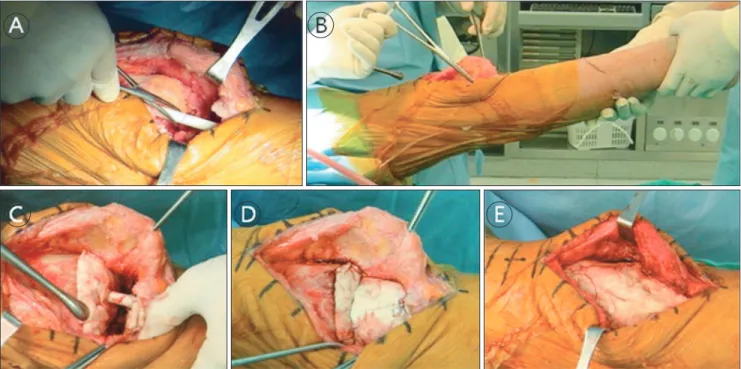
An entry hole was created at the center of the distal femur and proximal tibia for the insertion of the cement rod. The rod was then inserted into the femur and tibia through this hole. During insertion, it was important to place the center of the cement rod on an imaginary joint line. Th e proximal medullary canal of the tibia was fi lled with antibiotic-impregnated cement up to the surface of the proximal tibia, while the surgical assistant maintained proper anatomic alignment and joint space. Subsequently,
the same procedure was performed for the distal femur.
Th e space between the cement of the distal femur and the proximal tibia was fi lled with more antibiotic-impregnated cement. Finally, the suprapatellar pouch and medial and lateral gutter space were fi lled with antibiotic-impregnated cement to reduce soft tissue adhesion (Fig. 2). Cylinder splint immobilization was required for three days aft er the operation, aft er which a fi xed-angle knee brace was used and toe-touching ambulation was allowed until the reim- plantation surgery.
DISCUSSION
From April to November 2007, the authors performed the static technique in four patients using the novel antibiotic- impregnated cement rod for the treatment of infected TKA (culture: staphylococcus in three cases and no bac- teria in one case). Aft er the implant removal surgery, six weeks of intravenous antibiotic treatment was adminis- tered. Follow-up laboratory studies, including erythrocyte sedimentation rate and C-reactive protein, culture study via knee aspiration and a frozen biopsy from the second- stage operation (< 5 polymorpho-leukocytes/high power fi eld) were performed to confi rm successful eradication of the infection. The second-stage reimplantation was per- formed when all the criteria for the validation of infection control were met (Fig. 3). Th e second-stage reimplantation was performed using the rectus snipping approach, and more than 90o of fl exion was obtained intra-operatively. In all four patients, no re-infection was evident aft er two and a half years of follow-up. Th e range of motion of the knee joints were respectively improved from 50 to 80, 95, and
Fig. 1. (A) Preparation of the Steinmann pin and 36 Fr-diameter silicone tube. (B) Filling of the 50 mL enema syringe with the antibiotic-imprgnated cement. (C) Peeling off the tube.
247
Yoo et al. Th e Modifi ed Static Spacers Using Antibiotic-Impregnated Cement Rod in Two-Stage Revision for Infected Total Knee Arthroplasty
Clinics in Orthopedic Surgery • Vol. 3, No. 3, 2011 • www.ecios.org
Th e main advantage of this technique is the mainte- nance of a normally aligned lower limb during the interval period. Th is maintains knee stability in combination with early muscle strengthening exercises, including quadriceps setting exercise, and enables the patient to comfortably dress and manage him/herself during the intervening period. Th e cement rod and static spacer provide a stable 100, and the knee society scores were 70, 86, 65, and 84,
respectively, in the last follow-up evaluation.
Fehring et al.8) emphasized the importance of resting the joint in septic joint conditions. Others also reported that the static spacer technique provides more stability than the mobile spacer technique in patients with severe bone loss.5,8)
Fig. 2. Intramedullary nailing technique with the cement-impregnated rod. (A) Insertion of the cement-impregnated nail into the medullary canals of the femur and tibia, and approximation of the joint line and space with a previously marked line on the nail. (B) During this procedure, an assistant is needed to maintain suffi cient joint space and anatomic alignment. (C) Covering the proximal tibia and distal femur with antibiotic-impregnated cement.
(D) Filling the joint space with cement around the nail. (E) Filling the suprapatellar pouch, medial and lateral gutter space with cement to reduce soft tissue adhesion.
Fig. 3. A 76-year-old female with chronic deep infection 18 months after primary total knee arthroplasty. (A) Immediate postoperative plain radiograph at the fi rst-stage operation with the antibiotic- impregnated cement intramedullary nailing in situ. Good anatomic alignment and suffi cient joint space were achieved.
(B) Plain radiograph at the immediate postoperative period of the second-stage reimplantation with stem extension.
248
Yoo et al. Th e Modifi ed Static Spacers Using Antibiotic-Impregnated Cement Rod in Two-Stage Revision for Infected Total Knee Arthroplasty
Clinics in Orthopedic Surgery • Vol. 3, No. 3, 2011 • www.ecios.org
gap between the femur and tibia, thereby minimizing soft tissue contracture and shortening of the lower limb. In ad- dition, symmetric maintenance of the soft tissue of both medial and lateral gutters requires no additional soft tissue balancing at the second-stage reimplantation.
A metal intramedullary nail can also be used to stabilize the knee joint. Th e additional cost of a metal nail, however, and the diffi culty in infection control due to bio- fi lm formation around the metal nail can be troublesome.
In addition, a metal nail cannot be removed easily at the second stage reimplantation due to its hardness, and soft tissue adhesion of the femoral or tibial medullary canals.
On the other hand, an antibiotic-impregnated cement rod enjoys advantages, such as inexpensive antibiotic delivery to the marrow spaces and easy removal by using a Her- cules cutter. In addition, a static spacer is anchored to the
cement rod, which can prevent spacer migration and bone erosion. This feature is believed to generate less cement wear debris than with the conventional static spacer or mobile articulating spacer technique. During the conduct of the antibiotic-impregnated cement rod technique, an- tibiotic-impregnated cement was applied to the proximal tibia, distal femur, joint gap space, suprapatellar pouch, and both gutters in a stepwise manner. Th is technique en- ables easy removal of the cement and reduced soft tissue adhesion at second-stage reimplantation.
CONFLICT OF INTEREST
No potential confl ict of interest relevant to this article was reported.
1. Blom AW, Brown J, Taylor AH, Pattison G, Whitehouse S, Bannister GC. Infection aft er total knee arthroplasty. J Bone Joint Surg Br. 2004;86(5):688-91.
2. Hanssen AD, Rand JA. Evaluation and treatment of infec- tion at the site of a total hip or knee arthroplasty. Instr Course Lect. 1999;48:111-22.
3. Goldman RT, Scuderi GR, Insall JN. 2-stage reimplantation for infected total knee replacement. Clin Orthop Relat Res.
1996;(331):118-24.
4. Windsor RE, Insall JN, Urs WK, Miller DV, Brause BD.
Two-stage reimplantation for the salvage of total knee arthroplasty complicated by infection: further follow- up and refinement of indications. J Bone Joint Surg Am.
1990;72(2):272-8.
5. Emerson RH Jr, Muncie M, Tarbox TR, Higgins LL. Com- parison of a static with a mobile spacer in total knee infec- tion. Clin Orthop Relat Res. 2002;(404):132-8.
6. Hofmann AA, Kane KR, Tkach TK, Plaster RL, Camargo MP. Treatment of infected total knee arthroplasty using an
REFERENCES
articulating spacer. Clin Orthop Relat Res. 1995;(321):45- 54.
7. Leone JM, Hanssen AD. Management of infection at the site of a total knee arthroplasty. Instr Course Lect. 2006;55:449- 61.
8. Fehring TK, Odum S, Calton TF, Mason JB. Articulating versus static spacers in revision total knee arthroplasty for sepsis: the Ranawat Award. Clin Orthop Relat Res.
2000;(380):9-16.
9. Goldstein WM, Kopplin M, Wall R, Berland K. Temporary articulating methylmethacrylate antibiotic spacer (TAM- MAS): a new method of intraoperative manufacturing of a custom articulating spacer. J Bone Joint Surg Am. 2001;83 Suppl 2 Pt 2:92-7.
10. Haddad FS, Masri BA, Campbell D, McGraw RW, Beau- champ CP, Duncan CP. Th e PROSTALAC functional spacer in two-stage revision for infected knee replacements: pros- thesis of antibiotic-loaded acrylic cement. J Bone Joint Surg Br. 2000;82(6):807-12.