* 농촌진흥청 국립축산과학원 (National Institute of Animal Science, RDA)
Corresponding author : ChangSix Ra, Dept. of Animal Life System, Kangwon National Uniersity, Chunchon, 200-701, Korea.
Tel: (033)250-8618, Fax:(033) 251-7719, E-mail:[email protected] 2011년 10월 10일 투고, 2011년 12월 30일 심사완료, 2011년 12월 30일 게재확정
국가 온실가스 인벤토리 축산부문 작성을 위한 온실가스 배출계수 개발 현황에 관한 연구
이진의⋅이현주⋅박규현*⋅최병양⋅라창식 강원대학교 동물생명과학대학
A Research on the Status of Greenhouse Gas Emission Factors from Livestock Sector to Create a National
Greenhouse Gas Inventories
Jin Eui Lee, Hyun Ju Lee, Kyu Hyun Park*, Byong Yang Choi and Chang Six Ra Department of Animal Life System, Kangwon National University
Summary
In this study, researches on the development of country specific greenhouse gas measurement and sampling methods from the livestock sector were reviewed. Research on greenhouse gas emission factors was started in early 2000 but was not actively involved in the development of livestock sector based emission factor: since 2009, works are underway for the development of livestock sector based emission factor. Most of the research on greenhouse gas emission in the field of animal studies were done by National Institute of Animal Science, because of the uniqueness of the research laboratories. Methods of emission measurement are still not internationally certified and therefore, measurement and sampling methods for Korea livestock sector are being studied, consulting the worldwide research trends. Flux chamber method are commonly using in Korea for green house gas emission factors measurement. In recent years, continuous measurement of the microclimate was introduced to measure greenhouse gases from livestock manure storage facilities and the micrometeorology method should be adapted as recommended by Intergovernmental Penal on Climate Change (IPCC) Guideline.
(Key words : Greenhouse Gas, Emission Factor, CH
4, N
2O, Livestock)
서 론
우리나라는 2009년 11월 온실가스를 2020 년까지 BAU 대비 30% 감축하는 자발적 감 축 목표를 내놓았으며 이러한 감축 목표를 효과적으로 달성하기 위하여 2010년 1월 저
탄소녹색성장기본법 을 제정하였고 ‘온실가
스 ․에너지 목표관리제’를 2010년 말부터 시
행하고 있다. 또한 2011년 7월 산업별 감축
목표를 설정한 ‘2020년 저탄소 녹색사회 구
현을 위한 로드맵’을 발표하였다. 이러한 국
내외 온실가스 감축을 위한 움직임에 따라
온실가스 저감을 위한 노력과 함께 국가의 온실가스 인벤토리를 정확하게 구축하는 것 은 필수적인 사항이 되었다.
축산 부문에서 발생하는 온실가스는 반추 동물의 장내발효를 통해 발생하는 메탄 (CH
4) 과 가축 분뇨 처리 과정에서 발생하는 메탄 (CH
4)과 아산화질소(N
2O)이며, 현재 우리나라 축산 부문의 국가 온실가스 인벤토리는 IPCC 가이드라인의 배출량 산정방법론과 기 본 배출계수를 적용한 Tier 1 방법론을 바탕 으로 작성되고 있다. IPCC 가이드라인의 기 본 배출계수 값은 1996 IPCC 가이드라인에 비해 2006 가이드라인에서 더욱 세분화된 기 후대별, 축종별, 분뇨 처리 방법별 배출계수 를 제시하고 있다. 이 값은 우리나라 고유의 축산 환경 여건을 반영한 값은 아니며, 배출 총량에 있어 오차를 더 크게 하는 결과를 초 래할 수 있다. 예를 들어 한우 (Korean Native Cattle)는 IPCC에서 분류하고 있는 ‘소’와 사 육환경, 사료, 체중, 분뇨 처리방법 등이 다 르므로, 온실가스의 효율적 저감 대책 수립 과 온실가스 인벤토리의 정확한 산정을 위해 서는 국가 고유의 현황을 반영한 배출계수를 산정하는 연구는 필수적이라고 할 수 있다.
우리나라에서는 국립축산과학원을 중심으 로 축산부문 온실가스에 대한 대부분의 연구 가 진행되고 있다. 온실가스 저감을 위한 저 메탄 사료의 개발에 관한 연구 등과 함께 2000년 대 초반부터 온실가스 배출량에 대한 본격적인 연구가 시작되었으며, 그 이전의 연구 결과는 미미한 실정이다.
따라서 본 종설 (Review)에서는 향후 국가 고유의 배출계수를 사용하여 온실가스 인벤 토리를 구축하기 위한 현황 파악 및 기초 연 구로, 현재까지 개발된 우리나라의 축산부문 온실가스 측정 및 샘플링 방법과 온실가스 배출계수 관련 연구 현황을 조사하고자 하였 다.
1. 축산부문 온실가스 배출계수 측정 및 샘플링 방법 관련 현황 조사
IPCC에서는 축산분야를 포함한 농업분야 의 배출계수 개발을 위해 최소 3년 이상 반 복 시험, 최소 주 2회 이상 측정한 결과, 분 기별로 하루 이상 배출 패턴을 측정해야 하 는 시계열적 연속 측정이 이루어져야하며, 측정 장소에 대한 위치, 면적, 기온 등 기본 적인 정보도 함께 수집하도록 제안하고 있다 (IPCC, 2000). 이것은 측정 년도의 환경 조건 이 평년과 다른 경우 대표성을 지닌 배출계 수 값이 될 수 없기 때문이다.
가. 국외 현황
(1) 국외 장내 발효 배출계수 측정 및 샘 플링 방법
축산분야의 온실가스 측정 방법에 대하여 국제적으로 공인된 방법론은 아직까지 없으 며, 본 연구에서는 캐나다 등 선진국의 온실 가스 측정 방법에 대하여 조사하였다.
캐나다 등 국외에서 반추 동물의 장내 발
효 배출계수 측정 및 샘플링방법으로 주로
사용된 방법은 후드 혹은 마스크를 이용한
호흡 챔버법이다. 이 방법은 반추 동물의 사
료 급여의 차이에 따른 CH
4의 배출량을 측
정하기 위한 최적의 방법으로, 챔버의 구조
가 간단하고 작동이 용이하여 특히 축사에서
사육되는 가축의 온실가스 측정에 편리한 이
점이 있다. 아래의 Fig. 1은 캐나다 정부 소
속 기관인 Agriculture and Agri-Food Canada
(AAFC)의 중소 동물 후드타입 챔버이다. 이
방법은 시험 동물을 위한 사료조와 급수구가
내부에 위치하고 투명 재질 (아크릴류)로 밀
폐되게 제작이 되어 챔버내에 있는 시험 동
물의 상태 및 활동을 관찰할 수 있다. 챔버
와 함께 온실가스를 분석할 수 있는 분석 시
스템이 함께 구성되므로 시료의 채 및 측정
(Sean McGinn et al., 2010) Fig. 1. The hood-type respiration chamber.
(A) Canada (B) Denmark (C) New Zealand (D) Switzerland
(Sean McGinn et al., 2010) Fig. 2. Animal chamber.
이 동시에 이루어진다. 그러나 장기적인 모 니터링이 불가능하며, 시험 동물의 움직임에 따라 챔버가 손상이 되는 경우 등 단점이 있 다 (Sean McGinn 외, 2010).
최근에는 시험 동물을 대형 챔버에 넣고 발생되는 온실가스를 측정하는 animal chamber 방법이 전세계적으로 많이 이용되고 있다.
Fig. 2는 캐나다 외 여러 나라에서 사용되고 있는 animal chamber로 챔버의 용량, 공기 유 입/유출량, 온습도 등의 조건은 챔버에 따라 다르게 적용되고 있다. 이 방법은 Flow- Through mass balance chamber로 Fig. 3과 같 은 원리이다.
(2) 국외 가축 분뇨 처리 배출계수 측정
및 샘플링 방법
가축분뇨 처리부문에서 사용할 수 있는 배 출계수 측정법은 농업, 폐기물분야에서 일반 적으로 사용하는 방법인 챔버법과 IPCC에서 권장하는 미기상학적 방법이 있다. 챔버법은 close 챔버법과 open 챔버법으로 나눌 수 있 으며, 미기상학적 방법은 여러 가지 방법이 있지만 축산환경 분야에서 적용이 가능한 방 법은 flux gradient법과 eddy covariance법, mass balance법이 있다 (한국환경공단, 2008).
현재 미국, 캐나다 등 선진국에서는 온실가
(Sean McGinn 외, 2010) Fig. 3. Schematic of animal chamber.
스 분석방법으로 연속측정기술 (Trace Gas Analyzer, TGA), 미기상학적 방법을 이용한 온실가스 측정 방법을 개발 중에 있다.
가) 챔버법
온실가스 측정시 가장 보편적으로 사용되 는 방법이며, 외부 공기의 유입 여부에 따라 close 챔버법과 open 챔버법으로 나눌 수 있 다. 측정하고자 하는 온실가스 발생원 위에 챔버를 놓아 챔버 안팎의 농도차를 이용하여 배출량을 계산할 수 있다. close 챔버법의 경 우 연속적인 측정이 어려워 open 챔버를 이 용하게 되면 이러한 문제는 해결이 가능하 나, 면적이 좁은 챔버는 특성상 발생원 전체 면적 중 일부분의 배출량만을 측정할 수 있 다는 문제점이 있어 가축분뇨와 같은 시공간 적으로 불균질한 (heterogeneous) 배출원의 경 우 측정의 정확도가 떨어 질 수 있으므로 측 정 지점의 선정에 유의해야 하며 (한국환경공 단, 2008), 이러한 문제를 보완하기 위해 mega 챔버법을 사용하기도 한다.
나) 미기상학적 방법
이 방법은 챔버법과 달리 온실가스 발생원 에 인위적인 영향을 주지 않고 장기적이고
연속적인 모니터링이 가능한 방법이다. 하지 만 측정법의 운용을 위해서 고도의 기술과 고가의 측정 장비가 필요하다. 각 방법의 이 론에 맞는 적절한 축산환경에서의 측정이 가 능하며, 여러 가지 방법이 있지만 flux gradient 법과 eddy covariance법, mass balance법이 축 산환경 분야에서 쓰일 수 있는 방법이다. 특 히 분뇨 처리시설은 온실가스의 농도가 지점 별로 균일하지 않기 때문에 flux gradient법과 eddy covariance 방법은 권장하지 않으며, mass balance 방법이 주로 사용된다. Mass balance 방법은 여러 높이의 측정 장소에서 평균 풍속과 농도를 측정하여 온실가스 발생 량을 계산하는 방법으로 다른 방법에 비해 측정이 비교적 용이하다는 장점이 있다 (Kyu Hyun Park et al. 2006) (Fig. 4, 5).
(3) 국외 온실가스 분석방법
챔버법을 이용하여 샘플링시 온실가스를
분석하는 일반적인 방법은 Gas Chromatography
를 이용하는 방법이다. 그러나 mega chamber
법이나 미기상학적 방법의 경우 가스의 연속
적 분석이 필요하므로, 실시간 분석이 가능
한 TGA를 이용하여 온실가스를 분석하는데
이 분석 방법은 고감도임과 동시에 선택성
(http://www.campbellsci.com, instruction manual) Fig. 7. Real-time analysis of greenhouse
gas using TGA.
(Claudia et al., 2006) Fig. 5. Greenhouse gas measurement practice
for animal waste storage facility using mass balance method.
(Claudia et al., 2006) Fig. 4. Selection of green house gas measure-
ment points for animal waste facility using mass balance method.
(http://www.campbellsci.com, instruction manual) Fig. 6. TGA system configuration.
(다양한 가스의 분석이 가능)이 우수하며, 휴 대가 용이하여 외부에서도 분석이 가능한 장 점이 있다. Fig. 6은 TGA 장치 구성을 나타 낸 것이며, Fig. 7은 실시간 데이터 분석 사 례를 보여주고 있다.
(나) 국내 현황
(1) 국내 장내 발효시 발생되는 CH
4의 배 출계수 측정 및 샘플링방법
국내의 장내 발효 CH
4배출계수 개발 시
적용된 측정 및 샘플링 방법은 다음 Table 1
과 같다. 국외 측정 사례에서와 유사하게 국
내에서도 후드 타입 호흡챔버 센서를 이용하
여 온실가스를 측정하였다. 농촌진흥청 국립
축산과학원에서 2009년 개발한 후드타입 호
흡 챔버는 해외 것과 유사한 것으로 가축의
목과 머리부분만을 후드 쪽으로 위치시키게
되고, 반추위의 메탄발효 미생물에 의해 생
성되어 입을 통해 배출된 CH
4의 양을 실시
간으로 측정할 수 있기 때문에 CH
4배출계
수 개발을 위한 연구뿐만 아니라, CH
4저감
제의 효과검증, CH
4저감을 위한 사료 급여
전략 구축을 위한 연구 등에 폭넓게 활용하
게 되었다. Fig. 8은 국립축산과학원이 개발
한 후드타입 호흡챔버 설비 (A)와 개방 회로
Table 1. CH
4measurement and sampling methods for enteric fermentation emission factors Development Authority Period Type of
animal
Measurement and sampling methods
Rural Development Administration National Institute of Animal Science
2008
~ 2011
Korean Cattle Hood- type respiration chamber
& sensor
Rural Development Administration National Institute of Animal Science
2009
~ 2013
Korean Cattle On tracer development
Dairy Hood- type respiration chamber
& sensor
Deer Hood- type respiration chamber
& sensor
Black goat Hood- type respiration chamber
& sensor
(A) (B)
Fig. 8. Respiration chamber facility practices at National Institute of Animal Science.
(Seol et al., 2011) Fig. 9. A schematic of hood-type respir- ation chamber at National Institute of Animal Science.
형 호흡챔버 (B)를 보여주고 있으며, Fig. 9는 후드타입 호흡챔버 모식도 이다.
(2) 국내 가축 분뇨 CH
4및 N
2O 배출계수 측정 및 샘플링 방법
국내의 가축 분뇨 CH
4및 N
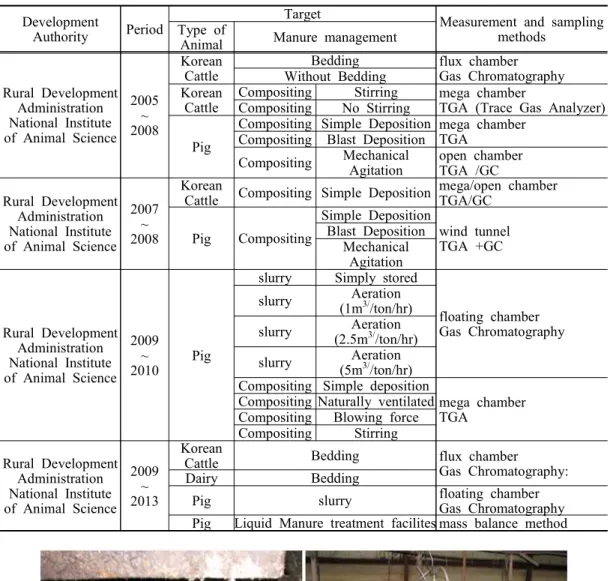
2O 배출계수 개 발 시 사용된 측정 및 샘플링 방법은 다음 Table 2와 같다. 실제로 가축이 사육되고 있는 깔짚 혹은 무깔짚 우사, 슬러리 돈사의 경우 특성상 지속적인 모니터링이 어렵기 때문에 open (flux) 챔버법을 사용하고 있다 (Fig. 10).
분뇨의 퇴비화, 액비화 등 분뇨를 저장하여
Table 2. Measurement and sampling methods for greenhouse gas emission factor for animal waste handling facilities or site
Development
Authority Period
Target
Measurement and sampling methods
Type of
Animal Manure management
Rural Development Administration National Institute of Animal Science
2005
~ 2008
Korean Cattle
Bedding flux chamber Gas Chromatography Without Bedding
Korean Cattle
Compositing Stirring mega chamber
TGA (Trace Gas Analyzer) Compositing No Stirring
Pig
Compositing Simple Deposition mega chamber Compositing Blast Deposition TGA
Compositing Mechanical Agitation
open chamber TGA /GC Rural Development
Administration National Institute of Animal Science
2007
~ 2008
Korean
Cattle Compositing Simple Deposition mega/open chamber TGA/GC
Pig Compositing
Simple Deposition
wind tunnel TGA +GC Blast Deposition
Mechanical Agitation
Rural Development Administration National Institute of Animal Science
2009
~ 2010
Pig
slurry Simply stored
floating chamber Gas Chromatography slurry Aeration
(1m
3//ton/hr) slurry Aeration
(2.5m
3//ton/hr) slurry Aeration
(5m
3//ton/hr) Compositing Simple deposition
mega chamber TGA
Compositing Naturally ventilated Compositing Blowing force Compositing Stirring Rural Development
Administration National Institute of Animal Science
2009
~ 2013
Korean
Cattle Bedding flux chamber
Gas Chromatography:
Dairy Bedding
Pig slurry floating chamber Gas Chromatography Pig Liquid Manure treatment facilites mass balance method
(National Institute of Animal Science, 2010) Fig. 10. Measurements of greenhouse gases using a floating chamber for slurry type pig
housing.
(National Institute of Animal Science, 2010) Fig. 11. Measurement of greenhouse gases using mass balance method for manure
treatment facilities.
처리하는 시설의 경우 소형 open (flux) 챔버 보다는 open 챔버의 일종이지만 처리 시설 전체에서 배출되는 온실가스의 측정이 가능 한 mega 챔버 (윈드돔, 윈드터널)를 이용하고 있으나, 분뇨 처리시설의 면적이 큰 경우 챔 버를 이용한 측정법에는 어려움이 많아, 최 근에는 미기상학적 방법인 mass balance 법을 이용한 측정법을 시험 연구 중에 있다 (국립 축산과학원, 2010) (Fig. 11).
(3) 국내 온실가스 분석 방법
국내 온실가스의 분석 방법으로는 tedlar bag 등 가스 포집백이나 실린지 등에 채취한 시료의 경우 Gas Chromatography를 이용하고 있으며, mega chamber 등을 이용하여 채취되 는 시료의 경우에는 실시간 분석이 이루어져 야하기 때문에 국외 사례에서와 마찬가지로 TGA를 이용하여 분석하고 있다(최동윤 외, 2010).
2. 국내 국가 온실가스 배출계수 개발 현황
축산분야의 국내 온실가스 관련 연구는 2000년 대 초반부터 본격적으로 시작되었으
나, 국가 보고서 작성 및 배출계수 개발을 위한 연구는 2009년부터 국립축산과학원에서 수행중인 ‘축산부문 온실가스 배출계수 및 배출량 평가’ 연구이다. 이전의 연구들은 배 출량 산정에 중점을 두거나 배출량 및 배출 계수 측정 방법론 설정을 위한 기초 연구로, 현재 국가 보고서에 적용되고 있는 배출계수 는 없다. 그러나 축산분야의 온실가스 배출 계수 개발을 위한 기초 연구로서의 의미가 크므로 본 연구의 내용에 수록 하였으며, 2009년부터 시행중인 ‘축산부문 온실가스 배 출계수 및 배출량 평가’ 연구의 연구 결과는 과제 종료 이전이라 비공개이므로 결과는 수 록하지 않았다. 또한, 2002년 수행된 ‘기후변 화 협약에 따른 축산 부문 국가 보고서’에서 는 IPCC 배출계수 산정방법론에 따라 적용 가능한 국내의 통계자료를 이용하여 Tier 2 수준의 배출계수를 산정하였는데, 산정된 배 출계수는 한국환경공단의 2010년 ‘지자체 온 실가스 배출량 산정 지침’에서 2010년부터 배출계수로 적용되고 있다 (Table 3).
(1) 장내 발효시 발생되는 CH
4의 배출계수
개발현황
Table 3. Researches on livestock greenhouse gas emissions and emission factors Publi-
cation type
Agency /Journal Title Executed
year
Report National Institute of Animal Science
Reports on Convention on National Climate Change in
Accordance with Livestock Sector 2002
Paper
Journal of Animal Science and
Technology
Study by the National on Livestock Methane Emissions
from Entric Fermentation, 45(6):997-1006 2003
Report National Institute of Animal Science
Calculation of Emission Factor for Greenhouse Gas and Development of Reduction Strategy for Ruminant Livestock Enteric Fermentation
2008~
2011
Paper
Journal of Animal Science and
Technology
Comparison of Methane Production in Korean Native Cattle (Hanwoo) Fed Different Grain Sources 2011
Report National Institute of Animal Science
Quantifying Greenhouse Gas Emissions and Developing Emission Factors in Livestock agriculture sector
2009~
2013
Report National Institute of Animal Science
Investigation on Emissions of Greenhouse Gases from the Storage Period Liquid Manure 2003
Report National Institute of Animal Science
Investigation on GHG Emissions from Stored Manure
and Litter 2004
Report National Institute of Animal Science
Investigation on Greenhouse Gas Emissions from Animal Waste Processing and Compositing
2005~
2008
Report National Institute of Animal Science
Studies on Greenhouse Gas Emissions Reductions from Animal Waste Processing
2009~
2010
Report National Institute of Animal Science
Quantifying Greenhouse Gas Emissions and Developing Emission Factors in Livestock agriculture sector
2009~
2013
Report National Institute of Animal Science
Investigation on Greenhouse Gas Emissions from Animal Waste
2007~
2008 국내에서는 반추 동물에 의한 CH
4배출량
을 저감하기 위해 사료의 개선 등에 대한 연 구는 이전부터 이루어지고 있었으나, 배출계 수를 개발하기 위한 연구는 시작 단계이다.
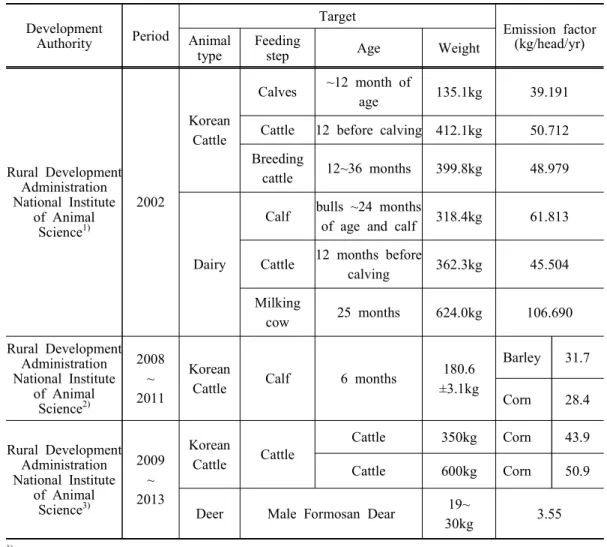
Table 4는 가축의 장내 발효에 의해 발생되 는 CH
4의 배출계수 개발 연구 현황이며, 각 연구에 대한 상세 내용을 요약하였다.
Table 5는 국내에서 개발된 CH
4배출계수
Table 4. Developments for CH
4emission factors generated from enteric fermentation
Development
Authority Period
Target
Emission factor (kg/head/yr) Animal
type
Feeding
step Age Weight
Rural Development Administration National Institute
of Animal Science
1)2002
Korean Cattle
Calves ~12 month of
age 135.1kg 39.191 Cattle 12 before calving 412.1kg 50.712 Breeding
cattle 12~36 months 399.8kg 48.979
Dairy
Calf bulls ~24 months
of age and calf 318.4kg 61.813 Cattle 12 months before
calving 362.3kg 45.504 Milking
cow 25 months 624.0kg 106.690 Rural Development
Administration National Institute
of Animal Science
2)2008
~ 2011
Korean
Cattle Calf 6 months 180.6
±3.1kg
Barley 31.7 Corn 28.4
Rural Development Administration National Institute
of Animal Science
3)2009
~ 2013
Korean
Cattle Cattle
Cattle 350kg Corn 43.9 Cattle 600kg Corn 50.9
Deer Male Formosan Dear 19~
30kg 3.55
1)Reports on Convention on National Climate Change in Accordance with Livestock Sector (National Institute of Animal Science, 2002)
2)Calculation of Emission Factor for Greenhouse Gas and Development of Reduction Strategy for Ruminant Livestock Enteric Fermentation (National Institute of Animal Science, 2008-2011)
3)Quantifying Greenhouse Gas Emissions and Developing Emission Factors in Livestock agriculture sector (National Institute of Animal Science, 2009-2013).
와 IPCC 가이드라인 및 미국, 일본, 뉴질랜 드의 NIR의 배출계수를 비교한 표이다. 장내 발효에 의한 CH
4의 배출은 같은 축종이어도 월령, 사육 환경, 사료 등에 의하여 다르기 때문에, 각 지역별로 제시하는 배출계수에 차이가 있다.
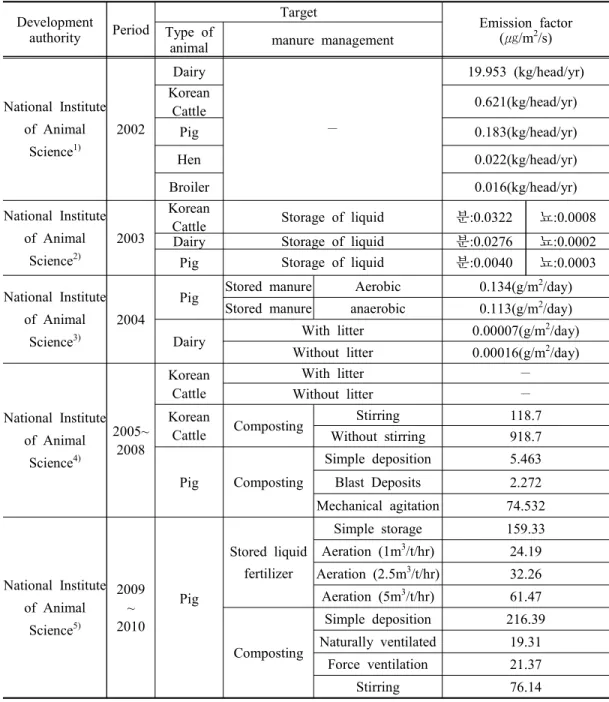
(2) 가축 분뇨 처리 시 발생하는 CH
4의 배 출계수 개발현황
국내에서는 가축분뇨 처리 시 발생하는
CH
4의 배출량 산정 또는 저감 기술 관련한
연구는 이전부터 있었으나, 가축 분뇨 처리
방법별 온실가스의 배출계수에 관한 본격적
인 연구는 현재 진행되고 있는 ‘축산 부문
온실가스 배출계수 개발 및 배출량 평가’가
유일하다. 따라서 기존의 연구는 배출계수
개발 관련 연구의 의미보다는 배출량 산정으
로서의 의미가 더 크나, 향후 연구를 위한
Table 5. Comparison of emission factor of CH
4caused by enteric fermentation
(unit : kg CH
4/head/yr)
Type of animal Domestic IPCC 1996 G/L
IPCC 2006 G/L
USA NIR 2011
Japan NIR 2011
New Zealand NIR 2011
Korean Cattle
Calf(~12months of
age). 39.191
44 47
60 53.8
56.2 Calf(~6months of age
fed on barley). 31.7
- 36.2
Calf(~6months of age
fed onmaize). 28.4
Cattle 50.712 43
51.9(F) 68.5(M) Cattle (Cattle early
period/ corn) 43.9
69 Cattle (Cattle late
period/ corn) 50.9
Breeding cattle 48.979 94 57
Dairy
Calf 61.813
56 61
46 38.8
76.9
Cattle 45.504 70 68.0
Milking cattle 106.690 140 132.1
Deer Male Farmosan 3.55 20 20 - - 22.3
기초 자료로 활용하고자 조사하였다. 국립축 산과학원 2002년 연구는 실측에 의한 배출계 수 산정이 아닌 IPCC 가이드라인의 Tier 2 배출계수 산정식에 따라 국내 통계자료 등에 서 이용 가능한 변수를 배출계수 산정식에 대입하여 계산한 결과 값으로, ‘2010년 지자 체 온실가스 배출량 산정 지침 (한국환경공 단, 2010)’에서 사용하고 있다. 국립축산과학 원에서 2009년부터 시작하여 현재 연구 진행 중인 과제의 연구 결과는 과제 종료 전이므 로 분석하지 않았다 (Table 6).
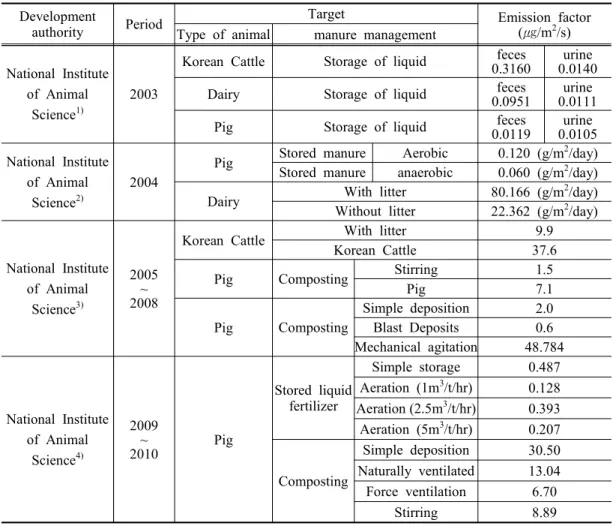
(3) 가축 분뇨 처리 시 발생하는 N
2O의 배 출계수 개발현황
국내에서 가축분뇨 처리 시 발생하는 N
2O
의 배출계수에 대한 연구는 거의 없는 실정
이다. 가축분뇨 처리방법별 N
2O의 배출계수
에 관한 본격적인 연구는 2009년부터 국립축
산과학원과 일부 대학을 중심으로 진행되고
있다. 따라서 기존의 배출계수 관련 연구는
CH
4배출계수와 마찬가지로 배출계수 개발
관련 연구의 의미보다는 배출량 산정으로서
의 의미가 더 크다고 할 수 있다 (Table 7).
Table 6. Developments of CH
4emission factor generated from maunre management systems Development
authority Period
Target
Emission factor ( ㎍/m
2/s) Type of
animal manure management
National Institute of Animal
Science
1)2002
Dairy
-
19.953 (kg/head/yr) Korean
Cattle 0.621(kg/head/yr)
Pig 0.183(kg/head/yr)
Hen 0.022(kg/head/yr)
Broiler 0.016(kg/head/yr)
National Institute of Animal
Science
2)2003
Korean
Cattle Storage of liquid 분:0.0322 뇨:0.0008 Dairy Storage of liquid 분:0.0276 뇨:0.0002 Pig Storage of liquid 분:0.0040 뇨:0.0003 National Institute
of Animal Science
3)2004
Pig Stored manure Aerobic 0.134(g/m
2/day) Stored manure anaerobic 0.113(g/m
2/day) Dairy With litter 0.00007(g/m
2/day)
Without litter 0.00016(g/m
2/day)
National Institute of Animal
Science
4)2005~
2008
Korean Cattle
With litter -
Without litter -
Korean
Cattle Composting Stirring 118.7 Without stirring 918.7
Pig Composting
Simple deposition 5.463 Blast Deposits 2.272 Mechanical agitation 74.532
National Institute of Animal
Science
5)2009
~ 2010
Pig
Stored liquid fertilizer
Simple storage 159.33 Aeration (1m
3/t/hr) 24.19 Aeration (2.5m
3/t/hr) 32.26 Aeration (5m
3/t/hr) 61.47
Composting
Simple deposition 216.39 Naturally ventilated 19.31
Force ventilation 21.37
Stirring 76.14
1)Reports on Convention on National Climate Change in Accordance with Livestock Sector (National Institute of Animal Science, 2002)
2)Investigation on Emissions of Greenhouse Gases from the Storage Period Liquid Manure (National Institute of Animal Science, 2003)
3)Investigation on GHG Emissions from Stored Manure and Litter (National Institute of Animal Science, 2004)
4)Investigation on Greenhouse Gas Emissions from Animal Waste Processing and Compositing (National Institute of Animal Science, 2005-2008)
5)Studies on Greenhouse Gas Emissions Reductions from Animal Waste Processing (National Institute of Animal Science, 2009-2010)
Table 7. Developments of N
2O emission factor generated from maunre management systems Development
authority Period Target Emission factor
(㎍/m
2/s) Type of animal manure management
National Institute of Animal
Science
1)2003
Korean Cattle Storage of liquid feces 0.3160
urine 0.0140 Dairy Storage of liquid feces
0.0951
urine 0.0111 Pig Storage of liquid feces
0.0119
urine 0.0105 National Institute
of Animal Science
2)2004
Pig Stored manure Aerobic 0.120 (g/m
2/day) Stored manure anaerobic 0.060 (g/m
2/day) Dairy With litter 80.166 (g/m
2/day) Without litter 22.362 (g/m
2/day)
National Institute of Animal
Science
3)2005
~ 2008
Korean Cattle With litter 9.9
Korean Cattle 37.6
Pig Composting Stirring 1.5
Pig 7.1
Pig Composting
Simple deposition 2.0 Blast Deposits 0.6 Mechanical agitation 48.784
National Institute of Animal
Science
4)2009
~ 2010
Pig
Stored liquid fertilizer
Simple storage 0.487 Aeration (1m
3/t/hr) 0.128 Aeration (2.5m
3/t/hr) 0.393 Aeration (5m
3/t/hr) 0.207
Composting
Simple deposition 30.50 Naturally ventilated 13.04 Force ventilation 6.70
Stirring 8.89
1)Investigation on Emissions of Greenhouse Gases from the Storage Period Liquid Manure (National Institute of Animal Science, 2003)
2)Investigation on GHG Emissions from Stored Manure and Litter (National Institute of Animal Science, 2004)
3)Investigation on Greenhouse Gas Emissions from Animal Waste Processing and Compositing (National Institute of Animal Science, 2005-2008)
4)Studies on Greenhouse Gas Emissions Reductions from Animal Waste Processing (National Institute of Animal Science, 2009-2010).
결 론
배출계수에 대한 국내의 연구는 2000년대 초반부터 있었으나, 활발한 연구를 진행하지 는 못하였으며 2009년부터 현재 진행중인
‘축산 부문 배출계수 개발 및 배출량 평가’
연구에서 배출계수를 개발 중에 있다. 축산 분야의 연구는 농촌진흥청 국립 축산과학원 을 중심으로 모든 연구가 이루어지고 있으
며, 따라서 아직 인증된 온실가스 시험기관 이 없는 실정이며 연구의 특수성으로 인하여 시험 기관의 인증 및 지정은 어려울 것으로 보인다.
배출계수의 측정 방법으로는 국제적으로
인증된 방법은 아직 없으며, 선행 연구사례
혹은 국외의 연구 동향에 맞추어 측정방법을
연구하며 개선하고 있는 실정이다. 국내의
경우 주로 캐나다 등에서 사용하고 있는 온
실가스 측정방법과 유사한 방법을 도입하여 배출계수를 측정하고 있으며 장내발효 부문 은 호흡가스 측정 챔버를 이용하는 것 일반 적이고, 가축 분뇨 처리시설 부문은 처리시 설 별로 다른 측정 방법을 요구하는데 일반 적으로 가장 많이 사용되는 방법은 농업 및 폐기물분야에서 많이 사용하는 플럭스 챔버 법이며, 최근에는 미기상학적 방법을 도입하 여 가축분뇨 저장시설에서의 온실가스 측정 방법에 대한 연구가 진행 중이다. IPCC에서 권장하는 시계열적 연속 측정이 되기 위해서 는 미기상학적 방법에 대한 지속적으로 진행 되어야 할 것이다.
사 사
본 연구는 농촌진흥청 국책기술 개발사업 연구비 지원으로 수행되었으며 이에 감사 드 립니다.
인 용 문 헌