상추 및 오이 시설재배 토양의 미생물 다양성 분석
김병용·원항연·박인철·이상엽·김완규·송재경*
국립농업과학원 농업미생물팀
Microbial Diversity and Community Analysis in Lettuce or Cucumber Cultivated Greenhouse Soil in Korea
Byung-Yong Kim, Hang-Yeon Weon, In-Cheol Park, Sang Yeob Lee, Wan-Gyu Kim, and Jaekyeong Song*
Agricultural Microbiology Team, National Academy of Agricultural Science, Rural Development Administration, Suwon, 441-707, Republic of Korea
The soil chemical properties, microbial community structures and biochemical properties of lettuce or cucumber-cultivated greenhouse soil samples were analyzed to assess soil health and characterize microbial distribution in 8 locations in Korea. Although most of chemical properties were within the soil management guidelines, the available phosphate, and the contents of exchangeable potassium and calcium were higher than those of recommended levels. In the culture-dependent analysis, 841 bacterial strains were isolated from the greenhouse soils and were identified at the genus level by 16S rRNA gene sequences analysis. The dominant bacterial genera were Bacillus (35.7%), Microbacterium (9.3%), Arthrobacter (5.7%) and Lysobacter (5.1%).
The abundance of pseudomonads was highly variable depending on the soil samples. In the culture-independent analysis, soil microbial community was investigated by using phospholipid fatty acid (PLFA) method. Principal component analysis (PCA) showed that a specific grouping for microbial community structure in the greenhouse soils was not observed based on cultivated crops and investigated sites. The results revealed that the greenhouses soils examined are relatively sound managed in terms of soil chemical contents and microbial properties.
Key words: Microbial diversity, Community structure, Lettuce, Cucumber, Greenhouse soil
접수 : 2011. 11. 20 수리 : 2011. 12. 2
*연락저자 : Phone: +82312900484 E-mail: [email protected]
서 언
국민소득의 증가로 고품질 신선채소류의 소비가 지속적 으로 증가하고 있으며, 이에 따라 시설채소재배의 면적도 증가하고 있다. 또한, 국민들의 식생활에 대한 많은 관심으 로 안전한 친환경 농산물에 대한 요구와 소비도 급격히 높 아지고 있다. 이것은 작물의 생산성 향상과 더불어 농식품 의 안전성을 동시에 추구하기 위한 농업적 기반 연구가 필 요하다는 것을 시사한다 (Kwak et al., 2003). 시설재배는 외부의 자연환경과 차단된 상태에서 토지이용율을 높이기 위해 연중 집약적으로 작물을 재배하기 때문에 노지재배에 비하여 물질순환이 제한적이며, 연작장애가 발생하는 부작 용이 있다 (Cho et al., 2006). 특히 질소, 인산, 칼륨 등의 비료 성분이 과다하게 집적되는 염류축적장애의 개선을 위
해서는 시설재배 토양과 물질순환을 담당하는 토양 내 미생 물의 관계를 검토할 필요가 있다 (Suh et al., 1998). 시설재 배토양의 여러 장애들을 극복하고 환경친화적인 재배환경 을 유지하기 위해서는 미생물의 다양성을 이해하고, 생태계 의 개선을 도모하는 일련의 연구활동을 수행해야 한다 (Lee and Ha, 2011).
본 연구는 국내 시설재배지 토양의 미생물의 분포 특성 을 밝히고 건전성을 평가하고자 수행되었다. 이를 위해 대 표적인 시설재배 작물인 상추와 오이의 대규모 재배지역에 서 토양시료를 채취하여 토양화학성을 포함한 토양의 생화 학적 특성, 미생물 분포, 배양 및 비배양법에 의한 군집구조 를 분석하였다.
재료 및 방법
시료채취 전국 주요 시설재배단지 중에서 상추재배지 역은 대전, 완주, 여주, 양평을 선정하였으며, 오이재배지
역은 공주, 순천, 용인, 상주를 선정하여 각 지역별 5농가를 대상으로 총 40점의 토양 및 식물체를 채취하였다. 토양시 료는 수확기 시설재배지의 표토를 0-15 cm 깊이로 채취하 였다. 채취한 시료를 그늘에서 풍건하여 2 mm체로 통과시 킨 후 토양화학분석에 이용하였으며, 미생물 계수에 이용한 시료는 습토를 곧바로 분석에 사용하였다.
토양시료 화학특성분석 준비된 토양 시료는 농촌진 흥청 국립농업과학원의 토양 및 식물체 분석법 (NIAST, 2000) 에 준하여 분석을 실시하였다. pH는 토양과 증류수의 비율 을 1:5로 희석하여 pH meter로 측정하였고, 전기전도도 (EC)의 측정값은 희석 현탁액의 비전도도를 EC meter로 측 정하여 25℃에 대한 값으로 환산하여 표시하였다. 유기물은 Tyurin법으로, 유효인산은 Lancaster법으로 측정하였다. 치 환성 칼륨, 칼슘, 마그네슘 등의 양이온은 1M Ammonium acetate (pH 7.0)로 추출하여 ICP기기 (Inductively Coupled Plasma, Labtam-8440)로 측정하였고, 무기태 질소 함량 은 2M KCl로 추출하여 자동분석기 (Auto analyzer, RFA, Germany)를 사용하여 측정하였다.
미생물 분리 및 배양 박테리아의 계수 및 분리를 위 하여 희석현탁액 (10-1∼10-6)을 만든 후 0.1 ml을 선택배 지에 도말하였다. 전체 박테리아의 배양을 위해 선택배지 로 TSA (trypticase soy agar; BBL)를 이용하였다. 형광성 Pseudomonas 속 (genus) 균주의 선택적 배양을 위해 P-1 agar 배지 (KH2PO4 1 g, MgSO4・7H2O 0.5 g, KCl 0.2 g, NaNO3 5 g, sodium deoxycholate 1 g, betaine 5 g, agar 15 g, distilled water 1 L, pH 7.2~7.4)에 도말하여 3~5일 간 배양한 후 365 nm의 자외선 램프를 조사하여 형광을 발 하는 콜로니만 계수하였다. 토양 내 곰팡이의 분리 및 배양 을 위해 선택배지로 Rose bengal agar 배지 (KH2PO4 1 g, MgSO4・7H2O 0.5 g, peptone 5 g, glucose 10 g, rose Bengal 0.033 g, streptomycin sulfate 0.033 g, agar 20 g, distilled water 1 L)에 시료 현탁액을 도말하여, 각각 3일과 5일에 생 육 콜로니를 계수하였다. 모든 선택배지들은 30℃ 항온기에 서 배양하였으며, 각 시료별로 3개의 평판배지상에 나타난 콜로니를 각각 계수한 후 평균한 값을 콜로니 형성수 (colony forming unit, cfu)로 표시하였다.
분리된 박테리아의 분류 및 동정 분리된 박테리아의 동정을 위해서 16S rRNA 유전자의 부분 염기서열을 Song et al. (2001)의 방법에 따라 분석하였다. 반복 계대 배양을 통해서 얻은 순수 분리 균주들의 genomic DNA를 상업용 추 출키트 (Toyobo, Japan)를 사용해 추출하였다. 16S rRNA 유전자 증폭실험에서 일반적으로 사용되는 primer인 fD1
(forward primer; 5′-AGAGTTTGATCCTGGCTCAG-3′)과 rP2 (reverse primer; 5′-ACGGCTACCTTGTTACGACTT-3′)를 이 용하여 16S rRNA 유전자를 PCR 반응을 통해 증폭하였다.
증폭된 PCR 산물은 시퀀싱 primer인 510R primer (5′- TATTACCGCGGCTGCTGGCA-3′)를 이용하여 유전자 분석기 3100 Genetic Analyser (Applied Biosystems, USA)로 분석 하였다. 얻어진 염기서열은 NCBI server의 BLAST 프로그 램을 통해 속 (genus) 수준까지 부분 동정하였다.
토양 효소활성도 측정 토양 내 생존 미생물의 주요 지 표로서 탈수소효소 (dehydrogenase)의 활성을 측정하였다.
Casida (1977)의 방법에 준하여 기질로서 2,3,5-triphenyl tetrazolium chloride (TTC)와 반응 후 생성된 triphenyl formazan (TPF)의 양을 정량하였다. 토양 시료 2.5 g과 1%
TTC-Tris-HCl buffer (pH7.6) 2.5 mL을 시험관 (150 X 18 mm)에 넣고, 24시간 동안 암상태의 37℃에서 반응시켰다.
각 토양시료의 활성도측정을 3회 반복하였고, TTC를 첨가 하지 않은 토양을 대조군으로 삼았다. 반응 후반기에 25 mL 메탄올을 넣어 1분 동안 vortexing 한 후 혼합액을 여과하 였다. 여과액을 흡광광도계를 사용해 485 nm에서 측정하였 다. 효소 활성도는 표준곡선과의 비교를 통해 24시간 후 생 성된 TPF 량 (µg)으로 표시하였다.
토양시료에서 인지질지방산 (PLFA)의 추출 인지질 지 방산 (phospholipid fatty acid, PLFA) 추출은 Brant et al.
(2006)의 방법에 따라 Bligh-Dyer 추출법 (Bligh and Dyer, 1959; Bossio et al., 1998)을 변형하여 수행하였다. 즉, 시 료 건조토양 (6 g)에서 세포막 지방산을 추출하여 silicic acid column chromatography을 사용하여 PLFA 만을 선택적으 로 분획하였다.
PLFA의 정량분석 분획된 PLFA는 Zelles et al. (1995) 의 방법에 따라 methylation 시킨 후 fatty acid methyl esters 형태로 치환하였다. 치환된 지방산은 flame ioninnzation detector (FID)가 장착된 GC (HP 6890A, USA)에서 분석하 였으며, MIDI system (Sherlock Microbial Identification System, USA)으로 동정 및 정량하였다.
통계분석 정량된 시료의 군집구조 분석을 위한 통계분 석은 SAS 프로그램 (SAS Institute, USA)의 주성분 분석 (Principal component analysis, PCA)을 이용하였다. 토양 미생물 총량과 미생물 군집은 5% 수준에서 LSD 검정을 하 였고, 각각의 미생물 군집은 총 지방산 함량의 상대비율로 변경하여 주성분 분석에 사용하였다.
Table 1. Chemical properties of greenhouse soil samples collected from lettuce or cucumber cultivated sites in Korea.
Crop Site pH EC OM Avail. P2O5
Exch. Cation
K Ca Mg
(1:5) dS m-1 g kg-1 mg kg-1 --- cmolc kg-1 ---
Lettuce
Daejeon 5.9 0.6 16.9 1,719 0.6 6.9 1.5 Yangpyeong 7.1 1.0 21.2 1,494 1.2 13.6 3.2 Yeoju 6.7 1.4 14.1 1,012 2.4 9.4 2.8 Wanju 6.4 1.2 15.9 1,516 1.7 9.5 2.4 Average 6.5 ± 1.2 1.1 ± 0.8 17.0 ± 11.1 1,439 ± 280 1.5 ± 0.9 9.8 ± 3.8 2.5 ± 0.7
Cucumber
Gongju 6.0 0.9 16.3 1,344 1.4 8.2 2.3 Sangju 6.9 1.0 17.3 1,626 1.5 8.9 2.7 Suncheon 6.9 1.3 20.9 1,311 1.8 12.3 3.3 Yongin 6.4 0.6 12.5 1,252 1.0 6.0 1.6 Average 6.6 ± 0.3 0.9 ± 0.4 16.8 ± 4.3 1,395 ± 231 1.4 ± 0.4 8.8 ± 3.5 2.5 ± 0.9
Table 2. Abundance of microorganisms in the greenhouse soil with cultivation of lettuce or cucumber in Korea.
Crop Site Bacteria Fungi Pseudomonads pH
Lettuce
×107 cfu g-1 ×10⁵ cfu g-1 ×10⁶ cfu g-1 (1:5)
Daejeon 4.5 8.0 2.0 5.9
Yangpyeong 7.7 6.4 4.5 7.1
Yeoju 9.0 7.0 1.7 6.7
Wanju 3.3 5.4 1.1 6.4
Average 6.0 6.6 2.3 6.5 ± 1.2
Cucumber
Gongju 8.5 10.0 1.2 6.0
Sangju 8.5 5.9 2.7 6.9
Suncheon 8.2 9.8 2.8 6.9
Yongin 6.4 5.3 1.4 6.4
Average 7.9 7.8 2.0 6.6 ± 0.3
결과 및 고찰
토양의 화학성 전국 40개 지역에서 채취한 시설재배 지 토양화학성의 분석결과는 Table 1과 같다. 유기물함량 (OM)은 12.5-21.2 g kg-1의 범위로 적정함량 (20-30 g kg-1) 에 근접하거나 조금 적은 양으로 측정되었다. 토양시료의 pH 는 6.5 (± 0.6)으로 약산성이었고, 전기전도도 (EC)는 0.6- 1.4 dS m-1로 양호한 상태였다. 그러나 대부분의 토양 시료 에서 유효인산과 칼륨 및 칼슘은 적정 범위를 초과하여 토 양에서의 양분 과잉집적을 확인할 수 있었다. 특히, 대전의 상추재배지와 상주의 오이재배지는 유효인산의 적정범위 (350-500 mg kg-1)의 세 배를 초과하는 매우 높은 수치였 다. 재배 작물별 토양 화학성의 측정값은 대체적으로 큰 차 이 없이 비슷한 경향이었다.
미생물밀도 및 분리 배양 작물 및 지역별 미생물밀도 비교를 위해서 박테리아, 곰팡이, 형광성 Pseudomonas 속을
각각의 토양시료에서 선택적으로 배양, 분리하였다 (Table 2).
대부분의 오이재배지는 상추재배지보다 박테리아와 곰팡이 모두 높은 밀도를 보였다. 그러나, 형광성 Pseudomonas 속 의 경우는 평균적으로 상추재배지에서 높았다. 환경변화에 민감하게 반응하는 형광성 Pseuodomonas 속은 토양의 건 전성 지표로서 종종 사용되는데, 양평 상추재배지에서 가장 높게 나타났고, 다른 지역에서는 대체로 비슷하였다. 토양 pH가 상대적으로 낮은 대전 상추재배지 (pH 5.9)와 공주 오 이재배지 (pH 6.0)에서는 다른 재배지와 달리 곰팡이의 밀 도가 높은 것으로 나타났다. 미생물의 분포는 토양내 pH와 도 밀접한 연관이 있는 것으로 알려져 있다 (Aciego Pietri and Brookes, 2008; Fernández‐Calviño and Bååth, 2006;
Lauber et al., 2009; Rousk et al., 2010). 본 연구의 결과 는 이전의 연구결과들에서도 설명된 것처럼 박테리아의 경 우는 pH의 영향이 큰 반면 곰팡이는 상대적으로 영향을 덜 받아, 산성토양에서 곰팡이의 밀도가 높은 것으로 판단된다 (Bååth, 1996; Fernández-Calviño et al., 2011).
Table 3. Isolation frequency of bacterial genera from the greenhouse soils with cultivation of lettuce or cucumber.
Genus (%)
Lettuce Cucumber
Total Daejeon Yangpyeong Yeoju Wanju Subtotal Gongju Sangju Suncheon Yongin Subtotal
Agromyces 3.6 4.9 2.5 1.4 3.0 1.0 0.9 2.5 3.8 1.9 2.5
Arthrobacter 4.5 9.7 17.5 4.3 8.9 - 2.7 2.5 1.3 1.6 5.7
Bacillus 39.6 35.0 27.5 45.7 37.3 38.4 42.3 21.3 27.8 33.6 35.7
Cellulosimicrobium - - 0.8 - 0.2 1.0 0.9 2.5 - 1.1 0.6
Flavobacterium 1.8 1.9 1.7 1.4 1.7 1.0 0.9 7.5 - 2.2 1.9
Flexibacter - - 3.3 0.7 1.1 - - 1.3 3.8 1.1 1.1
Frateuria 7.2 1.0 2.5 5.1 4.0 6.1 0.9 - - 1.9 3.1
Lysobacter 1.8 8.7 - 2.9 3.2 10.1 8.1 6.3 5.1 7.6 5.1
Microbacterium 5.4 7.8 19.2 3.6 8.9 5.1 9.0 16.3 10.1 9.8 9.3
Nocardioides 3.6 - 1.7 2.9 2.1 4.0 2.7 5.0 3.8 3.8 2.9
Paenibacillus 4.5 3.9 1.7 4.3 3.6 7.1 0.9 1.3 10.1 4.6 4.0
Pedobacter 1.8 1.0 - 1.4 1.1 - - - 1.3 0.3 0.7
Pimelobacter - - 0.8 - 0.2 - - 6.3 - 1.4 0.7
Pseudomonas 2.7 - 2.5 3.6 2.3 - 2.7 1.3 1.3 1.4 1.9
Pseudoxanthomonas - 1.9 - 1.4 0.8 1.0 0.9 3.8 - 1.4 1.1
Rhizobium - 2.9 3.3 1.4 1.9 2.0 3.6 1.3 7.6 3.5 2.6
Rhodanobacter - 1.0 - 1.4 0.6 4.0 - - - 1.1 0.8
Rhodococcus - - 0.8 0.7 0.4 - 1.8 - 1.3 0.8 0.6
Sinorhizobium 0.9 1.9 0.8 0.7 1.1 1.0 1.8 - - 0.8 1.0
Sphingomonas - 1.0 - 0.7 0.4 6.1 - 1.3 1.3 2.2 1.2
Sphingopyxis - 4.9 - 0.7 1.3 2.0 - 1.3 3.8 1.6 1.4
Stenotrophomonas - - - - - 1.0 6.3 - - 2.2 1.0
Swingsiella 2.7 - 0.8 - 0.8 1.0 - - 1.3 0.5 0.7
Tetrasphaera 4.5 1.0 4.2 2.9 3.2 - - - 2.5 0.5 2.0
Thermomonas - - 0.8 0.7 0.4 - 2.7 - 1.3 1.1 0.7
Xanthomonas - 1.0 - - 0.2 - 0.9 2.5 2.5 1.4 0.7
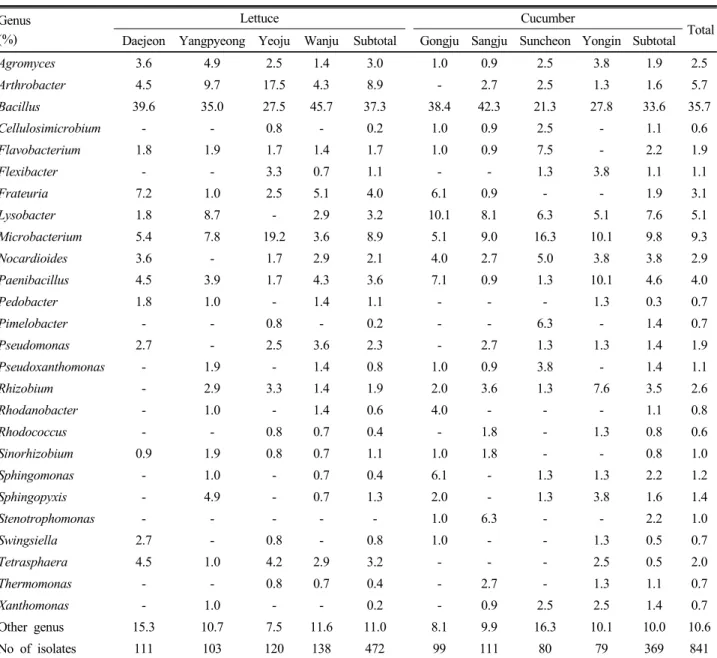
Other genus 15.3 10.7 7.5 11.6 11.0 8.1 9.9 16.3 10.1 10.0 10.6 No of isolates 111 103 120 138 472 99 111 80 79 369 841
분리 박테리아의 동정 Table 3은 지역 및 작물별 시 설재배지 토양에서 분리한 박테리아의 동정결과이다. 상추 재배지 (472균주)와 오이재배지 (369균주)에서 총 841균주 가 분리되었고, 이들 균주들은 85개의 속 (genus)으로 동정 되었다. 모든 조사지역에서 Bacillus 속이 가장 많이 분리되 었고, 각 시료에서 21.3~45.7%를 점유하여 평균 35.7%를 차 지하였다. 그 외에 5% 이상의 우점 분리군은 Microbacterium (9.3%), Arthrobacter (5.3%), Lysobacter 속 (5.1%) 등이었 다. Bacillus 속은 내생포자를 형성하여 고온, 건조 등 불리 한 환경조건에서도 생존할 수 있기 때문에 시설 재배지를 포함한 대부분의 농경지에서 우점하고 있는 것으로 보고 되어 있다 (Garbeva et al., 2003; McSpadden Gardener, 2004). 특히 시설재배지는 각종 시용자재가 투여되고 집약 적으로 재배되는 특성 때문에 다른 박테리아군에 비해 상대 적으로 우점할 수 있는 환경인 것으로 판단된다.
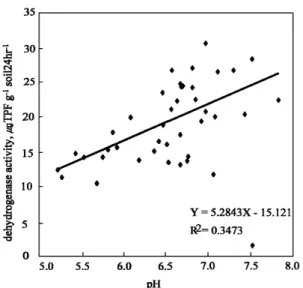
토양 효소 활성도 시설재배지중 재배작물별 탈수소효 소 (dehydrogenase) 활성은 상추재배지 (평균 19.7 ㎍ TPF g-1 soil 24 hr-1)가 오이재배지 (평균 18.8 ㎍ TPF g-1 soil 24 hr-1)보다 높았다 (Table 4). 지역별로는 양평과 상주지 역에서 높은 경향을 보였다. 토양의 화학성과 토양생물학적 특성과는 다양한 상관관계가 존재한다. 탈수소효소와 토양 의 pH와의 관계를 회귀분석한 결과, 결정계수 (R2=0.35)가 높지는 않았지만, 정의 상관관계를 보였다 (Fig. 1). 이는 토 양의 pH가 토양내 효소의 활성에 영향을 주었기 때문이라 고 판단된다.
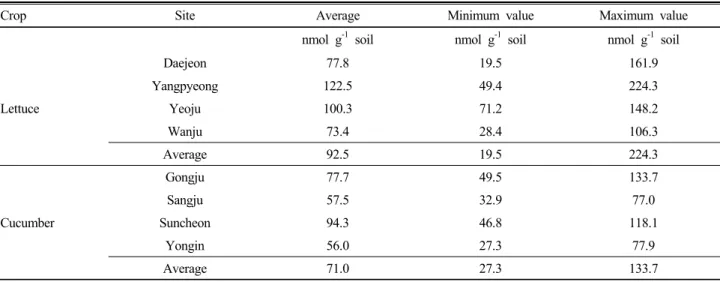
토양 내 PLFA 함량 및 군집구조분석 토양 내 서식미 생물에서 추출된 인지질지방산 (PLFA)은 19.5-224.3 nmol g-1 soil의 범위로 큰 편차를 보였으며, 상추재배지가 오이재 배지보다 평균값이 높게 나왔지만, 두 그룹간의 유의성 있
Table 4. Activity of dehyrogenase in the greenhouse soils with cultivation of lettuce or cucumber at each sampling site in Korea.
Crops Site Average Minimum value Maximum value
㎍ TPF g-1 soil ㎍ TPF g-1 soil ㎍ TPF g-1 soil
Lettuce
Daejeon 15.7 10.4 19.9
Yangpyeong 25.4 21.1 30.6
Yeoju 21.1 15.7 26.5
Wanju 17.2 12.4 26.7
Average 19.7 10.4 30.6
Cucumber
Gongju 15.2 11.3 24.3
Sangju 23.7 20.8 27.0
Suncheon 18.2 13.2 26.7
Yongin 18.2 15.0 25.4
Average 18.8 11.3 27.0
Table 5. Concentration of phospholipid fatty acids (PLFAs) extracted from each sampling site.
Crop Site Average Minimum value Maximum value nmol g-1 soil nmol g-1 soil nmol g-1 soil
Lettuce
Daejeon 77.8 19.5 161.9
Yangpyeong 122.5 49.4 224.3
Yeoju 100.3 71.2 148.2
Wanju 73.4 28.4 106.3
Average 92.5 19.5 224.3
Cucumber
Gongju 77.7 49.5 133.7
Sangju 57.5 32.9 77.0
Suncheon 94.3 46.8 118.1
Yongin 56.0 27.3 77.9
Average 71.0 27.3 133.7
는 차이는 관찰되지 않았다. 지역별 평균은 용인의 오이재 배지가 (56.0 nmol g-1 soil) 가장 낮았으며 양평의 상추재 배지가 (122.5 nmol g-1 soil) 가장 높았다. 대전의 상추재배 지처럼 다른 지역에서도 동일 지역 내의 서로 다른 시료에 서 큰 변이가 관찰되었다.
토양 내 PLFA함량과 유기물함량과의 상관관계를 분석한 결과, 정의 상관관계를 확인하였다 (Fig. 2). 이것은 퇴비 등 의 유기물 투여가 토양에 존재하는 미생물에게 영양원으로 공급되어 토양내의 미생물 Biomass 함량의 증가요인으로 작용한 것으로 판단된다. 이전 연구에서도 토양내의 미생물 함량과 유기물 함량 간에는 밀접한 관련이 있는 것으로 알 려져 있으며, McGill et al. (1986)은 미생물체량의 크기가 토양에 시용된 장기간의 유기 탄소의 양에 좌우된다는 가설 을 제시한 바 있다. Fauci and Dick (1994)은 유기질소와 무 기질소의 장단기적 효과를 검토한 결과, 유기물을 시용한 경우 biomass C가 80-400% 증가되었고, 장기간 화학비료 의 시용은 유기물 함량과 생물활성을 감소시켰으나, 단기간
에는 큰 영향을 미치지 않았다고 보고하였다. 따라서, 화학 비료보다는 건전한 토양생태계를 유지하기 위해서는 적절 한 유기물의 시용이 필요하다고 판단된다.
Figure 3은 토양추출 인지질 지방산을 이용하여 주성분 분석을 한 결과로서, 작물별 혹은 지역별로 뚜렷이 구분되 지 않았다. 이는 토양화학성 측면에서 성분별 범위가 크지 않았기 때문에 미생물 군집구조에도 유사한 경향이 나타난 것으로 유추된다. 또한, 시료수가 전체 토양의 특성을 반영 하지 못하거나, 본 연구에서 활용된 기술수준에서 토양미생 물 군집이 해석되기 어려운 복잡한 관계를 형성하고 있기 때문일 것으로도 판단된다. 따라서 향후 시설재배지의 토양 미생물의 다양성을 측정하기 위해서는 최근 미생물 생태연 구에 활발하게 적용되는 pyrosequencing 방법과 같은 진보 된 연구기술을 적용함으로써, 토양생태계를 좀 더 체계적으로 이해하려는 시도가 필요하다고 볼 수 있다 (Hirsch et al., 2010; Nacke et al., 2011).
Fig. 1. The relationship between the dehydrogenase activity and soil pH.
Fig. 2. The relationship between the extracted PLFA and contents of organic matter.
Fig. 3. Score plot of a principal component analysis of microbial phospholipid fatty acids extracted from the greenhouse soils with cultivation of lettuce or cucumber in Korea.
요 약
시설재배지의 토양미생물 분포 특성을 밝히고 토양의 건 전성을 평가하고자, 전국 주요 시설재배 8개 주산단지에서 각각 5포장을 선정하여 토양화학성, 미생물분포 및 생화학 적 특성을 조사하였다. 토양화학성은 가용성인산, 칼륨, 칼슘의 함량이 적정범위보다 크게 상회하여 상당량의 염 류 집적을 확인하였다. 토양미생물의 배양적 방법을 통해 조사한 시설재배지의 주요 우점 박테리아는 Bacillus 속, Microbacterium 속, Arthrobacter 속, Lysobacter 속 등이 었으며, 형광성 Pseudomonas 속의 밀도는 상추와 오이 재배 지에서 각각 0.018-7.3×10⁴ cfu g-1, 0.0013-9.6 ×10⁴ cfu g-1으로 시료에 따라 큰 변이를 보였다. 비배양학적 방법을 통한 토양미생물 분포 조사를 위해 수행한 인지질지방산 (PLFA)의 주성분 분석 결과, 작물 및 지역별 군집구조의 큰 차이는 없었다. 따라서 토양화학성 및 미생물군집구조 측면 에서 시설재배지 조사지역의 토양은 대체로 건전한 것으로 판단된다.
사 사
본 논문은 농촌진흥청 공동연구사업 (과제번호: PJ006 88703)의 지원에 의해 이루어졌으며, 이에 감사드립니다.
인 용 문 헌
Aciego Pietri, J.C. and P.C. Brookes. 2008. Relationships between soil pH and microbial properties in a UK arable soil. Soil Biol. Biochem. 40:1856-1861.
Bååth, E. 1996. Adaptation of soil bacterial communities to prevailing pH in different soils. FEMS Microbiol. Ecol.
19:227-237.
Bligh, E.G. and W.J. Dyer. 1959. A rapid method of total lipid extraction and purification. Can. J. Biochem. Physiol.
37:911-917.
Bossio, D.A., K.M. Scow, N. Gunapala, and K.J. Graham.
1998. Determinants of soil microbial communities: effects of agricultural management, season, and soil type on phospholipid fatty acid profiles. Microb. Ecol. 36:1-12.
Brant, J.B., E.W. Sulzman, and D.D. Myrold. 2006. Microbial community utilization of added carbon substrates in response to long-term carbon input manipulation. Soil Biol. Biochem.
38:2219-2232.
Casida Jr, L.E. 1977. Microbial metabolic activity in soil as measured by dehydrogenase determinations. Appl. Environ.
Microbiol. 34:630-636.
Cho, K.R., C.S. Kang, T.J. Won, and K.Y. Park. 2006.
Effects of compressed expansion rice hull application and drip irrigation on the alleviation of salt accumulation in the plastic film house soil. Korean J. Soil Sci. Fert. 39:
372-379.
Fauci, M.F. and R.P. Dick. 1994. Soil microbial dynamics:
short-and long-term effects of inorganic and organic nitrogen.
Soil Sci. Soc. Am. J. 58:801-806.
Fernández-Calviño, D., J. Rousk, P.C. Brookes, and E.
Bååth. 2011. Bacterial pH-optima for growth track soil pH, but are higher than expected at low pH. Soil Biol. Biochem.
43:1569-1575.
Fernández‐Calviño, D. and E. Bååth. 2006. Growth response of the bacterial community to pH in soils differing in pH.
FEMS Microbiol. Ecol. 73:149-156.
Garbeva, P., J.A. Van Veen, and J.D. Van Elsas. 2003.
Predominant Bacillus spp. in agricultural soil under different management regimes detected via PCR-DGGE. Microb.
Ecol. 45:302-316.
Hirsch, P.R., T.H. Mauchline, and I.M. Clark. 2010. Culture- independent molecular techniques for soil microbial ecology.
Soil Biol. Biochem. 42:878-887.
Kwak, H.K., K.S. Seong, N.J. Lee, S.B. Lee, M.S. Han, and K.A. Roh. 2003. Changes in chemical properties and fauna of plastic film house soil by application of chemical fertilizer and composted pig manure. Korean J. Soil Sci.
Fert. 36:304-310.
Lauber, C.L., M. Hamady, R. Knight, and N. Fierer. 2009.
Pyrosequencing-based assessment of soil pH as a predictor of soil bacterial community structure at the continental scale. Appl. Environ. Microbiol. 75:5111.
Lee, Y.H. and S.K. Ha. 2011. Impacts of chemical properties on microbial population from upland soils in Gyeongnam
province. Korean J. Soil Sci. Fert. 43:572-577.
McGill, W.B., K.R. Cannon, J.A. Robertson, and F.D. Cook.
1986. Dynamics of soil microbial biomass and water-soluble organic C in Breton L after 50 years of cropping to two rotations. Can. J. Soil Sci. 66:1-19.
McSpadden Gardener, B.B. 2004. Ecology of Bacillus and Paenibacillus spp. in agricultural systems. Phytopathology 94:1252-1258.
Nacke, H., A. Thürmer, A. Wollherr, C. Will, L. Hodac, N.
Herold, et al. 2011. Pyrosequencing-based assessment of bacterial community structure along different management types in German forest and grassland soils. PLoS ONE 6:e17000.
NIAST. 2000. Method of analysis of soil and plant. National Institute of Agricultural Science and Technology, Suwon, Korea.
Rousk, J., E. Bååth, P.C. Brookes, C.L. Lauber, C. Lozupone, J.G. Caporaso, et al. 2010. Soil bacterial and fungal communities across a pH gradient in an arable soil. ISME J 4:1340-1351.
Song, J., H.Y. Weon, S.H. Yoon, D.S. Park, S.J. Go, and J.W. Suh. 2001. Phylogenetic diversity of thermophilic actinomycetes and Thermoactinomyces spp. isolated from mushroom composts in Korea based on 16S rRNA gene sequence analysis. FEMS Microbiol. Lett. 202:97-102.
Suh, J.S., B.G. Jung, and J.S. Kwon. 1998. Soil microbial diversity of the plastic film house fields in Korea. Korean J. Soil Sci. Fert. 31:197-203.
Zelles, L., Q.Y. Bai, R. Rackwitz, D. Chadwick, and F. Beese.
1995. Determination of phospholipid-and lipopolysaccharide- derived fatty acids as an estimate of microbial biomass and community structures in soils. Biol. Fertil. Soils 19:115-123.