ISSN 0367-6315 (Print) / ISSN 2288-2162 (Online) Korean J. Soil Sci. Fert. 47(6), 496-499 (2014) http://dx.doi.org/10.7745/KJSSF.2014.47.6.496
Diversity of Soil Microbial Communities Formed by Different Light Penetrations in Forests
Jun Ho Park†, Min Keun Kim1†, Byung-Jin Lee2, HyeRan Kim3, Young Han Lee1**, and Young-Son Cho2* Gyeongsangnam-do Forest Environment Research Institute, Jinju 660-871, Republic of Korea
1Division of Environment-friendly Agriculture Research, Gyeongsangnam-do Agricultural Research and Extension Service, Jinju 660-985, Republic of Korea
2Gyeongnam National University of Science and Technology, Agronomy · Medicinal Plant Resource, Jinju 660-758, Republic of Korea
3Korea Research Institute of Bioscience and Biotechnology, Daejeon 305-806, Republic of Korea
(Received: November 10 2014, Revised: November 13 2014, Accepted: November 17 2014)
The present study investigated variations in soil microbial communities and the chemical properties of forest soils by differing amounts of penetrating sunlight. The soil temperature was significantly higher in higher light-penetrated soils. Higher light-penetrated soils (LP70) showed significantly more fungal communities than the lower light-penetrated soils (LP40 and LP50) (p < 0.05). The NH4-N concentration in LP70 was significantly lower than those of LP40 and LP50, whereas the other chemical properties showed no significant difference among the soils. The cy19:0 to 18:1ω7c ratio was significantly lower in LP70 than in LP 40 and LP50 showing the negative correlation of light level with microbial stresses (p < 0.05). The soil microbial communities and the chemical properties that showed positive eigenvector coefficients for PC1 were the fungi to bacteria, fungi, arbuscular mycorrhizal fungi, and Gram-positive bacteria, whereas negative eigenvector coefficients were found for NH4-N, actinomycetes, Gram-negative bacteria, and bacteria. Consequently, the amount of penetrating light was responsible for microbial compositions in the forest soils in correlation with the concentration of NH4-N and soil temperature.
Key words: Microbial community, Light penetration, Forest soil, Fungi
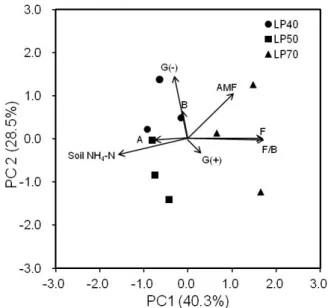
Principal component (PC) analysis of the soil microbial communities subject to the different light penetrations. LP40, light penetration 40%; LP50, light penetration 50%; LP70, light penetration 70%; A, actinomycetes; AMF, arbuscular mycorrhizal fungi; B, bacteria; F, fungi; G(+), Gram-positive bacteria; G(-), Gram-negative bacteria.
Article
1)
*Corresponding author : Phone: +82557513221, E-mail: [email protected]
**Co-Corresponding author : Phone: +82552541313, E-mail: [email protected]
§Acknowledgement: This study was conducted with the support of the Research Cooperating Program for Agricultural Science & Technology Development (Project No. PJ008801), RDA, Republic of Korea.
Jun Ho Park, Min Keun Kim, Byung-Jin Lee, HyeRan Kim, Young Han Lee, and Young-Son Cho 497
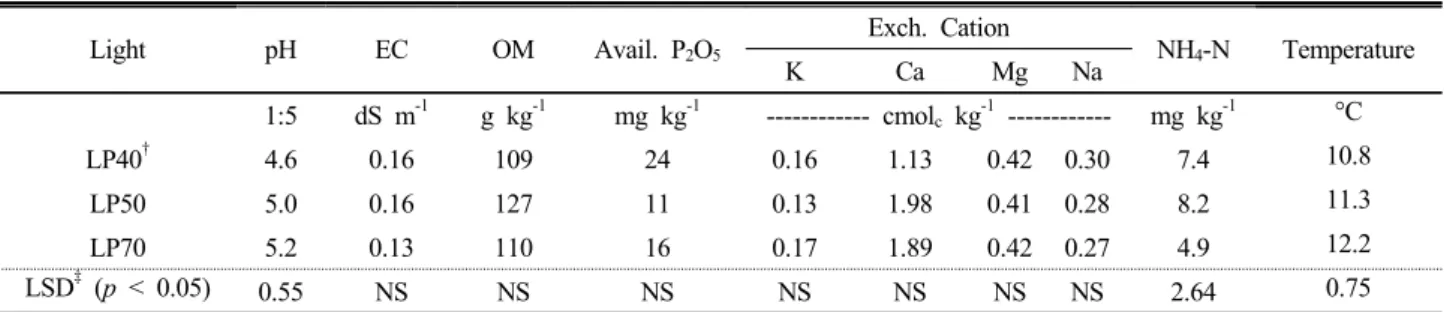
Table 1. Chemical properties of forest soils as affected by light penetration.
Light pH EC OM Avail. P2O5
Exch. Cation
NH4-N Temperature
K Ca Mg Na
1:5 dS m-1 g kg-1 mg kg-1 --- cmolc kg-1 --- mg kg-1 °C
LP40† 4.6 0.16 109 24 0.16 1.13 0.42 0.30 7.4 10.8
LP50 5.0 0.16 127 11 0.13 1.98 0.41 0.28 8.2 11.3
LP70 5.2 0.13 110 16 0.17 1.89 0.42 0.27 4.9 12.2
LSD‡ (p < 0.05) 0.55 NS NS NS NS NS NS NS 2.64 0.75
†LP40, light penetration 40%; LP50, light penetration 50%; LP70, light penetration 70%.
‡The Fisher’s least significant difference (LSD) was used to detect and separate the mean treatment differences at 5.0% levels of significance, NS not significant.
Introduction
Microbial communities in soil are a very important property for soil ecosystems in the forestry industry (Hynes and Germida 2013) since microbial diversity is an assessing indicator for soil quality and health (Mäder et al. 2002, Lee and Kim 2011, Yang et al. 2012). Soil microbial communities have been well evaluated in forest soils with long-term nitrogen fertilization (Blaško et al 2013) as well as in upland soils with different fertilization (Lee et al 2013). Light is one of the most effective environmental factors for community composition in soils (Rodriquez-Romero et al. 2010). Davies et al (2013) reported that light constructed phototrophic, bacterial, and fungal communities on soil surfaces. Although some reports showed that light had a significant effect on differentiation of soil microbial communities, the impact of penetrating light levels on forest soil microbial communities and chemical properties is less well studied.
In this study, we analyzed variations of soil microbial communities and chemical properties in forest soils sampled from regions receiving different levels of light penetrating light. These findings would provide basic information for forest soil management and forest development in Korea.
Materials and Methods
Soil sampling and chemical properties assay Soil was sampled from Mount Geumwon in Geochang County, South Gyeongsang province, Republic of Korea (35° 43' N and 127°46' E) on October 23, 2012. During the week before soil sampling, the average temperature was 8.6°C and the precipitation was 12.4 mm in this area. The experimental plot was generated from regions receiving 40%, 50% and 70% light and named LP40, LP50, and LP70 respectively. The plots (20 x 20 m) were laid out in a randomized complete block design with three replicates. The soil was classified in the Samgag series (sandy loam, Lithosols) based on the Korean taxonomy of soil classification (NIAST, 2000). These soils have thin brown sandy loam A horizons and moderately thick strong brown to
yellowish brown sandy loam cambic B horizons. The 800g soil samples (0-15 cm depth) were collected from each plot using an auger. The samples were freeze-dried and maintained in a freezer at -20°C before analysis. The soil samples were crushed to pass through a 2mm sieve.
Soil microbial community assay The assay of soil microbial communities was conducted based on the previously reported method (Lee and Kim, 2011; Lee et al 2013; Yang et al, 2012). The FAME was profiled using an Agilent 6890 GC with a flame ionization detector and the microbial types were identified based on the Sherlock Microbial Identification System (Microbial ID, Ins., Newark, DE).
Statistical analysis All data was statistically analyzed using the SAS software version 9.2 (SAS Institute, Cary, NC). The measured individual soil microbial and chemical variables were compared using a one-way analysis of variance (ANOVA). Fisher’s exact test was used at a 5.0% level of significance (p < 0.05). To determine the overall effects of the amount of penetrating light in forest soils, soil microbial communities and chemical data were analyzed by principal component analysis (PCA).
Results and Discussion
The forest soils sampled from different light-penetration regions were analyzed for their chemical properties. The soil temperature was significantly higher in higher light-penetration regions. The soil pH of LP40 was significantly lower than that of LP70 (Table 1). In general, all soils showed acidity resulted from low exchangeable Ca concentration in these forest soils.
The NH4-N concentration in LP70 was significantly lower than that of LP40 and LP50, whereas the other chemical properties of the soils showed no significant difference.
The fungal communities were significantly more prevalent in LP70 than in LP40 and LP50 (p < 0.05). The fungal communities were known to be more sensitive to environmental conditions than bacterial communities due to their high
Diversity of Soil Microbial Communities Formed by Different Light Penetrations in Forests
498
Table 2. Soil microbial communities in the forest soils expressed as % total fatty acid methyl esters subject to the different light penetrations.
Light B† G(-) G(+) A F AMF G(-)/G(+) F/B
LP40‡ 32.7 18.7 11.9 3.5 11.3 3.0 1.58 0.35
LP50 33.0 18.2 12.7 3.2 11.6 1.9 1.43 0.35
LP70 32.8 18.3 12.5 3.1 16.7 3.1 1.47 0.51
LSD§ (p < 0.05) NS NS 0.81 NS 1.06 0.93 0.094 0.031
†A, actinomycetes; AMF, arbuscular mycorrhizal fungi; B, bacteria; F, fungi; G(+), gram-positive bacteria; G(-), gram-negative bacteria.
‡LP40, light penetration 40%; LP50, light penetration 50%; LP70, light penetration 70%.
§The Fisher’s least significant difference (LSD) was used to detect and separate the mean treatment differences at 5.0% levels of significance, NS not significant.
Fig. 1. Ratio of fatty acid cy19:0 to 18:1w7c of different forest soils as affected by light penetration. Means by the same letter within a column are not significantly different at 0.05 probability level according to DMRT. Bars represent one standard deviation of the mean.
Fig. 2. Principal component (PC) analysis of the soil microbial communities subject to the different light penetrations. The variance explained by each PC axis is shown in parentheses.
The arrows indicate eigenvectors of the individual soil microbial communities of PC. LP40, light penetration 40%; LP50, light penetration 50%; LP70, light penetration 70%; A, actinomycetes;
AMF, arbuscular mycorrhizal fungi; B, bacteria; F, fungi;
G(+), Gram-positive bacteria; G(-), Gram-negative bacteria.
dependency on high organic matter (Hamman et al. 2007, Lee et al. 2013). Furczak and Joniec (2007) reported that ammo- nification was negatively correlated with filamentous and cellulolytic fungi. The activity of ammonium oxidation bacteria, Nitrosomonas species, was significantly decreased by lower temperatures caused by lack of light penetration (Groeneweg et al. 1994). The size of a fungal community was negatively affected by NH4-N concentration in forest soils (Wallandeer et al. 1999). In this study, fungi were the most affected forest soil microbial community most affected by the amount of light penetration which was negatively correlated with NH4-N concentration.
The ratio of Gram-negative bacteria to Gram-positive bacteria was significantly decreased in the LP50 and LP70 samples compared to the LP40 sample by enlarged Gram-positive bacteria community (p < 0.05). It was interpreted that the Gram-negative bacteria were more dependent on the amount of available organic matter (Mechri et al. 2010) and Gram- positive bacteria were more responsive to light level. The cy19:0 to 18:1ω7c ratio, an indicator of environmental stress in bacterial communities (Guckert et al. 1986), was significantly
lower in LP70 than in LP 40 and LP50 showing the negative correlation of light level with microbial stresses (Fig. 1). To verify the effects of light penetration on forest soil microbial communities, PCA was applied to all of the individual FAME biomarkers. PC1 explained 40.3% of the variance, whereas PC2 explained 28.5%, to give a cumulative total of 68.8%
(Fig. 2). The PC1 of the PCA separated the samples from different light-penetration plots (p < 0.05). The soil microbial communities and the chemical properties that showed positive eigenvector coefficients for PC1 were the fungi to bacteria, fungi, arbuscular mycorrhizal fungi, and Gram-positive bacteria, whereas negative eigenvector coefficients were found for NH4-N, actinomycetes, Gram-negative bacteria, and bacteria.
Consequently, the amount of light penetration was responsible
Jun Ho Park, Min Keun Kim, Byung-Jin Lee, HyeRan Kim, Young Han Lee, and Young-Son Cho 499
for microbial compositions in the forest soils in correlation with the concentration of NH4-N and soil temperature. This result provides a foundation for forest development and conservation.
References
Blaško, R., P. Högberg, L.H. Bach, and M.N. Högberg. 2013.
Relations among soil microbial community composition, nitrogen turnover, and tree growth in N-loaded and previously N-loaded boreal spruce forest. Forest Ecol. Manag. 302:319-328.
Davies, L.O., H. Schäfer, S. Marshall, I. Bramke, R.G. Oliver, and G.D. Bending. 2013. Light structures phototroph, bacterial and fungal communities at the soil surface. PLoS ONE 8(7):
e69048.
Furczak, J. and J. Joniec. 2007. Preliminary study of sludge effect on soil microbial activity of a podzolic soil under willow culture. Int. Agrophys. 21:39-48.
Groeneweg, J., B. Sellner, and W. Tappe. 1994. Ammonia ocidation in nitrosomonas at NH3 concentrations near Km:
effects of pH and temperature. Water Res. 28:2561-2566.
Guckert, J.B., M.A. Hood, and D.C. White. 1986. Phospholipid ester-linked fatty acid profile changes during nutrient deprivation of Vibrio cholerae: increases in cis/trans ratio and proportions of cyclopropyl fatty acid. Appl. Environ. Microbiol. 52:794-801.
Hamman, S.T., I.C., Burke, and M.E. Strombeerger. 2007.
Relationships between microbial community structure and soil environmental conditions in a recently burned system. Soil Biol. Biochem. 39:1703-1711.
Hynes, H.M., J.J. Germida. 2013. Impact of clear cutting on soil
microbial communities and bioavailable nutrients in the LFH and Ae horizons of Boreal Plain forest soils. Forest Ecol.
Manag. 306:88-95.
Lee, Y.H., and H, Kim. 2011 Response of soil microbial communities to different farming systems for upland soybean cultivation. J. Korean Soc. Appl. Biol. Chem. 54:423-433.
Lee, Y.H., M.K. Kim, J. Lee, J.Y. Heo, T.H. Kang, H. Kim, and H.D. Yun. 2013. Organic fertilizer application increases biomass and proportion of fungi in the soil microbial community in a minimum tillage Chinese cabbage field. Can. J. Soil Sci.
93:271-278.
Mäder, P., A. Flieβbach, D. Dubois, L. Gunst, P. Fried, and U.
Niggli. 2002. Soil fertility and biodiversity in organic farming.
Science 296:1694-1697.
Mechri, B., H. Chehab, F. Attia, F.B. Mariem, M. Braham, and M. Hammami. 2010. Olive mill wastewater effects on the microbial communities as studied in the field of olive trees by analysis of fatty acid signatures. Eur. J. Soil Biol. 46:312-318.
Rodriquez-Romero, J., M. Hedtke, C. Kastner, S. Müller, and R.
Fischer. 2010. Fungi, hidden in soil or up in the air: light makes a difference. Annu. Rev. Microbiol. 64:585-610.
Wallander, H., K. Arnebrant, and A. Dahlberg. 1999. Relationships between fungal uptake of ammonium, fungi growth and nitrogen availability in ectomycorrhizal Pinus sylvestris seedlings.
Mycorrhiza 8:215-223.
Yang, S.K., M.K. Kim, Y.W. Seo, K.J. Choi, S.T. Lee, Y.S.
Kwak, and Y.H. Lee. 2012. Soil microbial community analysis of between no-till and tillage in a controlled horticultural field.
World J. Microbiol. Biotechnol. 28:1797-1801.