Microbial Community of the Arctic Soil from the Glacier Foreland of Midtre Lovénbreen in Svalbard by
Metagenome Analysis
Yoon Ji Seok
1†, Eun-Ji Song
2,3†, In-Tae Cha
4, Hyunjin Lee
1, Seong Woon Roh
3,5, Ji Young Jung
6, Yoo Kyung Lee
6, Young-Do Nam
2,3*, and Myung-Ji Seo
1,4*
1
Department of Life Sciences, Graduate School of Incheon National University, Incheon 22012, Republic of Korea
2
Research Group of Gut Microbiome, Korea Food Research Institute, Sungnam 13539, Republic of Korea
3
Korea University of Science and Technology, Daejeon 34113, Republic of Korea
4
Division of Bioengineering, Incheon National University, Incheon 22012, Republic of Korea
5
Biological Disaster Analysis Group, Korea Basic Science Institute, Daejeon 34133, Republic of Korea
6
Arctic Research Center, Korea Polar Research Institute, KIOST, Incheon 21990, Republic of Korea
Received: January 25, 2016 / Revised: March 30, 2016 / Accepted: April 19, 2016
Introduction
The Arctic environment is characterized by an
extremely cold climate, short growing season, and lim- ited nutrient supply [22]. For the last few decades, the arctic environment has been undergoing large changes because of increase in temperature caused by global warming, increased human activity and a wide-range of transport pollutants [14]. The temperatures in the Arctic have increased twice as much as the global average over the past 100 years, resulting in thawing glacier and exposure of glacier forelands that have long been cov- ered by ice [6, 10, 30]. The forelands exposed after glacial retreat present new habitats for microorganisms that Recent succession of soil microorganisms and vegetation has occurred in the glacier foreland, because of glacier thawing. In this study, whole microbial communities, including bacteria, archaea, and eukaryotes, from the glacier foreland of Midtre Lovénbreen in Svalbard were analyzed by metagenome sequencing, using the Ion Torrent Personal Genome Machine (PGM) platform. Soil samples were collected from two research sites (ML4 and ML7), with different exposure times, from the ice. A total of 2,798,108 and 1,691,859 reads were utilized for microbial community analysis based on the metagenomic sequences of ML4 and ML7, respectively. The relative abundance of microbial communities at the domain level showed a high proportion of bacteria (about 86−87%), whereas archaeal and eukaryotic communities were poorly repre- sented by less than 1%. The remaining 12% of the sequences were found to be unclassified. Predominant bacterial groups included Proteobacteria (40.3% from ML4 and 43.3% from ML7) and Actinobacteria (22.9%
and 24.9%). Major groups of Archaea included Euryarchaeota (84.4% and 81.1%), followed by Crenarchaeota (10.6% and 13.1%). In the case of eukaryotes, both ML4 and ML7 samples showed Ascomycota (33.8% and 45.0%) as the major group. These findings suggest that metagenome analysis using the Ion Torrent PGM platform could be suitably applied to analyze whole microbial community structures, providing a basis for assessing the relative importance of predominant groups of bacterial, archaeal, and eukaryotic microbial communities in the Arctic glacier foreland of Midtre Lovénbreen, with high resolution.
Keywords: Arctic, glacier foreland, microbial community, metagenome, Ion Torrent
*Corresponding authors Y.-D. N.
Tel: +82-31-780-9306, Fax: +82-31-709-9876 E-mail: [email protected]
M.-J. S.
Tel: +82-32-835-8267, Fax: +82-32-835-0804 E-mail: [email protected]
†
These authors contributed equally to this work.
© 2016, The Korean Society for Microbiology and Biotechnology
then play important roles in biogeochemical cycles, soil development, heterotrophic activities and their associ- ated plant growth [29]. Therefore, the soil microbial com- munities in the glacier foreland could be key determinants of ecosystem stability and function in the newly exposed region. However, fundamental knowledge regarding microbial communities in the glacier foreland has been insufficient to understand their ecosystems, resulting in the need for studies of microbial diversity and composi- tion in these Arctic environments [9, 29].
Our knowledge regarding microbial diversity has been greatly extended by molecular analysis of certain marker genes including 16S rRNA, rpoB ( β subunit of RNA polymerase), and gyrB (structural gene for the DNA gyrase β subunit) that enable investigation of microbial community structure by providing valuable phylogenetic information in the environmental samples [25, 32]. Since development of the PCR-based 16S rRNA gene cloning technique, various culture-independent approaches targeting effective marker genes or gene regions have been developed and successively applied to assessment of the microbial community structure, including fluorescence in situ hybridization (FISH), rRNA slot-blot hybridization, denaturing gradient gel electrophoresis (DGGE), and terminal restriction frag- ment length polymorphism (T-RFLP) [16, 24, 26, 27].
However, the aforementioned molecular methods are not adequate to reveal overall microbial communities of certain environments because the techniques are still time-consuming, expensive and unreliable, since analy- sis of subdominant microbial groups and species provide results with low resolutions [32]. To overcome these lim- itations, various next-generation sequencing (NGS) plat- forms have recently been applied to the field of microbial ecology, permitting in-depth sequencing and determina- tion of microbial community dynamics in various types of environments with high taxonomic resolution [20, 38].
These NGS platforms include: 1) 454 sequencing sys- tems as a pyrosequencing-based high-throughput sequenc- ing system, 2) SOLiD and Illumina second-generation sequencing systems based on the oligonucleotide ligation technique, 3) the Ion Torrent Personal Genome Machine (PGM) platform based on semiconductor technology [36].
Since the Ion Torrent PGM was most recently intro- duced and takes a different approach to sequencing than the other methods, several recent studies have investi-
gated analysis of microbial community dynamics using this platform [34].
Since the end of the Little Ice Age, the glacier has decreased and a new terrestrial ecosystem has appeared in the Midtre Lovénbreen foreland in Svalbard [18]. To date, although vegetation and bacterial succession related to the ecosystem in this area have been studied [10, 15, 21, 25], we still lack detailed information regard- ing variations in members of the microbial community such as archaea and eukaryotic microorganisms. There- fore, the present study was conducted to investigate microbial communities in Arctic soil samples (ML4 and ML7) of Midtre Lovénbreen in Svalbard by employing the Ion Torrent PGM as NGS platform. The ML4 site was recently exposed from the ice and now contains sparsely distributed plant species. On the contrary, the ML7 site was exposed before the Little Ice Age and con- tained several plants species growing with a coverage of 40% [13]. Our results will provide suitable application of a scalable and high-throughput Ion Torrent PGM plat- form for metagenomic analysis of the microbial commu- nity structure.
Materials and Methods
Sampling site description
Soil samples (0 −5 cm depth) were collected from two regions (ML4 and ML7) on the glacier foreland of Midtre Lovénbreen, Svalbard (78.9
oN, 12.0
oE) [13]. The two groups can be described as follows: the average age of ML4 is 33 years since the glacial retreat, and ML7 is outside the glacier moraine before the Little Ice Age. The physical and chemical properties of soil samples taken from ML4 and ML7 differed from each other. Soil pH of ML4 (pH 8.3) was slightly higher than that of ML7 (pH 7.6). Soil from ML4 was classified as sandy loam, but soil from ML7 was classified as loam. ML7 showed higher soil organic carbon concentration (2.80 ± 0.58%) than ML4 (0.44 ± 0.33%). Saxifraga oppositifolia was observed first, and its coverage was 10% in ML4, but diverse vas- cular plants such as Salix polaris and Silene acaulis cov- ered 40% of the ground in ML7 [13].
Ion Torrent PGM sequencing
Total genomic DNA was extracted using a commer-
cially available DNA extraction kit (FDS-FastDNA
SPIN Kit for soil; MP Biomedicals) [33]. The extracted genomic DNA was stored at -20ºC. Library preparation was conducted using the Thermo Scientific
TMMuseek Library Preparation Kit for Ion Torrent
TMwith 100 ng of extracted genomic DNAs according to the manufac- turer’s instructions. Each sample was replicated three times (technical replicates). MuA transposase enzyme catalyzes the fragmentation of DNA and tags the frag- ments. Platform specific adaptors were added and amplified using a High-Fidelity DNA polymerase. Prod- ucts of 400 bp to 450 bp were obtained using the E-Gel SizeSelect
TM2% Agarose Gel. The libraries were quanti- fied using an Agilent 2100 Bioanalyzer with High Sensi- tivity DNA chips following the manufacturer’s protocol.
Emulsion PCR was performed using an Ion OneTouch 400 Template Kit (Life Technologies, CA, USA) and run on the Ion OneTouch 2 platform. Emulsion PCR prod- ucts were enriched for templated Ion Sphere™ Particles (ISPs) using the OneTouch ES instrument (Life Technol- ogies) according to the manufacturer's recommenda- tions. Sequencing was performed on the Ion PGM™
System and 318v2 chip using the Ion PGM™ Sequenc- ing 400 Kit (Ion Torrent™, Thermo Fisher) following the manufacturer’s recommendations.
Statistical analysis
Taxonomic profiles of the metagenomic reads obtained from Ion Torrent PGM sequencing were assigned using Metagenome Rapid Annotation with the Subsystem Technology (MG-RAST) server (http://metagenomics.
nmpdr.org/) [17]. The abundance data were identified via the lowest common ancestor using 1e
-05as the maxi- mum e-value, a minimum identify of 60%, and a mini- mum alignment length of 15 as a cutoff. Statistical analysis for distinct taxonomic levels from the MG- RAST server was conducted using the Statistical Analy- ses of Metagenomic Profiles (STAMP) software v2.0 [23].
To analyze the phylotype diversity, the richness estima- tors, Chao_1, and Shannon and Simpson diversity indi- ces were calculated using the Species Prediction and Diversity Estimation (SPADE) software [5].
Results and Discussion
Data characteristics
The microbial communities from Arctic soil samples
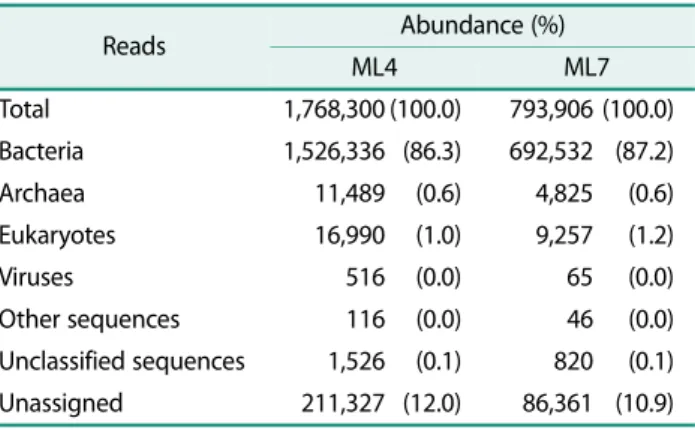
(ML4 and ML7) in the Midtre Lovénbreen, Svalbard were investigated using a metagenome sequencing method. A total of 2,798,108 and 1,691,859 reads with average lengths of 147 and 125 bp were finally obtained after sequence quality control steps (a predicted error rate of one percent, Q20) from ML4 and ML7 samples, respectively. After quality control, 1,768,300 and 793,906 reads of each sample were successively assigned to bac- teria, archaea and eukaryotes in the database of the MG-RAST server (Table 1). When microbial communi- ties were analyzed, higher bacterial abundance and diversity were found than that of archaeal or eukaryotic diversity in both sites. At the domain level, the following numbers of bacterial reads 1,526,336 and 692,532 were found to be dominant for ML4 and ML7, respectively.
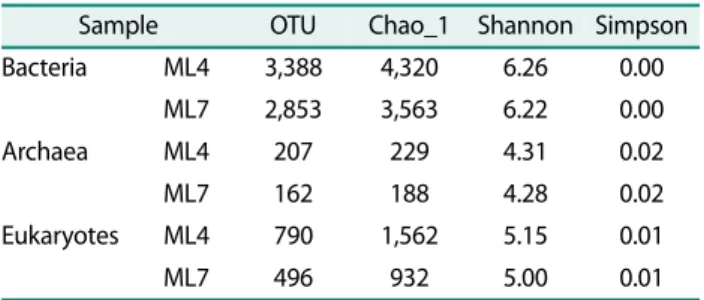
The minor distributions consisted of archaea (11,489 for ML4 and 4,825 for ML7) and eukaryotes (16,990 and 9,257). Although the numbers of reads for each domain in both samples were uneven, comparison among the communities of three domains via diversity indices revealed that the bacterial abundance was higher than that of archaea and eukaryotes, showing that the high operational taxonomic units (OTUs) phylotype richness of bacteria affected the richness estimator, Chao_1 (Table 2). The diversity indices also exhibited consistent patterns with species richness, regardless of sample sites, with the bacterial communities to showing the greatest diversity (Shannon, 6.26 and 6.22; Simpson, 0.00 and 0.00) and archaea showing the lowest diversity (Shannon, 4.31 and 4.28; Simpson, 0.02 and 0.02). This significant difference in diversity between bacterial and other communities was consistent with the results of previously studies [12, 31].
Table 1. Abundance of microbial communities about domain levels in ML4 and ML7 samples.
Reads Abundance (%)
ML4 ML7
Total 1,768,300 (100.0) 793,906 (100.0) Bacteria 1,526,336 (86.3) 692,532 (87.2)
Archaea 11,489 (0.6) 4,825 (0.6)
Eukaryotes 16,990 (1.0) 9,257 (1.2)
Viruses 516 (0.0) 65 (0.0)
Other sequences 116 (0.0) 46 (0.0)
Unclassified sequences 1,526 (0.1) 820 (0.1)
Unassigned 211,327 (12.0) 86,361 (10.9)
Bacterial community structure
The bacterial community compositions of the ML4 and ML7 samples were similar and classified into 28 differ- ent phyla including Proteobacteria, Actinobacteria, Planctomycetes, Firmicutes, Verrucomicrobia, Acidobac- teria, Cyanobacteria, Bacteroidetes, Chloroflexi, and other 19 candidates (Fig. 1). The dominant phyla were revealed to be Proteobacteria (40.3% and 43.3%) and Act- inobacteria (22.9% and 24.9%). These two predominant phyla accounted for more than half of the total bacterial sequences. The bacterial community structure exhibited good consistency with the findings of previous studies
showed that Proteobacteria and Actinobacteria were the dominant bacterial groups in Arctic soil samples [22, 35].
DGGE analysis of an active layer from the Canadian high Arctic also showed that the dominant bands corre- sponded to Proteobacteria and Actinobacteria [31]. A few previous studies reported that the metabolically versa- tile Actinobacteria, oligotrophic Acidobacteria, and widely distributed Bacteroidetes were dominant in Arctic tundra soils [15, 22]. Several genera from the phylum Actinobacteria were detected in this study. Specifically, the detection of Nocardia, which is known to form myce- lia, may be advantageous in oligotrophic environments as its hyphae can absorb water and nutrients. The bacte- rial community in this study also included Planctomyce- tes (6.4% and 6.0%), Acidobacteria (2.8% and 3.8%) and Bacteroidetes (4.5% and 3.1%), although these groups were less abundant than others. The abundance of the phylum Acidobacteria may reflect the low levels of nutri- ents present in high Arctic soils and the decrease in soil pH occurring along the chronosequence [11]. The abun- dance of the phylum Cyanobacteria (6.5% and 3.7%) indicates that it is as an essential ecosystem engineer related to the nitrogen fixation process particularly in Table 2. Summary of OUT counts, richness and diversity esti-
mates for the bacteria, archaea and eukaryotes in ML4 and ML7 samples.
Sample OTU Chao_1 Shannon Simpson
Bacteria ML4 3,388 4,320 6.26 0.00
ML7 2,853 3,563 6.22 0.00
Archaea ML4 207 229 4.31 0.02
ML7 162 188 4.28 0.02
Eukaryotes ML4 790 1,562 5.15 0.01
ML7 496 932 5.00 0.01
Fig. 1. Relative abundance of phylum (A) and class levels (B) in bacterial community based on OTUs distribution in ML4 and
ML7 Arctic soil samples. The combined distribution of minor phyla and classes except those represented as majors was repre-
sented to be “Others”.
oligotrophic environments such as glacial foreland in Arctic cryoconite communities [7, 8, 27, 28]. While ana- lyzing the methane-oxidizing bacteria within the Proteo- bacteria group, Beijerinckiaceae (0.2% and 0.3%) and Methylocystaceae (0.1% and 0.2%) were detected as Alp- haproteobacteria and Methylococcaceae (0.2% and 0.2%) as Gammaproteobacteria which was in accordance with the results of another investigation of the Midtre Lovén- breen soil of Svalbard, Arctic [13].
Archaeal community structure
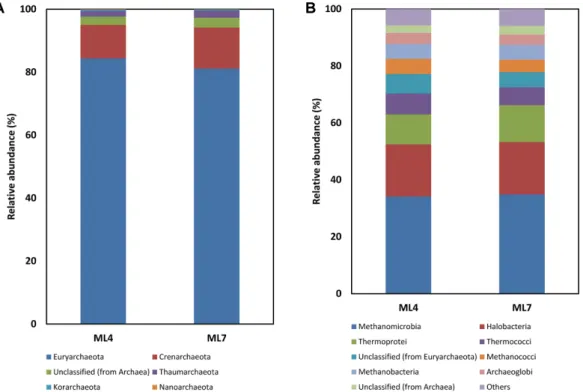
In the case of archaeal community structure, ML4 and ML7 samples exhibited a similar composition. When compared to the bacterial community structure, the archaeal community structure was relatively simple, consisting Euryarchaeota (84.4% and 81.1%), followed by Crenarchaeota (10.6% and 13.1%), an unclassified group (2.6% and 3.1%), Thaumarchaeota (1.8% and 2.3%) and minor groups including Korarchaeota and Nanoarchaeota (Fig. 2). This order of community compo- sition is strongly comparable to that of the subarctic Alaskan tundra based on 454 pyrosequencing [22]. A previous study of the archaeal community structure of
the active layer soil from Resolute in the Canadian High Arctic also supported our results, with Euryarchaeota acting as the major archaea group [12]. In addition, the relatively high levels of Crenarchaeota and Thaumar- chaeota were comparable to the results of other studies of the archaeal community structure in the Canadian High Arctic [31]. Thaumarchaeota is known to play a major role in geochemical cycles of bioelements includ- ing carbon and nitrogen in nature [3, 19].
The major class within the Euryarchaeota group was Methanomicrobia (34.2% and 34.9%) which is consistent with the results of other studies reporting that the class Methanomicrobia is abundant in subarctic Tundra soil [22]. In addition, most archaeal communities found in the active layer and permafrost of the Canadian High Arctic were reportedly composed of Methanomicrobia and Methanobacteria based on microarray analysis [37].
Among the Methanomicrobia class, the abundant genus was revealed to be Methanosarcina, followed by Metha- nospirillum, which may be a potentially large source of atmospheric methane [4, 12]. These results combined with the bacterial community structure that consists of methane-oxidizing bacteria strongly imply that the
Fig. 2. Relative abundance of phylum (A) and class levels (B) in archaeal community based on OTUs distribution in ML4 and
ML7 Arctic soil samples. The combined distribution of minor phyla and classes except those represented as majors was repre-
sented to be “Others”.
simultaneous production and consumption of methane is one of the key components of the carbon cycle in the Midtre Lovénbreen foreland in Svalbard.
Eukaryotic community structure
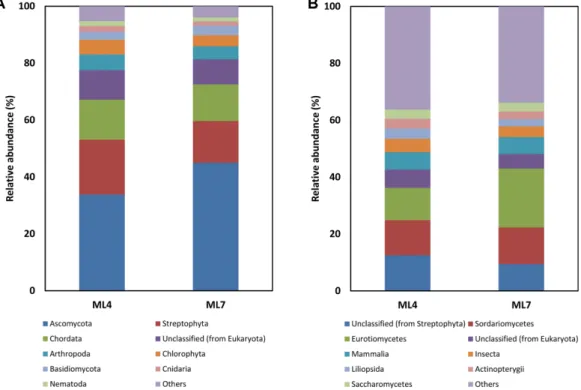
The eukaryotic community in ML4 and ML7 was found to be diverse, predominantly composed of Ascomycota (33.8% and 50.0%), Streptophyta (19.3% and 14.6%) and Chordata (14.0% and 12.9%) (Fig. 3). Although most studies have focused on analysis of bacterial and archaeal communities in Arctic environments, the fun- gal community composition in Svalbard was recently studied by cloning and sequencing the internal tran- scribed spacer (ITS) fragments. In that study, the major groups of Arctic Dryas octopetala root-associated fungal community were Basidiomycota (68.8%) and Ascomycota (30.7%) [1]. Another similar study showed that the Arc- tic Bistorta vivipara root-associated fungal community in Svalbard had the same major groups based on the 454 pyrosequencing approach [2]. Although Basidiomycota was a relatively minor group (2.8% and 3.3%) in our study, the major abundance of Ascomycota was compa- rable to that of previous studies. This incongruence
might be due to the different methods of microbial com- munity analysis, of which the sequence depth in the approaches using the sequencing of ITS fragments and pyrosequencing are insufficient to fully recover the diversity of microbial communities, resulting in the recovered taxonomic profile being incomplete. In another study, Saxifraga oppositifolia was regularly observed in the ML4 region, whereas vascular plants such as Salix polaris and Silene acaulis were diversely distributed in the ML7 region [13]. In addition, the Arc- tic Dryas octopetala was not observed in either region due to its growth condition as dry environments. Basidi- omycota is represented by fungal biomass in the form of extraradical mycelium and thick ectomycorrhizal (ECM) mantles, whereas Ascomycota was found to have a sparse amount of external mycelium, thin mantles and endophytes [1]. A previous study of the phylogenetic relationship between arctic endophytes and plants living in the arctic Tundra in Nunavut, Canada showed that the Dothideomycetes, Sordariomycetes and Leotiomycetes support our findings, with the major class of Ascomycota being Sordariomycetes (12.3% and 12.9%), Leotiomycetes (3.2% and 3.0%), and Dothideomycetes (2.5% and 3.9%).
Fig. 3. Relative abundance of phylum (A) and class levels (B) in eukaryotic community based on OTUs distribution in ML4
and ML7 Arctic soil samples. The combined distribution of minor phyla and classes except those represented as majors was rep-
resented to be “Others”.
In summary, the bacterial, archaeal and eukaryotic communities in Arctic soil from the glacier foreland of Midtre Lovénbreen in Svalbard were examined with a high resolution by using the scalable and rapid NGS technologies, in particular, the Ion Torrent PGM plat- form. Analysis of soil microorganisms other than bacte- ria has been limited in this region due to the low mass of microorganisms; however, this NGS-based metagenomic approach could address this limitation, enabling analy- sis of the whole microbial community structures includ- ing bacteria, archaea and even eukaryotes more rapidly, than previously employed molecular methods such as PCR-based 16S rRNA gene cloning, DGGE and pyrose- quencing. There have been many studies of the micro- bial community structures in Svalbard Arctic regions and it is difficult to characterize and compare microbial communities in Arctic soil samples. However, the results of the present study are concordant with those of other previous studies of microbial ecosystems in Arctic region.
Acknowledgments
This research was supported by the Basic Science Research Pro- gram through the National Research Foundation of Korea funded by the Ministry of Science, ICT & Future Planning (2014R1A1A1002980) and by the Korea Polar Research Institute (KOPRI, PE16030).
References
1. Bjorbækmo MFM, Carlsen T, Brysting A, Vrålstad T, Høiland K, Ugland KI, et al. 2010. High diversity of root associated fungi in both alpine and arctic Dryas octopetala. BMC Plant Biol. 10: 244.
2. Blaalid R, Davey ML, Kauserud H, Carlsen T, Halvorsen R, Høiland K, Eidesen PB. 2014. Arctic root-associated fungal community composition reflects environmental filtering. Mol. Ecol. 23: 649 − 659.
3. Brochier-Armanet C, Boussau B, Gribaldo S, Forterre P. 2008.
Mesophilic Crenarchaeota: proposal for a third archael phylum, the Thaumarchaeota. Nat. Rev. Microbiol. 6: 245−252.
4. Cadillo-Quiroz H, Yahiro E, Yavitt JB, Zinder SH. 2008. Characteri- zation of the archaeal community in a minerotrophic fen and ter- minal restriction fragment length polymorphism-directed isolation of a novel hydrogenotrophic methanogen. Appl. Envi- ron. Microbiol. 74: 2059 −2068.
5. Chao A, Shen TJ. 2003. Program SPADE (Species Prediction and Diversity Estimation) Program and user’s guide available at http:/
/chao.stat.nthu.edu.tw.
6. Coulson SJ, Hodkinson ID, Webb NR. 2003. Aerial dispersal of
invertebrates over a high-Arctic glacier foreland: Midtre Lovén- breen, Svalbard. Polar Biol. 26: 530 −537.
7. Edwards A, Mur LAJ, Girdwood SE, Anesio AM, Stibal M, Rassmer AME, et al. 2014. Coupled cryoconite ecosystem structure-func- tion relationships are revealed by comparing bacterial communi- ties in alpine and Arctic glaciers. FEMS Microbiol. Ecol. 89: 222 − 237.
8. Evonne PYT, Warwick FV, Proulx D, Noüe PLJ. 1997. Polar cyano- bacteria versus green algae for tertiary waste-water treatment in cool climates. J. Appl. Phycol. 9: 371 −381.
9. Green J, Bohannan JM. 2006. Spatial scaling of microbial biodi- versity. Trends Ecol. Evol. 21: 501 −507.
10. Hinzman LD, Bettez ND, Bolton WR, Chapin FS, Dyurgerove MB, Fastie CL, et al. 2005. Evidence and implications of recent climate change in northern Alaska and other arctic regions. Clim. Change 72: 251 −298.
11. Hodkinson ID, Coulson SJ, Webb NR. 2003. Community assembly along proglacial chronosequences in the high Arctic: vegetation and soil development in north-west Svalbard. J. Ecol. 91: 651 − 663.
12. Kim OS, Kim HM, Lee HK, Lee YK. 2014. Microbial community structure of the active layer soil from Resolute, Canadian high Arctic. J. Climate Change Res. 5: 249 −256.
13. Kwon HY, Jung JY, Kim OS, Laffly D, Lim HS, Lee YK. 2015. Soil development and bacterial community shifts along the chrono- sequence of the Midtre Lovénbreen glacier foreland in Svalbard.
J. Ecol. Environ. 38: 461 −476.
14. Larose C, Prestat E, Cecillon S, Berger S, Malandain C, Lyon D, et al.
2013. Interactions between snow chemistry, mercury inputs and microbial population dynamics in an arctic snowpack. PLoS One 8: e79972.
15. Lee SH, Jang I, Chae N, Choi T, Kang H. 2013. Organic layer serves as a hotspot of microbial activity and abundance in Arctic tundra soils. Microb. Ecol. 65: 405−414.
16. Llobet-Brossa E, Rossello-Mora R, Amann R. 1998. Microbial com- munity composition of Wadden sea sediments as revealed by fluorescence in situ hybridization. Appl. Environ. Microbiol. 64:
2691 −2696.
17. Meyer F, Paarmann D, D’Souza M, Olson R, Glass EM, Kubal M, et al. 2008. The metagenomics RAST server – a public resource for the automatic phylogenetic and functional analysis of metage- nomes. BMC Bioinformatics 9: 386.
18. Moreau M, Mercier D, Laffly D, Rousse E. 2008. Impacts of recent paraglacial dynamics on plant colonization: A case study on Midtre Lovénbreen foreland, Spitsbergen (79
oN). Geomorphol- ogy 95: 48 −60.
19. Muller F, Brissac T, Le Bris N, Felbeck H, Gros O. 2010. First descrip- tion of giant Archaea (Thaumarchaeota) associated with putative bacterial ectosymbionts in a sulfidic marine habitat. Environ.
Microbiol. 12: 2371 −2383.
20. Nam YD, Kim HJ, Seo JG, Kang SW, Bae JW. 2013. Impact of pelvic
radiotheraphy on gut microbiota of gynecological cancer
patients revealed by massive pyrosequencing. PLoS One 8:
e82659.
21. Nilsen L, Brossard T, Joly D. 1999. Mapping plant communities in a local Arctic landscape applying a scanned infrared aerial pho- tograph in a geographical information system. Int. J. Remote Sens.
20: 463 −480.
22. Park HJ, Chae N, Sul WJ, Lee BY, Lee YK, Kim D. 2015. Temporal changes in soil bacterial diversity and humic substances degra- dation in subarctic tundra soil. Microb. Ecol. 69: 668 −675.
23. Parks DH, Beiko RG. 2010. Identifying biologically relevant differ- ences between metagenomics communities. Bioinformatics 26:
715 −721.
24. Pereira e Silva MC, Dias ACF, van Elsas JD, Salles JF. 2012. Spatial and temporal variation of archaeal, bacterial and fungal commu- nities in agricultural soils. PLoS One 7: e51554.
25. Ravenschlag K, Sahm K, Amann R. 2001. Quantitative molecular analysis of the microbial community in marine Arctic sediments (Svalbard). Appl. Environ. Microbiol. 67: 387 −395.
26. Sahm K, MacGregor BJ, Jørgensen BB, Stahl DA. 1999. Sulfate reduction and vertical distribution of sulfate-reducing bacteria quantified by rRNA slot-blot hybridization in a coastal marine sediment. Environ. Microbiol. 1: 65 −74.
27. Schmidt SK, Reed SC, Nemergut DR, Grandy AS, Cleveland CC, Weintraub MN, et al. 2008. The earliest stages of ecosystem suc- cession in high-elevation (5000 metres above sea level), recently deglaciated soils. Proc. Biol. Sci. 275: 2793 −2802.
28. Schulz S, Brankatschk R, Dümig A, Kögel-Knabner I, Schloter M, Zeyer J. 2013. The role of microorganisms at different stages of ecosystem development for soil formation. Biogeosciences 10:
3983 −3996.
29. Schütte UME, Abdo Z, Foster J, Ravel J, Bunge J, Solheim B, et al.
2010. Bacterial diversity in a glacier foreland of the high Arctic.
Mol. Ecol. 19: 54 −66.
30. Serreze MC, Walsh JE, Chapin FS, Osterkamp T, Dyurgerov M,
Romanovsky V, et al. 2000. Observational evidence of recent change in the northern high-latitude environment. Clim. Change.
46: 159 −207.
31. Steven B, Pollard WH, Greer CW, Whyte LG. 2008. Microbial diver- sity and activity through a permafrost/ground ice core profile from the Canadian high Arctic. Environ. Microbiol. 10: 3388 −3403.
32. Takahashi S, Tomita J, Nishioka K, Hisada T, Nishijima M. 2014.
Development of a prokaryotic universal primer for simultaneous analysis of Bacteria and Archaea using next-generation sequenc- ing. PLoS One 9: e105592.
33. Vishnivetskaya TA, Layton AC, Lau MC, Chauhan A, Cheng KR, Meyers AJ, et al. 2014. Commercial DNA extraction kits impact observed microbial community composition in permafrost sam- ples. FEMS Microbiol. Ecol. 87: 217 −230.
34. Whiteley AS, Jenkins S, Waite I, Kresoje N, Payne H, Mullan B, et al.
2012. Microbial 16S rRNA Ion Tag and community metagenome sequencing using the Ion Torrent (PGM) Platform. J. Microbiol.
Methods 91: 80 −88.
35. Wilhelm RC, Niederberger TD, Greer C, Whyte LG. 2011. Microbial diversity of active layer and permafrost in an acidic wetland from the Canadian High Arctic. Can. J. Microbiol. 57: 303 −315.
36. Yang Y, Xie B, Yan J. 2014. Application of next-generation sequencing technology in forensic science. Genomics Proteomics Bioinformatics 12: 190−197.
37. Yergeau E, Hogues H, Whyte LG, Greer CW. 2010. The functional potential of high Arctic permafrost revealed by metagenomic sequencing, qPCR and microarray analyses. ISME J. 4: 1206 −1214.
38. Yergeau E, Lawrence JR, Sanschagrin S, Waiser MJ, Korber DR,
Greer CW. 2012. Next-generation sequencing of microbial com-
munities in the Athabasca River and its tributaries in relation to
oil sands mining activities. Appl. Environ. Microbiol. 78: 7626 −
7637.
국문초록
북극 스발바르 군도 중앙로벤 빙하 해안 지역의 토양 시료 내 메타지놈 기반 미생물 군집 분석 석윤지
1†, 송은지
2,3†, 차인태
4, 이현진
1, 노성운
3,5, 정지영
6, 이유경
6, 남영도
2,3*, 서명지
1,4*
1
인천대학교 대학원 생명과학과
2
한국식품연구원 장내미생물연구단
3
과학기술연합대학원대학교
4
인천대학교 생명공학부
5
한국기초과학지원연구원 생물재난연구팀
6