Effect of Soil Textures on Fruit Yield, Nitrogen and Water Use Efficiencies of Cucumber Plant as Affected by Subsurface Drip Fertigation in the Greenhouse
Tae-Jun Lim*, Jin-Myeon Park, Young-Eun Park, Seong-Eun Lee, and Ki-In Kim
1Horticultural and Herbal Crop Environment Division, RDA-NIHHS, Wanju, 565-852, Korea
1
Dept. of Horticultural Science, Mokpo National University, Muan, 534-729, Korea
(Received: April 28 2015, Revised: October 13 2015, Accepted: October 13 2015)
Growing crops under different soil textures may affect crop growth and yield because of soil N availability, soil N leaching, and plant N uptake. The objective of this study was to evaluate effects of three different soils (sandy loam, loam, and clay loam) on cucumber (Cucumis sativus L.) yield, nitrogen (N) use efficiency (NUE), and water use efficiency (WUE) by subsurface drip fertigation in the greenhouse. Three different soil textures are sandy loam, loam, and clay loam with 3 replications. The dimension of each lysimeter was 1.0 m (W) × 1.5 m (L) × 1.0 m (H). Cucumber was transplanted on April 8 th and Aug 16 th in 2011. The subsurface drip line and tensiometer was installed at 30 and 20 cm soil depth, respectively. An irrigation with 100 mg N L -1 concentration was automatically applied when the tensiometer reading was 10 kPa. Volumetric soil water content for cucumber cultivation was the highest in 30 cm soil depth regardless of soil texture and was lowered when soil depth was deeper. The volumetric soil water contents at soil depths of 10, 30, 50, and 70 cm were the highest at clay loam, followed by loam, and sandy loam. The growth of cucumber at the 50 th day after transplanting was the lowest at sandy loam. Cucumber fruit yields were similar for all three soil textures. The highest amount of water use at sandy loam was observed. Nitrogen and water use efficiencies for cucumber were higher for clay loam, followed by loam and sandy loam, while the amount of N leaching was the greatest under sandy loam, followed by loam, and clay loam. Overall, growing cucumber on either loam or clay loam is better than sandy loam if subsurface drip fertigation is used in the greenhouse.
Key words: Soil texture, Subsurface drip fertigation, N management
N use efficiency and water use efficiency (WUE) of cucumber for three different soil textures by subsurface drip fertigation during the growing season.
Treatment N use efficiency
†WUE
‡Semi-forcing culture Retarding culture Semi-forcing culture Retarding culture --- kg kg
-1--- --- kg m
-3---
Sandy loam 0.55b 0.37b 19.5b 12.7b
Loam 0.62ab 0.40ab 22.3ab 13.7ab
Clay loam 0.71a 0.47a 25.6a 16.5a
†
N use efficiency was determined as N uptake divided by N input
‡
Mean separation within columns by Duncan’s multiple range test at 5% level.
1)
*Corresponding author : Phone: +82632386341, Fax: +82632386305, E-mail: [email protected]
§
Acknowledgement : This study was supported by National Institute of Horticultural & Herbal Science research project (PJ007702), Rural
Development Administration, Republic of Korea.
Introduction
우리나라 시설온실의 재배면적은 지속적으로 증가하여 1980년에 7,141 ha에서 2011년 60,226 ha로 8.4배 확대되었 다 (MAFRA, 2014). 또한 시설재배에서는 1년에 여러 번의 작물 재배가 가능하기 때문에 노지 작물과 비교하면 훨씬 더 많은 양의 물을 필요로 한다 (Park et al., 2012). 시설 온실에서의 관수는 과채류 재배의 영향으로 점적호스를 이 용한 관수가 가장 많은 전체의 40.9%인 20,886 ha에서 사 용되고 있다 (MAFRA, 2014). 하지만 시설에서의 점적관수 는 거의 대부분 지표관수 방법을 이용하고 있으며 지중관수 를 이용한 시설채소 재배면적은 아직 미미한 수준에 머물고 있다.
지중관수는 지표면 아래 10~40 cm의 깊이에 관수호스를 매설하는 방법으로 작물의 뿌리 부근에 양분과 수분을 직접 공급하므로 지표층에서의 수분 증발이 적고 지표관수보다 관수한 수분이 넓게 퍼짐으로써 물의 이용률이 높은 이점이 있다고 보고되고 있다 (Camp et al., 1997; Zhuge et al., 2004). 하지만 지중관수의 도입초기인 1970년대에는 관수 호스에 구멍이 막히거나 재배기간 동안 작물의 뿌리가 관수 호스를 막는 등 문제점이 있어 실용화 되지 못하였으나 (Blass, 1971), 막힘의 문제점을 개선한 관수자재가 개발되 어 이스라엘과 미국을 중심으로 사용 면적이 지속적으로 증 가하고 있다 (Camp, 1998; Enciso et al., 2015). Lamn et al. (2012)은 2003년부터 2008년까지 미국에서의 지중관수 에 대한 사용 면적이 160 천 ha에서 260 천 ha로 60% 증가 하였다고 보고하였으며, 옥수수, 양파, 브로콜리, 꽃양배추 등 다양한 작물을 대상으로 연구가 수행되고 있다 (Jordan et al., 2014; Thompson et al., 2000; Thompson et al., 2003).
토성은 모래, 미사, 점토의 함유비율로 토양 중 수분 특 성 및 질소 동태에 영향을 준다고 알려져 있다 (Armstrong et al., 2009, Tremblay et al., 2012; Zhu et al., 2009). 예 를 들어 식양토의 포화수리전도도는 2.3 mm h
-1인 반면 사 양토에서는 25.9 mm h
-1로 10배 이상 빨라서 작물이 흡수 할 수 없는 근권 아래로의 물의 이동이 용이하다 (Rawl et al., 1982). 또한 토양의 포화수분 상태에서 포장용수량까 지 수분함량의 범위가 사양토와 비교하여 식양질 토양에서 넓어 보다 긴 시간 동안 작물에 수분 공급이 가능하기 때문 에 토성이 물의 이용효율에 영향을 미칠 수 있다. 그리고 Sogbedji et al. (2000)은 거친 입자가 많고 배수조건이 용 이한 양질사토에서 점토의 비율이 상대적으로 높은 식양토 와 비교하여 질산태 질소의 용탈량이 많게 되므로 입자의 크기 분포에 따라서 질소의 이용효율이 달라질 수 있다고 보고하고 있다.
이러한 영향 때문에 토성이 작물의 생육 및 수량에도 영
향을 미칠 수 있다 (Nolin et al., 1989). Oberle and Keeney (1990)은 최대의 옥수수 수량을 얻는데 필요한 질소 시비량 이 미사질양토 또는 미사질식양토에서 155~210 lb N acre
-1인 반면 양질사토 또는 사양토에서는 175~230 lb N acre
-1로 보다 많은 양이 요구된다고 하였으며, Nyiraneza et al.
(2012)은 밀의 총 생산량이 사양토에서는 4.5와 4.9 Mg ha
-1이었지만 양토에서는 7.1 Mg ha
-1로 증대되어 토성이 밀의 생장에 있어서 중요한 인자라고 평가하였다.
하지만 시설재배지와 같이 작물이 생육하는 기간에 필요 한 충분한 수분과 질소를 공급할 수 있는 조건에서도 토성 차이가 작물의 생육과 토양 수분 및 질소의 이용에 영향을 줄 것으로 판단하였다. 따라서 본 연구는 지중관비를 이용 한 시설오이 재배에서 토성의 차이가 오이 수량 및 양분 흡 수량, 질소 및 수분 이용효율에 미치는 영향을 구명하고자 수행하였다.
Materials and Methods
지중 점적호스를 이용한 오이 재배에서 토성의 차이에 따른 작물의 생육, 질소이용효율 및 물 이용량에 대한 차이 를 구명하기 위해서 국립원예특작과학원 탑동 포장에서 라 이시미터를 이용하여 2011년에 2작기에 걸쳐서 수행하였다.
라이시미터의 크기는 가로 × 세로 × 높이가 각각 1.0 m, 1.5 m, 1.0 m 이며 하단 중앙부에 배출구를 두었다. 충진된 각각의 토양은 미국 농무성 (USDA) 기준에 의거 사양토 (모 래 : 미사 : 점토= 660 : 230 : 110 g kg
-1), 양토 (모래 : 미 사 : 점토 = 580 : 300 : 120 g kg
-1), 식양토 (모래 : 미사 : 점토 = 510 : 330 : 160 g kg
-1)로 분류되었다. 전용적밀도 는 모든 처리가 1.19 g cm
-3가 되도록 동일한 무게로 맞추 어 토양을 충진하였으며, 처리간의 토양양분 편차 및 토양 교란에의 영향을 최소화하기 위해 100 mm에 해당하는 물을 처리구별로 2010년 8월에 공급하였으며 볏짚퇴비 5.0 Mg ha
-1의 양을 9월에 공급하였다. 시험에 사용한 각각의 토양 pH는 7.1~7.4, 유기물의 함량은 22~24 g kg
-1이었으며 질 산태 질소는 43~52 mg kg
-1의 범위를 나타내었다 (Table 1). 토양은 반촉성 재배작형으로 오이를 정식하기 전에 분 석하였으며, 토양검정 시비추천량에 준하여 질소 관비를 100 mg L
-1의 농도로 작물 정식 후부터 재배가 종료될 때까 지 물을 공급할 때마다 관비의 형태로 공급하였다. 질소는 요소로 사용하였으며 억제작형에서도 동일한 질소 관비농 도로 공급하였다. 인산 및 칼리의 시비는 표준시비량을 기 준으로 전량 밑거름으로 시비하였다.
질소는 시험에 사용한 점적호스의 점적공은 20 cm 간격
이며 2.1 L h
-1의 유량으로 일정하게 공급되는 압력보상형
점적호스 (Vered, Metzerplas Inc.)를 사용하였다. 점적호스
는 토양 20 cm의 깊이에 매설하였으며 오이 묘 정식 전에
Table 1. Physiochemical properties of soil used for the experiment.
Treatment pH EC OM Avail.P
2O
5NO
3-N Ex. cations
K Ca Mg
1:5 dS m
-1g kg
-1--- mg kg
-1--- --- cmol
ckg
-1--- Sandy loam 7.4 (0.10)
†1.1 (0.11) 24 (0.5) 610 (11.5) 52.8 (4.3) 0.54 (0.02) 10.6 (0.3) 2.7 (0.12) Loam 7.3 (0.04) 1.5 (0.05) 22 (0.4) 394 (15.7) 50.7 (3.1) 0.60 (0.02) 9.6 (0.2) 2.8 (0.07) Clay loam 7.1 (0.06) 1.7 (0.10) 22 (0.4) 376 (13.7) 52.6 (6.7) 0.61 (0.02) 9.1 (0.3) 2.9 (0.05)
†
( ) indicates standard error.
Table 2. Cucumber height and number of nodes under different soil textures by semi-forcing culture at the 50
thday after transplanting in 2011.
Treatment The 50
thday after transplanting Plant height No. of nodes
cm ea plant
-1Sandy loam 78.5 (2.05)
†11.7 (0.33)
Loam 80.7 (3.14) 12.2 (0.54)
Clay loam 81.2 (3.34) 12.5 (0.43)
Significance NS
‡NS
†
( ) indicates standard error.
‡
Mean separation within columns by Duncan’s multiple range test at 5% level.
두둑을 10 cm 하였으므로 두둑의 지표면으로부터 점적호스 는 30 cm의 깊이에 설치되었다. 토양의 수분관리는 토양수 분장력계인 텐시오미터를 두둑의 높이로부터 20 cm의 토양 깊이에 설치하였으며 관수 개시점으로는 10 kPa에 도달하 면 10분 동안 1일 6회에 걸쳐서 관비가 자동으로 공급될 수 있도록 하였다. 작물 재배기간 동안 각각의 라이시미터 하 단에 50 L통을 놓고 용탈수의 양을 매주 조사 측정하였으 며, 용탈수 중의 질산태 질소의 농도는 이온크로마토그래피 (DX-500, Dionex, USA)를 이용하여 측정하였다. 질소 양 분수지는 질소 관비 공급량으로부터 식물체 질소 흡수량과 질소 용탈량을 제외한 값으로 계산하였다.
오이는 백다다기로 2011년 봄과 가을 2작기 동안, 봄에는 반촉성작형으로 가을에는 억제작형으로 재배하였다. 봄과 가을 정식일은 4월 8일과 8월 16일 이었으며 재배기간은 각 각 110일과 72일 이었다. 재식주수는 라이시미터 한 구당에 2주를 정식하였으며, 생육조사는 봄 작기인 반촉성작형에 서 정식 후 50일에 초장과 엽수를 각각 조사하였다. 토양의 수분함량은 토양 깊이 10, 30, 50, 70 cm에 토양수분센서 (SM 100, Spectrum Inc., USA)를 매설하였으며 정식 후 23 일인 5월 1일부터 15일간 데이터로거 (WatchDog 1000 Series, Spectrum Inc., USA)를 이용하여 조사하였다.
토양분석은 2 mm 체를 통과한 풍건 시료에 대해서 토양 및 식물체 표준분석법에 준하여 실시하였다 (NIAST, 2000).
토양 pH는 토양과 물의 비율을 1:5로 하여 30분간 진탕 후 pH meter (ORION Model 720A, USA)로 측정하였고, 토양 EC는 1:5로 침출한 후 Conductance meter (YSI Model 35, USA)로 분석하였다. 유기물은 Tyurin법 (Nelson and sommer, 1996), 유효인산은 Lancaster법 (Lancaster, 1970)으로, 치 환성 K, Ca, Mg은 1N-CH
3COONH
4(pH 7.0) 완충용액으로 침출하여 ICP-OES (MX2, GBC, Australia)를 사용하여 측 정하였다. 질산태 질소는 2M KCl로 침출하여 켈달 (B-316, Bűchi, Switzerland)로 증류한 후 황산표준용액 0.01N로 적 정하여 계산하였다 (Mulvaney, 1996). 식물체 시료는 70℃
에서 건조 후 분쇄된 시료를 산 분해용액 (HClO
4:H
2SO
4= 10:1)으로 습식 분해하여 질소는 Kjeldahl법 (NIAST, 2000) 으로 측정하였다. 통계분석은 SAS프로그램 (Statistical analysis system ver. 9.2, USA)을 이용하였으며 Duncan’s
Multiple range test를 통해 처리간의 통계적 유의성을 비교 검토하였다.
Results and Discussion
정식 후 50 일에 오이의 초장 및 엽수는 처리간의 차이를 보이지 않았다 (Table 2). 활착기간 동안에 오이는 뿌리가 뻗지 못 해 지표면 부근 토양의 수분 상태에 영향을 받게 되 고, 사양토는 모세관력을 통한 표층으로의 수분이동이 양토 나 식양토와 비교하여 상대적으로 적어서 (Elmaloglou and Diamantopoulos, 2009; Gajanayake et al., 2014), 활착 초 기에 생육이 부진할 수 있다. 하지만 오이가 생장하고 뿌리 가 발달하면서 관수지점 부근까지 뻗어 내려감으로써 토성 으로 인한 오이 생육의 차이는 없는 것으로 나타났다.
2작기에 걸친 오이 수량을 비교하여 보면, 오이의 생육과
마찬가지로 사양토에서 가장 낮고 식양토에서 가장 높은 생
산량을 나타내었으나 토성과 오이 수량간에 유의성 있는 차
이를 보이지 않았다 (Table 3). 이러한 사실은 오이의 생육
에 필요한 충분한 양의 질소와 수분이 공급이 되는 조건에
서는 토성이 오이 수량의 제한인자가 되지 못 함을 알 수 있
다. 하지만 토성의 차이가 작물의 수량에 영향을 미친다는
여러 연구결과들이 보고되고 있는데, 이는 토양의 양분이나
수분이 제한적인 조건에서 토양 유기물 및 양분량에서 차이
Table 3. Comparison of the cucumber yields by semi-forcing and retarding cultures at different soil textures under subsurface drip fertigation.
Treatment Semi-forcing culture
Retarding
culture Total --- Mg ha
-1--- Sandy loam 44.5 (4.1)
†15.8 (1.1) 60.3 (3.0) Loam 46.3 (1.3) 15.5 (0.7) 61.8 (1.4) Clay loam 47.9 (0.5) 16.7 (1.4) 64.6 (1.0)
Significance NS
‡NS NS
†
( ) indicates standard error.
‡
Mean separation within columns by Duncan’s multiple range test at 5% level.
Fig. 1. Volumetric soil water contents under three different sol textures at soil depths of 10 cm (a), 30 cm (b), 50 cm (c), and 70 cm (d) (the horizontal distance from drip line = 0 cm) from 23 days to 38 days after transplanting. Error bars indicate standard error of the mean.
가 발생하거나 (Bird et al., 2000; Nyiraneza et al., 2012) 토양수분 보유력에 차이가 발생하였기 때문이다 (Arora et al., 2011; Jalota et al., 2010). Miller and Martin (1983)은 토성 및 관개량에 따른 감자의 수량비교에서 토성에 따라서 물 공급량은 달랐지만 만일 작물에 필요한 충분한 양의 물 이 공급된 경우에는 토성의 차이에 관계없이 감자의 수량은 거의 동일한 최대 생산량을 보인다고 보고하여 본 연구결과 와 동일하였다. 한편 오이의 수량은 억제작형과 비교하여 반촉성작형에서 많았는데, 이는 반촉성작형의 재배기간이 억제작형보다 38일이 많았으며 오이 수확기에 상대적으로
높은 일평균온도와 작물생육에 적합한 온도로 유지되었기 때문인 것으로 판단되었다.
토양 깊이에 따른 오이 재배기간에의 수분함량은 Fig. 1 과 같다. 물이 토양의 표면에 공급되어 표토 부근에서 가장 높은 수분함량을 나타내는 지표관수와는 달리 지중관수는 물이 공급되는 위치에 따라서 수분함량 분포도에 대한 차이 를 나타내었다 (Martinez Hernandez et al., 1991; Phene et al., 1991). 토양의 용적수분함량은 토성에 관계없이 관수지 점인 지중 30 cm에서 가장 높았으며 토양의 깊이가 증가할 수록 수분함량은 낮아졌다. 토양 깊이별 용적수분함량은 식 양토에서 가장 높았고 양토 및 사양토의 순서로 감소하였는 데 이는 토성이 수분을 보유하고 지탱할 수 있는 수분보유 력과 연관이 있기 때문인 것으로 사료된다 (Whiting, 2012).
토양 깊이에 따른 수분함량의 토성별 차이는 토양 깊이 70 cm에서 가장 적었으며 지중 10 cm와 30 cm에서 증가하는 경향을 보였다. 또한 수분이 공급되는 지중 30 cm로부터 지 중 70 cm와 지중 10 cm간의 수분함량의 편차는 식양토에서 0.089 cm cm
-3및 0.081 cm cm
-3을, 사양토에서는 0.053 cm cm
-3및 0.078 cm cm
-3을 나타내어, 사양토에서 하층부 로의 수분이동과 비교하여 상층부로의 이동은 상대적으로 용 이하지 않음을 알 수 있다 (Elmaloglou and Diamantopoulos, 2009).
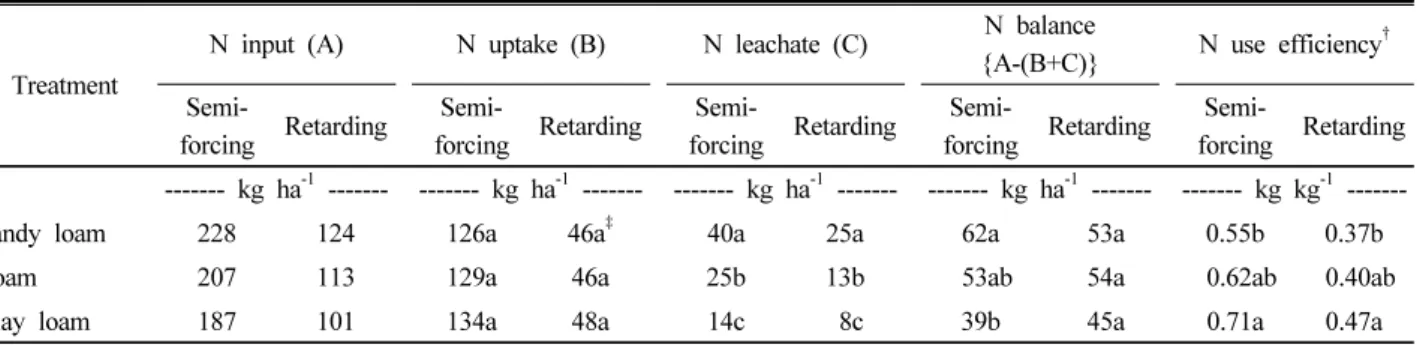
식양토에서 재배된 오이의 질소흡수량이 각각 134 및 48
Table 4. N input, cucumber N uptake, N leachate, N balance, and N use efficiency at three different soil textures by subsurface drip fertigation during the growing season.
Treatment
N input (A) N uptake (B) N leachate (C) N balance
{A-(B+C)} N use efficiency
†Semi-
forcing Retarding Semi-
forcing Retarding Semi-
forcing Retarding Semi-
forcing Retarding Semi-
forcing Retarding --- kg ha
-1--- --- kg ha
-1--- --- kg ha
-1--- --- kg ha
-1--- --- kg kg
-1---
Sandy loam 228 124 126a 46a
‡40a 25a 62a 53a 0.55b 0.37b
Loam 207 113 129a 46a 25b 13b 53ab 54a 0.62ab 0.40ab
Clay loam 187 101 134a 48a 14c 8c 39b 45a 0.71a 0.47a
†
N use efficiency was determined as N uptake divided by N input.
‡
Mean separation within columns by Duncan’s multiple range test at 5% level.
Table 5. The amount of irrigation and water use efficiency (WUE) of cucumber for the three different soil textures by subsurface drip fertigation during the growing season.
Treatment
Seasonal irrigation WUE
†Semi-
forcing Retarding Semi-
forcing Retarding --- m
3ha
-1--- --- kg m
-3---
Sandy loam 2,280 1,240 19.5b
‡12.7b
Loam 2,070 1,130 22.3ab 13.7ab
Clay loam 1,870 1,010 25.6a 16.5a
†
WUE was determined as cucumber yield divided by water input.
‡