Characteristics of Fertility of Cucumber Cultivated Soils at Controlled Horticulture in Chungnam Province
Moon-Tae Choi, Yeo-Uk Yun, Jin-Il Lee, Jong-Eun Lee, Suck-Kee Jung, Yun-Gyu Nam, and Young Han Lee1*
Chungcheongnam-do Agricultural Research and Extension Services, Yesan 340-861, Republic of Korea
1Gyeongsangnam-do Agricultural Research and Extension Services, Jinju 660-370, Korea
(Received: May 20 2014, Revised: May 20 2014, Accepted: July 30 2014)
The management of soil chemical properties is very important to sustainable agriculture of many horticultural crops, including cucumber. This study was conducted to find the optimal soil properties of environmentally friendly agriculture in controlled horticulture. Soil chemical properties of 267 samples were collected from soil in Chungnam Province. The average of pH, EC, OM, available P2O5, exchangeable K, Ca, and Mg was 6.1, 5.38 dS m-1, 34 g kg-1, 1,321 mg kg-1, 1.50 cmolc kg-1, 10.3 cmolc kg-1, and 3.4 cmolc kg-1, respectively. The organic matter content in silty clay loam was significantly higher than in the other soil textures, whereas the pH, EC, exchangeable K, and Mg in loamy fine sand showed significantly lower among soil textures. The EC value and exchangeable Mg concentration were highest in mountain foot-slope soils. The frequency distribution within optimum range of soil chemical properties was 26.2%, 30.3%, 2.3%, 3.8%, 3.4%, and 6.7%
for pH, OM, available P2O5, exchangeable K, Ca, and Mg, respectively. Especially, excessive portion of available P2O5 and exchangeable Ca were 94.0% and 94.4%, respectively. The EC value and organic matter content of soil samples were positive correlation with all chemical properties except soil pH. In principle component analysis of chemical properties in soil samples, the percentage of variance explained by PC 1 was 52.2%, while PC 2 explained 21.3% of the variance, for a cumulative total of 73.5%. In conclusion, these results are considered to improve soil nutrient management for sustainable controlled horticulture.
Key words: Cucumber, Chemical property, Soil texture, Landform
Frequency distribution of chemical properties of cucumber cultivated soils in controlled horticulture (n=267).
1)
*Corresponding author : Phone: +82552541313, E-mail: [email protected]
§Acknowledgement: This study was conducted with the support of the Research Cooperating Program for Agricultural Science &
Technology Development (Project No. PJ009198152013), RDA, Republic of Korea.
Introduction
오이 재배면적은 1990년에 6,951 ha에서 1994년 8,710 ha로 급격히 증가하였다가 1990년대 중반 이후 점차로 감소 하여 2009년에는 4,396 ha였으며 시설면적도 1999년 이후 연평균 3%씩 감소하고 있다 (RDA, 2012). 그러나 시설 오이 의 단위면적당 생산량은 1990년에 3,677 kg 10a-1에서 2010 년에 7,617 kg 10a-1로 107% 증대되었다. 충남지역은 수도 권 인근지역으로 시장입지가 유리하여 청장계, 백다다기오이 등의 반촉성 재배를 통하여 시장 점유율이 1990년에 10.2%에 서 2010년 21.3%로 증가되었다.
시설재배는 집약적인 농업의 형태로 농가소득 증대를 위 해 연작을 하는 경우가 대부분이다. 시설 오이의 경우도 연 작을 할 경우 염류농도 (EC)의 상승, 양분 불균형, 병충해 증 가 등으로 수량과 품질이 떨어지게 되며 이러한 문제점을 개 선하기 위해 토양 양분 분석을 통한 맞춤형 시비관리가 필 수적이다 (Hyun et al., 2011). 그러나 충남지역 시설재배지 는 과다한 시비와 연작으로 인하여 유효 인산 및 교환성 칼 륨, 칼슘, 마그네슘 등의 염류가 집적되어 작물 생육부진과 수량감소의 원인이 되고 있다 (NIAST, 2009). 이러한 문제 점은 오래전부터 보고된 것으로 하우스 내부의 토양은 하우 스 외부의 토양에 비해 질산태 질소, 유효 황, 염소의 함량 은 2.5-3배, 교환성 염기함량은 1.2-1.8배, EC는 2.8배 높 은 것으로 알려져 있다 (Jung et al., 1994). 그리고 시설재 배지에서 염류농도가 높아지면 토양 미생물이 받는 스트레 스도 높아지게 된다 (Lee et al., 2011). 시설하우스에서 오 이를 재배할 때 저농도 돈분 액비를 사용하면 토양 인산과 중금속이 축적될 우려는 없으나 토양의 칼리와 나트륨의 함 량이 높아져 염류가 집적될 수 있다 (Seo et al., 2011). 시 설재배지의 염류를 제거하기 위한 방법은 물관리 개선 (Cho et al., 2006; Chung et al., 2008), 청예작물 재배 (Hyun et al., 2011), 유기물 시용 (Cho et al., 2006), 미생물 이용 (Lee et al., 1996; Lee et al., 1997) 등이 있으며 근본적으로 토양 검정을 통한 비료사용량을 준수하는 것이 중요하다.
본 연구는 친환경농업을 위한 충남지역 시설 오이 재배 지의 토양 화학성을 조사하여 지역, 토성 및 지형에 따른 토 양 화학성 변화를 검토하여 적정 시비처방을 위한 기초자료 를 얻기 위하여 수행하였다.
Materials and Methods
토양 시료채취 및 조제 충남지역 특화작목인 시설 오 이 재배지의 토양 화학성을 분석하여 양분관리 기초자료로 활용코자 2010년에서 2011년까지 2개년에 걸쳐 지역별 재 배면적과 지형 및 토성 등을 고려하여 주산지인 논산 13, 공 주 73, 부여 17 및 천안 164 농가를 선정하였다. 토양시료는
수확 후기인 5월에 표토를 0-15 cm 깊이에서 600 g 정도를 3반복으로 채취하였다. 채취한 토양은 음지에서 7일간 풍건 하여 2 mm 체를 통과된 것을 화학성 분석에 사용하였다.
토양 화학성 분석, 지형 및 특성 화학성 분석은 농촌 진흥청 농업과학기술원 토양 및 식물체 분석법 (NIAST, 2010a) 을 적용하여 pH와 EC는 초자전극법으로 pH meter (Orion 520A pH meter, Orion Research Inc., Boston, USA)와, EC meter (Orion 3STAR EC meter, Orion Research Inc., Boston, USA)로 측정하였고, 유기물은 Tyurin법, 유효인산은 Lancaster 법으로 분석하였다. 교환성 K, Ca, Mg 및 Na 등의 양이온 은 1M NH4OAc로 추출하여 ICP (Varian 730-ES, Varian Inc., Palo AHO, USA)로 분석하였다. 조사지점의 지형과 토성은 한국토양의 분류방법 (NIAST, 2000)에 따라 조사하였다. 오 이의 수량은 농가의 총 생산량을 설문을 통하여 조사하였다.
통계분석 통계분석은 SAS 프로그램 9.1.3 버젼 (2006) 을 사용하였다. 지역, 토성 및 지형에 따른 토양 화학성분은 5% 수준에서 Tukey's Studentized Range Test를 하였으며 토양 화학성분의 주성분 분석을 통하여 토양 비옥도의 특성 을 비교 검토하였다.
Results and Discussion
시설 오이 재배지 토양 화학성 충남지역 시설 오이 재배지의 지역별 토양 화학성 평균은 pH를 제외한 EC, 유 기물, 유효인산, 교환성 양이온들이 적정 비옥도 수준보다 높은 것으로 나타났다 (Table 1). 토양 EC 값은 논산 지역이 7.35 dS m-1로서 부여 3.49 dS m-1, 천안 5.19 dS m-1보다 유의적으로 높았다. 부여를 제외한 논산, 공주, 천안 지역은 전국 시설오이 재배지 EC 평균값인 4.96 dS m-1보다 높은 것으로 나타나 충남지역의 시설오이 재배지의 염류집적이 심각한 것으로 판단된다 (NIAST, 2009). 유효인산 함량은 적 정수준인 400-500 mg kg-1보다 2.6-3.4배 높았으며 특히 논산 지역이 1,678 mg kg-1으로 공주 1,305 mg kg-1, 천안 1,297 mg kg-1에 비해 유의적으로 높은 것으로 나타났다.
공주, 부여, 천안지역의 시설오이 재배지 유효인산 함량은 전국 시설오이 재배지 유효인산 평균 함량인 1,328 mg kg-1 과 비슷한 수준을 보였으나 논산지역은 높게 나타나 양분 불균형 해소가 필요할 것으로 생각된다 (NIAST, 2009). 논 산 지역의 교환성 칼륨과 마그네슘 함량은 2.15 cmolc kg-1 과 4.4 cmolc kg-1으로 다른 지역에 비해 유의적으로 높게 나타났다. 오이의 수량은 천안 지역이 777 kg 10a-1로 염류 농도가 높은 공주 지역에 비해 31% 높은 수준이었다.
토성에 따른 토양 화학성은 Table 2와 같으며 조사지점 의 토성은 양토가 36.4%로 가장 많았으며 사양토 36.0%, 미
Table 1. Chemical properties of cucumber cultivated soil in controlled horticulture affected by different regions.
Region pH EC OM Avail. P2O5
Exch. cation
Yield Sample
K Ca Mg
1:5 dS m-1 g kg-1 mg kg-1 --- cmolc kg-1 --- kg 10a-1
Gongju 6.0a 5.90ab 35ab 1,305b 1.58b 9.9a 3.4b 595b 73
Nonsan 6.1a 7.35a 41a 1,678a 2.15a 10.9a 4.4a - 13
Buyeo 6.1a 3.49c 35ab 1,350ab 1.07c 9.5a 2.9b - 17
Cheonan 6.1a 5.19b 34b 1,297b 1.45bc 10.6a 3.4b 777a 164
Average 6.1 5.38 34 1,321 1.50 10.3 3.4 698
Optimum level‡ 6.0-6.5 <2.0 20-30 400-500 0.7-0.8 5.0-6.0 1.5-2.0
†Tukey's Studentized Range Test at 5% level.
‡NIAST (2010): Fertilizer recommendation for crops.
Table 2. Chemical properties of cucumber cultivated soil in controlled horticulture affected by different soil textures.
Soil texture pH EC OM Avail. P2O5
Exch. cation
Yield Sample
K Ca Mg
1:5 dS m-1 g kg-1 mg kg-1 --- cmolc kg-1 --- kg 10a-1
Silty clay loam 5.7ab† 6.98a 47a 1,571a 2.03a 10.3a 3.1ab 713ab 5
Silt loam 6.0a 5.80ab 36b 1,469a 1.65a 10.7a 3.5a 574b 39
Sandy loam 6.0a 5.67ab 34b 1,350a 1.50ab 10.7a 3.5a 786a 82
Fine sandy loam 6.2a 4.90ab 32b 1,094a 1.33ab 9.2a 2.9ab 647ab 16
Loamy fine sand 5.3b 3.77b 37b 1,493a 0.85b 7.3a 2.1b - 3
Loam 6.1a 5.14ab 34b 1,258a 1.45ab 9.9a 3.3ab 685ab 83
Optimum level‡ 6.0-6.5 <2.0 20-30 400-500 0.7-0.8 5.0-6.0 1.5-2.0
†Tukey's Studentized Range Test at 5% level.
‡NIAST (2010): Fertilizer recommendation for crops.
사질양토 17.1%, 세사양토 7.0%, 미사질식양토 2.2%, 양질 세사토 1.3% 순이었다. 토양 pH는 양질세사토에서 5.3으로 다른 토성에 비해 유의하게 산성을 나타냈다. 토양 EC 값은 미사질식양토에서 6.98 dS m-1로 가장 높았으며 양질세사 토가 3.77 dS m-1로 가장 낮은 값을 보였다. 유기물 함량은 미사질식양토가 47 g kg-1으로 다른 토성에 비해 유의하게 높았으며 교환성 칼륨 함량은 미사질식양토가 2.03 cmolc kg-1, 미사질양토는 1.65 cmolc kg-1으로 양질세사토 0.85 cmolc
kg-1보다 유의적으로 높았다. 교환성 마그네슘 함량은 미사 질양토와 사양토에서 3.5 cmolc kg-1으로 양질세사토 2.1 cmolc kg-1보다 유의적으로 높았다. 그러나 토양의 유효인 산 및 교환성 칼슘 함량은 토성에 따른 차이가 없었다. 사양 토의 EC, 유효인산, 교환성 칼륨 및 마그네슘 함량은 양토 에 비해 높은 경향으로 Kim et al. (2006)이 보고한 바와 일 치하였다. 오이의 수량은 사양토 786 kg 10a-1, 미사질식양 토 713 kg 10a-1로 높은 반면 미사질양토는 574 kg 10a-1로 낮았다.
충남지역 지형별 토양 화학성은 Table 3과 같다. 조사지 점의 지형은 하성평탄지가 59.0%로 가장 많았으며 곡간지
25.4%, 선상지 11.6%, 구릉지 2.2%, 산록경사지 0.9%, 홍적 대지 0.9% 순이었다. 토양 pH는 홍적대지가 6.6, 구릉지가 6.3으로 산록경사지 5.2보다 유의적으로 높았다. 토양 EC 값과 교환성 마그네슘 함량은 산록경사지가 각각 8.52 dS m-1와 5.0 cmolc kg-1로 가장 높게 나타나 전국 시설재배지 평균값과 상반된 결과를 보였으며 (NIAST, 2009) 홍적대지 가 각각 2.41 dS m-1와 2.7 cmolc kg-1로 가장 낮았다. 그리 고 토양 유기물, 유효인산, 교환성 칼륨과 칼슘 함량은 지형 별로 차이가 없었다. 지형에 따른 오이의 수량은 구릉지가 853 kg 10a-1, 선상지가 814 kg 10a-1로서 산록경사지 525 kg 10a-1보다 유의적으로 많았다. 이러한 결과는 토양의 염 류집적에 따른 오이의 생육부진으로 판단되었다 (Min et al., 2011).
토양 양분 과부족률 시설 오이 재배에 필요한 토양 양 분의 과부족율은 Fig. 1과 같다. 토양의 pH는 적정수준이 6.0에서 6.5로서 오이 재배 토양의 초과된 비율은 25.8%인 반면 부족한 비율은 48.0%로 매우 높게 나타났다. 이러한 경향은 충남지역 시설 딸기 재배지 토양의 pH 분포비율과
Table 3. Chemical properties of cucumber cultivated soil in controlled horticulture affected by different landforms.
Landform pH EC OM Avail. P2O5
Exch. cation
Yield Sample
K Ca Mg
1:5 dS m-1 g kg-1 mg kg-1 --- cmolc kg-1 --- kg 10a-1
Vally 6.1ab† 5.50ab 36a 1,445a 1.62a 11.0a 3.8ab 750ab 59
Hill 6.3a 5.37ab 31a 1,063a 0.97a 10.9a 3.6ab 853a 5
Mountain foot-slope 5.2b 8.52a 36a 1,369a 1.41a 10.9a 5.0a 525b 2
Alluvial fan 6.2ab 5.76ab 32a 1,217a 1.41a 11.3a 3.4ab 814a 27
Alluvial plains 6.0ab 5.27ab 34a 1,289a 1.47a 9.8a 3.1b 665ab 137
Diluvial terrace 6.6a 2.41b 36a 1,526a 1.25a 9.3a 2.7b - 2
Optimum level‡ 6.0-6.5 <2.0 20-30 400-500 0.7-0.8 5.0-6.0 1.5-2.0
†Tukey's Studentized Range Test at 5% level.
‡NIAST (2010): Fertilizer recommendation for crops.
Fig. 1. Frequency distribution of chemical properties of cucumber cultivated soils in controlled horticulture (n=267).
상반되는 결과였으며 (Choi et al., 2010a). 유기물 함량은 적정수준이 20에서 30 g kg-1인 비율이 30.3%인 반면 관리 상 목표치 이상인 비율이 62.7%로 나타났다. 이러한 경향은 경남지역 시설재배지의 분포비율과 유사한 경향이었다 (Lee et al., 2013). 적정한 유기물 시용은 작물의 생육을 촉진하 여 수량이 증대되는 효과와 토양 미생물의 유의적인 증가를 기대할 수 있다 (Arancon et al., 2006). 따라서 시설오이 재 배지의 유기물 함량을 적정수준으로 관리하는 것이 무엇보 다 시급한 것으로 생각되었다. 유효인산 함량은 적정수준인 400에서 500 mg kg-1 (NIAST, 2010) 비율은 불과 2.3%이었 으며 94.0%가 초과되어 심각한 양분 불균형 현상을 나타냈 다. 이러한 결과는 인산의 시비효율이 낮고 (Tagliavini et al., 2005) 친환경농업과 유기농업에 대한 관심이 높아지면 서 인산 함량이 높은 축분퇴비 등을 과량 시용한 결과로 생 각되었다 (Choi et al., 2010b). 실제 전국 시설재배지 1,334 개소의 토양 유효인산 초과비율은 80.8%로 매우 높게 나타 났으며 (NIAST, 2009) 경남 시설재배지 유효인산 초과비율
인 76.0%와 유사한 경향이었다 (Lee et al., 2013). 따라서 이러한 문제를 해결하기 위해서는 토양검정을 통한 인산시 비가 필수적이다. 교환성 칼륨 함량의 적정수준인 0.7에서 0.8 cmolc kg-1인 비율은 3.8%인 반면 초과비율은 80.1%로 높게 나타났다. 교환성 칼슘 함량의 초과비율은 94.4%로 매 우 높게 나타났으며 NIAST (2009)가 전국 시설재배지 토양 의 교환성 칼슘 함량 초과비율이 1996년 52.4%, 2000년 53.4%, 2004년 62.9%, 2008년 88.2%로 지속적으로 증가한다고 보 고한 결과와 Lee et al. (2013)이 경남지역 시설재배지에서 초 과비율이 2000년 44.0%, 2004년 79.5%, 2008년 98.5% 및 2012년 96.5%로 심각한 불균형 현상을 보고한 결과와 일치 하였다. 이러한 결과는 토양의 pH가 7.0 이상이라도 석회를 사용해야 한다는 농민의 잘못된 인식에 기인된 것으로 생각 되었다 (NIAST, 2006a). 따라서 시설재배지에서도 석회소 요량 분석에 의한 석회비료 사용량을 준수할 수 있도록 지 속적인 농민교육을 실시하여 토양의 교환성 칼슘 함량을 적 정하게 관리하여야 할 것이다. 충남지역 시설오이 재배지
Table 4. A correlation coefficient between chemical properties of cucumber cultivated soils in controlled horticulture (n=267).
Parameter EC OM Avail. P2O5 Exch. K Exch. Ca Exch. Mg
pH -0.297*** -0.146* -0.141* -0.039 0.413*** 0.150*
EC 0.472*** 0.428*** 0.686*** 0.380*** 0.649***
OM 0.755*** 0.710*** 0.306*** 0.475***
Avail. P2O5 0.720*** 0.298*** 0.486***
Exch. K 0.319*** 0.586***
Exch. Ca 0.581***
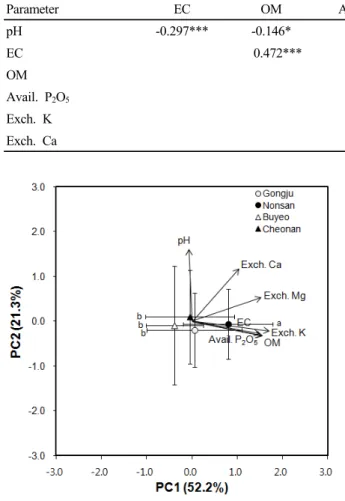
Fig. 2. Principal components analyses of chemical properties of cucumber cultivated soils in controlled horticulture affected by different regions (n=267). The variance explained by the each principal component (PC) axis is shown in parentheses.
Means by the same letter within a column are not significantly different at 0.05 probability level according to Tukey's studentized range test. Bars represent one standard deviation of the mean.
The PC1 of the PCA separated the samples from Nonsan and other regions (p < 0.05).
Fig. 3. Principal components analyses of chemical properties of cucumber cultivated soils in controlled horticulture affected by different soil textures (n=267). The variance explained by the each principal component (PC) axis is shown in parentheses.
Means by the same letter within a column are not significantly different at 0.05 probability level according to Tukey's studentized range test. Bars represent one standard deviation of the mean.
The PC1 of the PCA separated the samples from silty clay loam and loamy fine sand (p < 0.05).
토양의 교환성 마그네슘 함량 분포비율은 적정수준이 6.7%
에 불과하였고 초과비율은 89.2%로 교환성 칼슘 함량 분포 비율과 유사한 경향이었다.
토양 화학성 상관관계 및 주성분 분석 조사농가의 토양 화학성분의 상관관계는 Table 4와 같다. 토양 pH는 교 환성 칼슘 및 마그네슘과 고도의 유의적인 정의 상관을 나 타낸 반면에 EC, 유기물, 유효인산과는 부의 상관을 나타냈 다. 토양 EC는 모든 성분과 고도로 유의적인 정의 상관을 보였으며 특히 교환성 칼륨과 마그네슘의 영향이 큰 것으로 나타났다. 유기물 함량은 EC, 유효인산 및 교환성 양이온들 과 고도의 정의 상관을 보였다. 특히 유효 인산 함량과 상관 계수가 높게 나타난 것은 가축분 퇴비를 유기물의 공급원으 로 농가에서 많이 시용하기 때문인 것으로 판단되었다 (Choi
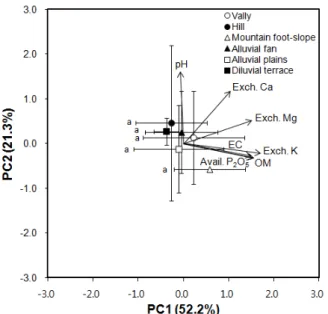
et al., 2010b). 그리고 토양의 교환성 양이온 성분들도 모 두 고도의 정의 상관을 나타냈다. 토양 화학성분의 주성분 분석결과는 Fig. 2, 3, 4와 같다. 각 화학성분 7가지의 주성 분 분석으로 PC (Principal Component) 1은 52.3%, PC 2는 21.2%를 나타냈으며 합계 73.5%의 누적비율을 보였다. 토 양 화학성분의 PC 1 주성분은 교환성 칼륨 (1.682), 유기물 (1.549), 유효 인산 (1.539) 및 교환성 마그네슘 (1.525)이 관 련되었다 (Table 5). 지역에 따른 주성분 분석결과는 논산 지역이 교환성 칼륨, 유기물, 유효 인산 및 교환성 마그네슘 함량의 차이로 인하여 공주, 부여, 천안 지역과 유의적으로 구별되었고 (p < 0.05) 공주와 천안 지역의 오이 수량차이는 화학성에 의한 요인보다 다른 요인에 기인되는 것으로 판단 된다. 토성에 따라 미사질식양토는 양질세사토와 뚜렷하게 구별되었다 (p < 0.05).
Fig. 4. Principal components analyses of chemical properties of cucumber cultivated soils in controlled horticulture affected by different landforms (n=267). The variance explained by the each principal component (PC) axis is shown in parentheses.
Means by the same letter within a column are not significantly different at 0.05 probability level according to Tukey's studentized range test. Bars represent one standard deviation of the mean.
Table 5. Result of principal components analyses (n=267).
Parameter PC1 PC2
pH -0.059 1.603
EC 1.492 -0.325
OM 1.549 -0.376
Avail. P2O5 1.539 -0.367
Exch. K 1.682 -0.215
Exch. Ca 1.089 1.176
Exch. Mg 1.525 0.530
Eigenvalue 3.653 1.494
Proportion (%) 52.2 21.3
Cumulative proportion (%) 52.2 73.5
Conclusion
친환경농업의 확산을 위한 기초자료를 구축하고자 2010 년부터 2011년까지 공주, 논산, 부여, 천안 지역 시설 오이 재배지 267개소의 토양 화학성을 조사하였다. 토양 양분은 적정수준에 비해 pH는 부적정 비율이 많은 반면에 유기물, 유효 인산, 교환성 칼륨, 칼슘, 마그네슘 등은 초과비율이 매우 높아 양분 불균형이 심한 것으로 나타났다. 따라서 지 속 가능한 시설 오이의 안정적인 생산을 위해서는 토양검정 을 통한 적정 시비량 조절이 중요한 것으로 생각된다.
References
Arancon, N.Q., C.A. Edwards, and P. Bierman. 2006. Influences of vermicomposts on field strawberries: Part 2. Effects on soil microbiological and chemical properties. Bioresource Technol.
97:831-840.
Cho, K.R., C.S. Kang, T.J. Won, and K.Y. Park. 2006. Effects of compressed expansion rice hull application and drip irrigation on the alleviation of salt accumulation in the plastic film house soil. Korean J. Soil Sci. Fert. 39:372-379.
Choi, M.T., J.I. Lee, Y.U. Yun, J.E. Lee, B.C. Lee, E.S. Yang, and Y.H. Lee. 2010a. Characteristics of fertility on strawberry cultivated soil of plastic film house in Chungnam Province in Korea. Korean J. Soil Sci. Fert. 43(2):160-165.
Choi, M.T., J.I. Lee, Y.U. Yun, J.E. Lee, B.C. Lee, E.S. Yang, and Y.H. Lee. 2010b. Relationship between fertilizer application level and soil chemical properties for strawberry cultivation under greenhouse in Chungnam Province. Korean J. Soil Sci.
Fert. 43(2):153-159.
Chung, B.Y., K.S. Lee, M.K. Kim, Y.H. Choi, M.K. Kim, J.Y.
Cho. 2008. Salt accumulation and desalinization of rainfall interception culture soils of Rubus sp. in gochang-gun, Jeollabuk- do. Korean J. Soil Sci. Fert. 41:310-317.
Hyun, B.K., S.J. Jung, Y.J. Jung, J.Y. Lee, J.K. Lee, B.C. Jang, and N.D. Choi. 2011. Soil management techniques for high quality cucumber cultivation in plastic film greenhouse. Korean J. Soil Sci. Fert. 44(5):717-721.
Jung, G.B., I.S. Ryu, and B.Y. Kim. 1994. Soil texture, electrical conductivity and chemical components of soils under the plastic film house cultivation in northern central areas of Korea. Korean J. Soil Sci. Fert. 27:33-39.
Kim, J.J., S.S. Kang, K.I. Kim, and S.D. Hong. 2006. Relationship among chemical properties of soils with different texture taken from plastic film house of Chungbuk area. Korean J. Soil Sci.
Fert. 39(3):144-150.
Lee, Y.H., B.K. Ahn, and Y.K. Sonn. 2011. Effects of electrical conductivity on the soil microbial community in a controled horticultural land for strawberry cultivation. Korean J. Soil Sci. Fert. 44(5):830-835.
Lee, Y.H., M.S. Yang, and H.D. Yun. 1996. Effect of plant- growth-promoting-bacteria inoculation on the growth and yield of red pepper (Capsicum annuum L.) with different soil electrical conductivity level. Korean J. Soil Sci. Fert. 29:396-402.
Lee, Y.H., S.T. Lee, K.P. Hong, S.D. Lee, J.H. Kim, Y.S. Ok, M.K. Kim, and H.R. Kim. 2013. Long-term variations of chemical properties in controlled horticultural soils of Gyeongnam Province. Korean J. Soil Sci. Fert. 46(5):308-312.
Lee, Y.H., W.S. Cho, J.G. Kim, H.S. Lee, S.R. Park, and H.D.
Yun. 1997. Effect of plant-growth-promoting bacteria inoculation on the growth and yield of cucumber (Cucumis sativa L.).
Korean J. Soil Sci. Fert. 30:196-199.
Min, S.G., S.H. Lee, S.H. Nam, Y.U. Choi, S.Y. Lee, S.S. Park, S.T. Lee, E.S. Kim, W.D. Song, and Y.H. Lee. 2011. Effect of different cultivation systems on soil glomalin content and nutrient uptake of strawberry in controlled horticultural land.
Korean J. Soil Sci. Fert. 44(3):452-456.
NIAST (National Institute of Agricultural Science and Technology).
2000. Taconomical classification of Korean soils. NIAST, Suwon, Korea.
NIAST (National Institute of Agricultural Science and Technology).
2006. Annual report of the monitoring project on agro-environmental quality in 2004. RDA, Suwon, Korea.
NIAST (National Institute of Agricultural Science and Technology).
2009. Annual report of the monitoring project on agro-environmental quality in 2008. RDA, Suwon, Korea.
NIAST (National Institute of Agricultural Science and Technology).
2010a. Analytical methods of soil and plant. NIAST, Suwon, Korea.
NIAST (National Institute of Agricultural Science and Technology).
2010b. Fertilizer recommendation for crops. RDA, Suwon, Korea.
RDA (Rural development administration). 2012. competitiveness improvement correspond to FTA (Cucumber). RDA, Suwon, Korea.
SAS. 2006. SAS 9.1.3 Version. SAS Inst., Cary, NC.
Seo, Y., M. Ahn, A. Kang, and Y.S. Jung. 2011. Influence of continuous application of low-concentration swine slurry on soil properties and yield of tomato and cucumber in a greenhouse.
Korean J. Soil Sci. Fert. 44(5):773-778.