88
한 국 균 학 회 지
The Korean Journal of Mycology
New Records of Two Agarics: Galerina sideroides and Gymnopus luxurians in South Korea
Seokyoon Jang
1, Yeongseon Jang
2and Jae-Jin Kim
1*
1Division of Environmental Science & Ecological Engineering, College of Life Science & Biotechnology, Korea University, Seoul 136- 701, Korea
2Division of Wood Chemistry & Microbiology, Korea Forest Research Institute, Seoul 130-712, Korea
ABSTRACT : Studies on the diversity of indigenous fungi were conducted in the central districts of South Korea from 2008 to 2013. During the studies, potentially unrecorded agarics were collected. All specimens collected in this study were examined morphologically and phylogenetic analysis was also performed. They were identified as Galerina sideroides and Gymnopus luxurians. These fungi have never been reported in South Korea. We report them here with detailed descriptions and figures.
KEYWORDS : Agaricomycetes, ITS, Phylogeny, Taxonomy
Introduction
Biodiversity has decreased with massive extinctions since the appearance of human. Climate change has also accelerated the loss of biodiversity [1]. In line with the effectuation of the Nagoya Protocol on Access to Genetic Resources and the Fair and Equitable Sharing of Benefits Arising from their Utilization to the Convention on Bio- logical Diversity [2], knowledge of biodiversity is becom- ing much more important.
Fungi have major roles as decomposers and symbiotes in ecosystems. Fungi have also been useful biological res- ources [3]. However, the known diversity of fungi is only a small part of the actual fungal diversity. In Korea, there are more unrecorded fungi than recorded fungi [4].
Therefore, diversity studies on indigenous fungi have been conducted [5, 6].
During the studies, agarics were collected in the cent- ral districts of South Korea from 2008 to 2013. Observa- tion of phenotypic characteristics and molecular analysis were performed for identification of the collected speci- mens. Among them, two species; Galerina sideroides and Gymnopus luxurians were recorded for the first time in the Korean fungous flora. In this paper, the detailed des- cription and figures for two species are provided with a phylogenetic tree for each fungus.
Materials and Methods
Morphological observation
Measurements and drawings were made from slide pre- parations mounted in Melzer's reagent using an Olympus BX51 light microscope (Olympus Corporation, Tokyo, Japan) [7]. More than 30 measurements from different positions were made to ascertain the average dimensions of each characteristic. In the case of basidiospores, 5% of the measurements were excluded from each end of the range, and are shown in parenthesis. Munsell color [8] was followed as the color standard. The voucher specimens were deposited at the Herbarium of the National Insti- tute of Biological Resources, Korea (KB).
Molecular analysis
Genomic DNAs were extracted from the two dry speci- mens using an Accuprep Genomic DNA extraction kit (Bioneer, Daejeon, Korea). In addition, Galerina sideroides CBS 162.46 was received and its genomic DNA was ext-
Research Article
*Corresponding author E-mail: [email protected] Received September 13, 2014 Revised November 29, 2014 Accepted June 12, 2015
This is an Open Access article distributed under the terms of the Creative Commons Attribution Non-Commercial License (http://
creativecommons.org/licenses/by-nc/3.0/) which permits unrestricted non-commercial use, distribution, and reproduction in any medium, provided the original work is properly cited.
Kor. J. Mycol. 2015 June, 43(2): 88-91 http://dx.doi.org/10.4489/KJM.2015.43.2.88 pISSN 0253-651X • eISSN 2383-5249
© The Korean Society of Mycology
First Report of Two Agarics in South Korea
89
racted according to the described method. Internal trans- cribed spacer (ITS) region [9, 10] was analyzed by perfor- ming polymerase chain reaction (PCR) according to the previously described method [11]. For each species under analysis, closely related sequences were downloaded from GenBank. The obtained sequences were proofread and aligned with the selected reference sequences from Gen- Bank using MAFFT 7.130 [12] and modified manually using MacClade 4.08 [13]. Neighbor joining trees were created using PAUP 4.0b10 [14]. The Kimura 2-parameter model was applied [15]. One thousand replications of bootstrap analysis were performed for branch stability.
Results and Discussion
Taxonomy
Galerina sideroides (Bull.) Kühner, Encyclop. Mycol. 7:
215 (1935) (Fig. 1)
Synonym: Galerula stylifera G.F. Atk., P. Amer. Philos.
Soc. 57: 365. 1918
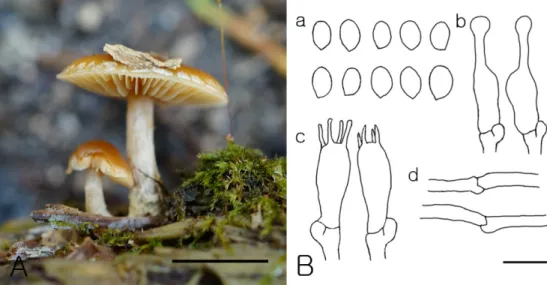
Pileus 1~2 cm diam, convex, appearing viscid, at first brown (7.5YR5/8) to brownish yellow (10YR7/8), becom- ing brown (7.5YR5/8) when dry, margin faintly striate.
Lamellae adnate, subclose pale brown (10YR8/4), becom- ing brown (7.5YR6/6) when dry; spore print brown. Stipe 1~2 cm long, 0.1~0.3 cm wide, central, terete, longitudi- nally striate, very pail brown (10YR8/2), becoming brown (7.5YR6/6) when dry. Partial veil fibrous. Hyphal system monomitic; generative hyphae with clamps, thin-walled or somewhat thick-walled, 2.5~4 µm diam. Basidia cla-
vate; with 4-sterigmata and basal clamp; 18.5~25 × 6~7 µm. Cheilocystidia tibiiform, with basal clamp, thin-walled, slightly projecting, 23.5~28.5 × 5.5~6 µm. Basidiospores smooth, ellipsoid, inamyloid, (5.1~)5.5~7(7.2) × 3.5~4.5 (~4.9) µm.
Specimen examined: Korea, Gangwon-do, Mt. Odae, 37°44'30" N, 128°35'03" E, on the branch of Abies holo- phylla, 2 Oct 2013, Seokyoon Jang, KUC20131001-02 (KB, NIBRFG0000132751; GenBank accession No. KM45 3735).
Note: In South Korea, four species of Galerina; G. caly- ptrata P.D. Orton, G. fasciculata Hongo, G. helvoliceps (Berk. & M.A. Curtis) Singer, and G. vittiformis (Fr.) Singer have been reported [4]. This species is easily reco- gnized by its smaller fruit body and basidiospores com- pared to the other Korean Galerina species [16-18]. The obtained ITS sequence of Galerina sideroides KUC20131 001-02 was 400 bp. It was placed in the monophyletic clade with the reference sequences of G. sideroides (Fig.
2A). Hence, we report KUC20131001-02 as G. sideroides.
Gymnopus luxurians (Peck) Murrill, N. Amer. Flora 9:
362. 1916. (Fig. 3)
Pileus 2.5~6.5 cm diam, convex when young, later plano-convex or plane, convex when dry, margin at first incurved, even, smooth, later decurved, radially streaked;
when young reddish brown (5YR5/3) or reddish grey (5YR5/2) overall, becoming brown (10YR4/4) when dry.
Lamellae shallowly adnexed to sinuate, close; very pale brown (10YR9/2) colored at first, becoming brown (7.5
Fig. 1. Galerina sideroides. A, Basidiocarps; B, Microscopic features; a, basidiospores; b, cheliocystidia; c, basidia; d, generative hyphae (scale bars: A = 1 cm , B = 10 µm).
90
Seokyoon Jang, Yeongseon Jang and Jae-Jin KimFig. 3. Gymnopus luxurians. A, Basidiocarps; B, microscopic features; a, basidiospores; b, basidia; c, cheliocystidia; d, generative hyphae (scale bars: A = 1 cm, B = 10 µm).
Fig. 2. Neighbor joining trees of internal transcribed spacer region sequences of the examined agarics; Galerina sideroides and Gymnopus luxurians. A, The dataset was created from 19 taxa and 393 characters; B, The dataset was created from 22 taxa and 664 characters. Bootstrap values less than 50 were not shown. Specimens examined in this study are in bold. GenBank accession numbers are in parentheses.
First Report of Two Agarics in South Korea
91
YR5/8) when dry. Stipe 3~8 × 0.3~0.6 cm, central, terete or compressed, longitudinally striate, fibrous, hollow, caespitose, pale brown (10YR8/2) at first, becoming brown (10YR4/4) when dry. Partial veil absent. Hyphal system monomitic; generative hyphae with clamp, 2~6.5 µm diam.
Basidia clavate; with 4-sterigmata and basal clamp; 18.5~
26.5 × 5~7 µm. Cheilocystidia with basal clamp, abund- ant; versiform, often irregularly clavate or fusoid, ventri- cose; hyaline, thin-walled, 15.5~24 × 4~7 µm. Basidio- spores more or less ellipsoid, thin-walled, smooth, inamy- loid, (5.5~)5.9~8.8(~9) × (3~)3.2~4.5(~5.1) µm.
Specimen examined: Korea, Chungcheongbuk-do, Mt.
Joryeong, 36°46'12" N, 128°02'24" E, on hardwood, 10 Jul 2008, Jae-Jin Kim, KUC20080710-14 (KB, NIBRFG00001 07194); Seoul, Seongbuk-gu, 37°35'26" N, 127°01'26" E, 10 Jul 2008, Jae-Jin Kim, KUC20080725-28 (KB, NIBRFG00 00107805; GenBank accession no. KM496470).
Note: In Korea, four species of Gymnopus; Gymnopus confluens (Pers.) Antonín, Halling & Noordel, G. dryoph- ilus (Bull.) Murrill, G. erythropus (Pers.) Antonín, Halling
& Noordel, and G. peronatus (Bolton) Gray have been reported [4]. The characteristics of our specimens were in agreement with the previous description of Gymnopus luxurians [19]. G. luxurians is characterized by its larger size of basidiocarp compared with other Korean Gymno- pus spp., brown and convex pileus, close lamellae, and caespitose stripe. In our phylogenetic tree (Fig. 2B), G.
luxurians KUC20080725-18 was placed in the monophy- letic group of G. luxurians with a high bootstrap value (92.2).
Acknowledgements
This research was supported by the Basic Science Res- earch Program through the National Research Founda- tion of Korea (NRF) funded by the Ministry of Education (NRF-2013R1A1A2A10011390). This work was also sup- ported by the project on survey and excavation of Korean indigenous species of NIBR under the Ministry of Environ- ment, Republic of Korea.
REFERENCES
1. Dirzo R, Young HS, Galetti M, Ceballos G, Isaac NJ, Collen
B. Defaunation in the Anthropocene. Science 2014;345:401-6.
2. Secretariat of the Convention on Biological Diversity. Nagoya Protocol on Access to Genetic Resources and the Fair and Equitable Sharing of Benefits Arising from their Utilization to the Convention on Biological Diversity. Montreal: United Nations Environmental Programme; 2011.
3. Deacon JW. Fungal biology. 4th ed. Hoboken: Wiley-Black- well; 2005.
4. Committee of Mycological Term Consultation. List of mush- rooms in Korea. Seoul: Korean Society of Mycology; 2013.
5. Jang Y, Lee SW, Jang S, Lim YW, Lee JS, Kim JJ. Four unre- corded wood decay fungi from Seoul in Korea. Mycobiology 2012;40:195-201.
6. Jang Y, Jang S, Lee J, Lee H, Lee H, Lee YM, Hong JH, Min M, Lim YW, Kim C, et al. Wood decay fungi in South Korea:
polypores from Seoul. Mycobiology 2014;42:140-6.
7. Largent DL, Johnson D, Watling R. How to identify mush- rooms to genus, III. microscopic features. Eureka: Mad River Press; 1977.
8. Munsell color. Munsell soil color charts: with genuine Mun- sell color chips. Grand Rapids: Munsell color; 2009.
9. White TJ, Bruns TD, Lee SB, Taylor JW. Amplification and direct sequencing of fungal ribosomal RNA genes for phylo- genetics. In: Innis MA, Gelfand DH, Sninsky JJ, editors. PCR protocols: a guide to methods and applications. New York:
Academic Press; 1990. p. 315-22.
10. Gardes M, Bruns TD. ITS primers with enhanced specificity for basidiomycetes: application to the identification of mycor- rhizae and rusts. Mol Ecol 1993;2:113-8.
11. Jang Y, Choi HE, Lim YW, Lee JS, Kim JJ. The first report of Ceriporia lacerata (Phanerochaetaceae, Basidiomycota) in Korea. Mycotaxon 2012;119:397-403.
12. Katoh K, Standley DM. MAFFT multiple sequence alignment software version 7: improvements in performance and usabi- lity. Mol Biol Evol 2013;30:772-80.
13. Maddison DR, Maddison WP. MacClade 4.08: analysis of phylogeny and character evolution. Sunderland: Sinauer Associates; 2005.
14. Swofford DL. PAUP*: phylogenetic analysis using parsimony:
4.0 beta. Sunderland: Sinauer Associates; 2002.
15. Kimura M. A simple method for estimating evolutionary rates of base substitutions through comparative studies of nucleo- tide sequences. J Mol Evol 1980;16:111-20.
16. Pegler DN, Young TW. Basidiospore form in the British spe- cies of Galerina and Kuehneromyces. Kew Bull 1972;27:483- 500.
17. Park WH, Lee JH. New wild fungi of Korea. Seoul: Kyohaksa;
2011.
18. Hongo T. Notes on Japanese larger fungi (21). J Jpn Bot 1974;
49:294-305.
19. Desjardin DE, Halling RE, Hemmes DE. Agaricales of the Hawaiian Islands. 5. The genera Rhodocollybia and Gymno- pus. Mycologia 1999;91:166-176.