• 검색 결과가 없습니다.

A New Record of Nannizziopsis mirabilis from Field Soil in Korea

N/A
N/A
Protected

Academic year: 2021

Share "A New Record of Nannizziopsis mirabilis from Field Soil in Korea"

Copied!
6
0
0

로드 중.... (전체 텍스트 보기)

전체 글

(1)

This is an Open Access article distributed under the terms of the Creative Commons Attribution Non-Commercial License (http: //creativecommons.org/licenses/by- nc/4.0/) which permits unrestricted non-commercial use, distribution, and reproduction in any medium, provided the original work is properly cited.

© 2018 THE KOREAN SOCIETY OF MYCOLOGY.

https://doi.org/10.4489/KJM.20180035

RESEARCH ARTICLE

A New Record of Nannizziopsis mirabilis from Field Soil in Korea

Mahesh Adhikari

1

, Sun Kumar Gurung

1

, Sang Woo Kim

1

, Hyun Goo Lee

1

, Han Jun Ju

1

, Byeong Heon Gwon

1

, San Kosol

1

, Setu Bazie

1

, Hyang Burm Lee

2

, Youn Su Lee

1

*

1

Division of Biological Resources Sciences, Kangwon National University, Chuncheon 24341, Korea

2

Division of Food Technology, Biotechnology and Agrochemistry, College of Agriculture and Life Sciences, Chonnam National University, Gwangju 61186, Korea

*Corresponding author: [email protected]

ABSTRACT

Nannizziopsis mirabilis (KNU17-67) was isolated from a field soil sample collected from Jeju- do in 2017. This fungal isolate was identified and described by its morphological characters and the internal transcribed spacer rDNA gene sequencing. Potato dextrose agar medium was used to study its macro and micromorphology. In addition, a molecular phylogenetic tree was constructed for its precise confirmation as N. mirabilis. This fungal isolate has not officially been reported previously in Korea.

Keywords: Ascomycota, Identification, Nannizziopsis mirabilis , Phylogeny

INTRODUCTION

The genus Nannizziopsis is a member of the family Nannizziopsiaceae, the order Onygenales, and can be obtained from soil. Fungal species belonging to the Nannizziopsiaceae have the peculiar character of causing skin infections in reptiles [1]. In addition, the members of this family produce hyaline, thin, and one-celled conidia [1]. This family lies under the largest phylum of the kingdom Fungi, Ascomycota. There are more than 64,000 species of ascomycetes [2]. The typical feature of the ascomycetes is the presence of the ascus, a microscopic sexual structure containing nonmotile spores called ascospores [2].

The genus Nannizziopsis was first described by Currah [3] in 1985 to represent a single species, Rollandina vriesii Apinis [4]. Apinis’ idea to the genus Rollandina was initially based on the structure of hyphae found on the stalk [4], since this structure appears to be based upon two fungi, the stalk, stipe of a small mushroom, and the ascomata of a Nannizzia and its Microsporum anamorph [5]. According to Uchuyama et al. [6], Currah [3] had proposed the new genus Nannizziopsis and proposed the new combination. This genus is characterized by the presence of white ascomata, peridial asperulate hyphae constricted at the septa, and hyaline and globose ascospores [6].

Accepted: August 28, 2018 Revised: August 28, 2018 Received: June 5, 2018

Kor. J. Mycol. 2018 September, 46(3): 249-254 OPEN ACCESS

pISSN : 0253-651X eISSN : 2383-5249

(2)

During a survey of a Korean indigenous fungal species from field soils, Nannizziopsis mirabilis was isolated from Jeju-do field soil in 2017. This fungal species has not been officially reported before, and herein, we are reporting this species as a new record from Korea. The prime objective of this study was to: (1) study the morphology and molecular aspects of N.

mirabilis , and (2) to compare and distinguish this newly recorded species with previously reported N. mirabilis species.

MATERIALS AND METHODS

Soil sample collection and isolation of fungi

Soil samples were brought from agricultural field soils in Jeju-do, Korea. The samples were collected from a depth of 0~15 cm, air dried, and stored in plastic bags at 4°C until use.

Approximately 200~250 g of soil was collected for each sample. Fungal isolates were isolated from a conventional dilution plating technique [7]. One gram of the soil sample was suspended in nine milliliters of sterile distilled water; the mixture was shaken vigorously for 2~3 min. The soil suspensions were diluted serially in sterile distilled water. One milliliter each from the dilutions, 10

-3

, 10

-4

, 10

-5

and 10

-6

, was pipetted and streaked onto petri plates containing potato dextrose agar (PDA; Difco, Detroit, MI, USA) supplemented with 100 μg/L chloramphenicol (a bacteriostatic agent) for 5~7 days at 25°C until the growth of fungal colonies was observed.

The pure cultures were maintained on PDA slants at 4°C for future use.

Morphological description

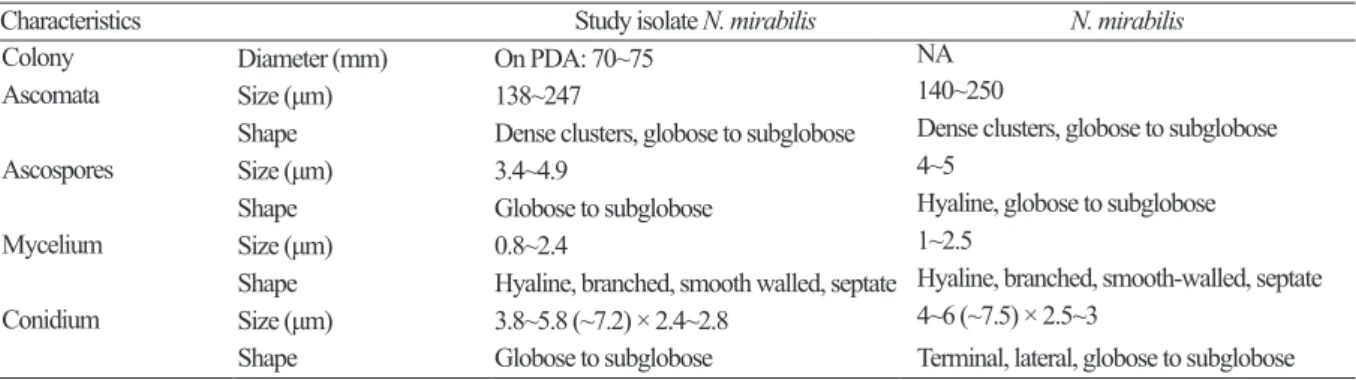
Morphological characteristics of isolates KNU17-67 was observed on PDA (MB Cell, Los Angeles, CA, USA), at 25°C in the dark for 7 days. Medium was prepared as described by Samson et al. [8]. After incubation, the diameter of the colonies was measured, and the degree of sporulation was determined. Colony color (obverse and reverse side) was described using a Methuen handbook of color [9]. Microscopic pictures were taken using an HK 3.1 CMOS digital camera (KOPTIC, Seoul, Korea) attached to an Olympus BX50F-3 microscope (Olympus, Tokyo, Japan) and a scanning electron microscope (LEO Model 1450VP Variable Pressure Scanning Electron Microscope; Carl Zeiss, Oberkochen, Germany). Detailed morphological features of the isolate have been presented in Table 1.

Genomic DNA extraction, sequencing, and data analysis

Total genomic DNA was extracted from isolate KNU17-67 using a DNeasy Plant Mini kit (Qiagen, Germantown, MD, USA), following the manufacturer’s instructions. The internal transcribed spacer (ITS) region of rDNA was amplified by the primers ITS1 (5′-TCCGTAGGTGAACCTGCG-3′) and ITS4 (5′-TCCTCCGCTTATTGATATGC-3′) [10].

The amplified PCR products were sequenced using an ABI Prism 3730 DNA analyzer

(Applied Biosystems, Foster City, CA, USA). The sequences were compared with reference

(3)

ITS sequences from GenBank at the National Center for Biotechnology Information (NCBI), using the basic local alignment search tool [11]. The nucleotide sequence of KNU17-67 was deposited at the culture collection facility of the National Institute of Biological Resources (NIBR, NIBRFG0000501850). The nucleotide sequences were also deposited in GenBank and assigned the accession number MH231761. The isolates used in this study to construct the phylogenetic tree were summarized in Table 2 with their strain and GenBank accession numbers. A phylogenetic relationship was analyzed using molecular evolutionary genetic analysis (MEGA 6) software [12]. A neighbor-joining tree was constructed using the Kimura two-parameter substitution model [13]. Bootstrap analysis was performed with 1,000 replications to determine the support for each clade.

Table 1. Morphological comparison between the studied Nannizziopsis mirabilis isolate and the previously reported N.

mirabilis isolate

Characteristics Study isolate N. mirabilis N. mirabilis

Colony Diameter (mm) On PDA: 70~75 NA

Ascomata Size (μm) 138~247 140~250

Shape Dense clusters, globose to subglobose Dense clusters, globose to subglobose

Ascospores Size (μm) 3.4~4.9 4~5

Shape Globose to subglobose Hyaline, globose to subglobose

Mycelium Size (μm) 0.8~2.4 1~2.5

Shape Hyaline, branched, smooth walled, septate Hyaline, branched, smooth-walled, septate Conidium Size (μm) 3.8~5.8 (~7.2) × 2.4~2.8 4~6 (~7.5) × 2.5~3

Shape Globose to subglobose Terminal, lateral, globose to subglobose PDA, potato dextrose agar; NA, not available.

a
Sources of descriptions [6].

Table 2. List of ITS rDNA sequences of Nannizziopsis mirabilis and its allied species used in this study, along with their isolate and GenBank accession numbers

Seq. no. Species Isolate no. GenBank accession no. (ITS)

1 Nannizziopsis hominis UAMH7859 NR111877.1

2 Nannizziopsis guarroi CCFVBCH10 NR111274.1

3 Nannizziopsis infrequens UAMH10417 NR111181.1

4 Nannizziopsis draconii CCFVB CH12 NR111331.1

5 Nannizziopsis chlamydospora UTHS04-2056 NR111522.1

6 Nannizziopsis obscura UAMH5875 NR111878.1

7 Nannizziopsis pluriseptata UTHSC10-1045 NR111524.1

8 Nannizziopsis dermatitidis UAMH7583 NR111875.1

9 Nannizziopsis arthrosporioides UTHCR-4263 NR111523.1

10 Nannizziopsis vriesii UAMH3527 NR111874.1

11 Nannizziopsis vriesii CBS407.71 AJ131687.1

12 Nannizziopsis barbata UAMH11185 NR111613.1

13 Nannizziopsis crocodili UAMH9666 NR111876.1

14 Paranannizziopsis crustacea UAMH10199 NR111879.1

15 Paranannizziopsis australasiensis UAMH11645 NR111879.1

16 Paranannizziopsis californiensis UAMH10693 NR111880.1

17 Nannizziopsis mirabilis UAMH7712 KF477243.1

18 Nannizziopsis mirabilis (study isolate) KNU17-67 MH231761.1

(4)

RESULTS AND DISCUSSION

Nannizziopsis mirabilis Uchy, Kamiya and Udagawa. Mycoscience 36 (2): 205 (1995).

[MB#413562].

Morphology of the isolate KNU17-67

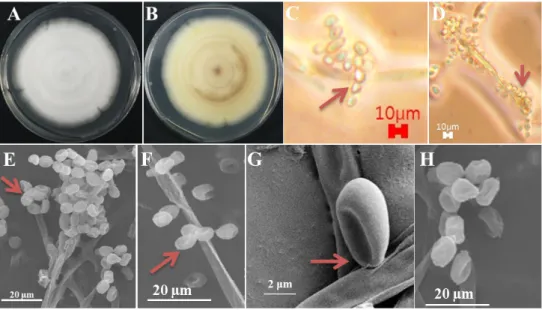
Macro and micro morphological pictures of the isolate are shown in Fig. 1. Colony growth on PDA was fast; the colonies attained a diameter of 70~75 mm after growth for 7 days at 25°C.

The front and back side of the colony was white and yellow color, respectively (Fig 1A, 1B).

The texture of the colony was floccose; the sporulation was dense (Fig. 1C, 1F). The form of the colony was irregular, and the surface was smooth. Ascomata were dense and in clusters, globose to subglobose, and 138~247 μm in diameter. Mycelium was hyaline, branched, smooth-walled, septate, and 0.8~2.4 μm diameter in size. Ascopores were found to be globose to subglobose in shape and have a diameter of 3.4~4.9 μm (Fig. 1D, 1E). Conidia were globose and subglobose, with a size of 3.8~5.8 (~7.2) × 2.4~2.8 μm (Fig. 1D). The morphological characters of the isolate N. mirabilis were compared with those of the previously reported N.

mirabilis [6]. The shape and size of the ascospores and conidia of the studied isolate fit reasonably with the description of N. mirabilis reported by Uchuyama et al. [6], except for the subtle differences in the sizes of the ascomata, ascospores, and conidia. However, the similar macro and micromorphological characters of the studied isolate suggest that the isolate is N.

mirabilis .

Fig. 1. Morphological characters of Nannizziopsis mirabilis KNU17-67 grown on potato dextrose agar for 7 days at 25°C. A, Front colony; B, Back colony; C, Simple microscopic picture of conidia;

D, Simple microscopic picture of apical conidia; E, Scanning electron microscopic picture of terminal

conidia; F, Scanning electron microscopic picture of apical and terminal conidia; G, H, Scanning electron

microscopic picture of ascospores.

(5)

Molecular phylogeny of the isolate KNU17-67

To study the phylogenetic relationship between the studied isolate and previously reported N.

mirabilis , their ITS rDNA sequences were compared and analyzed. As shown in Fig. 2, the study isolate was clustered in the same group, with 100% similarity with N. mirabilis .

Based on both morphological and molecular characters, the studied isolate KNU17-67 was identified as N. mirabilis , which is new in Korea. It has some valuable biotechnological importance that would be valuable in the field of fungal taxonomy and fungal biotechnology.

Conclusively, further studies on the isolation and identification of several new fungal species within the Ascomycota kingdom are required to extend our knowledge about the indigenous fungal species in Korea.

ACKNOWLEDGEMENTS

This work was supported by a grant from the National Institute of Biological Resources (NIBR), funded by the Ministry of environment (MOE) of the Republic of Korea under the project of survey and discovery of indigenous Korean fungal species, and a grant from the University Industry Cooperation Foundation of Kangwon National University (KNU).

REFERENCES

1. Stchigel AM, Sutton DA, Cano-Lira JF, Cabañes FJ, Abarca L, Tintelnot K, Wickes BL,

Fig. 2. Neighbor-joining phylogenetic analysis of Nannizziopsis mirabilis KNU17-67 obtained from

field soil in Korea, by using the partial 18S-ITS1-5.8S-ITS2-28S rDNA region sequences. Numerical

values (> 50) on the branches are the bootstrap values presented as percentage of bootstrap replication

from 1,000 replicate analyses. ‘T’ indicates the type strain of each species.

(6)

Garcia D, Guarro J. Phylogeny of chrysporia infecting reptiles: proposal of the new family Nannizziopsiaceae and five new species. Persoonia 2013;31:86-100.

2. Adhikari M, Gurung SK, Kim HS, Bazie S, Lee HG, Lee HB, Lee YS. Three new records of Ascomycetes isolates from field soils in Korea. Mycobiology 2017;45:327-37.

3. Currah RS. Taxonomy of the Onygenales: Arthodermataceae, Gymnoascaceae, Myxotrichaceae and Onygenaceae. Mycotaxon 1985;24:1-216.

4. Apinis AE. Concerning Rollandina. Trans Br Mycol Soc 1970;55:499-502.

5. von Arx JA. Notes on Gymnoascaceae. Persoonia 1977;9:393-400.

6. Uchuyama S, Kamiya S, Udagawa S. A new species of Nannizziopsis from New Jersey soil.

Mycoscience 1995;36:205-9.

7. Davet P, Rouxel F. Detection and isolation of soil fungi. Plymouth: Science Publishers; 2000.

8. Samson RA, Houbraken J, Thrane U, Frisvad JC, Andersen B. Food and indoor fungi. Utrecht:

CBS-KNAW Fungal Biodiversity Centre; 2010.

9. Kornerup A, Wanscher JH. Methuen handbook of colour. 2nd ed. London: Methuen; 1967.

10. White TJ, Bruns T, Lee S, Taylor J. Amplification and direct sequencing of fungal ribosomal RNA genes for phylogenetics. In: Innis MA, Gelfand DH, Sninsky JJ, White TJ, editors. PCR protocols: a guide to methods and applications. San Diego: Academic Press; 1990. p. 315-22.

11. National Center for Biotechnology Information. GenBank overview [Internet]. Bethesda (MD): National Center for Biotechnology Information; 2015 [cited 2018 June 03]. Available from: https://www.ncbi.nlm.nih.gov/genbank/.

12. Tamura K, Stecher G, Peterson D, Filipski A, Kumar S. MEGA6: Molecular Evolutionary Genetics Analysis version 6.0. Mol Biol Evol 2013;30:2725-9.

13. Kimura M. A simple method for estimating evolutionary rates of base substitutions through

comparative studies of nucleotide sequences. J Mol Evol 1980;16:111-20.

수치

Table 1. Morphological comparison between the studied Nannizziopsis mirabilis isolate and the previously reported N
Fig. 1. Morphological characters of Nannizziopsis mirabilis KNU17-67 grown on potato dextrose  agar  for 7 days at 25°C

참조

관련 문서

The study derived the problems according to results of field-centered synthetic analysis on yellow croakers of fishery system currently used in Chujado, Korea

Relationship between soil pH and phosphatase activity in volcanic ash soil of citrus orchards on the different surface soil management practices at

A laboratory experiment was performed to investigate the removal of nitrogen and phosphorus from plating factory effluent using the soil column.. Soil,

We determined the nucleotide sequences of the mitochondrial DNA (mtDNA) control region using cloning and sequencing, and obtained the complete sequence from the cattle bones

Full genome cloning and nucleotide sequence analysis of hepatitis C virus from sera of chronic hepatitis patients in Korea. Detection of hepatitis C virus RNA

In this architectural design field, the space with new concept and organic space come into sight, escaping from the space concept in the geometric and

In this context, this study compared and analyzed a variety of soil decontamination methods used to evaluate the wide-area soil contaminated with Cs:

The g pressure correction so obtained is used only to correct the velocity field so that it satisfies continuity, i.e., to obtain. The new pressure field is calculated