This is an Open Access article distributed under the terms of the Creative Commons Attribution Non-Commercial License (http: //creativecommons.org/licenses/by- nc/4.0/) which permits unrestricted non-commercial use, distribution, and reproduction in any medium, provided the original work is properly cited.
© 2019 THE KOREAN SOCIETY OF MYCOLOGY.
https://doi.org/10.4489/KJM.20190011
Accepted: March 15, 2019 Revised: March 15, 2019 Received: February 7, 2019 Kor. J. Mycol. 2019 March, 47(1): 89-94
OPEN ACCESS pISSN : 0253-651X eISSN : 2383-5249
RESEARCH NOTE
범부채에서 녹병균 Puccinia iridis의 동정
최인영
1, 최영준
2, 김진영
3, 신현동
4,*1
전라북도농업기술원 농업환경과,
2군산대학교 생물학과,
3경기도농업기술원 원예연구과,
4고려대학교 환경생태 공학부
Identification of Puccinia iridis on Iris domestica in Korea
In-Young Choi
1, Young-Joon Choi
2, Jin-Young Kim
3, Hyeon-Dong Shin
4,*1
Division of Agricultural Environment, Jeollabuk-do Agricultural Research and Extension Services, Iksan 54591, Korea
2
Department of Biology, Kunsan National University, Gunsan 54150, Korea
3
Division of Horticulture Research, Gyeonggi-do Agricultural Research and Extension Services, Hwaseong 18388, Korea
4
Division of Environmental Science and Ecological Engineering, Korea University, Seoul 02841, Korea
*
Corresponding author: [email protected]
ABSTRACT
A rust fungus on Iris domestica (syn. Belamcanda chinensis) from China was previously identified as Puccinia iridis. Accordingly, the identity of the rust fungus on the same host species in Korea needs to be reexamned. Morphological characteristics of the Korean materials matched with P. iridis. Molecular phylogenetic analyses based on internal transcribed spacer and large subunit rDNA sequences of two representative materials confirmed the identification by high sequence similarities of 100% and 99% with the reference sequences available in NCBI GenBank database. Phylogenetic tree inferred from neighbor-joining method proved them to be clustered in P. iridis group. Thus, the rust fungus on I. domestica in Korea was determined as P. iridis. On the other hand, a previous record that Puccinia belamcandae is another rust agent on I. domestica in Korea should be reconfirmed in future.
Keywords: Belamcanda chinensis, identification, Iris domestica, Puccinia belamcandae, Puccinia iridis
범부채는 붓꽃과(
Iridaceae
)에 속하는 숙근성 다년생 식물로서 조경용으로 널리 식재되며[1
-3
], 동양 의학에서도 다양한 용도로 쓰인다[4
]. 범부채는Belamcanda
속의 단일종 식물로서Belamcanda chinensis
(L
.)DC
.로 기록되어 왔으나,2005
년 분류학적 재검토를 통하여Iris
속으로 편입되면서 정 명이Iris domestica
(L
.)Goldblatt
&Mabb
.로 변경되었다[5
]. 이에 따라 범부채 녹병균에 대한 분류학 적 재검토가 이루어졌다[6
]. 즉, 중국 길림성 창춘에서 채집된 범부채 녹병균의 형태적 특징과rDNA
-Young-Joon Choi
https://orcid.org/0000-0002-0909-4723
ITS
영역의 분석을 바탕으로 범부채 녹병균은 기존에 알려진 붓꽃류 녹병균(Puccinia iridis
)으로 동 정되었다. 따라서, 그 동안 범부채 녹병이 기록된 일본, 대만, 인도, 네팔, 한국에서도 범부채 녹병균의 분류학적 재검토를 통하여Puccinia belamcandae Dietel
인지 확인이 필요하다는 의견이 제기되었다 [6
]. 이에 따라 본 연구진은 한국에서 채집되어 고려대학교 진균표본실에 보존된 범부채 녹병균을 재 검토하여 최종적으로Puccinia iridis
로 동정 및 보고하고자 한다.표본 내역
고려대학교 식물표본보관소(
KUS
)에 총2
점의 범부채 녹병균이 보존되어 있다. 보존된 시료 내역은KUS
-F23394
(9 Jun 2008
, 오산, 물향기수목원),KUS
-F30180
(17 Oct 2017
, 화성, 경기도농업기술 원) 등이다.녹병균의 형태적 특징
보존된 표본시료를 육안으로 관찰하여 발병 부위의 병징과 표징을 확인하였고, 해부현미경으로 정확 하게 재검경하였다. 녹병균의 분류학적 특징을 파악하고 크기를 측정하고자 명시야 광학현미경 (
BX51
;Olympus
,Tokyo
,Japan
)을 사용하였다. 광학현미경 사진은 미분간섭현미경(Axio Imager
;Carl Zeiss
,Oberkochen
,Germany
)을 이용하여 촬영하였다. 또한, 녹병균의 외부형태와 미세구조를Fig. 1. Puccinia iridis on Iris domestica. A, Iris domestica plants heavily infected with Puccinia iridis;
B, Uredinia formed on the leaf surface; C, Close-up view of erumpent uredinia; D, E, Urediniospores focused on the median view (D) and the surface view (E) observed under light microscope; F, Uredinium showing a group of urediniospores; G, H, Urediniospores observed under scanning electron microscope.
관찰은 주사전자현미경(
JSM
-5410LV
;JEOL
,Japan
)을 이용하였다.여름포자더미(
uredinia
)는 주로 잎 양면에 형성되었으나 시료에 따라 때로는 한쪽 면에 훨씬 더 많 이 형성되는 경우도 있었다. 또한, 대부분 군데군데 흩어져 있었지만 때로는 엽맥을 따라 연이어 형성 되기도 하였다(Fig
.1A
). 색깔은 적갈색 내지 진갈색으로 다소 돌출되었으며, 장타원형 내지 원통형 에 가까운 모양으로 길이는600
~1
,200 µm
, 폭은200
~600
(~900
)µm
의 범주에 들지만 때로는2
~4
개 의 여름포자더미가 붙은 듯이 길게 형성된 경우도 있었다. 거의 대부분 여름포자더미를 덮고 있던 기 주식물의 표피세포층이 찢어진 채로 잔존하여 지저분한 모습이었다(Fig
.1B
,1C
). 여름포자 (urediniospore
)는 매우 짧거나 거의 흔적에 가까운 꼭지(pedicel
)가 있으며, 거꾸로 계란형 내지 밑이 좁아지는 타원형이거나 구형에 가까우며,22
~32 x 20
~26 µm
(자연건조 상태)였다. 여름포자의 세포 벽 두께는 약2
~3 µm
이며, 담황색 내지 무색이며, 표면에 미세한 돌기가 분포하였다(Fig
.1D
~1H
). 겨 울포자 세대는 채집되지 않았다. 이러한 형태적 특징은Iris spp
.에서 보고된Puccinia iridis Wallr
.의 기록과 일치하였다[6
,7
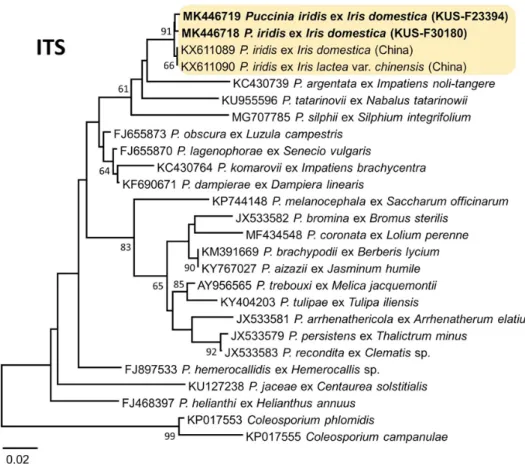
].Fig. 2 Phylogenetic tree inferred from neighbor-joining method using the internal transcribed spacer
(ITS) ribosomal DNA (rDNA) region sequences of Puccinia iridis on leopard flower (Iris domestica) isolates and some reference isolates retrieved from GenBank. The numbers above the nodes are the bootstrap values obtained from 1,000 replications. The Korean isolates presented in this study are indicated in bold.염기서열 분석
고려대학교 표본실에 보존되어 있는 범부채 녹병균 시료
2
점(KUS
-F23394
,F30180
)의 시료를 대상 으로internal transcribed spacer
(ITS
) 영역과28S large subunit
(LSU
)rDNA
영역의 염기서열을 분 석하였다.Aime
[8
]의 방법에 따라 건조 시료에서 여름포자를 메스로 긁어1
.5 ml eppendorf tube
에 채 취하고 액체질소를 넣고 마쇄한 후,DNeasy Plant Mini kit
(QIAGEN
,Valencia
,CA
)를 이용하여genomic DNA
를 추출하였다.Ribosomal DNA
(rDNA
)의internal transcribed spacer
(ITS
) 영역은ITS15u
/ITS4rust primer
[9
],28S large subunit
(LSU
) 영역은LR0R
와LR6 primer
[10
]를 사용하여PCR
로 증폭시켰다. 증폭된 산물은 정제를 위해1
.5
%agarose gel
에서 분리한 후PCR purification kit
(Core
-one
TM,Core
-bio
,Korea
)를 사용하였다.ABI 3130 auto sequencer
를 이용하여ITS
와LSU
의 염 기서열을Macrogen
(Seoul
,Korea
)에 의뢰하여 분석하였으며,ITS
와LSU rDNA
염기서열은GenBank database
(National Centre for Biotechnology Information
[NCBI
],US National Institute of Health Bethesda
,http
://blast
.ncbi
.nlm
.nih
.gov
/Blast
.cgi
)에서 확인하였다. 또한,DNASTAR computer package 7
.1
(Lasergene
,Madison
,WI
,USA
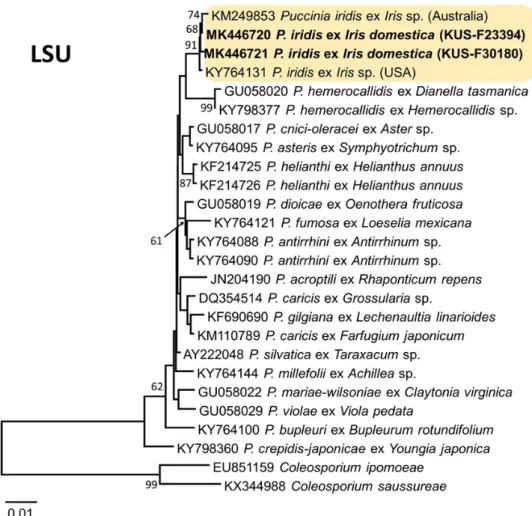
)를 이용하여 염기서열을 편집 및 정리하였다.Fig. 3. Phylogenetic tree based on neighbor-joining method comparing the large subunit (LSU)
sequences of Puccinia iridis on leopard flower (Iris domestica) isolates and some reference isolates retrieved from GenBank. The numbers above the nodes are the bootstrap values obtained from 1,000 replications. The Korean isolates presented in this study are indicated in bold.계통학적 분석은
MEGA 6
.06 program
[11
]을 이용하여neighbor
-joining
방법으로 작성하였으며, 염 기서열의 유전자 거리는Tamura
-Nei parameter model
로 계산하였고,bootstrap analysis
은1
,000
반복으로 수행하였다.범부채 녹병균(
KUS
-F23394
,F30180
)에 대한NCBI
의GenBank
등록번호는ITS
영역의 염기서열 은MK446719
,MK446718
이며,LSU
영역의 염기서열은MK446720
,MK446721
이다.NCBI
에서ITS
영역에 대한Blastn
분석한 결과GenBank
에P
.iridis
로 등록된 염기서열KX611089
,KX611090
등과100
%의 상동성을 보였다. 또한LSU
영역에 대한Blastn search
한 결과도P. iridis
로 등록된 염 기서열KM249853
,KY764131
등과99
%의 상동성을 보였다. 또한, 계통수 작성 결과MK446719
,MK446718
의ITS
염기서열은 중국에서 채집한Iris domestica
(범부채),Iris lactea var
.chinensis
(타 래붓꽃)의P
.iridis
와 하나의 그룹을 형성하였으며(Fig
.2
),MK446720
,MK446721
의LSU
염기서열 은 미국과 호주에서 채집한Iris sp
.(붓꽃속)의P
.iridis
와 같은 계통으로 묶였다(Fig
.3
).고찰
붓꽃속(
Iris
)은 붓꽃과(Iridaceae
), 붓꽃족(Irideae
)에 속하며, 약300
종을 포함하는 큰 분류군이다[3
].우리나라에 자생하는 붓꽃속 식물은 범부채를 포함하여
16
종이지만[12
], 독일붓꽃(Iris
×germanica
) 을 비롯한 수많은 원예종들이 도입되어 식재되고 있다. 그 중에서 붓꽃(Iris sanguinea
=Iris nertschinskia
)의 녹병균은Puccinia iridis
[7
], 범부채의 녹병균은P
.belamcandae
[1
]로 보고되어 있 다. 본 연구를 통하여 우리나라 범부채에도 녹병균으로P
.iridis
가 존재한다는 사실을 확인하였다. 앞 서 범부채에서 녹병균으로 기록된P
.belamcandae
의 정체성에 관해서는 좀더 연구가 필요하다[1
]. 전 세계에P
.iridis
의 기주식물로 총77
종이 기록되었으며,Iris
속의 종이 약26
%이지만, 조경용으로 식 재되거나 재배되는 대부분의 기주식물에는 기록되어 있다. 따라서 향후 우리나라에서도 붓꽃류의 녹 병이 더 발견될 가능성은 매우 높을 것으로 생각된다.다른 한편으로는, 이와 같이 종 분화가 많이 이루어진
Iris
속의 식물에서 녹병균이P
.iridis 1
종이 라는 것도 주목할 부분이다. 미국농무성의 데이터베이스에는Puccinia sessilis
,P
.melanopsis
,P
.phyllachoroidea
등이 한 때 일부 종의Iris
식물에 기록된 것으로 되어 있지만, 이러한 기록들은 대부 분 오류이거나 재확인이 필요할 것으로 판단된다[13
]. 따라서 정확하게 형태적 검경에 의해P
.iridis
로 동정된 신뢰할만한 시료들을 대상으로 분자계통학적 분석을 통해 종 다양성의 범주 또는 다계통 성 여부를 연구할 필요가 있다. 이런 관점에서 한국의 범부채 녹병균의 형태적 특징과 분자적 정보를 제공하고, 최종적으로P
.iridis
로 동정한 것은 균학적으로 크게 기여하였다고 평가 받을 수 있다.적요
중국에서 범부채의 녹병균이
Puccinia iridis
로 동정됨에 따라 우리나라에서도 범부채의 녹병균을 재 검토하였다. 저자들이 채집한2
점의 시료를 형태적으로 검토한 결과 모두P
.iridis
의 특징과 일치하 였다. 또한 유전분석한 결과ITS
및LSU rDNA
영역의 염기서열이 기존에 기록된P
.iridis
와 각각100
% 및99
%의 상동성을 나타냈다. 이를Neighbor
-joining
분석법으로 계통수를 작성하였을 때도P
.iridis
계통군에 속하였다. 따라서 우리나라에서 범부채의 녹병균으로P
.iridis
의 존재가 확인되었 다. 한편, 우리나라에서2003
년에 범부채의 녹병균으로 기록된Puccinia belamcandae
에 대한 재검토 는 향후 숙제로 남게 되었다.ACKNOWLEDGEMENTS
This study was supported by a grant from the National Research Foundation of Korea
(NRF
),funded by the Ministry of Science
,ICT
&Future Planning
[Project No
.2016R1C1B2008013
],Republic of Korea
.REFERENCES
1. Kwon JH, Park CS. Rust of Belamcanda chinensis caused by Puccinia belamcandae. Kor J Mycol 2004;32:54-6.
2. Park SJ, Sim JK, Park HD. A molecular systematic study of Korean Iris (Iridaceae) based on RAPD analysis. Kor J Plant Taxon 2002;32:383-96.
3. Sim JK, Kim JH. A Systematic Study of the genus Iris series Chinensis Lawrence (Iridaceae) based on RAPD analysis. Kor J Plant Taxon 2002;32:95-108.
4. Woźniak D, Matkowski A. Belamcandae chinensis rhizoma-a review of phytochemistry and bioactivity. Fitoterapia 2015;107:1-14.
5. Goldblatt P, Mabberley DJ. Belamcanda included in Iris, and the new combination I.
domestica (Iridaceae: Irideae). Novon 2005;15:128-32.
6. Ji JX, Wang Q, Li Y, Li Z, Kakishima M. New rust disease caused by Puccinia iridis on leopard flower in China. Plant Dis 2017;101:383.
7. Kwon JH, Park CS. Rust of Iris nertschinskia caused by Puccinia iridis. Res Plant Dis 2003;9:125-7.
8. Aime MC. Toward resolving family-level relationships in rust fungi (Uredinales).
Mycoscience 2006;47:112-22.
9. Beenken L, Zoller S, Berndt R. Rust fungi on Annonaceae II: the genus Dasyspora Berk. &
MA Curtis. Mycologia 2012;104:659-81.
10. Vilgalys R, Hester M. Rapid genetic identification and mapping of enzymatically amplified ribosomal DNA from several Cryptococcus species. J Bacteriol 1990;172:4238-46.
11. Tamura K, Stecher G, Peterson D, Filipski A, Kumar S. MEGA6: molecular evolutionary genetics analysis version 6.0. Mol Biol Evol 2013;30:2725-9.
12. Koh JC. Germplasm collection of natural Iris spp. and commercial varietal development.
Seoul Korea: Ministry of Science and Technology; 2006.
13. Farr DF, Rossman AY. Fungal databases. Systematic mycology & microbiology laboratory, ARS, USDA. Internet Resource; 2019 [cited 2019 Jan 28] Available from: http://ntars- gringov/fungaldatabases/.