J. Fish Pathol., 32(2) : 069~080 http://dx.doi.org/10.7847/jfp.2019.32.2.069
Introduction
The family Vibrionaceae consists of a large num- ber of ecologically diverse species and is widely dis- tributed in the aquatic environment. They are either ubiquitous inhabitants of aquatic environments or symbiotic with marine life, but some of them are pathogenic to other organisms (Thompson et al., 2005; Soto and Nishiguchi, 2014). As of 2017, the family Vibrionaceae is classified into 8 genera:
Vibrio, Photobacterium, Catenococcus, Grimontia, Echinimonas, Salinivibrio, Enterovibrio and Aliivibrio (Doi et al., 2017).
The genus Aliivibrio was established with the spe- cies previously belonged to the genera Photobacte- rium and Vibrio, based on phylogenetic and pheno- typic differences from them (Urbanczyk et al. 2007), and currently comprises 6 species: Aliivibrio fischeri (Beijerinck, 1889), Aliivibrio logei (Bang et al., 1978), Aliivibrio salmonicida (Egidius et al., 1986), Aliivi- brio wodanis (Lunder et al., 2000), Aliivibrio fini- sterrensis (Beaz-Hidalgo et al., 2010) and Aliivibrio sifiae (Yoshizawa et al., 2010). Within the genus
Multilocus sequence analysis of the genus Aliivibrio: Identification and phylogeny of Aliivibrio species isolated from cultured
walleye pollock (Gadus chalcogrammus) in Korea
U-Hwa Nam, Hyun-Joon Seo, Su-Rim Jang, Mi-Ri Kim and Jeong-Ho Kim†
Department of Marine Bioscience, Gangneung-Wonju National University, Gangneung, 25457, Korea
We performed MLSA (multilocus sequence analysis) and phenotypic characterization of Aliivibrio species isolated from walleye pollock (Gadus chalcogrammus) maintained in 3 different facilities of Gangwon Province, the east coast of Korea. Of 38 Aliivibrio species identified by 16S rDNA sequences, 12 strains were randomly selected and MLSA was conducted with 5 house-keeping genes (gapA, gyrB, pyrH, recA and rpoA) and 16S rDNA gene. Phylogenetic analysis and homology of the concatenated sequences (4,580 bp) with other Vibrionaceae genera revealed that 4 strains (GNGc16.1, YYGc16.1, YYGc16.2, GSGc18.1) were identified as Aliivibrio logei and one strain (GSGc16.1) as A. wodanis. One strain (GSGc17.1) was tentatively identified as A. logei, but needs further analysis because it did not belong to the same clade with A. logei type strain. 6 strains (GSGc17.2, GNGc16.2, GSGc16.2, GSGc17.3, GSGc18.2, GSGc17.4) need further investigation as potential novel species. Either phenotypic characterization or 16S rDNA sequence alone did not provide enough information for identification of Aliivibrio strains at the species level. A. logei and A. wodanis are generally known as non-pathogenic bacteria, but also known as opportunistic or secondary pathogens of cold water fishes. Cares should be taken to prevent potential outbreaks due to these bacteria, although there was no outbreaks during the sampling period.
Key words: Aliivibrio, Vibrionaceae, MLSA, Multilocus sequence analysis, Walleye pollock, Gadus chalcogrammus.
†Corresponding author: Jeong-Ho Kim Tel: +82-33-640-2851; Fax: +82-33-640-2340 E-mail: [email protected]
Aliivibrio, 3 species (A. fischeri, A. logei, A. sifiae) are known for bioluminescence (Dunlap et al., 2007;
Kaeding et al., 2007; Yoshizawa et al., 2010). On the other hand, A. salmonicida and A. wodanis are known to cause cold water vibriosis (CV), Hitra disease and winter ulcer in cold water fish species such as Atlantic salmon (Salmo salar) and Atlantic cod (Gadus mo- rhua) (Egidius et al., 1986; Lunder et al., 2000;
Khider et al., 2018). Moreover, the bioluminescetic A. logei is also known as a potential pathogen of cod larvae (Reid et al., 2009). Therefore, clear identi- fication of the genus Aliivibrio to the species level is important for precise diagnosis and appropriate control strategies in aquaculture farms.
In general, identification of Aliivibrio species can be attempted by amplification of 16S DNA fragment.
However, it is difficult to identify them with a single 16S DNA gene, because the homology of this gene among the species in the family Vibrionaceae is very high (Urbanczyk et al., 2007). Recent advances in ge- netic analysis technology have enabled genus Alivibrio to be distinguished from other Vibrionaceae genera at the genome-level, but due to the presence of vari- ous phenotypes in the genus Aliivibrio, the clear dis- tinction among species is still difficult (Ast et al., 2009).
Various methods have been applied to clearly iden- tify Vibrios to the species level, and in particular, identification using MLSA (Multilocus Sequence Analysis) has been actively used for Vibrios taxon- omy (Sawabe et al., 2007; Thompson et al., 2009).
MLSA is a method for delineating bacterial species within a genus and obtaining a higher resolution of the phylogenetic relationships among species or gen- era, by combining 16S rDNA sequences commonly used for bacterial identification with a number of housekeeping gene sequences (Glaeser and Kämpfer, 2015). Several MLSA schemes have been reported for identification and phylogenetic relationships of bacterial genera and species within genera (e.g., genus Aeromonas, genus Edwardsiella, genus Photobacte-
rium and genus Vibrio) (Cano-Gomez et al., 2011;
Abayneh et al., 2012; Labella et al., 2018; Wamala et al., 2018).
Walleye pollock (Gadus chalcogrammus) is one of the most commercially valuable fish species in Korea.
The annual catch of walleye pollock has been drasti- cally decreased since 2000s, and not fully recovered yet (Kang and Kim, 2015). Recently artificial prop- agation of walleye pollock was succeeded (Seo and Kwon, 2017), but still there is insufficient information available for successful recovery for walleye pollock resources in Korea. In general, mortalities due to in- fection of pathogens are thought to be one of the main obstacles against successful mass production of fish fry. Thus, it is necessary to investigate potential patho- gens in walleye pollock. Currently, several pathogens such as Ichthyophonus, viral hemorrhagic septicemia virus (VHSV), nervous necrosis virus (NNV) and Vibrio anguillarum have been reported in walleye pollock (Meyers et al., 1999; White et al., 2014; Jeon et al., 2016; Nam et al., 2017; Seo et al., 2018), but no mass mortality associated with these pathogens has been reported yet.
During the routine monitoring of bacterial diseases in artificially produced walleye pollock from aqua- culture facilities in Gangwon Province, the east coast of Korea, bacterial strains suspicious of the genus Aliivibrio were constantly obtained. The presence of Aliivibrio species in seawater was reported in Korea (Suh et al., 2015), but not identified at the species level. In this study, we identified the genus Aliivibrio isolated from walleye pollock at the species level by MLSA, together with phenotypic characteristics.
Materials and methods
Sampling
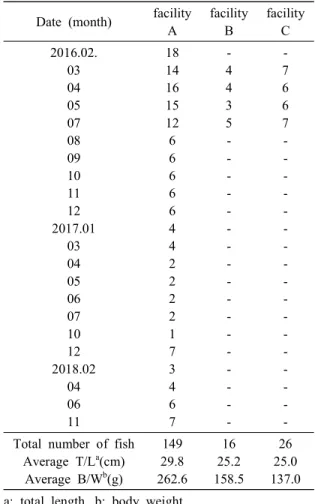
A total of 191 fish (average total length 27.9 cm, average body weight 220.2 g) were randomly col- lected from 3 different locations (A, B, C) during February 2016 and November 2018 (Table 1). The
aquaculture facility A used FRP round tank filled with deep sea water and surface water to maintain the wa- ter temperature constant (approximately 10℃). The facility B used marine netpen cages and the water temperature was fluctuated seasonally (8-20℃). The facility C used FRP tank, but the water temperature was fluctuated during sampling period (10-20℃). The fish in the facility B and C were maintained until June and July, due to the high water temperature in summer. We also collected seawater flowing into the fish tank of the facility C.
Isolation of bacteria
The fish samples were taken to the laboratory im-
mediately after sampling, and euthanized by an over- dose of anesthetics (2-phenoxyethanol, Sigma, USA).
After measuring the body size of the samples, the presence of any external abnormal signs were checked with naked eyes. Then, the abdominal cavity of the fish was opened and the internal organs were exam- ined. The sterilized loop were deeply stabbed into the spleen and kidneys to plate on TSA medium (Trypti- case soybean agar, Difco, USA) supplemented with 1.5% NaCl and the plate cultured at 20℃ for 24 to 48 h. Approximately 50 mg of the upper part of the small intestine was also cut and homogenized with 450 μl of PBS. Then they were diluted to 102 folds and plated on TSA medium as above. The most domi- nant colonies were transferred to TCBS medium (Thiosulfate citrate bile salts sucrose, Difco, USA) and incubated at 20℃ for 24-48 h. 200 μl of filtered seawater with a membrane filter (pore size 5.0 μm, Advantec, Japan) was applied to the TSA medium, and then bacterial isolation was attempted as above.
Genomic DNA extraction
All of the 124 colonies appeared in TCBS medium were cultured in TSB medium (Trypticase soybean broth, Difco, USA) supplemented with 1.5% NaCl at 20℃ for 24 h. The cultured bacteria were pelleted by centrifugation at 1,764 ×g for 10 min, washed 2-3 times with PBS, and centrifuged again under the same conditions. After that, genomic DNA was extracted according to the QIAamp DNA mini kit (Qiagen, Germany). 180 μl of ATL buffer and 20 μl of Protei- nase K (10 mg / ml) were added to the bacterial pellet and lysed at 60℃. And 200 μl of AL buffer was add- ed and reacted at 70℃ for 10 min. The DNA was precipitated by adding 200 μl of ethanol, transferred to a column tube, washed at 5,018 ×g, and then 200 μl of AE buffer was added to extract the genomic DNA.
PCR amplification and phylogenetic analysis using MLSA
Table 1. Sampling information of walleye pollock (Gadus chalcogrammus)
Date (month) facility A
facility B
facility C 2016.02.
03 04 05 07 08 09 10 11 12 2017.01
03 04 05 06 07 10 12 2018.02
04 06 11
18 14 16 15 12 6 6 6 6 6 4 4 2 2 2 2 1 7 3 4 6 7
- 4 4 3 5 - - - - - - - - - - - - - - - - -
- 7 6 6 7 - - - - - - - - - - - - - - - - - Total number of fish
Average T/La(cm) Average B/Wb(g)
149 29.8 262.6
16 25.2 158.5
26 25.0 137.0 a: total length, b: body weight
Conventional PCR was conducted with 124 bacte- rial strains, using 16S rDNA primer set (Table 2).
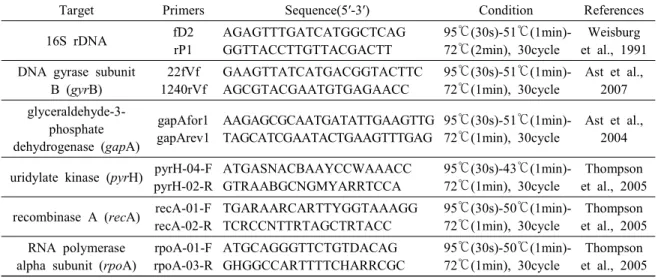
The amplified PCR product was electrophoresed us- ing 1.5% agarose gel and the target band was con- firmed under a UV transilluminator. The target band was purified using gel purification kit (Bioneer, Korea), and sequenced with ABI Prism 3730 XL DNA analyzer (PE applied biosystems, USA). The obtained 16S rDNA sequences were compared with those of the family Vibrionaceae in the GenBank by Blast search (NCBI, USA). Of the Aliivibrio species identified by 16S rDNA sequences, 12 strains (8 in A, 2 in B, 2 in C) were randomly selected for further MLSA. Additional primer sets were selected for MLSA : DNA gyrase subunit B (gyrB), glyceraldehyde- 3-phosphate dehydrogenase (gapA), uridylate kinase (pyrH), recombinase A (recA) and RNA polymerase alpha subunit (rpoA) genes. Information on all the primer sets and PCR conditions are shown in Table 2. The PCR products were sequenced by the same method as above.
Multiple alignment was performed with the refer- ence sequences of the family Vibrionaceae (Ast et al., 2009; Yoshizawa et al., 2010), to analyze system- atic information of the genus Aliivibrio bacteria iso- lated from walleye pollock in this study. We removed
all gaps and missing sequences among multiple sequences. Neighbor joining tree (Saitou and Nei, 1987) was constructed using the Kimura two-parame- ter model of the MEGA 7 program (Kimura, 1980;
Kumar et al., 2016), and the bootstrap values were based on 1,000 times.
Phenotypic characterization
Biochemical and physiological characteristics of the 12 strains used for MLSA were also investigated.
API 20E and API ZYM test (Biomerieux, France) were conducted for biochemical characterization.
Conventional gram staining and catalase test were al- so conducted. In addition, these strains were cultured in TSB (Trypticase soybean broth, Difco, USA) me- dium to observe growth by different salinity condition (0.5, 5, 7% NaCl) and different temperature condition (4, 10, 22, 25, 30℃). The results was compared with those of other known genera in the family Vibriona- ceae.
Results and Discussion
A total of 38 strains were identified as Aliivibrio species by 16S rDNA sequencing of 124 strains pro- duced in TCBS medium. They showed 99.4-100.0%
Table 2. Oligonucleotide primers used for PCR identification of isolated bacteria
Target Primers Sequence(5′-3′) Condition References
16S rDNA fD2
rP1
AGAGTTTGATCATGGCTCAG GGTTACCTTGTTACGACTT
95℃(30s)-51℃(1min)- 72℃(2min), 30cycle
Weisburg et al., 1991 DNA gyrase subunit
B (gyrB)
22fVf 1240rVf
GAAGTTATCATGACGGTACTTC AGCGTACGAATGTGAGAACC
95℃(30s)-51℃(1min)- 72℃(1min), 30cycle
Ast et al., 2007 glyceraldehyde-3-
phosphate dehydrogenase (gapA)
gapAfor1 gapArev1
AAGAGCGCAATGATATTGAAGTTG TAGCATCGAATACTGAAGTTTGAG
95℃(30s)-51℃(1min)- 72℃(1min), 30cycle
Ast et al., 2004
uridylate kinase (pyrH) pyrH-04-F pyrH-02-R
ATGASNACBAAYCCWAAACC GTRAABGCNGMYARRTCCA
95℃(30s)-43℃(1min)- 72℃(1min), 30cycle
Thompson et al., 2005 recombinase A (recA) recA-01-F
recA-02-R
TGARAARCARTTYGGTAAAGG TCRCCNTTRTAGCTRTACC
95℃(30s)-50℃(1min)- 72℃(1min), 30cycle
Thompson et al., 2005 RNA polymerase
alpha subunit (rpoA)
rpoA-01-F rpoA-03-R
ATGCAGGGTTCTGTDACAG GHGGCCARTTTTCHARRCGC
95℃(30s)-50℃(1min)- 72℃(1min), 30cycle
Thompson et al., 2005
homology with all other Aliivibrio species registered in the GeneBank (data not shown), and it was difficult to clearly identify them at the species level with a single gene. Because each Aliivibrio species are known to have highly homologous genes among each other (Urbanczyk et al., 2007; Ast et al., 2009), MLSA is required for clear identification of Allivibrio strains at the species level. In this study, we randomly selected the 12 Aliivibrio species identified by 16S rDNA gene sequencing, and brought them to MLSA by combining the nucleotide sequences of 6 genes (gyrB, gapA, pyrH, recA, rpoA and 16S rDNA).
Then, these concatenated sequence data (4,580 bp) were compared with those of genus Aliivibrio, genus Photobacterium and genus Vibrio for the species identification and phylogenetic analysis.
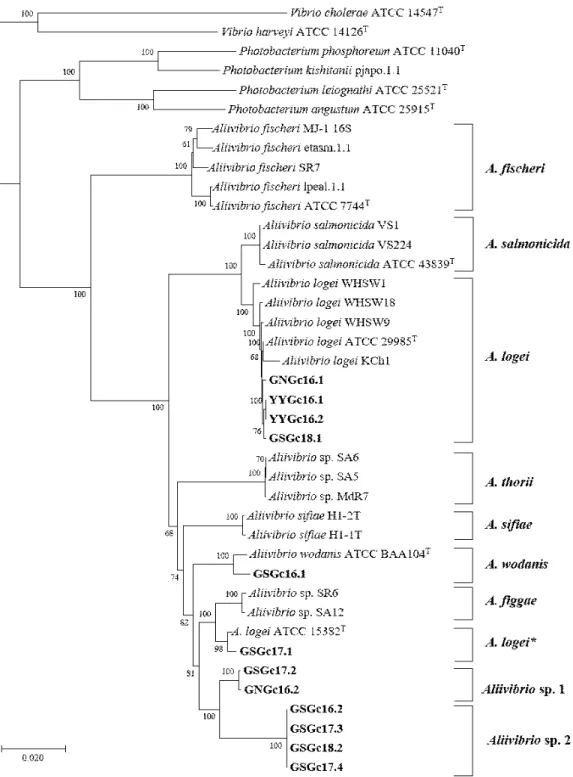
The Aliivibrio concatenated alignment tree resolved A. fischeri, A. salmonicida, A. logei, A. sifiae and A.
wodanis as distinct clades with strong bootstrap sup- port. A. thorii and A. figgae also fell into 2 distinct clades, although their species name are not officially accepted yet (Fig. 1). 6 of 12 strains were closely clustered with A. logei ATCC 29985T (GNGc16.1, YYGc16.1, YYGc16.2, GSGc18.1), A. logei ATCC 15382T (GSGc17.1) and A. wodanis ATCC BAA104T (GSGc16.1), while the other 6 strains (GSGc17.2, GNGc16.2, GSGc16.2, GSGc17.3, GSGc18.2, GSGc 17.4) were clustered distinctly from other known Aliivibrio species and divided into 2 clusters (Fig. 1).
Interestingly, GSGc17.1 was clustered with A. logei ATCC 15382T, but they were independently clustered with the type strain A. logei ATCC 29985T and other strains (GNGc16.1, YYGc16.1, YYGc16.2, GSGc18.1) (Fig. 1).
When the concatenated sequences (4,580 bp) of the 12 Allivibrio strains from walleye pollock and other Aliivibrio species used in MLSA were compared to investigate their homology, 4 strains (GNGc16.1, YYGc 16.1, YYGc16.2, GSGc18.1) showed 99.8% homol- ogy with A. logei type strain ATCC 29985T, and 99.4- 99.5% homology with A. logei WHSW1 (Table 3A).
GSGc16.1 showed 99.1% homology with A. wodanis type strain ATCC BAA-104T, 97.4 homology with A.
figgae SA12 and 96.8% homology with A. logei ATCC 15382T (Table 3B). GSGc17.1 showed 99.6%
homology with A. logei ATCC 15382T, 98.6% homol- ogy with A. figgae SA12 and 96.8% homology with A. wodanis ATCC BAA-104T (Table 3B). However, A. logei ATCC 15382T and GSGc17.1 showed only 95.2% and 95.0% homology with the type strain A.
logei ATCC 29985T (Table 3B), respectively. Ast et al., (2009) demonstrated that 3 strains (A. logei ATCC 15382T, A. logei SR6, A. logei SA12) belong to differ- ent clusters from type strain A. logei ATCC 29985T, and mentioned these 3 strains might be incorrectly identified. Recently, Klemetsen (2016) reidentified 2 strains (A. logei SR6, A. logei SR12) as A. figgae by MLSA.
For MLSA, we only selected Allivibrio strains hav- ing all 6 genes (gyrB, gapA, pyrH, recA, rpoA and 16S rDNA) sequences available in NCBI. Conse- quently, 5 different A. logei strains were found but only 1 A. wodanis strain and no A. finisterrensis strain were found for MLSA in our study. Moreover, Klemetsen (2016) reported 5 new Aliivibrio species (e.g., A. magni, A. thrudae, A. modi, A. friggae and A. raniae) but did not register their genetic informa- tion in NCBI. More information on those house-keep- ing genes of the Aliivibrio species mentioned above, particularly for A. wodanis, would be necessary to resolve their phylogenetic position and relationships with other known Allivibrio species.
Biochemical and physiological characteristics of 12 strains used in MLSA were also investigated. All strains were identified Gram- negative. Biochemical and physiological characteristics of the 4 strains (GNGc16.1, YYGc16.1, YYGc16.2, GSGc18.1) were identical to those of A. logei ATCC 29985T, except for 25℃ growth. For GSGc16.1 and GSGc17.1 strains, biochemical and physiological characteristics were identical to those of A. wodanis ATCC BAA-104T and A. logei ATCC 15382T, respectively, except for
Fig. 1. Phylogenetic reconstructions based on six concatenated genes (gapA, gyrB, pyrH, recA, rpoA, and 16S rDNA).
Alignment was performed on all genes, and gaps and missing parts in the sequence were eliminated to make a total of 4,580 bp. The number after bacterial scientific name means strain number registered in the NCBI. This tree was constructed based on neighbor-joining method. Numbers at nodes denote the level of bootstrap based on 1,000 replicates. A. thorii and A. figgae have not been recognized as official bacterial species names yet.
several parameters (e.g. 30℃ growth test, indole test, gelatinase activity test, D-mannose test, sucrose test for GSGc16.1, and 30℃ growth test, lysine-decarbox- ylase test, urease test for GSGc17.1). The 6 sreains (GSGc17.2, GNGc16.2, GSGc16.2, GSGc17.3, GSGc 18.2, GSGc17.4) shared several biochemical and physiological characteristics with other species of ge- nus Aliivibrio (Table 4), but there was no parameter for clearly differentiating them at the species level.
Urbanczyk et al. (2007) showed that 4 biochemical tests (Gelatinase activity, Voges-Proskauer test, Arginine dihydrolase, and Indole production) can distinguish genus Aliivibrio from genus Vibrio. However, pheno- typic characterizations alone are thought to be in- sufficient to distinguish Allivibrio species; biochem- ical and physiological characteristics of 4 strains (GNGc16.1, YYGc16.1, YYGc16.2, GSGc18.1) and A. logei ATCC 29985T were almost identical, but GSGc16.1 and GSGc17.1 strains showed that at least 3 tests (Grow that 30°C, D-Mannitol, D-Mannose) did not coincide with other known Allivibrio species (Table 4).
From the results of MLSA, 5 of 12 strains from walleye pollock were clearly identified as A. logei or A. wodanis. Other 7 strains need re-identification (GSGc17.1) or further characterization as potential novel species (Aliivibrio sp. 1 for GSGc17.2, GNGc 16.2, and Aliivibrio sp. 2 for GSGc16.2, GSGc17.3, GSGc18.2, GSGc17.4). Our study suggested that MLSA provides an accurate and practical approach for routine identification of Allivibrio species.
Aliivibrio logei and A. wodanis are known as op- portunistic or secondary pathogen of gadoid and sal- monid fish (Brunvold et al., 2007; Reid et al., 2009;
Karlsen et al., 2014; Hjerde et al., 2015), although A. logei has been extensively studied as biolumines- cetic species (Konopleva et al., 2016). The 38 Aliivi- brio strains in this study were obtained from the vis- ceral organs (e.g., spleen, kidney, intestines) of fish maintained in 3 different facilities, but there was no considerable trends regarding the occurrence of
Aliivibrio species (Table 5). During the sampling peri- od in our study, neither mass mortality nor abnormal clinical symptoms suspicious for bacterial infection were found. Therefore, currently the possibility of Aliivibrio species as a pathogen to walleye pollock is thought to be low. But continuous monitoring is necessary because they can cause outbreaks when the host fish is immunologically compromised or dam- aged by other pathogens (Karlsen et al., 2014).
Acknowledgments
We thank Dr. O-Nam Kwon (GABI Co. Ltd.), Dr.
Joo-young Seo and Mr. Woo-Seok Hong (Gangwon Cold Sea Fisheries Resources Center) for fish sam- pling. This work was supported by the Ministry of Oceans and Fisheries by the Korea Government (2015-0586), and the scholarship program of Gang- neung-Wonju National University.
References
Abayneh, T., Colquhoun, D.J. and Sørum, H.: Multi-lo- cus sequence analysis (MLSA) of Edwardsiella tar- da isolates from fish. Vet. Microbiol., 158: 367-375.
2012.
Ast, J.C., Cleenwerck, I.K., Engelbeen, K., Urbanczyk, H., Thompson, F.L., De Vos P. and Dunlap, P.V.:
Photobacterium kishitanii sp. nov., a luminous ma- Table 5. Information on 12 Aliivibrio strains in this study
Strain Date location Source
GSGc16.1 GSGc16.2 YYGc16.1 YYGc16.2 GNGc16.1 GNGc16.2 GSGc17.3 GSGc17.4 GSGc17.1 GSGc17.2 GSGc18.1 GSGc18.2
2016.02 2016.02 2016.03 2016.03 2016.03 2016.05 2017.01 2017.01 2017.04 2017.04 2018.02 2018.02
facility A facility A facility B facility B facility C facility C facility A facility A facility A facility A facility A facility A
spleen kidney spleen kidney spleen kidney spleen spleen intestine intestine water intestine
rine bacterium symbiotic with deep-sea fishes. Int.
J. Syst. Evol. Microbiol, 57: 2073-2078, 2007.
Ast, J.C. and Dunlap, P.V.: Phylogenetic analysis of the lux operon distinguishes two evolutionarily distinct clades of Photobacterium leiognathi. Arch. Microbiol.
123, 181: 352-36, 2004.
Ast, J.C., Urbanczyk, H. and Dunlap, P.V.: Multi-gene analysis reveals previously unrecognized phyloge- netic diversity in Aliivibrio. Syst. Appl. Microbiol., 32: 379- 386, 2009.
Bang, S.S., Baumann, P. and Nealson. K.H.: Phenotypic characterization of Photobacterium logei (sp. nov.), a species related to P. fischeri. Curr. Microbiol., 1:
285-288, 1978.
Beaz-Hidalgo, R., Doce, A., Balboa, S., Barja, J.L. and Romalde, J.L.: Aliivibrio finisterrensis sp. nov., iso- lated from Manila clam, Ruditapes philippinarum and emended description of the genus Aliivibrio. Int.
J. Syst. Evol. Microbiol., 60: 223-228, 2010.
Beijerinck, M.W.: Le Photobacterium luminosum, bact- erie lumineuse de la Mer du Nord. Arch. Neerl. Sci.
Exactes. Nat., 23: 401-405, 1889.
Brunvold, L., Sandaa, RA., Mikkelsen, H., Welde, E., Bleie, H. and Bergh, Ø.: Characterisation of bacte- rial communities associated with early stages of in- tensively reared cod (Gadus morhua) using Denatur- ing Gradient Gel Electrophoresis (DGGE). Aquacul- ture, 272: 319-327, 2007.
Cano-Gomez, A., Høj, L., Owens, L., Andreakis, N.:
Multilocus sequence analysis provides basis for fast and reliable identification of Vibrio harveyi-related species and reveals previous misidentification of im- portant marine pathogens. Syst. Appl. Microbiol., 34: 561–565, 2011.
Doi, H., Osawa, I., Adachi, H. and Kawada, M.: Vibrio japonicus sp. nov., a novel member of the Nereis clade in the genus Vibrio isolated from the coast of Japan. PLoS One, 12:e0172164, 2017.
Dunlap, P.V., Ast, J.C., Kimura, S., Fukui, A., Yoshino, T. and Endo, H.: Phylogenetic analysis of host-sym- biont specificity and codivergence in bioluminescent symbioses. Cladistics, 23: 507-532, 2007.
Egidius, E., Wiik, R., Andersen, K., Hoff, K.A. and Hjeltnes, B.: Vibrio salmonicida sp. nov., a new fish pathogen. Int. J. Syst. Bacteriol., 36: 518-520, 1986.
Glaeser, S.P. and Kämpfer, P.: Multilocus sequence analysis (MLSA) in prokaryotic taxonomy. Syst.
Appl. Microbiol., 38: 237-245, 2015.
Hjerde, E., Karlsen, C., Sørum, H., Parkhill, J., Willas-
sen, N.P. and Thomson, N.R.: Co-cultivation and transcriptome sequencing of two co-existing fish pathogens Moritella viscosa and Aliivibrio wodanis.
BMC Genomics, 16: 447, 2015.
Jeon, C.H., Nam, U.H. and Kim, J.H.: Biochemical and Molecular Characteristics of Vibrio anguillarum iso- lated from Alaska Pollock Theragra chalcogramma seedlings. Kor. J. Fish Aquat. Sci., 49: 359-366, 2016.
Kang, S.K. and Kim, S.A.: What caused the collapse of walleye pollock population in Korean waters?.
KMI Int. J. Maritime Affairs and Fisheries, 7: 43-58, 2015
Kaeding, A.J., Ast, J.C., Pearce. M.M., Urbanczyk, H., Kimura, S., Endo, H., Nakamura, M. and Dunlap, P.V.: Phylogenetic diversity & cosymbiosis in the bioluminescent symbioses of ‘‘Photobacterium mandapamensis’’. Appl. Environ. Microbiol., 73:
3173- 3182, 2007.
Karlsen, C., Vanberg, C., Mikkelsen, H. and Sørum, H.:
Co-infection of Atlantic salmon (Salmo salar), by Moritella viscosa and Aliivibrio wodanis, develop- ment of disease and host colonization. Vet. Microbiol., 171: 112-121, 2014.
Khider, M., Willassen, N.P. and Hansen, H.: The alter- native sigma factor RpoQ regulates colony morphol- ogy, biofilm formation and motility in the fish pathogen Aliivibrio salmonicida. BMC Microbiol., 18: 116, 2018.
Kimura, M.: A simple method for estimating evolu- tionary rates of base substitutions through com- parative studies of nucleotide sequences. J. Mol.
Evol., 16: 111- 120, 1980.
Klemetsen, T.: An Insight into the Aliivibrio genus. A comparative study on relationships and traits of spe- cies within the genus Aliivibrio. KJE-3900 Master's Thesis in Chemistry, Arctic University, Norway, 2016.
Konopleva, M.N., Khrulnova, S.A., Baranova, A., Eki- mov, L.V., Bazhenov, S.V. and Goryanin, II.: A combination of luxR1 and luxR2 genes activates Pr- promoters of psychrophilic Aliivibrio logei lux-oper- on independently of chaperonin GroEL/ES and pro- tease Lon at high concentrations of autoinducer.
Biochem. Biophys. Res. Commun., 473: 1158-1162, 2016.
Kumar, S., Stecher, G. and Tamura, K.: MEGA7: molec- ular evolutionary genetics analysis version 7.0 for bigger datasets. Mol. Biol. Evol., 33: 1870-1874, 2016.
Labella, A.M., Castro, M.D., Manchado, M. and Borrego, J.J.: Description of new and amended clades of the Genus Photobacterium. Microorganisms, 6: 24, 2018.
Lunder, T., Forum, H., Holstad, G., Steigerwalt, A.G., Mowinckel, P. and Brenner, D.J.: Phenotypic and genotypic characterization of Vibrio viscosus sp.
nov. and Vibrio wodanis sp. nov. isolated from Atlantic salmon (Salmo salar) with ‘‘winter ulcer’’.
Int. J. Syst. Evol. Microbiol., 50: 427-450, 2000.
Meyers, T.R., Short, S. and Lipson, K.: Isolation of the North American strain of viral hemorrhagic septice- mia virus (VHSV) associated with epizootic mortal- ity in two new host species of Alaskan marine fish.
Dis. Aquat. Org., 38: 81-86, 1999.
Nam, U.H., Jeon, C.H., Seo, H.J., Choi, D.Y., Seo, J.Y., Kwon O.N., Kim, W.S. and Kim, J.H.: Monitoring of viruses in cultured walleye pollock Gadus chal- cogrammmus. J. Fish Pathol., 30: 1-9, 2017.
Reid, H.I., Treasurer, J.W., Adam, B. and Birkbeck, T.H.: Analysis of bacterial populations in the gut of developing cod larvae and identification of Vibrio logei, Vibrio anguillarum and Vibrio splendidus as pathogens of cod larvae. Aquaculture, 288: 36-43, 2009.
Saitou, N. and Nei, M.: The neighbor-Joining Method-a new method for reconstructing phylogenetic trees.
Mol. Biol. Evol., 4: 406-425, 1987.
Sawabe, T., Kita-Tsukamoto, K. and Thompson, F.L.:
Inferring the evolutionary history of vibrios by means of multilocus sequence analysis. J. Bacteriol., 189: 7932-7936, 2007.
Seo, H.J., Nam, U.H. and Kim, J.H.: Monitoring of vi- ruses in wild walleye pollock (Gadus chalcogram- mus) population in Korea. J. Fish Pathol., 31: 71-79, 2018.
Seo, J.Y. and Kwon, O.N.: Naturally collection and de- velopment until yolk absorption of domestic walleye pollock Theragra chalcogramma fertilized eggs and larvae. J. Kor. Academia-Industrial Coop. Soc., 18:
49-54, 2017.
Soto, W. and Nishiguchi, M.K.: Microbial experimental
evolution as a novel research approach in the Vibrio- naceae and squid-Vibrio symbiosis. Front. Microbiol., 5: 593, 2014.
Suh, S.S., Park, M., Hwang, J., Kil, E.J., Jung, S.W.
and Lee, S.: Seasonal dynamics of marine microbial community in the South Sea of Korea. PLoS One 10: e0131633, 2015.
Thompson, C.C., Vicente, A.C., Souza, R.C., Vasconce- los, A.T., Vesth, T., Alves, N., Ussery, D.W., Iida, T. and Thompson, F.L.: Genomic taxonomy of Vibrios. BMC Evol. Biol., 9: 258, 2009.
Thompson, F.L., Gevers, D., Thompson, C.C., Dawyndt, P., Naser, S., Hoste, B., Munn, C.B. and Swings, J.: Phylogeny and molecular identification of Vibrios on the basis of multilocus sequence analysis. Appl.
Environ. Microbiol., 71: 5107-5115, 2005.
Urbanczyk, H., Ast, J.C., Higgins, M.J., Carson, J., Dunlap, P.V.: Reclassification of Vibrio fischeri, Vibrio logei, Vibrio salmonicida and Vibrio wodanis as Aliivibrio fischeri gen. nov., comb. nov., Allivibrio logei comb. nov., Allivibrio salmonicida comb. nov.
and Aliivibrio wodanis comb. nov. Int. J. Syst. Evol.
Microbiol., 57: 2823-2829, 2007.
Wamala, S.P., Mugimba, K.K., Dubey, S., Takele, A., Munang'andu, H.M., Evensen, Ø., Mutoloki, S., Byarugaba, D.K. and Sørum, H.: Multilocus se- quence analysis revealed a high genotypic diversity of Aeromonas hydrophila infecting fish in Uganda.
J. Fish dis., 41: 1579-1600, 2018.
Weisburg, W.G., Barns, S.M., Pelletier, D.A. and Lane, D.J.: 16S Ribosomal DNA amplification of phyloge- netic study. J. Bacteriol., 173: 697-703, 1991.
White, V.C., Morado, J.F. and Friedman: Ichthyophonus- infected Walleye Pollock Theragra chalcogramma (Pallas) in the eastern Bering Sea: a potential reser- voir of infections in the North Pacific. J. Fish Dis., 37: 641-655, 2014.
Yoshizawa, S., Karatani, H., Wada, M., Yokota, A. and Kogure, K.: Aliivibrio sifiae sp. nov., luminous ma- rine bacteria isolated from seawater. J. Gen. Appl.
Microbiol., 56: 509-518, 2010.
Manuscript Received : Nov 14, 2019 Revised : Dec 4, 2019 Accepted : Dec 10, 2019