서 론
알비노 현상은 일반적으로 자연적인 색소 결핍에 의해 발생 하며(Lin and Fisher, 2007), 우리나라 및 해외의 다양한 어류에 서 보고되고 있다(Vielkind et al., 1971; Koga and Hori, 1997;
Yoo et al., 2003; Kang et al., 2007; Oh et al., 2010). 이 중에서 도 최근 우리나라에서 황금미꾸라지(또는 황금미꾸리)로 불리 는 미꾸리속(Misgurnus) 알비노 개체들이 매우 낮은 빈도로 출현하고 있다. 우리나라에서 발견되는 미꾸리속 알비노 개체
들은 안구의 색을 기준으로 빨간색과 검은색 2가지 타입으로 분류할 수 있으며, 이 중에서도 빨간색 안구를 가진 타입은 완 벽한 백색증(albinism)의 특징을 가지고 있어 관상어류로 가치 가 높다.
현재까지 우리나라에 보고된 잉어목(Cypriniformes) 미꾸리 과(Cobitidae)에 속하는 미꾸리속 어류는 미꾸라지(Misgurnus mizolepis)와 미꾸리(M. anguillicaudatus) 2종으로 우리나라 전국 하천의 중·하류에 진흙 바닥이나 농수로에서 주로 서식 한다(Kim et al., 2005). 두 종은 염색체 수(Kim et al., 1995a), 입수염 길이, 체색, 반점의 유무 등을 근거로 분류할 수 있는 것으로 보고되어 있다(Kim et al., 2005). 하지만 외부 형태의 경우 서식하는 환경에 따라 크기와 특징이 달라질 수 있으며
—139 — http://www.fishkorea.or.kr
우리나라 미꾸리속 (genus Misgurnus) 알비노 개체의 미토콘드리아 및 핵 유전자 염기서열 분석에 의한 유전적 동정
송하윤·문신주1·김근식2·방인철1,*
국립수산과학원 중앙내수면연구소, 1순천향대학교 생명시스템학과, 2한국해양과학기술원 동해연구소
Genetic Species Identification by Sequencing Analysis of Nuclear and Mitochondrial Genes for Albino Misgurnus Species from Korea by Ha-Youn Song, Shin-Joo Moon1, Keun-Sik Kim2 and In-Chul Bang1,* (Inland Fisheries Research Institute, National Institute of Fisheries Science, Gapyeong 12453, Republic of Korea; 1Life Science and Biotechnology, Soonchunhyang University, Asan 31538, Republic of Korea; 2East Sea Research Institute, Korea Institute of Ocean Science and Technology, Uljin 36315, Republic of Korea)
ABSTRACT The spontaneous color mutant, albino individuals of genus Misgurnus, are rarely discovered in Korea and there are difficult to identify morphological species due to lack melanin pigmentation. In this study, we developed a genetic identification method for the species of albino Misgurnus individuals based on phylogenetic analysis by using recombination activating gene 1 (rag1) and cytochrome b(cytb) region of mitochondrial DNA. As a result of molecular phylogenetic analysis, three clades were identified as Misgurnus mizolepis, M. anguillicaudatus and M. mohoity.
The homology of the cytb sequences of M. mohoity was best match to that of M. mohoity sequences in GenBank database. As a result of species identification of 25 albino Misgurnus individuals based on the phylogenetic tree, the red-eye type was identified as 16 M. anguillicaudatus and one M. mizolepis.
The remaining three individuals were identified as one M. mizolepis♀×M. anguillicaudatus♂, and two M. mohoity♀×M. anguillicaudatus♂, respectively. In addition, the five black-eye type individuals were identified as one M. anguillicaudatus, three M. mizolepis and one M. mohoity. Therefore, this genetic identification method will be an useful techniques for species or hybrid identification in genus Misgurnus.
Key words: Loach, albino, Misgurnus, hybrid, molecular markers
* Corresponding author: In-Chul Bang Tel: 82-41-530-1286, Fax: 82-41-530-1256, E-mail: [email protected] ISSN: 1225-8598(Print), 2288-3371(Online)
Accepted: June 28, 2017
(West-Eberhard, 2005; Kerschbaumer et al., 2011), 이로 인해 종 동정이 어려운 경우가 있다. 특히 색소 결핍에 의해 발생하 는 알비노 개체는 기존의 분류 방법인 체색 차이와 반점 유무 를 기준으로 구분하기에는 어려움이 있다.
최근 외부 환경에 의해 변이가 심한 외부형질에 의존하는 전통적인 분류학적 연구방법의 한계를 극복 및 보완하고자 다 양한 분자생물학적 기법을 사용하고 있다(Kim et al., 2003).
특히 유전자의 염기서열을 확보하여 비교 분석하는 분자계통 학적 기법이 보편적으로 이용되고 있다(Slechtova et al., 2007;
Sonnenberg et al., 2007; Cebrat et al., 2008; Lee et al., 2009;
Yun et al., 2009; Kim et al., 2015). 분자계통학적 기법을 이 용하여 동일 속내에 종을 분류하기 위해서는 적절한 분자마 커의 선택이 필수적이다. 핵 유전자 중 하나인 recombination activating gene 1(rag1) 영역은 면역 글로빈과 T-세포 수용체 유전자의 재결합에 관련된 유전자로서 염기서열이 잘 보존 되어 있고, 진화를 잘 반영하는 것으로 알려져 있다(Kim and Bang, 2010). 이와 더불어 미토콘드리아 유전자는 일반적으로 모계유전을 하는 특징을 가지며, 유전자 재조합이 일어나지 않아 점진적인 변화를 관찰할 수 있는 장점이 있다(Hauswith and Clayton, 1985; Irwin et al., 1991; Howard and Berlocher, 1998). 따라서 다양한 어류에서 핵 유전자와 미토콘드리아 유 전자를 동시에 이용하여 분자계통학적 분석을 수행한 바 있 으며(Mayden et al., 2008; Lee et al., 2009; Song and Bang 2015), 유전적 변이 분석(Song and Park, 2006), 자연잡종의 동 정(Yun et al., 2009; Lee et al., 2009; Kim et al., 2015) 등에 널 리 이용되고 있다.
따라서 본 연구는 핵 유전자인 rag1 영역과 미토콘드리아 유전자인 cytochrome b(cytb) 영역의 염기서열을 비교 분석함 으로써 국내 하천에 분포하는 미꾸리속 알비노 개체의 유전적 동정을 수행하고자 하였다.
재료 및 방법
1. 실험어 수집
본 연구에 사용한 미꾸리속 알비노 개체는 전라북도 완주군 봉동읍 만경강 일대에서 채집한 25개체를 이용하였다. 실험 어 눈의 색 차이를 기준으로 빨간색 눈과 검은색 눈 두 가지 타입으로 구분하였다. 빨간 눈 알비노 개체는 RGL(Red eyed, golden color, loach)로 표기하였으며, 검은 눈 알비노 개체는 BGL(Black eyed, golden color, loach)로 표기하였다.
2. Genomic DNA의 분리 및 PcR
실험어의 지느러미의 일부를 절단하여 페놀추출법으로
genomic DNA를 추출하였으며(Asahida et al., 1996), 추출한 genomic DNA는 NanoDrop ND-1000(Thermo Scientific Inc., Germany)을 이용하여 양을 측정하고, 0.8% 아가로즈 젤에 전 기영동 후 질을 확인하여 실험에 이용하였다.
핵 유전자 rag1 영역과 미토콘드리아 유전자 cytb 영역을 PCR 증폭할 수 있는 프라이머를 디자인하기 위해 GenBank 와 Ensembl에서 이용 가능한 어류 종들의 염기서열을 확보 하였다. 이 염기서열들은 BioEdit 프로그램(ver. 7.1.11; www.
mbio.ncsu.edu/BioEdit/bioedit.html)의 ClustalW(Thompson et al., 1997)를 이용하여 다중서열정렬을 수행한 후, 보존성 이 높은 부분의 염기서열 정보를 바탕으로 프라이머를 제작하 였다(Table 1). 중합효소연쇄반응(polymerase chain reaction, PCR)은 genomic DNA 100ng과 각 프라이머 5μM을 사용하 여 AccuPower PCR Premix(Bioneer Inc., Korea)로 반응하였 다. PCR 조건은 최초 94℃에서 4분간 초기 열변성 반응 이 후, 94℃에서 1분, 55℃ annealing 온도에서 1분, 72℃에서 1 분 반응을 35회 실시하였으며, 최종 72℃에서 5분간 반응하였 다. 증폭된 산물은 1.5% 아가로즈 젤 상에서 전기영동 한 후 에 EcoDyeTM solution(BioFact, Korea)으로 염색하여 증폭된 PCR 산물의 유무를 확인하였다.
3. 염기서열 분석 및 계통도 작성
증폭된 PCR 산물은 HiGeneTM Gel & PCR purification sys
tem Kit(BioFact, Korea)를 이용하여 정제하였으며, 이후 염기 서열분석기(ABI 3730xl DNA Analyzer)를 이용하여 염기서열 을 결정하였다. 확보된 염기서열을 대상으로 BioEdit 프로그램 (ver. 7.1.11)을 이용하여 각각의 유전자 염기서열을 다중 배열 하여 정리하였다(Thompson et al., 1997).
계통수 작성은 MEGA(ver. 6.06) 프로그램을 이용하여 Kimura 2-parameter model로 Neighbour joining(NJ) 방법 을 이용하였고(Tamura et al., 2013), 비교군으로 GenBank 에 등록되어 있는 국내산 미꾸리(M. mizolepis) 및 미꾸라지 (M. anguillicaudatus) 염기서열, 일본(AB473348) 및 중국(EU 131139, JN858850)산 미꾸리속 어류의 염기서열을 비교군으 Table 1. Sequence information of primers used for genetic identifi- cation in this study
Primer name Sequences(5′→3′) Annealing temp.(℃) Recombination activating gene 1(rag1)
rag1 1492F AGY CAR TAY CAY AAR ATG TA 54 rag1 2476R TCC TGR AAG ATY TTG TAR AA 54 Cytochrome b(cytb)
cytb 14513F TGR CTT GAA RAA CCA YCG TTG T 55 cytb 15868R GTG GGA GTT ARA ATC TC 55
*Y=C+T, R=A+G
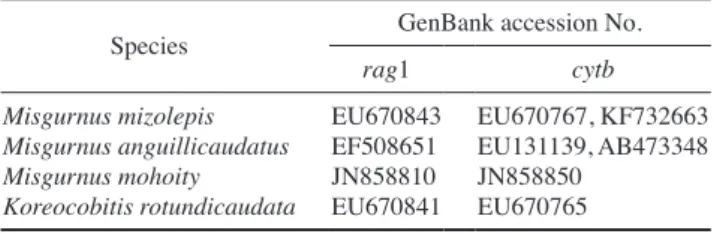
로 이용하였고, 외그룹으로 새코미꾸리(Koreocobitis rotundi- caudata)의 염기서열을 이용하였다(Table 2). 분자계통도 내 분지의 지지도를 통계적으로 계산하기 위해 1,000회 bootstrap 분석을 수행하였다(Felsenstein, 1981).
분석 결과 나타난 계통별 염기서열을 National Center for
Biotechnology Information(NCBI)의 Basic Local Alignment Search Tool(BLAST, http://www.ncbi.nlm.nit.gov/blast)를 이 용하여 유전자은행에 확보되어 있는 염기서열 중 가장 높은 유사성을 보이는 염기서열을 확인하였다.
결과 및 고찰
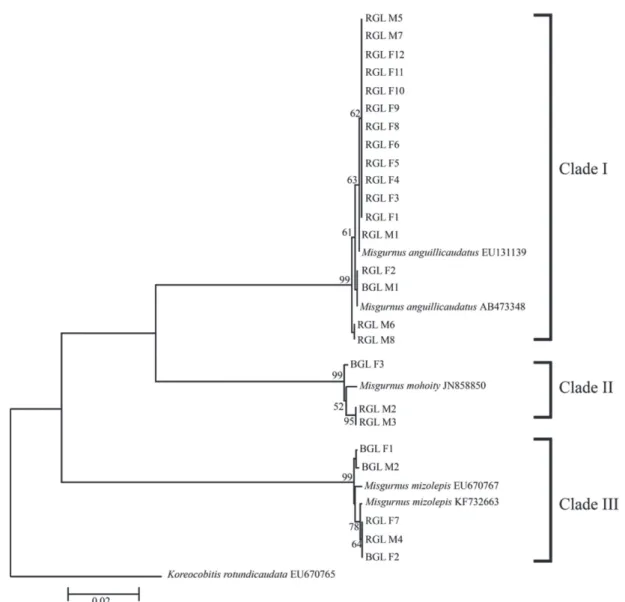
본 연구에서 제작한 프라이머를 이용하여 PCR을 수행한 결 과 확보된 rag1 영역은 828bp의 염기서열을 확보하였으며, cytb 영역은 1,121bp의 염기서열을 확보하였다. 확보된 염기서 열을 이용하여 미꾸리속 알비노 개체들의 rag1 영역과 cytb 영 역의 분자계통도를 작성한 결과 두 유전자 모두 3개의 단계통 Table 2. Accession number of reference sequences in Genbank for
this study
Species GenBank accession No.
rag1 cytb
Misgurnus mizolepis EU670843 EU670767, KF732663 Misgurnus anguillicaudatus EF508651 EU131139, AB473348 Misgurnus mohoity JN858810 JN858850
Koreocobitis rotundicaudata EU670841 EU670765
Fig. 1. Neighbour joining phylogenetic tree by the Kimura 2-parameter model showing phylogenetic relationship among genus Misgurnus spe- cies based on recombination activating gene 1(rag1) sequence data.
군이 형성되었으며(Figs. 1, 2), Clade Ⅰ은 미꾸리(M. anguilli- caudatus) 계통군으로 분리되었고 Clade Ⅲ은 미꾸라지(M.
mizolepis) 계통군으로 분리되었다. 따라서 미꾸라지속 알비 노 개체는 단계통군으로 뚜렷하게 구분이 되어 Kim(2009)의 분류체계와 동일하게 종 구분이 가능하였다. 하지만 Clade Ⅱ 는 국내에 보고된 미꾸리속 어류 계통군에 포함되지 않는 별 도의 계통군을 형성하였고, cytb 영역의 분자계통도에서 더욱 뚜렷하게 나타남으로써 현재 국내에 분포하는 미꾸리와 미꾸 라지 외에 미기록 종인 M. mohoity가 서식하고 있는 것으로 추정되었다. Clade Ⅱ에 해당하는 개체의 염기서열을 이용해 Genbank에 등록된 염기서열과의 BLAST 분석결과 미꾸리속 어류인 M. mohoity의 염기서열과 가장 높은 유사성을 나타내 었다(Table 3).
분자계통도를 기준으로 종 동정을 수행한 결과는 Table 3에
제시하였으며, RGL 20개체 중 16개체는 미꾸리로 판별하였고 1개체는 미꾸라지로 판별하였다. 나머지 3개체 중 RGL 수컷 2번과 3번은 rag1 분자계통도에서 미꾸리 계통군(Clade Ⅰ)에 포함되고, cytb 분자계통도는 M. mohoity 계통군(Clade Ⅱ)에 포함됨에 따라 M. mohoity♀×미꾸리♂의 교잡종으로 판별하 였다. 또한 RGL 수컷 4번은 rag1 분자계통도에서 미꾸리 계통 군(Clade Ⅰ)에 포함되고, cytb 분자계통도는 미꾸라지 계통군 (Clade Ⅲ)에 포함됨에 따라 미꾸라지♀×미꾸리♂ 교잡종으 로 판별하였다. 한편 BGL 5개체는 미꾸리 1개체와 미꾸라지 3 개체로 판별하였으며, 나머지 BGL 암컷 3번 개체는 M. mohoity 로 판별하였다. 이상과 같이 RGL 개체 20마리 중 3마리가 잡 종으로 판별되어 15%의 빈도를 보였으나, BGL 개체 5마리 중 잡종 개체는 전혀 확인되지 않았다. 추후 샘플 수를 늘려 분석 한다면 BGL 잡종 개체의 확인이 가능할 것으로 판단된다.
Fig. 2. Neighbour joining phylogenetic tree by the Kimura 2-parameter model showing phylogenetic relationship among genus Misgurnus spe- cies based on cytochrome b(cytb) sequence data.
일반적으로 백색증 현상은 멜라닌 색소 결핍에 의해 두 가지 형태로 발생하는 것으로 알려져 있으며(Kinnear et al., 1985), 미꾸리속 어류의 경우 어체에 발현되는 표현형에 따라 다음 과 같이 두 가지 표현형으로 구분할 수 있다. 첫째, RGL 개 체는 유전자 돌연변이에 의해 표피와 망막의 멜라닌색소포 (melanophore)의 결핍으로 인해 완벽한 백색증으로 표현되는 알비노와 둘째, BGL 개체와 같이 발생생리학적 문제로 인해 색소 침착이 줄어들거나 없지만 망막은 색소침착이 이루어진
부분적 백색증(partial albinism) 또는 루시즘(leucism)으로 구 분하고 있다(Kinnear et al., 1985). 이와 같이 비정상적인 피부 색소 침착과 함께 안구에 정상적인 색소 침착이 나타나는 경 골어류를 루시즘(leucism and leucistic phenotype)으로 일반적 인 알비노 개체들과 구분하고 있다(Clark, 2002; Veena et al., 2011; Muto et al., 2013). 따라서 BGL 개체는 눈을 제외하고 전체 신체 표면에 색소 침착이 없는 루시즘 표현형이 발현되 는 개체로서 일반적인 백색증을 가지는 RGL 개체와 구분되었 Table 3. Result of genetic identification of albinism genus Misgurnus species
Type No. of fish
Species
categorizations Species
Best-matched database sequence
(GenBank accession No.) Sequence
homology(%) E-value
rag1 cytb rag1 cytb rag1 cytb
RGL
16 AA AA M. anguillicaudatus M. anguillicaudatus
(EF508651) M. anguillicaudatus
(EU131139, AB473348) 99 99 0.0 2 AA MMO Hybrid(OA) M. anguillicaudatus
(EF508651) M. mohoity
(JN858850) 99 99 0.0
1 AA MM Hybrid(MA) M. anguillicaudatus
(EF508651) M. mizolepis
(EU670767, KF732663) 98 99 0.0
1 MM MM M. mizolepis M. mizolepis
(EU670843) M. mizolepis
(EU670767, KF732663) 99 99 0.0
BGL
1 AA AA M. anguillicaudatus M. anguillicaudatus
(EF508651) M. anguillicaudatus
(EU131139, AB473348) 99 99 0.0
1 MMO MMO M. mohoity M. mohoity
(JN858810) M. mohoity
(JN858850) 99 99 0.0
3 MM MM M. mizolepis M. mizolepis
(EU670843) M. mizolepis
(EU670677, KF732663) 99 99 0.0
*RGL: Red eyed golden loach, BGL: Black eyed golden loach, AA: Misgurnus anguillicaudatus, MM: M. mizolepis, MMO: M. mohoity, MA: M. mizolepis♀×M.
anguillicaudatus♂ hybrid, OA: M. mohoity♀×M. anguillicaudatus♂ hybrid.
Fig. 3. Photographs of albinism(A) and leucism(B) fishes from genus Misgurnus species from Korea.
A
B
다(Fig. 3).
루시즘은 유전변이, 서식지 오염 및 내교배(inbreeding) 등 이 발생 원인으로 알려져 있으나(Veena et al., 2014), 포획한 후 실내에서 사육 시 일정 시간이 경과되면 피부에 색소침착 이 이루어진 것으로 보아 유전적 돌연변이인 백색증 현상과는 뚜렷하게 구분되었다.
한편 종간 잡종화는 인위적인 방류, 산란시기의 일치, 산란 장소의 부족현상 등의 다양한 이유로 발생하고 있다(Jansson et al., 1991; Kuriiwa et al., 2007). 이 중 미꾸리과 어류는 자연 상태에서도 종간 잡종이 일어난 사례가 보고되어 있으며(Lee et al., 2009; Kwon et al., 2014), 미꾸리속 어류인 미꾸리와 미 꾸라지의 경우 자원조성, 방생 등의 이유로 무분별하게 국 내 하천 생태계에 이입되고 있는 실정이다(Kim et al., 1995b;
Park et al., 1997). 특히 최근 중국에서 생산 또는 포획한 미꾸 리속 어류를 국내에 지속적으로 수입하고 있어 국내 하천 생 태계에 이입될 확률 또한 높다. 이로 인해 현재까지 기록되지 않은 M. mohoity가 출현한 것으로 추정된다. 따라서 추후 M.
mohoity에 대한 표본의 추가 확보 및 원기재 논문 검토 등을 통한 정확한 종 동정과 유입 경로 파악 등에 대한 후속 연구 가 필요할 것으로 판단된다.
일반적으로 미꾸라지와 미꾸리는 입수염 길이에서 종간 차 이를 보이며, 미꾸라지는 가장 긴 입수염이 눈 지름의 약 4 배 정도로 긴 반면에 미꾸리는 2.0~2.5배 정도로 미꾸라지에 비해 상대적으로 짧아 두 종간 구분이 가능하다(Kim et al., 2005). 그러나 두 종간에 유도된 잡종의 경우 입수염 길이의 차이가 명확하게 구분이 되지 않는 한계점이 존재한다(Park et al., 1997). 미꾸리속 알비노 개체의 경우에는 체색과 반문 이 발현되지 않을 뿐만 아니라 잡종 개체도 나타남으로써 외 부형질에 기반을 두는 종 동정 방법과 함께 본 연구에서 이용 한 분자마커 및 분자계통학적 분석을 추가할 시 보다 정확하 게 종 동정을 할 수 있을 것으로 판단된다.
요 약
최근 우리나라에서 자연발생적인 미꾸리속 알비노 개체들 이 낮은 빈도로 출현하고 있으나, 색소 결핍으로 인해 형태적 종 동정이 어렵다. 따라서 본 연구에서는 핵 유전자인 recom- bination activating gene 1(rag1) 영역 및 미토콘드리아 유전자 cytochrome b(cytb) 영역을 이용한 분자계통학적 분석을 이 용해 미꾸리속 알비노 개체의 분자동정을 수행하였다. 그 결 과 rag1과 cytb의 분자계통도에서 미꾸라지, 미꾸리, 그리고 M. mohoity로 3개의 clade가 확인되었다. 확보된 M. mohoity 의 염기서열을 유전자은행의 BLAST를 이용해 유사성을 검 색한 결과 M. mohoity와 가장 유사하였다. 분자계통도를 기준
으로 25마리의 알비노 미꾸리속 개체의 종 동정을 수행한 결 과 빨간 눈 타입은 미꾸리 16마리, 미꾸라지 1마리로 판별되 었고, 나머지 3개체는 미꾸라지♀×미꾸리♂ 잡종 1마리와 M.
mohoity♀×미꾸리♂ 잡종이 2마리 판별되었다. 또한 검은 눈 타입 5마리는 미꾸리 1마리와 미꾸라지 3마리 및 M. mohoity 1마리로 판별되었다. 따라서 본 연구에 이용한 분자마커를 활 용함으로써 미꾸리속 어류의 정확한 종 또는 잡종을 동정하기 위한 유용한 방법으로 이용될 수 있을 것이다.
RefeReNces
Asahida, T., T. Kobayashi, K. Saitoh and I. Nakayama. 1996. Tissue preservation and total DNA extraction from fish stored at ambient temperature using buffers containing high concen- tration of urea. Fish. Sci., 62: 727-730.
Cebrat, A., A. Cebula, A. Laszkiewicz, M. Kasztura, A. Miazek and P. Kisielow. 2008. Mechanism of lymphocyte-specific in- activation of RAG-2 intragenic promoter of NWC: Implica- tions for epigenetic control of RAG locus. Mol. Immunol., 45: 2297-2306.
Clark, S. 2002. First report of albinism in the white spotted bamboo shark, Chiloscyllium plagiosum(Orectolobiformes: He- miscyllidae), with a review of reported color aberrations in elasmobranchs. Zoo. Biol., 21: 519-524.
Felsenstein, J. 1981. Evolutionary trees from DNA sequences: a maximum likelihood approach. J. Mol. Evol., 17: 368-376.
Hauswith, W.W. and D.A. Clayton. 1985. Length heterogeneity of a conserved displacement-loop sequence in human mitochon- drial DNA. Nucl. Acids. Res., 13: 8093-8104.
Howard, D.J. and S.H. Berlocher. 1998. Endless forms: species and speciation. Oxford Univ. Press., 470pp.
Irwin, D.M., T.D. Kocher and A.C. Wilson. 1991. Evolution of cy- tochrome b gene of mammals. J. Mol. Evol., 32: 128-144.
Jansson, H., I. Holmgren, K. Wedin and T. Andersson. 1991. High frequency of natural hybrids between Atlantic salmon, Sal- mo salat L., and brown trout S. trutta L., in a Swedish river.
J. Fish Biol., 39: 343-348.
Kang, D.Y., H.C. Kim, J.H. Kim, K.G. Kim and J.I. Myeong. 2007.
Effects of environment factors on the occurrence of pseu- do-albinism in cultured flounder, Paralichthys olivaceus.
Korean J. Ichthyol., 40: 234-242.(in Korean)
Kerschbaumer, M., L. Postl, M. Koch, T. Wiedl and C. Sturmbauer.
2011. Morphological distinctness despite large-scale phe- notypic plasticity-analysis of wild and pond-bred juveniles of allopatric populations of Tropheus moorii. Naturwissen- schaften, 98: 125-134.
Kim, D.S., Y.K. Nam and I.S. Park. 1995a. Survival and karyolog- ical analysis of reciprocal diploid and triploid hybrids be- tween mud loach(Misgurnus mizolepis) and cyprinid loach (Misgurnus anguillicaudatus). Aquaculture, 135: 257-265.
Kim, D.S., Y.K. Nam and I.S. Park. 1995b. Performance of diploid
and triploid hybrid loach, Misgurnus mizolepis female×M.
anguillicaudatus. Aquaculture, 137: 326-327.
Kim, I.S., Y. Choi, C.L. Lee, Y.J. Lee, B.J. Kim and J.H. Kim. 2005.
Illustrated Book of Korean Fishes. Kyo-Hak., Seoul, pp.
200-203.(in Korean)
Kim, I.S. 2009. A review of the spined loaches, family Cobitidae (Cypriniformes) in Korea. Korean J. Ichthyol., 21: 7-28.
Kim, K.Y. and I.C. Bang. 2010. Molecular phylogenetic position of Abbottina springeri(Cypriniformes; Cyprinidae) based on nucleotide sequences of RAG1 gene. Korean J. Ichthyol., 22: 273-278.
Kim, K.Y., M.H. Ko, S.J. Cho, W.J. Kim, M.H. Son and I.C. Bang.
2015. A natural hybrid of intergeneric mating between a female Pungtungia herzi and a male Pseudorasbora parva (Cypriniformes: Cyprinidae). Fish. Aquatic. Sci., 18: 99-107.
Kim, Y.J., I.C. Kim, S.Y. Lee, W.O. Lee, Y.C. Cho and J.S. Lee.
2003. The use and conservation in molecular phylogeny of fish mitochondrial DNAs in Korean waters. Korean J. Lim- nol., 36: 221-234.(in Korean)
Kinnear, P.E., B. Jay and C.J. Witkop. 1985. Albinism. Surv Oph- thalmol., 30: 75-101.
Koga, A. and H. Hori. 1997. Albinism due to transposable element insertion in fish. Pigment Cell. Melanoma. Res., 10: 377381.
Kwon, Y.S., M.H. Ko and Y.J. Won. 2014. Genomic replacement of native Cobitis lutheri with introduced C. tetralineata through a hybrid swarm following the artificial connection of river systems. Ecol. Evol., 4: 1451-1465.
Kuriiwa, K., N. Hanzawa, T. Yoshino, S. Kimmura and M. Nishida.
2007. Phylogenetic relationships and natural hybridization in rabbitfishes(Teleostei: Siganidae) inferred from mito- chondrial and nuclear DNA analysis. Mol. Phyl. Ecol., 45:
69-80.
Lin, J.Y. and D.E. Fisher. 2007. Melanocyte biology and skin pig- mentation. Nature, 445: 843-850.
Lee, I.R., H. Yang, J.H. Kim., K.Y. Kim and I.C. Bang. 2009. Iden- tification of a natural hybrid between the striped spine loach Cobitis tetralineata and the King spine loach Iksookimia longicorpa by analyzing mitochondrial COI and nuclear RAG1 sequences. Korean J. Ichthyol., 24: 287-290.(in Korean)
Mayden, R.L., K.L. Tang, R.M. Wood, W.J. Chen, M.K. Angnew, K.W. Conway, L. Yang, A.M. Simons, H.L. Bart, P.M.
Harris, J. Li, C. Wnag, K. Saitoh, S. He, H. Liu, Y. Chen, M. Nishida and M. Miya. 2008. Inferring the tree of life of the order Cypriniformes, the earth’s most diverse clade of freshwater fishes: Implications varied taxon and character sampling. J. Syst. Evol., 46: 244-438.
Muto, N., T. Noda and Y. Kai. 2013. First record of albinism in the rockfish Sebastes pachycephalus complex(Scorpaeni- formes: Scorpaenidae). Ichthyol. Res., 60: 195-197.
Oh, M.K., J.Y. Park, C.H. Kim and E.J. Kang. 2010. Study on the pigmentation of albinic bitterlings Acheilognathus signifer (Pisces; Cyprinidae) based on its entire body, appendage
and eye. Korean J. Ichthyol., 22: 96-104.
Park, I.S., BS. Kim, H.M. Park, Y.K. Nam, C.H. Jeong and D.S.
Kim. 1997. Improved early survival in back-crosses of male mud loach(Misgurnus mizolepis) ×cyprinid loach(M.
anguillicaudatus) hybrids to female cyprinid loach. J.
Aquacult., 110: 363-371.(in Korean)
Slechtova, V., J. Bohlen and H.H. Tan. 2007. Families of Cobitoidea (Teleostei: Cypriniformes) as revealed from nuclear genetic data and the position of the mysterious genera Barbucca, Psilorhynchus, Swepenticobitis and vaillantella. Mol. Evol., 44: 1358-1365.
Song, H.B. and G.M. Park. 2006. A molecular genetic variation among intra-populations of Korean shinner, Coreoleuciscus splendidus Mori(Cyprinidase). Korean J. Ichthyol., 18: 78- Song, H.Y. and I.C. Bang. 2015. Coreoleuciscus aeruginos86. (Tele- ostei: Cypriniformes: Cyprinidae), a new species from the Seomjin and Nakdong rivers, Korea. Zootaxa, 3931: 140- Sonnenberg, R., A.W. Nolte and D. Tautz. 2007. An evaluation of 150.
LSU rDNA D1-D2 sequences for their use in species iden- tification. Frontiers in Zool., 4: 6.
Tamura, K., G. Stecher, D. Peterson, A. Filipski and S. Kumar.
2013. MEGA6: Molecular Evolutionary Genetics Analysis version 6.0. Mol. Biol. Evol., 30: 2725-2729.
Thompson, H.D., T.J. Gibson, F. Plewniak, F. Jeanmougin and D.G.
Higgins. 1997. The CLUSTAL X windows interface: Flex- ible strategies for multiple sequence alignment aided by quality analysis tools. Nucleic Acids Res., 254: 4876-4882.
Veena, S., S. Thomas, S.G. Raje and R. Durgekar. 2011. Case of leucism in the spadenorse shark, Scoliodon laticaudus (Muller and Henle, 1838), from Man galore Karnataka. In- dian J. Fish., 25: 109-112.
Veena, S., M. Muktha, L. Edward, V. Uma Mahesh, M.V. Rao, S.
Megharajan, K. Dhanraju, M.S. Kumar, Ch. Moshe and S.
Ghosh. 2014. Leucism in seerfish Scomberomorus commer- son, landed at landed at Chintapalli, Andhra Pradesh. Ma- rine Fisheries Information Service; Technical and Extension Series, 221: 13-13.
Vielkind, J., U. Vielkind and F. Anders. 1971. Melanotic and amela- notic melanomas in xiphophorin fish. Cancer Res., 31: 868
West-Eberhard, M.J. 2005. Developmental plasticity and the origin 875.
of species differences. Pro. Natl. Acad. Sci. USA, 102: 6543- 6549.
Yoo, J.H., T. Takeuchi and K.S. Jeong. 2003. Effect of thyroid hormones and albinism during metamorphosis of flounder, Paralichthys olivaceus under low temperature stress. Fish Aquatic Sci., 36: 65-67.(in Korean)
Yun, Y.E., I.R. Lee, S.Y. Park, E.J. Kang, E.O. Kim, S.K. Yang, Y.K.
Nam and I.C. Bang. 2009. Genetic identification of hybrids between Rhodeus uyekii and R. notatus by sequence analy- sis of RAG-1 gene. J. Aquacult., 22: 79-82.(in Korean)