• 검색 결과가 없습니다.

Five Species of Endophytic Fungi Isolated from Roots of Native Orchid Plants from Korea

N/A
N/A
Protected

Academic year: 2021

Share "Five Species of Endophytic Fungi Isolated from Roots of Native Orchid Plants from Korea"

Copied!
7
0
0

로드 중.... (전체 텍스트 보기)

전체 글

(1)

Received: 21 November, 2017 Revised: 27 November, 2017 Accepted: 28 November, 2017

Ⓒ The Korean Society of Mycology

This is an Open Access article distributed under the terms of the Creative Commons Attrib- ution Non-Commercial License (http://creative- commons.org/licenses/by-nc/4.0/) which permits unrestricted non-commercial use, distribution, and reproduction in any medium, provided the original work is properly cited.

Kor. J. Mycol. 2017 December, 45(4): 355-361 https://doi.org/10.4489/KJM.20170041

pISSN : 0253-651X eISSN : 2383-5249

OPEN ACCESS

RESEARCH NOTE

한국 자생 난초 뿌리에서 분리한 미기록 내생균 5종

이봉형, 엄안흠*

한국교원대학교 생물교육과

Five Species of Endophytic Fungi Isolated from Roots of Native Orchid Plants from Korea

Bong-Hyung Lee, Ahn-Heum Eom

*

Department of Biology Education, Korea National University of Education, Cheongju 28173, Korea

*Corresponding author: [email protected]

Abstract

In this study, endophytic fungi were isolated from the roots of three native orchid species from Korea: Bletilla striata, Oreorchis patens, and Cephalanthera longibracteata. The isolated fungal endophytes were identified based on the morphological and molecular characteristics including sequence analysis of internal transcribed spacer (ITS) and 28S ribosomal DNA regions. As a result, we discovered 5 species of fungal endophytes that have not been previously reported in Korea: Phialocephala bamuru, Coniochaeta mutabilis, Phialophora foetens, Calonectria canadensis, and Neonectria ramulariae.

Keywords: Orchid, Fungal endophytes, Bletilla striata, Oreorchis patens, Cephalanthera longibracteata

난초과 식물은 다른 육상식물과는 달리 특이적 균근균(mycorrhizal fungi)과 공생관계를 형 성하고 있다[1]. 난초와 공생관계를 형성하는 난균근균(orchid mycorrhizal fungi)은 계통학 적으로 담자균류에 속하여, 완전세대인 Ceratobasidium, Sebacina, Tulasnella속과 불완전 세대인 Rhizoctonia속이 있다[2]. 반면 대부분의 육상생물들은 Glomeromycota문에 속하는 수지상균근균(arbuscular mycorrhizal fungi)과 공생관계를 형성하고 있다[3]. 가장 원시적 형태의 난초인 Apostasia속 식물 뿌리에는 수지상균근균 대신 담자균류인 Ceratobasidium, Tulasnella, Botryobasidium 등의 난균근균이 초기부터 공생관계를 형성하고 있다고 알려져 있다[4]. 특히 100여종의 비광합성 난초들은 난균근균에 영양학적으로 완전히 의존(myco- heterotrophic) 하며, 일반 난초들도 종자 발아와 초기 엽록소 생성 과정에 난균근균이 중요한 영향을 미치는 것으로 알려져 있다[5].

난초과 식물의 뿌리에는 비균근성 내생균(non-mycorrhizal fungal endophytes)도 서식하

는 것으로 보고되어 왔다[6]. 그러나 내생균의 생물활성에 대한 연구는 거의 없는 실정이며,

난초 뿌리에서 분리된 dark septate endophytes (DSE)의 특성에 관한 일부 연구만 진행되었

(2)

다[7]. 그러나 내생균 역시 난초의 종자발아와 생장에 중요한 영향을 미칠 것으로 생각된다.

난초 뿌리에서 분리한 Phialocephala fortinii는 자생란인 Dactylorhiza praetermissa의 종자 발아와 유묘 생장을 촉진시키는 등 내생균의 생물학적 기능에 대한 잠재성을 생각해 볼 수 있 다[8]. 우리나라에서도 멸종위기 1급 난초과 식물인 광릉요강꽃(Cypripedium japonicum Thunb.) 과 복주머니란(Cypripedium macranthum Sw.)에서 분리한 내생균의 다양성에 대한 연구[9]가 진행되었으나, 관련 연구는 거의 미미한 실정이다. 이에 한국 자생 난초인 자란, 감 자난초, 은대난초 등에서 내생균을 분리하고 다양성을 연구하던 중 국내 미기록으로 확인된 5 종의 균류를 보고하고자 한다.

전라남도 진도군(N34°48’, E126°25´)에서 자란(Bletilla striata (Thunb. ex Murray) Reichb. fil), 강원도 정선군 함백산(고도 1,572 m, N37°09´, E128°55´)에서 감자난초 (Oreorchis patens (Lindl.) Lindl.) 와 은대난초(Cephalanthera longibracteata Blume)의 뿌 리를 채집하였다. 48시간 이내 병징이 없는 뿌리를 무작위적으로 선별하여 Richardson 등 [10] 의 방법을 변형하여 균을 분리하였다. 뿌리를 표면 살균하기 위해 70% 에탄올과 3% 차 아염소산나트륨(NaClO) 용액을 차례로 처리하고, streptomycin과 chloramphenicol 항생 제를 처리하였다. 표면 살균된 뿌리는 멸균된 거름종이로 물기를 제거한 후, 5 mm 크기로 잘라 water agar (WA)에 4개씩 치상하였다. 25°C 암소에서 배양하면서 뿌리에서 자라나온 균주를 potato dextrose agar (PDA)와 malt extract agar (MEA)에 각각 계대배양하였다. 순

Fig. 1. Colony of strain 15P005 (Phialocephala bamuru) grown on potato dextrose agar (PDA)

for 7 days at 25°C, front (A) and back (B); Colony of strain 15P095 (Coniochaeta mutabilis)

grown on PDA for same conditions, front (C) and back (D); Colony of strain 15P106

(Phialophora foetens) grown on PDA for same conditions, front (E) and back (F) and

conidiomata (K); Colony of strain 15P283 (Calonectria canadensis) grown PDA for same

(3)

수 분리된 균주는 25°C 암소에서 7일간 배양하며, 균총의 생장속도, 색, 모양, 고도 등의 형 태학적 특징을 관찰하였으며(Fig. 1), 이후 슬라이드 배양법을 통해 균사와 포자를 광학현미 경과 전자현미경을 통해 관찰하였다(Fig. 2). 분자생물학적 동정을 위하여 DNeasy Plant mini kit (Qiagen, Germantown, MD, USA) 을 사용하여 균주의 Genomic DNA를 추출하였 다. 추출된 DNA를 주형으로 PCR을 수행하였으며, Primer ITS1F와 ITS4를 이용하여 internal transcribed spacer (ITS) 영역[11]을, primer LR0R과 LR16을 이용하여 ribosomal DNA 의 large subunit (LSU) 영역[12]을 증폭하였다. PCR 조건 중 annealing 온도는 ITS 영 역은 58°C, LSU 영역은 54°C를 설정하여 수행하였다. PCR 산물은 1.5% agarose gel에서 20 분간 전기영동하였으며, 예상되는 크기의 band를 추출하여 정제한 후 염기서열 분석을 의뢰하였다(SolGent, Daejeon, Korea). 분석된 염기서열은 NCBI 상에서 BLAST를 이용하 여 유사도를 확인한 후 각 종들 간의 계통관계 분석을 통한 taxonomic position을 확인하기 위해 MEGA6 [13]를 이용하여 neighbor-joining 방법으로 계통수를 완성하였다(Figs.

3~4). 분리된 균주는 국립생물자원관(NIBR)에 기탁하였으며, 염기서열은 GenBank에 제 출하였다.

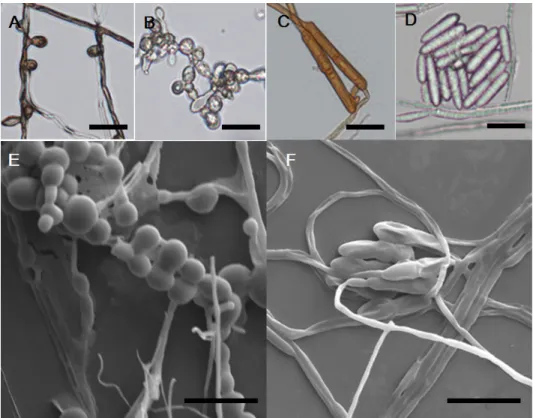
Fig. 2. Hyphae and conidiospore of strain 15P005 (Phialocephala bamuru) (A); aggregation

spore of strain 15P106 (Phialophora foetens) optical microscope image (B) and scanning

electron microscopes (SEM) image (E); macroconidia of strain 15P283 (Calonectria

canadensis) (C); conidiospores of strain 15P325 (Neonectria ramulariae), optical microscope

image (D) and SEM image (F) (scale bars: A~D = 10 µm, E~F = 20 µm).

(4)

Fig. 3. Neighbor-joining tree of endophytic fungal strains isolated from roots of native orchid plants. The internal transcribed spacer (ITS) region were used for sequence analysis. Exidia uvapassa was used as an outgroup.

Fig. 4. Neighbor-joining tree of endophytic fungal strains isolated from roots of native orchid

plants large subunit (rDNA) region was used for sequence analysis. Exidia uvapassa was used

as an outgroup.

(5)

Phialocephala bamuru P.T.W.Wong & C. Dong, Australasian Plant Pathology 44:

55 (2015)

PDA 배지에서 7일간 배양 시 직경 28~32 mm 크기로 균총을 형성하였으며(Fig. 2A), 풍부한 공중균사는 형성 초기 회백색을 띠고 있었으나, 시간이 지남에 따라 검은색에서 암갈색으로 변하였고, 균총의 뒷면 역시 암갈색을 띠었다(Fig. 2B). 균사의 뒷면은 동심원 모양의 띠가 여 러 개 나타났으며, 가장자리로 갈수록 띠의 색은 밝아졌다. 균사는 격벽이 뚜렷이 관찰되었으 며, 짙은 갈색의 균사에서 가지가 나와 3~5 × 4~6 µm 크기의 포자를 형성하였다(Fig. 1A). 이 균주의 ITS 영역의 염기서열을 분석한 결과 P. bamura KJ877191과 99.0% 유사도를 보였으 며, LSU 영역에 대한 염기서열을 분석한 결과 P. bamura KJ996069와 99.0% 유사도를 보였 다.

관찰표본: 전라남도 진도, N34°48’, E126°25´, 2015년 6월 1일, 자란(Bletilla striata (Thunb. ex Murray) Reichb. Fil) 의 뿌리, 15P005 (NIBRFG0000499913)

Coniochaeta mutabilis (J.F.H. Beyma) Z.U. Khan, Gené & Guarro, Antonie van Leeuwenhoek 104 (2): 250 (2013)

PDA 배지에서 7일간 배양 시 직경 30~35 mm 크기의 균총을 형성하였으며, 중심부는 옅은 갈색, 가장자리는 백색의 환을 형성하였다(Fig. 2C). 시간이 지남에 따라 옅은 갈색의 중심부 는 검은색으로 변하였으며, 가장자리는 계속 회백색을 띠었다. 또한 머리털 형태의 공중균사 가 표면에 형성되어 있었으며, 검은색으로 변한 중심부는 방사형의 여러 개의 깊은 홈이 형성 되었다. 균총의 뒷면은 중심부는 옅은 갈색, 가장자리는 아이보리색을 띠었다(Fig. 2D). 이 균 주의 ITS 영역의 염기서열을 분석한 결과 C. mutabilis HM036599과 99.0% 유사도를 보였 으며, LSU 영역에 대한 염기서열을 분석한 결과 C. mutabilis JX507651와 99.0% 유사도를 보였다.

관찰표본: 강원도 정선 함백산, N37°09´, E128°55´, 2015년 7월 17일, 감자난초(Oreorchis patens (Lindl.) Lindl.) 의 뿌리, 15P095(NIBRFG0000500059)

Phialophora foetens W. Gams & Domsch, Nova Hedwigia 18: 16 (1970)

PDA 배지에서 7일간 배양 시 직경 15~19 mm 크기의 균총을 형성하였으며, 중심부는 군청 색의 균사 위에 회백색의 공중균사가 솜처럼 덮여 있다(Fig. 2E). 균총의 가장자리에는 흰색 의 환이 형성되며, 균총의 뒷면은 짙은 군청색을 띤다(Fig. 2F). 균총의 가장자리에는 균사 가 모여 분생자과(conidiomata) 형태의 구조물이 나타난다(Fig. 2K). 효모처럼 생긴 구형의 분생포자는 여러 개가 모여 군집을 이루고 있으며, 크기는 3~5 × 4~5 µm이다(Fig. 1B, 1E).

이 균주의 ITS 영역의 염기서열을 분석한 결과 P. foetens AB190394과 99.0% 유사도를 보 였으며, LSU 영역에 대한 염기서열을 분석한 결과 P. foetens AB190424와 98.0% 유사도를 보였다.

관찰표본: 강원도 정선 함백산, N37°09´, E128°55´, 2015년 7월 17일, 감자난초(Oreorchis

patens (Lindl.)) 의 뿌리, 15P106(NIBRFG0000500058)

(6)

Calonectria canadensis (J.C. Kang, Crous & C.L. Schoch) L. Lombard, M.J. Wingf.

& Crous, Studies in Mycology 66: 56 (2010)

PDA 배지에서 7일간 배양 시 직경 35~45 mm 크기의 균총을 형성하였으며, 흰색의 균사가 성기게 형성되며, 공중균사가 발달하였다(Fig. 2G). 균총의 뒷면은 옅은 아이보리 색을 띠고 있으며, 가장자리에는 솜털 모양의 균사가 뚜렷이 관찰되었다(Fig. 2H). 표면에는 시간이 지 나며 투명한 물방울 모양의 삼출물이 관찰되었다(Fig. 2L). 균총은 시간이 지나며 아래쪽 균 사부터 짙은 갈색으로 변하였고, 이후 뒷면은 암갈색을 띠었다. 균사의 색이 변하는 과정에서 도 표면은 솜털 모양의 흰색 균사가 덮고 있으며, 흰색 균사 내에 조그마한 구멍이 전체에 고 르게 형성된다. 포자는 긴 원통형을 띠고 있으며, 크기는 3~4 × 19~23 µm이다(Fig. 1C). 이 균주의 ITS 영역의 염기서열을 분석한 결과 C. Canadensis GQ280556과 99.0% 유사도를 보 였으며, LSU 영역에 대한 염기서열을 분석한 결과 C. Canadensis GQ280678 99.0% 유사도 를 보였다.

관찰표본: 강원도 정선 함백산, N37°09´, E128°55´, 2015년 7월 17일, 은대난초(Cephalanthera longibracteata Blume) 의 뿌리, 15P283 (NIBRFG0000499914)

Neonectria ramulariae Wollenw., Annales Mycologici 15 (1-2): 52 (1917) PDA 배지에서 7일간 배양 시 직경 32~40 mm 크기의 균총을 형성하였으며, 중심부에는 조 밀하게 흰색의 균사가 균총을 형성하고 있고, 가장자리는 균사의 밀도가 낮아진 형태로 흰색 의 환을 형성하고 있다(Fig. 2I). 균총의 뒷면은 연한 미색을 띠고 있다(Fig. 2J). 시간이 지나 면 균총의 중심부는 수직층의 아래부터 옅은 갈색으로 변한다. 긴 타원형의 포자는 크기가 2~4 × 10~18 µm 이며, 가운데 격벽이 뚜렷이 관찰된다(Fig. 1D, 1F). 이 균주의 ITS 영역의 염기서열을 분석한 결과 N. ramulariae AJ279446과 99.0% 유사도를 보였다.

우리나라에서 자생하는 난초과 식물에 공생하는 내생균에 대한 연구는 매우 부족한 실정 이다. 특히 내생균의 다양성과 군집 분석에 대한 연구는 조금씩 진행되고 있으나, 분리된 균 주의 생리활성과 숙주와의 상호작용에 대한 연구는 거의 전무하다. 그러나 내생균은 생물자 원으로서 종 다양성을 확보하는 측면에서뿐만 아니라, 다양한 약리활성 기능을 가지고 있기 때문에 이에 대한 지속적인 연구가 필요할 것이다.

적 요

본 연구는 전라북도 진도에서 자란(Bletilla striata), 강원도 정선군 함백산에서 감자난초(

Oreorchis patens) 와 은대난초(Cephalanthera longibracteata)의 뿌리에서 내생균을 분리하

고 이들의 형태 및 분자생물학적 방법을 통해 동정하였다. 각 균주의 형태학적 특징을 분석하

기 위해 포자의 모양과 특징을 관찰하였고, 분자생물학적 동정을 위해 ITS1F와 ITS4 primer

를 이용하여 internal transcribed spacer (ITS) 및 large subunit (LSU) rDNA영역을 분석하였

다. 그 결과 Phialocephala bamuru, Coniochaeta mutabilis, Phialophora foetens, Calonectria

Canadensis, Neonectria ramulariae 5 종의 국내 미기록 내생균이 동정되어 이를 보고하고자

(7)

Acknowledgements

This work was supported by a grant from the National Institute of Biological Resources (NIBR), funded by the Ministry of Environment (MOE) of the Republic of Korea.

REFERENCE

1, Rasmussen HN. Recent developments in the study of orchid mycorrhiza. Plant Soil 2002;244:149-63.

2. Sneh B, Burpee L, Ogoshi A. Identification of Rhizoctonia species. St. Paul: APS Press;

1991.

3. Wang B, Qiu YL. Phylogenetic distribution and evolution of mycorrhizas in land plants.

Mycorrhiza 2006;16:299-363.

4. Yukawa T, Ogura-Tsujita Y, Shefferson RP, Yokoyama J. Mycorrhizal diversity in Apostasia (Orchidaceae) indicates the origin and evolution of orchid mycorrhiza. Am J Bot 2009;96:1997-2009.

5. Leake JR. The biology of myco-heterotrophic (‘saprophytic’) plants. New Phytol 1994;

127:171-216.

6. Currah RS, Zelmer CD, Hambleton S, Richardson KA. Fungi from orchid mycorrhizas.

In: Arditti J, Pridgeon AM, editors. Orchid Biology. Dordrecht: Springer; 1997. p.

117-70.

7. Bayman P, Otero JT. Microbial endophytes of orchid roots. In: Schulz BJ, Boyle CJ, Sieber TN, editors. Microbial root endophytes. Berlin: Springer; 2006. p. 153-77.

8. Zimmerman E, Peterson RL. Effect of a dark septate fungal endophyte on seed germination and protocorm development in a terrestrial orchid. Symbiosis (Rehovot) 2007;43:45-52.

9. Lee BH, Han HK, Kwon HJ, Eom AH. Diversity of endophytic fungi isolated from roots of Cypripedium japonicum and C. macranthum in Korea. Kor J Mycol 2015; 43:20-5.

10. Richardson KA, Currah RS, Hambleton S. Basidiomycetous endophytes from the roots of neotropical epiphytic Orchidaceae. Lindleyana 1993;8:127-37.

11. Gardes M, Bruns TD. ITS primers with enhanced specificity for basidiomycetes- application to the identification of mycorrhizae and rusts. Mol Ecol 1993;2:113-8.

12. Vilgalys R, Hester M. Rapid genetic identification and mapping of enzymatically amplified ribosomal DNA from several Cryptococcus species. J Bacteriol 1990;172:

4238-46.

13. Tamura K, Stecher G, Peterson D, Filipski A, Kumar S. MEGA6: Molecular Evolutionary

Genetics Analysis version 6.0. Mol Biol Evol 2013;30:2725-9.

수치

Fig. 1.  Colony of strain 15P005 (Phialocephala bamuru) grown on potato dextrose agar (PDA)  for 7 days at 25°C, front (A) and back (B); Colony of strain 15P095 (Coniochaeta mutabilis)  grown on PDA for same conditions, front (C) and back (D); Colony of st
Fig. 2. Hyphae and conidiospore of strain 15P005 (Phialocephala bamuru) (A); aggregation  spore of strain 15P106 (Phialophora foetens) optical microscope image (B) and scanning  electron microscopes (SEM) image (E); macroconidia of strain 15P283 (Calonectr
Fig. 3. Neighbor-joining tree of endophytic fungal strains isolated from roots of native orchid  plants

참조

관련 문서

We identified the fungal strains based on their morphological characteristics and on the phylogenetic analysis using DNA sequences of the internal transcribed spacer, small subunit

Endophytic fungal strains were isolated from the sterilized roots of a medicinal plant, Ligusticum chuanxiong and identified based on morphological characteristics and molecular

Neighbor-joining phylogenetic tree based on a concatenated alignment of internal transcribed spacer, large subunit and beta-tubulin sequences.. Xylaria hypoxylon was used as

The isolated fungal strains were identified based on a phylogenetic analysis using nucleotide sequences of the internal transcribed spacer region, large subunit region of

Neighbor-joining phylogenetic tree based on a combined alignment of both internal transcribed spacer (ITS), large subunit (LSU) and β-tubulin (TUB) sequences.. Xylaria longipes

ABSTRACT : Endophytic fungal strains were isolated from 5 aquatic plant species (Trapa japonica, Miscanthus sacchariflorus, Oenanthe javanica, Typha orientalis and Zizania

ABSTRACT : This study was conducted to investigate diversity of orchid endophytic fungi from roots of two terrestrial orchids, Cypripedium japonicum and Cypripedium macranthum

ABSTRACT : Forty-two endophytic fungi were isolated from the roots of coastal plants, such as Aster sphathulifolius Maxim., Aster tripolium L., Phragmites australis, and