179 This is an Open-Access article distributed under the terms of the Creative Commons Attribution Non-Commercial License (http://
creativecommons.org/licenses/by-nc/3.0) which permits unrestricted non-commercial use, distribution, and reproduction in any medium, provided the original work is properly cited.
J. Mushrooms 2019 December, 17(4): 179-184 http://dx.doi.org/10.14480/JM.2019.17.4. 179 Print ISSN 1738-0294, Online ISSN 2288-8853
© The Korean Society of Mushroom Science
*Corresponding author E-mail : [email protected]
Tel : +82-55-254-1352, Fax : +82-55-254-1319 Received October 8, 2019
Revised November 8, 2019 Accepted December 2, 2019
표고 톱밥배지에서 분리한 배양 진균의 다양성 분석
김민근*· 심순애· 최시림· 홍광표
경상남도농업기술원 환경농업연구과
Diversity analysis of culture-dependent fungal species isolated from the sawdust media of Lentinula edodes
Min-Keun Kim*, Soon-Ae Sim, Si-Lim Choi, and Kwang-Pyo Hong
Environmental Agriculture Research Division, Gyeong sang nam-do Agricultural Research and Extension Services, Jinju 52733, Republic of Korea
ABSTRACT:
This study was conducted to investigate the diversity of culture-dependent fungal species in the sawdust media of Lentinula edodes. A total of 405 fungi were isolated from the specimens and identified to belong to 24 genera and 42 species.
Among the identified 42 species of fungi, 26.2% belonged to Penicillium sp., 9.5% belonged to Trichoderma sp., and 64.3%
belonged to others. Especially, Trichoderma harzianum, which is a causal agent of fungal disease in mushroom, was found on all the farms, and showed the highest frequency among the identified fungi. Community analysis showed that the fungal diversity patterns of the samples were similar to each farm and many kinds of fungi existed in the sawdust media at high levels. These results showed that the management of internal environments would be required for the stable cultivation of Lentinula edodes.
KEYWORDS: Diversity analysis, Fungi, Lentinula edodes, Oak mushroom
서 론
표고(Lentinula edodes)는 담자균문(Basidomycota), 구 멍장이버섯과(Polyporaceae) 잣버섯속(Lentinus), 송이과 (Tricholomataceae) 표고속(Lentinula)에 속하는 버섯으로 한국을 비롯하여 중국, 대만, 일본 등 동북아시아지역에서 주로 생산, 소비되고 있다. 참나무류 그루터기에서 발생되 는 백색부후균으로 목질을 분해할 수 있는 리그린 분해효 소를 생산하는 것으로 보고되었으며(Field et al., 1993),
식용 및 약용으로 널리 이용되어져 오고 있다. 표고버섯 은 Lentinan에 의한 항종양 작용(Suzuki and Oshima, 1976) 과 Eritadenine에 의한 혈중 콜레스테롤 저하 작용 (Jong and Birmingham, 1993), 면역조절(Yap and Ng, 2001), 심장혈관의 혈당저하(Enman et al., 2007), 간 기 능개선(Akamatsu et al., 2004), 항바이러스(Takehara et al., 1979)등 많은 약리작용이 보고되었다. 1920년 후반부 터 시작된 표고버섯 재배는 참나무를 이용한 원목재배방 식으로 이루어져 왔으며 대한산림조합연합회에서 우량종 균을 육성 보급하면서 본격적으로 시작되었다 (Lee et al., 1994; Jang et al., 2012). 2017년 기준 국내 표고버섯 생산량은 23,983톤으로 이중 95.5%가 생표고 버섯 형태 로 생산되고 있으며(Korea Forest Service, 2018), 재배규 모는 참나무류를 이용한 노지 원목재배가 16,814천본 (27.9%), 하우스를 이용한 시설 원목재배가 21,057천본 (37.1%), 참나무류 톱밥을 이용한 시설 톱밥재배가 22,340천봉(34.9%)을 차지하고 있다 (Statistics Korea, 2015). 표고 톱밥재배는 1990년대 중반부터 시작되었으나 재배기술 미확립으로 널리 보급되지 못하다가 2000년대 초반부터 점차 재배가 늘어나게 되었다(Ko et al., 2009).
표고 톱밥재배는 원목가격 상승, 농촌 인구의 고령화, 버
섯가격 하락에 따른 수익성악화 등으로 원목재배에 대한 병행 또는 대체 가능한 재배방법으로 높은 관심을 받고 있다 . 그러나 2018년 기준 중국으로부터 수입된 톱밥배지는 41,750톤으로 국내에서 재배되는 톱밥배지의 약 66%를 차지 고 하고 있어 국내에서 표고 톱밥배지의 생산 및 공급 확대 가 요구되고 있다. 표고 톱밥재배에 대한 관심이 높아지면서 재배면적도 함께 증가되었지만 완전히 확립되지 못한 재배 방법과 함께 다양한 병해에 노출되어 표고 톱밥재배 농가들 에게 있어 어려움으로 작용하고 있다. 버섯재배 과정에서 발 생되는 병해의 경우 Verticillium fungicola var. fungicola에 의 해 유발되는 양송이(Agaricus bitorquis)의 dry bubble병 (Gea et al., 2003), Ewingella americana 에 의한 양송이 (Agaricus bitorquis)의 internal stipe necrosis병(Inglisand and Burden, 1996), Erwinia carotovorasub sp. carotovora (Okamoto et al., 1999)에 의한 팽이버섯(Flammulina velutipes)의 soft rot병, Pantoea sp.에 의한 큰느타리 (Pleurotus eryngii)의 soft rot병(Kim et al., 2007), Cladobotryum mycophilum에 의한 큰느타리(Pleurotus eryngii)의 cob web병, Cladobotryum varium에 의한 큰느 타리(Pleurotus eryngii)의 white mold병(Kim et al., 1998), Cladobotryum spp. 에 의한 표고(Lentinula edodes)의 cob web병, Verticillium spp. 에 의한 dry bubble병(Sharma et. al, 2016) 등 다양한 곰팡이와 세균들이 보고되어 있으 며 많은 피해를 유발하는 것으로 알려져 있다.
본 연구에서는 표고 톱밥재배 농가에서 재배중인 배지 를 대상으로 실험실내에서 배양 가능한 곰팡이를 분리, 동정하고 그들의 분포수준과 빈도를 분석함으로서 표고 재배사내의 곰팡이 다양성을 분석하고자 하였다.
재료 및 방법
시료채집 및 순수분리
표고 톱밥배지에 존재하는 곰팡이를 분리하고 다양성을 분석하기 위하여 2018년 2월, 3월, 5월, 9월에 경남지역 진주(A, B, D, E 농가), 함안(C 농가)에 위치한 표고 톱밥 배지 재배농가 5곳으로부터 버섯발생이 이루어지지 못하는 배지를 수집하였다. 수집된 배지로부터 곰팡이를 분리하기 위하여 감염된 부위를 멸균된 메스(No. 11)를 이용하여 일 정한 크기(2.0 cm × 2.0 cm) 로 잘라 내어 1.0 × 10⁵ 까지 순 차적으로 희석하여 ampicillin(100 μg/mL)이 첨가된 Potato Dextrose Agar(PDA; Difco, Detroit, MI, USA) 평판배지 도말 25oC에서 3-5일간 배양하였다. 배지에 자라난 곰팡 이의 colony의 모양과 색 등 형태학적으로 다르게 관찰되 는 것을 대상으로 potato dextrose aga 배지에 순수분리 하였으며, 순수 분리된 곰팡이는 4oC에 보관하면서 이후 분석시험에 이용하였다.
Genomic DNA의 추출 및 polymerase chain reaction (PCR) 반응
분리된 곰팡이들의 Internal Transcribed Spacer(ITS) 염기 서열을 해독하기 위하여 Potato Dextrose Broth(PDB; Difco, Detroit, MI, USA)배지에 접종하여 25oC에서 130rpm으로 7-10일 동안 진탕 배양하였다. 배양이 완료된 시료는 cell strainer(SPL, Gyeonggi-do, Korea)를 이용하여 곰팡이 균사 를 거른 뒤 3차 살균증류수로 3회 반복하여 씻어내어 균사 배양에 이용된 배지여액을 모두 제거하였다. Genomic DNA 추출은 Maxwell 16 Tissue DNA Purification Kit (Promega, Madision, WI, USA)를 이용하였으며, ITS 영역 의 증폭은 ITS1(5′-TCCGTAGGTGAACCTGCGG-3′)과 ITS4 (5′-TCCTCCGCTTATTGATATGC-3′) 프라이머를 사용하 였다. PCR 반응은 pre-denaturation(95oC, 5 min), denaturation (94oC, 1 min), annealing(58oC, 1 min), extension(72oC, 1 min 30 sec) 과정을 35회 실시하고, 최종적으로 72oC, 10 min 동안 반응시간을 주어 rDNA-ITS 영역을 증폭하 였다. 증폭된 PCR 산물은 1.2% agarose 상에서 전기 영 동하여 UV illuminator에서 확인하였으며, Gel SV Kit (Genall, Seoul, Korea)를 이용하여 정제한 후에 pGEM-T easy vector(Promega, Madision, WI, USA)에 크로닝하여 ABI3730XL DNA analyzer(Applied Biosystems, Carlsbad, CA, USA) 염기서열 분석기를 이용하여 분석하였다.
ITS염기 서열 분석 및 다양성 분석
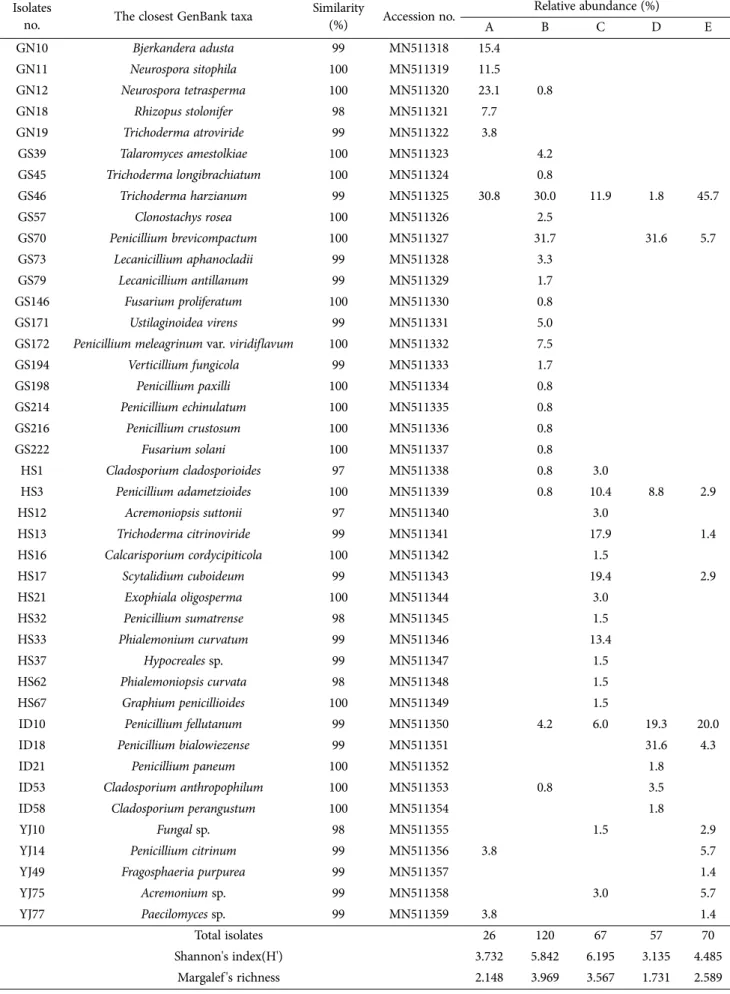
분석된 염기서열의 동정을 위하여 National Center for Biotechnology Information (http://www.ncbi.nlm.nih.gov) 의 사이트의 BLAST검색 프로그램을 이용하여 GenBank 데이터베이스와 상동성이 높은 근연종들과 비교 및 분석 을 하였다. 분석된 DNA 염기서열은 GenBank에 등록하 였으며 등록번호는 Table 1에 제시하였다. 동정된 곰팡이 들의 다양성 분석을 위하여 생물다양성 분석에 이용되는 Margalef's richness(Margalef, 1958), Shannon's diversity index (H') (Lambshead et al., 1983; Pielou, 1975)등의 다양성 지수를 차용하여 표고 톱밥재배농가로부터 분리된 곰팡이들의 다양성정도를 분석하였다.
표고 톱밥배지 유래 분리된 곰팡이들 간의 계통분석 표고 곰팡이 감염 배지로부터 분리된 곰팡이들의 계통 수 작성은 DNAMAN 프로그램(Lynnon Biosoft, Quebec, Canada)을 사용하였고, neighbor-joining(NJ, 1,000 bootstrap replicates) 방법으로 Kimura 2-parameter 모델을 이용하 였다.
결과 및 고찰
표고 톱밥배지 유래 진균 분리 및 계통분석
표고 톱밥재배에서 발생 가능한 곰팡이들의 다양성을
Table 1. Diversity index and relative abundances of fungal species isolated from the sawdust media of Lentinula edodes
Isolates
no. The closest GenBank taxa Similarity
(%) Accession no. Relative abundance (%)
A B C D E
GN10 Bjerkandera adusta 99 MN511318 15.4
GN11 Neurospora sitophila 100 MN511319 11.5
GN12 Neurospora tetrasperma 100 MN511320 23.1 0.8
GN18 Rhizopus stolonifer 98 MN511321 7.7
GN19 Trichoderma atroviride 99 MN511322 3.8
GS39 Talaromyces amestolkiae 100 MN511323 4.2
GS45 Trichoderma longibrachiatum 100 MN511324 0.8
GS46 Trichoderma harzianum 99 MN511325 30.8 30.0 11.9 1.8 45.7
GS57 Clonostachys rosea 100 MN511326 2.5
GS70 Penicillium brevicompactum 100 MN511327 31.7 31.6 5.7
GS73 Lecanicillium aphanocladii 99 MN511328 3.3
GS79 Lecanicillium antillanum 99 MN511329 1.7
GS146 Fusarium proliferatum 100 MN511330 0.8
GS171 Ustilaginoidea virens 99 MN511331 5.0
GS172 Penicillium meleagrinum var. viridiflavum 100 MN511332 7.5
GS194 Verticillium fungicola 99 MN511333 1.7
GS198 Penicillium paxilli 100 MN511334 0.8
GS214 Penicillium echinulatum 100 MN511335 0.8
GS216 Penicillium crustosum 100 MN511336 0.8
GS222 Fusarium solani 100 MN511337 0.8
HS1 Cladosporium cladosporioides 97 MN511338 0.8 3.0
HS3 Penicillium adametzioides 100 MN511339 0.8 10.4 8.8 2.9
HS12 Acremoniopsis suttonii 97 MN511340 3.0
HS13 Trichoderma citrinoviride 99 MN511341 17.9 1.4
HS16 Calcarisporium cordycipiticola 100 MN511342 1.5
HS17 Scytalidium cuboideum 99 MN511343 19.4 2.9
HS21 Exophiala oligosperma 100 MN511344 3.0
HS32 Penicillium sumatrense 98 MN511345 1.5
HS33 Phialemonium curvatum 99 MN511346 13.4
HS37 Hypocreales sp. 99 MN511347 1.5
HS62 Phialemoniopsis curvata 98 MN511348 1.5
HS67 Graphium penicillioides 100 MN511349 1.5
ID10 Penicillium fellutanum 99 MN511350 4.2 6.0 19.3 20.0
ID18 Penicillium bialowiezense 99 MN511351 31.6 4.3
ID21 Penicillium paneum 100 MN511352 1.8
ID53 Cladosporium anthropophilum 100 MN511353 0.8 3.5
ID58 Cladosporium perangustum 100 MN511354 1.8
YJ10 Fungal sp. 98 MN511355 1.5 2.9
YJ14 Penicillium citrinum 99 MN511356 3.8 5.7
YJ49 Fragosphaeria purpurea 99 MN511357 1.4
YJ75 Acremonium sp. 99 MN511358 3.0 5.7
YJ77 Paecilomyces sp. 99 MN511359 3.8 1.4
Total isolates 26 120 67 57 70
Shannon's index(H') 3.732 5.842 6.195 3.135 4.485
Margalef 's richness 2.148 3.969 3.567 1.731 2.589
분석하고자 경남지역 5개 농가로부터 표고이 발생되지 않 는 배지를 수집하였다. 수집되어진 배지들은 대부분 정상 적인 버섯발생이 이루어지지 않았으며 배지표면은 곰팡이 균사 또는 포자들로 뒤 덮여 있는 경우가 많았다. 경남지 역 표고 톱밥재배 농가로부터 수집된 버섯배지 시료로부터 총 405균주의 진균을 분리하였다. PDA 배지에서 배양되는 colony 특성, 균사 형태 및 ITS 영역의 염기서열 분석에 기초 하여 24속 42종을 동정하였다(Table 1). ITS 염기서열에 기초 하여 동정된 진균류의 분석결과 자낭균류 37종, 담자균류 1 종, 접합균류 1종, 곰팡이류 1종으로 대부분 자낭균류가 차지 하고 있었다. 자낭균류 중에서는 Penicillium 속이 11종으로 가장 많이 분리되었으며, 다음으로 Trichoderma속 4종, Cladosporium속 3종, Fusarium속 2종, Lecanicillium속 2 종, Neurospora속 2종, Acremoniopsis속, Acremonium속, Calcarisporium속, Clonostachys속, Exophiala속, Fragos- phaeria속, Graphium속, Hypocreales속, Paecilomyces속, Phialemoniopsis속, Phialemonium속, Scytalidium속, Talaromyces속, Ustilaginoidea속, Verticillium속이 각각 1 종이 확인 되었다. 자낭균류의 경우 많은 분생포자를 형
성하여 제한된 공간에서 빠른 시간 내에 표고 톱밥배지로 확산됨으로서 우점 할 수 있을 것으로 사료되어지며 이에 대한 피해가능성도 높은 것으로 판단되었다. 버섯 배지시 료에서 분리된 진균류은 NCBI GenBank에 등록하였으며, 24속 42종에 대한 유연관계를 작성하였다(Fig. 1).
분리 진균의 다양성 분석 및 특성
버섯 배지시료로부터 분리된 진균류의 종 풍부도 (species richness)를 확인하기 위하여 Margalef's richness 적용하였을 때, B농가에서 3.67, C농가에서 3.57로 다른 3개 농가에 비해 높게 나타났다. 종 다양성 지수(species diversity)를 확인하기 위하여 Shannon's index(H') 분석 한 결과 C농가에서 6.19로 가장 높게 나타났고, B농가에 서 5.84, E농가 4.48, A농가 3.73, D농가 3.13으로 나타 나났다. 특히 B, C 농가의 경우 종 풍부도 결과 값과 종 다양성 지수 값이 서로 상반되는 결과를 보여주었다 (Table 1). 분리 진균류에 대한 상대적 빈도율을 살펴보면 Trichoderma속과 Penicillium속에서 높게 확인되었다.
특히 Trichoderma harzianum이 3개 농가에서 각각 30.8%
Fig. 1. Phylogenetic analysis of fungal species isolated from the sawdust media of Lentinula edodes. This phylogenetic tree was constructed by using the neighbor-joining method (1,000 bootstrap replications). Bootstrap values (90%) are indicated at relevant nodes.
(A농가) 30.0%(B농가), 45.7%(E농가) 높은 비율로 확인 되었으며, Penicillium brevicompactum의 경우 2개 농가에서 각각 31.7%(B농가) 31.6%(D농가) 로 높게 확인 되었다. 분 리 균주들에 대한 특성들을 살펴보면, 버섯재배에 있어 곰 팡이 병을 유발 하는 원인균을 알려져 있는 Trichoderma harzianum, T. atroviride, T. longibrachiatum, Penicillium brevicompactum, Verticillium fungicola, Neurospora sp., Scytalidium sp. 등 다양한 병원성 진균들이 확인 되 었다(Ospina-Giraldo et al., 1999; Samuels et al., 2002;
Gea et al., 2003; Kim et al., 2012; Tian et al., 2017). 버 섯재배 과정에서 심각한 피해를 유발 할 수 있는 푸른곰 팡이병의 원인균인 T. harzianum의 경우 5개 농가에서 수 집된 모든 시료에서 확인되었고(Fig. 2a), T. atroviride와 T. longibrachiatum의 경우 1개 농가, Penicillium brevicompactum의 경우 3개 농가에 확인되었다(Fig. 2b).
Dry bubble 병의 원인균인 Verticillium fungicola의 경우 1개 농가에서 확인이 되었으며, Scytalidium cuboideum의 경우 2개 농가에서 확인 되었다(Fig. 2c). Scytalidium cuboideum이 분리된 시료의 경우 톱밥배지 전체를 연한 분홍색을 가지는 포자들이 뒤덮고 있어 정상적인 버섯발 생이 이루어지지 못한다는 사실을 확인하였다. Sun and Bian (2012)은 목이버섯(Auricularia polytricha) 재배에 있어 Scytalidium lignicola이 slippery scar병을 일으키는 원인균이라는 사실을 보고함에 따라 본 시료에서 분리된 Scytalidium sp. 의 경우 표고 재배에 있어 주의가 필요할 것으로 생각되었다. 표고 재배농가로부터 수집된 배지 시 료에서 분리된 진균류에 대하여 종 다양성 및 종 풍부도 등 지수 값에 기준하여 분석한 결과 시료를 수집한 모든 농가에서 다양한 진균들이 존재하고 있는 것으로 확인되 었다. 특히 Trichoderma속과 Penicillium속에 대한 높은 분리비율은 이들 진균류에 대한 적극적인 예방 및 방제에 대한 연구가 필요할 것으로 판단되었다. 이상의 연구결과 를 통해 표고 톱밥배지는 다양한 외부환경에 노출됨으로 서 다양한 진균류가 존재 할 수 있다는 사실을 확인 할 수 있었다. 또한 이러한 진균들은 기존에 보고되지 않았 던 여러가지 진균병을 유발 할 수 있는 잠재적 병원균으 로 진행 될 수 있는 가능성이 있기에 재배사 내부의 환경
및 오염에 대한 관리가 필요할 것으로 사료되었다.
적 요
본 연구는 표고 재배방식의 변화와 함께 톱밥재배가 증 가됨에 따라 재배과정에서 발생 가능한 다양한 진균류를 분리, 동정하고 이들에 대한 다양성 분석하고자 시험을 수행하였다. 경남지역 5개 농가로부터 수집된 시료에서 405균주를 분리하고 이들에 ITS 염기서열 분석을 통해 24속 42종을 확인하였다. 분리된 진균들에 대한 동정결과 Penicillium 속이 11종, Trichoderma속 4종이 확인되어 높 은 다양성을 보여주었다. T. harzianum 의 경우 5개 농가 에서 수집된 모든 시료에서 확인되었으며, Penicillium brevicompactum의 경우 3개 농가에 확인되었다. 2개 농가 에서 확인되어진 Scytalidium cuboideum의 경우 표고 톱 밥배지 조기부후 및 버섯 발생 저해 등의 피해증상이 확 인됨에 따라 주의가 필요할 것으로 사료되었다. 또한 표 고 톱밥재배의 경우 다양한 진균류이 존재가능하기 때문 에 재배사 내부의 환경관리 및 예방이 필요할 것으로 판 단되었다.
감사의 글
본 연구는 농촌진흥청 지역특화기술개발과제 연구지원 (Project No.PJ013575022019)에 의해서 이루어진 것이며 연구비지원에 감사드립니다.
REFERENCES
Akamatsu S, Watanabe A, Tamesada M, Nakamura R, Hayashi S, Kodama D, Kawase M, Yagi K. 2004. Hepatoprotective effect of extracts from Lentinus edodes Mycelia on dimethylnitrosamine-induced liver injury. Biol Pharm Bull 27:
1957-1960.
Enman J, Rova U, Berglund KA. 2007. Quantification of the bioactive compound eritadenine in selected strains of shiitake mushroom (Lentinus edodes). J Agric Food Chem 55: 1177- 1180.
Fig. 2. Colony morphology of the major fungal species isolated from the sawdust media of Lentinula edodes. A, Trichoderma