주요용어 뇌졸중 내원시간 건강지각 신체적 자각증상 자기효능: , , , ,
서 론 I.
연구의 필요성 1.
. 2005
2 ,
(Korea National Statistical Office, 2006).
24 (An, 2002).
,
, ,
뇌졸중 환자의 병원 내원시간에 영향을 미치는 요인
이상현
1
․ 이영휘2
․ 김화순2
․ 임지영2
Factors Influencing the Hospital Presentation Time of Stroke Patients
Lee, Sang Hyun
1Lee, Young Whee
2Kim, Hwa Soon
2Lim, Ji Young
21
RN, BupyungSaerim Hospital,
2Professor, Nursing Department, Inha University, Inchon, Korea
Purpose: This cross-sectional survey research was undertaken to identify the factors influencing time from onset
to hospital arrival of stroke patients and to provide basic information for the development of intervention programs for stroke patients. Methods: The data were collected using a convenient sampling method from three hospitals in Inchon. The subjects were 78 patients who were diagnosed as stroke by doctor and they voluntarily participated in the study. Results: On the average, subjects arrived at the hospitals by 16.72 hours after the onset of stroke events with the range from 0.17 hours to 72 hours. Thirty-four(43.6%) subjects arrived within 3 hours which can maximize treatment effects. There was significant difference in hospital presentation time according to the level of knowledge(χ2=18.629, p=.0003). A negative correlation was found between the hospital presentation time and self-efficacy (r= -.320, p=.004). Stepwise multiple regression analysis revealed that the most powerful predictor was self-efficacy. Self-efficacy, the level of knowledge and physical symptoms were significant factors and accounted for 21.7% of the variance of hospital presentation time in stroke patients. Conclusion: According to the results, self-efficacy is a useful concept for reducing the hospital presentation time from onset of attack in stroke patients.Therefore, nurses should consider educational programs which include not only a knowledge of stroke and recurrence prevention but also the concept of self-efficacy.
Key Words : Cerebrovascular accident, Self-efficacy, Hospital Presentation time, Health perception, Physical symptoms
Corresponding address: Lee, Young Whee, Nursing Department, Inha University, 253 Yonghyun-dong, Nam-gu, Inchon 402-751, Korea. Tel:
82-32-860-8202, Fax: 82-32-874-5880, E-mail: [email protected]
투고일 2006 10 18 심사의뢰일 2006 10 18 심사완료일 2007 3 23
.
. ,
(Dirksen, Lewis, & Heikemper, 2000; Song
& Lee, 2002).
,
(tissue plas- minogen activator) 3
(Adams, Victor, & Ropper, 1997; Kim et al., 2001).
17 (Song & Lee, 2002),
An(2002)
3 (28%) 72
(16%) .
, , , , ,
,
(Hong & Park, 1999; Jung et al., 1995; Song & Lee, 2002).
,
(Song, 1997).
. ,
.
(Kim, 2002),
. ,
(Lim, 2002; Ryu, 2004) .
, ,
,
.
연구목적2.
,
.
1) .
2) .
3)
. 4)
.
연구방법 II.
연구설계 1.
, .
연구대상 2.
3 78 .
1)
2) ,
3)
연구도구 3.
. .
1)
,
, , , , , ,
.
2)
, ,
, ,
, .
3)
Yoo(2001)
4
. 14 ‘ ’ 0
‘ ’ 3
0 -42
. 4)
Ware Sherbourne(1992) 36
Short Form 36(SF-36) Health Survey Questionnaire
5 . SF-36
0 100
5
100 .
. Kim(2002)
Cronbach's alpha coefficient=.84 ,
.85 .
5)
(Bandura,
1982). Sherer (1982)
(General self-effica-
cy) . Sherer (1982)
, .
, ,
. 17
, ‘ ’ ‘
‘ 4 ,
. 17-68
. Cronbach's alpha
coefficient=.86 , .80
, .91 .
6)
,
.
자료수집 방법 및 기간4.
2005 7 25 10 30
3 ,
, .
1)
.
2) , ,
. 3)
. 4)
, 3-5
, .
자료분석 방법 5.SPSS .
, .
(Lee, Jung, Kim, Song, & Hwang, 2002).
2 Wilcoxon test , 3
Kruskal-Wallis test .
, ,
Pearson Product Moment
Correlation .
(Stepwise Multiple Regression) .
연구결과III.
뇌졸중 환자의 병원 내원시간 1.
Table 1 . ,
16.72 ,
0.17 72
.
3
43.6%(34 ) , 6
56.4% (44 ) .
43.5% (34 ) 6
.
뇌졸중 환자의 일반적 특성 및 병원 내원시간의 2.
차이
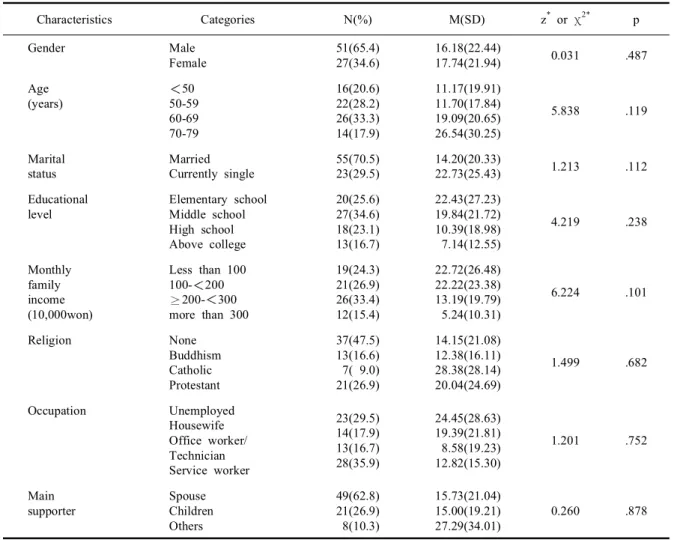
Table 2 .
65.4%(51 ) . 58.8
(18.36) 60 33.3% ,
70.5%(55 )
Table 1. Hospital presentation time of stroke patients (N=78)
Hospital presentation
time (hours) N(%) Mean(SD) Range
0- 3 3- 6 over 6
34(43.6) 10(12.8) 34(43.5)
16.72(22.14) 0.17-72
. 34.6%(27 )
, 200 300
33.4%(26 )
. 47.5%(37 )
35.9%(28
) ,
,
62.8%(49 ) .
.
뇌졸중 환자의 질병관련 특성 및 병원 내원시간의 3.
차이
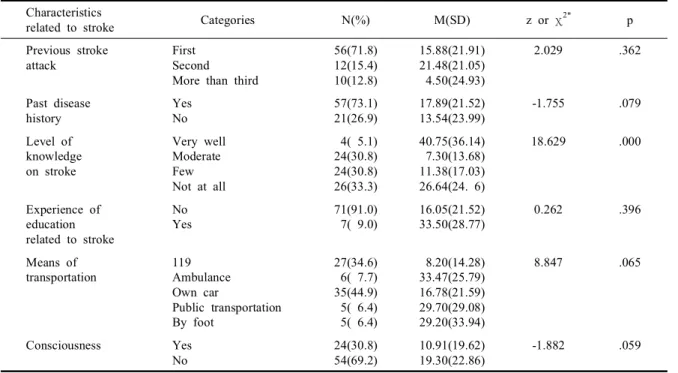
Table 3 .
33.3%(26 ) .
(χ
2=18.629, p=.0003).
44.9%
Table 2. Differences in hospital presentation time by general characteristics (N=78)
Characteristics Categories N(%) M(SD) z
*or χ
2*p
Gender Male
Female
51(65.4) 27(34.6)
16.18(22.44)
17.74(21.94) 0.031 .487
Age (years)
50 50-59 60-69 70-79
16(20.6) 22(28.2) 26(33.3) 14(17.9)
11.17(19.91) 11.70(17.84) 19.09(20.65) 26.54(30.25)
5.838 .119
Marital status
Married Currently single
55(70.5) 23(29.5)
14.20(20.33)
22.73(25.43) 1.213 .112
Educational level
Elementary school Middle school High school Above college
20(25.6) 27(34.6) 18(23.1) 13(16.7)
22.43(27.23) 19.84(21.72) 10.39(18.98) 7.14(12.55)
4.219 .238
Monthly family income (10,000won)
Less than 100 100- 200
200- 300 more than 300
19(24.3) 21(26.9) 26(33.4) 12(15.4)
22.72(26.48) 22.22(23.38) 13.19(19.79) 5.24(10.31)
6.224 .101
Religion None
Buddhism Catholic Protestant
37(47.5) 13(16.6) 7( 9.0) 21(26.9)
14.15(21.08) 12.38(16.11) 28.38(28.14) 20.04(24.69)
1.499 .682
Occupation Unemployed
Housewife Office worker/
Technician Service worker
23(29.5) 14(17.9) 13(16.7) 28(35.9)
24.45(28.63) 19.39(21.81) 8.58(19.23) 12.82(15.30)
1.201 .752
Main supporter
Spouse Children Others
49(62.8) 21(26.9) 8(10.3)
15.73(21.04) 15.00(19.21) 27.29(34.01)
0.260 .878
* Wilcoxon test for 2 category variable, Kruskal-Wallis test for more than 3 category variable.
(35 ) 6.4%(5 ) .
(χ
2=8.847, p=.059).
71.8%(56 )
, ‘ ’
73.9%(57 ) , , ,
. (91.0%)
69.2% .
, , ,
.
병원 내원시간과 자기효능감 신체적 자각증상
4. , ,
건강지각과의 상관관계
, ,
Table 4 .
(r=-.320 p=
.004)
.
. Table 3. Differences in hospital presentation time by disease related characteristics (N=78)
Characteristics
related to stroke Categories N(%) M(SD) z or χ
2*p
Previous stroke attack
First Second More than third
56(71.8) 12(15.4) 10(12.8)
15.88(21.91) 21.48(21.05) 4.50(24.93)
2.029 .362
Past disease history
Yes No
57(73.1) 21(26.9)
17.89(21.52) 13.54(23.99)
-1.755 .079
Level of knowledge on stroke
Very well Moderate Few Not at all
4( 5.1) 24(30.8) 24(30.8) 26(33.3)
40.75(36.14) 7.30(13.68) 11.38(17.03) 26.64(24. 6)
18.629 .000
Experience of education related to stroke
No Yes
71(91.0) 7( 9.0)
16.05(21.52) 33.50(28.77)
0.262 .396
Means of transportation
119 Ambulance Own car
Public transportation By foot
27(34.6) 6( 7.7) 35(44.9) 5( 6.4) 5( 6.4)
8.20(14.28) 33.47(25.79) 16.78(21.59) 29.70(29.08) 29.20(33.94)
8.847 .065
Consciousness Yes
No
24(30.8) 54(69.2)
10.91(19.62) 19.30(22.86)
-1.882 .059
* Wilcoxon test for 2 category variable, Kruskal-Wallis test for more that 3 category variable
Table 4. Correlations among hospital presentation time, self-efficacy, physical symptoms and health perception (N=78)
Variables Self-Efficacy Physical symptoms Health perception
Time of hospital presentation
r=-.320 (p=.004)
r=-.180 (p=.116)
r=-.193
(p=.091)
자기효능 신체적 자각증상 건강지각 점수
5. , ,
,
Table 5 .
4 2. 29
2.50 2.98
3.00
1.50 0.55 .
6. 뇌졸중 환자의 병원 내원시간에 영향을 미치는 요인
,
Table 6 .
‘ ’
‘ ’ 1, ‘ ’ 2,
‘ ’ 3 .
10%
,
22% .
논 의 IV.
.
.
16.72 William,
Rosamond Morris(2000) 4.3
Song Lee(2002)
17 .
3
43.6% Hong Park(1999)
22% Schroeder,
Rosammond, Morris, Evenson Hinn(2000)
47.3% .
, 6
.
Table 5. Self-efficacy, health perception and physical symptoms of stroke patients (N=78)
Variables Mean (SD) Range
Self efficacy 2.29(.276) 1.53-3.06
Health perception 2.98(.428) 2.00-4.40
Physical symptoms 0.55(.305) 0.07-1.43
Table 6. Predictors of hospital presentation time (N=78)
Variables β R
2F p
Self-efficacy -.344 .102 8.658 .001
Knowing very well .260 .166 7.451 .014
Physical symptoms -.228 .217 6.836 .031
6
56.4% . 1995
Cho(1996) Hong Park(1999) 39.9%, 33.2%
10 ,
, 119
. Cho(1996)
22.2%, 21.1%,
19.9%, 119 9.2% ,
44.9%
119 34.6% . 10
119 119
.
65.4%, 34.6%
. An(2002)
50.7%, 49.3% ․
.
Youn (2003) 1.74:1
.
60 33.3%, 50 28.2%
Cho, Choi, Lee Ha(1998) 60 30.5%. 50 30.5%
50 , 60 .
30
. 50, 60
. ,
. Kim(1992)
.
28.2%
.
‘ ’ , ‘
’ 33.3%
.
‘ ’
9% ,
. Yu (2002) 3
.
Cho(1996) 119
, Williams (1993)
.
(p=.065) 119 8.20
, 16.78 ,
33.47 . 119
119 119
.
,
. Harpaer, Potter Castledern(1992) Feldmann (1993)
. Jung (1995) Cho(1996)
.
.
, ,
.
(Cho, Lee, & Kim, 2002; Choi, 2004; Kim & So, 2001).
, .
. An(2002)
, 8
.
Song(1997)
.
.
. ,
.
2-3
.
.
,
.
.
Robinson-Smith, Johnston Allen(2000)
. Gillis(1993)
23 ,
. Bandura(1982)
, ,
.
,
, ,
,
. , , ,
,
, , , ,
.
. ,
,
. .
.
. .
결론 및 제언 VI.