
http://dx.doi.org/10.12925/jkocs.2015.32.4.767
수송용 바이오연료 정책에 따른 품질기준 영향에 관한 연구
박조용
✝ㆍ김재곤ㆍ민경일ㆍ박천규ㆍ하종한
한국석유관리원 석유기술연구소(2015년 11월 25일 접수; 2015년 12월 8일 수정; 2015년 12월 14일 채택)
Effect Study of Fuel Specifications on Biofuels Policy in Transport Sector
Jo-Yong Park✝ㆍJae-Kon KimㆍKyong-IL MinㆍCheon-kyu ParkㆍJong-Han Ha
Petroleum Technology R&D Center, Korea Petroleum Quality and Distribution Authority,
Chungcheongbuk-do, 363-883, Korea
(Received November 25, 2015; Revised December 8, 2015; Accepted December 14, 2015)
요 약 : 바이오매스로부터 생산되는 수송용 바이오연료는 온실가스 저감과 지속가능하고 친환경적으 로 석유제품을 대체할 수 있다. 수송용 바이오연료의 의무혼합과 보급 목표는 유럽연합, 미국 등의 많은 나라에서 발표하였고 정부의 정책에 의해 활성화되었다. 본 논문에서는 각국의 수송용 바이오연료 정책 과 품질기준에 대해 논하겠다. 유럽연합의 바이오연료는 온실가스를 저감하는 정책으로 이동하였다. 미 국은 RFS2 하에서 바이오연료의 품질기준을 설정하였고 연방 및 주 정부 수준에서 바이오연료를 촉진 하는 정책을 펴고 있다. 한국은 휘발유에 산소 함량 기준으로 2.3%를 산화물로 허용하고 있으며 바이오 디젤은 2015년 7월 31일부터 B2.5로 의무혼합하고 있다.
주제어 : 바이오연료, 품질기준, 바이오디젤, 바이오에탄올, 신재생에너지 연료 혼합의무화, 온실가스
Abstract : Transport biofuels produced from biomass can be substituted for petroleum fuels due to GHG reduction, sustainability and environmental friendly. Mandates and targets of biofuels are announced in the European union, United states and other countries worldwide and promoted by the government policies. This paper reviewed current status of the national biofuels policies and fuel specifications in transport sector. EU biofuels policy shifted and GHG emission reduction became the main focus of the policy. There are specification requirements for biofuels in the U.S.under the RFS2, but there are other polices as well that serve to promote the uptake of biofuels both at the federal and state level. Korea government has allowed 2.3% oxygen in gasoline to come from oxygenates, increased the biodiesel blend mandate from B2 to B2.5 effective from Jul.
31, 2015.
Keywords : Biofuel, Specification, Biodiesel, Bioethanol, Renewable fuel standard, Green house gas(GHG).
✝
Corresponding author
(E-mail: [email protected])
1. 서 론
바이오연료는 1990년대부터 유가상승 대응과 농업정책 육성을 위하여 유럽에서 바이오디젤을 중심으로 보급이 시작되어 의무혼합제도 도입 및 목표 설정 등을 통해 보급 활성화가 진행되어 왔 다. 현재는 자국의 산업육성과 안정적인 바이오연 료 시장을 위한 정책 및 이산화탄소 저감효과를 기반으로 한 의무혼합제도 도입과 차세대 연료의 개발과 활성화를 위해 많은 노력을 기울이고 있 다[1]. 유럽의 바이오연료는 휘발유에 ETBE (Ethyl Tertiary Butyl Ether)와 같은 에스테르 및 에탄올을 혼합하여 사용하고 있으며, 경유에 FAME(Fatty Acid Methyl Ether) 및 HVO (Hydroteated Vegetable Oil) 또는 BTL(Biomass to Liquid) 연료 등을 사용할 수 있도록 허용하 고 있다. 바이오연료에 대한 기준은 기존의 휘발 유와 경유에 대한 품질기준 안에 규정되어 있다 [2].
미국의 바이오연료 정책은 RFS에 의해 에너지 정책의 일환으로 작용하고 있으며 2007년 EISA(Energy Independence and Security Act)에 의해 개정되었다. 미국 내의 연간 석유제품에 혼 합될 바이오연료의 양을 결정하고 정제업자, 수입 업자, 혼합업자들은 바이오연료 의무사용량을 달 성해야한다. 바이오연료 의무사용량은 미국에서 생산되는 휘발유 총량과 수입되는 양에 의해 결 정이 된다[3-5]. 미국의 ASTM(American Society for Testing Materials)은 연료의 품질과 기준을 관리하고 있다. 석유제품과 윤활유에 대한 품질기준 제정에 대해서는 연료 생산사(석유제품, 바이오연료), 엔진 제조업자, 사용자, 정부 등으로 이루어진 ASTM의 위원회 D02(ASTM Committee D02)에서 진행하고 있다. 미국의 ASTM 연료 기준은 사용자의 안전과 보호를 위 한 최소한의 허용 기준이기 때문에 ASTM 자체 는 법적인 강제성을 갖지는 않는다. 바이오연료의 경우 ASTM 기준은 일반적으로 면세 혜택 자격 을 얻기 위해 요구되거나 미국에서 합법적인 판 매를 목적으로 하고 있다.
국내의 바이오연료 정책은 바이오디젤 중심으 로 이루어졌으며 2007년 9월 정부 관계부처 합 동으로 제1차 바이오디젤 중장기 보급계획 수립 을 시작으로 석유 및 석유대체연료 사업법 상에 서 바이오디젤 2% ~ 5%까지 경유에 의무혼합하 여 보급하였다. 최근에 제4차 신 ․ 재생에너지 기
본계획에 따라 RFS 제도 하에서 바이오디젤 중 장기 보급 혼합비율이 현행 2%에서 2015년 7월 31일부터 2.5%로 상향되었다. 국내에서는 한국석 유관리원(K-Petro)에서 석유 및 석유대체연료 사 업법에서 바이오연료 품질 기준을 제정하여 시행 중에 있다[6]. 국내의 석유 및 석유대체사업법에 서는 2006년부터 에탄올, ETBE 등과 같은 함산 소 물질에 대해 휘발유에 산소함량 기준으로 2.3 wt%를 허용하도록 규정하고 있다.
본 논문에서는 유럽과 미국의 바이오연료 정책 과 바이오에탄올, 바이오디젤의 품질기준에 대해 알아보고 국내의 바이오연료 정책 및 품질 기준 분석을 통하여 국내도입 가능한 바이오연료에 대 해 알아보겠다.
2. 국외 바이오연료 정책 및 품질 기준
2.1 유럽의 바이오연료 정책 동향유럽의 바이오연료 시장에 영향을 주는 규정은 2009년 제정된 CCP(EU Energy and Climate Change Package)와 FQD(Fuel Quality Directive)가 있으며 2020년까지 20(GHG)/20(효 율)/20(신재생에너지)을 목표로 하고 있다. 이중 에 유럽 전체 에너지의 20%를 신재생에너지로 보급한다는 목표로 2009년에 CCP의 한 부분인 신재생에너지지침(2009/28/EC, RED)이 시행되 었고 2010년 12월까지 회원국은 이 규정을 따라 야 한다. 이 규정에 의하여 지속가능성 도입 및 2020년까지 수송부문에 바이오연료 10% 혼합을 의무화하는 것을 목표로 각 회원국들은 독자적인 목표를 설정하여 운영 중에 있다(Table 1).
특히, 유럽은 셀룰로스, 폐기물, 잔류물 등의 비식용 원료의 확대를 위하여 RED(Renewable Energy Directive) 지침 하에서 의무량에 대해 2 배로 간주(Double Counting)해 주고 있으며 이 산화탄소 저감효과 및 생물다양성 등을 고려하여 지속가능성 기준을 도입하여 운영 중에 있다. 지 속가능성 기준에 대한 검증은 국가 인증시스템 또는 유럽위원회와 유럽연합에서 승인된 19개의 자발적 인증 시스템(ISCC, RSPO 등)에 의해 검 증되며 온실가스(GHG) 감축 기준은 현재 신규 설비대상 35%, 2017년부터 50%, 2018년까지 60%를 목표로 하고 있다. 최근 식량계 원료에 대해서는 2015년 4월 RED 개정을 통해 7%로 제한하고 있다[7-9].
Table 1. Overview of Biofuels Mandatory Target[7]
Country National Biofuel Targets Mandatory(M)
Austria 3.4%(energy content) ethanol in gasoline
6.3% biocomponent(energy content) diesel M Denmark 2012: 1%(energy content) in gasoline and 1%(energy content) in diesel M
France Ethanol 7% by energy content
Biodiesel 7.7% by energy content M
Germany 2009-14: 4.4% by energy content biodiesel target and 2.8% by energy content ethanol target
2010-14: 6.25% by energy content combined biofuels M
Lithuania 2014: biodiesel blended at 7 vol%(+/- 0.5%)
2014: gasoline must contain 5-10 vol% ethanol or 10-22 vol%
ETBE(+/- 0.5 vol%) M
Portugal
Until 2014, biodiesel suppliers have to provide a blend of FAME at 6.75%
From 2015, there will be a requirement of 2.5% of biocomponents in gasoline
M
Romania 2011 2014 2016 2018
Ethanol/ETBE in gasoline 4.5 8 FAME in diesel 5 6.5 According to Decision 1121/2013 in vol%
M
Slovakia
Biofuels Ethanol ETBE Biodiesel
2014 4.5 4.1 3.0 6.8
2015 5.5 4.5 3.0 7.5
2016 5.5 4.6 3.0 7.6
2017 5.8 4.7 3.0 7.8
2018 7.2 5.9 3.0 9.7
2019 7.5 6.2 3.0 10.1
2020 8.5 7.0 3.0 11.5
Introduced by Act 492/2010 effective Jan. 1, 2011, by energy content:
M
Spain 2013: 4.1% by energy content For biodiesel, 4.1% by energy content
For ethanol, 3.9% by energy content M
유럽은 바이오연료의 보급 활성화를 위하여 세 금혜택 등 인센티브 부여 정책을 시행하고 있으 며 각 국가별로 별도의 인센티브를 설정 및 운영 하고 있다. 최근 독일은 온실가스저감 의무화 제 도를 도입하여 2세대 연료에 대해 혜택을 주는 정책을 펴고 있다. 프랑스는 2세대 바이오연료(셀 룰로스 및 폐기물)에 대해 더블카운트를 주며 수
입을 막고 자국생산에 유리한 정책을 펴고 있다.
스페인은 2014년 4월 폐유(동물 또는 식물), 동 물유지에 더블카운트를 인정했으나 상세 가이드 라인 미흡으로 2016년 초까지는 시행이 어려울 것으로 보인다.
2.2 유럽의 바이오연료 품질 기준 2.2.1 바이오에탄올
유럽의 연료 에탄올 품질 규격은 FQD 98/70/EC에서 요구한 대로 에탄올과 ETBE를 휘 발유에 산소함량 기준으로 3.7 wt%까지 혼입할 수 있으며, 이는 10 vol%의 에탄올 또는 22 vol%의 ETBE에 해당된다. Table 2에서 에탄올 은 유럽표준위원회(CEN)의 EN 15376:2014에 명시된 기준을 충족시켜야 하며 폴란드와 스웨덴 같은 일부 회원국들은 자국만의 연료 에탄올 표 준을 적용하고 있다.
에탄올 및 기타 함산소 물질들의 제한은 개정 된 FQD를 통해 변경되었다. 2009년에 개정된 FQD는 에탄올 함량 제한을 5 vol%에서 10 vol%로 증가시켰으며 산소 함량을 2.7 wt%에서 3.7 wt%로 증가시켰다(E10 등급). 그 결과, 다른 함산소 물질들도 비례적으로 증가하게 되었다. 하 지만, 이전 FQD에서 설정된 수준과 동일하게 최 대 3 vol%로 정해진 메탄올 함량은 예외로 하고 있다.
연료의 품질과 온실가스 배출 저감에 관련된 지침 FQD 2009/30/EC에 따르면 유럽연합 회원 국은 자국 시장의 휘발유가 FQD 지침에 수록된 E10에 대한 규정과 관련된 품질 기준을 반드시 준수하도록 하고 있다. 하지만 일부 오래된 차량 들은 높은 에탄올 함량을 지닌 휘발유를 사용하 기에는 적합하지 않거나 이러한 휘발유를 사용하 는 것이 허용되지 않기 때문에 유럽연합 회원국 들은 최대 에탄올 함량이 5%인 휘발유(E5 등급) 의 적절한 사용범위를 보장할 필요가 있다. 유럽 연합 회원국이 필요하다고 간주하는 경우, E5는 회원국에서 최소 2013년 또는 그 이상 기간까지 사용될 수 있다. 하지만, 지금은 4개 국가(프랑 스, 핀란드, 독일, 네덜란드)만이 자국 시장에서 E10 등급의 휘발유를 판매하고 있을 뿐이다.
유럽표준위원회는 FFV(Flex-Fuel Vehicle)에 사용할 E85 연료(Table 3)에 대하여 TS 15293이 라고 하는 기술 규격(Technical Specifications:
TS)을 개발하였다. 하지만 CEN/TS 15293은 표 준이 아니라는 점에 주의해야 하고 표준 개발 전 에 검토할 필요가 있는 대안적 규격으로 만들었 을 뿐이다. 프랑스, 오스트리아, 스웨덴, 헝가리, 폴란드, 체코와 같은 일부 회원국들은 국가 표준 으로 채택하고 있다. 유럽표준위원회는 CEN/TS 15293에 대한 작업을 마무리하고 있으며 앞으로
E85에 대한 완성된 표준을 발표할 계획이다 [11-12].
2.2.2 바이오디젤
FQD 및 유럽표준위원회(CEN)의 EN 590:2013에 따르면, 바이오디젤(FAME)은 자동 차 경유에 7 vol%(B7)까지 혼합될 수 있다. 혼합 성분으로서의 FAME은 가장 최근인 2014년 CEN의 EN 14214:2012+A1:2014/AC에서 규 정된 품질 기준을 준수해야 한다(Table 4). 또한 EN 14214:2012+A1:2014/AC는 지역 및 시기 (계절)에 따라 혼합할 FAME의 올바른 선택에 대하여 자세히 권고하고 있다. 유럽의 품질기준은 바이오디젤 내에 포함된 이중결합과 관련한 요오 드가에 대해 기준을 정하고 있고 산화안정도도 8 시간으로 가장 엄격한 기준을 갖고 있다. 이는 대두유 유래 바이오디젤의 유럽 시장 진입에 대 한 제한 요인으로 작용하고 있다.
2009년까지는 FQD 내에 FAME 함량에 대한 규정이 없었다. FAME는 연료 품질 및 온실가스 배출 저감에 대한 지침 2009/30/EC에서 처음으 로 품질 항목으로 추가되었고, 이 지침은 경유 내의 FAME 함량을 7 vol%로 제한하도록 정하 고 있다. 또한, 이 지침에서는 회원국의 더 높은 바이오디젤 혼합을 허용하고는 있지만 차량과 관 련된 기술적 이유 때문에 반드시 FAME 함량 제 한을 수립하고 준수하도록 하고 있다[13-14].
바이오디젤 혼합과 관련하여 현재 CEN은 10 vol%와 30 vol% FAME가 혼합된 경유에 대한 두 가지 새로운 표준을 개발하고 있으며 몇몇 회 원국들은 국가 기준을 제정하였다. 폴란드는 B20(20 vol% FAME)을 시장에서 판매하고 있으 며 프랑스나 체코와 같은 몇몇 국가들은 기업 등 에 소속된 차량에 사용할 B30(30 vol% FAME) 을 판매하고 있다.
2.3 미국의 바이오연료 정책 동향
미국은 2005년 에너지정책법의 개정에 따라 2007년 신재생연료 의무혼합제도(RFS : Renewable Fuel Standard)가 시행되었고 2단계 RFS2가 2010년 에너지 자립 및 에너지안보법 (EISA : Energy Independence and Security Act) 에 의해 발효되었다. RFS2의 주요내용은 2022년 까지 360억 갤런(1.36억 kL)을 보급목표로 하고 있으며 Renewable Fuel(옥수수 BE), Advanced Biofuel(사탕수수 BE, HVO), Biomass-based
Table 2. Current EU Ethanol Specifications[10]
Spec Name EN 15376 EN 15376:2011
Grade Ethanol
Effective Date Apr, 2015 Aug, 2011
Source EN 15376:2014 EN 15376:2011
Additional Comments EU
Ethanol, vol%, min 98.7(4) 98.7(4),(6)
Water, vol%, max 0.300 0.3(7)
Chloride, inorganic, ppm, max 1.5 6.0
Copper, ppm, max 0.100 0.1
Methanol, vol%, max 1.0 1.0(8)
Acetic Acid, g/l, 100% EtOH, max 0.007(3)
Acidity, wt%, max 0.007
C3-C5 alcohols, ppm, max 20,000
Non-volatile matter, g/100ml, max 0.01
Denaturant, vol% (9) (5)
Sulfur, ppm, max 10.0 10
Sulfate, ppm, max 3.0 4.0
Electrical Conductivity, μS/m, max 250(10) 250
Phosphorus, g/l, max 0.00015
Appearance clear & colourless
Dye content, g/100 l, max (2)
Use of additives (1)
(1) Suitable anti-corrosion fuel additives without known harmful side effects and that are compatible with the finished gasoline are recommended in the appropriate amount.
(2) The use of dyes and markers is allowed.
(3) Total acidity expressed in %(m/m) as acetic acid.
(4) Includes ethanol and higher saturated alcohols content.
(5) Denaturants as required by European and national customs regulations are permitted, provided they do not cause harmful side effects to vehicles and petroleum distribution systems. It is strongly recommended to use: (a) automotive gasoline meeting EN 228 specifications, (b) ETBE, (c) MTBE, (d) TBA(tertiary butyl alcohol), (e) isobutanol and (f) isopropanol.
(6) 98.7%(m/m) according to EN 15376:2011.
(7) 0.3 m/m% according to EN 15376.
(8) 1.0%(m/m) according to EN 15376.
(9) Denaturants, as required by European and national customs regulations are permitted, provided they do not cause harmful side effects to vehicles and petroleum distribution systems. Where denaturing of the automotive ethanol is required, it is strongly recommended to select denaturants from the list below that are known to be non-harmful to vehicle systems: (a) automotive petrol conforming to EN 228, (b) ETBE, (c) MTBE, (d) TBA, (e) isobutanol, (f) isopropanol.
(10) To be measured prior to additivation.
Table 3. Current EU E85 Specifications[10]
Spec Name CEN/TS 15293/2011
Grade E85
Effective Date Feb, 2011
Source CEN/TS 15293
Additional Comments Ethanol Blend
RON, min 104(1)
MON, min 88(1)
Sulfur, ppm, max 10
Lead, g/l, max -
Manganese, g/l, max -
RVP @ 37.8℃, kPa 35(s)~60(s) / 50(w)~80(w)(3)
Density @ 15℃, kg/m3 760~800
FBP, ℃, max -
Residue, vol%, max -
Methanol, vol%, max 1.0
Ethanol, vol%, max 85(s) / 75(w)(3),(4)
Ethers(5 or more C atoms), vol%, max 11
C3-C5 alcohols, ppm, max 6
Phosphorus, g/l, max 0.00015
Oxidation stability (Induction period), minutes, min 360
Water, vol%, max 0.4
Existent gum (solvent washed), mg/100ml, max 5
Chloride, inorganic, ppm, max 1.2
Copper, ppm, max 0.10
Copper corrosion, 3hr @ 50℃, merit (class), max class 1
Color clear & bright
pH 6.5~9.0(2)
Acidity, wt%, max 0.005(5)
Electrical Conductivity, μS/m, max 1.5
(1) Recommended value.
(2) Measured as pHe.
(3) Summer: Class A May 1 - Sept. 30, Winter: CEN notes that each country must choose which climate classes to use for other periods of the year.
(4) 70 vol% min in summer, 50 vol% min in winter.
(5) As acetic acid.
Table 4. Current EU biodiesel Specifications[10]
Spec Name EN 14214+A1:2014/AC
Grade FAME(Fatty Acid Methyl Esters)
Effective Date Oct, 2014
Source EN 14214+A1:2014/AC
Cetane number, min 51
Ester content(concentration), wt%, min 96.5
Sulfur, ppm, max 10
Density @ 15℃, kg/m3 860~900
Density @ 20℃, kg/m3, min (3)
Viscosity @ 40℃, cSt 3.5~5.0
Flash Point, ℃, min 101
Carbon residue 10%, wt%, max 0.3
Water, vol%, max 500(7)
Sulfated Ash, wt%, max 0.02
Total contamination, ppm, max 24
Copper corrosion, 3hr @ 100℃, merit(class), max class 1(4)
Acid value, mg KOH/g, max 0.5
Methanol, vol%, max 0.2(6)
Monoglycerides, wt%, max 0.7
Diglycerides, wt%, max 0.2
Triglycerides, wt%, max 0.2
Free Glycerol, wt%, max 0.02
Total glyceride, wt%, max 0.25
Linolenic acid methyl ester, wt%, max 12.0 Polyunsaturated methyl esters, wt%, max 1.0
Iodine number, g/100g, max 120
Phosphorus, g/l, max 4(2)
Alkali, Group I(Na, K), ppm, max 5.0(5) Metals, Group II(Ca, Mg), ppm, max 5.0 Oxidation stability @ 110℃, hour, min 8.0
Others(use of additives etc.) (1)
(1) The use of dyes and markers is allowed.
(2) A lower limit of 2.5 kg/kg may come into force after validation work on the measurement standard and on engine oil impacts.
(3) Density may be measured over a range of temperatures from 20℃ to 60℃. See testing methods for details.
(4) Measured at 50℃.
(5) A lower limit may come into force after validation by work on the measurement standard precision.
(6) Methanol content must not exceed 0.20 wt%.
(7) Water content must not exceed 500 mg/kg
Table 5. Current ASTM Ethanol Specifications[18]
Spec Name ASTM D 4806-14
Grade Ethanol
Effective Date Jun, 2014
Source ASTM International
Additional Comments Denatured Anhydrous(for blending)
Ethanol, vol%, min 92.1
Water, vol%, max 1.0(2)(3)
Gum(Solvent washed), mg/100ml, max 5.0
Chloride, inorganic, ppm, max 10
Copper, ppm, max 0.1
Methanol, vol%, max 0.5
Acidity, wt%, max 0.007
Denaturant, vol% 1.96(4)(5)~5.2(6)(7)(8)
Sulfur, ppm, max 10
Sulfate, ppm, max 4
pH 6.5~9.0(1)
(1) Measured as pHe.
(2) In some cases, a lower water content may be necessary to avoid phase separation of a gasoline-ethanol blend at very low temperatures. This reduced water content, measured at the time of delivery, shall be agreed upon between the supplier and purchaser.
(3) Also defined as 1.26 wt% max.
(4) Additional U.S. denaturant regulation per the Alcohol and Tobacco Tax and Trade Bureau (TTB).
(5) TTB Formulas require a minimum of two parts of approved denaturant to 100 parts of ethanol with a minimum of 195 proof ethanol.
(6) Additional U.S. denaturant regulation per the U.S. EPA.
(7) The maximum amount of denaturant the EPA allows in denatured fuel ethanol for determining volumes for RFS2 compliance purposes.
(8) The only denaturants allowed for the denatured fuel ethanol defined by this specification are natural gasoline, gasoline blendstocks or unleaded gasoline.
Diesel(FAME), Cellulosic Biofuel의 4개 카테고 리로 구분하고 온실가스 저감효과도 각각 20%, 50%, 50%, 60%로 규정하였다. 미국은 각 주별 원료 수급상황 등을 고려하여 의무혼합 수준과 조건 등을 다르게 운영하고 있다(Fig. 1).
미국은 바이오에탄올 혼합자에 한해 소비세를 면세하였다가 2012년부터 폐지하였다. 바이오디 젤 혼합자와 셀룰로스 바이오연료에 대해서는 세 금을 지원하고 있으며, 또한 의무혼합이행량 달성 을 위해 관세 폐지 정책을 펴고 있다. EPA(환경 부)와 USDA(농무성)에서 다양한 프로그램을 통 해 바이오작물 생산자의 경작지 개간비용, 수확 및 저장 비용, 바이오연료 생산사의 연료생산 비
Fig. 1. U.S. Motor Fuel RFS Targets[15].
용, 에탄올 인프라 구축비 및 교육 프로그램 등 에 지원제도를 도입하여 보급 활성화를 추진 중
Table 6. Current ASTM Specifications for E85[18]
Spec Name ASTM D 5798-13a
Grade E85-Class 1 E85-Class 2 E85-Class 3 E85-Class 4
Effective Date Jul, 2013
Source ASTM International
Sulfur, ppm, max 80
Lead, g/l, max (2)
RVP @ 37.8℃, kPa 38~62 48~65 59~83 66~103
Oxygenates
Methanol, vol%, max 0.5
Ethanol, vol% 51~83
Hydrocarbon + aliphatic ether, vol% (6)
C3-C5 alcohols, ppm, max 2(5)
Phosphorus, g/l, max (3)
Water, vol%, max 0.78(7)
Existent gum(solvent washed), mg/100ml, max 5 Existent gum(solvent unwashed), mg/100ml, max 20
Chloride, inorganic, ppm, max 1
Copper, ppm, max (4)
Appearance Clear and bright
pH 6.5~9.0(1)
Acidity, wt%, max 0.005
(1) Measured as pHe.
(2) Lead is not permitted to be added according to Federal Regulations; the lead limit for gasoline is 0.013 g/L.
(3) Phosphorus may not be added according to federal regulations; the phosphorus limit in gasoline is 0.0013 g/L.
(4) 0.07 mg/l
(5) C3-C8 expressed as vol%.
(6) The hydrocarbon blendstock may be unleaded gasoline, gasoline blendstock for oxygenate blending (BOB), natural gasoline or other hydrocarbons in the gasoline boiling range.
(7) 1 wt% maximum
에 있다. 특히, EISA 법령에 차세대 바이오연료 확대를 위해 기존 옥수수 공장을 셀룰로스 공정 으로 변경 시 보조금 지급, 셀룰로스 바이오연료 의 상용화 R&D 지원, GHG 50%저감의 차세대 바이오연료(Advanced Biofuel) 생산사 대상 보조 금 지원 등을 명시하여 운영 중에 있다[16-17].
2.4 미국의 바이오연료 품질 기준 2.4.1 바이오에탄올
미국의 에탄올에 대한 품질기준은 ASTM D
4806으로 Table 5에 나타내었다. 바이오에탄올은 일반적인 불꽃 점화 엔진 차량의 휘발유에 혼합 되어 사용되는 연료를 말하며 ASTM D4806 품 질기준을 만족해야 한다. 바이오에탄올은 휘발유 에 75%에서 85%를 혼합(E85)하여 사용하고 있 으며 품질기준은 Table 6에 나타내었다. ASTM E85 기준은 현재 미국의 규정에는 없으나 2015 년에 E85에 허용되는 휘발유 성분을 정의하고 입 안을 제안한 상태이다.
Table 7. Current ASTM Specification(B100)[18]
Spec Name ASTM D 6751-12
Grade No. 1-B S15 No. 1-B S500 No. 2-B S15 No. 2-B S500
Effective Date Nov, 2012
Source ASTM International
Additional Comments Biodiesel(B100) Blend Stock for Diesel Fuel states that biodiesel is a fatty acid alkyl(methyl or ethyl)
ester(FAME/FAEE)
Cetane number, min 47
Sulfur, ppm, max 15(3) 500(3) 15(3) 500(3)
Viscosity @ 40℃, cSt 1.9~6.0
Flash Point, ℃, min 93,130(1)
Carbon residue 100%
(CCR), wt%, max 0.050
Water and sediment, vol%, max 0.050
Sulfated Ash, wt%, max 0.020
Copper corrosion, 3hr @
100℃, merit(class), max 3(2)
Acid value, mg KOH/g, max 0.50
Methanol, vol%, max 0.2(1)
Monoglycerides, wt%, max 0.40 0.40
Free Glycerol, wt%, max 0.020
Total glycerol, wt%, max 0.240
Phosphorus, ppm, max 10
Alkali, Group I(Na, K),
ppm, max 5
Metals, Group II(Ca, Mg),
ppm, max 5
Distillation, T90, ℃, max 360
Cloud Point(CP), ℃, max Report
Oxidation stability @
110℃, hour, min 3
Cold Soak Filterability, sec,
max 200 200 360(4) 360(4)
(1) If methanol content is above this maximum level, this specification may still be met if the flash point meets a minimum of 130 degrees Celsius.
(2) The Copper Strip Corrosion Test is conducted for 3 hrs at 50℃.
(3) Other sulfur limits may apply to selected areas in the U.S. and in other countries.
(4) If the B100 is intended for blending into diesel fuel that is expected to give satisfactory vehicle performance at fuel temperatures at or below -12 degrees Celsius shall comply with a cold soak filterability limit of 200 seconds max.
2.4.2 바이오디젤
현재 미국의 바이오디젤은 주로 경유 석유제품 에 B5 또는 B20과 같은 형태로 혼합되어 사용되 고 있다. B5는 5 vol%의 바이오디젤과 95 vol%
경유를 혼합한 것이며 B20은 바이오디젤 20
vol%가 혼합된 연료를 말한다. 미국의 바이오디 젤은 대부분이 대두유 유래 바이오디젤로서 바이 오디젤 내의 이중결합과 관련한 산화안정도 및 요오드가에 대한 기준이 유럽과 국내에 비해 강 하지 않다.
Fig. 2. Biodiesel Dissemination Plan.
ASTM은 B6에서 B20 혼합연료(ASTM의 D7467)에 대한 사양을 승인하고 바이오디젤 5 vol% 혼합 연료는 기존의 경유 연료기준(ASTM D975)에 통합하였다.
3. 국내 바이오연료 정책 및 품질 기준
3.1 국내 바이오연료 정책 동향국내 수송용 바이오연료는 바이오디젤만 유일 하게 상용화가 되었고 바이오에탄올은 4개 주유 소의 실증연구만 이루어졌다. 바이오에탄올은 상 업화 전의 시범보급 사업은 아직 수행되지 않은 상태에 있다. 수송용 바이오가스는 국내 생산 플 랜트 구축이 시작되어 기존 CNG 인프라 및 국 내 유기성 폐자원을 활용할 수 있다는 측면에서 바이오디젤과 바이오에탄올의 가장 큰 문제점인 원료수급 안정성을 어느 정도 해결할 수 있다는 장점을 가지고 있다[4].
2007년 9월 정부 관계부처 합동으로 제1차 바 이오디젤 중장기 보급계획을 수립하여 2010년까 지 바이오디젤 혼합비율, 면세 등의 정책을 확정 하고 경유에 바이오디젤 혼합비율을 2007년 이후 매년 0.5%씩 상향조정하여 2010년부터 2.0%를 경유에 혼합하여 보급하기로 하였다. 또한, BD20 사용조건 완화 등을 통하여 바이오디젤 생산 업 체의 독자적 보급영역 확대를 도모하였다. 하지 만, 바이오에탄올은 한국석유관리원이 주관하고 정유 업계 4사와 주정업계 1사가 참여한 실증평 가 연구를 수행하였다. 경기, 충청, 호남, 영남 지 역 4개 주유소를 통한 E3, E5 실증평가를 통해 바이오에탄올 3%와 5% 혼합 연료에 대해 기존 유통인프라 사용이 가능함을 확인한 바 있다[1, 6, 9].
2012년부터 그 동안의 바이오디젤 면세제도를
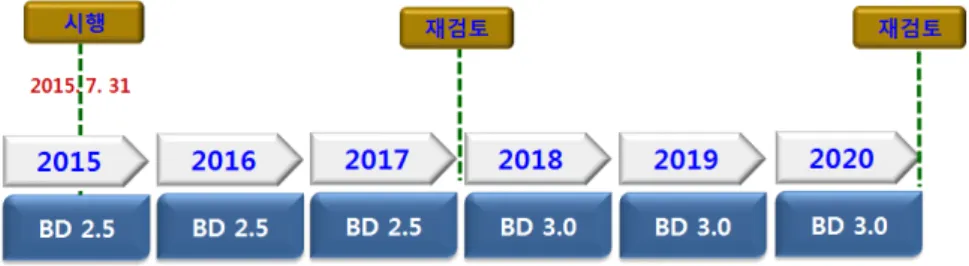
폐지하고 석유 및 석유대체연료 사업법 상의 경 유 품질기준 고시에 의하여 바이오디젤 2% ~ 5%까지 경유에 혼합하도록 하는 바이오디젤 혼 합의무제도를 시행하여 2015년 6월까지 바이오디 젤 2%를 경유에 의무혼합하여 보급하였다. 또한, 제4차 신 ․ 재생에너지 기본계획에서 수송부문의 신 ․ 재생에너지 연료 혼합의무화제도(Renewable Fuel Standard, RFS)가 신에너지 및 재생에너지 개발 ․ 이용 ․ 보급 촉진법에 근거 하여 2015년 7 월 31일부터 전면 도입되었다. RFS 제도는 초기 에 바이오디젤만 의무이행수단으로 하였고, 이에 바이오디젤 중장기 보급 혼합비율이 현행 2%에 서 2015년 7월 31일부터 2.5%로 상향하여 2017 년까지 유지하고 2018년부터 2020년까지 3.0%
로 상향할 계획이다.
3.2 국내 바이오연료 품질 기준 3.2.1 바이오에탄올
국내의 석유 및 석유대체사업법에서는 2006년 부터 에탄올, ETBE 등과 같은 산소화합물에 대 해 산소 함량을 기준으로 허용하여 사용하고 있 다. 산소화합물로는 MTBE가 대부분 사용되고 있으며 사업법 상에서 산소허용 기준은 2.3 wt%
로 규정되어 있다. 연료용 에탄올과 에탄올 혼합 연료에 대한 품질 기준은 아직 정부차원에서 규 정되지 않았지만 한국석유관리원은 수송용 에탄 올에 대한 품질 기준을 마련 중에 있다. 하지만, 정부는 아직까지 휘발유 혼합 에탄올에 대한 정 책 가이드를 제시하지 못하고 있다. 해외 플랜트 개발을 통한 에탄올의 안정적인 공급에 대한 문 제에 직면하고 있기 때문이다. 그러나 유럽과 미 국의 경우에서 바이오에탄올의 함량을 점차적으 로 높여가고 있으며 브라질을 중심으로 많은 나 라에서 FFV 차량의 판매를 허용하고 있는 추세
Spec Name Petroleum and Alternative Fuels Business Act
Grade -
Effective Date Jan, 2006
Source Korea Petroleum Quality &Distribution
Authority Additional Comments
Ester content(concentration), wt%, min 96.5
Sulfur, ppm, max 10
Density @ 15℃, kg/m3 860 ~ 900
Viscosity @ 40℃, cSt 1.9 ~ 5.0
Flash Point, ℃, min 120
Carbon residue 10%, wt%, max 0.1
Water, wt%, max 0.05
Ash, wt%, max 0.01
Total contamination, ppm, max 24
Copper corrosion, 3hr @ 100℃, merit(class), max 1
Acid value, mg KOH/g, max 0.50
Methanol, wt%, max 0.2
Monoglycerides, wt%, max 0.80
Diglycerides, wt%, max 0.20
Triglycerides, wt%, max 0.20
Free Glycerol, wt%, max 0.02
Total glycerol, wt%, max 0.24
Phosphorus, ppm, max 10
Sediment, wt%, max 24
Alkali, Group I(Na, K), ppm, max 5
Metals, Group II(Ca, Mg), ppm, max 5
Cold Filter Plugging Point(CFPP), ℃, max 0(w) Oxidation stability @ 110℃, hour, min 6 Table 8. Current Biodiesel Specifications[1]
에 있고 E85에 대한 품질기준을 마련하고 있다.
이에 국내에서도 수송용 에탄올에 대한 품질기준 이 빠른 시일 내에 마련되어야 할 것이다.
3.2.2 바이오디젤
국내의 바이오디젤에 대한 품질 기준은 2006 년부터 제정되었다. 국내의 바이오디젤과 바이오 디젤 혼합 연료는 환경부에서 2002년에 처음 논 의되기 시작하였다. 환경부의 배출 특성 실험 결 과로부터 신재생에너지 연료로서 바이오디젤을 제시하였다. 이에 따라 정부는 2005년부터 경유 차량 판매를 허용하였고 바이오디젤은 공기오염 을 저감하는 대안으로 여겨졌다. 비록 국내 원료 사용의 한계를 가지고 있지만 면세 혜택을 통한 바이오디젤 활성화를 실행하였다. 정유사들은
2006년 7월부터 2007년 12월까지 B5 도입에 앞 서 바이오디젤을 0.5 vol% 혼합하도록 요구했다.
중장기 바이오디젤 보급 계획은 2007년 9월에 발표되었고 2008년 1월에 1 vol%를 시작으로 매 년 0.5%씩 증가되어 2012년 B3에 도달하는 계 획을 발표하였다. 그러나 정부는 2010년 1월부터 2012년 말까지 최소 B2로 할 것으로 계획을 변 경하고 2013년에 다시 B2에 대해 향후 계획 전 까지 유지하기로 결정하였다.
국내 바이오디젤의 품질기준은 대부분 유럽의 기준을 따르고 있다. 또한, 동・식물성 유지에서 유래한 바이오디젤로 한정하고 있고 필터막힘점 (Cold Filter Plugging Point, CFPP)에 대해서는 혹한기(11.15 ~ 2.28)에 한해 관리가 되고 있다.
미국의 경우에는 필터막힘점을 일정온도에서 필
Spec Name Petroleum and Alternative Fuels Business Act
Grade B20
Effective Date Apr, 2009
Source Korea Petroleum Quality
&Distribution Authority Additional Comments
Cetane number, min 45
Sulfur, ppm, max 30
Density @ 15℃(60°F), kg/m3 815 ~ 845
Viscosity @ 40℃, cSt 1.9 ~ 5.5
Distillation, T90, ℃, max 360
Flash Point, ℃, min 40
Carbon residue 10%, wt%, max 0.15
Cold Filter Plugging Point(CFPP), ℃, max -16(w)
Pour Point(PP), ℃, max -17.5(w)/0.0(s)
Water and sediment, vol%, max 0.02
Ash, wt%, max 0.02
Lubricity, HFRR wear scar diam @ 60℃, micron, max 460 Copper corrosion, 3hr @ 100℃, merit(class), max 1
Total acid number, mg KOH/g, max 0.10
FAME content, vol% 17(s)~23(s)/7(w)~13(w)
Table 9. Current B20 Specifications[1]
터가 막히는데까지 걸리는 시간으로 관리하고 있 는 반면에 국내의 경우에는 필터가 막히는 시점 의 온도로 관리하고 있다.
B20은 현재 대형 버스, 트럭 등에 사용을 허용 하고 600대의 수화물 차량에 사용해 왔으며 겨울 기간에는 B20을 대신하여 B10을 사용하고 있다.
4. 결 론
국내외에서 수송부문의 온실가스 저감을 위한 수단으로 바이오연료의 보급확대 정책과 함께 바 이오디젤, 바이오에탄올을 중심으로 품질기준을 제정하여 보급을 활성화하고 있다. 유럽은 셀룰로 스, 폐기물 등의 비식용 원료에 대해 더블카운트 를 주고 있으며 이산화탄소 저감을 고려하여 지 속가능성기준을 도입하고 있다. 미국도 RFS2 프 로그램을 통해 온실가스 저감 최소치를 설정하여 온실가스 감축에 우수한 것으로 평가되고 있는 2 세대 신재생연료의 기술개발을 촉진하여 사용 확
대를 증진하고 있다. 바이오에탄올은 휘발유에 혼 합되어 사용되고 있으며 E100, E85 등의 형태로 품질기준이 설정되어 있다. 바이오디젤은 FAME 를 경유에 10% 내외로 의무혼합하는 방식으로 보급되고 있으며 BD100에 대해 기준을 설정하고 있다. 국내는 2015년부터 바이오디젤의 대해 2.5%로 의무혼합이 확대되었으나 바이오에탄올은 중장기 로드맵만이 계획되어 있어 바이오에탄올 에 대한 품질기준이 마련되어 있지 않다. 따라서 국내의 RFS 제도 시행에 따른 수송용 바이오연 료에 대한 LCA 결과를 통해 바이오디젤, 바이오 에탄올 원료 수급 및 보급, 개발에 대한 중장기 로드맵이 필요하다.
감사의 글
본 연구는 환경부의 환경정책기반 공공기술개 발사업(2014000710002)에서 지원받았습니다.
References
1. J.-K. Kim, E.-S. Yim and C. Jung, “Study on Comparison of Global Biofuels Mandates Policy in Transport Sector”,
New
& Renewable Energy
, 7, 18 (2011).2. C.H.B. Cruz, G.M. Souza, and L.A.B.
Cortez, ‘“Biofuels for Transport”,
Future Energy
, 2, 215 (2014).3. S.K. Hoekman, A. Broch, C. Robbins, E.
Ceniceros and M. Natarajan, “Review of Biodiesel Composition, Poperties, and Specifications”,
Renew. Sustain. Energy Rev.
, 16, 143 (2012).4. J.-K. Kim, C.H. Jeon, E.S. Yim, C.S.
Jung, S.B. Lee, Y.J. Lee and M.J. Kang,
“A Study on Fuel Quality Characteristics of F-T Diesel for Production of BTL Diesel”,
J. Kor. Oil Chem. Soc.
, 29, 450 (2012).5. J.-K. Kim, C.H. Jeon, E.S. Yim and C.S.
Jung, “A Study on the Fuel Characteristics of Hydrotreated Biodiesel (HBD) for Alternative Diesel Fuel”,
J. Kor. Oil Chem.
Soc.
, 28, 508 (2011).6. J.-K. Kim, E.-S. Yim and C. Jung, “Study on Review Sustainability Criteria and Key Approaches for Biofuel”,
New &
Renewable Energy
, 3, 1 (2013).7. Stratas Advisors, EU: Biofuels Policy &
Market, https://stratasadvisors.com (2014).
8. Y. Su, P. Zhang, and Y. Su, “An Overview of Biofuels Policies and Industrialization in the Major Biofuel Producing Countries”,
Renewable and Sustainable Energy Reviews
, 50, 991 (2015) 9. J.-K. Kim, E.-S. Yim and C. Jung, “TheStatus of Sustainable Biofuels Policy and Development”,
KIC News
, 16, 1 (2013).10. Stratas Advisors, EU: Biofuels Specifications, https://stratasadvisors.com (2015).
11. L. Pedro and J.P-A. Ignacioe, “A Sustainable Framework for Biofuels in Europe”,
Energy Policy,
52, 166 (2013).12. Y. Su, P. Zhang and Y. Su, “An Overview of Biofuels Policies and Industrialization in the Major Biofuel Producing Countries”,
Renewable and Sustainable Energy Reviews,
50, 991 (2015).13. E. Kazamia and A.G. Smith , “Assessing the Environmental Sustainability of Biofuels”,
Trends in Plant Science
, 19, 615 (2014).14. A. Mohr and S. Raman, “Lessons from First Generation Biofuels and Implications for the Sustainability Appraisal of Second Generation Biofuels”,
Energy Policy
, 63, 114 (2013).15. Stratas Advisors, United States: Biofuels Policy & Market, https://stratasadvisors.com (2015).
16. J. Witcover, S. Yeh and D. Sperling,
“Policy Options to Address Global Land use Change from Biofuels”,
Energy Policy
, 56, 63 (2013).17. J. Goldemberg, F..C. Mello, C.E.P. Cerri, C.A. Davies, C.C. Cerri, “Meeting the Global Demand for Biofuels in 2021 through Sustainable Land use Change Policy”,
Energy Policy
, 69, 14 (2014).18. Stratas Advisors, United States: United States: Biofuels Specifications, https://stratasadvisors.com (2015).
![Table 1. Overview of Biofuels Mandatory Target[7]](https://thumb-ap.123doks.com/thumbv2/123dokinfo/4924144.537904/3.892.142.751.213.884/table-overview-biofuels-mandatory-target.webp)
![Table 2. Current EU Ethanol Specifications[10]](https://thumb-ap.123doks.com/thumbv2/123dokinfo/4924144.537904/5.892.144.749.210.663/table-current-ethanol-specifications.webp)
![Table 3. Current EU E85 Specifications[10]](https://thumb-ap.123doks.com/thumbv2/123dokinfo/4924144.537904/6.892.142.747.248.852/table-current-e-specifications.webp)
![Table 4. Current EU biodiesel Specifications[10]](https://thumb-ap.123doks.com/thumbv2/123dokinfo/4924144.537904/7.892.139.737.205.849/table-current-biodiesel-specifications.webp)
![Fig. 1. U.S. Motor Fuel RFS Targets[15].](https://thumb-ap.123doks.com/thumbv2/123dokinfo/4924144.537904/8.892.149.703.483.793/fig-u-s-motor-fuel-rfs-targets.webp)
![Table 6. Current ASTM Specifications for E85[18]](https://thumb-ap.123doks.com/thumbv2/123dokinfo/4924144.537904/9.892.158.749.449.857/table-current-astm-specifications-e.webp)
![Table 7. Current ASTM Specification(B100)[18]](https://thumb-ap.123doks.com/thumbv2/123dokinfo/4924144.537904/10.892.149.754.339.920/table-current-astm-specification-b.webp)
![Table 9. Current B20 Specifications[1]](https://thumb-ap.123doks.com/thumbv2/123dokinfo/4924144.537904/13.892.143.736.223.646/table-current-b-specifications.webp)
