• 검색 결과가 없습니다.

Simulation of Power Line Communication Slient Node Problem Using OPNET

N/A
N/A
Protected

Academic year: 2021

Share "Simulation of Power Line Communication Slient Node Problem Using OPNET"

Copied!
9
0
0

로드 중.... (전체 텍스트 보기)

전체 글

(1)

Simulation of Power Line Communication Slient Node Problem Using OPNET

Jun-Ho Huh

, Kyungryong Seo

††

ABSTRACT

The Information & Communication Technology (ICT) and the Internet of Things (IoT) have become the major issues in Republic of Korea recently. While RS-232, Zigbee, and WiFi-related technologies are used in the ICT-based systems, we focus on the Power Line Communication (PLC) in this paper.

By carrying out OPNET simulations, we've implemented the PLC Router Node Model, PLC Terminal Node Model, PLC Link Model, and PLC Palette Model and executed the simulations arranging 20 holds within the range of 400m (20m apart). As a result, we confirmed that the slient node problem had occurred at the point of 200m-2000m (as of 2016) distance preventing further communications. However, the control group, by contrast, was able to carry out the communications by installing a router. We expect that this paper will contribute to the development of a foundation technology which will saves costs by performing the simulation prior to building actual large-scale ICT Complex in the future work.

Key words: PLC, PLC Slient Node Problem, IoT, ICT, OPNET.

※ Corresponding Author : Kyungryong Seo, Address:

DSLab, Pukyong National University at Daeyeon, 45, Yongso-ro, Nam-gu, Busan, Republic of Korea, TEL : +82-51-629-6254, E-mail : [email protected]

Receipt date : Sep. 1 2015, Revision date : Dec. 7 2016 Approval date : Jan. 3 2017

††

Dept. of Software, Catholic University of Pusan (E-mail : [email protected])

††
Dept. of Computer Engineering, Pukyong National University at Daeyeon

(E-mail: [email protected])

1. INTRODUCTION

In recent years, the systems related to the Vertical Farm and IoT are being studied widely.

Although there are some useful technological means (e.g., RS-232, Zigbee and Wifi) to establish these systems, we are concentrating our paper on the Power Line Communication technology. Commu- nications utilizing existing power line are generally called the Power Line Communication and this technology uses high-frequency signals to trans- mit or store data through power lines, during which frequency signals are separated with the dedicated power line modem(s) as low or high frequency sig- nals before reaching to a terminal device. Two dif- ferent speed levels are available for the PLCs:

high-speed and low-speed. The former uses fre- quency bands between 0.5 and 30MHz reaching

speeds of 14Mbps to 1Gbps (as of 2015) while the latter relies on the bands between 10 and 450KHz achieving a maximum speed of 9.6Kbps normally used for electric equipments or devices. In fact, the PLC media are originally designed for power transmissions.

It’s been assumed that the channel character- istics of PLC are unsuitable for a data communica- tion purpose due to rather heavy noises and serious signal attenuation [1-3]. One way to improve reli- ability of the PLC communication is to enhance its physical layer associated with channel estimation and selection, filtering design, power distribution or others [1, 3, 4].

Meanwhile, China is one of the major producers

of aquaculture products and their production vol-

ume is the largest among these countries. In this

country, the ICT-farms distant from the cities are

(2)

Fig. 1. Mechanism of PLC and PLC Slient Node Problem.

attempting to surmount high costs of internet in- stallation by constructing the internet network through existing power lines. Since the problem of silent node often appears in the long-distance PLCs, this paper targeted the fishing villages where the internet service is not available.

The PLC technology is being applied to the home-network construction or factory automation nowadays but due to the improvements made in transmission speed and stability achieved with re- cent digital power line technology, its applicability is still growing and getting much attentions [5].

One of the main reasons for such interest is be- cause of the feasibility of low-cost implementation using existing power line distribution and smart meter networks. Meanwhile, the situation-specific simulations and modeling of PLC-based solution will be needed to implement PLC system in a noise-filled channel environment to improve both the stability and reliability. Although many studies have been carried out for modeling PLC’s physical characteristics with a variety of simulation tools so far, they many more are yet to come [1, 5, 6, 7].

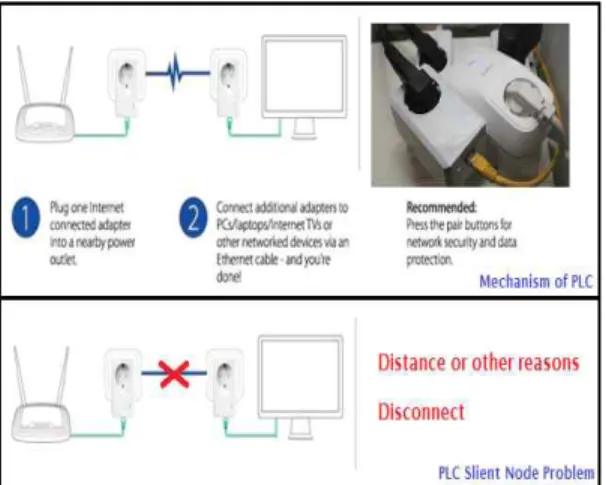
The above Fig. 1 shows a structure where data is sent through power line by installing two PLC adapters in the wall outlet. Using the power line installed at the time of construction, the electricity

is supplied with the low frequency band of 60Hz and the data will be transmitted with the remaining high frequency bands available. New product lines of adapters with the maximum speed of 1G/bps have been released recently.

The PLC technology is increasingly accepted in the fields of building automation, security control and others as it enables convenient and cost-effec- tive communication system. One such system is the Automatic Meter Reading (AMR) system where meter readings can be sent over to a power company through the power lines available in most of the industrial and public sectors. Not requiring separate or additional infrastructures is a very strong advantage and quite suitable for establish- ing the low-cost AMR network [6-11].

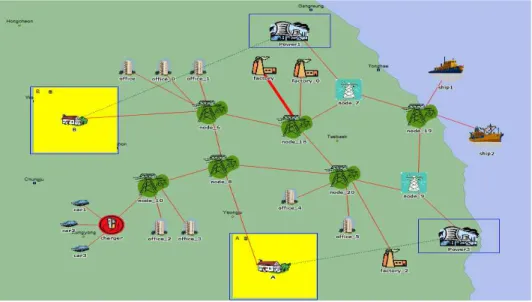
For the simulations, the scenario in which the PLC-applied environment has been created and was applied to the households divided into A and B blocks. For both blocks, twenty homes standing 20m apart against each other have been arranged equally. Only the difference was that a router was installed at a point of 200m distance in the B-block but none for the A-block to test the performance of the PLC network. Finally, a performance analy- sis was performed for each of TCP, UDP and RUDP application to measure their performances.

The problem of communication cut-off, which rep- resents the silent node problem, appeared at the point of 200m distance and we simulated this phe- nomenon by using OPNET Modeler 14.5 PL8.

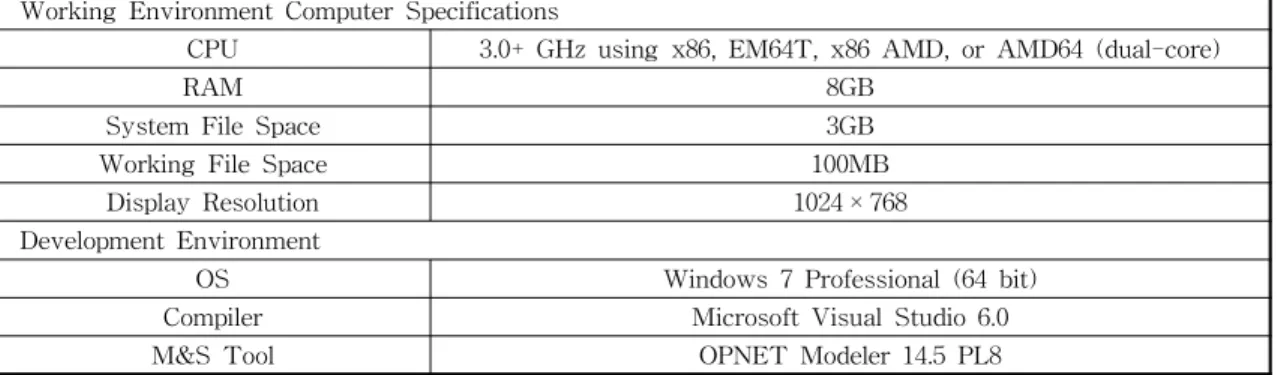
Simulation environment for performance evalu- ation, hardware and software are shown in Table.

1.

The silent node problem was simulated based on

the previous successful implementation of the PLC

using OPNET Modeler 14.5 PL8 [6]. The C++ lan-

guage was used partially for the coding. The simu-

lations were carried out under the two different en-

vironments; with or without routers. The simu-

lated transmission distance was 400m for each

environment.

(3)

Table 1. Simulation Environment

Working Environment Computer Specifications

CPU 3.0+ GHz using x86, EM64T, x86 AMD, or AMD64 (dual-core)

RAM 8GB

System File Space 3GB

Working File Space 100MB

Display Resolution 1024 × 768

Development Environment

OS Windows 7 Professional (64 bit)

Compiler Microsoft Visual Studio 6.0

M&S Tool OPNET Modeler 14.5 PL8

Fig. 2. Two-state Transition Markov Model for a Meter

Unit. Fig. 3. PLC Router Node Model.

2. RELATED RESEARCH

2.1 Meter Unit Model of AMR Simulation Modeling The "Silent Node" is thought to cause incom- plete communications between a metering unit (meter) and the Data Concentrator (DC). That is, a signal carrying the metering data will not be de- livered to its final destination due to signal attenu- ation, noise or varying impedances in a PLC net- work. Here, the "node" represents a metering unit and its performance will depend on the network environments to work properly or to be silent.

The state transition probability of the meter unit under specific conditions (e.g., Good and Bad) can be represented with the Two-state Markov model [4, 5] as below Fig. 2.

"Good" and "Bad" in this model refer to the pos- sible conditions under which a meter is being placed. While the meter unit in the "Good" con- dition can communicate with DC or other relay meter units, the meter in the "Bad" condition will be in silent node [6-7]. As for Pg and Pb, they in- dicate the possibilities of the meters currently placed under both conditions. Pgg is the possibility

that the meter under the "Good" condition would still remain at the same environment whereas Pgb shows the possibility that the meter would move to the "bad" condition. Similar possible reverse movements of the meter in the "Bad" condition are represented as Pb and Pbg. Following [4], this two-state transition can be quantified using the equations (1) - (3) so that the local balance can be formulated as (4):

(1) (2) (3) (4)

2.2 PLC Router Node Model

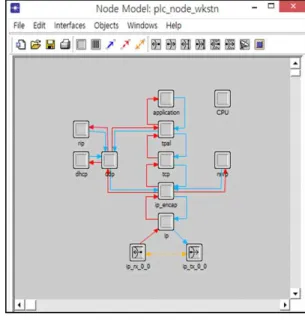
This PLC router model Fig. 3 was developed

based on the route model for packet generation,

(4)

Fig. 4. PLC Router Node Model Mechanism.

Fig. 5. PLC Terminal Node Model.

disposal and relay. The model supports Open Shortest Path First (OSPF) Routing Information Protocol (RIP) and other features provided by OPNET Modeler 14.5 PL8. The PPP interface was adopted to link with other node model(s) consider- ing its extendability in designing process.

It is possible to link with thirty two nodes (max.) with this design Fig. 4 and if the number exceeds thirty two, the situation can be resolved by estab- lishing links with two or more relay nodes. The model is shaped as a "Star" form as a single router can establish links with thirty two nodes, and has all the features of routers (OPNET)[12-17].

It is possible to set IP address and other parame- ters and even select the routing protocols to be used. The disadvantage of the model is, however, its centralized organization. Should the router placed at the center fails to function, the connection with other network(s) (e.g., between A and B net- works) cannot be expected. Even with such dis- advantage, it's preferable to use router(s) as far as the network is concerned because overall func- tion of the network will not be impaired even if some of the nodes fail.

2.3 PLC Terminal Node Model

The PLC terminal node model cannot fulfill a re- lay function but still can generate and discard IP packets. The model has been designed to describe

a basic IP protocol and adopts UDP and TCP as its transport protocols. Similar to the Router Node Model, the Point-to-Point Protocol (PPP) interface was used for the link with other node model. In this model, one node will be able to connect with one adjacent node only (i.e., end-to-end terminal node connection).

Fig. 5 describes the terminal model which in- cludes all of the terminals attributes provided by OPNET Modeler 14.5 PL 8 and IP address, trans- port protocol and other parameters can be defined in the model.

As described in Fig. 6, the connections between the nodes are based on a 1:1 connection so that to reach other remotely located node, it has to go through another nodes each time forming a "Ring"

form connections. The disadvantage is that failure

of a single node can lead to entire network failure

and this problem can be solved by using Fiber

Distributed-Data Interface (FDDI). Meanwhile,

this model also includes all the features provided

by OPNET Modeler 14.5 PL8.

(5)

Fig. 6. PLC Terminal Node Model Mechanism.

Fig. 7. Overall Scenarios.

2.4 PLC Link Model

In this nodes-linking model, the traffics flow be- tween the nodes. This model has been implemented based on the PPP model and its default bandwidth is set at 11Mbps as a data rate [1]. Each node's linking speed can't be controlled by the user to simulate different environments. Alteration of the bandwidth can be achieved by opening "Edit Attributes" by right-clicking the model and select- ing or entering desired bandwidth afterwards.

3. IMPLEMENTATION OF THE PLC SILENT NODE PROBLEM WITH OPNET

Overall scenario is shown in Fig. 7 where the topologies of A and B blocks are described. In the A-block, there are 20 homes standing 20m apart and no communication-support equipment has been installed. As for the B-clock, the same ar- rangement has been made but a router exits at a point of 200m distance.

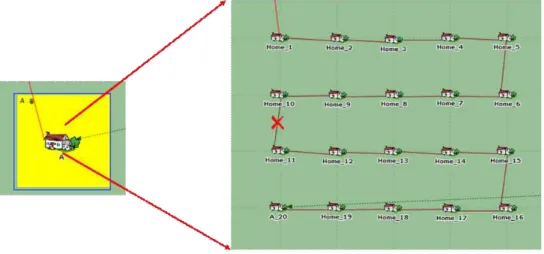
The A-block construction is as below Fig. 8.

The "Silent Node" scenario was executed here and the result showed that communication was not successful beyond 200m.

On the other hand, in the B-block Fig. 9, com-

munication had been carried out normally as there

was a router. It is evident that the PLC-based net-

work needs some kind of supporting communica-

tion equipments to reach remotely located destina-

tions to overcome some of the problems involved

in the PLC networks. Similar network has been ap-

plied to a deluxe apartment complex construction

site in Shanghai where the PLC Smart Grid system

is being used for the communications. Not limited

to this site, world's leading construction companies

and IT companies are forming consortiums to

(6)

Fig. 8. A-Block Construction.

Fig. 9. B-block Construction.

adapt the PLC-based smart grid system in other rapidly growing housing markets (i.e., China and other developing countries). That is, the silent node problem is one of the weaknesses in a long-dis- tance PLC and serious enough to cause communi- cation disruptions. Their recent goal is to offer IoT technology to the customers using the system.

Zigbee is considered to be another possibility but it needs more technical improvements.

4. IMPLEMENTATION OF THE PLC SILENT NODE PROBLEM WITH OPNET ITS VERI- FICATION

The traffic is generated by transmitting 300bit packets from the power origin of both blocks (A and B) every second. So, performance indexes is end-to-end delay.

Not a single communication was successful in

the control group where the silent node problem

appeared. It is the “Silent Node” problem in AMR

systems, when a metering data cannot directly

transmit messages to the Data Concentrator (DC)

or receive valid signals from DC [6, 7]. It required

more time as the distance increased and the traffic

did not reach 20th home in the A-block.

(7)

Fig. 10. TCP End-to-End Delay.

Fig. 11. UDP End-to-End Delay.

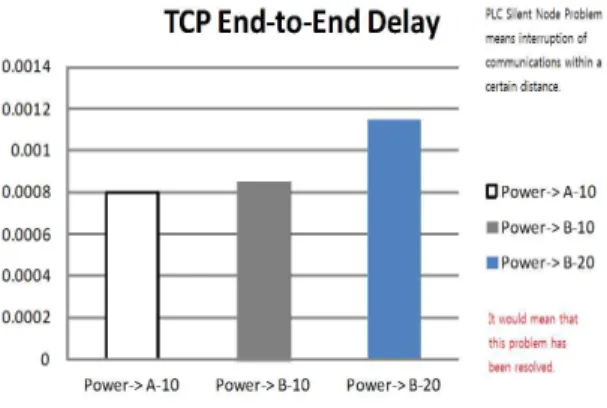
Fig. 10 shows the End-to-End delay occurred for using TCP. B-block received all the packets successfully. That is, the PLC silent node problem means interruption of communications within a certain distance. Therefore, if it was possible to measure the TCP End-to End delay value, it would mean that this problem has been resolved.

In this case also, further the distance, more time was required and the traffic was not delivered to the 20th home in the A-block. Yet, the situation in the B-block was successful. Fig. 11 shows the End-to-End delay when UDP has been adopted for the network. Therefore, if it was possible to meas- ure the UDP End-to End delay value, it would mean that this problem has been resolved.

Therefore, if it was possible to measure the UDP End-to End delay value, it would mean that this problem has been resolved. This study aims to im- plement the silent node problem, which is one of the disadvantages of the PLC systems, and verify

whether the problematic situation has been prop- erly implemented or recreated through OPNET simulation. In the simulation, it was confirmed that a basic TCP/UDP data was transmitted and the communication was interrupted during the re- ception process due to the silent node problem.

5. CONCLUSION AND FUTURE WORK OPNET Modeler 14.5 PL8 was used for the per- formance analysis focusing on the silent node problem. The tests conducted for each case (i.e., TCP/UDP bases) revealed different results. That is, the traffic did not reach the node located beyond 200m distance in A-block while all the nodes in B-block received the traffic as router had been in- stalled at the point of 200m. We anticipate that our paper of the silent node problem will be funda- mental to the ICT. Also, we are scheduled to con- duct a larger scale simulations in future study where protocols and security related issues will be dealt with and then the study will be presented to construction companies as a system proposal. This paper is a continuing study where some descrip- tions of additional experiments have been in- troduced into the existing paper published earlier [1]. Even though it was not possible to carry out an ideal simulation in prior paper because of the fact that we were unable to generate the silent node problem itself successfully, we plan to proceed with a large-scale research in our future work based on this paper.

APPENDIX

This is an extended study of the preceding jour-

nal paper published in the JMIS [1]. The PLC was

implemented in the preceding study as it was not

provided by the OPNET 14.5 PL8 Modeler as a de-

fault option. Also, recreating the silent node prob-

lem in a simulation is an another difficulty so that

it was implemented additionally in this study as

well. We expect that this study will be a mean-

(8)

ingful research in providing a platform technology for the PLC systems through simulations before adopting it for the larger complexes. The first draft of this paper was presented in 2015 at The 11th International Conference on Multimedia Informat- ion Technology and Applications (MITA 2015), June 30-July 2, 2015, Tashkent, Uzbekistan, IEEE Region 10, Changwon Section [6]. I am grateful to 5 anonymous commentators who have contributed to the enhancement of our article with their val- uable suggestions at the conference.

REFERENCES

[ 1 ] J.H. Huh and K.R. Seo, "PLC-Based Smart Grid Home Network System Design and Implementation Using OPNET Simulation,"

J ournal of Multimedia and Information Sys- tems, Vol.1, No. 2, pp. 113-120, 2014.

[ 2 ] S. Panchadcharam, G.A. Taylor, I. Pisica, M.R. Irving, “Modeling and Analysis of Noise in Power Line Communication for Smart Metering,” Power and Energy Society General Meeting, IEEE, pp. 22-26, 2012.

[ 3 ] L. Xiao-sheng, Z. Liang, Z. Yan, and X.

Dianguo, "Performance Analysis of Power Line Communication Network Model Based on Spider Web," Proceeding of 8th Interna- tional Conference on P ower Electronics ECCE Asia, pp. 953-959, 2011.

[ 4 ] D. Sabolic, "Influence of the Transmission Medium Quality on the Automatic Meter Reading System Capacity," IEEE Transac- tions on P ower Delivery, Vol. 18, No. 3, pp.

725-728, 2003.

[ 5 ] S. Tsuzuki, I.S. Areni, and Y. Yamada, "A feasibility Study of 1Gbps PLC System Assuming a High-Balanced DC Power-Line Channel," P roceeding of 2012 16th IEEE International Symposium, pp. 386-391, 2012.

[ 6 ] J.H. Huh, T.H. Koh, N.J. Kim, and K.R. Seo,

"Design and Test Bed Experiments of Smart

Grid-Based PLC Slient Node Problem Using OPNET," Proceedings of the 11th Internatio- nal Conference on Multimedia Information Technology and Applications, pp. 317-322, 2015.

[ 7 ] Q. Gao, J.Y. Yu, P.H.J. Chong, P.L. So, and E. Gunawan, "Solutions for the “Silent Node”

Problem in an Automatic Meter Reading System Using Power-Line Communications,"

IEEE Transactions on Power Delivery, Vol.

23, No. 1, pp. 150-156, 2008.

[ 8 ] J.H. Huh and K.R. Seo, "Design and Implementation of the Basic Technology for Solitary Senior Citizen's Lonely Death Moni- toring System Using PLC," Journal of Korea Multimedia Society, Vol. 18, No. 6, pp. 742- 752, 2015.

[ 9 ] J.H. Huh, H.B. Kim, and K.R. Seo, "A Preliminary Analysis Model of Big Data for Prevention of Bioaccumulation of Heavy Metal-Based Pollutants: Focusing on the Atmospheric Data Analyses," Advanced Science and Technology Letters, SERSC, Vol. 129, pp. 159-164, 2016.

[10] C. Boden, M. Karnstedt, M. Fernandez, V.

Markl, "Large-Scale Social Media Analytics on Stratosphere," World Wide Web, 2013.

[11] V. Borkar, M. Carey, R. Grover, N. Onose, and R. Vernica, "Hyracks: A Flexible and Exten- sible Foundation for Data-Intensive Comput- ing," P roceeding of International Council for Open and Distance Education, pp. 1151-1162, 2011.

[12] D. Battré, M. Hovestadt, B. Lohrmann, A.

Stanik, and D. Warneke, "Detecting Bottle- necks in Parallel Dag-Based Data Flow Programs," Proceeding of 2010 IEEE Work- shop on Many-Task Computing on Grids and Supercomputers, pp.1-10, 2010.

[13] A. Behm, V.R. Borkar, M.J. Carey, R Grover,

C Li, N. Onose, et al., "Asterix: Towards a

Scalable, Semi-Structured Data Platform for

(9)

Evolving-World Models," Distributed and Parallel Databases, Vol. 29, No. 3, pp. 185- 216, 2011.

[14] K.S. Beyer, V. Ercegovac, R. Gemulla, A.

Balmin, M.Y. Eltabakh, C.C. Kanne, et al.,

"Jaql: a Scripting Language for Large Scale Semi-Structured Data Analysis," Proceeding of International conference on Very Large data Bases, Vol. 4, No. 12, pp. 1272-1283, 2011.

[15] B. Sivaneasan, P.L. So, and E. Gunawan, "A New Routing Protocol for PLC-Based AMR Systems," IEEE Transactions on Power Delivery, Vol. 26, No. 4, pp. 2613-2620, 2010.

[16] J.H. Huh, T.H. Koh, and K.R. Seo, Design of a Shipboard Outside Communication Network and the Test Bed Using PLC: for the Workers' Safety Management During Ship- Building process, Proceedings of the 10th International Conference on Ubiquitous Infor- mation Management and Communication, ACM IMCOM 2016, No. 43, pp. 1-6, 2016.

[17] J.H. Huh, S. Otgonchimeg, and K.R. Seo,

"Advanced Metering Infrastructure Design and Test Bed Experiment Using Intelligent Agents: Focusing on the PLC Network Base Technology for Smart Grid System," The Journal of Supercomputing, Vol. 72, No. 5, pp.

1862-1877, 2016.

Jun-Ho Huh

finished the Cooperative Marine Science and Engineering Pro- gram, Texas A&M University at Galveston, United States of America in Aug. 2006.

Received B.S. in Science Degree from Department of Major of Applied Marine Sciences (Currently Faculty of Marine Biomedical Sciences), B.S. in Engineering Degree (Double Major) from Department of Major of Computer Engineering from Jeju National University at Ara, Jeju, Republic of Korea in Aug. 2007.

M.A. in Education Degree from Department of Major of Computer Science Education, Graduate School of Education, Pukyoug National University at Daeyeon,

Busan, Republic of Korea in Aug. 2012.

Received the Ph.D. in Engineering Degree from Department of Major of Computer Engineering, Grad- uate School, Pukyoug National University at Daeyeon, Busan, Republic of Korea in Feb. 2016.

He received the Best Paper Award from Korea Multi- media Society five times (Nov. 2014, May. 2015, Nov.

2015, May, 2016. Oct, 2016). And he received Best Paper Award The 10th 2016 International Interdiscipli- nary Workshop Series from HSST (Aug. 2016). Also, he received Best Paper Award The 16th International Conference on Control, Automation and Systems (Oct.

2016), ICROS with IEEE Xplore.

Currently he is Associate Editor at Human-centric Computing and Information Sciences (HCIS), Springer Berlin Heidelberg with FTRA (SCOPUS/ESCI in- dexed). Also, he is Associate Editor at Journal of Infor- mation Processing Systems (JIPS), Korea Information Processing Society (SCOPUS/ESCI indexed).

Research Professor of Dankook University at Jukjeon, Yongin, Republic of Korea (July. 2016- Sep. 2016).

Currently he is Assistant Professor of Department of Software, Catholic University of Pusan, Busan, Repu- blic of Korea (Dec. 2016-).

His research interests are Green IT, Smart Grid, Network Security, IoT, Curriculum of Computer.

Kyungryong Seo

received B.S. in Engineering Degree from Department of Major of Electrical Machinery Engineering from Pusan Natio- nal University, Busan, Republic of Korea in Feb. 1983.

M.S. in Engineering Degree in Electrical Engineering from Korea Advanced Institute of Science and Technology (KAIST), Daejeon, Repu- blic of Korea in Feb. 1990. Received the Ph.D.

Engineering Degree in Electrical Engineering from Korea Advanced Institute of Science and Technology (KAIST), Daejeon, Republic of Korea in Aug. 1995.

He received the Best Paper Award from Korea Multi- media Society six times (Nov. 2007, Nov. 2014, May.

2015, Nov. 2015, May 2016, Nov. 2016). And he re- ceived Best Paper Award The 10th 2016 International Interdisciplinary Workshop Series from HSST (Aug.

2016). Currently he is a Full (Tenure) Professor of Computer Engineering Departments, Pukyong National University, Busan, Republic of Korea.

His research interests are High Speed Computer

Network, High Availability Computting.

수치

Fig. 1. Mechanism of PLC and PLC Slient Node Problem.
Table 1. Simulation Environment
Fig. 4. PLC Router Node Model Mechanism.
Fig. 7. Overall Scenarios.
+3

참조

관련 문서

Department of Naval Architecture and Ocean Engineering, Seoul National University of College of Engineering.. 학부 4학년 교과목“창의적

Department of Naval Architecture and Ocean Engineering, Seoul National University... 2009

Department of Naval Architecture and Ocean Engineering, Seoul National University of College of Engineering.. Ship Motion & Wave Load

Department of Naval Architecture and Ocean Engineering, Seoul National University of College of Engineering@. 서울대학교 조선해양공학과 학부4학년

School of Computer Science & Engineering Seoul

School of Mechanical and Aerospace Engineering Seoul National University..

School of Mechanical and Aerospace Engineering Seoul National University..

Department of Naval Architecture and Ocean Engineering, Seoul National University of College