Print ISSN: 2288-4637 / Online ISSN 2288-4645 doi:10.13106/jafeb.2021.vol8.no1.997
Islamic Work Ethics and Employee Performance: The Role of Islamic Motivation, Affective Commitment, and Job Satisfaction
Kuntarno Noor AFLAH
1, Suharnomo SUHARNOMO
2, Fuad MAS’UD
3, Ali MURSID
4Received: September 30, 2020 Revised: November 30, 2020 Accepted: December 14, 2020
Abstract
This study aims to redesign and find out the role of Islamic work ethics in influencing Islamic motivation, affective commitment, job satisfaction, and employee performance. Respondents in this study are populations of various cross-sectoral and cross-profession employees, such as government and private workers, soldiers, educators (teachers and lecturers) in various offices in Central Java. 220 questionnaires were distributed to all respondents, but the number of the returned questionnaires was 200. Thus, totally, this study analyzed 200 questionnaires. Data are analyzed using Structural Equation Modelling (SEM). The results show that the eight hypotheses are accepted:
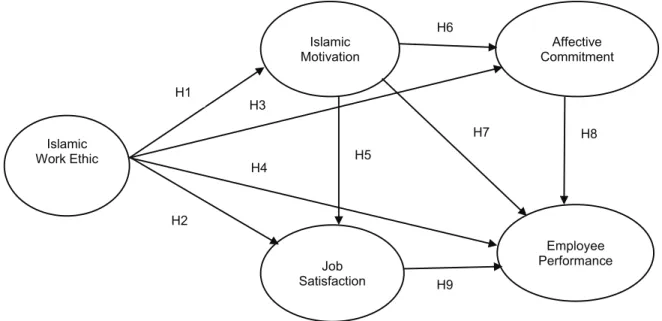
there is a positive and significant influence of Islamic work ethics on Islamic motivation; there is a positive and significant effect of Islamic work ethics on job satisfaction; there is a positive and significant effect of Islamic work on affective commitment; there is a positive and significant influence of Islamic motivation on affective commitment; there is a positive and significant influence of Islamic motivation on job satisfaction; there is a positive and significant effect of job satisfaction on employee performance; there is a positive and significant effect of affective commitment on employee performance; there is a positive and significant influence of Islamic motivation on employee performance.
Keywords: Islamic Work Ethics, Islamic Motivation, Affective Commitment, Job Satisfaction, Employee Performance JEL Classification Code: A13, B40, M12
performance (Vosloban, 2012). Moreover, the good employee performance can be influenced by job satisfaction (Inuwa, 2016), and employees who perform well can be influenced by motivation and desire to survive, having affective commitment such as self belonging to the company (Imran, Allil, & Mahmoud, 2017; Tone, 2018). Scholars also reported that ethics based on religious norms affected the good performance (Rokhman, 2016).
Islamic work ethics derived from Al-Quran and Hadith’s concerns on various things, including individual behavior, creativity, accountability, and teamwork in the workplace.
When a person has a close relationship with God, then his attitude and behavior are based on the Shariah rule (Rokhman, 2016). As regards research focused on Islamic work ethics, previous studies revealed that Islamic work ethics affects job satisfaction, organizational commitment, but does not affect work intention (Rokhman, 2016). Other studies posit that Islamic work ethics affects organizational satisfaction and commitment (Komari & Djafar, 2013), and it also affects job satisfaction, organizational commitment and work performance (Hayati & Caniago, 2012). According to Hayati and Caniago (2012), when the Islamic work ethics
1
First Author. Department of Human Resource Management, College of Economics and Business, Diponegoro University Semarang, Central Java, Indonesia. Email: [email protected]
2
Profesor, College of Economics and Business, Diponegoro University, Semarang, Central Java, Indonesia.
Email: [email protected]
3
Associate Professor, College of Economics and Business, Diponegoro University, Semarang, Central Java, Indonesia.
Email: [email protected]
4
Corresponding Author. Assistant Professor, Department of Management, Bank BPD Jateng School of Economics and Business, Semarang, Central Java, Indonesia [Postal Address:
Sukarno Hatta No. 88, Semarang, Central Java, 50196, Indonesia]
Email: [email protected]
© Copyright: The Author(s)
This is an Open Access article distributed under the terms of the Creative Commons Attribution Non-Commercial License (https://creativecommons.org/licenses/by-nc/4.0/) which permits unrestricted non-commercial use, distribution, and reproduction in any medium, provided the original work is properly cited.