Print ISSN: 2288-4637 / Online ISSN 2288-4645 doi:10.13106/jafeb.2019.vol6.no2.161
The Effect of Personality Traits on Employee Job Satisfaction with Moderating Role of Islamic Work Ethics
Raja Nabeel-Ud-Din JALAL
1, Naveeda ZEB
2, Um-E-Roman FAYYAZ
3Received: October 22, 2018 Revised: January 2, 2019 Accepted: February 26, 2019
Abstract
Personality factors and ethical values are considered as vital element in social and professional life. This present research aims to explore the relationship between Personality and Job Satisfaction. Further, we tried to test the moderating effect of Islamic work ethics (IWE) in the relationship of Personality traits with Job satisfaction. Convenience sampling was used in defining sample as in Pakistan the re is no data base which provides information regarding number of employees. Due to moderating variabl e the data has been collected from respondents who identify themselves as Muslim. To collect data from respondents Self-administered, close-ended questionnaires and e-questionnaire were used in this study and respondents were targeted in the normal working environment. Correlation and regression analysis was used to analyze the data statistically. The results of study indicated that neuroticism exhibits significant negative effect on job s atisfaction. Also, openness to experience, agreeableness and conscientiousness showed positive effect on job satisfaction. Whereas, extraversion exhibits no effect on job satisfaction and IWE has a negative effect on job satisfaction. However, the output indicates that IWE do not act as moderator in the relation of agreeableness and conscientiousness with job satisfaction moderation effect of IWE is observed between the relationship of neuroticism, extraversion and openness to experience with job satisfaction.
Keywords: Neuroticism, Contentiousness, Openness to Experience, Job Satisfaction, Islamic Work Ethics.
JEL Classification Code: J28, M10, C90, D90.
1. Introduction 1
Personality plays a major impact on human behavior.
Psychologist states that there are multiple psychological factors which influences employee satisfaction and motivation within an organization (Furnham, Chamorro- Premuzic, & McDougall, 2002). To analyze employee’s well- being, researchers has given importance to job satisfaction
1 First Author and Corresponding Author. Ph.D. Scholar, Accounting, Management and Business Economics, Università degli studi G.D’Annunzio Chieti-Pescara, Italy. [Postal Address:
Dipartimento di Economia Aziendale, Università degli studi G.
D’Annunzio Chieti Pescara, Viale Pindaro, 42 - 65127 Pescara, Italy] E-mail: [email protected]
2 Assistant Professor, University of Kotli, AJ&K, Pakistan.
E-mail: [email protected]
3 Ph.D. Scholar, Accounting, Management and Business Economics, Università degli studi G.D’Annunzio Chieti-Pescara, Italy. E-mail: [email protected]
© Copyright: Korean Distribution Science Association (KODISA)
This is an Open Access article distributed under the terms of the Creative Commons Attribution Non- Commercial License (https://creativecommons.org/licenses/by-nc/4.0/) which permits unrestricted non- commercial use, distribution, and reproduction in any medium, provided the original work is properly c ited.
and job relating factors which influences employee level of satisfaction. Personality traits may drive the utility difference between self-employed and employed workers (Hundley, 2001; Benz & Frey, 2008). A limited amount of work has done on individual factors (personality, demography, married life, religious beliefs etc.) which are effecting job satisfaction. Staw, Bell, and Clausen (1986) provided a base for future studies by discovering a link between personality and job satisfaction.
Job Satisfaction is defined as individual positive feelings regarding his job (Warr, 2002; Robbin & Judge, 2003;
Luthans, 2005). From past two decades psychologist, behavioral experts, and scientist are focusing on individual personality and its relationship with job satisfaction.
Researchers are giving attention to personality big five
taxonomy and its relationship with job satisfaction (Kanfer,
1990). Genetics, environmental factors influence 30% in job
satisfaction. The personality big five traits have shown
association of 0.41 with job satisfaction. Also strong
association was observed among JS and neuroticism (-
0.29), JS and extraversion (0.25), and JS and
conscientiousness (0.26) (Judge, Bono, Ilies, & Gerhardt,
2002). When neurotic employee believes that justice in reward distribution and performance recognition it reduces its job satisfaction. On other hand a positive thinking (extravert) hardworking, vigilant(Conscious) faithful and courteous(agreeable) and intellectual(Openness to experience) employee will just focuses in doing thing in a better way not focuses on getting big reward.
Massive studies related to work ethics have been carried out in western countries. Ethics is considered as an important topic in present day world. Increase in unethical practices has leaded toward work place ethics awareness.
Notable researchers like Blood (1969), Putti, Aryee, & Liang (1989), Oliver (1990), Wyld and Jones (1997), and Georgel and Jone (1997) studied work ethics in western context. The Islamic work ethics (IWE) merged as a new era of research (Ali, 1988; Ali, 1992; Youssef, 2000). Islamic work ethics is part of belief system which focuses that work is a virtue for one and he or she has to establish a balance between his work and social life (Ahmad, 1976). Islam mean peace and unconditional submission to Allah Almighty (Abuznaid, 2005;
Uddin, 2003). Islam has provided guide line for socio- economic affairs. Islamic work ethics determines what is right thing to do? What is wrong to avoid and the base of Islamic work ethics is Quran and Sunnah of Prophet Muhammad (Peace-Be-Upon Him) (Ahmad, 1976; Beekun, 1997; Rice, 1999; Ali & Weir, 2005).
Islam has forced on ethics in social and economic affairs and Prophet Muhammad (Peace-Be-Upon Him) life is best example for everyone. The reason to study Islamic work ethics is that in world economy, Muslims are also playing a vital role, the Arab business companies operating in Arab countries as well as in western countries follow up Islamic values in business dealing and the organization ethical setup rely on Islamic principles and it act as a moderator in work.
Religion motivates one to achieve certain objectives (Ali, Falcone, & Azim, 1995). Also religion determines certain values to be adopted in work. Islamic work ethics is similarly part of Muslims values that determine that work should be considered as a virtue. According to Ali (1996) IWE forces one on bring positive change to organization. It is individual moral responsibility to do his work in a corrective and constructive manner consider his work as a holy thing which will ultimately increase the work out come. Islamic work ethics focus on same thought that work and its outcome should be considered as a moral duty for one. Islamic work ethics is derived from Quran and Sunnah (primary source) concepts which are Taqwa, Amal Saleh, Al-Birr, Al-Qist, Ehsaan, Mas’uliyyah, Maruf and Itqaan (Ahmad, Rofie, &
Salim, 2016).
The present research aims to explore the relationship between Personality Trait and JS with interactive effect of
IWE in Pakistan. The earlier studies have identified IWE moderating impact in the relationship of job satisfaction, compensation and supervisor support with organization commitment (Yousef, 2000; Jalal, Zaheer, & Sultan, 2017) and IWE with mediating role of personality (Khan, Nazeer, &
Naqvi, 2015). This study will provide base for future researches to study the relationship of personality with job satisfaction with moderating effect of Islamic work ethics in Pakistan as well as help organization in maintaining the job satisfaction level of employees by using IWE as a key moderator.
2. Literature Review
2.1. Job Satisfaction (JS)
JS is defined as positive feeling on one regarding his or her job (Locke, 1976; Spector, 1997; Warr, 2002; Robbin &
Judge, 2003; Luthans, 2005). Previous researches shows that JS is positively associated with life satisfaction of human being (Judge & Watanabe, 1993), ethics (Viswesvaran & Deshpande, 1996), OCB (Hoffman, Blair, &
Woehr, 2007), and job performance (Judge & Bono, 2001).
Massive studies has been initiated in past to determine the determinants of employee job satisfaction. Literature Evidences depicts that these causes include Job characteristics (Loher, Noe, Moeller, & Fitzgerald, 1985), perceived organizational support (POS) (Eisenberger, Fasolo, & Davis-LaMastro, 1990; Eisenberger, Cummings, Armeli, & Lynch, 1997; Eisenberger, Armeli, Rexwinkel, Lynch, & Rhoades, 2001 ) employee supervisor relation and supervisor support (Baruch-Feldman, Brondolo, Ben-Dayan,
& Schwartz, 2002), role ambiguity and role conflict, workload (Schuler, 1975; 1977; Jalal & Zaheer, 2017), and justice (Kim & Leung, 2007). A part of organizational factor minimum work has done on individual factors (personality, demography, married life, religious beliefs etc.) which are effecting job satisfaction of employees. Staw et al. (1986) provided a base for future studies by discovering a link between personality and job satisfaction. From past two to three decades psychologist, behavioral experts, and scientist are focusing on individual personality and its relationship with job satisfaction. Researchers are giving attention to Personality Big five and its relationship with job satisfaction (Kanfer, 1990).
2.2. Neuroticism and Job Satisfaction
Neurotic individuals are negative in nature due to which
they have more negative life events experiences as
compared to other individuals (Magnus, Diener, Fujita, &
Pavot, 1993). These experiences are negative because they select specific situations which result negative affect (Diener, Emmons, Larsen, & Griffin, 1985). Neuroticism arises because individual has differences in physiological mechanisms and neurological processes (Eysenck, Eysenck, & Barrett, 1985; Gray, 1970). It is related with lower well-being, and emotional instability which promotes negative emotions in such individuals (Costa & McCrae, 1991). According to Goldberg (1993) individuals who have this trait have nervousness issues, have mood swings and are insecure. Such employee’s interaction at work is less at job as compared to emotionally stable employees. Neurotic individuals encounter strong negative influence to unpleasant events (Rusting & Larsen, 1997). Neuroticism is also stigmatized as negative emotions (Connolly &
Viswesvaran, 2000), and this negative affectivity generate resistance to positive mood generating events in neurotic individuals and consider tasks outcomes more negatively (Brief, Butcher, & Roberson, 1995; Necowitz & Roznowski, 1994). Judge et al. (2002) found neuroticism has significant negative relationship with job satisfaction (-0.29) and can be called as a good predictor. Similar results were analyzed in meta-analysis study of Connolly and Viswesvaran (2000).
This means that lack of attention in terms of recognizing the effort s and low rewards generates low job satisfaction.
Studies from Israel and Japan depicts that neurotics employees with higher level of neuroticism results in JS (Judge, Locke, Durham, & Kluger, 1998; Piccolo, Judge, Takahashi, Watanabe, & Locke, 2005).
H
1: Neuroticism has significant negative effect on job satisfaction.
2.3. Extraversion and Job Satisfaction
Whereas, Neuroticism is associated with negative life events experiences (Magnus et al., 1993), on the other hand extraversion is linked with experiencing the positive emotions (Costa & McCrae, 1991). These positive emotions generate job satisfaction (Connolly & Viswesvaran, 2000).
Extraverts are highly energetic, confident, active and social (Goldberg, 1990). They are more friendly, socially active and focuses on interpersonal interactions (Watson & Clark, 1997). Extraversion is arises due to individual differences (Eysenck et al., 1985; Gray, 1970), and extraverts have more positive feelings and experiences as compared to neurotic individuals (Rusting & Larsen, 1997). Extroverts have high positive affectivity and experience job satisfaction (Magnus et al., 1993; Connolly & Viswesvaran, 2000). The experimental studies depicts that extroverts employees focuses on favorable and positive elements of tasks and their judgments are positive and they focuses on more pleasant thing than unpleasant things as compared to
neurotic individuals (Bower, 1981; Forgas & Bower, 1987).
Extraversion has significantly positive relationship with job satisfaction (0.25) (Judge et al., 2002).
H
2: Extraversion has significant positive effect on job satisfaction.
2.4. Openness to Experience and JS
Openness to experience (OPEX) is also known as intellectuality and defined as scientific, artistic, creative thinking (Goldberg, 1990; Feist, 1998) low level of religiosity, liberalism (Feist, 1998). Openness to experience induces one to experience good feeling and bad feeling deeply (DeNeve & Cooper, 1998). Openness to experience has significant positively associated with JS (Judge et al., 2002).
However, according to Templer (2012) there is no relationship between openness to experience and job satisfaction.
H
3: Openness to experience has significant positive effect on job satisfaction.
2.5. Agreeableness and Job Satisfaction
Agreeableness is associated with trust courtesy, happiness (Goldberg, 1990; 1993; Costa & McCrae, 1991).
Individuals having high level of agreeableness have courage to take risks and have positive satisfaction (Costa & McCrae, 1991; Organ & Lingl, 1995) The study conducted by Judge et al. (2002) has identified significant positive association (0.17) among agreeableness and JS. Similarly, positive correlation with job satisfaction (0.30) was observed by Templer (2012). However, correlations were variable across the studies. Agreeable employee has the values of benevolence, conformity (Roccas, Sagiv, Schwartz, & Knafo, 2002). Agreeableness is a true predictor of job satisfaction (Templer, 2012). Agreeableness varies from society to society. Collective societies have high agreeableness as compared to individualist societies (Triandis, 1989, Markus
& Kitayama, 1991; Organ & Lingl, 1995; Roccas et al., 2002;
Triandis & Suh, 2002; Yamagishi, Hashimoto, & Schug, 2008).
H
4: Agreeableness has significant positive effect on job satisfaction.
2.6. Conscientiousness Agreeableness and Job Satisfaction
It is defined as being thorough, careful, or vigilant. It
implies a desire to do a job or task well. Conscientious
employees are organized, reliable, responsible and
hardworking in nature (Goldberg, 1993). Researchers,
academicians and psychologists consider that of overall performance is predicted by conscientiousness (Barrick &
Mount, 2005). If one will show better performance, it will result in more recognition and rewards (Judge, 2001). Judge et al. (2002) detected significant positive association (0.26) among conscientiousness and job satisfaction. Similar results were analyzed in past by DeNeve and Cooper (1998) and Templer (2012) has also found positive correlation among conscientiousness and job satisfaction.
Conscientiousness has significant effect on job satisfaction (Templer, 2012).
H
5: Conscientiousness has significant positive effect on employee job satisfaction.
2.7. Islamic Work Ethics (IWE) Moderating Role
IWE concept origin has been recorded, extracted and adopted from the primary sources of Islam (Quran, Hadith).
Moral principles of Islam help one in distinguishing what is right and what is wrong. Islam has provided guide line for socio-economic affairs. Islamic work ethics determines what is right thing to do? What are wrong things to avoid? The idea of IWE is Quran and Sunnah (Beekun, 1997; Ali & Weir, 2005). Islamic work ethic determines how to behave at work.
Quran allow one to control one life and behavior but God (Allah) control everything (Watt, 1948). The life and Personality of Prophet Muhammad Peace-Be-Upon-Him is the best example. Muslims have some moral obligations towards work and society. Parboteeah, Paik, and Cullen (2009), stated that religion has influenced the work values of its followers. IWE has significant impact on job satisfaction (Khan et al., 2015; Yousef, 2000; Koh & Boo, 2001;
Viswesvaran & Deshpande, 1996).
H
6: Islamic work ethics has significant positive effect on job satisfaction.
When neurotic employee believes that justice in reward distribution and performance recognition it reduces its job satisfaction. On other hand a positive thinking (extravert) hardworking, vigilant(Conscious) faithful and courteous (agreeable) and intellectual(Openness to experience) employee will just focuses in doing thing in a better way not focuses on getting big reward. According to Ali (1996) IWE forces one on bring positive change to organization. It is individual moral responsibility to do his work in a corrective and constructive manner consider his work as a holy thing which will ultimately increase the work out come. Islamic work ethics focus on same thought that work and its outcome should be considered as a moral duty for one. And Islamic work ethics moderate and create sense of righteous deeds in individual personality.
H
7a: Islamic work ethic moderates the significant negative relationship of neuroticism with JS and this relationship will be stronger in those employees case who have high level of IWE values.
H
7b: Islamic work ethic moderates the significant positive relationship of Extraversion JS and this relationship will be stronger in those employees case who have high level of IWE values.
H
7c: Islamic work ethic moderates the significant positive relationship of Openness to experience with JS and this relationship will be stronger in those employees case who have high level of IWE values.
H
7d: Islamic work ethic moderates the significant positive relationship of Agreeableness JS and this relationship will be stronger in those employees case who have high level of IWE values.
H
7e: Islamic work ethic moderates the significant positive relationship of Conscientiousness with employee JS and this relationship will be stronger in those employees case who have high level of IWE values.
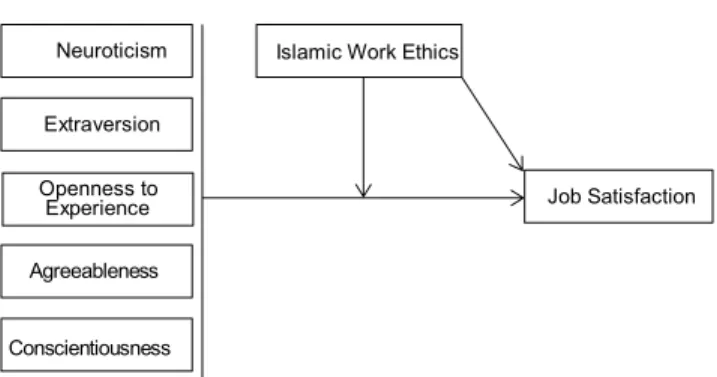
2.8. Research Model
Figure 1: Research Model
3. Research Methodology
3.1. Population and Sampling
This present research aims to explore the relationship between Personality and Job Satisfaction with moderating role of Islamic work ethics. Personality has an impact on individual behavior and personality traits can predict the job satisfaction in employees. Religion motivates one to achieve certain objectives (Ali et al., 1995). Also, religion determines certain values to be adopted in work and IWE forces one on bring positive change in self. To examine this particular relationship public and private sector organizations employees of Pakistan and AJK State were considered as target population in this study.
Neuroticism
Extraversion Openness to
Experience Agreeableness Conscientiousness
Islamic Work Ethics
Job Satisfaction
Convenience sampling technique was used in collection of data from the employees of private sector organizations of Pakistan and AJK State. As the moderating variable is Islamic work ethics so the data was collected from only Muslim employees. Self-administered, close-ended questionnaires and electronic questionnaires were used to collect data. A total number 350 questionnaires were distributed, and 150 electronic questionnaires were emailed to the respondents. Out of these 350, 290 were returned and only 271 questionnaires out of these were in useable form. Whereas, 95 respondents filled the electronic questionnaires. Out of these 95, only 90 electronic questionnaires were properly filled and in useable form. The total response rate was 72.2%. As in data collection, research ethics were strictly followed, and the responses were collected on voluntary participation basis and It was made cleared that the data will be used for research purpose and confidentiality and anonymity was guaranteed.
The majority of respondents were male (70.4%) with average ages 26-30 (40.4%). Most of them have MS/M.Phil.
(50.4%) degree who had been working with private sector organizations (54.8%) for less than 1 year to 5 year (55.7%).
3.2. Variables of Study
A 5 point Likert scale has been used in this study where 1 represented Strongly Disagree and 5 represent Strongly Agree. Cronbach's Alpha was used to check the reliability of scales.
Neuroticism
To measure Neuroticism Costa and McCrae (1991), 5 item scale has been used. Sample item included, “When I’m under a great deal of stress, sometimes I feel like I’m going to pieces.” The reliability for this scale was found to be 0.819.
Extraversion
To measure Extraversion Costa and McCrae (1991), 4 item scale has been used. Sample item included, “I am a cheerful, high-spirited person.” The reliability for this scale was found to be 0.784.
Openness to experience
To measure Openness to Experience Costa and McCrae (1991), 5 item scale has been used 1 item was dropped due to its low reliability. Sample item included, “I have little interest in speculating on the nature if the universe or the human condition.” The reliability for this scale was found to be 0.740.
Agreeableness
To measure Agreeableness Costa and McCrae (1991), 4 item scale has been used. Sample item included, “I
generally try to be thoughtful and considerate.” The reliability for this scale was found to be .717.
Conscientiousness
To measure Conscientiousness Costa and McCrae (1991), 5 item scale has been used. Sample item included,
“I’m pretty good about pacing myself so as to get things done on time.” The reliability for this particular scale was 0.709.
IWE
To measure IWE Ali (1992), 17 item scale has been used.
Sample item included, “Justice and generosity in the workplace are necessary conditions for the society’s welfare.” The reliability for this scale was found to be 0.842.
Job Satisfaction
To measure “JS” Brayfield and Rothe (1951), 6 item scale has been used. Sample item included “Most days I am enthusiastic about my job”. The reliability for this scale was found to be 0.759.
Control Variables
To control out variation in job satisfaction due to demographic variables of this particular study One-way ANOVA test was performed. The results depicted that significant differences in job satisfaction across qualification (F=4.451, p<.01), organization (F=10.41, p<.01) and experience (F=3.09, p<0.05). However, gender and age do not cause any changes in JS mean value. Thus, qualification, organization and experience was controlled in this study.
4. Results
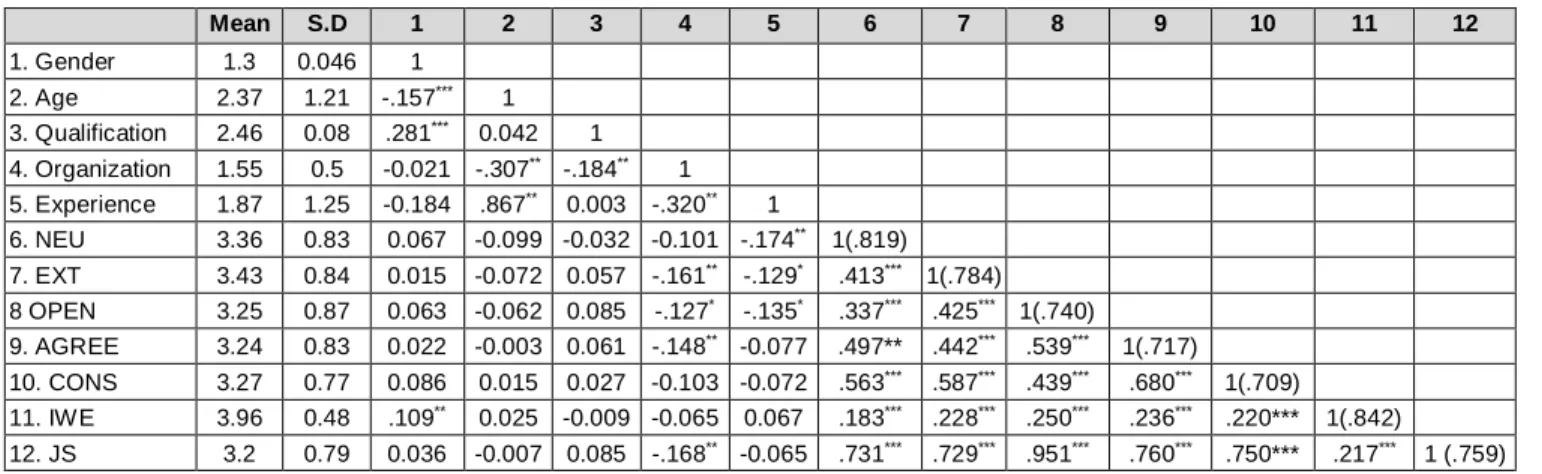
The Table 1 depicts that neuroticism has positive
association with job satisfaction (r = 0.731, p<0.001) which
is contrary to Hypothesis 1. Whereas, a strong positive
correlation among extraversion and job satisfaction (r =
0.729, p<0.001) is observed, which provide base for the
initial support to Hypothesis 2. Also openness to experience
has strong positive association with JS (r = 0.951, p<0.001),
which provide initial support to Hypothesis 3. Similarly,
agreeableness has strong positive correlation with job
satisfaction (r = 0.760, p<0.001) and it initially support
Hypothesis 4. And Conscientiousness and job satisfaction
has a strong positive correlation (r = 0.750, p<0.001) which
supports Hypothesis 5). On the other hand Islamic work
ethics has positive association with job satisfaction (r =
0.217, p<0.001).
Table 1: Means, σ, and Correlations, and Reliabilities
Mean S.D 1 2 3 4 5 6 7 8 9 10 11 12
1. Gender 1.3 0.046 1
2. Age 2.37 1.21 -.157*** 1 3. Qualification 2.46 0.08 .281*** 0.042 1 4. Organization 1.55 0.5 -0.021 -.307** -.184** 1 5. Experience 1.87 1.25 -0.184 .867** 0.003 -.320** 1
6. NEU 3.36 0.83 0.067 -0.099 -0.032 -0.101 -.174** 1(.819) 7. EXT 3.43 0.84 0.015 -0.072 0.057 -.161** -.129* .413*** 1(.784) 8 OPEN 3.25 0.87 0.063 -0.062 0.085 -.127* -.135* .337*** .425*** 1(.740)
9. AGREE 3.24 0.83 0.022 -0.003 0.061 -.148** -0.077 .497** .442*** .539*** 1(.717)
10. CONS 3.27 0.77 0.086 0.015 0.027 -0.103 -0.072 .563*** .587*** .439*** .680*** 1(.709)
11. IWE 3.96 0.48 .109** 0.025 -0.009 -0.065 0.067 .183*** .228*** .250*** .236*** .220*** 1(.842)
12. JS 3.2 0.79 0.036 -0.007 0.085 -.168** -0.065 .731*** .729*** .951*** .760*** .750*** .217*** 1 (.759)
*p<0.05, **p<0.01 and ***p<0.001.
n = 361, For gender,1 “male”; 2, “female”. Age ranges from 1, “20-25”; 2, “26-30”; 3, “31-35”; 4, “36-40”; 5, “41 or above”.
For Qualification 1, “Graduate”; 2, “Master”; 3, “MS/MPhil”; 4, “PhD”.
For Organization 1, “Public”; 2, “Private”.
Experience Ranges from from 1, “0-5”; 2, “6-10”; 3, “11-15”; 4, “16-20”; 5, “21 or above”.
NEU = Neuroticism, EXT = Extraversion, OPEN = Openness to Experience, AGREE= Agreeableness, CONS = Conscientiousness, IWE = Islamic Work Ethics, JS = Job Satisfaction.
Table 2: Moderated Regression Analysis
Predictors Job Satisfaction
Β R2 ∆R2
Step 1
Control variables 0.046***
Step 2
NEU -0.084* 0.324*** 0.289***
EXT 0.055ns
OPEN 0.755***
AGREE 0.117***
CONS 0.078**
IWE -0.063*
Step 3
NEU x IWE -0.276*** 0.350*** 0.027***
EXT x IWE 0.162**
OPEN x IWE 0.132**
AGREE x IWE 0.092ns CONS x IWE -0.018ns
n = 361. NEU = Neuroticism, EXT = Extraversion, OPEN = Openness to Experience, AGREE= Agreeableness, CONS = Conscientiousness, IWE = Islamic Work Ethics, JS = Job Satisfaction.
* p < 0.05, ** p < 0.01, *** p < 0.001 and ns = not significant.
Cohen, West, and Aiken (2014) interactive regression technique has been used to test hypothesis 7a, 7b, 7c, 7d, and 7e.
Table 3, depicts the results of moderated analysis. IWE moderate the relationship of neuroticism and job satisfaction (β = -0.276, p<0.001) hence hypothesis 7a is supported.
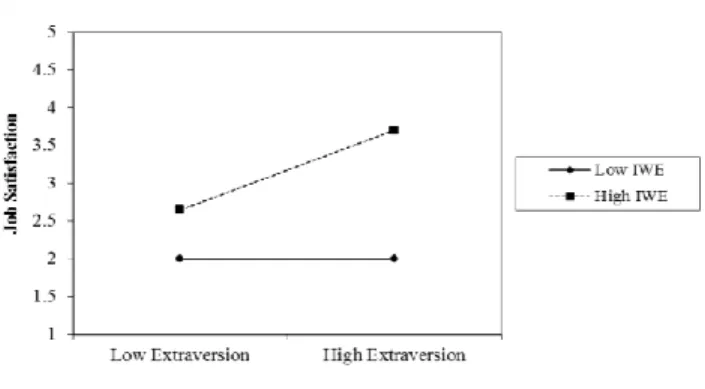
Also moderation effect of IWE on the relationship of
extraversion and job satisfaction was found to be significant (β = 0.162, p<0.01), which leaded to the acceptance of hypothesis76b. Similarly, it was found that IWE also significantly moderates the relationship of openness to experience with job satisfaction, thus hypothesis 7c is supported.
However, in moderated regression analysis it was found that, IWE has no moderating effect on the relationship of agreeableness and job satisfaction (β = 0.092, p = ns) which leads toward no support of hypothesis 7d. Whereas, similar result observed i.e. IWE has no Interactive effect on the relationship of conscientiousness with JS (β = -0.018, p = ns), which leaded towards the conclusion that hypothesis 7e is not supported.
IWE = Islamic work ethics
Figure 2: Interactive effect of NEU and IWE JS.
IWE = Islamic work ethics
Figure 3: Interactive effect of EXT and IWE on JS.
IWE = Islamic work ethics
Figure 4: Interactive effect of Openness to Experience and IWE on JS.