1. Introduction
The keyword of the 4th industrial revolution era are AI (artificial intelligence), IoT (internet of things), big data, fusion. The common point of these is
'connection'. At this point, the government selected eight categories as the "Fourth Industrial Revolution Leader Training Project" in response to the fourth industrial revolution, which included information security. This is likely to continue to foster
Influences of Affectivity and Organizational Commitment on Job Satisfaction and Work Performance of
Information Security Professionals
Joon-Hwan Kim
1, Hyung-Jin Mun
2*1
Department of Paideia, Sungkyul University
2
Department of Information & Communication Engineering, Sungkyul University
정보보안 종사자의 정서성과 조직몰입이 직무만족 및 업무성과에 미치는 영향
김준환1, 문형진2*
1성결대학교 파이데이아학부, 2성결대학교 정보통신공학부
Abstract The purpose of this study empirically examined relationship among affectivity(positive affectivity vs.
negative affectivity) and organizational commitment on job satisfaction and work performance of information security professionals. To this end, we conducted a questionnaire survey on 174 information security professionals and analyzed the collected data using structural equation modeling (SEM). It was found that positive affectivity had a positive influences on organizational committment. But negative affectivity was not significantly related to organizational committment. In addition, organizational committment had a positive relationship with job satisfaction and work performance. The results of the empirical study are meaningful to understand the effects of the positive affective aspect of information security professionals on job satisfaction and work performance.
Key Words : Positive Affectivity, Negative Affectivity, Organizational Committment, Work Performance, Job Satisfaction
요 약 본 연구는 정보보안 종사자가 경험하는 감정적 반응인 정서성(긍정 정서 vs. 부정 정서)과 조직몰입이 직무만족 및 업무성과에 미치는 영향을 분석하는데 그 목적이 있다. 이를 위하여, 국내 기업에서 근무하고 있는 정보보안 종사자 174명을 대상으로 한 설문자료를 통해 구조방정식모형 (SEM)을 활용하여 검증하였다. 분석 결과는 다음과 같다. 긍정정서 는 조직몰입에 긍정적인 영향을 미치는 것으로 나타났다. 부정정서는 유의미한 관계가 나타나지 않았다. 또한 조직몰입이 직무만족 및 업무성과에 미치는 영향에 있어서 모두 유의적인 정적 관계를 갖는 것으로 나타났다. 이러한 연구결과는 정보 보안 종사자의 긍정적인 정서 측면이 직무만족 및 업무성과에 미치는 영향을 검증하는데 의미를 두고 있다.
주제어 : 긍정 정서, 부정 정서, 조직몰입, 직무만족, 업무성과
*Corresponding Author : Hyung-Jin Mun ([email protected]) Received March 29, 2018
Accepted June 20, 2018
Revised May 28, 2018 Published June 28, 2018
high-quality talent in promising areas[1]. With the recent expansion of security intelligence, it is important to actively cope with security in almost all fields such as corporations, medical and public sectors. Big data analysis shows the threats that have been neglected in the past, and there are various ways to cope with security incidents quickly and accurately. Despite the importance of information security, according to the survey conducted by RSA 2015 (the world's largest information security conference) and ISACA (Information Systems Audit and Control Association), information security professionals were satisfied with information security. However, satisfaction with each individual company was low[2].
The domestic security industry is experiencing a slowdown in growth and a decline in recruitment.
Despite the increase in overseas exports, exports are continuing to suffer. This is the growth of the industry, but the decrease in the number of new hires has to be approached from the structural point of view, and the characteristics of the security industry with high social importance should be considered. The information security task requires a high level of expertise compared to the general task and attempts to manage and control the security policy within the organization.
As a result, the conflict with the internal staff becomes more intense and the unilateral sacrifice, patience, In this study, the satisfaction rate of job satisfaction is lower than that of other jobs because it is frequently asked to take a supervision[3]. Therefore, it is necessary to closely analyze the internal conflicts and emotional states of information security professionals, to identify factors that affect their security stresses, and to improve their job satisfaction and work performance by lowering the stress level[4].
However, there is insufficient research on the individual characteristics that mediate the emotional effects of relative organizational commitment, and it is necessary to reconsider whether organizational commitment had a positive effect on all members in the same way. It had been focused mainly on improvement
of conflict management and quality of work due to conflict of interests occurring within the organization, and had been limited to education and selection programs to solve human tragedies in this field[4,5].
Therefore, this study focuses on the emotional inner workings of information security professionals, and it is necessary to make effort for emotional management considering the characteristics of jobs to them rather than engineering or technology. As mentioned earlier, the main purpose of this study was to uncover the relationship between affectivity(positive affectivity vs.
negative affectivity) and to examine its effect on job satisfaction and work performance. As a result of a comprehensive literature review, it was found that this topic has been hardly researched in previous studies.
The specific research questions of this study were stated as follows:
1. What are the relationships between the components of affectivity (positive affectivity vs. negative affectivity) and organizational committment?
2. What are the effects of organizational committment on job satisfaction and work performance?
2. Review of Literature
2.1 Affectivity
Positive affectivity reflected the tendency to experience a positive emotional state and reflected the degree of feeling enthusiastic, lively, and exhaustive.
Negative affectivity was a tendency to experience an
unpleasant emotional state, Strong people tend to focus
on the negative side and generally tend to be less
satisfied with their lives[6,7]. An employee with a high
level of positive affectivity is optimistic and
enthusiastic about things, while an employee with low
positive affectivity showed a tendency to have no
enthusiasm and indifference, rather than showing
negative emotions. Also, those who showed high
negative affectivity showed pessimistic and unstable,
while those with low negative emotions showed more
calm emotional tendency[8]. Hotel employees' positive affectivity was positively associated with deep acting but was not significantly related to surface acting[9].
Additionally, Chinese employees with positive affectivity tended to use more deep acting and the expression of naturally felt emotion but less surface acting than employees who were low in emotional regulation[10]. Therefore, if positive affectivity was involved, it could be understood that the emotional state was canceled as the tension condition was quickly resolved.
2.2 Organizational Committment
Organizational commitment is not based on compulsory regulations, but rather on the psychological state that organizational members are willing to attach to the particular organization they work in, and that voluntarily devote their efforts to organizational development by accepting organizational values and goals[11]. According to Meyer and Allen (1991), conceptualization of organizational commitment included three branches: affirmative commitment, continuance commitment, normative commitment.
Affirmative commitment was a feeling of strong identification with an individual and an intense attachment to the organization. Continuance commitment refer to the tendency to maintain consistency and continuity of behavior. Normative commitment was based on a feeling of sense of duty to the organization and was based on the perception that it was moral to remain in the organization[12].
Organizational commitment had been found to be related to job performance in several studies, but it had received less attention than relative relevance between job satisfaction and job performance. Organizational commitment was related to job satisfaction, but object oriented was a different concept of organization.
Organizational commitment was less related to job performance[13] than job satisfaction[14].
Organizational commitment had been found to increase organizational citizenship behavior, but the actual
relevance of performance had not been fully demonstrated[15].
3. Research Model and Hypotheses
3.1 Affectivity and Organizational Committment Organizational commitment is characterized by a strong belief in the value of an organization and a willingness to do more than a defined role for organizational commitment[16]. This implies that information security professionals with positive affectivity will try to control internal emotions and external emotions so that they are similar to each other, and relatively few psychological resources will be wasted due to emotions. Therefore, various emotional resources that can be utilized are expected to have a positive effect on organizational commitment. On the other hand, information security professionals with negative affectivity will use typical emotional expressions rather than various emotional expressions, and such limited emotional expressions are expected to negatively affect their intrinsic organizational commitment in the process of interaction within the organization[17]. Therefore, the research hypotheses regarding the relationship between affectivity(positive affectivity vs. negative affectivity) and organizational committment are presented as follows:
H 1-1: Positive affectivity is positively related to organizational committment.
H 1-2: Negative affectivity is negatively related to organizational committment.
3.2 Organizational Committment and Job Satisfaction
Job Satisfaction is a positively emotional state as
subjective value that an individual gets as a result of
job related evaluation[4,18]. In particular, information
security professionals work in an independent
environment, and their professionalism and knowledge
are concentrated. Therefore, in order to satisfy the
performance within the organization, the job satisfaction of the information security professionals must be preceded. In this respect, the job satisfaction of information security workers should be utilized as a tool for quality service. As a result, companies can provide more consistent services and information security professionals can accumulate more capabilities and experience[19]. Organizational commitment reduced the turnover intention of organizational members, but the actual relevance of performance was not fully demonstrated[15]. In addition, in the previous study, it was found that HLM (Hierarchical Linear Model) was applied to analyze the level of job satisfaction and organizational commitment at the individual level. As a result, it was found that organizational commitment decreased the turnover intention of the members and increased job satisfaction[20].
Several researchers have studied the relationship between organizational committment and job satisfaction. Though these finding imply that organizational committment increases job satisfaction, there are also other studies which was not negatively associated with organizational committment and job satisfaction[21]. As mentioned earlier, Wharton (1993) found that organizational committment was positively related to job satisfaction on workers employed in the banking and hospital industries[22]. This assumption implies that suppressing one’s emotions may lead to decrease satisfaction in the workplace, but if one succeeds in regulating emotions in organizational committment, job satisfaction may actually increase.
Therefore, the hypothesis regarding the relationship among organizational committment and job satisfaction are:
H 2: Organizational committment is positively related to job satisfaction.
3.3 Organizational Committment and Work Performance
Though a number of researchers have studied the negative consequences of affectivity, such as job stress,
there is lack of quantitative research on the effect of affectivity on work performance[5,23].
As a result of empirical analysis on the part-time employees’ job satisfaction and organizational commitment on performance. their organizational commitment had positive effect on performance[24].
Organizational commitment was more strongly related than job satisfaction with turnover intentions for the tellers, but not for the professionals. Job satisfaction was related more strongly than organizational commitment with supervisory ratings of performance for both samples[25]. And organizational commitment of members in social welfare organization had a positive impact on job performance[26]. If the performance is effective, it may result in a feeling of accomplishment. Thus, the research hypotheses are described as follows:
H 3: Organizational committment is positively related to work performance.
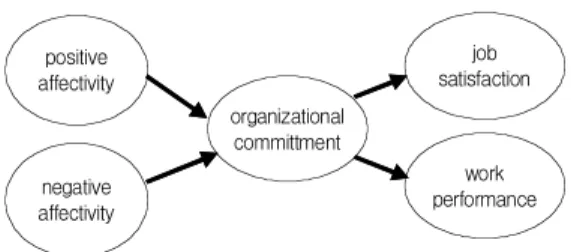
We present the research model which contains hypotheses derived in Fig. 1.
negative affectivity positive affectivity
work performance
job satisfaction organizational
committment
Fig. 1. Research Model
4. Methods
4.1 Sample and Data Collection
Convenience sampling was used for this study. The
survey questionnaires were distributed to 200
information security professionals who work in 8
companies located in the metropolitan area in Korea. As
a result, a total of 181 copies were collected, and the
data collected through a total of 174 copies were used
for the analysis, except for the 7 cases that had missing
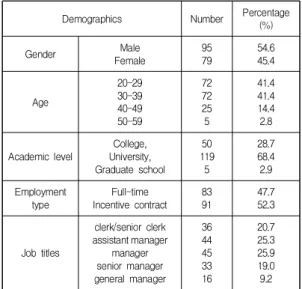
values. The demographic information of the participants was presented in Table 1.
Table 1. Demographic Information
Demographics Number Percentage
(%)
Gender Male
Female
95 79
54.6 45.4
Age
20-29 30-39 40-49 50-59
72 72 25 5
41.4 41.4 14.4 2.8
Academic level
College, University, Graduate school
50 119
5
28.7 68.4 2.9 Employment
type
Full-time Incentive contract
83 91
47.7 52.3
Job titles
clerk/senior clerk assistant manager
manager senior manager general manager
36 44 45 33 16
20.7 25.3 25.9 19.0 9.2
4.2 Measurements
One inventory which adopts items from different measurements would be used to assess affectivity, organizational committment, and job satisfaction.
Another inventory was used to assess work performance. PANA was defined as it is possible for a person to be high in both positive affectivity and negative affectivity, high in one and low in the other, or low in both[27]. To measure affectivity, 10 items of the positive and negative affectivity scale (PANAS), which was suggested by Watson, Clark, and Tellegen’s (1988) research[27], would be used. This test was most frequently used in organizational contexts. One item of negative affectivity that lowered the reliability of the instrument were deleted (items : "I like myself, I can solve any problems that occur to me", "I can not get rid of the feeling of failing" etc). Organizational commitment refers to the individual's attachment to the organization as a psychological adhesive between the worker and the organization, inducing the worker to devote to the organization and to remain in the organization[16,28]. In order to measure organizational
commitment, we used a scale consisting of 7 items used[29] (items : "I am proud to tell others that I am part of our company", "I am very satisfied with my choice" etc). Job satisfaction was defined as one of the attitudes related to the job is the pleasant and positive emotional state that an individual gets as a result of an assessment of their job or job experience[3,5]. Job satisfaction was measured using the JDS (Job Diagnostic Survey), 5 items scale developed by Hackman and Oldham (1975)[30] (items : "In general, I like working here", "In general, I don’t like my job(R)",
"All in all, I am satisfied with my job" etc). Work performance was defined as the degree of responsibility and responsibilities imposed upon the performance of a job[5,14]. The test assessed the information security professionals’ expertise, the efficiency of performance, the effectiveness of performance, and the results of recent job performance. Participants indicate the extent to which they feel each emotion on average using a 5-point Likert scale from 1 (very slightly or not at all) to 5 (extremely).
4.3 Data Analyses
We used SPSS 22.0 and AMOS 22.0 to analyze the relationship between variables. Structural equation modeling (SEM) would be conducted to test the research hypotheses. Anderson and Gerbing’s (1988) two-step approach would be used[31], whereby a measurement model was first examined, followed by a series of structural models aimed at testing the hypothesized relationships. That is, the value estimated by applying the structural equation modeling can be more reliable than the model based only on the measurement variables since the measurement error can be taken into consideration.
The validity and reliability of the inventory that
were measured using multi-item scales that have been
previously developed and used was examined. The
internal reliability of the group items from the PANAS
(Cronbach α=.777 and .561), organizational commitment
(Cronbach α=.828), and JDS (Cronbach α=.864), and
items of the work performance (Cronbach α=.895) evaluation inventory was assessed with Cronbach’s coefficient alpha. Confirmatory factor analysis (CFA) would be used to examine the validity of the each construct measured by items adopted from tests of positive affectivity, negative affectivity, organizational committment, and job satisfaction. Also, the construct validity of the performance evaluation inventory was examined with CFA. The inventories was revised to improve its reliability and validity if required.
Table 2. Descriptive Statistics and Correlations
Variables 1 2 3 4 5
1. positive affectivity 1 2. negative affectivity -.061 1 3. organizational
committment .246
**-.025 1
4. job satisfaction .196
**-.098 .326
**1 5. work performance .150
*-.039 .382
**.477
**Mean 3.67 3.26 3.33 3.58 3.33
SD .562 .509 .451 .482 .505
5. Results
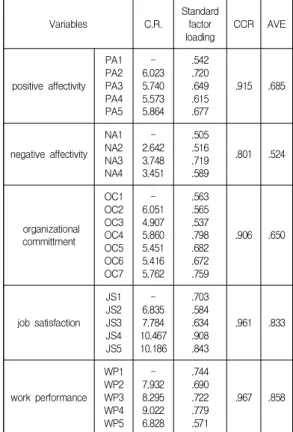
5.1 Assessment of the Measurement Model As presented in Table 3, A confirmatory measurement model specifies the relations of the observed measures to their posited underlying constructs, with the constructs allowed to intercorrelate freely. A confirmatory structural model then specifies the causal relations of the constructs to one another, as posited by some theory. the model fit estimates indicated that the measurement model appropriately fit the data (χ²=352.47, df=280; RMR=.031; RMSEA=.039;
GFI=.970; TLI=.946; CFI=.954). In evaluating the adequacy of the measurement and structural models, the following fit indices would be used. The upper bound of goodness-of-fit indices for the CFI, TLI, GFI was typically considered .90, and for the RMR, RMSEA, the lower bounds of goodness-of-fit indices are .08.
Table 3. Results of Confirmatory Factor Analysis
Variables C.R.
Standard factor loading
CCR AVE
positive affectivity PA1 PA2 PA3 PA4 PA5
- 6.023 5.740 5.573 5.864
.542 .720 .649 .615 .677
.915 .685
negative affectivity NA1 NA2 NA3 NA4
- 2.642 3.748 3.451
.505 .516 .719 .589
.801 .524
organizational committment
OC1 OC2 OC3 OC4 OC5 OC6 OC7
- 6.051 4.907 5.860 5.451 5.416 5.762
.563 .565 .537 .798 .682 .672 .759
.906 .650
job satisfaction JS1 JS2 JS3 JS4 JS5
- 6.835 7.784 10.467 10.186
.703 .584 .634 .908 .843
.961 .833
work performance WP1 WP2 WP3 WP4 WP5
- 7.932 8.295 9.022 6.828
.744 .690 .722 .779 .571
.967 .858
5.2 Assessment of the Structural Model The overall fit of the model was good (χ²=406.84 with 281 degrees of freedom) and the CFI was .920.
Other goodness of fit indexes also reached a reasonably good level (GFI=.917; TLI=.907; RMR=.042; RMSEA=
.051). As presented in Table 4, Information security professionals' positive affectivity was positively related to organizational commitment but negative affectivity was not significantly related to organizational commitment (path coefficient=.297, t=3.106, p<.05; path coefficient=.046, t=.593, p=.553). Therefore, hypothesis 1-1 was supported, but hypothesis 1-2 was rejected.
Second, organizational commitment was positively
related to job satisfaction (path coefficient=.743, t=3.575,
p<.01). Thus, hypothesis 2 was supported. Finally,
organizational commitment was positively related to
work performance (path coefficient=.532, t=4.033,
p<.01). Therefore, hypothesis 3 was supported.
Table 4. Hypotheses Testing
Hypothesis Standardized
Coefficient T-values Result
H 1-1 .297 3.106
*Supported
H 1-2 .046 .593 Not Supported
H 2 .743 3.575
**Supported
H 3 .532 4.033
**Supported
**