Print ISSN: 2288-4637 / Online ISSN 2288-4645 doi:10.13106/jafeb.2021.vol8.no1.495
The Role of Technology, Organizational Culture, and Job Satisfaction in Improving Employee Performance during the Covid-19 Pandemic
I Ketut Setia SAPTA
1, Muafi MUAFI
2, Ni Made SETINI
3Received: September 30, 2020 Revised: November 30, 2020 Accepted: December 05, 2020
Abstract
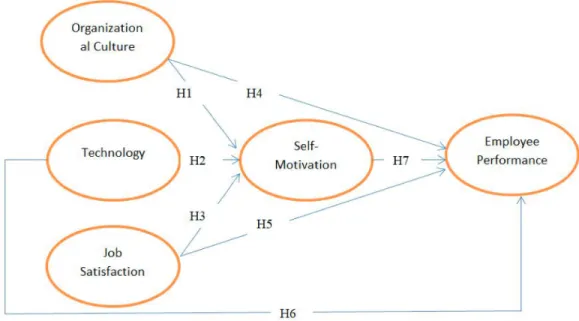
In the current Covid-19 pandemic, technology’s role is important; with technology, all activities can carry on. This study explains that technology, organizational culture, and job satisfaction at rural banks in Bali can be a motivation for improving performance, especially during a pandemic. A questionnaire is distributed online using Google Form to a total of 350 employees; the data is collected from a sample of employees from rural banks in Denpasar, Bali. Respondents had to meet the following criteria: a minimum work period of one year and a minimum high school education or equivalent. With these criteria, 100 samples were obtained. The dependent variable is employee performance; the independent variables are organizational culture, technology, and job satisfaction; the intervening variable is work motivation. This study uses Structural Equation Modeling with a variance-based or component-based approach with Partial Least Square.
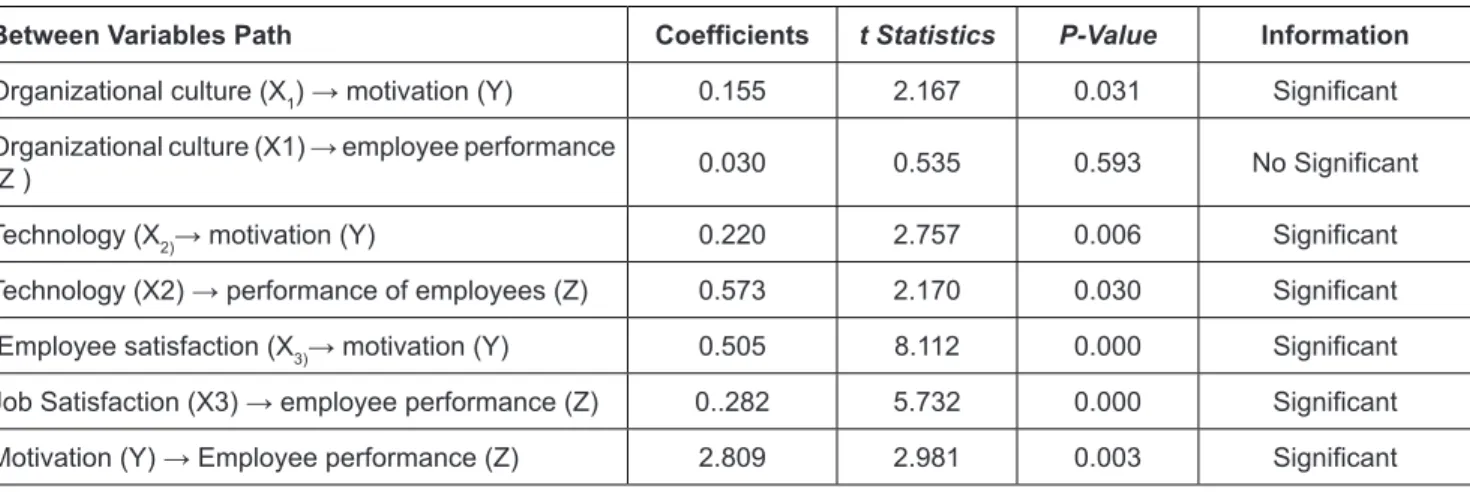
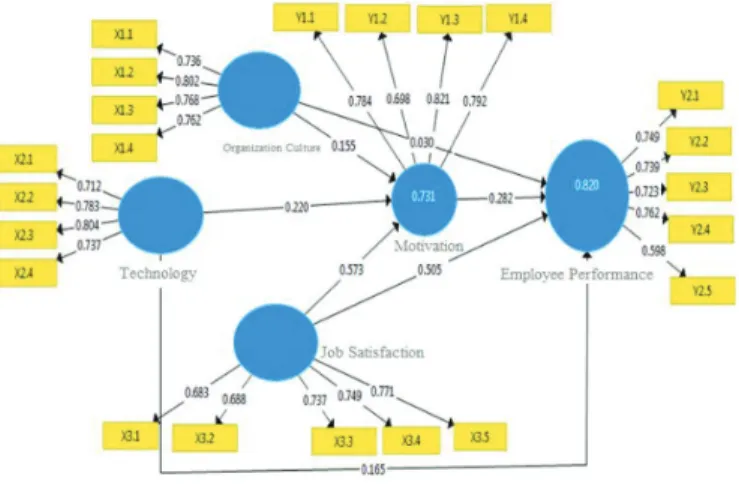
The study results show that organizational culture, job satisfaction, and technology provide motivation and have a significant positive effect on employee performance. However, organizational culture does not have a positive or direct impact on employee performance. The study results can be used as a basis for designing business strategies to improve employee performance in a competitive environment to advance the credibility of a bank.
Keywords: Organizational Culture, Job Satisfaction, Technology, Motivation, Employee Performance JEL Classification Code: D8, L1, L2, L22
of competition became increasingly fierce, coloring the Indonesian banking industry (Kadir & Amalia, 2017; Uno, 2020). The impact of intense competition has led to banking practices moving to unhealthy conditions. The government considers it necessary to limit the number of banks in Indonesia by issuing regulations setting requirements in financial performance. The impact was very significant in reducing the number of banks; several banks eventually merged. Human resources are used to synergize other resources to achieve organizational goals so that, without human resources, additional resources are idle and less useful in achieving organizational goals. Banks will be successful if they require employees do more than just their formal duties and are willing to deliver performance that exceeds expectations. Rural banks have the potential for human resources to carry out various functions of banking activities, especially during the Covid-19 outbreak, which demands to maintain distancing.
An organization also will not develop if the human resources do not have the desire to advance the organization from within them. Quality human resources become an
1
First Author and Corresponding Author. Faculty of Economics and Business, Universitas Mahasaraswati Denpasar, Bali, Indonesia [Postal Address: l. Kamboja No.11A, Dangin Puri Kangin, Kec.
Denpasar Utara, Kota Denpasar, Bali 80233, Indonesia]
Email: [email protected] ; [email protected]
2
Faculty of Business and Economics, Universitas Islam Indonesia, Yogyakarta, Indonesia
3
Faculty of Economics and Business, Universitas Udayana, Bali, Indonesia
© Copyright: The Author(s)
This is an Open Access article distributed under the terms of the Creative Commons Attribution Non-Commercial License (https://creativecommons.org/licenses/by-nc/4.0/) which permits unrestricted non-commercial use, distribution, and reproduction in any medium, provided the original work is properly cited.