Print ISSN: 2288-4637 / Online ISSN 2288-4645 doi:10.13106/jafeb.2021.vol8.no1.781
The Role of Islamic Business Ethics and Market Condition on Organizational Performance
Hamdi BULDAN
1, Edy Suandi HAMID
2, Jaka SRIYANA
3, Achmad TOHIRIN
4Received: October 01, 2020 Revised: December 06, 2020 Accepted: December 14, 2020
Abstract
The purpose of this study is to test empirically the effect of Islamic business ethics and market conditions on organizational performance in state-owned construction companies in Indonesia. Data collection in this study was conducted online and the total number of data used was 81 respondents, both directors, heads of departments, and managers (general and project). This study uses a partial least squares structural equation model (PLS-SEM) with a quantitative approach that aims to test hypotheses and relationships between variables, such as Islamic business ethics, market conditions, project management, organizational culture, competitive strategy, and organizational performance. This study shows Islamic business ethics has a significant direct effect on organizational performance. Market conditions do not have a direct significant effect on organizational performance. Meanwhile, the mediating variables of project management and competitive strategy have a significant direct effect on organizational performance. Organizational culture does not have a significant influence on organizational performance.
Conversely, market conditions have a significant influence through the mediating variables of project management and competitive strategy on organizational performance. Besides, this study is an attempt to determine the impact of the criteria factors affecting the measurement of the performance of construction organizations in Indonesia in terms of the external environment and organizational structure.
Keywords: Islamic Business Ethics, Organizational Performance, Organizational Structure, Structural Equation Models JEL Classification Code: A11, A13, L10, P40
construction organizations (Hu & Liu, 2018; Bourne &
Neely, 2003). This implies a gap between theory and practice in the organizational performance analysis model, which is evidenced by significant inconsistencies in performance measurement in the field (Assaad & El-adaway, 2020). In general, the environment affects the internal structure and organizational processes, and centrally affects organizational performance (Hambrick, 1980). This, which implies the use of a number of ethical values based on an Islamic perspective regarding work and ensuring the quality of work, if and when used (Beekun & Badawi, 2005; Beekun, 2012).
Aziz (2013) suggested that the difference between Islamic business ethics and conventional business ethics lies in the foundation of Tauhid and long-term orientation (eternity), while western ethics is based on the human mind, namely the minds of philosophers. According to Muhammad et al.
(2008), Islamic business ethics is essential because ethical choices are unavoidable. The challenge of Islamic business ethics is to make that inevitable ethical decision making explicit to make it better. Far from being anti-business, ethics provides essential support for maximizing long-term business value.
1 First Author and Corresponding Author. [1] Lecturer, Department of Informatics Engineering, Faculty of Computer Science, Universitas Amikom Yogyakarta, Indonesia [2] Doctoral Student, Faculty of Business and Economics, Universitas Islam Indonesia, Indonesia [Postal Address: Ring Road Utara, Condongcatur, Sleman, Yogyakarta 55281, Indonesia] Email: [email protected]
2 Professor, Department of Economics, Faculty of Business and Economics, Universitas Islam Indonesia, Indonesia.
Email: [email protected]
3 Professor, Department of Economics, Faculty of Business and Economics, Universitas Islam Indonesia, Indonesia.
Email: [email protected]
4 Associate Professor, Department of Economics, Faculty of Business and Economics, Universitas Islam Indonesia, Indonesia.
Email: [email protected]
© Copyright: The Author(s)
This is an Open Access article distributed under the terms of the Creative Commons Attribution Non-Commercial License (https://creativecommons.org/licenses/by-nc/4.0/) which permits unrestricted non-commercial use, distribution, and reproduction in any medium, provided the original work is properly cited.
1. Introduction
There has been much criticism in the literature about
the failure of the performance model or framework in
Beekun and Badawi (2005) find that a clear difference between normative Islamic business ethics and Muslim practice. Meanwhile, a high Islamic work environment in terms of ethics shows greater loyalty and engagement with the organization can indirectly improve company performance (Salahudin et al., 2016). Besides, one of the other important mechanisms for determining performance in the environment is market conditions because it determines the failure criteria for a project performance of a construction organization (Agarwal & Rathod, 2006; Belout & Gauvreau, 2004). Chan and Chan (2004) states that market conditions have the power to reshape the broad characteristics of the firm.
In general, it is assumed that there is a relationship with market conditions that can improve organizational performance (Isik et al., 2010). Whereas previous research stated that market conditions do not have a direct influence on performance, as well as there is an unclear relationship between environmental market conditions and the adoption of a comprehensive performance measurement system (Claver-Cortés et al., 2012; Pedersen & Sudzina, 2012). On the problems that have been studied, this study conducts an empirical test of the relationship between the environment and organizational performance which is mediated by the organizational structure in organizational construction through contingency theory. This paper is structured as follows. The following section will contain a literature review and hypotheses. The next section describes the research method, followed by results and discussion.
The final section will offer implications, conclusions, and directions for future research.
2. Literature Review
2.1. Organizational Performance in Economic Library
Organizational performance is defined as the ability of the organization to achieve success with its stated goals (Wade
& Recardo, 2001). According to Ahmed and Shafiq (2014), organizational performance is considered an achievement that all businesses aim, for the survival and success of the organization.
A company’s performance can be measured in a number of ways, including financial performance, product performance, and market performance (Li et al., 2006). Profitability is the main goal in organizational performance (Stewart & Waroonkun, 2007). Therefore, in general, performance should be based on effectiveness, efficiency, economy, quality, consistency of behavior, and normative measures (Wade & Recardo, 2001).
2.2. Islamic Economic Theory
Islamic economic theory presents development ideals based on the philosophy of Islamic life. Economics in
Islam is inseparable from the notion of humans since moral beings have obligations to God as well as to others. Islamic economy is transformative and does not have to provide a truly autonomous alternative and, in this sense, is isolated from capitalism (Tripp, 2006). The principles of Islamic economics refer to the principles of social justice concerning the distribution of natural wealth and products and are based on the notion of mutual responsibility and mutual equality (Alatas, 2006). Islamic ethics are fundamental values (norms) in the system of human relations to God to fellow humans and to the natural environment which are sourced from the Al-Qur’an and the Hadith of the Prophet Allah SWT based on faith and taqwa to Allah SWT, whereas Islamic business ethics is the elaboration of norms in the activities of human existence that are integrated into the economic field from a religious perspective so that functionally it forms a religious awareness in carrying out any economic activity.
2.3. Contingency Theory
Contingency theory was first introduced to study the relationship between strategy, structure, and performance (Chandler, 1962). This is because the organization is in an increasingly dynamic environment and its adaptation to the environment (Ginsberg & Buchholtz, 1990). Besides, it looks at organizational relationships based on environment, organizational size, and organizational strategy. Contingency theory focuses on strategy rather than structure, and the fit between strategy and the environment (Lee & Miller, 1996).
3. Hypotheses
3.1. Islamic Business Ethics
Beekun and Badawi (2005) suggested that the Islamic ethical system is fair, balanced, wise, and generous.
According to Gümüsay (2015), at the macro level, the use of Islamic ethics greatly affects various other institutions such as the market. Abuznaid (2009) stated that Islamic ethics will inevitably lead to ethical behavior including legal interpretations, organizational factors, individual factors, social factors, environmental factors, and managers.
According to Senam et al. (2014), construction and project management activities must be carried out in the best and ethical manner and not cause damage. In this case, Allah said in the Qur’an in Surah al-A`raf: 56 “... Truly Allah mercy is very close to those who do good”.
The most interesting aspect of Islamic work ethics
is creating a management culture to invite goodness and
prohibit wrongs (Abbasi et al., 2012). Abuznaid (2009)
stated that the Islamic perspective suggests building success
based on the Qur’an and the Hadith such that doing business
must have ethics. Sami and Rahim (2017) found a positive
relationship between Islamic ethics and job performance and project outcomes. Salahudin et al. (2016) suggested that a high Islamic work environment in terms of ethics shows greater loyalty and engagement with the organization indirectly improves company performance. This reasoning leads to the following hypothesis:
H1: Islamic business ethics significantly influence
market conditionsH2: Islamic business ethics significantly influence
project managementH3: Islamic business ethics significantly influence
organizational cultureH4: Islamic business ethics significantly influence
competitive strategyH5: Islamic business ethics significantly influence
organizational performance3.2. Market Conditions
Belout and Gauvreau (2004) stated that market conditions are related to project management and organization, however, ignore project characteristics. Isik et al. (2010) found that other parameters that affect the performance of a construction company, directly and indirectly, are project performance and market conditions. There is an alignment of organizational characteristics and competitive strategies adopted by the organization based on external factors (Barreto, 2010). Chew et al. (2008) stated that companies can shape strategies and performance so that there are reciprocal interactions at various levels of analysis between the market environment and the company’s capabilities. This reasoning leads to the following hypothesis:
H6: Market conditions significantly influence project
managementH7: Market conditions significantly influence
organizational cultureH8: Market conditions significantly influence competitive
strategyH9: Market conditions significantly influence
organizational performance3.3. Project Management
Zulu (2007) evaluated the relationship between project management and project performance in the UK. The study concluded that there is a direct and indirect relationship between the factors that affect project management and project performance. According to Isik et al. (2010), the performance of construction companies is affected by project management competence. This reasoning leads to the following hypothesis:
H10: Project management significantly influences
organizational performance3.4. Organizational Culture
It is generally accepted that organizational culture can influence organizational performance because organizational culture as a management tool can improve the performance of construction organizations by reducing pressure (Oyewobi et al., 2016). Several previous studies argued that organizational culture can increase performance effectiveness (Cheung et al., 2012). Stewart and Waroonkun (2007) found that one of the best places to start improvement is by studying the work culture of the organization. This reasoning leads to the following hypothesis:
H11: Organizational culture significantly influences
organizational performance3.5. Competitive Strategy
Pertusa‐Ortega et al. (2010) suggested that organizational structure can influence competitive strategy, but not directly affect company performance. Organizational strategies are also said to have an important influence on superior performance (Chew et al., 2008). According to Oyewobi et al. (2016), internal strategy positively affects company performance. This reasoning leads to the following hypothesis:
H12: Competitive strategy significantly influences
organizational performanceIn short, the external environment (Islamic business ethics and market conditions) can affect the organizational structure (project management, organizational culture, and competitive strategy), and the organizational structure affects organizational performance. Therefore, the organizational structure plays a role as a mediator in the relationship between the external environment and organizational performance.
Figure 1, shows the research model.
4. Research Methods
4.1. Sample Methods and Data Collection
The study focuses on state-owned Indonesian
construction companies, which consists of 9 macro-scale
companies. A construction company in Indonesia is a
special regional company that has a dynamic and unique
nature. There are differences in some aspects that can
be significant such as type of expertise, project size, and
market share.
We made improvements using the procedural solutions in this study in determining the sample. This was done to avoid general bias (Zikmund, 1994). First, we prequalify prospective respondents. The total population was 225, and we carried out the eligibility selection. As many as 116 respondents were eligible to become samples.
Furthermore, this study collected data by sending a survey in the form of a questionnaire via google form to each director, head of the division, and manager (general and project). Meanwhile, only 81 completed questionnaires were received. Besides, the process of collecting questionnaires was assisted by independent enumerators recruited for this study. Thus, the level of respondents in this study was 70%.
Second, all responses to questions posed in the questionnaire were kept confidential to get honest answers. Finally, the characteristics and experiences of respondents were used as an overview of construction companies, see Table 1.
4.2. Survey Technique
The data collection technique consists of 3 stages through a questionnaire. The first stage introduced the objectives of the survey in filling in respondents’ perceptions of the factors that affect organizational performance in construction companies. The second part contains the respondent’s personal data. And the last stage contains survey data that will be filled in by respondents based on their perceptions of working in a construction organization.
In the next stage, the feasibility of the questionnaire with 30 respondents was tested to ensure similarity of perception and relevance to practice. Once appropriate, questionnaires were distributed to respondents online. All constructs - Islamic business ethics, market conditions, project management, organizational culture, competitive strategy, and organizational performance were measured using a seven-point Likert scale with “1” indicating “totally disagree at all” and “7” indicating “completely agree at all”.
4.3. Data Analysis Technique
In analyzing the survey data, the Partial Least Squares Structural Equation Modeling (PLS-SEM) method was used.
SEMs make it possible to test multivariate relationships using path analysis and Confirmatory Factor Analysis (CFA) (Lomax & Schumacker, 2012). PLS-SEM can handle more complex model structures and lack of data such as heterogeneity (Hair et al., 2014). PLS-SEM analysis was tested using SmartPLS 3.0 software.
Evaluation is carried out on the structural model by investigating the reliability and validity values of the
Figure 1: Model in ResearchTable 1: Sample Demographics
Characteristic n (81) %
Respondent title:
Director
Head of Division Project manager
3119 31
38.27 23.46 38.27 Gender:
MaleFemale 78
3 96.30
3.70 Age:≤ 30 year old
31 – 35 years old 36 – 40 years old
≥ 41 years old and above
46 1259
4.947.41 14.81 72.84 Education level:
Bachelor Master Doctoral
3743 1
45.68 53.09 1.23 Years of service:
< 5 year old 5 - <10 years old
> 10 years old
52 74
6.172.47 91.36
constructs. After producing a valid model, the next step is to examine the relationship between constructs to analyze the estimated pathway for the hypothesized relationship. This study assessed the level of significance using the bootstrap procedure with 81 samples and 550 subsamples by looking at the path coefficient and loading factor. This study assessed the overall measurement model on discriminant validity, individual reliability, and convergent validity, to prove the path coefficient testing on the hypothesized relationship.
5. Result and Analysis
5.1. Loading Factor and Data Validity
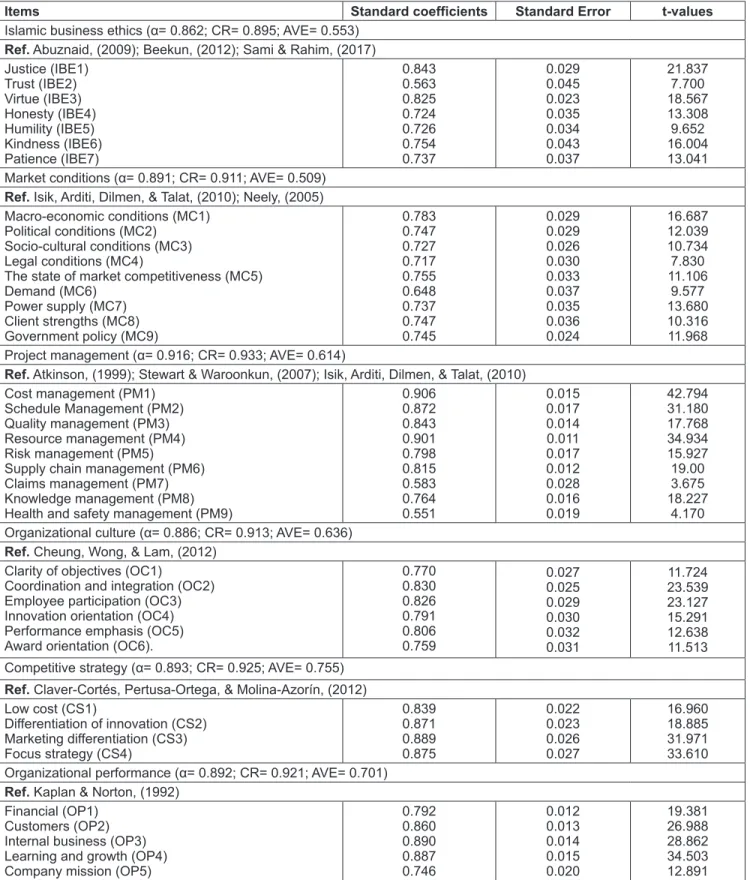
Confirmatory Factor Analysis (CFA) is a statistical technique used to verify the factor structure of a set of observed variables. CFA allows the researcher to test the hypothesis that a relationship between observed variables and their underlying latent constructs exists. CFA will be used in our study to evaluate discriminant validity and convergent. The result of the standard value coefficient test shows values >0.55 in all constructs (Comrey & Lee, 2013) by using a significant t-value of >1.96 (Anderson & Gerbing, 1988) and Standard Errors (SE).
The Average Variant Extracted (AVE) value for each indicator requires that the value be >0.5 for a good model.
The AVE has often been used to assess discriminant validity based on the following “rule of thumb”: if the square root of the AVE of each latent variable is greater than the correlation coefficients between that latent variable and other latent variables in the measurement model, then the model satisfies the discriminant validity criterion.
Discriminant validity in this study fulfills the criterion that all square roots of the AVE score are higher than the correlation between the constructs. Composite Reliability (CR) of each construct is more than 0.6, which is used to test the reliability value of indicators on a variable. Cronbach Alpha (CA) is said to be good if α ≥ 0.5 and it is said to be sufficient if α ≥ 0.3 (Hair et al., 2014), see Table 2.
5.2. Hypothesis Testing
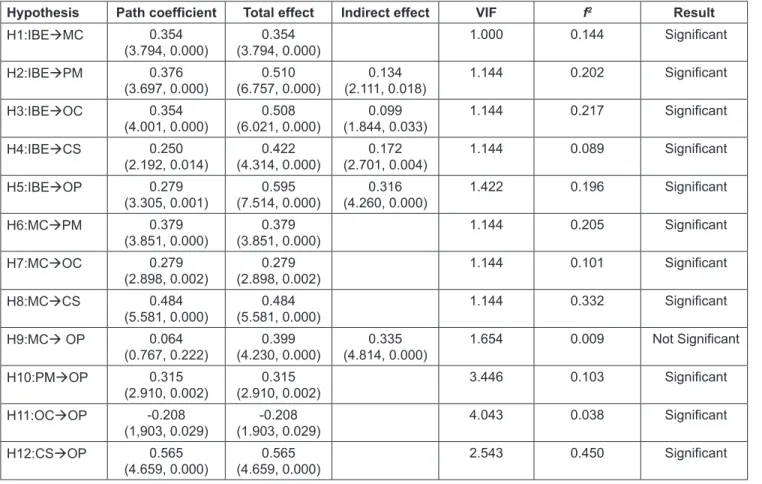
We use the structural model through bootstrap to estimate the results of the path coefficients between constructs, and the significance value, see Table 3.
The structural model aims to assess the coefficient of determination R
2to reflect variations in endogenous constructs. Specifically, the structural model assigns a value of 12.6 percent to the variant market conditions, 38.6 percent for the project management variant, 32.6 percent for the organizational culture variant, 38.3 percent for the competitive strategy variant, and 72.1 for the organizational performance variant. Variance inflation factor (VIF) is a measure of the amount of multicollinearity in a set of
multiple regression variables. In this study, we test the VIF tolerance value of all predictor constructs that have a value of less than 5, ranging from 1,000 to 4,043. This shows that collinearity is not a concern in this study. Multicollinearity is a problem because it undermines the statistical significance of an independent variable. Other things being equal, the larger the standard error of a regression coefficient, the less likely it is that this coefficient will be statistically significant.
Islamic business ethics has a direct significant effect on market conditions (β= 0.354; t= 3.794; p= 0.000), project management (β= 0.376; t= 3.697; p= 0.000), organizational culture (β= 0.354; t= 4.001; p= 0.000), competitive strategy (β= 0.250; t= 2.192; p= 0.014), and organizational performance (β= 0.279; t= 3.305; p= 0.001). Therefore, H1- H5 has a significant effect.
Market conditions have a direct significant effect on project management (β= 0.379; t= 3.851; p= 0.000), organizational culture (β= 0.279; t= 2.898; p= 0.002), competitive strategy (β= 0.484; t= 5.581; p= 0.014), and organizational performance (β= 0.064; t= 0.767; p= 0.222).
Therefore, H6-H8 has a significant effect. However, for H9 it has no significant effect. Meanwhile, the path coefficient of project management with organizational performance is 0.315 with a t value of 2.910 and at a 0.002 significance level. The results show a significant relationship between project management and organizational performance. It can be concluded that H10 has a significant effect.
The path coefficient of organizational culture with organizational performance is -0.208 with a significant t-value of 1.903 at a 0.029 significance level. The results confirm the significant relationship between organizational culture and organizational performance. Hypothesis test results concluded that H11 has a significant effect.
Finally, the path coefficient of competitive strategy with organizational performance is 0.565 with a t-value of 4.659 and at a 0.000 significant level. The results show a significant relationship between competitive strategy and organizational performance. Hypothesis test results concluded that H12 has a significant effect. Since the direct relationship between market conditions and organizational performance (H9) does not have a significant effect, we further examine the indirect effect. The results of this study indicate that market conditions have a significant effect on organizational performance indirectly through project management. The path coefficient shows that it is 0.118 with a t-value of 2.259 and a p-value of 0.012. Therefore, market conditions indirectly affect organizational performance through project management.
Market conditions have an indirect significant effect on organizational performance through competitive strategy.
The path coefficient shows a value of 0.274 with a t value
of 3.635 and 0.000 as the p-value. Therefore, it can be
concluded, market conditions indirectly affect organizational
performance through competitive strategy.
Table 2: Questionnaire Items and Data Validity
Items Standard coefficients Standard Error t-values
Islamic business ethics (α= 0.862; CR= 0.895; AVE= 0.553) Ref. Abuznaid, (2009); Beekun, (2012); Sami & Rahim, (2017) Justice (IBE1)
Trust (IBE2) Virtue (IBE3) Honesty (IBE4) Humility (IBE5) Kindness (IBE6) Patience (IBE7)
0.843 0.563 0.825 0.724 0.726 0.754 0.737
0.029 0.045 0.023 0.035 0.034 0.043 0.037
21.837 7.700 18.567 13.308 9.652 16.004 13.041 Market conditions (α= 0.891; CR= 0.911; AVE= 0.509)
Ref. Isik, Arditi, Dilmen, & Talat, (2010); Neely, (2005) Macro-economic conditions (MC1)
Political conditions (MC2) Socio-cultural conditions (MC3) Legal conditions (MC4)
The state of market competitiveness (MC5) Demand (MC6)
Power supply (MC7) Client strengths (MC8) Government policy (MC9)
0.783 0.747 0.727 0.717 0.755 0.648 0.737 0.747 0.745
0.029 0.029 0.026 0.030 0.033 0.037 0.035 0.036 0.024
16.687 12.039 10.734 7.830 11.106
9.577 13.680 10.316 11.968 Project management (α= 0.916; CR= 0.933; AVE= 0.614)
Ref. Atkinson, (1999); Stewart & Waroonkun, (2007); Isik, Arditi, Dilmen, & Talat, (2010) Cost management (PM1)
Schedule Management (PM2) Quality management (PM3) Resource management (PM4) Risk management (PM5)
Supply chain management (PM6) Claims management (PM7) Knowledge management (PM8) Health and safety management (PM9)
0.906 0.872 0.843 0.901 0.798 0.815 0.583 0.764 0.551
0.015 0.017 0.014 0.011 0.017 0.012 0.028 0.016 0.019
42.794 31.180 17.768 34.934 15.927 19.00 3.675 18.227
4.170 Organizational culture (α= 0.886; CR= 0.913; AVE= 0.636)
Ref. Cheung, Wong, & Lam, (2012) Clarity of objectives (OC1)
Coordination and integration (OC2) Employee participation (OC3) Innovation orientation (OC4) Performance emphasis (OC5) Award orientation (OC6).
0.770 0.830 0.826 0.791 0.806 0.759
0.027 0.025 0.029 0.030 0.032 0.031
11.724 23.539 23.127 15.291 12.638 11.513 Competitive strategy (α= 0.893; CR= 0.925; AVE= 0.755)
Ref. Claver-Cortés, Pertusa-Ortega, & Molina-Azorín, (2012) Low cost (CS1)
Differentiation of innovation (CS2) Marketing differentiation (CS3) Focus strategy (CS4)
0.839 0.871 0.889 0.875
0.022 0.023 0.026 0.027
16.960 18.885 31.971 33.610 Organizational performance (α= 0.892; CR= 0.921; AVE= 0.701)
Ref. Kaplan & Norton, (1992) Financial (OP1)
Customers (OP2) Internal business (OP3) Learning and growth (OP4) Company mission (OP5)
0.792 0.860 0.890 0.887 0.746
0.012 0.013 0.014 0.015 0.020
19.381 26.988 28.862 34.503 12.891
6. Discussion
6.1. Theoretical Implication
Islamic business ethics has a significant direct effect on organizational performance. This implies that the importance of Islamic business ethics in improving organizational performance (Basheer et al., 2019). The significant impact on the relationship between Islamic business ethics and organizational performance has been discussed in several empirical studies (Basheer et al., 2019; Ali & Al-Owaihan, 2008; Abbasi et al., 2012). The view of Islamic ethics in doing business is used as ethical guidelines that must be manifested in a Muslim manager such as being fair, trustworthy, acting with kindness, truth, honesty, patience, and humility. These guidelines set out the Islamic code of conduct related to business life. Therefore, it can be concluded that adopting Islamic business ethics in doing business can improve organizational performance.
Market conditions also do not have a significant direct effect on organizational performance. This confirms that different market conditions have a moderating effect on organizational
performance (Ullah et al., 2020). The findings in this study are reinforced by Pedersen and Sudzina (2012) that there is no clear relationship between environmental uncertainty, market conditions, and organizational performance.
Managing the impact on exogenous environmental factors (in this case market conditions) which have the power to create uncertainty and factors influenced by the environment outside the organization is a key strength to shape the broad characteristics of a construction company so that it can give a boost to the efficiency of organizational performance. Organizational performance management plays a huge role in making sure that the company is able to sustain planned growth. Analysis of organizational performance measures provides a fairly broad mechanism.
Measuring performance is a vital part of monitoring an organization’s progress. It comprises measuring the actual performance outcomes or results of an organization against its intended goals. The strategic plan provides performance targets for the organization; it sets the corporate direction.
This study can provide direction on the importance of the analysis of organizational performance measures from a financial and non-financial perspective.
Table 3: Hypothesis Test
Hypothesis Path coefficient Total effect Indirect effect VIF f2 Result
H1:IBEMC 0.354
(3.794, 0.000) 0.354
(3.794, 0.000) 1.000 0.144 Significant
H2:IBEPM 0.376
(3.697, 0.000) 0.510
(6.757, 0.000) 0.134
(2.111, 0.018) 1.144 0.202 Significant
H3:IBEOC 0.354
(4.001, 0.000) 0.508
(6.021, 0.000) 0.099
(1.844, 0.033) 1.144 0.217 Significant
H4:IBECS 0.250
(2.192, 0.014) 0.422
(4.314, 0.000) 0.172
(2.701, 0.004) 1.144 0.089 Significant
H5:IBEOP 0.279
(3.305, 0.001) 0.595
(7.514, 0.000) 0.316
(4.260, 0.000) 1.422 0.196 Significant
H6:MCPM 0.379
(3.851, 0.000) 0.379
(3.851, 0.000) 1.144 0.205 Significant
H7:MCOC 0.279
(2.898, 0.002) 0.279
(2.898, 0.002) 1.144 0.101 Significant
H8:MCCS 0.484
(5.581, 0.000) 0.484
(5.581, 0.000) 1.144 0.332 Significant
H9:MC OP 0.064
(0.767, 0.222) 0.399
(4.230, 0.000) 0.335
(4.814, 0.000) 1.654 0.009 Not Significant
H10:PMOP 0.315
(2.910, 0.002) 0.315
(2.910, 0.002) 3.446 0.103 Significant
H11:OCOP -0.208
(1,903, 0.029) -0.208
(1.903, 0.029) 4.043 0.038 Significant
H12:CSOP 0.565
(4.659, 0.000) 0.565
(4.659, 0.000) 2.543 0.450 Significant
Project management has a significant effect on organizational performance. According to Pinto and Mantel (1990), good relations between construction management companies to accelerate operations and help achieve better organizational performance. This study assumes that organizational performance is affected by project management (Chan & Chan, 2004; Larsson et al., 2018).
This states that the management structure is an important element in producing project success so that it can have an impact on improving the performance of the construction organization.
Organizational culture is directly significant to organizational performance. This implies organizational culture as a major causal factor in organizational growth and development. A growing interest in workplace spirituality has led to the development of a new paradigm in organizational science. Theoretical assumptions abound as to how workplace spirituality might enhance organizational performance, most postulating a significant positive impact (Jurkiewicz & Giacalone, 2004). Previous empirical studies stated that organizational culture can have a direct effect on organizational performance (Cheung et al., 2012).
This study generally confirms that organizational culture can impact and reduce problems/conflicts that occur so that it can affect organizational performance. Organizational culture as a representation of the internal environment is considered a tool in shaping the characteristics of both attitudes and behavior intentionally by the management of the organization in carrying out activities within the organization.
Organizational culture creates a strong commitment within the organizational environment internally so that it can provide maximum effort in improving organizational performance.
Competitive strategy is directly significant to organizational performance. This is reinforced by a study by Oyewobi et al. (2016) who stated that there is a direct effect of competitive strategy on organizational performance. Lestari et al. (2020) emphasized strategic aspects are something that needs to be applied to position the industry amid competition. This study, in general, provide knowledge about the relationship between competitive strategy and organizational performance. This implies that the information used as decision making in determining the competitive strategy adopted will ultimately have an impact on improving organizational performance.
6.2. Managerial Implication
This research provides insight for decision-makers to apply Islamic business ethics in companies. Islamic business ethics is essential because ethical choices are unavoidable.
The challenge of Islamic business ethics is to make that inevitable ethical decision making explicit to make it better.
Far from being anti-business, ethics provides essential support for maximizing long-term business value (Muhammad et al., 2008). It is hoped that this research can strengthen Islamic behavior and better understand the use of Islamic ethical codes in doing business for managers. According to Astuti et al. (2020), the spiritual value in leadership inspires employees to build an organizational vision that ultimately has an impact on employee performance.
The indirect effect of market conditions through project management and competitive strategy on organizational performance has a significant effect. Market conditions are factors that are beyond management’s control (Isik et al., 2010). So, the spatial competition and the strategies are considerably varied by the contingent context and conditions, a tailored investigation based on the informed judgment should be applied to better understand the situated market. It is expected that the manager’s understanding of market conditions can provide insight in evaluating and minimizing the risk of loss or failure for management and project operations so that analyzing market conditions can create a strategy to compete in the market. These findings, provide a clear message to the management of the organization by monitoring activities on external factors and providing important information related to market changes needed to formulate a competitive strategy with similar companies. Therefore, it is expected that the management will be able to compete and grab market share competitively and healthily.
It is hoped that these findings will encourage managers to use and focus on non-financial indicators, in addition to financial indicators, that have a higher level of complexity.
This is aimed at addressing the quality and performance problems of the construction industry, especially in state- owned Indonesian construction companies. Regulation occurs in Indonesia, with increasing community involvement, social and environmental practices, and commercial disclosure of performance information. This requires managers to focus on large amounts of non-financial information to use as a performance measure.
7. Conclusion and Limitations
The conclusion of this study discusses the influence
of the external environment in state-owned Indonesian
construction companies on organizational performance,
namely: Islamic business ethics and market conditions. As
well as investigating the role of mediation on organizational
performance. In this case, the organizational structure
includes project management, organizational culture, and
competitive strategy. This study bridges the gap between
theory, empirical, and practice in the integration of external
environmental principles and the effects on organizational
performance. The findings support the contingency theory
by revealing the environment-structure-organizational performance relationship.
This study contributes theoretically and practically, although this study still has limitations for future research.
It is hoped that it can also be carried out on the development of more developed instruments that include measures of organizational performance practices outside that was not included in this study, as well as using a larger sample size to reassess the effectiveness associated with the findings of this study.
References
Abbasi, A. S., Rehman, K. U., & Bibi, A. (2011). Islamic work ethics: How it affects business performance. Actual Problems of Economics, 12(Jan), 312. https://ssrn.com/abstract=1992008 Abuznaid, S. A. (2009). Business ethics in Islam: The glaring
gap in practice. International Journal of Islamic and Middle Eastern Finance and Management, 2(4), 278-288. https://doi.
org/10.1108/17538390911006340
Agarwal, N., & Rathod, U. (2006). Defining ‘success’ for software projects: An exploratory revelation. International Journal of Project Management, 24(4), 358–370. https://doi.org/10.1016/j.
ijproman.2005.11.009
Ahmed, M., & Shafiq, S. (2014). The impact of organizational culture on organizational performance: A case study of the telecom sector. Global Journal of Management & Business Research, 14(3), 21–30. https://www.journalofbusiness.org/
index.php/GJMBR/article/view/1254
Alatas, S. F. (2006). Islam and the science of economics. In: I. M.
Abu-Rabi (Ed.), The Blackwell companion to contemporary Islamic thought (pp. 587-606), Singapore: Blackwell Press.
Ali, A. J., & Al-Owaihan, A. (2008). Islamic work ethic: A critical review. Cross-Cultural Management Development, 14(6), 5-19.
http://dx.doi.org/10.1108/13527600810848791
Anderson, J. C., & Gerbing, D. W. (1988). Structural equation modelling in practice: a review and recommended two-step approach. Psychological Bulletin, 103(3), 411-423. https://doi.
org/10.1037/0033-2909.103.3.411
Assaad, R., & El-adaway, I. H. (2020). Enhancing the knowledge of construction business failure: A social network analysis approach. Journal of Construction Engineering and Management, 146(6), 04020052. https://doi.org/10.1061/
(ASCE)CO.1943-7862.0001831
Astuti, S. D., Shodikin., M., & Ud-Din, M. (2020). Islamic leadership, Islamic work culture, and employee performance:
The mediating role of work motivation and job satisfaction.
Journal of Asian Finance, Economics, and Business, 7(11), 1059–1068. https://doi.org/10.13106/jafeb.2020.vol7.
no11.1059.
Aziz, A. (2013). Islamic perspective business ethics: Implementation of Islamic ethics for the business world. Bandung, Indonesia:
Alfabeta Press.
Barreto, I. (2010). Dynamic capabilities: A review of past research and an agenda for the future. Journal of Management, 36(1), 256-280. https://doi.org/10.1177/0149206309350776
Basheer, M. F., Hameed, W., Sabir, S. A., & Jehangir, M. S. (2019).
Islamic Business Ethics And Islamic Banks Performance In Malaysia: Does Sincerity Matter?. Hamdard Islamicus, 42(4), 225-241.
Beekun, R. I. (2012). Character centered leadership: Muhammad (p) as an ethical role model for CEOs. Journal of Management Development, 31(10), 1003-1020. https://doi.
org/10.1108/02621711211281799
Beekun, R. I., & Badawi, J. A. (2005). Balancing ethical responsibility among multiple organizational stakeholders: The Islamic perspective. Journal of Business Ethics, 60(August), 131–145. https://doi.org/10.1007/s10551-004-8204-5
Belout, A., & Gauvreau, C. (2004). Factors influencing project success: The impact of human resource management.
International Journal of Project Management, 22(1), 1–11.
https://doi.org/10.1016/S0263-7863(03)00003-6
Bourne, M., & Neely, A. (2003). Implementing performance measurement systems: A literature review. Business Performance Management, 5(1), 1-24. https://doi.org/10.1504/
IJBPM.2003.002097
Chan, A. P. C., & Chan, A. P. L. (2004). Key performance indicators for measuring construction success. Benchmarking:
An International Journal, 11(2), 203-221. https://doi.
org/10.1108/14635770410532624
Chandler, Jr. A. D. (1962). Strategy and structure: Chapters in the history CF, the industrial enterprise. London, UK: MIT Press.
Cheung, S. O., Wong, P. S. P., & Lam, A. L. (2012). An investigation of the relationship between organizational culture and the performance of construction organizations. Journal of Business Economics and Management, 13(4), 688–704. https://doi.org/1 0.3846/16111699.2011.620157
Chew, D. A. S., Yan, S., & Cheah, C. Y. J. (2008). Core capability and competitive strategy for construction SMEs in China.
Chinese Management Studies, 2(3), 203-214. https://doi.
org/10.1108/17506140810895898
Claver-Cortés, E., Pertusa-Ortega, E. M., & Molina-Azorín, J. F.
(2012). Characteristics of organizational structure relating to hybrid competitive strategy: Implications for performance.
Journal of Business Research, 65(7), 993-1002. https://doi.
org/10.1016/j.jbusres.2011.04.012
Comrey, A. L., & Lee, H. B. (2013). A first course in factor analysis (2nd ed.). New York, NY: Psychology Press.
Ginsberg, A., & Buchholtz, A. (1990). Converting to profit status:
Corporate responsiveness to radical change. Academy of Management Journal, 33(3). https://doi.org/10.5465/256576 Gümüsay, A. A. (2015). Entrepreneurship from an Islamic
perspective. Journal of Business Ethics, 130(May), 199–208.
https://doi.org/10.1007/s10551-014-2223-7
Hair Jr, J. F., Sarstedt, M., Hopkins, L., & Kuppelwieser, V. G.
(2014). Partial least squares structural equation modeling (PLS-SEM): An emerging tool in business research. European Business Review, 26(2), 106-121. https://doi.org/10.1108/EBR- 10-2013-0128
Hambrick, D. C. (1980). Operationalizing the concept of business- level strategy in research. The Academy of Management Review, 5(4), 567-575. https://doi.org/10.2307/257462
Hu, X., & Liu, C. (2018). Measuring efficiency, effectiveness, and overall performance in the Chinese construction industry.
Engineering, Construction, and Architectural Management, 25(6), 780-797. https://doi.org/10.1108/ECAM-06-2016-0131 Isik, Z., Arditi, D., Dilmen, I., & Talat, B. M. (2010). The
role of exogenous factors in the strategic performance of construction companies. Engineering, Construction, and Architectural Management, 17(2), 119-134. https://doi.
org/10.1108/09699981011024650
Jurkiewicz, C. L., & Giacalone, R. A. (2004). A values framework for measuring the impact of workplace spirituality on organizational performance. Journal of Business Ethics, 49(January), 129–142. https://doi.org/10.1023/B:BUSI.0000015843.22195.b9 Larsson, J., Eriksson, P. E., & Pesämaa, O. (2018). The importance
of hard project management and team motivation for construction project performance. International Journal of Managing Projects in Business, 11(2), 275-288. https://doi.
org/10.1108/IJMPB-04-2017-0035
Lee, J., & Miller, D. (1996). Strategy, environment, and performance in two technological contexts: Contingency theory in Korea.
The SAGE Dictionary of Qualitative Management Research, 17(5), 729-750. https://doi.org/10.1177/017084069601700502 Lestari, S. D., Leon, F. M., Widyastuti, S., Brabo, N. A., & Putra, A.
H. P. K. (2020). Antecedents and Consequences of Innovation and Business Strategy on Performance and Competitive Advantage of SMEs. Journal of Asian Finance, Economics, and Business, 7(6), 365–378. https://doi.org/10.13106/jafeb.2020.
vol7.no6.365
Li, S., Ragu-Nathan, B., Ragu-Nathan, T. S., & Rao, S. S.
(2006). The impact of supply chain management practices on competitive advantage and organizational performance.
Omega: The International Journal of Management Science, 34(2), 107-24. https://doi.org/10.1016/j.omega.2004.08.002 Lomax, R. G., & Schumacker, R. E. (2012). A beginner’s guide to
structural equation modeling. New York, NY: Taylor & Francis Press.
Muhammad, M. Z., Ilias, A., Ghazali, M. F., Abdullah, R. C., &
Amin, H. (2008). An analysis of Islamic ethics in Small and Medium Enterprises (SMEs). Unitar E-Journal, 4(1), 46-58.
https://doi.org/10.4197/Islec. 26-2.5
Oyewobi, L. O., Windapo, A. O., Rotimi, J. O. B., & Jimoh, R.
A. (2016). Relationship between competitive strategy and
construction organization performance: The moderating role of organizational characteristics. Management Decision, 54(9), 2340-2366. https://doi.org/10.1108/MD-01-2016-0040 Pedersen., E. R., & Sudzina, F. (2012). Which firms use measures?:
Internal and external factors shaping the adoption of performance measurement systems in Danish firms. International Journal of Operations & Production Management, 32(1), 4-27. https://
doi.org/10.1108/01443571211195718
Pertusa‐Ortega, E. M., Molina‐Azorín, J. F., & Claver‐Cortés, E.
(2010). Competitive strategy, structure, and firm performance:
A comparison of the resource‐based view and the contingency approach. Management Decision, 48(8), 1282-1303. https://
doi.org/10.1108/00251741011076799
Pinto, J. K., & Mantel, S. (1990). The causes of project failure.
IEEE Transactions on Engineering Management, 37(4), 269- 276. https://doi.org/10.1109/17.62322
Salahudin, S. N. B., Baharuddin, S. S. B., Abdullah, M. S., & Osman, A. (2016). The effect of Islamic work ethics on organizational commitment. Procedia Economics and Finance, 35(October), 582–590. http://doi.org/10.1016/S2212-5671(16)00071-X Sami, F. A., & Rahim, A. A. (2017). Ethics and values in the
construction industry from an Islamic perspective. Journal of the Malaysian Institute of Planners, 15(1), 319–326. http://
dx.doi.org/10.21837/pm.v15i1.248
Senam, M. R., Rashid, K. A., Sarkawi, A. A., & Zaini, M. R. (2014).
Construction Project Leadership from the Perspective of Islam.
International Journal of Islamic Thought, 6(1), 46–56.
Stewart, R. A., & Waroonkun, T. (2007). Benchmarking construction technology transfer in Thailand. Construction Innovation, 7(3), 218-239. https://doi.org/10.1108/14714170710754722 Tripp, C. (2006). Islam and the moral economy: The challenge of
capitalism. Cambridge, UK: Cambridge University Press.
Ullah, A., Iqbal, S., & Shams, S. M. R. (2020). Impact of CRM adoption on organizational performance: Moderating role of technological turbulence. Competitiveness Review, 30(1), 59-77. https://doi.org/10.1108/CR-11-2019-0128
Wade, D., & Recardo, R. (2001). Corporate Performance Management: How to Build a Better Organization Through Measurement Driven Strategies Alignment. Boston, MA:
Butterworth Heinemann Press.
Zikmund, W. (1994). Business research methods (5th ed). Sydney, Australia: Dryden Press.
Zulu, S. (2007). Impact of project management on project performance: A structural equation modelling approach. In:
Boyd, D (Ed.), Procs 23rd Annual ARCOM Conference, (pp. 651-660). Belfast, UK: Association of Researchers in Construction Management.