Print ISSN: 2288-4637 / Online ISSN 2288-4645 doi:10.13106/jafeb.2020.vol7.no6.387
1
First Author. Universitas Tridinanti Palembang, Indonesia
2
Corresponding Author. Professor and Head, Doctoral Management Program, Postgraduate Studies, Universitas Muhammadiyah Yogyakarta, Indonesia [Postal Address: Jl. Brawijaya, Tamantirto, Kec. Kasihan, Bantul, Yogyakarta, 55183, Indonesia]
3
Universitas Muhammadiyah Yogyakarta, Indonesia
© Copyright: The Author(s)
This is an Open Access article distributed under the terms of the Creative Commons Attribution
Non-Commercial License (http://Creativecommons.org/licenses/by-nc/4.0/) which permits
unrestricted noncommercial use, distribution, and reproduction in any medium, provided the
original work is properly cited.
Effects of Work Motivation and Leadership toward Work Satisfaction and Employee Performance: Evidence from Indonesia
Irwan PANCASILA
1, Siswoyo HARYONO
2, Beni Agus SULISTYO
3
Received: March 17, 2020 Revised: March 28, 2020 Accepted: May 01, 2020
Abstract
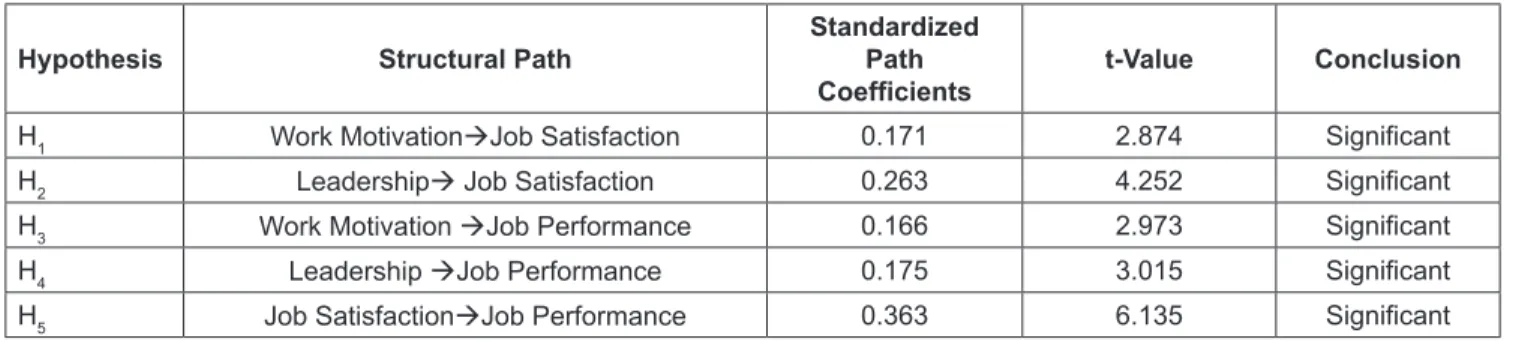
The purpose of this study is to determine the effect of work motivation and leadership on job satisfaction and its implications on employee performance. A total of 355 samples of Bukit Asam Coal Mining Company Ltd. in Indonesia were selected proportionally with random sampling. Data were obtained through questionnaires. Data analysis technique employed structural equation modeling (SEM) with AMOS 22. The results of the study show that leadership and work motivation have a positive and significant effect on job satisfaction. Leadership has a more considerable influence (0.263) than work motivation (0.171) toward employee job satisfaction. The influence of leadership towards job performance is 0.175. The influence of work motivation towards job performance is 0.166. Job satisfaction has the most dominant influence (0.363) towards employee performance. The direct effect of leadership on employee performance is 0.175 greater than the indirect influence of leadership on employee performance through employee job satisfaction, which is only 0.096. Likewise, the direct effect of work motivation towards employee performance is 0.166 greater than the indirect effect of work motivation towards employee performance through employee job satisfaction, which is only 0.062. Thus, job satisfaction does not mediate the effects of leadership and work motivation toward employee performance.
Keywords : Leadership, Work Motivation, Satisfaction, Performance, Indonesia.
JEL Classification Code: D20, D22, D23
1. Introduction
Companies in the industry 4.0 and ree market era are currently facing more severe challenges than previous eras.
The challenge for each company is to prepare themselves to face globalization in order to remain maximally profitable while reducing losses from the global competition through effective and efficient management of resources. Companies must have competitive advantages through resource wealth that is not only tangible and intangible but also unique
(Fo, 2015). Of the many resources, the most valuable resource is human resources. Without adequate human resources, other resources will be idle. Awosusi and Fasanmi (2014) stated that the human factor is the most vital and critical of all organizational resources.
Directorate of Mineral, Mining, and Geothermal Business, Directorate of Mineral (2010) argued Indonesia is one of the largest coal exporting countries in the world, and in 2020 it is predicted that exports will reach 361 million tons. Coal production 15 years ago was only 31 million tons, currently increasing to eight times and in 2010 to 256 million tons.
Indonesia, which previously was an oil exporter country, has now become an oil importer, so coal is increasingly essential to replace oil in the composition of energy use in Indonesia.
Table 1 is a prediction of Total Production, Domestic Needs, and Exports in the year of 2015 to 2025.
The domestic and international coal market conditions
have been very enthusiastic with a high price level. Currently,
there are many companies engaged in coal exploration, so
that the level of competition that must be faced by PT Bukit
Asam becomes increasingly more oppressive. The foremost