• 검색 결과가 없습니다.

Primary Small Cell Carcinoma in Stomach

N/A
N/A
Protected

Academic year: 2021

Share "Primary Small Cell Carcinoma in Stomach"

Copied!
4
0
0

로드 중.... (전체 텍스트 보기)

전체 글

(1)

Primary Small Cell Carcinoma in Stomach

계명의대학술지 제31권 1호 Keimyung Med J Vol. 31, No. 1, June, 2012

Corresponding Author: Seung Tae Kim, M.D., Division of Hematology-Oncology, Department of Medicine, Korea University Anam Hospital, Korea University College of Medicine

126-1 Anam-dong 5-ga, Seongbuk-gu, Seoul 136-705, Korea Tel) +82-2-920-6622 E-mail) [email protected]

Divisions of Hematology-Oncology, Department of Medicine, Korea University Anam Hospital, Korea University College of Medicine, Seoul, Korea

Jung Wan Choe, M.D., Ja Young Ryu, M.D., Seu Hee Yoo, M.D., Lee Sang Yup, M.D., Soon Wook Lee, M.D., Joo Hee Park, M.D., Yeul Hong Kim, M.D., Seung Tae Kim, M.D.

Introduction

Primary small cell carcinoma of the stomach, synonymous with neuroendocrine carcinoma of the stomach, is a rare neoplasm. Although accounting for only 0.1% of all gastric cancers, gastric small cell

carcinoma is extremely aggressive and spreads systemically even at an early clinical stage. The prognosis is poor. Most patients die within 1 year.

There is no consensus regarding treatment regimens including surgery, chemotherapy, radiation therapy, microwave coagulating therapy, and various

Abstract

Small cell carcinoma (SCC) is most commonly found in the lung, but is occasionally found in the gastrointestinal tract. The following case presents the discovery of small cell carcinoma of stomach in a 74 year old man who presented with dyspepsia. An esophagogastroduodenal endoscopic examination revealed an ulcerofungating tumor over the lesser curvature of the stomach. Computed tomography showed enhanced wall thickening of the less curvature, stomach with suspicious metastatic lymph nodes and organs. Histological examination confirmed primary small cell carcinoma of the stomach. The patient was treated with chemotherapy consisting of cisplatin 80 mg/m

2

on day 1 combined with etoposide 80 mg/m

2

on days 1-3.

After one cycle of the chemotherapy, his hospital course was complicated by a hospital acquired pneumonia.

He subsequently died on day 24 of hospitalization. We report a patient with gastric pure small cell carcinoma who tried the chemotherapy, as a rare case in Korea.

Key Words : Small cell carcinoma, Stomach

(2)

110 계명의대학술지 제31권 1호 2012

combinations of the above [1]. Gastric small cell carcinoma is based on histologic specimens. We describe a very rare case of primary pure small cell carcinoma originated from the stomach in Korea.

Case Report

In May 2011, a 74-year-old man presented with a 2-month history of intermittent epigastric pain &

dyspepsia. He had neither a relevant past history nor a contributory family history. Physical examination was not remarkable. On admission labs including carcinoembryonic antigen (CEA) were within the normal range. Endoscopic examination revealed an ulcerofungating mass on high body, lesser curvature side of stomach (Fig. 1).

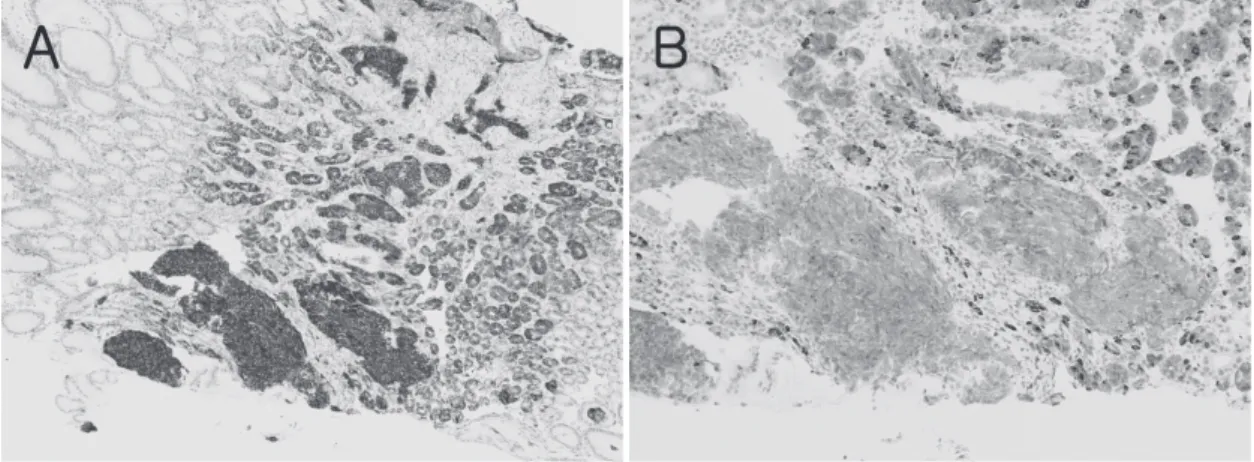
Histological examination of endoscopic biopsies of the gastric mass revealed an infiltrating neoplasm composed of round cells with scant cytoplasm (Fig.

2). The cells were negative for lymphocyte common surface antigens such as leukocyte common antigen (LCA), chromogranin, while being positive for synaptophysin, CK, CD56. Computed Tomographic (CT) scan of the abdomen exhibited thickening of the stomach wall at high body lesser curvature, metastatic lymph nodes (Left paraaortic, aortocaval

area, neck), liver, adrenal grand, pancreas uncinate process metastasis and carcinomatosis peritonei (Fig. 3,4). But simultaneously performed chest CT showed no neoplastic mass or metastatic lesions in lung, which is the most common site of SCC. The p at i en t r ec ei v ed 1 cy c le of c om b in at i on chemotherapy consisting of cisplatin 75 mg/m

2

on day 1 combined with etoposide 100 mg/m

2

on days 1-3. After the first chemotherapy, hospital course was complicated by episodes of hospital acquired pneumonia, increasing lethargy, and change in mental status. The patient subsequently died on day 24 of hospitalization

Discussion

Primary gastric SCC, first reported in 1976, is extremely rare and accounts for only 0.1% of all gastric carcinoma [2]. Even in all gastrointestinal SCC, gastric SCC represents only 11%. To the best of our knowledge, 213 cases of primary small cell carcinoma of the stomach have been reported in the literature (168 males, 44 females, 1unspecified) [3,4]. The majority of gastric small cell carcinoma (GSCC) cases have been reported from Japan. Our patient with GSCC is one of the few reported cases in the literature outside of Japan. GSCC predominantly occurs in males in their mid sixties.

Presenting symptoms are often identical to gastric

adenocarcinoma. Patients present with epigastric

pain, nausea, anorexia, early satiety, and weight

loss. Based on the largest reviews of histologically

proven GSCC by Namikawa et al . (107 patients) and

Tanemura et al . (67 patients), these tumors usually

occur in the upper-third of the stomach [5]. The

average tumor size varies from 0.8 to 17 cm. The

mass can be polypoid or ulcerating depending upon

its size. Since GSCC tumor incidence is low, no

proper classification for tumor staging or grading

Fig. 1. Endoscopic view of the less curvature mass.

(3)

111 Primary Small Cell Carcinoma in Stomach

has been assigned. Gastric small cell carcinoma is classified as either a pure type tumor or a composite-type tumor admixing adenocarcinomatous and/or squamous differentiation. Although many theories have been postulated, the origin of SCC remains unclear. SCC is thought to originate from preexisting neuroectodermal cells, pluripotent epithelial stem cells, or adenocarcinoma precursor cells [5]. The diagnosis is made by histologic review of endoscopic or surgical biopsy specimen. The histological features of GSCC are similar to those of

pulmonary SCC, demonstrating very scanty cytoplasm, small-sized oval nuclei, and multiple m i t o t i c f i g u r e s . H i s t o l o g y a s w e l l a s immunohistochemistry are considered to be the hallmark of pathological diagnosis. Neuron-specific enolase, chromogranin and grimelius staining are used for immunohistochemical diagnosis. CEA staining can be used to rule out adenocarcinoma [6].

CD56 markers can also be used to differentiate between small cell carcinoma and large cell carcinoma [5]. Prognosis is universally dismal.

Fig. 3. Mass at the high body lesser curvature with

perigastric infiltration (arrow). Fig. 4. About 2.0 cm sized left adrenal gland metastasis (arrow) and hepatic metastasis with peripheral enhancement (arrow head).

Fig. 2. Neoplastic cells with scanty cytoplasm and finely granular nucleus show strong positivity for CD56 (A),

Synaptophysin (B) stain.

(4)

112 계명의대학술지 제31권 1호 2012

Without treatment, even localized disease rapidly overtakes patients with median survival measuring weeks with no long-term survivors. Patients with more extensive disease have a more dismal prognosis. As the SCC is a kind of poorly differentiated neuroendocrine tumors (NETs), proliferative rate can be assessed as the number of mitosis per unit area of tumor or as the percentage of neoplastic cells immunolabeling for the proliferation marker Ki67. The standard treatment for gastric SCC has not been established.

Chemotherapy is the first line of treatment for extra- pulmonary SCC, with surgical interventions being limited to cases in which palliative care is the goal.

Gastric SCC has been treated with regimens concocted for other more common NETs like esophageal small cell carcinoma and Small cell lung cancer (SCLC)[7]. Several trials and meta-analyses have shown improved survival with combined chemotherapy and radiotherapy in SCLC and actually there have been reports of complete clinical remission with SCLC chemotherapeutic regimens [1]. But the treatment outcome of our case was very poor. The tumor progressed rapidly with the worst outcome. Pathology reports showed that expression of Ki-67 in the tumor was extremely high (more than 60 labeled nuclei/x200 power field). As Ki-67 index is an indicator progression of NETs, we expected the limited gains of the chemotherapy.

Therefore, it is considered necessary to assess the biological behavior of the tumor at initially appropriate treatment for patients. Currently, no randomized controlled trials have been undertaken to determine the most effective treatment for SCGC because it is too rare and aggressive a tumor to get adequate numbers for a quality randomized

controlled trial. Further studies need to be performed providing guidelines for the evaluation and management of these uncommon malignancies.

References

1. Richards D, Davis D, Yan P, Guha S. Unusual case of small cell gastric carcinoma: case report and literature review. Dig Dis Sci 2011;56:951-7.

2. Kuo SC, Chao Y, Luo JC, Lee KC, Wu CW, Li AF, et al. Primary small cell carcinoma of the stomach successfully treated with cisplatin and etoposide. J Chin Med Assoc 2009;72:598-602.

3. Iwamuro M, Tanaka S, Bessho A, Takahashi H, Ohta T, Takada R, et al. Two cases of primary small cell carcinoma of the stomach. Acta Med Okayama 2009;63:293-8.

4. Tanemura H, Ohshita H, Kanno A, Kusakabe M, Tomita E, Nishigaki Y, et al. A patient with small-cell carcinoma of the stomach with long survival after percutaneous microwave coagulating therapy (PMCT) for liver metastasis. Int J Clin Oncol 2002;7:128-32.

5. Moise D, Singh J, Dahl K, Rashid S, Prasad A, Siddiqui G, et al. Extrapulmonary Small Cell Carcinoma of the Stomach: A Lethal Entity. Case Rep Gastroenterol 2010;4:298-303.

6. Namikawa T, Kobayashi M, Okabayashi T, Ozaki S, Nakamura S, Yamashita K, et al. Primary gastric small cell carcinoma: report of a case and review of the literature. Med Mol Morphol 2005;38:256-61.

7. O'Byrne KJ, Cherukuri AK, Khan MI, Farrell RJ, Daly

PA, Sweeney EC, et al. Extrapulmonary small cell

gastric carcinoma. A case report and review of the

literature. Acta Oncol 1997;36:78-80.

수치

Fig. 3.  Mass at the high body lesser curvature with

참조

관련 문서

Concentration-Dependent inhibition of cell viability by adenosine in human oral fibroblast and FaDu human head and neck squamous cell carcinoma · · ·

It also suggest that cell proliferation inhibits by a novel signal transduction for adenosine effect in human FaDu hypopharynx squamous cell carcinoma cells....

Differential Expression of Desmoglein1, Desmoglein3, Epithelial Membrane Antigen, Ber-EP4 and CD10 in Basal Cell Carcinoma and Squamous Cell Carcinoma

Objective: The purpose of this study was to analyze recent trend in incidence of basal cell carcinoma and squamous cell carcinoma in patients from the Gwangju City

편평상피세포암(squamous cell carcinoma), 선암(adenocarcinoma) 그리고 대세 포암(large cell carcinoma)으로 나뉘고 그에 따라 치료제가 조금씩

a prospective analysis of 50 cases. Preoperative staging of non-small-cell lung cancer with positron-emission tomography. Staging of non- small-cell lung cancer

현재 간암(Hepatocellular carcinoma) 1차치료제, 대장암(Colorectal cancer) 3차 치료제, 위암(Gastric cancer) 2차 치료제, 선양낭성암(Adenoid cystic

Patients with breast cancer; ovarian cancer; renal cell carcinoma; pancreatic neuroendocrine cancer; colorectal cancer; head and neck cancer; non-small cell lung