Printed in the Republic of Korea
http://dx.doi.org/10.5012/jkcs.2013.57.4.455
Synthesis and Biological Evaluation of 2-Amino-4 H-pyran-3,4,5-tricarboxylate Salt Derivatives
Ali Akbari*, Zabihollah Azami-Sardooei†, and Asghar Hosseini-Nia‡
Department of Chemistry, Faculty of Science, University of Jiroft, Jiroft, P.O. Box 8767161167, Iran
*E-mail: [email protected]
†Department of Corp Protection, Faculty of Agriculture, University of Jiroft, Jiroft, P.O.Box 8767161167, Iran
‡Department of Plant Protection National Research Station of Ornamental Plants, Mahallat, P.O.Box 37815-137, Iran (Received March 13, 2013; Accepted June 2, 2013)
ABSTRACT. A novel and simple method for the synthesis of 2-amino-4H-pyran-3,4,5-tricarboxylate derivative and the eval- uation of their antibacterial activity against Pseudomonas syringae, Xanthomonas citi and Pectobacterium carotovorum are reported. The structure of the isolated compounds has been determined by means of 1H/13C NMR and FT-IR Spectroscopy.
The reaction of alkyl isocyanides with acetylenic esters in the presence of dimethyl acetone-1,3-dicarboxylate in the present of BF3.SiO2 at ambient temperature. Some of the compound showed significant inhibition to growth of bacteria.
Key words: Biological evaluation, Antibacterial activity, 4H-Pyran-3,4,5-tricarboxylate, BF3.SiO2
INTRODUCTION
Homogeneous acidic catalysts such as H2SO4, HCl and BF3 are commonly used for organic synthesis. However, the above-mentioned catalysts have several disadvantages because they are corrosive, toxic or volatile, and generate large amounts of waste. Silica supported boron trifluo- ride, BF3.SiO2, which is easy to prepare and shows unusu- ally high Brønsted acidity which can be controlled by activation temperature, and exhibits considerable cata- lytic activity1 enables better accessibility of the reactants to the active sites. BF3.SiO2 is a solid super acid and has surface species such as Al–OBF2 and Si–OBF2, and the ion pairs, Al–OBF3––H+ or Si–OBF3––H+.2 The BF3.SiO2 is used in several organic transformations, such as in Claisen-Schmidt condensations,3 in synthesis of 14-aryl or alkyl-14H-dibenzo[a,j]xanthenes,4 1,2,4,5-tetrasubsti- tuted imidazoles,5 in the polymerization of styrene,6 the preparation of polyfunctionalized piperidin-4-ones,7α-amino phosphonates,8 quinoxalines,9 and 3,4-dihydropyrimidin- 2(1H)-ones.10
4H-pyranes have recently attracted much attention as an important class of heterocyclic having useful biological and pharmacological properties, such as cytotoxic (antican- cer),11−13 neuroprotective,14 HIV-inhibitory,15 antimicro- bial,16, 17 antifungal,18 and antioxidant activity.19 Recently, one methods has been reported for the synthesis of pyran derivatives via a three-component condensation of alky- lisocyanides with acetylenic esters and 1,3-diketones to
synthesis of 2-amino-4H-pyran-3,4,5-tricarboxylate deriva- tives.20 We reported the synthesis of fused 2-amino-4H- pyrane derivatives from the reaction of alkylisocyanides with acetylenic esters and 1,3-diketones, in the presence of BF3.SiO2 in H2O at room temperature. synthetic meth- odology for the synthesis of 4H-pyran as a part of green chemistry approach. H2O is a naturally occurring, cheap, and non-toxic ecofriendly solvent. And biological eval- uation antibacterial activity against Pseudomonas syrin- gae, Xanthomonas citi and Pectobacterium carotovorum with improved in vitro therapeutic index. These hetero- cycles then screened for their antibacterial activity against X. campestris pvs, P. syringae and P. carotovorum using Tetracyclin as standard antibiotic. Interestingly some of the compounds revealed better activity.
Pectobacterium carotovorum is a bacterium of the family Enterobacteriaceae; it formerly was a member of the genus Erwinia. The species is a plant pathogen with a diverse host range, including potato, African violet, and other agricul- turally and scientifically important plant species. It causes soft rot and blackleg of potato and vegetables, as well as slime flux on many different tree species.21,22
Xanthomonas can infect a wide variety of species includ- ing pepper, rice, citrus, cotton, tomato, broccoli, cabbage, and soybeans. Some types of Xanthomonas cause local- ized leaf spot or leaf streak while others spread system- ically and cause black rot or leaf blight disease.23,24
Pseudomonas syringae is responsible for causing dis- eases on over 180 plant species including fruit trees, veg-
etable crops and flowers. Pathovars of main economic importance in Europe are the pvs syringae, morsprunorum, avii and persicae, causing bacterial canker on sweet and sour cherry, plum, peach and apricot as well as in wild cherry.25,26
Acetylenic esters, alkyl isocyanides, dimethyl acetone- 1,3-dicarboxylate and other chemicals were purchased from Fluka and Merck companies. Products were char- acterized by IR, 1H-NMR and by comparison of their physical properties with those reported in the literature. IR spectra were run on a Bruker, Eqinox 55 spectrometer. 1H- NMR, and 13C-NMR spectra were obtained using a Bruker Avans 400 MHz spectrometer (DRX). Melting points were determined by a Buchi melting point B-540 B. V. CHI apparatus. The elemental analyser was done by Costech ECS 4010 CHNS-O analyser.
EXPERIMENTAL
Preparation of BF3.SiO2
0.37 g of BF3 (0.7 ml of BF3.Et2O) was added drop wise to a mixture of 0.63 g of silicagel and 5 ml of chloroform. The mixture was stirred for 1 h at room temperature. The resulted suspension was filtered. The obtained solid was washed with chloroform and dried at room temperature for 6 h.
General Procedure for the Synthesis of 2-Amino-4H- pyran-3,4,5-tricarboxylate Derivative
A mixture of dimethyl acetone-1,3-dicarboxylate (10 mmol, 1.82 ml) and dimethyl or diethyl acetylene dicar- boxylate (10 mmol) and BF3.SiO2 (0.32 g, 25 mol %) in 50 ml H2O, was added, drop wise at 0oC over 10 min iso- cyanide derivatives (10 mmol). The reaction mixture was then allowed to warm up to room temperature and stand for 6 h. After completion of the reaction, the mixture was extracted once with 50 ml toluene, made strongly alkaline with 25% aq. NaOH and then extracted with 2×50 ml tol- uene. The combined alkaline extracts was dried over MgSO4 and the solvent removed by distillation in a rotovap. All the products were characterized by Melting points, Ele- mental analyses C, H, and N, IR , 1H-NMR and 13C-NMR.
The residual compounds were dissolved in 10 ml EtOAc and 5N HCl/iso-propanol was added in portions until pH 5 was reached. Several times the acid addition had to be stopped and the formed crystals removed by filtration.
The salt was then recrystallised in iso-propanol.
Trimetyl 2-(tert-butylamino)-6-(2-methoxy-2-oxoethyl)- 4H-pyran-3,4,5-tricarboxylate:
Yellow oil, yield Solt 3.18 g, 73%, IR (KBr) (υmax/cm−1):
3456, 1744, 1737, 1721, 1683. 1H-NMR (400 MHz, CDCl3):
δ=1.34 (9H, s), 3.64 (3H, s), 3.69 (3H, s), 3.70 (3H, s), 3.75 (3H, s), 3.85 (2H, s), 4.55 (1H, s), 8.57 (1H, s).
13C-NMR (100 MHz, CDCl3): δ=30.34, 37.68, 37.70, 51.02, 52.17, 52.37, 52.56, 52.38, 72.28, 108.44, 154.48, 160.20, 165.94, 168.56, 169.38, 173.21. Anal calcd for C18H25NO9 (399.4): C, 54.13; H, 6.31; N, 3.51; Found: C, 54.1; H, 6.3; N, 3.5.
Trimetyl 2-(cyclohexylamino)-6-(2-methoxy-2-oxoet- hyl-4H-pyran-3,4,5-tricarboxylate:
White powder mp=116−118oC, yield Solt 3.23 g 67%, IR (KBr) (υmax/cm−1): 3504, 1744, 1730, 1724, 1686. 1H- NMR (400 MHz, CDCl3): δ=1.25−2.38 (10H, m), 3.66 (3H, s), 3.75 (3H, s), 3.77 (3H, s), 3.80 (3H, s), 3.94 (2H, s), 4.17 (1H, m), 4.54 (1H, s), 8.39 (1H, br). 13C-NMR (100 MHz, CDCl3): δ=24.42, 25.37, 29.65, 33.30, 33.70, 37.48, 37.87, 48.64, 49.98, 50.93, 52.13, 52.31, 71.68, 108.53, 154.75, 156.91, 159.05, 168.59, 169.21, 173.21. Anal calcd for C20H27NO9 (425.4): C, 56.47; H, 6.40; N, 3.29;
Found: C, 56.5; H, 6.4; N, 3.3.
Trimethyl 2-methoxycarbonylmethyl-6-(4-methoxy- phenylamino)-4H-pyran-3,4,5-tricarboxylate:
Yellow crystal, mp=188−189oC, yield Solt 3.10 g, 69%, IR (KBr) (υmax/cm−1): 3455, 3012, 1744, 1737, 1728, 1683, 1672, 1612, 1511, 1452, 1253, 1050. 1H-NMR (400 MHz, CDCl3): δ=3.62 (3H, s), 3.67 (s, 3 H), 3.69 (3H, s), 3.70 (3H, s), 3.73 (3H, s), 3.85 (2H, s), 4.55 (1H, s), 7.18 (d, J=8.6 Hz, 2H), 7.28 (d, J=8.6 Hz, 2H), 8.52 (1H, s). 13C- NMR (100 MHz, CDCl3): δ=30.31, 36.98, 37.30, 50.96, 51.52, 52.31, 52.48, 72.28, 108.44, 120.82, 132.76, 144.25, 145.22, 154.48, 160.20, 165.94, 168.56, 169.38, 173.21.
Anal calcd for C21H23NO10 (449.4): C, 56.12; H, 5.16; N, 3.12; Found: C, 56.1; H, 5.2; N, 3.1.
3,4-Diethyl 5-methyl 2-(tert-butylamino)-6-(2-meth- oxy-2-oxoethyl)-4H-pyran-3,4,5-tricarboxylate:
Yellow oil, yield Solt 3.33 g 72%, IR (KBr) (υmax/cm−1):
3455, 1744, 1738, 1734, 1638. 1H-NMR (400 MHz, CDCl3):
δ=1.24 (3H, t, J=8 Hz), 1.31 (3H, t, J=8 Hz), 1.38 (9H, s), 3.74 (3H, s), 3.80 (3H, s), 3.98 (2H, s), 4.08−4.25 (4H, m), 4.56 (1H, s), 8.62 (1H, br). 13C-NMR (100 MHz, CDCl3):
δ=14.10, 14.75, 30.34, 37.68, 37.89, 52.02, 52.31, 52.44, 59.84, 60.47, 72.47, 108.47, 154.19, 160.06, 166.89, 168.02, 169.57, 172.08. Anal calcd for C20H29NO9 (427.5): C, 56.20; H, 6.84; N, 3.28; Found: C, 56.20; H, 6.8; N, 3.3.
3,4-Diethyl 5-methyl 2-(cyclohexylamino)-6-(2-meth- oxy-2-oxoethyl)-4H-pyran-3,4,5-tricarboxylate:
Yellow oil, yield Solt 3.38 g 69%, IR (KBr) (υmax/cm−1):
3456, 1744, 1740, 1735, 1721. 1H-NMR (400 MHz, CDCl3):
δ=1.24 (3H, t, J=8 Hz), 1.30 (3H, t, J=8 Hz), 1.53−1.95
(10H, m), 3.74 (3H, s), 3.79 (3H, s), 3.90 (2H, s), 4.03− 4.31 (5H, m), 4.55 (1H, s), 8.42 (1H, br). 13C-NMR (100 MHz, CDCl3): δ=14.12, 14.60, 22.37, 24.36, 24.37, 33.28, 33.71, 37.50, 37.93, 49.90, 52.06, 52.30, 59.36, 60.87, 71.73, 108.46, 154.53, 158.85, 166.08, 168.68, 169.00, 172.99. calcd for C22H31NO9 (453.5): C, 58.27; H, 6.89;
N, 3.09; Found: C, 58.3; H, 6.9; N, 3.1.
4,5-Diethyl 3-methyl 2-(methoxycarbonylmethyl)-6-(4- methoxy-phenylamino)-4H-pyran-3,4,5-tricarboxylate:
Yellow crystal, mp=173−175oC, yield Solt 3.44 g, 72%, IR (KBr) (υmax/cm−1): 3455, 3011, 1743, 1736, 1728, 1682, 1672, 1612, 1511, 1452, 1253, 1050. 1H-NMR (400 MHz, CDCl3): δ=1.22 (3H, t, J=8 Hz), 1.30 (3H, t, J=8 Hz), 3.64 (3H, s), 3.67 (3 H, s), 3.70 (3H, s), 3.85 (2H, s), 4.10−4.25 (4H, m), 4.55 (1H, s), 7.15 (d, J=8.6 Hz, 2 H), 7.27 (d, J =8.6 Hz, 2H), 8.57 (1H, s). 13C-NMR (100 MHz, CDCl3): δ=14.21, 14.63, δ=30.34, 37.70, 38.42, 53.18, 51.76, 52.51, 52.38, 71.63, 108.31, 120.69, 132.64, 144.16, 145.01, 154.13, 160.16, 165.88, 168.50, 169.29, 173.08.
Anal calcd for C23H27NO10 (477.5): C, 57.86; H, 5.70; N, 2.93; Found: C, 58.0; H, 5.7; N, 2.9.
3,4-Di (tert-butyl) 5-methyl 2-(tert-butylamino)-6-(2- methoxy-2-oxoethyl)-4H-pyran-3,4,5-tricarboxylate:
Colourless crystal, mp=103−105oC, yield Solt 3.90 g 75%, IR (KBr) (υmax/cm−1): 3456, 1754, 1730, 1728, 1720. 1H-NMR (400 MHz, CDCl3): δ=1.40 (9H, s), 1.43 (9H, s), 1.53 (9H, s), 3.76 (3H, s), 3.81 (3H, s),3.89 (2H, s), 4.38 (1H, s), 8.55 (1H, br). 13C-NMR (100 MHz, CDCl3): δ=27.99, 28.54, 30.45, 37.70, 39.45, 51.92, 52.22, 52.32, 73.90, 79.31, 80.45, 108.78, 153.45, 159.71, 166.51, 166.75, 168.76, 172.24.
Anal calcd for C24H37NO9 (483.6): C, 59.61; H, 7.71; N, 2.90; Found: C, 59.6; H, 7.7; N, 2.9.
3,4-Di (tert-butyl) 5-methyl 2-(cyclohexylamino)-6-(2- methoxy-2-oxoethyl)-4H-pyran-3,4,5-tricarboxylate:
Yellow oil, yield Solt 3.82 g 70%, IR (KBr) (υmax/cm−1):
3488, 1747, 1740, 1728, 1686. 1H-NMR (400 MHz, CDCl3): δ=1.25−1.93 (10H, m), 1.42 (9H, s), 1.50 (9H, s), 3.72(3H, s), 3.77 (3H, s), 3.86 (2H, s), 4.10 (1H, s), 4.35 (1H, s), 8.27 (1H, br). 13C-NMR (100 MHz, CDCl3): δ=27.96, 28.52, 24.62, 24.73, 25.42, 33.46, 33.93, 37.47, 39.46, 50.04, 51.88, 52.26, 73.16, 79.17, 80.45, 108.81, 153.73, 158.54, 166.44, 168.61, 168.80, 172.36. Anal calcd for C26H39NO9 (509.6): C, 61.28; H, 7.71; N, 2.75; Found: C, 61.3; H, 7.7; N, 2.8.
4,5-Di-tert-butyl 3-methyl 2-(methoxycarbonyl methyl)- 6-(4-methoxy-phenylamino)-4H-pyran-3,4,5-tricarboxylyte:
Yellow crystal, mp=162−163oC, yield Solt 3.41 g, 64%, IR (KBr) (υmax/cm−1): 3458, 3008, 1743, 1737, 1727, 1683, 1672, 1612, 1511, 1452, 1253, 1050. 1H-NMR (400 MHz,
CDCl3): δ=1.40 (9H, s), 1.43 (9H, s), 3.69 (3H, s), 3.70 (3H, s), 3.75 (3H, s), 3.83 (2H, s), 4.52 (1H, s), 7.10 (d, J=8.6 Hz, 2 H), 7.22 (d, J=8.6 Hz, 2H), 8.59 (1H, s). 13C-NMR (100 MHz, CDCl3): δ=28.07, 28.61, 30.42, 37.02, 39.12, 51.17, 52.07, 52.26, 52.38, 73.38, 108.44, 120.82, 132.76, 144.25, 145.22, 154.48, 160.20, 165.94, 168.56, 169.38, 173.21. Anal calcd for C27H35NO10 (533.57): C, 60.78; H, 6.61; N, 2.63;
Found: C, 60.8; H, 6.6; N, 2.6.
Preparation of Plates and Microbiological Assays Inoculation of test bacteria (X. campestris pvs, P. syrin- gae and P. carotovorum) was prepared by inoculating a loopful of organism in a 10 ml nutrient broth and incu- bated at 37oC for 24 h each till a moderate turbidity was developed. 0.10 ml of this suspension was thoroughly mixed with 25 ml of nutrient agar medium in each. Pre- sterilized Petri plates and was set aside. After the cooling, the seeded agar plate was used for testing compounds by disc diffusion method. The sterilized paper discs were dipped in each compound solution. These discs were placed in the plates at equidistant. The central disc without any com- pound was taken as control. The petri plates then incu- bated at 37oC for 24 h. After the recommended period, zones of inhibition were measured. After solidification of medium, 0.10 ml of spore suspension was spread by ster- ilized spreader in a specific zone. The compounds were dissolved in DMSO solvent in 200 ppm concentration.
The paper discs were dipped in each compound solution for 5 min. Then these paper discs were placed equidistant in the plates. The central disc was dipped in DMSO sol- vent without compound was used as control. These Petri plates were kept for incubation period at 28oC for 3 days.
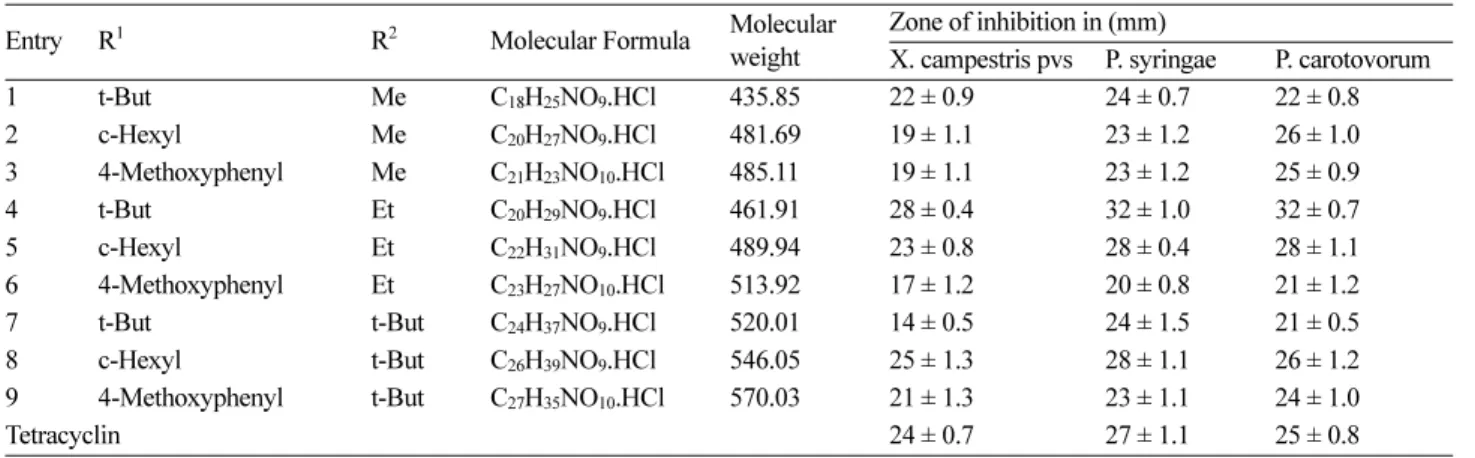
After the completion of recommended period, the zones of inhibition were measured (Table 3).
RESULTS AND DISCUSSION
In continuation, we have investigated the synthesis of 2- amino-4H-pyran-3,4,5-tricarboxylate derivatives in the pres- ence of BF3.SiO2 via condensation of alkylisocyanides with actylenic esters and dimethyl acetone-1,3-dicarbox- ylate affords highly functionalized compound (Scheme 2).
Herein, we report that BF3.SiO2 is an efficient catalyst for the synthesis of 2-amino-4H-pyran-3,4,5-tricarboxylate derivatives. The reaction of Diethyl 1,3-acetonedicarbox- ylate (10 mmol, 1.50 ml) with diethyl acetylene dicarboxylate (10 mmol, 1.67 ml) and 4-methoxyphenyl isocyanide (10 mmol, 1.33 g) was investigated for optimization of the reaction conditions (Scheme 1 and Table 1). The reaction
revealed that the best conditions were in H2O at room tem- perature.
Dimethyl acetone-1,3-dicarboxylate with dimethyl or diethyl acetylene dicarboxylate and various isocyanide were used as substrates for the synthesis of 2-amino-4H-pyran- 3,4,5-tricarboxylate derivatives derivatives in H2O at room temperature (Scheme 2 and Table 2).
We have synthesized a novel class 2-amino-4H-pyran derivative as potential antibacterial agents. In vitro anti- bacterial assay was performed against X. campestris pvs, P. syringae and P. carotovorum by using the disc diffusion method.27,28 The results obtained as zone of inhibition (mm) are presented in Table 3. Tetracycline was used as standard drugs for the assay. The concentration used for the test com- Scheme 1.
Table 1. Synthesis of 4,5-diethyl 3-methyl 2-(methoxycarbonylmethyl)-6-(4-methoxy-phenylamino)-4H-pyran-3,4,5-tricarboxylate
Entry Catalyst (mol %) Solvent Conditions Time (h) Yielda %
1 BF3.SiO2 (25) Chloroform r.t. 6 61
2 BF3.SiO2 (25) Ethanol r.t. 6 38
3 BF3.SiO2 (25) Water r.t. 3 46
3 BF3.SiO2 (25) Water 50°C 6 scarce
3 BF3.SiO2 (25) Water r.t. 6 64
4 BF3.SiO2 (25) Solvent-free r.t. 6 50
aIsolated yield
Scheme 2.
Table 2. Synthesis of 2-amino-3-cyano-1,4,5,6-tetrahydropyrano[3,2-c]quinolin-5-one derivativesa via Scheme 2
Entry R1b R2 Time (h) Yieldc % Mp (°C) [Rep]
1 t-But Me 6 73 Oil [Oil]20
2 c-Hexyl Me 6 67 116−118 [116–118]20
3 4-Methoxyphenyl Me 6 69 188−189
4 t-But Et 6 72 Oil[Oil]20
5 c-Hexyl Et 6 69 Oil
6 4-Methoxyphenyl Et 6 72 173−175
7 t-But t-But 6 75 103−105 [103–105]20
8 c-Hexyl t-But 6 70 Oil [Oil]20
9 4-Methoxyphenyl t-But 6 69 162−163
aThe dimethyl acetone-1,3-dicarboxylate (10 mmol, 1.82 ml) and acetylene dicarboxylate (10 mmol) in the presence of (0.32 g) of freshly prepared 37% BF3.SiO2 in H2O at room temperature.
bAll the products were characterized by IR and 1H-NMR.
cIsolated yield.
pounds and that of the standard drugs remains the same. It is observed from Table 1 that 2-amino-4H-pyran-3,4,5-tri- carboxylate derivative have exhibited moderate activity.
When 2-amino-4H-pyran-3,4,5-tricarboxylate derivatives were salt compound, there are high enhancement in the activity and solubility in water. Further, these function- alities were substituted with various groups like 3,4,5-tri- carboxylate and 2-methoxy-2-oxoethyl since in the earlier studies it has been shown that the presence of one or more of the aforesaid would lead to the improvement of the activity.
CONCLUSION
In conclusion, the reactions of alkyl isocyanides with electron deficient acetylenic esters in the presence of dim- ethyl acetone-1,3-dicarboxylate provides a simple one- pot entry in to the synthesis of poly functional 4H-pyran derivatives of potential synthetic interest. All synthesized compounds have shown good activity against the patho- genic bacteria.
Acknowledgments. Financial support for this work by the Research Council of University of Jiroft is gratefully acknowledged. And the publication cost of this paper was supported by the Korean Chemical Society.
REFERENCES
1. Wilson, K.; Clark, J. H. Synthesis of a Novel Supported Solid Acid BF3 Catalyst. Chem. Commun. 1998, 2135.
2. Klapotke, T. M.; Mc Monagle, F.; Spence, R. R.; Winfield, J. M. γ-Alumina-Supported Boron Trifluoride: Catalysis, Radiotracer Studies and Computations. J. Fluorine. Chem.
2006, 127, 1446.
3. Sadegi, B.; Mirjalili, B. F.; Hashemi, M. M. BF3·SiO2: An
Efficient Reagent System for the One-Pot Synthesis of 1,2,4,5- Tetrasubstituted Imidazoles. Tetrahedron Lett. 2008, 49, 2575.
4. Mirjalili, B. F.; Bamoniri, A.; Akbari, A. BF3·SiO2: An Efficient Alternative for the Synthesis of 14-Aryl or Alkyl-14H-dibenzo[a,j]xanthenes. Tetrahedron Lett. 2008, 49, 6454.
5. Sadegi, B.; Mirjalili, B. F.; Hashememi, M. M. BF3.SiO2: An Efficient Heterogeneous Alternative for Regio-Chemo and Stereoselective Claisen-schmidt Condensation. J. Iran.
Chem. Soc. 2008, 5(4), 694.
6. Boodhoo, K. V. K.; Dunk, W. A. E.; Vicevic, M.; Jachuck, R. J.; Sage, V.; Macquarrie, D. J.; Clark, J. H. Classical Cationic Polymerisation of Styrene in a Spinning Disc Reac- tor Using Silica Supported BF3 Catalyst. J. Appl. Polym.
Sci. 2006, 101(1), 8.
7. Dindulkar, S. D.; Parthiban P.; Y. T. Jeong. BF3·SiO2 is a Simple and Efficient Lewis Acid Catalyst for the One-Pot Synthesis of Polyfunctionalized Piperidin-4-ones. Monatsh.
Chem. 2012, 143, 113.
8. Reddy, M. V.; Dindulkar, S. D.; Jeong, Y. T. BF3·SiO2- Catalyzed One-Pot Synthesis of α-Aminophosphonates in Ionic Liquid and Neat Conditions. Tetrahedron Lett. 2011, 52, 4764.
9. Mirjalili, B. F.; Bamoniri, A.; Akbari, A. Nano-BF3·SiO2: a Reusable and Eco-friendly Catalyst for Synthesis of Qui- noxalines. Chem. Heterocycl. Comp. 2011, 47(4), 487.
10. Mirjalili, B. F.; Bamoniri, A.; Akbari, A. One-pot Synthesis of 3,4-Dihydropyrimidin-2(1H)-ones (thiones) Promoted by Nano-BF3.SiO2. J. Iran. Chem. Soc. 2011, 8, 135.
11. Rho, H. S.; Baek, H. S.; You, J. W.; Kim, S.; Lee, J. Y.;
Kim, D. H.; Chang, I. S. Bull. Korean Chem. Soc. 2007, 28(3), 471.
12. Li, D.-H.; Cai, S.-X.; Tian, L.; Lin, Z.-J.; Zhu, T.-J.; Fang, Y.-C.; Liu, P.-P.; Gu, Q.-Q.; Zhu, W.-M. Arch. Pharm.
Res. 2007, 30(9), 1051.
13. Wang, T.-S.; Wang, S.-Q.; Xiao, D.-L. J. Med. Plants Res.
2012, 6(26), 4259.
14. Larget, R.; Lockhart, B.; Renard, P.; Largeron, M. Biorg.
Med. Chem. Lett. 2000, 10, 835.
15. Groweiss, A.; Cardellins, J. H.; Boyd, M. R. J. Nat. Prod.
Table 3. Analytical and antibacterial activity of compounds
Entry R1 R2 Molecular Formula Molecular
weight
Zone of inhibition in (mm)
X. campestris pvs P. syringae P. carotovorum
1 t-But Me C18H25NO9.HCl 435.85 22 ± 0.9 24 ± 0.7 22 ± 0.8
2 c-Hexyl Me C20H27NO9.HCl 481.69 19 ± 1.1 23 ± 1.2 26 ± 1.0
3 4-Methoxyphenyl Me C21H23NO10.HCl 485.11 19 ± 1.1 23 ± 1.2 25 ± 0.9
4 t-But Et C20H29NO9.HCl 461.91 28 ± 0.4 32 ± 1.0 32 ± 0.7
5 c-Hexyl Et C22H31NO9.HCl 489.94 23 ± 0.8 28 ± 0.4 28 ± 1.1
6 4-Methoxyphenyl Et C23H27NO10.HCl 513.92 17 ± 1.2 20 ± 0.8 21 ± 1.2
7 t-But t-But C24H37NO9.HCl 520.01 14 ± 0.5 24 ± 1.5 21 ± 0.5
8 c-Hexyl t-But C26H39NO9.HCl 546.05 25 ± 1.3 28 ± 1.1 26 ± 1.2
9 4-Methoxyphenyl t-But C27H35NO10.HCl 570.03 21 ± 1.3 23 ± 1.1 24 ± 1.0
Tetracyclin 24 ± 0.7 27 ± 1.1 25 ± 0.8
2000, 63, 1537.
16. Deng, Y.; Lee, J. P.; Ramamonjy, M. T.; Synder, J. K.;
Des Etages, S. A.; Kanada, D.; Synder, M. P.; Turner, C.
J. J. Nat. Prod. 2000, 63, 1082.
17. Khan, I. A.; Avery, M. A.; Burandt, C. L.; Goins, D. K.;
Mikell, J. R.; Nash, T. E.; Azadega, A.; Walker, L. A. J.
Nat. Prod. 2000, 63, 1414.
18. Mori, K.; Audran, G.; Monti, H. Synlett 1998, 259.
19. Pietta, P. J. J. Nat. Prod. 2000, 63, 1035.
20. Nasiri, F.; Nazem, F.; Pourdavaie, K. Mol. Divers. 2007, 11, 101.
21. Park, E.-J.; Gray, P. M.; Oh, S.-W.; Kronenberg, J.; Kang, D.-H. J. Food. Science. 2008, 73(6), M278.
22. Toth, I. K.; Bell, K. S.; Holeva, M. C., Birch, P. R. J. Molec-
ular Plant Pathology 2003, 4(1), 17.
23. Yang, J. W.; Yi, H.-S.; Kim, H.; Lee, B.; Lee, S.; Ghim, S.-Y.; Ryu, C.-M. J. Ecology. 2011, 99(1), 46.
24. Boch, J.; Bonas, U. Annual Review of Phytopathology 2010, 48, 419.
25. Ivanovic, Z.; Zivkovic, S.; Starovic, M.; Josic, D.; Stank- ovic, S.; Gavrilovic, V. Arch. Biol. Sci. 2009, 61(4), 863.
26. Rodrigo, J. Sci. Hortic. 2000, 85(3), 155.
27. Lemriss, S.; Marquet, B.; Ginestet, H.; Lefeuvre, L.; Fas- souane, A.; Boiron, P. J. Mycol. Med. 2003, 13, 189.
28. Rahman, A.; Choudhary, M. I.; Thomsen, W. J. Bioassay Techniques for Drug Development; Harwood Academic Pub- lishers: Amsterdam, 2001; p 14.