118
책임저자 : 한세환, 서울시 노원구 상계7동 761-1
137-707, 상계백병원 외과 Tel: 02-950-1025, Fax: 02-3391-4393 E-mail: [email protected]
게재승인일:2008년 5월 20일
본 논문은 2003년 인제대학교 학술연구 조성비 보조에 의한 것임.
저위험군의 유두상 갑상선암에서 수술 후 국소 재발에 영향을 미치는 인자들에 대한 분석
인제대학교 의과대학 상계백병원 외과학교실
임승우ㆍ박성진ㆍ조현진ㆍ곽금희ㆍ양근호ㆍ배병노ㆍ김기환ㆍ김홍주ㆍ김영덕ㆍ한세환
Analysis of Factors Affecting Local Recurrences after Thyroid Surgery in Low Risk Papillary Thyroid Carcinomas
Seung-woo Lim, M.D., Sung-jin Park, M.D., Hyunjin Cho, M.D., Geumhee Gwak, M.D., Keun-Ho Yang, M.D., Byung-Noe Bae, M.D., Ki-Whan Kim, M.D., Hong-Joo Kim, M.D., Young-Duck Kim, M.D. and Sehwan Han,
M.D.Purpose: This study analyzed factors affecting local recur-
rences in AGES low risk papillary thyroid carcinomas (PTCs).Methods: The clinical records of 89 patients who underwent
thyroidectomy because of PTC were reviewed. Seventy pa- tients had belonged to low risk PTC according to the AGES classification scheme. The clinical data of these pa- tients concerning disease recurrence was analyzed consid- ering age, gender, operative methods, tumor size, lymph node (LN) metastasis, postoperative radioactive iodine scan (RI scan 131I), and SynthyroidⓇ intake.Results: Of the 70 patients, 56 were female (80%). Thirty-
seven patients underwent total thyroidectomy with central neck LN dissection and 33 patients underwent partial thyroidectomy with ipsilateral central neck LN dissection.Mean tumor size was 2 cm (0.4∼6 cm) and 31 patients had LN metastasis. Levels were <1μg/L in all patients who underwent total thyroidectomy but were 1∼10μg/L in patients who received partial thyroidectomy thyroglobulin.
Local recurrencein AGES low risk papillary carcinomas was significantly associated with tumor size >2 cm (P=0.030) and partial thyroidectomy (P=0.045). There was no significant association between local recurrence and age, gender, extrathyroidal extension, LN metastasis, RI scan
131I, or SynthyroidⓇ intake.
Conclusion: Partial thyroidectomy and tumor size >2 cm are
significantly associated with local recurrence in AGES low risk papillary thyroid carcinomas. (Korean J Endocrine Surg2008;8:118-122)
Key Words: AGES, Local recurrence, Papillary thyroid car-
cinoma, Thyroidectomy중심 단어:AGES, 국소재발, 유두상 갑상선암, 갑상 선절제술
Department of Surgery, Sanggye Paik Hospital, College of Medicine, Inje University, Seoul, Korea
서 론
유두상 갑상선암은 가장 흔한 갑상선 악성종양으로 전체 갑상선암의 약 85∼90% 이상을 차지하며, 경과가 천천히 진행되어 예후가 비교적 좋다고 알려져 있다.(1,2) 최근들어 초음파의 이용이 증가됨에 따라 갑상선 종물이 조기에 발 견되어 갑상선암으로 진단되는 경우도 증가하고 있다. 일 부에서는 크기가 1 cm 이하인 갑상선 미세유두암의 경우 예후가 양호해서 수술 없이 장기적인 추적관찰만 해도 된 다는 주장이 있는 반면에 크기에 관계없이 갑상선전절제술 을 시행하는 것이 재발방지를 위해 안전하며 추적관찰도 용이하다는 의견도 있다. 편엽절제술시 남아 있을 수 있는 다발성 병변의 가능성, 잔존 갑상선에서의 국소재발 및 재 수술의 난해성 문제, 갑상선전절제술 후 방사성요오드치료 의 이점 및 재발 예측 인자인 갑상선글로불린 수치의 효용 성 등으로 병변의 크기와 상관없이 전절제술을 시행하자는 주장이 증가하고 있는 추세이다.(3-7) 적절한 절제술을 위 한 여러가지 방법중의 하나가 scoring system을 이용한 것인 데, 갑상선의 절제범위를 결정하는데 합리적이어서 많이 사용하고 있다.(8)
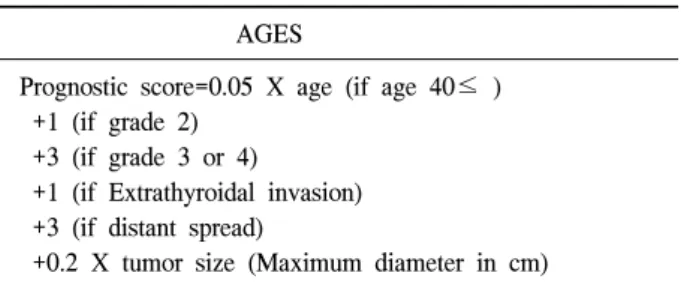
본 연구는 유두상 갑상선암으로 수술을 시행한 환자를 대상으로 나이, 조직학적 등급, 침윤정도, 크기에 따른 AGES scoring system (9) (Table 1)을 이용하여 AGES 저위험
119
Table 1. Prognostic factors in thyroid cancerAGES
Prognostic score=0.05 X age (if age 40≤ ) +1 (if grade 2)
+3 (if grade 3 or 4)
+1 (if Extrathyroidal invasion) +3 (if distant spread)
+0.2 X tumor size (Maximum diameter in cm) Based on Mayo Clinic data.
Table 2. Characteristics of patient with recurrence
Case 1 Case 2 Case 3 Case 4 Case 5
Gender f f f f f
Age 43 50 30 10 62
Site Rt. Lt. Rt. Rt. Bilateral
Initial op. ST* ST* RL† RL† T‡
Re op. T‡ T‡ LL§ LL§ Excision
Size (cm) 3 2.5 2.5 2.8 2.2
Metastatic 6 3 6 9 5
Lymph node No. Confined Confined Confined Extrathyroidal Extrathyroidal
extension to thyroid to thyroid to thyroid extension extension
Thyroglobulin level (ng/ml) 2 3 0.5 5 2.7
SynthyroidⓇ intake Yes Yes Yes Yes Yes
IWBS∥ No No No No Yes
AGES Low Low Low Low High
Score 2.75 3 0.5 56 4.54
Time to recurrence (month) 48 64 95 29 8
Recurrence site Op. bed Op. bed Lt. lobe Lt. lobe LN
*ST = subtotal thyroidectomy; †RL = right lobectomy with isthmectomy; ‡T = total thyroidectomy; §LL = left lobectomy with isthmectomy;
∥IWBS = iodine whole body scan.
군의 유두상 갑상선암 환자에서 수술 후 국소 재발에 영향 을 미치는 인자들에 대한 분석을 하였다.
방 법 1) 대상환자의 선택 및 환자군의 분류
1995년 7월부터 2005년 12월까지 유두상 갑상선암으로 진단받고 수술 받은 환자 중 수술 후 추적조사가 가능한 89명 환자들의 수술기록지와 병리조직 결과지를 후향적으 로 분석하여, AGES scoring system을 이용한 AGES 저위험 군 70명을 대상으로 하였다.
2) 수술방법
나이가 45세 이상, 갑상선 종양의 크기가 2 cm 이상, 갑상 선외 침습이 있는 경우, 수술 전 경부 림프절 전이 양성 소 견, 원격 전이가 있는 경우, 방사선 조사 기왕력 중 하나라
도 있는 경우에 갑상선전절제술 및 중앙 경부 림프절 절제 술을 시행하였고, 나이가 45세 미만이고, 갑상선 종양의 크 기가 2 cm 미만, 갑상선외 침습이 없는 경우, 수술 전 경부 림프절 전이 음성 소견, 원격 전이 소견이 없고, 방사선 조 사 기왕력이 없는 경우에는 갑상선부분절제술 및 선택적 경부 림프절 절제술을 시행하였다. 갑상선 조직을 남기느 냐 여부에 따라 갑상선전절제술과 갑상선부분절제술로 분 류하였다. 전절제술과 근전절제술(병변부위의 일측 엽절제 술과 반대편엽의 갑상선조직을 1 g 이하만을 남기고 엽절 제술을 시행)을 갑상선전절제술에 포함하였으며, 아전절제 술(부갑상선과 후두반회신경을 보존하기위해 2∼3 g 정도 의 갑상선조직만 남기고 양엽절제술 시행)과 일측엽절제술 및 협부절제술을 갑상선부분절제술로 분류하였다.
환자의 나이, 성별, 종양크기, 림프절 전이 유무, 침윤정 도, 수술방법, 갑상선글로불린(thyroglobulin)수치, 전신스캔 (Iodine whole body scan, IWBS), 방사성요오드치료(RI scan
131I), SynthyroidⓇ 투여 여부 등에서 재발과의 연관성을 알 아보았다.
3) 치료 방법 및 추적관찰
갑상선전절제술을 시행한 경우 SynthyroidⓇ를 복용하지 않고서 6주째 외래에서 진찰 및 혈액 검사, 혈청 갑상선 자 극 호르몬 수치, 혈청 갑상선글로불린 수치를 측정하였다.
혈청 갑상선 자극 호르몬 수치가 30μIU/ml 이상 증가한 것 을 확인한 후 잔여갑상선조직소멸을 목적으로 30 mCi의 방 사성요오드치료를 하고 5일 후 전신 스캔(IWBS)을 시행하 였다. 전신스캔결과 전이가 있거나 수술소견상 경부 림프
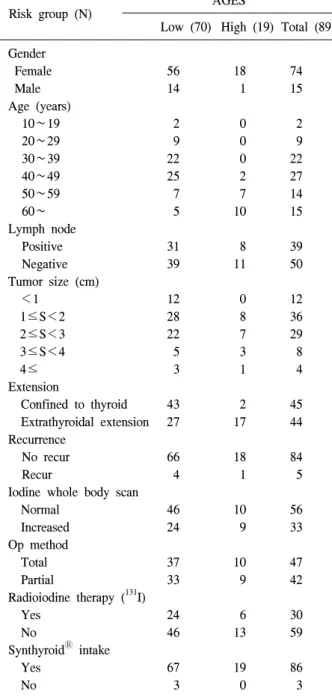
Table 3. Patient characteristics according to risk groups
Risk group (N) AGES
Low (70) High (19) Total (89) Gender
Female 56 18 74
Male 14 1 15
Age (years)
10∼19 2 0 2
20∼29 9 0 9
30∼39 22 0 22
40∼49 25 2 27
50∼59 7 7 14
60∼ 5 10 15
Lymph node
Positive 31 8 39
Negative 39 11 50
Tumor size (cm)
<1 12 0 12
1≤S<2 28 8 36
2≤S<3 22 7 29
3≤S<4 5 3 8
4≤ 3 1 4
Extension
Confined to thyroid 43 2 45
Extrathyroidal extension 27 17 44 Recurrence
No recur 66 18 84
Recur 4 1 5
Iodine whole body scan
Normal 46 10 56
Increased 24 9 33
Op method
Total 37 10 47
Partial 33 9 42
Radioiodine therapy (131I)
Yes 24 6 30
No 46 13 59
SynthyroidⓇ intake
Yes 67 19 86
No 3 0 3
절 전이가 있는 경우, 다발성 병변이 있었던 환자에서는 150 mCi의 고용량 방사성요오드치료를 시행하였다. 혈청 갑상선글로불린 수치는 수술 6주째 방사성면역계측법 (radioimmunoassay, RIA)에 의해 측정하였고 이후 6개월마 다 시행하였다. 갑상선에 종괴가 만져지거나 시행한 검사 에서 재발이 의심될 때는 초음파검사 및 세침흡입검사나 재수술을 이용한 조직검사로 재발여부를 확인하였다.
4) 통계검증
종양크기 2 cm는 AJCC 병기분류의 T1과 T2를 본 연구의 기준으로 하였다. 모든 자료의 비교분석은 Chi-square test, Pearson's correlation test 및 Fisher's exact test를 이용하였으 며 P value가 0.05미만이면 통계적 유의성이 있다고 판단하 였다.
결 과
유두상 갑상선암으로 진단 받은 89명의 환자 중 5명이 국 소 재발하였고, 원격전이는 없었다. 국소 재발한 환자는 70 명의 AGES 저위험군 환자 중 4명(5.7%)이 재발하였고, 19 명의 AGES 고위험군 환자에서는 1명(5%)이 국소 재발하였 다. 갑상선전절제술을 시행한 47명 환자에서 30명이 방사 성요오드치료를 시행 받았고, 47명 모두 SynthyroidⓇ를 복 용하였다. 갑상선 부분절제술을 시행한 42명의 환자에서는 39명이 SynthyroidⓇ를 복용하였다. SynthyroidⓇ를 복용한 환 자에서 6개월후 확인한 갑상선글로불린 수치는 갑상전전 절제술을 시행한 경우 1μg/L 이하이거나 검출되지 않았고, 갑상선부분절제술을 시행한 경우 10μg/L 이하로 환자 모 두 정상범위였다. 이후 6개월마다 갑상선글로불린 검사를 시행하였고 갑상선글로불린의 수치는 정상범위 이내였다.
AGES 고위험군에서는 19명 중 1명이 국소 재발하였는데, 여자 환자였고 갑상선전절제술을 시행한 환자였다(Table 2).
AGES 저위험군환자 70명 중 국소 재발한 환자 4명은 모두 여자였고, 갑상선부분절제술을 시행한 환자였다. 이들은 수 술 후 경과관찰 중 종괴가 촉지되어 초음파검사 및 세침흡 입검사 시행 후 국소 재발이 확인되어 재수술을 시행하였 다.
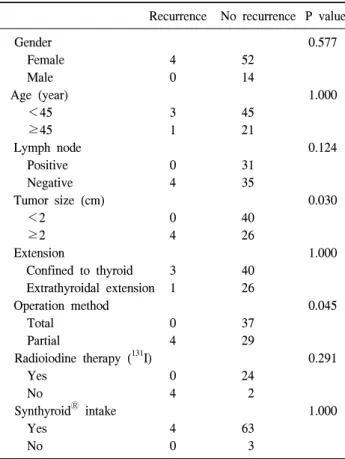
국소재발은 AGES 저위험군에서 갑상선부분절제술(P=
0.045)을 시행하였을 때와 2 cm 이상인 환자군(P=0.03)에서 통계학적으로 유의하였다. 종양크기 2 cm는 AJCC 병기분 류의 T1과 T2를 본 연구의 기준으로 하였다. 그 외 크기가 1 cm 이상 및 이하, 3 cm 이상 및 이하로 각각 나누어 국소 재발한 경우와 비교하였을 때는 통계학적인 유의성이 없었 다.
89명의 환자에서 AGES 저위험군이 70명(78.7%), AGES 고위험군이 19명(21.3%)이었다.
AGES 저위험군환자 70명의 연령분포는 10∼71세, 평균
연령은 40.3세였고 40대가 35.7%, 30대가 31.4%였다. 성별 비는 남:여=1:4 (14:56)로 여자에게 호발하였다.
37명은 갑상선전절제술을, 33명은 갑상선부분절제술을 받았다. 조직병리결과에서 종양의 크기는 0.4 cm 에서 6 cm 까지의 분포를 보였고 평균크기는 2.05 cm였다. 침윤 정도 는 갑상선에 국한된 경우가 43명(61.4%), 갑상선외 침범이 있는 경우가 27명(38.6%)였다. 갑상선외 침범이 있는 환자 는 모두 연부조직까지만 침범되어 있었다. 39명(55.7%)은 국소 림프절 전이소견이 없었고, 31명(44.32%)에서 국소 림 프절 전이소견이 있었다.
Table 4. Factors associated with local recurrence in low AGES risk groups
Recurrence No recurrence P value
Gender 0.577
Female 4 52
Male 0 14
Age (year) 1.000
<45 3 45
≥45 1 21
Lymph node 0.124
Positive 0 31
Negative 4 35
Tumor size (cm) 0.030
<2 0 40
≥2 4 26
Extension 1.000
Confined to thyroid 3 40
Extrathyroidal extension 1 26
Operation method 0.045
Total 0 37
Partial 4 29
Radioiodine therapy (131I) 0.291
Yes 0 24
No 4 2
SynthyroidⓇ intake 1.000
Yes 4 63
No 0 3
갑상선전절제술을 시행한 경우 6주간 SynthyroidⓇ를 복 용하지 않고 6주째 외래에서 진찰 및 혈액 검사, 혈청 갑상 선 자극 호르몬 수치, 혈청 갑상선글로불린 수치를 측정하 였다. 이때 혈청 갑상선 자극 호르몬 수치가 30μIU/ml 이 상 증가한 것을 확인한 후 잔여갑상선조직소멸을 목적으로 30 mCi의 방사성요오드치료를 하고 5일 후 전신 스캔 (IWBS)을 시행하였다. 전신스캔결과 전이가 있거나 수술소 견상 경부 림프절 전이가 있는 경우, 다발성 병변이 있었던 환자에서는 150 mCi의 고용량 방사성요오드치료 및 SynthyroidⓇ를 투여하였다. 갑상선전절제술을 시행한 37명 중 24명이 수술부위 섭취증가소견이 있어 방사성요오드 치 료를 받았고 6개월 간격으로 검사를 지속하였다. 나머지 13 명은 수술부위 섭취 증가소견이나 원격전이를 의심할 만한 소견은 없었다.
갑상전전절제술을 시행한 모든 환자의 갑상선글로불린 수치는 수술 후 6개월에 시행한 검사에서 1μg/L 이하였고, 갑상선부분절제술을 시행한 환자에서는 10μg/L 이하로 70 명 모두 정상범위였다. 이후 6개월 간격으로 시행한 검사결 과도 모두 정상범위 이내였다(Table 3).
고 찰
유두상 갑상선암은 예후가 양호하기 때문에 외과적 절제 범위에 대해 아직 논란이 있다. 원발병소의 크기가 1 cm 미 만인 비침습성 유두상 갑상선암의 경우에는 편측 엽절제술 이, 2 cm 이상인 경우 갑상선전절제술 및 근절제술이 일반 적으로 받아들여지고 있지만, 원발병소가 1∼2 cm 사이인 경우에는 수술방법에 대한 논란이 있다.(10) 이러한 이유는 유두상 갑상선암의 진행속도가 느리며 매우 양호한 예후를 보이기 때문이기도 하다.
유두상 갑상선암의 재발 및 진행에 관한 예후인자로는 진단 당시의 연령, 종양의 크기, 경부 림프절 전이, 다발성, 양엽의 침범, 갑상선 외 침범, 원격전이 등이 있다.(11,12) 45세 이상의 환자에서 유두상 갑상선암이 나쁜예후를 보이 며, 남자가 여자보다 예후가 나쁜 것으로 알려져 있다.(1) 본 연구의 AGES 저위험군에서는 나이, 성별 및 갑상선 외 침범이 재발과는 통계학적인 유의성이 없었다.
저위험군과 고위험군으로 구분되는 AGES scoring system 의 의의는 예후(사망률)가 뚜렷하게 차이가 있는 그룹으로 환자의 구분이 가능하며 저위험군의 환자는 사망률이 매우 낮을 뿐만 아니라 갑상선 절제범위가 환자의 사망률에 영 향을 주지 않는다는 사실이다.(8) 그러나 일부 환자에서는 수술 전 AGES scoring이 정확하지 못해 절제범위가 적절하 지 못할 가능성이 있다.(8) 수술 후의 결과 중 사망률 외에 국소재발에 대해서 본다면 갑상선의 절제범위에 따라 의미 있는 차이를 보고하고 있다. Hay 등(13)은 갑상선양엽절제 를 시행한 군과 일엽절제를 시행한 군사이에 사망률에서는
차이가 없었으나, 국소재발에 있어서는 일엽절제군에서 양 엽절제군에 비해 7배나 높은 재발률을 보였다고 하였으며, 저위험군에서 보존적 수술을 주장하는 그룹 중에서도 저위 험군 환자 중 11%에서 국소재발이 있었으며 이중 33%가 사망하였다고 보고하였다.(2) 본 연구의 결과에서도 AGES 저위험군에서 갑상선부분절제술을 시행한 군이 갑상선전 절제술을 시행한 군에 비해 국소재발이 유의하게 증가하였 고(P=0.045), 종양의 크기가 2 cm 이상인 환자군에서 국소 재발이 유의하게 증가하였다(P=0.03).
이에 반하여 Shah 등과 같이 저위험군 환자에서 일엽절 제술을 시행한 군과 전절제를 시행한 군 사이에 국소 재발 에는 차이가 없었다는 상반된 보고도 있으나,(14,15) 전반적 으로 갑상선 절제 범위와 국소재발과는 상관관계가 있는 것으로 인정되고 있다.
본 연구에서도 AGES 저위험군 70명 중에서 국소 재발한 환자 4명은 모두 여자였으며, 모두 갑상선부분절제술을 시 행한 환자였고, 국소재발 소견으로 재수술을 시행하였다.
나이, 성별, 갑상선글로불린 수치, 방사성요오드 치료, SynthyroidⓇ 투여여부는 수술 후 국소재발과 통계학적인 차 이는 없었다. 국소재발은 갑상선부분절제술(P=0.045)과 종 양의 크기가 2 cm 이상인 경우(P=0.03)에서 증가하는 것으
로 통계학적인 의미가 있었다(Table 4).
결 론
본 연구의 결과 AGES 저위험군 유두상 갑상선 암 환자 에서 종양의 크기가 2 cm 이상일 때와 갑상선부분절제술을 시행할 경우 국소재발의 가능성이 높았다. 그러나 대상 환 자 수가 적고 재발 환자 수도 적으며 후향적 분석이라는 한계가 있어 AGES 저위험군 유두상 갑상선암 환자 모두에 게 수술방법까지 유추하기에는 무리가 있으므로 향후 추가 적인 연구가 더 진행되어야 할 것으로 생각된다.
REFERENCES
1) Shin SH, Na MA, Kang YH, Son SM, Kim IJ, Kim YK. The histological features of papillary thyroid carcinomas 1.5 cm and less in size. Korean J Med 2007;73:44-9.
2) Rossi RL, Cady B, Silverman ML, Wool MS, Horner TA.
Current results of conservative surgery for differentiated thyroid carcinoma. World J Surg 1986;10:612-22.
3) Lee JD, Yun JS, Nam KH, Chung WY, Soh EY, Park CS.
Papillary thyroid microcarcinoma: clinicopathologic charac- teristics and treatment strategy. J Korean Surg Soc 2007;72:
276-82.
4) Marchesi M, Biffoni M, Faloci C, Biancari F, Campana FP.
High rate of recurrence after lobectomy for solitary thyroid nodule. Eur J Surg 2002;168:397-400.
5) Hazard JB. Small papillary thyroid carcinoma of the thyroid:
a study with special reference to the so-called nonencapsulated sclerosing tumor. Lab Invest 1960;9:86-97.
6) Farkas EA, King TA, Bolton JS, Fuhrman GM. A comparison
of total thyroidectomy and lobectomy in the treatment of dominant thyroid nodules. Am J Surg 2002;68:678-82.
7) Chow SM, Low SC, Chan JK, Au SK, Yau S, Lau WH.
Papillary microcarcinoma of the thyroid-prognostic signi- ficance of lymph node metastasis and multifocality. Cancer 2003;98:31-40.
8) 홍석준. 유두상 갑상선암의 일차수술과 재발 시의 수술적 치료. 대한내분비외과학회지 2003;3:97-105.
9) Shaha A. Treatment of thyroid cancer based on risk groups.
J Surg Oncol 2006;94:683-691.
10) Park SH, Kim SJ, Lee DH, Sung KY, Suh YJ, Kim JS, et al. Safety of the completion thyroidectomy in the mana- gement of well- differentiated thyroid carcinoma. J Korean Surg Soc 2003;65:397-401.
11) Akslen LA, LiVolsi VA. Prognostic significance of histologic grading compared with subclassification of papillary thryoid carcinoma. Cancer 2000;88:1902-8.
12) Yamashita H, Noguchi S, Murakami N, Toda M, Uchino S, Watanabe S, et al. Extracapsular invasion of lymph node metastasis: a good indicator of disease recurrence and poor prognosis in patients with thyroid microcarcinoma. Cancer 1999;86:842-9.
13) Hay ID, Grant CS, Bergstralh EJ, Thompson GB, Van Heerden JA, Goellner JR. Unilateral total lobectomy: is it sufficient surgical treatment for patients with AMES low-risk papillary thyroid carcinoma? Surgery 1998;124:958-66.
14) Shah JP, Loree TR, Dharker D, Strong EW. Lobectomy versus total thyroidectomy for differentiated carcinoma of the thyroid:
a matched-pair analysis. Am J Surg 1993;166:331-5.
15) Shaha AR, Shah JP, Loree TR. Low-risk differentiated thyroid cancer: the need for selective treatment. Ann Surg Oncol 1997;4:328-33.