INTRODUCTION
Atrial fibrillation (AF) is a common arrhythmia that is a potent independent risk factor for stroke and has a significant impact on longevity, approximately doubling all-cause and cardiovascular mortality rates. There are an estimated 2.2 mil- lion people in the United States (U.S.) with AF, with a median age of about 75 yr. The prevalence of AF is 2.3% in people older than 40 yr and 5.9% in those older than 65 yr. Approx- imately 70% of AF are between 65 and 85 yr of age (1). In the Framingham Study (2), the incidence of AF doubles with each advancing decade of age >50 yr and reaches almost 10%
in octogenarians. The incidence of AF is higher at all ages in men than women, but with a closing gap with advancing age.
After adjusting for age and other risk factors predisposing person to AF, men were 50% more likely than women to de- velop the rhythm disturbance (3).
In the Framingham Study (4), the most common cardiac precursors of AF were heart failure, myocardial infarction, and valvular heart disease. Adjusting only for age, cigarette smok- ing in women, and diabetes, hypertension and electrocardio- gram (ECG)-left ventricular hypertrophy (LVH) in both sexes
were significant AF predictors. After adjusting for other asso- ciated conditions as well as age and sex, diabetes and hyper- tension remained significant predictors of AF.
In other study (5), among 4,844 participants, 304 developed a first episode of AF during an average follow-up of 3.28 yr, for an incidence of 19.2 per 1,000 person years. The onset was strongly associated with age, male sex, and presence of clinical cardiovascular disease. The use of diuretics, a history of valvular disease, coronary heart disease, advancing age, higher levels of systolic blood pressure, height, glucose, cardiac injury score and left atrial size (≥3 cm) were all associated with an incr- eased risk of AF.
In the Korea, the prevalence of and risk factors for AF were not evaluated. This study aimed to describe the prevalence of and risk factors for AF in Korean.
MATERIALS AND METHODS
In this study, 14,540 adults (male 6,573/female 7,967) ≥40 yr old inhabitants in 5 cities and 3 counties in Gyeongsang- nam-do received screening test for general health between
Joon Hoon Jeong
Division of Cardiology, Department of Internal Medicine, Wallace Memorial Baptist Hospital, Busan, Korea
Address for correspondence Joon Hoon Jeong, M.D.
Division of Cardiology, Department of Internal Medicine, Wallace Memorial Baptist Hospital, 374-75 Namsan-dong, Keumjeong-gu, Busan 609-728, Korea Tel : +82.51-580-1202, Fax : +82.51-583-6200 E-mail : [email protected]
26
Prevalence of and Risk Factors for Atrial Fibrillation in Korean Adults Older than 40 Years
Atrial fibrillation (AF) is a common arrhythmia that is a potent independent risk fac- tor for stroke. The incidence of AF increase with age and most affected people have underlying cardiac disease. This study aimed to describe the prevalence of and risk factors for AF in Korean. In this study, 14,540 adults (male 6,573/female 7,967) ≥40 yr old received screening test for general health between April 2000 and December 2000. Participants answered questionnaires and underwent examinations that includ- ed blood pressure, electrocardiogram (ECG), total cholesterol, and fasting glucose.
Data analysis was done by SPSS 10.0 for Windows. The prevalence of AF was 0.7%
in people older than 40 yr and 2.1% in those older than 65 yr. The prevalence in men was 1.2% and women was 0.4% in people older than 40 yr. The prevalence in men was 3.3% and women was 1.1% in people older than 65 yr. Approximately 56.6%
of individuals with AF are older than 65 yr. The prevalence of AF was higher at all age group in men than in women. Also, the prevalence of AF was highest in people older than 80 yr. In univariate analysis, male sex, old age (≥65 yr), hypertension, diabetes mellitus, left ventricular hypertrophy in ECG, stroke, and cardiac disease were associated with an increased risk of AF. In multivariate analysis, however, risk factors of AF were male (odds ratio, OR 4.1; 95% confidence interval [CI] : 2.6 to 6.5; p=0.000), old age (OR 5.3; 95% CI:3.5 to 7.9; p=0.000), and cardiac disease (OR 19.8; 95% CI:12.3 to 31.8; p=0.000). In this study, the most potent risk factors of AF was cardiac disease.
Key Words : Atrial Fibrillation; Prevalence; Risk Factors; Epidemiology
Received : 23 August 2004 Accepted : 5 October 2004
April 2000 and December 2000 by National Health Insurance Cooperation. All participants answered questionnaires for his- tory of medical illness (hypertension, diabetes mellitus (DM), cardiovascular disease, hyperthyroidism, and so on), smoking, and alcohol drinking and underwent examinations that includ- ed blood pressure, ECG, total cholesterol, and fasting glucose.
Blood sampling was done after fasting state at least 12 hr.
Plasma total cholesterol and glucose were measured in an autoanalyzer (Automatic analyzer, Hitachi 736-20, Tokyo, Japan) by enzymatic and glucose-oxidase method. The 12- lead resting ECG was done by Auto Cardiner FCP-2201, FCP- 2155 (Fukuda Denshi Co., Tokyo, Japan). Hypertension was defined for each examination as a systolic blood pressure of at least 140 mmHg or a diastolic blood pressure of at least 90 mmHg on each of two readings by Joint National Com- mittee criteria VI (JNC VI) (6), or the use of antihypertensive medication. Diabetes mellitus was diagnosed if the subjects had a fasting glucose level of or higher (≥126 mg/dL) by ADA (American Diabetes Association) diagnostic criteria (7) or was taking insulin or an oral hypoglycemic agent at the current examination. Hypercholesterolemia was diagnosed if the subjects had a serum total cholesterol level of or higher (≥240 mg/ dL) by NCEP II (National Cholesterol Educa- tion Program II) criteria (8).
Clinical cardiovascular disease at baseline was defined by any of the following: a history of myocardial infarction, angina, stroke, congestive heart failure, valvular heart disease, cardio- myopathy, arrhythmia, aortic dissection, valve replacement surgery. Alcohol drinking was ascertained by self-report and categorized as the weekly alcohol consumption >90 g ethanol.
ECG-LVH was considered present if the subject fulfilled volt- age criteria (≥5 points by Romhilt-Estes criteria) for hyper- trophy and manifested lateral repolarization changes. AF was defined by disorganized atrial activity without discrete P waves, atrial activation ranging from 350 to 600 beats per minute, and irregularly irregular ventricular response.
Statistical analysis was done by SPSS 10.0 (Statistical pack- age for the social sciences, SPSS Inc, Chicago, IL, U.S.A.) for Windows and correlation analysis was by chi-square test, con- tingency coefficient, and Cramer’s V. Multivariate analysis was done by multinominal logistic regression test. A p value <0.05 was considered statistically significant.
RESULTS
A total of 14,540 subjects (6,573 men and 7,967 women) aged 54.6±10.8 (mean age±SD) yr (range 40 to 92) were enrolled in this study. Table 1 lists the numbers of participants according to age groups and sex.
The prevalence of AF was 0.7% (106/14,540) in people older than 40 yr and 2.1% (60/2,876) in those older than 65 yr. The prevalence in men was 1.2% (76/6,573) and women was 0.4% (30/7,967) in people older than 40 yr. The preva- lence in men was 3.3% (42/1,264) and women was 1.1% (18/
1,612) in people older than 65 yr. The mean age of individ- uals with AF is approximately 65.3 yr.
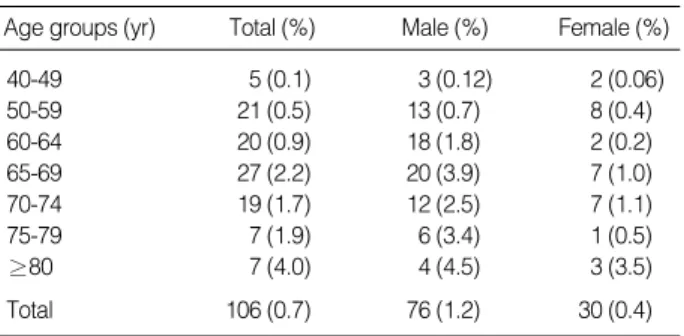
The prevalence of AF was 3-fold higher in men than in women. The prevalence of AF were 0.1% in aged 40-49 yr, 0.5% in aged 50-59 yr, 0.9% in aged 60-64 yr, 2.2% in aged 65-69 yr, 1.7% in aged 70-74 yr, 1.9% in aged 75-79 yr, 4.0% in over the 80 yr old (Table 2).
The prevalence in men is substantially greater than in wo- men at all ages. Fifty-seven percent of individuals with AF are older than 65 yr. This study showed that the prevalence of AF was the highest among over the 80 yr old (Table 2).
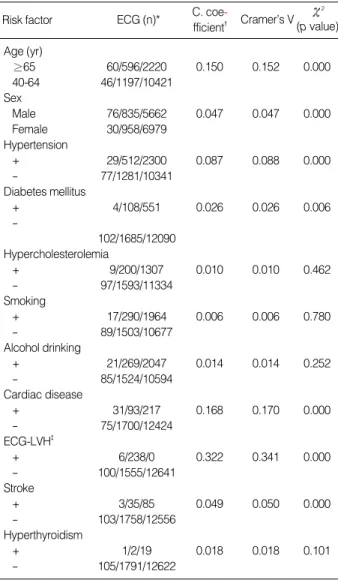
In univariate analysis, old age (p=0.000), male (p=0.000), hypertension (p=0.000), diabetes mellitus (p=0.006), cardiac disease (p=0.000), ECG-LVH (p=0.000), and stroke (p=0.000) were significantly associated with an increased risk of AF.
However, cigarette smoking (p=0.780), alcohol drinking (p=
0.252), hypercholesterolemia (p=0.462), and hyperthyroidism (p=0.101) were not associated with an increased risk of AF (Table 3).
After adjustment for age, sex, and other clinical variables, independent risk factors for AF were male (OR 4.1; 95% CI:
2.6 to 6.5; p=0.000), old age (OR 5.3; 95% CI:3.5 to 7.9;
p=0.000), and cardiac disease (OR 19.8; 95% CI:12.3 to 31.8; p=0.000) in this study. The most potent risk factor of AF was cardiac disease (Table 4).
DISCUSSION
AF is a common arrhythmia that is associated with increased
Age groups (yr) Total (%) Male (%) Female (%) 40-49 5,576 (38.4) 2,491 (37.9) 3,085 (38.7) 50-59 3,920 (27.0) 1,830 (27.8) 2,090 (26.2)
60-64 2,168 (14.9) 988 (15.0) 1,180 (14.8)
65-69 1,237 (8.5) 518 (7.9) 719 (9.0)
70-74 1.095 (7.5) 480 (7.3) 615 (7.7)
75-79 369 (2.5) 177 (2.7) 192 (2.4)
≥80 175 (1.2) 89 (1.4) 86 (1.1)
Total 14,540 (100) 6,573 (100) 7,967 (100) Table 1.Numbers of participants according to age groups & sex
Age groups (yr) Total (%) Male (%) Female (%)
40-49 5 (0.1) 3 (0.12) 2 (0.06)
50-59 21 (0.5) 13 (0.7) 8 (0.4)
60-64 20 (0.9) 18 (1.8) 2 (0.2)
65-69 27 (2.2) 20 (3.9) 7 (1.0)
70-74 19 (1.7) 12 (2.5) 7 (1.1)
75-79 7 (1.9) 6 (3.4) 1 (0.5)
≥80 7 (4.0) 4 (4.5) 3 (3.5)
Total 106 (0.7) 76 (1.2) 30 (0.4)
Table 2.Prevalence of atrial fibrillation according to age groups &
sex
* %=numbers of atrial fibrillation/numbers of participants.
risk for cardiovascular morbidity and mortality (8-12). Epi- demiological and clinical studies (13-16) have generally indi- cated that AF constitutes a major independent risk factor for stroke, with 3-5 fold increased risk after adjusting for other risk factors. The incidence rose sharply with age, and preva- lence of AF increased significantly over a span of 38 or 22 yr (2, 11). In Korea, AF will be serious clinical problem in the future due to substantially increasing of older ages.
AF may occur in both cardiac and noncardiac disease or it may present in the absence of any overt conditions (17, 18).
The cardiac causes associated with AF are various types of valvular heart disease (especially, mitral valve disease), acute myocardial infarction, myocarditis, cardiomyopathy (all forms), congenital heart disease, pericarditis, hypertensive cardiovas- cular disease, sick sinus syndrome, WPW syndrome, and heart failure. Noncardiac causes of AF that have been reported in- clude thyrotoxicosis, alcohol abuse, severe infection, pulmonary
embolism, pulmonary hypertension, and chronic obstructive pulmonary disease. Lone AF is, by definition, atrial fibrillation without ‘‘overt’’ structural heart disease. It occurs in approx- imately 10 percent of chronic AF (19-21).
The morbidity associated with AF is related to 1) excessive ventricular rate, which in turn may lead to hypotension, pul- monary congestion, or angina pectoris in susceptible individ- uals, and in some patients cause produce a tachycardia-medi- ated cardiomyopathy; 2) the pause following cessation of AF, which can cause syncope; 3) systemic emboliztion, which occurs most commonly in patients with rheumatic heart dis- ease; 4) loss of the contribution of atrial contraction to cardiac output, which may cause fatigue due to decrease in ventric- ular stroke volume of up to 20 to 25 percent; and 5) anxiety secondary to palpitations.
In this study, the prevalence of AF is 0.7% in people older than 40 yr and 2.1% in those older than 65 yr. The mean age of individuals with AF is approximately 65.3 yr. Fifty-seven percent of individuals with AF are older than 65 yr. This re- sults were lower than 2.3% in people older than 40 yr, and 5.9% in those older than 65 yr, with a median age of about 75 yr, and 84% of persons with AF are older than 65 yr in the U.S. study (1). This difference was due to the ratio of pop- ulation older than 65 yr in population older than 40 yr. In this study, the rate was 19.8% but 32.6% in U.S. study.
In the Framingham study (2), the prevalence of AF were 0.1% in aged 40-49 yr, 0.5% in aged 50-59 yr, 1.8% in aged 60-69 yr, 4.8% in aged 70-79 yr, 8.8% in older than 80 yr. In this study, the prevalence of AF were 0.1% in the 5th decades, 0.5% in the 6th decades, 1.4% in the 7th decades, 1.8% in the 8th decades, 4.0% in older than 80 yr. By comparison with the U.S. study, the prevalence of AF were same in the 5th and the 6th decades. The prevalence of AF, however, were greater in the 8th decades and in older than 80 yr in the U.S.
In the Framingham study (2), the prevalence of AF doubles with each advancing decade of age >50 yr and reaches almost 10% in octogenarians. In this study, the prevalence in men is substantially greater than in women at all ages. The preva- lence of AF was 3-fold higher in men than in women.
The incidence of AF is higher at all ages in men than wo- men, but with a closing gap with advancing age. After adjust- ing for age and other risk factors predisposing person to AF,
Risk factor ECG (n)* C. coe-
fficient� Cramer’s V
2
(p value) Age (yr)
≥65 60/596/2220 0.150 0.152 0.000
40-64 46/1197/10421
Sex
Male 76/835/5662 0.047 0.047 0.000
Female 30/958/6979
Hypertension
+ 29/512/2300 0.087 0.088 0.000
- 77/1281/10341
Diabetes mellitus
+ 4/108/551 0.026 0.026 0.006
-
102/1685/12090 Hypercholesterolemia
+ 9/200/1307 0.010 0.010 0.462
- 97/1593/11334
Smoking
+ 17/290/1964 0.006 0.006 0.780
- 89/1503/10677
Alcohol drinking
+ 21/269/2047 0.014 0.014 0.252
- 85/1524/10594
Cardiac disease
+ 31/93/217 0.168 0.170 0.000
- 75/1700/12424
ECG-LVH�
+ 6/238/0 0.322 0.341 0.000
- 100/1555/12641
Stroke
+ 3/35/85 0.049 0.050 0.000
- 103/1758/12556
Hyperthyroidism
+ 1/2/19 0.018 0.018 0.101
- 105/1791/12622
Table 3.Analysis of risk factors of atrial fibrillation
*ECG (n), Numbers of AF/ abnormal ECG/ normal ECG; �C. coefficient, contingency coefficient; �ECG-LVH, electrocardiographic left ventricular hypertrophy.
Risk factor Odds ratio 95% Confidence interval p value
Age ≥65 yr 5.3 3.5-7.9 0.000
Male 4.1 2.6-6.5 0.000
Cardiac disease 19.8 12.3-31.8 0.000
Hypertension 0.9 0.6-1.5 0.821
Diabetes mellitus 0.6 0.2-1.7 0.317
ECG-LVH* 0.8 0.4-1.3 0.901
Stroke 2.8 0.8-9.3 0.103
Table 4.Multinominal logistic regression analysis by adjusted risk factors of AF
*ECG-LVH, electrocardiographic left ventricular hypertrophy.
men were 50% more likely than women to develop the rhythm disturbance (3).
In the Framingham Study (4), the most common cardiac precursors of AF were heart failure, myocardial infarction, and valvular heart disease. These cardiac conditions accounted for 20% of the AF incidence in men and 31% of its occurrence in women. Heart failure imposed the greatest risk of AF, with a 4.5-fold increased risk in men and a 5.9-fold increase in women. Valvular heart disease was associated with a 1.8-fold increase in men and a 3.4-fold increase in women. Myocardial infarction was significantly associated with AF only in men, increasing their risk by 40%. Adjusting only for age, cigarette smoking in women, and diabetes, hypertension and ECG- LVH in both sexes were significant AF predictors. Women who smoked were 40% more likely to develop AF; those who were diabetic had a 2-fold increase risk; those with hyperten- sion had a 70% greater risk; and those with ECG-LVH had almost a 4-fold increase risk. In men, diabetes increased risk 70%, hypertension 80%, and ECG-LVH by 3-fold. After adjusting for other associated factors, as well as age and sex, diabetes and hypertension remained significant predictors of AF. In both age-adjusted and risk factor-adjusted analyses, neither obesity nor alcohol intake were substantial or signifi- cant risk factors for AF.
In other study (5), among 4,844 participants, 304 developed a first episode of AF during an average follow-up of 3.28 yr, for an incidence of 19.2 per 1,000 person years. The onset was strongly associated with age, male sex, and presence of clinical cardiovascular disease. The use of diuretics, a history of valvu- lar disease, coronary heart disease, advancing age, higher levels of systolic blood pressure, height, glucose, cardiac injury score and left atrial size (≥3 cm) were all associated with an in- creased risk of AF. However, the use of blockers and high levels of alcohol use, cholesterol, and forced expiratory volume in 1 sec (FEV1) were associated with reduced risk of AF.
In this study, male, old age, hypertension, DM, cardiac dis- ease, ECG-LVH, and stroke were significantly associated with an increased risk of AF. However, cigarette smoking, alcohol drinking, hypercholesterolemia, and hyperthyroidism were not associated with an increased risk of AF.
Earlier studies confirmed the role of alcohol as a precipi- tating factor for new-onset AF (22, 23). The mechanism of alcohol-induced AF is not known, but increased circulating catecholamines, changed conduction and refractory times, vagal reflexes, myocardial damage have been suggested (23, 24). In other study (25), increases in -adrenoceptor density and low-frequency/high-frequency ratio during ethanol intox- ication in patients with AF suggest an exaggerated sympa- thetic reaction. A controversy exists on the possible changes in adrenergic activity in healthy subjects. In our study, alco- hol drinking was not associated with risk factor for AF. This is same result in other studies (4, 5), but more studies were needed.
Hyperthyroidism is a well-known risk factor for atrial fib-
rillation. The incidence of AF was about 10 to 25% of patients who have thyrotoxicosis, it is more common in patients with older and combined cardiovascular disease. The mechanism is shortening of the functional refractory time, -adrenergic like effect, and direct effect of thyroid hormone. In this study, it was not associated with an risk factor for AF. This result seems due to very low incidence (0.15%) of hyperthyroidism in this study.
In conclusion, independent risk factors for AF were male, old age, and cardiac disease in this study. The most potent risk factor of AF was cardiac disease.
Although the incidence of AF in the Korea was lower than in the United States, AF will be serious clinical problem in the future due to substantially increasing of older ages.
REFERENCES
1. Feinberg WM, Blackshear JL, Laupacis A, Kronmal R, Hart RG.
Prevalence, age distribution and gender of patients with atrial fibril- lation. Analysis and implications. Arch Intern Med 1995; 155: 469-73.
2. Wolf PA, Abbott RD, Kannel WB. Atrial fibrillation as an indepen- dent risk factor for stroke: the Framingham Study. Stroke 1991; 22:
983-8.
3. Benjamin EJ, Levy D, Vaziri SM, D’Agostino RB, Belanger AJ, Wolf PA. Independent risk factors for atrial fibrillation in a population-bas- ed cohort: the Framingham Heart Study. JAMA 1994; 271: 840-4.
4. Kannel WB, Wolf PA, Benjamin EJ, Levy D. Prevalence, incidence, prognosis, and predisposing conditions for atrial fibrillation: popu- lation-based estimates. Am J Cardiol 1998; 82: 2N-9N.
5. Psaty BM, Manolio TA, Kuller LH, Kronmal RA, Cushman M, Fried LP, White R, Furberg CD, Rautaharju PM. Incidence of and risk fac- tors for atrial fibrillation in older adults. Circulation 1997; 96: 2455- 61.
6. Joint National Committee on Detection, Evaluation, and Treatment of High Blood Pressure. The sixth report of the Joint National Com- mittee (JNC-VI) on prevention, detection, evaluation, and treatment of high blood pressure. Arch Intern Med 1997; 157: 2413-46.
7. The Expert Committee on the Diagnosis and Classification of Diabetes Mellitus. Report of the expert committee on the diagnosis and classi- fication of diabetes mellitus. Diabetes Care 1997; 20: 1183-97.
8. The Expert Panel on Detection, Evaluation, and Treatment of High Blood Cholesterol in Adults. Summary of the second report of the National Cholesterol Education Program (NCEP) expert panel on detection, evaluation, and treatment of high blood cholesterol in adults (Adult Treatment Panel II). JAMA 1993; 269: 3015-23.
9. Wolf PA, Dawber TR, Thomas HE Jr, Kannel WB. Epidemiologic assessment of chronic atrial fibrillation and risk of stroke: the Fram- ingham Study. Neurology 1978; 28: 973-7.
10. Gajewski J, Singer RB. Mortality in an insured population with atrial fibrillation. JAMA 1981; 245: 1540-4.
11. Kannel WB, Abbott RD, Savage DD, McNamara PM. Epidemiologic features of chronic atrial fibrillation: the Framingham Study. N Engl J Med 1982; 306: 1018-22.
12. Britton M, Gustafsson C. Non-rheumatic atrial fibrillation as a risk factor for stroke. Stroke 1985; 16: 182-8.
13. Friedman GD, Loveland DB, Ehrlich SP Jr. Relationship of stroke to other cardiovascular disease. Circulation 1968; 38: 533-41.
14. Peterson P, Godtfredsen J. Embolic complications in paroxysmal atri- al fibrillation. Stroke 1986; 17: 622-6.
15. Wolf PA, Abbott RD, Kannel WB. Atrial fibrillation, a major contrib- utor to stroke in the elderly: the Framingham Study. Arch Intern Med 1987; 147: 1561-4.
16. The Cerebral Embolism Task Force. Cardiogenic brain embolism;
the second report of the Cerebral Embolism Task Force. Arch Neu- rol 1989; 46: 727-43.
17. Zipes DD, Jalife J. Cardiac electrophysiology. From cell to bedside.
p. 735-742, Philadelphia, Saunders, 1990.
18. Schlant RC, Alexander RW. Hurst’s The Heart. 8th ed. p. 725-728, New York, McGraw-Hill Inc, 1994.
19. Brand FN, Abbott RD, Kannel WB, Wolf PA. Characteristics and prognosis of lone atrial fibrillation, 30-year follow-up in The Fram- ingham Study. JAMA 1985; 254: 3449-53.
20. Kopecky SL, Gersh BJ, McGoon MD, Whisnant JP, Holmes DR Jr,
Ilstrup DM, Frye RL. The natural history of lone atrial fibrillation.
A population-based study over the decades. N Engl J Med 1987; 317:
669-74.
21. Furberg CD, Psaty BM, Manolio TA, Gardin JM, Smith VE, Rauta- harju PM. Prevalence of atrial fibrillation in elderly subjects (the Cardiovascular Health Study). Am J Cardiol 1994; 74: 236-41.
22. Koskinen P, Kupari M, Leinonen H, Luomanmaki K. Alcohol and new onset atrial fibrillation, a case-control study of a current series.
Br Heart J 1987; 57: 468-73.
23. Koskinen P, Kupari M, Leinonen H. Role of alcohol in recurrences of atrial fibrillation in persons less than 65 years of age. Am J Cardi- ol 1990; 66: 954-8.
24. Denison H, Jern S, Jagenburg R, Wendestam C, Wallerstedt S. Influ- ence of increased adrenergic activity and magnesium depletion on cardiac rhythm in alcohol withdrawal. Br Heart J 1994; 72: 554-60.
25. Maki T, Toivonen L, Koskinen P, Naveri H, Harkonen M, Leinonen H. Effect of ethanol drinking, hangover, and exercise on adrenergic activity and heart rate variability in patients with a history of alcohol induced atrial fibrillation. Am J Cardiol 1998; 82: 317-22.