Introduction
Cereal crops such as foxtail millet and Sorghum have increased in demand as functional foods; however, as of 2009, the self-sufficiency rate of cereal crops in South Korea was 48.5% for foxtail millet, 39.3% for sorghum, and 26.5% for other cereal crops, with a total self- sufficiency of only 27.9% (Ministry of Agriculture, Food and Rural Affairs, 2012). In the case of cereal crops such as foxtail millet and sorghum, the characteristics of cultivation, the variety of products, and the methods of
cultivation vary from region to region. The mechani-zation of planters, harvesters, and threshing machines etc has not been determined, and the labor time required for cereal crops is 4 times higher than for beans and 7 times higher than for rice. The rate of mechanization is only 20–60% in total, with sowing and transplantation at 4.0%, and harvesting at 12.1% (Rural Development Administration. 2012) Sowing and harvesting occupies 56% of the total working time, among which the working time required for 10a of sowing is 5.6 h and 10a of thinning is 8.9 h, which accounts for 25% of the total working time (Choi et al., 2015). In the case of seeding work, cereal crops are smaller in size than other seeds, and it is difficult to sow exactly a single seed, and after sowing a large amount of seeds, most farmers apply the thinning work
The Study on the Design Factors of the Groove-Roller Seed Metering Device
for Seeder of Foxtail millet & Sorghum
Il Su Choi1, Na Rae Kang1, Young Keun Kim1, Hyeon Jong Jun1*, Yong Choi1, Tae Gyoung Kang1, Chang Sik Hyun1, Sang Hee Lee1, Jin Gu Kim1, Seoung Hwa Yu1, Sun Ok Chung2*
1National Institute of Agricultural Science, RDA, Jeonju 54875, Korea
2Department of Biosystems Machinery Engineering, Chungnam National University, Daejeon, Korea
Received: October 8th, 2018; Revised: November 21th, 2018; Accepted: November 23th, 2018
Purpose: This research was conducted to determine the design factors of a seed-metering device for the development of a seeder. The device allows the seeder to sow precisely one to three seeds of foxtail millet and sorghum. To obtain fundamental information regarding the design of the seed-metering device, examination of the physical properties of foxtail millet and sorghum was conducted. Methods: Based on the results of an adaptability test using an existing seeder with foxtail millet and sorghum, an experimental roller-type seed-metering device was made. The seeding factors considered during the experiment were the width, length, and depth, as well as the shape of the groove in the seed-metering roller. By adapting an analysis of variance, the experimental results of the seeding factors were analyzed. Results: The measured results of the respective lengths and widths of the seeds were 2.11 and 1.64 mm for foxtail millet, and 3.68 and 3.32 mm for sorghum, respectively. The weight of 1,000 seeds was 2.43 g for foxtail millet and 17.5 g for sorghum. The seeds were of an elliptical shape, considering the length and width. A sieve analysis showed that the size distribution of foxtail millet was quite regular whereas that of sorghum was irregular. Conclusions: The seeding results showed that the rates of incorrect planting were low when the groove of the roller-type metering device is an elliptical type. To sow one to three seeds, the groove of roller-type metering devices 2.0 mm x 4.0 mm x 1.5 mm (width x length x depth) for foxtail millet, and 4.0 mm x 8.0 mm x 3.0 mm and 4.5 mm x 8.0 mm x 3.0 mm (width x length x depth) for Sorghum.
Keywords: Foxtail millet, Planter, Sorghum, Seed metering device
J. Biosyst. Eng. 43(4):303-310. (2018. 12) https://doi.org/10.5307/JBE.2018.43.4.303
eISSN : 2234-1862 pISSN : 1738-1266
*Corresponding author: Hyeon Jong Jun, Sun Ok Chung Tel: +82-63-238-4045, +82-42-821-6712;
Fax: +82-62-238-4249, +82-42-823-6246 E-mail: [email protected], [email protected]
separately. This indicates that significant labor is required. To increase the labor saving of cereal crops such as foxtail millet and sorghum, the mechanization of sowing and harvesting is urgently needed. To mechanize the seeding, it is necessary to develop a foxtail millet and sorghum seeder that can minimize the sowing and thinning required by allowing the precise sowing of minimization. Through advanced research on a seed-metering device for a sowing machine(Rhee et al., 2000). found a method to measure the grain size using a morphological analysis for a sowing machine design, and through an analysis of the particle sizes of various seeds reported that the aspect ratio (length/width, or L/W) is the most suitable form factor for use in a seeder design.
The performance of the seed metering device, which regularly discharges the seeds in the sowing machine, is an important factor determining the performance of the entire sowing machine, and the success rate of sowing is directly affected by the success rate of the seed metering device (Yang et al., 2014; Lee et al., 2014). Seeders are classified according to the breeding method used. The grooved rollers have grooves formed at regular intervals on the surface of the rollers, and as the rollers rotate, the seeds are discharged; thus, the structure is simple and the discharge amount can be easily controlled (Ryu and Kim, 1997). As a result of previous studies, with a groove- roller type sowing machine for small seed sowing, such as with foxtail millet and sorghum, using an existing sowing seeder, it was considered necessary to improve the breeding equipment to increase the seedling accuracy through a reduction in the high missed seeding rate and the seeding of large numbers of seeds (Choi et al., 2014).
In this study, for the development of sowing machines capable of small seed sowing, such as for foxtail millet and sorghum, experimental equipment for machine seeding was fabricated. In addition, based on factorial experiments, the design factors of the system suitable for foxtail millet and sorghum are investigated.
Materials and Methods
Investigation into physical properties of
foxtail millet and sorghum seeds
For the sowing of one to three small foxtail millet and sorghum seeds, to obtain the basic data necessary for the design of a seed metering device that can precisely meter
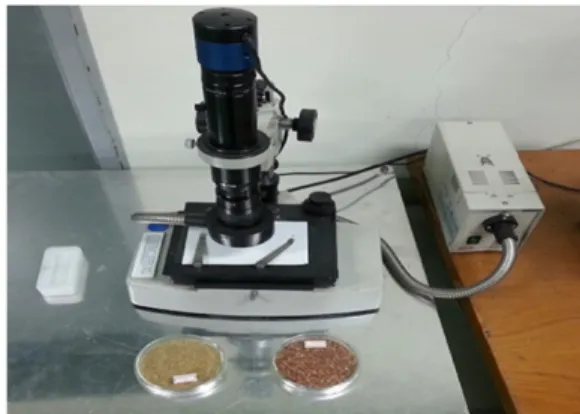
the seeding, the physical properties of the foxtail millet and sorghum were examined. The specific materials used in this study are ‘HwangKeum’ foxtail millet and ‘Nappungchal’ sorghum seeds. The seed shape, size, weight of 1,000 seeds, and fineness ratio reflecting the physical charac-teristics of foxtail millet and sorghum were measured during the design of the seed-metering system. The size of the seeds was determined through a random sampling of 100 foxtail millet and sorghum seeds. Used the multi-media imaging microscope (Scope 2001) was magnification 2.16 to 14 times and the camera had 130 mega pixels , as shown in Figure 1. After capturing the image of the seed, shown in Figure 2, using the multimedia image micro-scope, the length (L) and width (W) were measured using the calibration function, as indicated in Figure 3. The
Figure 1. Multimedia video microscope (Scope 2001).
(a) Calibration (Zero Point Setting) (b) Foxtail millet image Figure 2. Seed image observed in multimedia video microscope.
(a) Front view (b) Side view Figure 3. Measurement of seed size in foxtail millet and sorghum.
values of L and W were calculated from the measured fineness ratios. To determine the size distribution of the foxtail millet and sorghum seeds, a grain size analysis was conducted using testing sieves with mesh sizes of 7, 8, 10, 12, 14, 16, and 18, as shown in Figure 4. A grain size analysis was conducted using a sieve of a standardized mesh. Foxtail millet and sorghum seeds were passed through a standard netting in turn, and the weight percentage of the remaining seeds in the corpuscles was determined.
Foxtail millet and Sorghum Sowing Factor
Experiment
To investigate the design factors of the seed-metering device of the sowing machine, which can sow one to three small foxtail millet and sorghum seeds, a factor experiment of a groove roller-type device that can precisely sow such seeds was conducted.
Grooved-roller type seed-metering device is possible to control the amount of seeding changing the size of grooves. It is possible to control the size of the grooves of the transmission roller and regulate the amount of the seeds. A seed-metering roller was fabricated based on the size and shape of the seed-metering roller, and a sowing factor experiment was conducted.
Production of sowing factor test equipment
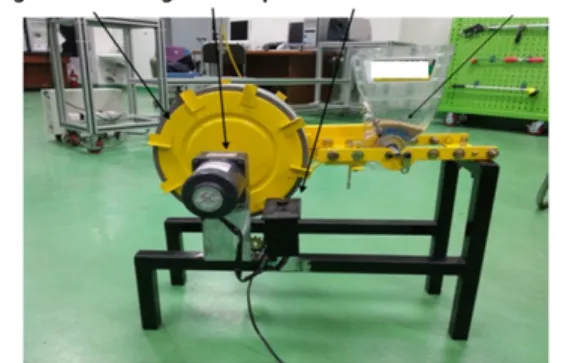
The equipment used in the sowing factor experiment was composed of a driving wheel, seed-metering device, drive motor, and speed controller, as shown in Figure 5. The driving motor driven to rotate the seed-metering rollers in the transmission section to sow the seeds in the transmission roller grooves. The specifications of the drive motor and speed controller are shown in Table 1.The diameter of the seed-metering roller was set to 60 mm in consideration of the transmission rollers of
currently available grooved roller seeders. A chain gear ratio of 13:11 was set for the drive wheel, and the seed-metering roller was set to six grooves for foxtail millet and four grooves for sorghum. The planting distance was 14 cm for foxtail millet and 21 cm for sorghum seeds.
As shown in Figure 6, the seed-metering roller grooves of the sowing factor test apparatus were modified to have a square shape or an elliptical shape in the longitudinal direction. Thus, one to three foxtail millet and sorghum
Table 1. Specifications of the motor and speed control unit used in the experimental device
Photo Item Specifications
Motor Model S8I25GE-V12 Company SPG Poles 4 Output 25 W Voltage 1∅ 220 V Freq. 60 Hz Speed Range 90–1,700 rpm Speed control unit ` Model SUA25lB-V12 Company SPG Voltage 1∅ 220 V Freq. 60 Hz Speed Regulation 5% Speed Range 90–1,700 rpm Range Temp.: 0–40°C RH: 0–85% Figure 4. Grain size analysis. Figure 5. Experimental device of seeding factors.
(a) Circle (b) Type A (square) (c) Type B (ellipse) Figure 6. Groove types of seed-metering roller.
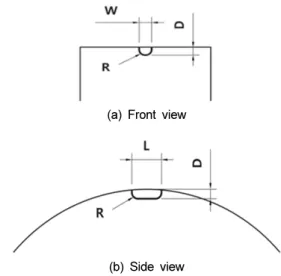
seeds were arranged in a row. In the case of a conven-tional circular seed-metering roller groove, as shown in Figure 6, more seeds are distributed between the gaps where the seeds are formed, and more seeds are separated and discharged than the target amount. The existing groove shape was improved in the L direction to minimize the gap between the seeds and to precisely control the desired seed amount. The main design parameters of the longitudinal seed-metering roller groove are shown in Figure 7.
In the figure, W represents the width of the groove, and should be somewhat larger than the unidirectional length of the foxtail millet and sorghum seeds, L represents the length of the groove and should be somewhat larger than the length of the desired amount of seeds arranged in a row in the longitudinal direction, D represents the depth of the groove and should be somewhat larger than the unidirectional length of the seeds, and R is the curvature of the groove, and prevents the seeds and foreign matter from sticking together. If the values of the above design variables are smaller than the suggested length, the seeding will be poor or the seed will be damaged, and if it is too large, the seeding accuracy will be decreased.
Sowing factor test
The width, length, and depth of the roller grooves for the factorial experiment were set in consideration of the main design parameters of the longitudinal roller seed metering roller grooves based on the physical properties of the foxtail millet and sorghum seeds. The curvature (R) preventing the foxtail millet seeds and foreign matter from sticking in the grooves is 0 for the square shape, and
1.0 for the elliptical shape. In the case of sorghum seeds, the factor according to the groove shape was added by setting 0 for a square shape and 1.5 for an ellipse. The width, length, depth, and shape factors of the seed- metering roller grooves are shown in Table 2, and the transmission rollers were manufactured using a total of 60 factors (24 for foxtail millet and 36 for sorghum).
Foxtail millet and sorghum seedlings were applied according to the sowing method, and based on an experi-ment conducted on a transplanting machine by the Agricultural Science and Technology Research Survey (Rural Development Administration, 2012). The sowing roller of the sowing factor test apparatus was rotated ten times at a speed of 127.4RPM, and the number of seeds discharged from each groove was measured. The results of this procedure were repeated three times, and the seeding performance of the foxtail millet and sorghum seeds was analyzed. A multivariate analysis of variance (MANOVA) was conducted using the SAS program (V. 9.2, SAS Institute, Cary, USA), and Duncan’s multiple test (p = 0.05) was used to test the level of significance between treatment types.
Results and Discussion
Physical properties of foxtail millet and
sorghum seeds
The measured L, W, and fineness ratio of foxtail millet and sorghum seeds are shown in Table 3. The weight of 1,000 seeds was measured as 2.43 g for foxtail millet and 17.5 g for sorghum. According to the shape, the fineness ratio of the seeds is 1.0–1.14 for circular, 1.14–1.33 for
(a) Front view
(b) Side view
Figure 7. Design factors of groove shape in roller-type metering device.
Table 2. Specifications of groove-type seed-metering roller used in the experimental device
Seed Width (mm) Length (mm) Depth (mm) Type Foxtail millet 2.0, 2.5 3.0, 4.0, 5.0 1.5, 2.0 Square, Ellipse Sorghum 4.0, 4.5 8.0, 8.5, 9.0 3.0, 3.5, 4.0 Square, Ellipse
Table 3. Physical properties of foxtail millet and sorghum
Seed Length (mm) Width (mm) L/W Ave Max Min S.D Ave Max Min S.D Ave Max Foxtail millet 2.11 2.87 1.71 0.24 1.64 1.99 1.26 0.12 1.3 1.7
short elliptical, 1.33–2.0 for elliptical, and 2.0 or more for long elliptical shapes (Choi, 1986). The average fineness ratio is 1.3 for foxtail millet, and 1.1 for sorghum. The foxtail millet has a short elliptical shape, and the sorghum is close to circular; however, when considering the maximum value, all shapes are elliptical, with 1.7 for foxtail millet and 1.4 for sorghum.
The results of the particle size distribution of foxtail millet and sorghum based on a grain size analysis are shown in Figure 8. As the analysis results show, the particle size distribution of foxtail millet is fine, with
approximately 97% of the seeds remaining when applying a 1.4 mm mesh. In the case of sorghum, 52% of the seeds remained for a 2.8 mm mesh, whereas 35% remained for a 2.36 mm mesh. The particle size distribution of sorghum was not irregular. In the seed size analysis, the deviation in L and W of sorghum was higher than that of the foxtail millet. The difference between the maximum and minimum values of L and W was about 1.0 mm for foxtail millet, and 1.5 mm for sorghum. The results of the particle size analysis show that the grain size was not uniform, and that the variation in grain size was high owing to the grain size distribution.
Factor test results
Sowing performance of foxtail millet
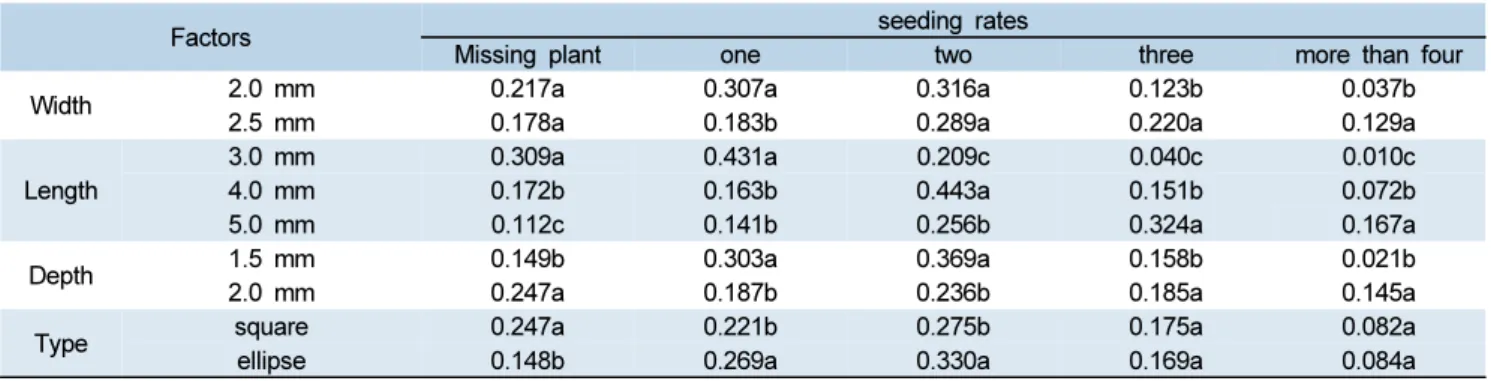
A MANOVA was conducted using the GLM model of the SAS program. The results of Duncan’s significance test are shown in Table 4. As a result of multivariate analysis of miss-planted rate, one grain sowing rate, two grains sowing rate, three grains sowing rate and four grains sowing rate. It was determined that there is a significant difference between the seed-metering roller groove and the sowing rate. The length, depth, and shape factors of the seed-metering roller grooves affect the concave ratio. The effect of the width factor on the receding rate was analyzed to be low. For a seeding rate of over four grains, the width, length, and depth factors were affected. The shape of the grooves was determined to be a factor of low significance.
As a result of the experiment on the sowing type according to factors such as the width, length, depth, and square/elliptical shapes, the best sowing performance was for a low yield rate, with a low seeding rate of four grains or more, or a high seeding rate of one to three grains. When the groove of the seed-metering roller had an elliptical width of 2.0 mm, a length of 4.0 mm, and a
(a) Foxtail millet
(b) Sorghum
Figure 8. Seed size distribution based on grain size analysis results for foxtail millet and sorghum.
Table 4. Duncan’s multiple range test results on seeding rates of foxtail millet based on seed-metering roller groove factors
Factors seeding rates
Missing plant one two three more than four Width 2.0 mm 0.217a 0.307a 0.316a 0.123b 0.037b
2.5 mm 0.178a 0.183b 0.289a 0.220a 0.129a
Length
3.0 mm 0.309a 0.431a 0.209c 0.040c 0.010c 4.0 mm 0.172b 0.163b 0.443a 0.151b 0.072b 5.0 mm 0.112c 0.141b 0.256b 0.324a 0.167a Depth 1.5 mm 0.149b 0.303a 0.369a 0.158b 0.021b 2.0 mm 0.247a 0.187b 0.236b 0.185a 0.145a
Type square 0.247a 0.221b 0.275b 0.175a 0.082a
ellipse 0.148b 0.269a 0.330a 0.169a 0.084a * Duncan’s multiple range test (p = 0.05)
depth of 1.5 mm, the seeding rate for one to three grains was 95.6% (20.6% for one grain, 72.8% for two grains, and 2.2% for three grains). In addition, the best sowing rate was 0% for four or more grains (Fig. 9).
Sorghum sowing performance
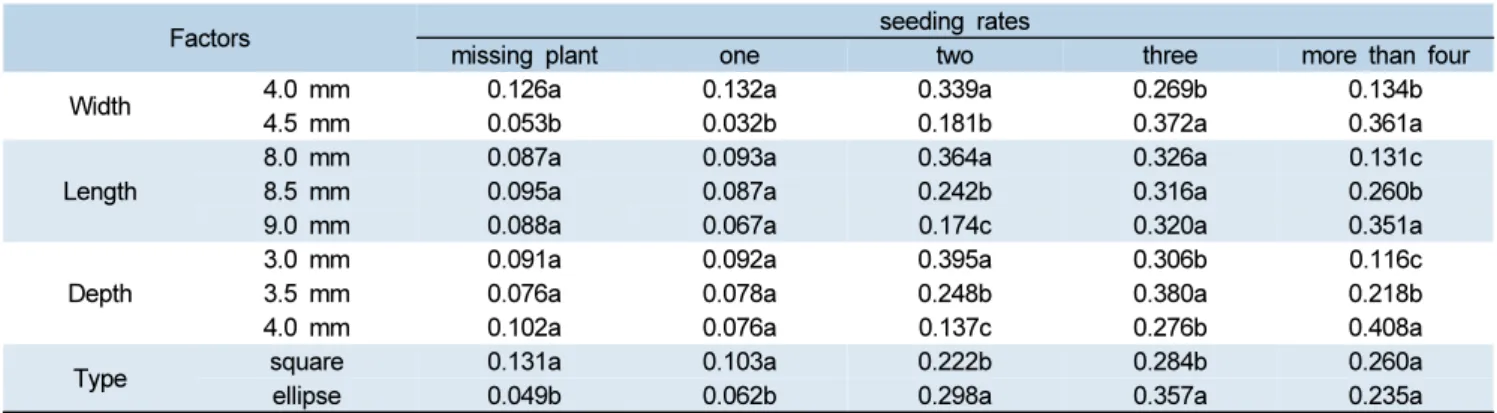
An analysis of the significance of the sorghum seeding test results was based on the width, length, depth, and shape of the seed-metering roller grooves. The MANOVA was conducted using the ANOVA analysis GLM model of the SAS program. The results of Duncan’s significance test are shown in Table 5. The results of the MANOVA on the missed planting rate, and one-, two-, three-, and four- grain or more sowing rates are described here. There is a difference in the sowing rate depending on the factors of the seed-metering roller groove. In particular, the R2 values of the two- and four-grain sowing rates were 0.86 and 0.93. All models were found to be highly significant. In the case of the missed planting rate, the width and shape of the seed-metering roller grooves were factors of influence. The effects of the length and depth factors on the cut-off rate were low.
The results of the sowing experiment according to the width, length, depth, and square/elliptical shapes of the seed-metering roller grooves are shown in the graph in Figure 10. The best sowing performance was shown for a low yield rate, with a low seeding rate of four grains or more, or a high seeding rate of one to three grains. The analysis showed that an elliptical width of 4.0 mm, length of 8.0 mm, and depth of 3.0 mm of the grooves resulted in a seeding rate of 95.8% for one to three seeds (10.8% for one grain, 70.8% for two grains, and 14.2% for three grains), and 0% for four or more grains, whereas an elliptical width of 4.5 mm, length of 8.0 mm, and depth of
Figure 9. Results based on groove type of metering roller for foxtail millet planting tests (width, length, and depth).
Table 5. Duncan’s multiple range test results of seeding rates for sorghum based on seed-metering roller groove factors
Factors seeding rates
missing plant one two three more than four Width 4.0 mm 0.126a 0.132a 0.339a 0.269b 0.134b
4.5 mm 0.053b 0.032b 0.181b 0.372a 0.361a
Length
8.0 mm 0.087a 0.093a 0.364a 0.326a 0.131c 8.5 mm 0.095a 0.087a 0.242b 0.316a 0.260b 9.0 mm 0.088a 0.067a 0.174c 0.320a 0.351a
Depth
3.0 mm 0.091a 0.092a 0.395a 0.306b 0.116c 3.5 mm 0.076a 0.078a 0.248b 0.380a 0.218b 4.0 mm 0.102a 0.076a 0.137c 0.276b 0.408a Type square 0.131a 0.103a 0.222b 0.284b 0.260a ellipse 0.049b 0.062b 0.298a 0.357a 0.235a * Duncan’s multiple range test (p = 0.05)
3.0 mm of the grooves resulted in a sowing rate of 99.2% for one to three grains (2.5% for one grain, 65.0% for two grains, and 31.7% for three grains), a missed planting rate of 0%, and a sowing rate of 0.8% for four or more grains.
Conclusions
In this study, we attempted to determine the main factors for the design of seed-metering rollers of grooved sowing planters to mechanize the sowing of foxtail millet
and sorghum seeds. During our experiment, foxtail millet showed a hill spacing of 14 cm, and sorghum demon-strated a hill spacing of 21 cm. A seed-metering roller was designed to sow one to three apple and orange seeds as a preparation for the test apparatus. The width, length, depth, and shape of grooves were considered as design factors of the seed-metering roller. The sowing factor experiment was designed such that when the trans-mission roller was rotated, the seeds of the foxtail millet and sorghum passed through the grooves of the seed- metering roller, and the seed-metering roller was replaced by this factor. The results of this experiment are as follows. The shape of the roller grooves had a significant effect on reducing the missed planting rate by protecting the seeds from becoming stuck in a screw when the groove was elliptical. In the case of the foxtail millet, the length, depth, and shape factors of the seed- metering roller grooves affected the missed planting rate. In particular, when the groove shape was elliptical, the missed planting rate was about two times lower. In the case of sorghum, the width and shape factors of the seed-metering roller grooves affected the missed planting rate. When the shape of the groove was elliptical, the missed planting rate was about three times lower.
To sow one to three foxtail millet and sorghum seeds, the following factors of the seed-metering roller grooves were shown. An elliptical shape with a width of 2 mm, length of 4 mm, and depth of 1.5 mm was found to be good for foxtail millet. In addition, an elliptical shape with a width of 4 mm, length of 8 mm, and depth of 3 mm, or a width of 4.5 mm, a length of 8 mm, and a depth of 3 mm, was found to be good for sorghum seeds.
Conflict of Interest
The authors have no conflicting financial or other interests.
Acknowledgement
This study was undertaken with the support of “Research Program for Agricultural Science & Technology Development(Project No PJ011807012018)”, National Institute of Agricultural Science, Rural Development Administration, Republic of Korea.
Figure 10. Results based on groove type for metering roller in sorghum planting tests (width, length, and depth).
References
Choi, B. H. 1986. The possibility of foddering of millet. REM0031043. Jeonju, Republic of Korea: Rural Develop-ment Administration.
Choi, I. S., H. J. Jun, Y. Choi, Y. K. Kim, T. K. Kang and C. S. Hyun. 2015. Development of seeder for foxtail millet & sorghum. In: Proceedings of the KSAM&KSBEC 2015 Spring Conference, pp. 109-110, Jeonju, Republic of Korea: April 2015 (in Korean).
Choi, I. S., S. O. Chung, H. J. Jun, Y. Choi, D. K. Choi, T. G. Kang, C. S. Hyun and C. K. Lee. 2014. Adaptability test of the existing seeder in Foxtail millet & Sorghum. CNU Journal of Agricultural Science 41(4): 259-264 (In Korean, with English abstract).
http://dx.doi.org/10.7744/cnujas.2014.41.4.259 Jung, K. Y., D. K. Kim, K. S. Lee and S. O. Chung. 2012.
Development of Cultivation Techniques for Enhancing Productivity of Cereal Crops. v. 2011. Suwon. Republic of Korea: Rural Development Administration National Institute of Crop Science (In Korea).
Lee, J. M., S. H. Yang, S. B. Shim, Y. J. Kim, W. K. Kim and J. W. Ha. 2014. Dynamics simulation of a garlic metering device of rotating disk-and-gripper type. In: Proceedings of the KSAM 2014 Autumn Conference, 19(2): pp.
100-101, Cheonan, Republic of Korea: October 2014 (in Korean).
Ministry for Food, Agriculture, Forestry and Fisheries. 2012. 7th Agricultrual Mechanization Master Plan. Sejing. Republic of Korea: Ministry for Food, Agriculture, Forestry and Fisheries (in Korean).
Rhee, J. Y., J. S. Hwang, C. J. Chung, H. J. Kim. 2000. Morphological analysis of seed for seeder design. In: Proceedings of the KSAM 2000 Spring Conference, 5(1): pp. 7-11, Suwon, Republic of Korea: February 2000 (in Korean).
Rural Development Administraion. 2012. Research Analysis Criteria about Agricultural Science and Technology. 5. Suwon. Republic of Korea: Rural Development Administraion (in Korean).
Ryu, I. H. and K. U. Kim. 1997. Design of roller-type metering device for precision planting. Journal of the Korean Society for Agricultural Machinery 22(4): 401-410 (In Korean, with English abstract).
Yang, S. H., Y. J. K im and J. W. Lee. 2014. Metering performance of vacuum-type metering device according to vacuum pressure and revolution speed of metering disk. In: Proceedings of the KSAM 2014 Spring Conference, 19(1): pp. 159-160, Jeonju, Republic of Korea: April 2014 (in Korean).