서 론
식품알레르기(food allergy)는 특정 식품에 노출된 후 특이 면역 반응에 의해 일어나는 비정상적인 유해반응이다.1 최근 많은 연구 들에서 식품알레르기의 유병률이 증가하면서 사회 경제적 부담도 같이 증가한다고 보고하고 있다.2,3 그러나 식품알레르기의 진단 기 준, 연구 대상군의 나이와 지역의 다양성, 식습관의 차이, 연구 방법 의 차이 등 여러 가지 변수로 인하여 식품알레르기의 정확한 유병 률을 파악하고 지역 간, 혹은 연령 간 유병률을 비교하는 것은 어려 운 실정이다. 또한 식품알레르기를 진단하는 가장 정확한 방법은경구유발시험(oral food challenge)이지만 시간과 노력은 많이 들고
검사 중에 부작용도 나타날 수 있어 실제 대규모 역학 연구에서는
제한적으로 사용되고 있고, 자가보고 혹은 보호자들이 작성한 설
문지를 통한 조사나 피부단자시험 혹은 특이 면역글로불린 E를 측
Allergy Asthma Respir Dis 6(1):4-13, January 2018 https://doi.org/10.4168/aard.2018.6.1.4
REVIEW
Correspondence to: So-Yeon Lee https://orcid.org/0000-0002-2499-0702 Department of Pediatrics, Childhood Asthma Atopy Center, Environmental Health Center, Asan Medical Center, 88 Olympic-ro 43-gil, Songpa-gu, Seoul 05505, Korea
Tel: +82-2-3010-3386, Fax: +82-2-473-3725, E-mail: [email protected] Received: June 14, 2017 Revised: July 24, 2017 Accepted: July 24, 2017
© 2018 The Korean Academy of Pediatric Allergy and Respiratory Disease The Korean Academy of Asthma, Allergy and Clinical Immunology
This is an Open Access article distributed under the terms of the Creative Commons Attribution Non-Commercial License
국내 소아 식품알레르기의 역학
민택기,1 편복양,1 김현희,2 박용민,3 장광천,4김혜영,5 염혜영,6 김지현,7 안강모,7 이수영,8 김경원,9 김윤희,9 이정민,10 김우경,11 송태원,12 김정희,13 이용주,14 전유훈,15 이소연;16 대한 소아알레르기 호흡기학회 식품알레르기 아토피피부염 연구회 1순천향대학교 의과대학 소아과학교실, 2가톨릭대학교 의과대학 소아과학교실, 3건국대학교 의학전문대학원 소아과학교실, 4국민건강보험 일산병원 소아청소년과, 5부산대학교 의과대학 소아과학교실, 6서울의료원 소아청소년과, 7성균관대학교 의과대학 삼성서울병원 소아청소년과, 8아주대학교 의과대학 소아과학교실, 9연세대학교 의과대학 소아과학교실, 10연세대학교 원주의과대학 소아과학교실, 11인제대학교 의과대학 서울백병원 소아청소년과, 12인제대학교 의과대학 일산백병원 소아청소년과, 13인하대학교 의과대학 소아과학교실, 14한림대학교 강남성심병원 소아청소년과, 15한림대학교 동탄성심병원 소아청소년과, 16서울아산병원 소아청소년과Epidemiology of food allergy in Korean children
Taek Ki Min,1 Bok Yang Pyun,1 Hyun Hee Kim,2 Yong-Mean Park,3 Gwang Cheon Jang,4 Hye-Young Kim,5 Hye Yung Yum,6 Jihyun Kim,7
Kangmo Ahn,7 Sooyoung Lee,8 Kyung Won Kim,9 Yoon Hee Kim,9 Jeong-Min Lee,10 Woo Kyung Kim,11 Tae Won Song,12 Jeong Hee Kim,13
Yong Ju Lee,14 You Hoon Jeon,15 So-Yeon Lee;16 Korean Academy of Pediatric Allergy & Respiratory Diseases Food Allergy and Atopic
Dermatitis Study Group
1Department of Pediatrics, Soonchunhyang University Hospital, Seoul; 2Department of Pediatrics, The Catholic University of Korea College of Medicine, Seoul; 3Department of Pediatrics, Konkuk University School of Medicine, Seoul; 4Department of Pediatrics, National Health Insurance Service Ilsan Hospital, Goyang; 5Department of Pediatrics, Pusan National University School of Medicine, Yangsan; 6Department of Pediatrics, Seoul Medical Center, Seoul; 7Department of Pediatrics, Samsung Medical Center, Sungkyunkwan University School of Medicine, Seoul; 8Department of Pediatrics, Ajou University School of Medicine, Suwon; 9Department of Pediatrics, Yonsei University College of Medicine, Seoul; 10Department of Pediatrics, Yonsei University Wonju College of Medicine, Wonju; 11Department of Pediatrics, Inje University Seoul Paik Hospital, Inje University College of Medicine, Seoul; 12Department of Pediatrics, Inje University Ilsan Paik Hospital, Inje University College of Medicine, Goyang; 13Department of Pediatrics, Inha University College of Medicine, Incheon; 14Department of Pediatrics, Hallym University Kangnam Sacred Heart Hospital, Seoul; 15Department of Pediatrics, Hallym University Dongtan Sacred Heart Hospital, Hwaseong; 16Department of Pediatrics, Childhood Asthma Atopy Center, Environmental Health Center, Asan Medical Center, Seoul, Korea
Food allergy has emerged as an important public health problem affecting people of all ages in many countries. The prevalence var-ies according to age, geographic regions, and ethnicity. For several years, many studvar-ies have suggested that the prevalence of food allergy is increasing at an alarming rate, for unclear reasons. Conversely, some studies have also provided findings that sensitization to common food allergens did not increase. Increased recognition rather than an actual increase in patients with IgE-mediated food allergy might lead to the increases in the prevalence of self-reported or physician-diagnosed food allergy. It is also noted that the prevalence of food allergy differs even in the same region according to the study design, i.e., hospital-based or community-based studies. Despite these limitations, epidemiologic data are important because they provide useful information on diagnosis, treat-ment, and prevention of food allergy. This review focuses on advances in the epidemiology of food allergy in Korean children. (Allergy Asthma Respir Dis 2018;6:4-13)
Keywords: Food allergy, Epidemiology, Child
2017-03-16 https://crossmark-cdn.crossref.org/widget/v2.0/logos/CROSSMARK_Color_square.svg
정하여 식품에 대한 감작 여부를 조사하여 식품알레르기 유병률 을 조사한 연구들이 많다.4-7 이런 제한점에도 불구하고 유병률을 포함한 역학 자료들은 식품알레르기의 진단, 치료, 예방에 있어서 여러 가지 유익한 정보를 제공하므로 중요하다. 이 논문에서는 식 품알레르기 유병률과 원인 식품별 자연 경과에 관련된 국내외 연 구들을 정리하였고, 최대한 국내의 자료들을 많이 수집하여 국내 식품알레르기 역학의 변화를 살펴보고자 하였다.
국내 소아의 식품알레르기 유병률
식품알레르기의 중요성에 대한 인식이 향상되면서 국내에서도 유병률에 관한 많은 조사가 있었다. 그러나 유병률을 비교하기 위 해서는 나이, 성별 등 연구 대상의 인구학적 특성이 비슷해야 하고, 진단 방법과 연구 방법이 같아야 한다. 일반적으로 환자나 보호자 를 대상으로 한 설문조사 연구가 병력과 감작 여부를 함께 조사하 거나 경구유발시험으로 조사한 연구보다 유병률이 높게 나타난 다.8 부모에 대한 설문조사에서 식품알레르기가 있다고 확인된 아 이들 중 경구유발시험에서 확진되는 경우는 20%에 불과하였다.9 따라서 식품알레르기의 유병률을 이해할 때는 조사된 연령과 식품 알레르기 진단 방법을 고려해야 한다. 국내에서 시행된 식품알레르기 유병률에 관한 대표적인 연구는 ‘국제 소아천식 및 알레르기질환의 역학조사(International Studyof Asthma and Allergies in Childhood, ISAAC)’의 일환으로 대한
소아알레르기 호흡기학회가 주관이 되어 1995년과 2000년 각각 시
행한 ‘한국 어린이, 청소년의 알레르기질환에 관한 전국적 역학조 사(Nationwide Study of Asthma and Allergies in Korean
Chil-dren)’이다.10 이 연구에서 “일생 동안 한 번이라도 식품알레르기 증 상이 나타난 경우”는 초등학생은 1995년 10.9%, 2000년 8.9%였으 며, 중학생은 1995년 11.3%, 2000년 12.6%였다. “일생 동안 한 번이 라도 식품알레르기로 진단”받은 유병률은 초등학생 1995년 4.2%, 2000년 4.7%였으며, 중학생 1995년 3.8%, 2000년 5.1%였다. “최근 12개월 내 식품알레르기 증상이 있는 경우”는 초등학생은 1995년 6.5%, 2000년 5.7%였으며, 중학생은 1995년 7.4%, 2000년 8.6%였 다. “최근 12개월 내에 식품알레르기로 치료를 받은 경우”는 초등 학생은 1995년 2.7%, 2000년 2.6%였으며, 중학생은 1995년 2.0%, 2000년 2.1%였다. 2010년 ISAAC Phase III의 일부로 6–7세 초등학 교 1학년 3,907명과 12–13세 중학교 1학년 3,975명을 대상으로 단 면조사연구(cross-sectional study)가 시행되었으며, 설문으로 조사 된 “일생 동안 식품알레르기 증상” 유병률은 초등학생 15.0%, 중 학생 12.5%, “현재 식품알레르기(현재 식품제한을 하고 있는 경 우)” 유병률은 초등학생 3.3%, 중학생 4.5%였으며, 즉시형 식품알 레르기로 확인된(병력과 ImmunoCAP 검사에서 특이 면역글로불 린 E>0.35 kU/L인 경우) 유병률은 각각 초등학생 0.3%와 중학생 0.6%로 나타났다.11 그러나 이 연구에서는 의심되는 항원에 대한 검 사가 모두 이루어지지 않았고 검사 결과가 위음성일 가능성이 있어 다른 연구보다 상대적으로 유병률이 낮게 조사된 것으로 판단된 다. 2012년에는 Lee 등12이 전국의 초∙중∙고 학생들을 대상으로 수 정 보완된 ISSAC 설문지를 이용하여 27,679명의 자료를 분석한 결 과, 일생 동안 증상 유병률과 진단 유병률은 12.6%, 6.8%였다. 최근 에 Kim 등13이 전국의 초∙중∙고 학생들을 대상으로 설문조사를 이 용한 단면조사연구에서는 일생 동안 증상 유병률 15.8%, 현재 즉시 형 식품알레르기(식품 섭취 후 4시간 이내에 증상 발생하는 현상이 반복되어 현재 제한하고 있는 경우) 유병률은 4.1%로 조사되었다. 전국적인 조사가 아닌 지역단위 조사의 경우, ISAAC 설문지를 이 용하여 2008년 Lee 등14이 제주지역의 학동전기, 초∙중∙고 학생들 을 대상으로 한 단면조사연구에서는 일생 동안 증상 유병률과 진 단 유병률은 각각 8.5%, 4.8%였고, 2010년 Jung 등15이 수도권 지역 의 어린이집 유아를 대상으로 한 연구에서는 21.0%, 6.1%, 2011년 Park 등16이 부천지역 초등학생을 대상으로 시행한 연구에서는 16.8%, 3.3%로 나타났다. 다른 방법으로 시행된 연구로는 2006– 2007년에 Kim 등17이 시행한 출생 코호트 연구에서 문진을 통한 추적 관찰 중에 반복적으로 식품 섭취 후 2시간 이내에 증상이 나 타나는 것을 즉시형 식품알레르기로 진단한 결과 생후 1년간 5.3% 의 유병률을 보였고, 2011년 Park 등18이 서울시내 0–6세 16,749명 을 대상으로 설문조사를 이용한 단면조사연구에서는 일생 동안 증상 유병률 15.1%, 진단 유병률 2.0%, 일생 동안 즉시형 식품알레 르기(반복적으로 식품 섭취 후 4시간 이내에 증상 발생하는 경우) 유병률은 7.0%로 조사되었다. 우리나라에서 시행된 식품알레르기 의 유병률에 대한 주요 연구를 나이, 조사 방법, 항원 등을 고려하 여 “일생 동안”으로 조사된 내용은 Table 1에, “최근 12개월 혹은 현재”로 조사된 내용은 Table 2에 정리하였다.
식품알레르기의 유병률이 증가하고 있는가?
식품알레르기의 유병률의 변화를 정확하게 보려면 같은 연령대 의 아이들에게서 같은 조사 방법을 적용하여 비교해야 하지만 외 국에서도 식품알레르기 유병률의 변화를 동일한 집단에서 같은 방 법으로 본 연구는 드물다. Branum과 Lukacs19는 미국의 1997–2007 National Health Interview Survey (NHIS)를 분석하여 2007 년 18세 미만 소아청소년의 식품알레르기 유병률이 20년간 3.3%에 서 3.9%로 18% 증가하였고, 1993–2006년 National Hospital Am-bulatory Medical Care Survey 진단코드 자료를 기반으로 외래 진
료 방문이 3배 증가하였다고 보고했다. Jackson 등20은 2009–2011
년 NHIS 자료를 추가 분석하여 5.1%까지 증가하였다고 발표했다.
Keet 등5은 미국에서 발표된 자가보고에 의한 식품알레르기 유병
Table 1.
Summary of studies on prevalence of ever having food allergy in Korean children
Study Area Study design Definition Participants Age (yr) Prevalence (%) Oh et al. 10 2004 8 Cities Cross-sectional Questionnaire 40,429 in 1995 6–15 Symptoms: 6–12 yr (10.9 in 1995 and 8.9 in 2000) ‘Symptom, ever’ 42,202 in 2000 12–15 yr (11.3 in 1995 and 12.6 in 2000) ‘Diagnosis, ever’
Diagnosis: 6–12 yr (4.2 in 1995 and 4.7 in 2000) 12–15 yr (3.8 in 1995 and 5.1 in 2000)
Jung et al. 15 2011 3 Cities Cross-sectional Questionnaire 919 in 2010 1–8
Symptoms: 21.0 (egg, 5.0; milk, 3.2)
‘Symptom, ever’
Diagnosis: 6.1
‘Diagnosis, ever’
Ahn et al.
11 2012
Across the nation
Cross-sectional Questionnaire 7,882 in 2010 6–7 and 12–13 15.0 in 6–7 yr and 12.5 in 12–13 yr ‘Perceived, ever’ Lee et al. 14 2012 Jeju Cross-sectional Questionnaire 25,024 in 2008 0–18 Symptoms: 8.5 ‘Symptom, ever’ Diagnosis: 4.8 ‘Diagnosis, ever’ Lee et al. 12 2013 16 Cities Cross-sectional Questionnaire 27,679 in 2012 6–18
Symptoms: 12.6 (egg, 2.8; milk, 1.7)
‘Symptom, ever’ Diagnosis: 6.8 ‘Diagnosis, ever’ Park et al. 16 2013 Bucheon Cross-sectional Questionnaire 1,929 in 2011 6–12
Symptoms: 16.8 (egg, 3.3; milk, 2.2)
‘Symptom, ever’
Diagnosis: 3.3 (egg, 1.5; milk, 1.0)
‘Diagnosis, ever’ Park et al. 18 2014 Seoul Cross-sectional Questionnaire 16,982 in 2011 0–6 Symptoms: 15.1 ‘Symptom, ever’ Diagnosis: 2.0 ‘Diagnosis, ever’ Immediate-type: 7.0 ‘Immediate-type, ever’ Kim et al. 22 2016 Seoul Cross-sectional Questionnaire 7,963 in 1995 6–12 Symptoms: 13.1 in 1995, 9.5 in 2000, 12.0 in 2005, 11.2 in 2008, 14.4 in 2012 ‘Symptom, ever’ 7,971 in 2000 Diagnosis: 4.6 in 1995, 5.2 in 2000, 6.4 in 2005, 5.5 in 2008, 6.6 in 2012 ‘Diagnosis, ever’ 7,131 in 2005 3,975 in 2008 3,307 in 2012 Kim et al. 13 2017
Across the nation
Cross-sectional Questionnaire 29,842 in 2015 6–16 Symptoms: 15.8 ‘Symptom, ever’
Table 2.
Summary of studies on prevalence of current food allergy in Korean children
Study Area Study design Definition Participants Age Prevalence (%) Oh et al. 10 2004 8 Cities Cross-sectional Questionnaire 40,429 in 1995 6–15 yr Symptoms: 6–12 yr (6.5 in 1995 and 5.7 in 2000)
‘Symptom, last 12 mo’
42,202 in 2000
12–15 yr (7.4 in 1995 and 8.6 in 2000)
‘Treatment, last 12 mo’
Treatment: 6–12 yr (2.7 in 1995 and 2.6 in 2000) 12–15 yr (2.0 in 1995 and 2.1 in 2000)
Jung et al. 15 2011 3 Cities Cross-sectional Questionnaire 919 in 2010 1–8 yr Symptoms: 10.6
‘Symptom, last 12 mo’
Treatment: 3.6
‘Treatment, last 12 mo’
Kim et al. 17 2011 Seoul Birth cohort Questionnaire by allergist 1,177 in 2006–2007 0–12 mo
Symptoms: 5.3 (egg, 2.8; milk, 1.7)
Ahn et al.
11 2012
Across the nation
Cross-sectional Questionnaire 7,882 in 2010 6–7 and 1: 3.3 in 6–7 yr and 4.5 in 12–13 yr 1.‘Perceived, current’ 2–13 yr 2: 0.3 in 6–7 yr and 0.6 in 12–13 yr
(Restriction, until now) 2. Confirmed immediate-type
Lee et al. 14 2012 Jeju Cross-sectional Questionnaire 25,024 in 2008 0–18 yr Symptoms: 4.6
‘Symptom, last 12 mo’
Treatment: 2.2
‘Treatment, last 12 mo’
Lee et al. 12 2013 16 Cities Cross-sectional Questionnaire 27,679 in 2012 6–18 yr Symptoms: 7.6
‘Symptom, last 12 mo’
Treatment: 2.6
‘Treatment, last 12 mo’
Park et al. 16 2013 Bucheon Cross-sectional Questionnaire 1,929 in 2011 6–12 yr Symptoms: 1.9
‘Symptom, last 12 mo’
Restriction: 3.9 (egg, 0.6; milk, 0.9)
‘Restriction, until now’
Park et al.
18 2014
Seoul
Cross-sectional
Questionnaire ‘Immediate-type, current’ (Restriction, until now)
16,982 in 2011 0–6 yr 3.7 (egg, 0.7; milk, 0.5) Kim et al. 22 2016 Seoul Cross-sectional Questionnaire 7,963 in 1995 6–12 yr Symptoms: 7.7 in 1995, 5.9 in 2000, 7.6 in 2005, 7.4 in 2008, 5.7 in 2012
‘Symptom, last 12 mo’
7,971 in 2000
Treatment: 2.9 in 1995, 2.7 in 2000, 2.8 in 2005, 2.4 in 2008, not available in 2012
‘Treatment, last 12 mo’
7,131 in 2005 3,975 in 2008 3,307 in 2012
Kim et al.
13 2017
Across the nation
Cross-sectional
Questionnaire
29,842 in 2015
6–16 yr
4.1 (egg, 0.21; milk, 0.18)
고 보고하였다. 그러나 이러한 설문지와 자가보고를 기반으로 한 결과들을 비교할 때는 설문지 문항의 차이와 함께 식품알레르기에 대한 인식이 증가하면서 인위적으로 유병률이 증가한 것처럼 평가 될 가능성을 생각해야 한다. 식품알레르기를 진단하는 가장 정확 한 방법인 경구유발시험을 이용한 유병률 조사는 대규모로 시행하 기 어렵지만 Osborne 등4이 호주에서 12개월 영아를 대상으로 시 행한 인구기반 연구에서 경구유발시험으로 진단된 유병률은 10.4%로 보고하였다. Hu 등21은 중국의 한 도시에서 1999년과 2009 년 각각 0–24개월 소아를 대상으로 두 번의 단면조사연구를 시행 하였고, 경구유발시험으로 진단된 유병률은 3.5%에서 7.7%로 증가 하였다. 최근에 우리나라에서 시행된 연구는 1995년부터 2012년까 지 ISAAC 설문지를 이용하여 시행한 역학조사 자료를 분석하여 국내 서울지역 초등학생의 식품알레르기 유병률의 변화를 보았으 며, 진단 유병률은 1995년 4.6%, 2000년 5.2%, 2005년 6.4%, 2008 년 5.5%, 2012년 6.6%로 전체적으로 조사 연도 경과에 따라 유병률 이 증가하는 경향을 보였다.22 국내외에서 식품알레르기 유병률이 증가하는 이유로는 위생가설과 장내 마이크로바이옴, 이유식의 시 작 시기, 낮은 비타민 D 농도, 항생제 노출과 식단의 변화 등이 추정 되고 있지만 아직 정확한 요인을 제시하지 못하고 있다.23,24 반면에 식품알레르기 증가에 대한 다른 시각을 보여주는 연구가
최근 보고되었다. McGowan 등7은 National Health and Nutrition-al Examination Survey (NHANES) III (1988–1994)와 NHANES 2005–2006에서 수집된 검체에서 ImmunoCAP을 이용하여 땅콩, 우유, 계란, 새우에 대한 감작률을 비교 분석한 결과 감작률이 24.3%와 21.6%로 유사하게 나타났다. 항원 감작만으로 식품알레 르기를 진단하기 어려운 점을 감안하더라도 이러한 결과는 최근의 유병률 증가가 대중들과 의사들의 질병에 대한 인식 증가 때문일 가능성을 제시하고 있다.
식품 항원별 유병률과 자연 경과
1. 계란 계란 알레르기는 흔한 식품알레르기 중 하나이며 우리나라에서 는 0.7%–5.0%까지 다양하게 보고되고 있으나,12,15-18 외국에서는 0.3%–2.5% 정도의 유병률이 보고되고 있다.6,25-27 설문을 이용한 연 구에서 Lee 등12의 조사에서는 계란에 대한 증상 유병률과 진단 유 병률은 각각 2.8%, 0.7%, Jung 등15의 조사에서는 증상 유병률이 5.0%, Park 등16의 조사에서는 증상 유병률과 진단 유병률은 3.3%, 1.5%였다. Kim 등17의 출생 코호트를 이용한 조사에서 증상 유병 률이 2.8%였고, Park 등18이 조사한 즉시형 반응의 유병률은 0.7% 로 다른 연구에 비해 낮게 조사되었으나, 국내 모든 연구에서 계란 알레르기는 우유 알레르기보다 높은 유병률을 보였다. 대부분의 계란 알레르기는 생후 첫 1년 동안 발생하며,28 계란 알 레르기의 자연 경과를 조사하기 위해 많은 전향적 연구들이 시행 되었다.29-31 대부분 취학연령이 되면 호전된다고 알려져 있지만,32 최근 연구들에서는 소실되는 시기가 우유 알레르기와 유사하게 점 점 늦어지고 있다. Savage 등33은 후향적 의무기록분석 연구를 통해 6세까지 12%, 10세까지 37%, 16세까지 68%의 아이들이 호전되었 다고 보고하였다. 우리나라에서 아토피피부염 환자 중 계란 알레르 기가 있는 환자들을 대상으로 한 연구에서 계란 알레르기가 소실 되는 중위 연령(median age)은 4세였고, 3세까지 41%, 5세까지 60%에서 소실되었다.31 가장 최근에 미국에서 시행된 다기관 코호 트 연구에서는 6세에 약 49.3% 환자들에서 계란 알레르기가 호전 되었다고 보고하였다.34 우유와 마찬가지로 계란을 가열하는 정도와 시간은 계란의 항 원성을 감소시킬 수 있다.35 조리되지 않은 계란에 반응하는 소아들 중 일부는 머핀이나 와플과 같은 형태의 가열된 계란에는 면역관 용을 보일 수 있고,36,37 최근에는 가열된 계란의 빈번한 섭취가 일반 적인 계란에 대한 면역관용을 촉진시킬 수 있다고 보고한 전향적 인 연구들도 있다.38,39 2. 우유 우유는 소아기 식품알레르기 중에서 가장 흔한 원인 중 하나로 부모들을 대상으로 한 조사에 의하면 유병률은 외국에서 2.5%– 3.8%,6,40 우리나라에서는 0.5%–3.2%로 보고되고 있고,12,15-18 소아 기 식품알레르기 원인 중 20%에 이른다.41 2012년에 Lee 등12이 전국 의 초∙중∙고 학생들을 대상으로 시행한 설문조사에서 우유에 대 한 증상 유병률과 진단 유병률은 각각 1.7%, 0.5%, 2010년 Jung 등15 이 수도권 지역의 어린이집 유아를 대상으로 한 조사에서는 증상 유병률 3.2%, 2011년 Park 등16이 부천지역 초등학생을 대상으로 시 행한 조사에서는 증상 유병률과 진단 유병률은 2.2%, 1.0%였다. 2006–2007년에 Kim 등17이 생후 12개월까지 추적 관찰한 출생 코 호트 연구에서 전화 설문을 이용하여 조사한 결과 증상 유병률이 1.7%였고, 2011년 Park 등18이 서울시내 취학 전 유소아를 대상으로 한 설문조사에서 즉시형 반응의 유병률은 0.5%로 다른 연구에 비 해 낮았다. 과거 연구들에 따르면 대부분의 우유 알레르기는 생후 1세 이전 에 시작되어,28 계란 알레르기와 유사하게 3–6세에 호전된다고 하 였으나,42,43 최근 자료들에 의하면 호전되는 시기가 점점 늦어지고 있다.32,44-46 이스라엘에서 시행된 인구 기반 코호트 자료에 따르면 우유 알레르기를 동반한 소아의 57%만이 4–5세경 면역관용을 획 득하였고, 이중에서 70.9%의 아이들은 2세경에 획득하였다.44 최근 유럽에서 시행된 전향적 연구에서 10세에 43%의 아이들만이 관용 을 획득하였고,45 미국에서 시행된 연구에서는 8세에 42%, 12세에 64%, 16세에 79%에서 관용을 획득하였다.46 미국에서 시행된 다른 연구에서는 5세에 52.6%에서 관용을 획득하였고, 면역관용을 획득하는 시기는 진단 당시의 우유 특이 면역글로불린 E 수치, 피부단 자시험 크기, 아토피피부염의 중증도와 관련 있다고 보고하였다.47 우리나라에서 시행된 연구에서는 아토피피부염을 동반한 소아에 서 5세경 약 50%가 관용을 획득하였고, 생후 24개월 동안 우유 특 이 면역글로불린 E 수치의 최고치가 면역관용의 가장 중요한 예측 인자였다.48 3. 땅콩 땅콩 알레르기 유병률은 1.2%–5% 정도로 추정되며 북아메리카 와 유럽 연구에서는 급격히 증가하는 추세이고,6,49-53 우리나라에서 는 0.35%–2.4% 정도로 보고되고 있다.12,15,16,18 Lee 등12의 설문을 이 용한 조사에서 땅콩에 대한 증상 유병률과 진단 유병률은 각각 0.6%, 0.4%, Jung 등15의 조사에서는 증상 유병률이 2.4%, Park 등16 의 조사에서는 증상 유병률과 진단 유병률이 0.8%, 0.4%, Park 등18 이 조사한 즉시형 반응의 유병률은 0.35%였다. 땅콩 알레르기는 아 시아보다 서양에서 출생한 소아에서 더 흔하다.54 땅콩 알레르기는 후기 아동기 또는 성인기에도 나타날 수 있지만 가장 흔한 발생하 는 연령은 18개월이며,55,56 영국에서 시행된 Learning Early About Peanut Allergy 연구 대상자 선별 평가에서 계란 알레르기와 심한 아토피피부염이 있는 영아에서 땅콩 알레르기 감작 위험성이 증가 됨을 보고하였다.57 최근 동일한 코호트에서 생후 4–11개월 고위험 군 영아를 대상으로 출생 후 5년 동안, 일주일에 3회 이상 땅콩을 지속적으로 먹인 아이들은 섭취를 제한했던 아이들에 비해 5세때 경구유발시험을 통해 확인된 발병률이 제한군에 비해 낮음을 보 고 하였다(3.2% vs. 17.2%).58 우유와 계란과는 달리 소아기에 발병한 땅콩 알레르기 대다수 는 성인이 되어도 사라지지 않는다.59,60 면역관용에 이르는 시기는 연구 디자인에 따라 다양한데, 가장 많은 데이터를 분석한 연구에 따르면 21.5%의 환자들이 4세에서 20세 사이에 면역관용을 획득 하였고,61 또 다른 연구에 따르면 5세까지 20%에서 호전되었다.62 최 근 호주의 전향적 연구에서도 4세경에 22%의 아이들이 땅콩 알레 르기가 호전되었다.60 드물지만 증상이 있었던 땅콩 알레르기 환자 가 경구유발시험 통과 후에 재발되기도 하는데 유발 시험에서 음성 임을 확인하고 1–2년 후 다시 섭취했을 때 증상이 나타났고, 그 사 이에 땅콩을 섭취하지 않은 환자들에서 주로 나타났다.63,64 4. 견과류 미국 자료에 따르면 1997년 0.2%, 2002년 0.5%, 2008년 1.1%로 땅콩과 비슷하게 견과류에 대한 유병률도 증가하고 있고,53 우리나 라에서는 0.3%–2.0%의 유병률을 나타내고 있다.15,16,18 Jung 등15의 설문을 이용한 조사에서는 증상 유병률은 2.0%, Park 등16의 조사 에서는 증상 유병률과 진단 유병률은 각각 0.4%, 0.3%, Park 등18이 조사한 즉시형 반응의 유병률은 0.5%였다. 상대적으로 견과류의 자연 경과는 잘 알려져 있지 않았지만 소아와 성인 모든 연령에서 처음으로 나타날 수 있다.53 청소년이나 성인의 견과류 알레르기는 꽃가루 흡입항원에 대한 교차반응인 꽃가루-식품 알레르기 증후 군(pollen-food allergy syndrome)을 고려해야 한다.65 견과류 알레 르기는 땅콩 알레르기와 비슷하게 성인까지 지속되는 경우가 많은 데,66 견과류(almond, brazil nut, cashew, hazelnut, macadamia, pecan, pine nut, pistachio, walnut)에 대한 특이 면역글로불린 E 수
치가 10 kUA/L 이하인 환자를 대상으로 경구유발시험을 시행한 연 구에서는 이전에 견과류에 반응 했었던 101명 중 9%에서만 면역관 용이 생겼다.65 이 연구에서 처음 진단 시 환자들의 연령은 3개월에 서 15.8세(중위 연령 1.3세)였고, 경구유발시험 당시 연령은 3–21.6 세(중위 연령 6.9세)였다. 우리나라에서는 각각의 견과류에 대한 알 레르기의 유병률을 따로 보고한 연구는 없었으나, 2009–2013년까 지 땅콩, 견과류와 씨앗으로 인해 발생한 아나필락시스 환자를 대 상으로 시행한 다기관 연구에서는 호두(41.3%), 땅콩(32.5%), 잣 (7.1%) 순으로 호두가 가장 흔한 원인이었다.67 5. 밀 밀 알레르기의 유병률은 외국에서 0.3%–1%,6,68 우리나라에서는 0.2%–1.3%로 보고되고 있고,12,15,16 자연 경과에 대한 연구는 드물 다. 50명의 폴란드 소아를 대상으로 한 전향적 연구에서 4세에 20%, 8세에 52%, 12세에 66%, 18세에 76%에서 면역관용을 획득했 다.69 대규모 후향적 연구에서는 밀 알레르기가 호전되는 중위 연령 값이 6.5세였고, 12세에 65%까지 호전되었다.70 면역관용이 획득되 는 연령을 결정하는 데 있어 밀 특이 면역글로불린 E 농도의 최고치 는 유용한 지표로 사용할 수 있지만 수치가 높아도 호전되는 경우 가 있었다.70 6. 기타 해산물, 육류, 참깨, 과일 등 기타 식품에 대한 알레르기가 있는 소아에서의 자연 경과는 아직 잘 밝혀지지 않았다. 메타분석에 의 한 유병률을 보면 생선 0.3%, 갑각류 0.6%, 과일 0.1%–4.3%, 채소 0.1%–1.4% 등이었다.26,71 우리나라에서는 생선 0.5%, 갑각류 0.5%– 3.6%, 과일 0.7%–2.9%, 채소 0.7%, 육류 2.3%의 유병률을 보이고 있다.12,15,18 보통 소아기에 발병하는 해산물, 참깨 등에 대한 알레르 기는 소수에서만 자연소실이 되는 좋지 않은 경과를 보인다.72-74 성 인에서 주로 나타나는 육류에 대한 지연성 알레르기 반응은 갈락 토오스-알파-1,3-갈락토스에 대한 반응으로 생각한다.75 과일과 채소에 대한 알레르기 반응 역시 어느 연령에서든 발생 가능하다. 소아기에 과일과 채소에 대한 반응들은 흔하며 그 증상 이 나타나는 시기가 짧다. 청소년기와 성인기에 과일과 채소에 대한 반응은 꽃가루-식품 알레르기 증후군과 관련 있다. 국내외에서 꽃 가루-식품 알레르기 증후군의 자연 경과에 대한 연구는 아직 진행
된 바 없다.
국내 소아에서의 아나필락시스
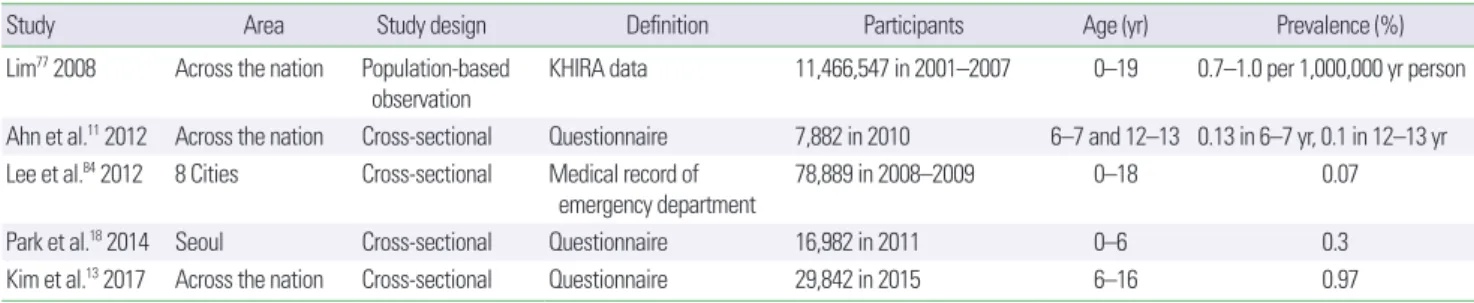
아나필락시스는 급격히 발생하는 전신적 중증 알레르기 반응이 며, 단시간 내에 여러 장기의 증상을 일으켜 적절한 처치를 하지 않 으면 사망에 이를 수도 있는 질환이다. 성인에서는 약물이 가장 흔 한 원인이지만, 소아에서는 식품이 가장 많은 비율을 차지한다.76,77 우리나라에서 소아청소년을 대상으로 시행한 대규모 다기관 조사 에서도 식품이 74.7% (우유 28.4%, 계란 13.6%, 견과류 13.2%, 밀 7.2%), 약물이 10.7% (항생제 34.9%, 비스테로이드소염제 17.9%)로 식품이 가장 흔한 원인이었다.78 6세 이하에서는 우유, 계란, 호두, 밀 등이 흔한 원인이고 7세 이상에서는 해산물과 메밀이 흔한 아나 필락시스 유발 요인이었다. 최근에 18세 이하 소아청소년을 대상으 로 시행한 다기관 연구에서는 원인 식품이 우유(27.5%), 계란 (21.9%), 밀가루(11.3%), 호두(10.5%), 땅콩(5.9%), 메밀(4.2%), 잣 (3.0%) 순으로 조사되었다.79 국외 조사에서 식품알레르기가 증가함에 따라 식품으로 인한 아나필락시스의 유병률과 사회적 부담이 증가하고 있다는 보고들 이 많다.80-83 우리나라에서 조사한 소아 아나필락시스의 유병률은 2001–2007년까지의 건강보험심사평가원의 의료보험 청구 자료를 이용한 연구에서 10만 명당 0.7–1.0건으로 보고되었으나, 이 중 식 품에 의한 아나필락시스의 정확한 자료는 없었다.77 이후 연구들은 2008–2009년 동안 Lee 등84이 우리나라 9개 종합병원의 응급실을 내원한 18세 이하의 소아청소년을 대상으로 한 조사에서 아나필락 시스 환자는 0.07%였고, 식품이 원인인 환자는 0.04%였다. 2010년 Ahn 등11이 6–7세 초등학교 1학년 3,907명과 12–13세 중학교 1학 년 3,975명을 대상으로 즉시형 식품알레르기 유병률을 알아보기 위한 단면조사연구에서는 진단된 아나필락시스 유병률이 0.1%였 고, 2011년 Park 등18이 서울시내 취학 전 유소아 16,749명을 대상으 로 설문조사를 이용한 단면조사연구에서는 증상 유병률이 0.3%였 다. 그리고 최근에 Kim 등13이 즉시형 식품알레르기의 유병률을 조 사하기 위해 전국의 초∙중∙고 학생들을 대상으로 설문조사를 이 용한 연구에서 아나필락시스 유병률은 0.97%였다. 조사 대상의 연 령대, 지역, 조사 방법, 질환에 대한 인식도 증가 등 여러 가지 변수 들로 인해 직접적인 평가는 어렵지만 식품에 의한 아나필락시스가 적지 않은 소아에서 발생하고 있음을 알 수 있다. 우리나라에서 시 행한 아나필락시스의 유병률에 대한 주요 연구는 Table 3에 정리하 였다.결 론
전 세계적으로 소아에서 식품알레르기 유병률이 증가하고 있으 며, 각 항원별 관용을 획득하는 시기도 이전 보고에 비해서 늦어지 고 있다. 우리나라에서도 외국과 비슷한 경향을 보이고 있지만 항원 별로 보았을 때 외국에 비해 우유보다 계란 알레르기가 좀 더 많은 것으로 보고되었고, 땅콩 알레르기 유병률은 상대적으로 낮았다. 완벽하게 설계된 조사를 통해 식품알레르기의 유병률과 자연 경 과를 파악하는 것은 환자나 보호자에게 질환의 경과와 관리법을 교육하고 관용이 생기는 시기를 예측하여 재평가 하는 데 중요하 다. 또한 경구면역 치료와 같은 새로운 치료법을 적용할 때 중요한 지표가 될 수 있다. 따라서 국내 식품알레르기에 대한 연령별, 항원 별 정확한 유병률 조사와 함께 자연경과를 전향적으로 추적하여 이를 바탕으로 개개인의 식품알레르기 예후 등을 예측함으로써 치 료에 도움이 될 것으로 생각한다.감사의 글
이 논문의 작성 과정에 도움을 주신 대한 소아알레르기 호흡기학회 산하 식품알레르기 아토피피부염 연구회(Food Allergy and Atopic Dermatitis Study Group) 선생님들께 감사 드립니다.
REFERENCES
1. Boyce JA, Assa'ad A, Burks AW, Jones SM, Sampson HA, Wood RA, et al. Guidelines for the Diagnosis and Management of Food Allergy in the United States: Summary of the NIAID-Sponsored Expert Panel Report. J
Table 3. Summary of studies on prevalence of anaphylaxis in Korean children
Study Area Study design Definition Participants Age (yr) Prevalence (%)
Lim77 2008 Across the nation Population-based
observation KHIRA data 11,466,547 in 2001–2007 0–19 0.7–1.0 per 1,000,000 yr person Ahn et al.11 2012 Across the nation Cross-sectional Questionnaire 7,882 in 2010 6–7 and 12–13 0.13 in 6–7 yr, 0.1 in 12–13 yr Lee et al.84 2012 8 Cities Cross-sectional Medical record of
emergency department 78,889 in 2008–2009 0–18 0.07 Park et al.18 2014 Seoul Cross-sectional Questionnaire 16,982 in 2011 0–6 0.3 Kim et al.13 2017 Across the nation Cross-sectional Questionnaire 29,842 in 2015 6–16 0.97 KHIRA, Korean Health Insurance Review and Assessment Service.
Allergy Clin Immunol 2010;126:1105-18.
2. Sicherer SH. Epidemiology of food allergy. J Allergy Clin Immunol 2011; 127:594-602.
3. Prescott SL, Pawankar R, Allen KJ, Campbell DE, Sinn JKh, Fiocchi A, et al. A global survey of changing patterns of food allergy burden in children. World Allergy Organ J 2013;6:21.
4. Osborne NJ, Koplin JJ, Martin PE, Gurrin LC, Lowe AJ, Matheson MC, et al. Prevalence of challenge-proven IgE-mediated food allergy using pop-ulation-based sampling and predetermined challenge criteria in infants. J Allergy Clin Immunol 2011;127:668-76.e1-2.
5. Keet CA, Savage JH, Seopaul S, Peng RD, Wood RA, Matsui EC. Tempo-ral trends and racial/ethnic disparity in self-reported pediatric food aller-gy in the United States. Ann Alleraller-gy Asthma Immunol 2014;112:222-9. e3.
6. McGowan EC, Keet CA. Prevalence of self-reported food allergy in the National Health and Nutrition Examination Survey (NHANES) 2007-2010. J Allergy Clin Immunol 2013;132:1216-9.e5.
7. McGowan EC, Peng RD, Salo PM, Zeldin DC, Keet CA. Changes in food-specific IgE over time in the National Health and Nutrition Examination Survey (NHANES). J Allergy Clin Immunol Pract 2016;4:713-20. 8. Burks AW, Tang M, Sicherer S, Muraro A, Eigenmann PA, Ebisawa M, et
al. ICON: food allergy. J Allergy Clin Immunol 2012;129:906-20. 9. Gupta RS, Springston EE, Smith B, Pongracic J, Holl JL, Warrier MR.
Par-ent report of physician diagnosis in pediatric food allergy. J Allergy Clin Immunol 2013;131:150-6.
10. Oh JW, Pyun BY, Choung JT, Ahn KM, Kim CH, Song SW, et al. Epide-miological change of atopic dermatitis and food allergy in school-aged children in Korea between 1995 and 2000. J Korean Med Sci 2004;19: 716-23.
11. Ahn K, Kim J, Hahm MI, Lee SY, Kim WK, Chae Y, et al. Prevalence of immediate-type food allergy in Korean schoolchildren: a population-based study. Allergy Asthma Proc 2012;33:481-7.
12. Lee AH, Kim KE, Lee KE, Kim SH, Wang TW, Kim KW, et al. Prevalence of food allergy and perceptions on food allergen labeling in school food-service among Korean students. Allergy Asthma Respir Dis 2013;1:227-34.
13. Kim M, Lee JY, Jeon HY, Yang HK, Lee KJ, Han Y, et al. Prevalence of im-mediate-type food allergy in Korean schoolchildren in 2015: a nationwide, population-based study. Allergy Asthma Immunol Res 2017;9:410-6. 14. Lee HS, Lee J, Kim JW, Hong SC, Kim SY, Lee KH. The prevalence of
al-lergic diseases in children living in Jeju. Pediatr Allergy Respir Dis 2012; 22:248-55.
15. Jung YH, Ko H, Kim HY, Seo JH, Kwon JW, Kim BJ, et al. Prevalence and risk factors of food allergy in preschool children in Seoul. Korean J Asth-ma Allergy Clin Immunol 2011;31:177-83.
16. Park JY, Park GY, Han YS, Shin MY. Survey of food allergy in elementary school children in Bucheon-city and relationship between food allergy and other allergic diseases. Allergy Asthma Respir Dis 2013;1:266-73. 17. Kim J, Chang E, Han Y, Ahn K, Lee SI. The incidence and risk factors of
immediate type food allergy during the first year of life in Korean infants: a birth cohort study. Pediatr Allergy Immunol 2011;22:715-9.
18. Park M, Kim D, Ahn K, Kim J, Han Y. Prevalence of immediate-type food allergy in early childhood in seoul. Allergy Asthma Immunol Res 2014;6:131-6.
19. Branum AM, Lukacs SL. Food allergy among children in the United States. Pediatrics 2009;124:1549-55.
20. Jackson KD, Howie LD, Akinbami LJ. Trends in allergic conditions among children: United States, 1997-2011. NCHS Data Brief 2013;(121):1-8. 21. Hu Y, Chen J, Li H. Comparison of food allergy prevalence among
Chi-nese infants in Chongqing, 2009 versus 1999. Pediatr Int 2010;52:820-4. 22. Kim YH, Lee SY, Lee E, Cho HJ, Kim HB, Kwon JW, et al. The change in
food allergy prevalence of elementary school children in Seoul since the last 20 years and the risk factor analysis. Allergy Asthma Respir Dis 2016; 4:276-83.
23. Smith PK, Masilamani M, Li XM, Sampson HA. The false alarm hypoth-esis: Food allergy is associated with high dietary advanced glycation end-products and proglycating dietary sugars that mimic alarmins. J Allergy Clin Immunol 2017;139:429-37.
24. Kim MH, Suh DI, Lee SY, Kim YK, Cho YJ, Cho SH. Microbiome research in food allergy and atopic dermatitis. Allergy Asthma Respir Dis 2016;4: 389-98.
25. Eggesbø M, Botten G, Halvorsen R, Magnus P. The prevalence of allergy to egg: a population-based study in young children. Allergy 2001;56:403-11.
26. Rona RJ, Keil T, Summers C, Gislason D, Zuidmeer L, Sodergren E, et al. The prevalence of food allergy: a meta-analysis. J Allergy Clin Immunol 2007;120:638-46.
27. Venter C, Pereira B, Voigt K, Grundy J, Clayton CB, Higgins B, et al. Prev-alence and cumulative incidence of food hypersensitivity in the first 3 years of life. Allergy 2008;63:354-9.
28. Kulig M, Bergmann R, Klettke U, Wahn V, Tacke U, Wahn U. Natural course of sensitization to food and inhalant allergens during the first 6 years of life. J Allergy Clin Immunol 1999;103:1173-9.
29. Clark A, Islam S, King Y, Deighton J, Szun S, Anagnostou K, et al. A lon-gitudinal study of resolution of allergy to well-cooked and uncooked egg. Clin Exp Allergy 2011;41:706-12.
30. Boyano-Martínez T, García-Ara C, Díaz-Pena JM, Martín-Esteban M. Prediction of tolerance on the basis of quantification of egg white-specific IgE antibodies in children with egg allergy. J Allergy Clin Immunol 2002; 110:304-9.
31. Kim J, Chung Y, Han Y, Ahn K, Lee SI. The natural history and prognos-tic factors of egg allergy in Korean infants with atopic dermatitis. Asian Pac J Allergy Immunol 2009;27:107-14.
32. Wood RA. The natural history of food allergy. Pediatrics 2003;111(6 Pt 3):1631-7.
33. Savage JH, Matsui EC, Skripak JM, Wood RA. The natural history of egg allergy. J Allergy Clin Immunol 2007;120:1413-7.
34. Sicherer SH, Wood RA, Vickery BP, Jones SM, Liu AH, Fleischer DM, et al. The natural history of egg allergy in an observational cohort. J Allergy Clin Immunol 2014;133:492-9.
35. Nowak-Wegrzyn A, Fiocchi A. Rare, medium, or well done? The effect of heating and food matrix on food protein allergenicity. Curr Opin Allergy Clin Immunol 2009;9:234-7.
36. Lemon-Mulé H, Sampson HA, Sicherer SH, Shreffler WG, Noone S, Nowak-Wegrzyn A. Immunologic changes in children with egg allergy ingesting extensively heated egg. J Allergy Clin Immunol 2008;122:977-83.e1.
37. Konstantinou GN, Giavi S, Kalobatsou A, Vassilopoulou E, Douladiris N, Saxoni-Papageorgiou P, et al. Consumption of heat-treated egg by chil-dren allergic or sensitized to egg can affect the natural course of egg aller-gy: hypothesis-generating observations. J Allergy Clin Immunol 2008; 122:414-5.
38. Leonard SA, Sampson HA, Sicherer SH, Noone S, Moshier EL, Godbold J, et al. Dietary baked egg accelerates resolution of egg allergy in children. J Allergy Clin Immunol 2012;130:473-80.e1.
39. Peters RL, Dharmage SC, Gurrin LC, Koplin JJ, Ponsonby AL, Lowe AJ, et al. The natural history and clinical predictors of egg allergy in the first 2 years of life: a prospective, population-based cohort study. J Allergy
Clin Immunol 2014;133:485-91.
40. Luccioli S, Ross M, Labiner-Wolfe J, Fein SB. Maternally reported food allergies and other food-related health problems in infants: characteris-tics and associated factors. Pediatrics 2008;122 Suppl 2:S105-12. 41. Warren CM, Jhaveri S, Warrier MR, Smith B, Gupta RS. The
epidemiolo-gy of milk allerepidemiolo-gy in US children. Ann Allerepidemiolo-gy Asthma Immunol 2013; 110:370-4.
42. Bishop JM, Hill DJ, Hosking CS. Natural history of cow milk allergy: clinical outcome. J Pediatr 1990;116:862-7.
43. Høst A, Halken S. A prospective study of cow milk allergy in Danish in-fants during the first 3 years of life. Clinical course in relation to clinical and immunological type of hypersensitivity reaction. Allergy 1990;45: 587-96.
44. Elizur A, Rajuan N, Goldberg MR, Leshno M, Cohen A, Katz Y. Natural course and risk factors for persistence of IgE-mediated cow's milk allergy. J Pediatr 2012;161:482-7.e1.
45. Santos A, Dias A, Pinheiro JA. Predictive factors for the persistence of cow's milk allergy. Pediatr Allergy Immunol 2010;21:1127-34.
46. Skripak JM, Matsui EC, Mudd K, Wood RA. The natural history of IgE-mediated cow's milk allergy. J Allergy Clin Immunol 2007;120:1172-7. 47. Wood RA, Sicherer SH, Vickery BP, Jones SM, Liu AH, Fleischer DM, et
al. The natural history of milk allergy in an observational cohort. J Aller-gy Clin Immunol 2013;131:805-12.
48. Suh J, Lee H, Lee JH, Cho J, Yu JS, Kim J, et al. Natural course of cow's milk allergy in children with atopic dermatitis. J Korean Med Sci 2011; 26:1152-8.
49. Nicolaou N, Poorafshar M, Murray C, Simpson A, Winell H, Kerry G, et al. Allergy or tolerance in children sensitized to peanut: prevalence and differentiation using component-resolved diagnostics. J Allergy Clin Im-munol 2010;125:191-7.e1-13.
50. Peters RL, Allen KJ, Dharmage SC, Tang ML, Koplin JJ, Ponsonby AL, et al. Skin prick test responses and allergen-specific IgE levels as predictors of peanut, egg, and sesame allergy in infants. J Allergy Clin Immunol 2013;132:874-80.
51. Rinaldi M, Harnack L, Oberg C, Schreiner P, St Sauver J, Travis LL. Pea-nut allergy diagnoses among children residing in Olmsted County, Min-nesota. J Allergy Clin Immunol 2012;130:945-50.
52. Kotz D, Simpson CR, Sheikh A. Incidence, prevalence, and trends of gen-eral practitioner-recorded diagnosis of peanut allergy in England, 2001 to 2005. J Allergy Clin Immunol 2011;127:623-30.e1.
53. Sicherer SH, Muñoz-Furlong A, Godbold JH, Sampson HA. US preva-lence of self-reported peanut, tree nut, and sesame allergy: 11-year fol-low-up. J Allergy Clin Immunol 2010;125:1322-6.
54. Shek LP, Cabrera-Morales EA, Soh SE, Gerez I, Ng PZ, Yi FC, et al. A population-based questionnaire survey on the prevalence of peanut, tree nut, and shellfish allergy in 2 Asian populations. J Allergy Clin Immunol 2010;126:324-31, 331.e1-7.
55. Green TD, LaBelle VS, Steele PH, Kim EH, Lee LA, Mankad VS, et al. Clinical characteristics of peanut-allergic children: recent changes. Pedi-atrics 2007;120:1304-10.
56. Vereda A, van Hage M, Ahlstedt S, Ibañez MD, Cuesta-Herranz J, van Odijk J, et al. Peanut allergy: clinical and immunologic differences among patients from 3 different geographic regions. J Allergy Clin Immunol 2011;127:603-7.
57. Du Toit G, Roberts G, Sayre PH, Plaut M, Bahnson HT, Mitchell H, et al. Identifying infants at high risk of peanut allergy: the Learning Early About Peanut Allergy (LEAP) screening study. J Allergy Clin Immunol 2013;131:135-43.e1-12.
58. Du Toit G, Roberts G, Sayre PH, Bahnson HT, Radulovic S, Santos AF, et
al. Randomized trial of peanut consumption in infants at risk for peanut allergy. N Engl J Med 2015;372:803-13.
59. Savage JH, Limb SL, Brereton NH, Wood RA. The natural history of pea-nut allergy: extending our knowledge beyond childhood. J Allergy Clin Immunol 2007;120:717-9.
60. Peters RL, Allen KJ, Dharmage SC, Koplin JJ, Dang T, Tilbrook KP, et al. Natural history of peanut allergy and predictors of resolution in the first 4 years of life: a population-based assessment. J Allergy Clin Immunol 2015;135:1257-66.e1-2.
61. Skolnick HS, Conover-Walker MK, Koerner CB, Sampson HA, Burks W, Wood RA. The natural history of peanut allergy. J Allergy Clin Immunol 2001;107:367-74.
62. Ho MH, Wong WH, Heine RG, Hosking CS, Hill DJ, Allen KJ. Early clinical predictors of remission of peanut allergy in children. J Allergy Clin Immunol 2008;121:731-6.
63. Fleischer DM, Conover-Walker MK, Christie L, Burks AW, Wood RA. The natural progression of peanut allergy: resolution and the possibility of recurrence. J Allergy Clin Immunol 2003;112:183-9.
64. Fleischer DM, Conover-Walker MK, Christie L, Burks AW, Wood RA. Peanut allergy: recurrence and its management. J Allergy Clin Immunol 2004;114:1195-201.
65. Fleischer DM, Conover-Walker MK, Matsui EC, Wood RA. The natural history of tree nut allergy. J Allergy Clin Immunol 2005;116:1087-93. 66. Byrne AM, Malka-Rais J, Burks AW, Fleischer DM. How do we know
when peanut and tree nut allergy have resolved, and how do we keep it resolved? Clin Exp Allergy 2010;40:1303-11.
67. Jeong K, Lee SY, Ahn K, Kim J, Lee HR, Suh DI, et al. A multicenter study on anaphylaxis caused by peanut, tree nuts, and seeds in children and adolescents. Allergy 2017;72:507-10.
68. Poole JA, Barriga K, Leung DY, Hoffman M, Eisenbarth GS, Rewers M, et al. Timing of initial exposure to cereal grains and the risk of wheat aller-gy. Pediatrics 2006;117:2175-82.
69. Czaja-Bulsa G, Bulsa M. The natural history of IgE mediated wheat aller-gy in children with dominant gastrointestinal symptoms. Alleraller-gy Asthma Clin Immunol 2014;10:12.
70. Keet CA, Matsui EC, Dhillon G, Lenehan P, Paterakis M, Wood RA. The natural history of wheat allergy. Ann Allergy Asthma Immunol 2009;102: 410-5.
71. Zuidmeer L, Goldhahn K, Rona RJ, Gislason D, Madsen C, Summers C, et al. The prevalence of plant food allergies: a systematic review. J Allergy Clin Immunol 2008;121:1210-8.e4.
72. Cohen A, Goldberg M, Levy B, Leshno M, Katz Y. Sesame food allergy and sensitization in children: the natural history and long-term follow-up. Pediatr Allergy Immunol 2007;18:217-23.
73. Aaronov D, Tasher D, Levine A, Somekh E, Serour F, Dalal I. Natural his-tory of food allergy in infants and children in Israel. Ann Allergy Asthma Immunol. 2008;101:637-40.
74. Sicherer SH, Muñoz-Furlong A, Sampson HA. Prevalence of seafood al-lergy in the United States determined by a random telephone survey. J Allergy Clin Immunol 2004;114:159-65.
75. Commins SP, Satinover SM, Hosen J, Mozena J, Borish L, Lewis BD, et al. Delayed anaphylaxis, angioedema, or urticaria after consumption of red meat in patients with IgE antibodies specific for galactose-alpha-1,3-ga-lactose. J Allergy Clin Immunol 2009;123:426-33.
76. Ye YM, Kim MK, Kang HR, Kim TB, Sohn SW, Koh YI, et al. Predictors of the severity and serious outcomes of anaphylaxis in korean adults: a multicenter retrospective case study. Allergy Asthma Immunol Res 2015; 7:22-9.
Pe-diatr 2008;51:351-4.
78. Lee SY, Ahn K, Kim J, Jang GC, Min TK, Yang HJ, et al. A multicenter retrospective case study of anaphylaxis triggers by age in Korean chil-dren. Allergy Asthma Immunol Res 2016;8:535-40.
79. Jeong K, Kim J, Ahn K, Lee SY, Min TK, Pyun BY, et al. Age-based causes and clinical characteristics of immediate-type food allergy in Korean children. Allergy Asthma Immunol Res 2017;9:423-30.
80. Yocum MW, Butterfield JH, Klein JS, Volcheck GW, Schroeder DR, Sil-verstein MD. Epidemiology of anaphylaxis in Olmsted County: a popu-lation-based study. J Allergy Clin Immunol 1999;104(2 Pt 1):452-6. 81. Decker WW, Campbell RL, Manivannan V, Luke A, St Sauver JL, Weaver
A, et al. The etiology and incidence of anaphylaxis in Rochester,
Minne-sota: a report from the Rochester Epidemiology Project. J Allergy Clin Immunol 2008;122:1161-5.
82. Ross MP, Ferguson M, Street D, Klontz K, Schroeder T, Luccioli S. Analy-sis of food-allergic and anaphylactic events in the National Electronic In-jury Surveillance System. J Allergy Clin Immunol 2008;121:166-71. 83. Dyer AA, Lau CH, Smith TL, Smith BM, Gupta RS. Pediatric emergency
department visits and hospitalizations due to food-induced anaphylaxis in Illinois. Ann Allergy Asthma Immunol 2015;115:56-62.
84. Lee SY, Kim KW, Lee HH, Lim DH, Chung HL, Kim SW, et al. Incidence and clinical characteristics of pediatric Emergency Department visits of children with severe food allergy. Korean J Asthma Allergy Clin Immu-nol 2012;32:169-75.