저작자표시-비영리-변경금지 2.0 대한민국 이용자는 아래의 조건을 따르는 경우에 한하여 자유롭게 l 이 저작물을 복제, 배포, 전송, 전시, 공연 및 방송할 수 있습니다. 다음과 같은 조건을 따라야 합니다: l 귀하는, 이 저작물의 재이용이나 배포의 경우, 이 저작물에 적용된 이용허락조건 을 명확하게 나타내어야 합니다. l 저작권자로부터 별도의 허가를 받으면 이러한 조건들은 적용되지 않습니다. 저작권법에 따른 이용자의 권리는 위의 내용에 의하여 영향을 받지 않습니다. 이것은 이용허락규약(Legal Code)을 이해하기 쉽게 요약한 것입니다. Disclaimer 저작자표시. 귀하는 원저작자를 표시하여야 합니다. 비영리. 귀하는 이 저작물을 영리 목적으로 이용할 수 없습니다. 변경금지. 귀하는 이 저작물을 개작, 변형 또는 가공할 수 없습니다.
농학석사학위논문
백출과
지황 중 Fosthiazate 및 기장 중
Tricyclazole 과 Tebuconazole 의
LC-MS/MS 와 GC-LC-MS/MS 분석법 개발
Development of LC-MS/MS and GC-MS/MS
Analytical Method for Fosthiazate in Atractylodes
rhizome white and Rehmannia root and
,Tricyclazole
and Tebuconazole in
Panicum miliaceum
2020 년 2 월
서울대학교 대학원
농생명공학부 응용생명화학전공
고 락 도
A Dissertation for the Degree of Master of Science
Development of LC-MS/MS and
GC-MS/MS Analytical Method for Fosthiazate
in Atractylodes rhizome white and
Rehmannia root and, Tricyclazole and
Tebuconazole in
Panicum miliaceum
February 2020
Rakdo Ko
Applied Life Chemistry Major
Department of Agricultural Biotechnology
Seoul National University
백출과
지황 중 Fosthiazate 및 기장 중
Tricyclazole 과 Tebuconazole 의 LC-MS/MS 와
GC-MS/MS 분석법 개발
Development of LC-MS/MS and GC-MS/MS Analytical
Method for Fosthiazate in Atractylodes rhizome white and
Rehmannia root and, Tricyclazole and Tebuconazole in
Panicum miliaceum
지도교수 김 정 한
이
논문을 농학석사학위논문으로 제출함
2019년 12월
서울대학교
대학원
농생명공학부
응용생명화학전공
고
락 도
고락도
석사학위논문을 인준함
2020년 1월
위
원
장
오 기 봉
(인)
부
위
원
장 김 정 한
(인)
위
원
신 찬 석
(인)
i
Abstract
Fosthiazate is an organophosphorus nematicide and insecticide. Atractylodes rhizome white and Rehmannia root is herbal medicine listed in the Korean Pharmacopeia (KP). This study develops a method for analyzing fosthiazate using GC-NPD. Cleanup using an SPE Cartridge was performed twice. This method using GC-NPD was complex to extract, partition and cleanup. After that, the method was developed by QuEChERS method using LC-MS/MS to improve unnecessary preparation procedures. LC-MS/MS on electrospray mode was used for the analysis of fosthiazate. In multiple reaction monitoring, m/z=228 and m/z=104.15 were engaged as the quantification ion and qualification ion, respectively. Method limit of quantitation (MLOQ) was 0.01 mg/kg. The linearity of matrix-matched calibration curve (r2) was ≥0.99 at the calibration range of 0.001-0.05 mg/kg. For the
recovery test, 5 g of macerated Atractylodes rhizome white or Rehmannia root was treated with standard solutions at MLOQ and 10MLOQ levels. Recovery rates were in the range of 70-120% (RSD≤20%) at two spiked levels (MLOQ and 10MLOQ) for Atractylodes rhizome white or Rehmannia root.
Proso millet (Panicum miliaceum L.) is the longest used summer cereal in human in addition to wheat and barley.Tricyclazole and tebuconazole is a fungicide which has been used for various crops including proso millet. LC-MS/MS on electrospray mode was used for the analysis of tricyclazole. In multiple reaction monitoring, m/z=136 and m/z=163.15 were engaged as the quantification ion and qualification ion, respectively. GC-MS/MS on electron ionization mode was used for the analysis of tebuconazole. In multiple reaction monitoring, m/z=125 and m/z=99.1 were engaged as the quantification ion and qualification ion, respectively. Method limit of quantitation (MLOQ) was 0.01 mg/kg. The linearity of matrix-matched calibration curve (r2) was ≥0.99 at the calibration range of 0.0025-0.25
ii
treated with standard solutions at 10MLOQ and 50MLOQ levels. Recovery rates were in the range of 70-120% (RSD≤20%) at two spiked levels (10MLOQ and 50MLOQ) for grain and straw. In field study, tricyclazole 20 % suspension concentrate formulation was treated on each 4 plots (50/40/30 days, 40/30/21 days, 30/21/14 days and 21/14/7 days before harvest) with three replicates. After harvest, grain and straw were analyzed to show that the residue levels of trycyclazole decreased according to treatment time. Maximum levels of residue were 5.68 mg/kg and 1.13 mg/kg for grain and straw in treatment plot of 21/14/7 days before harvest. In field study of tebuconazole, tebuconazole 20 % suspension concentrate formulation was treated on each 4 plots (50/40/30 days, 40/30/21 days, 30/21/14 days and 21/14/7 days before harvest) with three replicates. After harvest, grain and straw were analyzed to show that the residue levels of tebuconazole decreased according to treatment time. Maximum levels of residue were 1.66 mg/kg and 1.20 mg/kg for grain and straw in treatment plot of 21/14/7 days before harvest.
Key words: Herbal medicine, GC-NPD, SPE, QuEChERS, Fosthiazate,
LC-MS/MS, GC-LC-MS/MS, Minor crop, Proso millet, Residue
iii
Contents
Abstract ... ⅰ Contents ... ⅲ List of Figures ... ⅵ List of Tables ... ⅷ List of Abbreviations ... ⅹ Part 1 ... Introduction ... 1 Herbal medicine ... 1Atractylodes rhizome white ... 2
Rehmannia root ... 4
Fosthiazate ... 6
Cleanup using solid phase extraction ... 11
QuEChERS methodology ... 12
The purpose of studies ... 12
Materials and Methods ... 14
Analytical standard ... 14
Standard solutions ... 14
Subject herbal medicine... 14
Sampling... 15
Analytical instruments and conditions ... 16
Method validation ... 18
Matrix effect ... 23
Results and Discussion ... 24
iv
ILOD, ILOQ, MLOQ and calibration curve of fosthiazate analytical method
by GC-NPD ... 28
Optimization of cleanup using SPE cartridge ... 34
Recoveries of fosthiazate in Atractylodes rhizome white and Rehmannia root by GC-NPD ... 50
LC-MS/MS condition and multiple reaction monitoring optimization ... 56
ILOD, ILOQ, MLOQ and calibration curve of fosthiazate analytical method by LC-MS/MS ... 61
Optimization of sample preparation ... 64
Matrix effect ... 70
Recoveries of fosthiazate in Atractylodes rhizome white and Rehmannia root by LC-MS/MS ... 71 Part 2 ... 79 Introduction ... 80 Minor crops ... 80 Proso millet ... 81 Tricyclazole ... 83 Tebuconazole ... 88
PHI (Pre-Harvest Interval) ... 98
The purpose of studies ... 98
Materials and Methods ... 99
Analytical standard and pesticide for spraying ... 99
Standard solution ... 99
Subject crops ... 99
v
Sampling... 104
Analytical instruments and conditions ... 108
Method validation ... 110
Matrix effects ... 114
Residual analysis of proso millet sample ... 114
Results and Discussion ... 115
The meteorological data at field ... 115
LC-MS/MS condition and MRM(Multiple Reaction Monitoring) optimization .... 120
ILOD, ILOQ, MLOQ and calibration curve of tricyclazole ... 125
Matrix effects ... 130
Recoveries of tricyclazole in grain and straw of proso millet ... 131
Storage stability test of tricyclazole ... 137
Residual characteristics of tricyclazole in grain and straw of proso millet 141 GC-MS/MS condition and MRM(Multiple Reaction Monitoring) optimization .... 147
ILOD, ILOQ, MLOQ and calibration curve of tebuconazole... 151
Matrix effects ... 154
Recoveries of tebuconazole in grain and straw of proso millet ... 155
Storage stability test of tebuconazole ... 161
Residual characteristics of tebuconazole in grain and straw of proso millet ... 165
Conclusion ... 171
References ... 172
vi
List of Figures
Figure 1. Structure of fosthiazate ... 8
Figure 2. Chromatography of fosthiazate analyzed by GC-NPD ... 26
Figure 3. Concepts of ILOD and ILOQ ... 30
Figure 4. Calibration curve of fosthiazate ... 32
Figure 5. Chromatogram of interferences of fosthiazate in Atractylodes rhizome white and Rehmannia root by GC-NPD ... 44
Figure 6. Chromatogram of SPE florisil – NH2 cartridge and SPE alumina – NH2 cartridge test of fosthiazate in Atractylodes rhizome white by GC-NPD 46 Figure 7. Chromatogram of SPE silica – NH2 cartridge test of fosthiazate in Atractylodes rhizome white by GC-NPD ... 48
Figure 8. Chromatogram of recovery test of fosthiazate in Atractylodes rhizome white by GC-NPD ... 52
Figure 9. Chromatogram of recovery test of fosthiazate in Rehmannia root by GC-NPD ... 54
Figure 10. Scan spectrum of fosthiazate ... 58
Figure 11. Matrix matched calibration curves of fosthiazate ... 62
Figure 12. dSPE cleanup test in Atractylodes rhizome white and Rehmannia root 68 Figure 13. Chromatogram of recovery test of fosthiazate in Atractylodes rhizome white by LC-MS/MS ... 74
Figure 14. Chromatogram of recovery test of fosthiazate in Rehmannia root by LC-MS/MS ... 76
Figure 15. Structure of tricyclazole ... 84
Figure 16. Structure of tebuconazole ... 90
vii
Figure 18. Preparation of pesticide solution, spraying in field and preparation sample
... 106
Figure 19. Scan spectrum of tricyclazole ... 122
Figure 20. Concepts of ILOD&ILOQ ... 126
Figure 21. Matrix matched calibration curves of tricyclazole ... 128
Figure 22. Chromatogram of recovery test of tricyclazole in grain and straw of proso millet ... 134
Figure 23. Representative chromatograms of storage stability test tricyclazole ... 138
Figure 24. Chromatogram of residue analysis tricyclazole in grain and straw of proso millet ... 144
Figure 25. Scan spectrum of tebuconazole ... 148
Figure 26. Matrix matched calibration curves of tebuconazole ... 152
Figure 27. Chromatogram of recovery test of tebuconazole in grain and straw of proso millet ... 158
Figure 28. Representative chromatograms of storage stability test tebuconazole . 162 Figure 29. Chromatogram of residue analysis tebuconazole in grain and straw of proso millet ... 168
viii
List of Tables
Table 1. Allowed pesticides of Atractylodes rhizome white ... 3
Table 2. Allowed pesticides of Rehmannia root ... 5
Table 3. Physicochemical properties of fosthiazate ... 10
Table 4. Elution characteristics of fosthiazate using SPE-florisil cartridge ... 35
Table 5. Elution characteristics of fosthiazate using SPE-Silica cartridge ... 37
Table 6. Elution characteristics of fosthiazate using SPE-Alumina cartridge ... 39
Table 7. Elution characteristics of fosthiazate using SPE-NH2 cartridge... 42
Table 8. Recoveries test of fosthiazate in Atractylodes rhizome white and Rehmannia root by GC-NPD... 51
Table 9. The MRM transition parameter ... 60
Table 10. Extraction using QuEChERS method & dSPE cleanup recovery test of fosthiazate in Atractylodes rhizome white by LC-MS/MS ... 65
Table 11. Extraction using QuEChERS method & dSPE cleanup recovery test of fosthiazate in Rehmannia root by LC-MS/MS ... 66
Table 12. Recoveries test of fosthiazate in Atractylodes rhizome white and Rehmannia root by LC-MS/MS ... 72
Table 13. Allowed pesticides of proso millet ... 82
Table 14. Physicochemical properties of tricyclazole ... 86
Table 15. MRLs of tricyclazole in various agricultural products ... 87
Table 16. Physicochemical properties of tebuconazole ... 92
Table 17. MRLs of tebuconazole in various agricultural products ... 93
Table 18. The meteorological data ... 115
ix
Table 20. Recoveries test of tricyclazole in grain and straw of proso millet ... 132 Table 21. Storage stability of tricyclazole in grain and straw of proso millet ... 140 Table 22. Maximum residue of tricyclazole in grain and straw of proso millet.... 142 Table 23. The MRM transition parameters of tebuconazole ... 150 Table 24. Recoveries test of tebuconazole in grain and straw of proso millet ... 156 Table 25. Storage stability of tebuconazole in grain and straw of proso millet .... 164 Table 26. Maximum residue of tebuconazole in grain and straw of proso millet . 166
x
List of Abbreviations
ACE ACN CAS CID DL dSPE EC ESI GC GCB GR HX ILOD ILOQ IUPAC LC LC50 Acetone AcetonitrileChemical abstract service
Collision induced dissociation
Desolvation line
Dispersive solid phase extraction
Emulsifiable concentrate
Electrospray ionization
Gas-chromatography
Graphitized carbon black
Granules
Hexane
Instrumental limit of detection
Instrumental limit of quantitation
International union of pure and applied chemistry
Liquid-chromatography
xi LD50 ME MgSO4 MLOQ MOA MRLs MRM MS MSTD Na2SO4 NaCl NPD PHI PSA QuEChERS RSD S/N SC Lethal dose 50 Matrix effect Magnesium sulfate
Method limit of quantitation
Mode of action
Maximum residue limits
Multiple reaction monitoring
Mass spectrometry
Matrix-matched standard
Sodium sulfate
Sodium chloride
Nitrogen phosphorus detector
Pre-harvest interval
Primary secondary amine
Quick, Easy, cheap, effective, rugged and safety
Relative standard deviation
Signal to Noise
xii SPE SRM SSTD WG WP
Solid phase extraction
Selected reaction monitoring
Solvent standard
Dispersible granule
Part 1
Development of GC-NPD and LC-MS/MS Analytical
Method for Fosthiazate in Atractylodes rhizome white
1
Introduction
Herbal medicine
Herbal medicines have been used for thousands of years around the world. The history of herbal medicine has been proven to be effective over many years and has been used traditionally for many years.
In korea, herbs have been recognized for health care and disease treatment. Thesedays, they are the most widely manufactured and marketed in the pharmaceutical market for disease treatment and public health promotion in Korea. Korean traditional medicine is based on the philosophy of ancient medical science, and began with 11 oriental books that documented more about ancient remedies. Among these books, DongEu-Bo-Gam (by Hur Joon, AD1613) is the greatest masterpiece. This book is considered as a bible of Korean traditional medicine up to the present in Korea (Choi et al. 2002).
Among 520 herbal drug materials (HDMs) registered in Korea Pharmacopeia (KP) and Korean Herbal Pharmacopeia (KHP), more than 418 HDMs are mainly derived from plants that are mostly under cultivation like agricultural crops. Consumers could be exposed to residual pesticides through food and HDMs at the same time(Oh 2009).
2
Atractylodes rhizome white
Atractylodes rhizome white is a compositae herbal medicine listed in the Korean
Pharmacopeia (KP). The origin of Atractylodes rhizome white is defined as the root stem of Atractylodes japonica or Atractylodes macrocephala.
Atractylodes rhizome white uses its roots as herbal medicine. Young stems
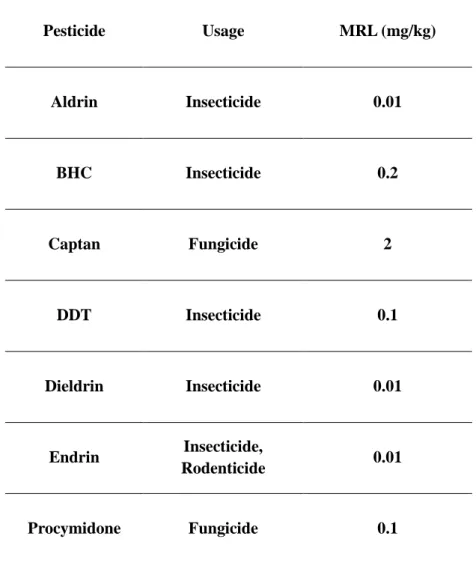
and leaves have a unique aroma and bitter taste and have been used for a long time in korea. Especially for herbal medicine, it is a very important medicine used in prescription drugs to promote digestion and gastrointestinal protection (Bang et al. 2004). For preventing pest of Atractylodes rhizome white, some pesticides allowed to use (table 1).
3
Table 1. Allowed pesticides of Atractylodes rhizome white
Pesticide Usage MRL (mg/kg) Aldrin Insecticide 0.01 BHC Insecticide 0.2 Captan Fungicide 2 DDT Insecticide 0.1 Dieldrin Insecticide 0.01 Endrin Insecticide, Rodenticide 0.01 Procymidone Fungicide 0.1
*Korean pharmacopoeia (Ministry of food and drugs safety) (Article 2 Medicine, 2019)
4
Rehmannia root
Rehmannia root is a herbal medicine of scrophulariaceae and is listed in the Korean
Pharmacopeia (KP). The origin of Rehmannia glutinosa is defined as Rehmannia
glutinosa ex steudel.
Rehmannia glutinosa has a variety of pharmacological actions and chemical
compositions. In recent decades, there have been many reports of the pharmacological functions and activities of Rehmannia glutinosa and active principles of blood system, immune system, endocrine system, cardiovascular system and nervous system and of anti-tumor, anti-senescence, etc (Zhang, Li, and Jia 2008). For preventing pest of Atractylodes rhizome white, some pesticides allowed to use (table 2)
5
Table 2. Allowed pesticides of Rehmannia root
Pesticide Usage MRL (mg/kg) Aldrin Insecticide 0.01 BHC Insecticide 0.2 DDT Insecticide 0.1 Dieldrin Insecticide 0.01 Endrin Insecticide, Rodenticide 0.01 Iminoctadine tris (albesilate) Fungicide 0.1 Kresoxim-methyl Fungicide 0.1 Pyrimethanil Fungicide 0.2 Thiram Fungicide 0.5
*Korean pharmacopoeia (Ministry of food and drugs safety) (Medicine; second part; Article 2, 2019)
6
Fosthiazate
Fosthiazate is an organophosphorous insecticide and nematicide (Fig 1.). Oragnophosphorus pesticides are organic compounds containing phosphorus.
Phosphorus can adopt a variety of oxidation states. IUPAC name is 3-[butan-2-ylsulfanyl(ethoxy) phosphoryl]-1,3-thiazolidin-2-one. It also has been called “Nemathorin”. The chemical formula of fosthiazate is C9H18NO3PS2. The physical
form is a slightly yellow and clear liquid.
Mode of action (MOA) of fosthiazate is known to inhibition of acetylcholine esterase in nematodes and other insects. Its excellent systemic actions also provide high performance against nematodes and foliar insect pests. It acts on the motility and larval stages of nematodes in the soil and prevents invasion to roots of crops (ISK, 1992).
Fosthiazate is applied on crops such as potato, tomato and banana. Its MRL is set at 0.05-0.5 mg/kg for crops including chili pepper and garlic. In Korea, fosthiazate was first registered in the form of emulsion in 1995 (MRLs for Pesticides in Foods, May 31, 2016).
8
10
Table 3. Physicochemical properties of fosthiazate
Property Information
Common name Fosthiazate (BSI, E-ISO, (m) F-ISO)
IUPAC name (RS)-[S-(RS)-sec-butyl O-ethyl
2-oxo-1,3-thiazolidin-3-ylphosphonothioate] CAS No. 98886-44-3 Molecular formula C9H18NO3PS2 Molecular weight 283.3 Boiling point 198 ℃/0.5 mmHg
Vapor pressure 0.53 mpa (25 ℃)
Kow Log P = 1.68
Solubility in solvent
In water 9850.0 mg/L (20-25 ℃). Soluble in hexane (15.14 g/L, 20-25 ℃), isopropanol, NMP, xylene
Mode of action Cholinestrease inhibitor
Toxicology
Acute oral (LD50, mg/kg) male rats 73, female rats 57 Acute percutaneous (LD50, mg/kg) male rats 2396, female rats 861
Skin irritation Not an irritant (rabbits). Eye Not an irritant (rabbits).
Inhalation (LC50, mg/1) male rats 0.832, female rats 0.558 (4 h)
Environmental fate
Animals Rapidly and extensively absorbed, with >90%
excretion, mainly via urine and air, within 48 h.
Soil/Environment Terrestrial field dissipation DT50 10-17 d. DT50 in aerobic soil 45 d, in anaerobic water sediment 37 d.
Mean Kroc 59
11
Cleanup using solid phase extraction
As an alternative medicine, the use of herbal products is becoming increasingly popular. However, the analysis of active compound present in herbal products faces great difficulties because of the complexity of trace amounts of pharmacologically active compounds and matrices. In addition, as the demand for solving quality-related problems in herbal products, the development of simple and reliable methods for the purification and, sensitive and selective determination of active compounds of herbal products is essential (Sun et al. 2002)
To cope with this problem, plant extracts must go through several cleanup steps, using unrelated separation mechanisms to increase orthogonality and purification efficiency. Common cleanup procedures such as column chromatography, solid phase extraction(SPE), liquid-liquid extraction, etc. are used (Dobrev et al. 2005).
The choice of method for a particular problem should be chosen based on the experience and skills available, the analyte and the matrix characteristics. Nevertheless, the popularity of SPE has increased in recent years due to its ease of automation and the availability of various stages. It is also considered eco-friendly as large volumes of solvents are not used, as in liquid–liquid extraction (Stevenson 1999).
12
QuEChERS methodology
Anastassiades, Lehotay, Stajnbaher, and Schenck (2003) developed an original analytical method that combines the extraction/isolation of pesticides from the food matrix with extract cleanup. They coined the acronym QuEChERS for it, i.e. Quick, Easy, Cheap, Effective, Rugged and Safe. This technique is the process of purifying extracts using fine scale extraction with ACN (acetonitrile) and dispersive solid-phase extraction (d-SPE). Since the development and publication of this method, QuEChERS has been gaining considerable popularity. It is the method of choice for food analysis, as it combines several steps and extends the range of recovered pesticides with older and more boring extraction techniques. This method has undergone various modifications and improvements over the years since its first introduction. These have been designed to improve recovery for certain types of foodstuff or types of pesticides (Wilkowska and Biziuk 2011).
The purpose of studies
This study is to develop the residual test method for fosthiazate in herbal medicine to establish the maximum residue limits (MRLs). The samples used in this study are
Atractylodes rhizome white and Rehmannia root. The herbal medicine samples are
to selectively analyze fosthiazate by GC-NPD through solid phase extraction and by LC-MS/MS through dispersive solid phase extraction purification in various matrices such as secondary metabolites and active compounds.
14
Materials and Methods
Analytical standard
Standard material of fosthiazate (Purity: 99.1 %) was purchased from Wako (Osaka, Japan).
Standard solutions
Standard stock solution of fosthiazate to be used in method using GC-NPD was prepared at the concentration of 1,000 mg/L with ACE (acetone). The working solutions were prepared by serial dilution of stock solution with acetone.
Standard stock solution of fosthiazate to be used in method using LC-MS/MS was prepared at the concentration of 1,000 mg/L with acetonitrile. The working solutions were prepared by serial dilution of stock solution with acetonitrile.
Subject herbal medicine
Atractylodes rhizome white (Atractylodes japonica) and Rehmannia Root
(Rehmannia glutinosa) which are the species in South Korea was used for experiments
15
Sampling
Acquisition of the herbal medicine sample was performed through a series of procedures. First, the sample is provided by a pharmaceutical company that sells herb sample. Next, the received sample is inspected by the herbal medicine pharmacist and the product is purchased. The herbal medicine sample purchased is subjected to sensory evaluation and used as a sample. After evaluation, the obtained sample was homogenized by food processor. Every sample was stored at -20 ℃ in polyethylene bags.
16
Analytical instruments and conditions 1) GC-NPD condition
GC-NPD analysis for fosthiazate was carried out on an Agilent 7890B equipped with Agilent 7693 auto sampler (Santa Clara, USA). A capillary column was DB-5MS Ultra Inlet (30m x 0.25mm, 0.25µm). The heater of Inlet was 260 ℃. Injection mode was pulsed-splitless mode (20 psi, until 0.75 min). The oven temperature program was initialized at 80 ℃ (held for 2min), increased to 300 ℃ at 10 ℃/min (held for 10). Total run time was 34 min. Detector was NPD (Nitrogen Phosphorus Detector) using blos bead (Agilent, USA). Nitrogen (≥ 99.999%) was used as carrier gas at a makeup gas flow (10 mL/min) and hydrogen and air (≥ 99.999%) was used as fuel gas to make flame. Hydrogen and air flow was 3 mL/min and 60 mL/min, respectively.
17
2) LC-MS/MS condition
LC-MS/MS analysis for fosthiazate was carried out on a LC-MS 8040 with UHPLC-Nexera (ESI positive mode). The oven temperature was 40 ℃ and the column was RaptorTM ARC-18 (100mm x 2.1 mm, 2.7 µm). Mobile phases were 0.1% formic
acid & 5mM ammonium formate in water/methanol (98/2, v/v) (A) and methanol/water (98/2, v/v) (B). The mobile phase (B) was initially hold at 5% for 1 min. Then (B) increased 5% to 95% for 8.5 min and hold 95% for 0.5 min. Finally decreased it to 5% for 0.5 min and hold 5% for 5 min. The flow rate was set at 0.2 mL/min and the injection volume was 5 µL. Desolvation line (DL) temperature was 250 ℃ and heat block temperature was 400 ℃. The nebulizing gas, drying gas was nitrogen and collision energy was used argon gas. Nebulizing gas flow was 3 L/min drying gas flow was 15 L/min. For MS/MS analysis, two transitions (quantifier and qualifier) were chosen for scheduled MRM mode after an automatic optimization procedure.
18
Method Validation
1) ILOQ (Instrumental Limit of Quantitation)
Standard solution (0.05 ~ 2 µg/mL) were analyzed by GC-NPD.
After matrix matched standard solution (0.001 ~ 0.05 µg/mL) were analyzed by LC-MS/MS. The ILOQ was settled as the concentration where the S/N (Signal-to-Noise) ratio was higher than 10.
2) MLOQ (Method Limit of Quantitation)
MLOQ was calculated by equation below
MLOQ (mg/L) = LOQ (ng) × Final volume (mL) × Dilution factor
19
3) Calibration curve and linearity
Solvent standard solution SSTD 1 (0.05 µg/mL) SSTD 2 (0.1 µg/mL) SSTD 3 (0.2 µg/mL) SSTD 4 (0.5 µg/mL) SSTD 5 (1 µg/mL) SSTD 6 (2 µg/mL)
A series of fosthiazate solvent standard solution with concentration of 0.05, 0.1, 0.2, 0.5, 1, 2 µg/mL were prepared with serial dilution in acetone for GC-NPD analysis. The relative standard deviation (RSD) was calculated at the calibration curve. Matrix matched standard solution MSTD 1 (0.001 µg/mL) MSTD 2 (0.0025 µg/mL) MSTD 3 (0.005 µg/mL) MSTD 4 (0.01 µg/mL) MSTD 5 (0.025 µg/mL) MSTD 6 (0.05 µg/mL) Standard solution 0.002 µg/mL 200 µL 0.005 µg/mL 200 µL 0.001 µg/mL 200 µL 0.02 µg/mL 200 µL 0.05 µg/mL 200 µL 0.1 µg/mL 200 µL Sample matrix 200 µL 200 µL 200 µL 200 µL 200 µL 200 µL
A series of matrix-matched fosthiazate solvent standard solution with concentration of 0.001, 0.0025, 0.005, 0.01, 0.025, 0.05 µg/mL were prepared with serial dilution in acetonitrile for LC-MS/MS analysis. The relative standard deviation (RSD) was calculated at the calibration curve.
20
4) Recovery test of fosthiazate analytical method by GC-NPD
The homogenized free pesticide Atractylodes rhizome white and Rehmannia root samples (5 g) in 250 mL centrifuge bottle were treated with the standard solution of fosthiazate at spiking level following: For Atractylodes rhizome white and
Rehmannia Root, 0.04 mg/kg and 0.4 mg/kg (MLOQ, 10 MLOQ). The samples of Atractylodes rhizome white and Rehmannia Root were moistened with 20 mL of
deionized water for 10 minutes. 50 mL of acetonitrile was added to each bottle, and the bottles were shaken vigorously (MMV-1000W, EYELA, Tokyo, Japan). After that, 7.5 g of sodium chloride (NaCl) were added to the bottles. The bottles were vigorously shaken for 5 min and centrifuged at 3,500 rpm for 5 minutes (Combi 408, Hanil Science industrial, Korea). Twenty-five milliliter of the supernatant was transferred into round flasks and evaporated (Water bath B-480, BUCHI, Oldham UK / Rotavapor R-114, BUCHI, Oldham, UK / Laborota 4000 efficient, Heidolph, Schwabach, Germany and Minichiller, Huber, Germany). The residues were dissolved in 50 mL deionized water for partition. Fifty milliliter of deionized water with residues was transferred into separate funnels. Next, the residues in round flask were dissolved in 50 mL hexane. Fifty milliliter of HX with residues was transferred into separate funnels. After that, the residues in round flask were dissolved in 50 mL saturated sodium chloride solution. Fifty milliliter of saturated sodium chloride solution with residues was transferred into separate funnels. After shaking separate funnels for 1 minute, the 50 mL hexane was filtered using sodium sulfate (Na2SO4),
transferred to round flasks and evaporated. The residues were dissolved in 4 mL of acetone/hexane (10/90, v/v) for clean-up. A silica solid phase extraction (SPE) cartridge (1,000 mg, 6 mL) was preconditioned with 5 mL of acetone/hexane (10/90,
21
v/v). After precondition, 4 mL of the extract was loaded on the cartridge (The sample was collected in loading step). The cartridge was washed with 20 mL of acetone/hexane (10/90, v/v). The cartridge was eluted with 10 mL of acetone/hexane (20/80, v/v) in test tubes. The eluates in test tubes were evaporated under nitrogen stream and re-dissolved with 4 mL of 0.1% formic acid in Ethyl acetate/hexane (10/90, v/v). An amino-propyl (NH2) solid phase extraction (SPE) cartridge (1,000
mg, 6 mL) was preconditioned with 5 mL of 0.1% formic acid in hexane. After precondition, 4 mL of the extract was loaded on the cartridge (The sample was collected in loading step). The cartridge was washed with 10 mL of 0.1% formic acid in Ethyl acetate/hexane (20/80, v/v). The cartridge was eluted with 10 mL of 0.1% formic acid in Ethyl acetate/hexane (30/70, v/v) in test tubes. The eluates in test tubes were evaporated under nitrogen stream and re-dissolved with 1 mL acetone. 2 µL of final sample was injected into GC-NPD.
22
5) Recovery test of fosthiazate analytical method by LC-MS/MS
Samples were extracted using the modified QuEChERS method. The homogenized free pesticide Atractylodes rhizome white and Rehmannia root samples (5 g) in 50 mL centrifuge tube were treated with the standard solution of fosthiazate at spiking level following: For Atractylodes rhizome white and Rehmannia root, 0.01 mg/kg and 0.1 mg/kg (MLOQ, 10 MLOQ). The samples of Atractylodes rhizome white and
Rehmannia root were moistened with 10 mL of deionized water for 10 minutes. 10
mL of acetonitrile was added to each tube, and the tubes were shaken vigorously (1600 MiniGTM, SPEX® SamplePrep, New Jersey, USA). After that, 4 g of
magnesium sulfate (MgSO4) and 1 g of sodium chloride (NaCl) were added to the
tubes. The tubes were vigorously shaken for 1 min and centrifuged at 3,500 rpm for 5 minutes (Combi 408, Hanil Science industrial, Korea). One milliliter of the supernatant was transferred into dSPE (Dispersive Solid Phase Extraction) tube containing 25 mg of PSA, 7.5 mg of GCB and 150 mg MgSO4 (RESTEK, Germany).
After voltexing for 1 minute, the d-SPE tubes were centrifuged at 13,000 rpm for 4 minutes. For matrix matching, 0.2 mL of supernatant was mixed with 0.2 mL of acetonitrile followed by analyzed using LC-MS/MS.
23
Matrix effect
Matrix effects (ME, %) was calculated by comparing the slope of calibration curve between solvent standard and matrix matched calibration curve using the following equation:
ME, % = slope of solvent standard calibration curve − 1" × 100slope of matrix matched calibration curve
A negative value of matrix effect indicates signal suppression, a positive value indicates signal enhancement in matrix contained environment (Caban et al. 2012)
24
Results and Discussion
GC-NPD condition
GC-NPD is an acronym for Gas Chromatography-Nitrogen Phosphorus Detector. The fosthiazate contains nitrogen and phosphorus, so NPD was selected. Injector temperature and injection mode were set to analyze the fosthiazate. The proper output was set by flowing air and hydrogen and increasing the voltage of NPD. After changing the temperature of the oven, fosthiazate was separated from the inside of the column and then chromatogram was confirmed through NPD. Comparing the acetone with the fosthiazate standard solution and confirming the retention time of the fosthiazate, the compound was quantified. Area values of fosthiazate peaks were calculated and quantified. The chromatogram of fosthiazate was found to be followed by two peaks, and integration was performed using the area sum function (Fig. 2.).
26
28
ILOD, ILOQ, MLOQ and calibration curve of fosthiazate analytical method by GC-NPD
Instrumental limit of detection (ILOD) and Instrumental limit of quantitation (ILOQ) are values that represent the sensitivity of analytical instrument. ILOD is determined by the minimum concentration of analyte providing S/N ratio of > 3 and ILOQ is determined by S/N ratio of > 10 (Fig. 3.) (Fong et al. 1999). In this experiment, ILOQ was checked from the results of analysis of several concentration standard solutions, 0.1 mg/L was observed as practicable ILOQ in GC-NPD.
Based on MLOQ calculating equation, MLOQ of fosthiazate in Atractylodes rhizome white and Rehmannia root is 0.04 mg/L.
Standard curves of fothiazate has a good linearity in samples of Atractylodes rhizome white and Rehmannia root. The range was between 0.05 to 2 mg/L of fosthiazate standard solution (Fig. 4.).
The regression equations were y = 1688.7x – 10.846. Coefficients of determination (r2) were over 0.999 in each samples.
30 Figure 3. Concepts of ILOD and ILOQ
31 min 13.8 14 14.2 14.4 min Hz Signal Noise
32
33 y = 1688.7x - 10.846 r² = 0.9992 0 500 1000 1500 2000 2500 3000 3500 4000 0.00 0.50 1.00 1.50 2.00 2.50 3.00 3.50 4.00 4.50
A
re
a
Amount (ng)
34
Optimization of cleanup using SPE cartridge
In order to effectively remove various matrix of analytical disturbances in herbal samples, various SPE cartridge cleanup processes were reviewed in SPE. Cleanup processes was added to washing section of the SPE cartridge and examined for the washing volume and elution section. The cleanup method was first established as fosthiazate standard solution. Then, the treated samples of the Atractylodes rhizome white and Rehmannia root were confirmed.
1) Florisil SPE cartridge (1 g, 6 cc)
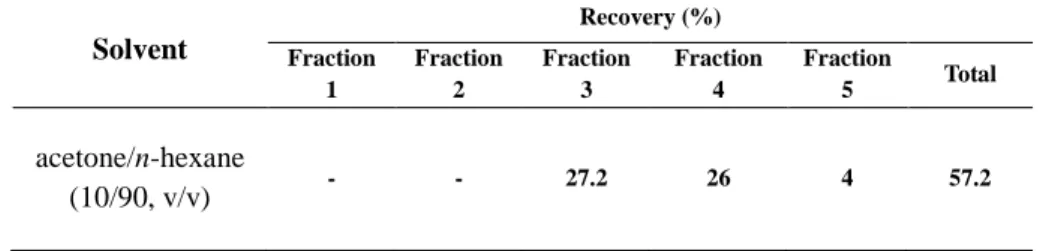
Fosthiazate solution 1 mL of 1 mg/L was added to a round bottom flask, concentrated and dissolved in acetone/n-hexane (10/90, v/v). The elution of fosthiazate was investigated using acetone/n-hexane mixture as the eluent. As a result, 5 mL of n-hexane and 5 mL of acetone/n-hexane (10/90, v/v) were allowed to flow for conditioning SPE cartridge. When loading the solution 4 mL of fosthiazate dissolved in acetone/n-hexane (10/90, v/v) and eluting into 10 mL of acetone/n-hexane (10/90, v/v), the fosthiazate was not eluted at all. When 10 mL of acetone/n-hexane (20/80, v/v) was poured out, 101% was eluted. In order to select the washing volume in the washing section, acetone/n-hexane (10/90, v/v) was fractionated by 5 mL. In the third fraction, 27.2% was eluted (Table 4). Thus, the florisil SPE cartridge was then conditioned by flowing 5 mL of n-hexane and 5 mL of acetone/n-hexane (10/90, v/v). After loading fosthiazate solution 0.25 mg/L, 4 mL of hexane (10/90, v/v), SPE cartridge was washed with 5 mL of acetone/n-hexane (10/90, v/v) and eluted with 10 mL of acetone/n-acetone/n-hexane (20/80, v/v). The eluate was concentrated using a nitrogen evaporator and dissolved in 1 mL of acetone to obtain the final solution.
35
Table 4. Elution characteristics of fosthiazate using SPE-florisil cartridge
Solvent Recovery (%) Fraction 1 Fraction 2 Fraction 3 Fraction 4 Fraction 5 Total acetone/n-hexane (10/90, v/v) - - 27.2 26 4 57.2
36
2) Silica SPE cartridge (1 g, 6 cc)
Fosthiazate solution 1 mL of 1 mg/L was added to a round bottom flask, concentrated and dissolved in acetone/n-hexane (10/90, v/v). The elution of fosthiazate was investigated using acetone/n-hexane mixture as the eluent. As a result, 5 mL of acetone/n-hexane (10/90, v/v) were allowed to flow for conditioning SPE cartridge. When loading the solution 4 mL of fosthiazate dissolved in acetone/n-hexane (10/90, v/v) and eluting into 10 mL of acetone/n-acetone/n-hexane (10/90, v/v), the fosthiazate was not eluted at all. When 10 mL of acetone/n-hexane (20/80, v/v) was poured out, 87% was eluted. In order to select the washing volume in the washing section, acetone/n-hexane (10/90, v/v) was fractionated by 5 mL. In the all fractions, the fosthiazate was not eluted at all (Table 5). Thus, the silica SPE cartridge was then conditioned by flowing 5 mL of acetone/n-hexane (10/90, v/v). After loading fosthiazate solution 0.25 mg/L, 4 mL of acetone/n-hexane (10/90, v/v), SPE cartridge was washed with 20 mL of acetone/n-hexane (10/90, v/v) and eluted with 10 mL of acetone/n-hexane (20/80, v/v). The eluate was concentrated using a nitrogen evaporator and dissolved in 1 mL of acetone to obtain the final solution.
37
Table 5. Elution characteristics of fosthiazate using SPE-Silica cartridge
Solvent Recovery (%) Fraction 1 Fraction 2 Fraction 3 Fraction 4 Fraction 5 Total acetone/n-hexane (10/90, v/v) - - - - - -
38 3) Alumina SPE cartridge (1 g, 3 cc)
Fosthiazate solution 1 mL of 1 mg/L was added to a round bottom flask, concentrated and dissolved in acetone/n-hexane (10/90, v/v). The elution of fosthiazate was investigated using acetone/n-hexane mixture as the eluent. As a result, 3 mL of n-hexane and 3 mL of acetone/n-hexane (10/90, v/v) were allowed to flow for conditioning SPE cartridge. When loading the solution 3 mL of fosthiazate dissolved in acetone/hexane (10/90, v/v) and eluting into 6 mL of n-hexane, 3% was eluted. Serially, the same cartridge was eluted into 6 mL of acetone/n-hexane (10/90, v/v) and acetone/n-hexane (20/80, v/v), 27% and 30% was eluted, respectively (Table 6). Because a total of 60% were eluted, formic acid was used to increase the elution output.
Fosthiazate solution 1 mL of 1 mg/L was added to a round bottom flask, concentrated and dissolved in acetone/n-hexane (10/90, v/v) with 0.1 % formic acid. As a result, 3 mL of n-hexane with 0.1 % formic acid and 3 mL of acetone/n-hexane (10/90, v/v) with 0.1 % formic acid were allowed to flow for conditioning SPE cartridge. When loading the solution 3 mL of fosthiazate dissolved in acetone/n-hexane (10/90, v/v) with 0.1 % formic acid and eluting into 6 mL of n-acetone/n-hexane with 0.1 % formic acid, 5% was eluted. Serially, the same cartridge was elutied into 6 mL of acetone/n-hexane (10/90, v/v) with 0.1 % formic acid and acetone/n-hexane (20/80, v/v) with 0.1 % formic acid, 45% and 50% was eluted, respectively (Table 6). Washing volume cannot be selected in the washing section. Thus, the alumina SPE cartridge was then conditioned by flowing 3 mL of n-hexane with 0.1 % formic acid and 3 mL of acetone/n-hexane (10/90, v/v) with 0.1 % formic acid. After loading fosthiazate solution 0.25 mg/L, 3 mL of acetone/n-hexane (10/90, v/v), SPE cartridge was eluted with 6 mL of acetone/n-hexane (20/80, v/v). The eluate was concentrated using a nitrogen evaporator and dissolved in 1 mL of acetone to obtain the final solution.
39
Table 6. Elution characteristics of fosthiazate using SPE-Alumina cartridge
Solvent Recovery (%)
(0/100, v/v) (10/90, v/v) (20/80, v/v) Total
acetone/n-hexane 3 27 30 60
acetone/n-hexane with
40
4) NH2 SPE cartridge (1 g, 6 cc)
Fosthiazate solution 1 mL of 1 mg/L was added to a round bottom flask, concentrated and dissolved in ethyl acetate/n-hexane (10/90, v/v). The elution of fosthiazate was investigated using ethyl acetate/n-hexane mixture as the eluent. As a result, 5 mL of n-hexane and 5 mL of ethyl acetate/n-hexane (10/90, v/v) were allowed to flow for conditioning SPE cartridge. When loading the solution 4 mL of fosthiazate dissolved in ethyl acetate/n-hexane (10/90, v/v) and eluting into 10 mL of ethyl acetate/n-hexane (10/90, v/v) and 10 mL of ethyl acetate/n-hexane (20/80, v/v) serially, the fosthiazate was not eluted at all. When 10 mL of acetone/n-hexane (30/70, v/v) was poured out, 30% was eluted (Table 7). Because a total of 30% were eluted, formic acid was used to increase the elution output.
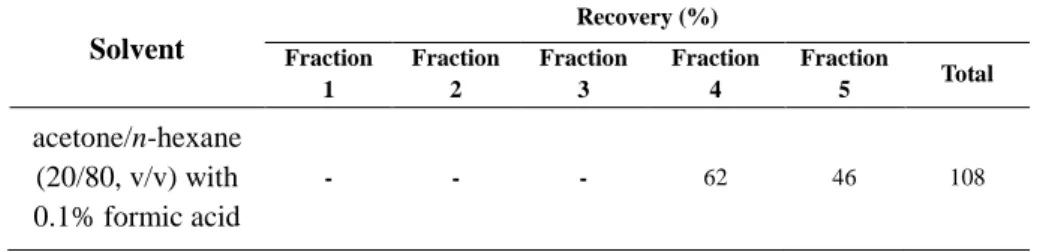
Fosthiazate solution 1 mL of 1 mg/L was added to a round bottom flask, concentrated and dissolved in ethyl acetate/n-hexane (10/90, v/v) with 0.1 % formic acid. As a result, 5 mL of n-hexane with 0.1 % formic acid and 5 mL of ethyl acetate/n-hexane (10/90, v/v) with 0.1 % formic acid were allowed to flow for conditioning SPE cartridge. When loading the solution 4 mL of fosthiazate dissolved in ethyl acetate/n-hexane (10/90, v/v) with 0.1 % formic acid and eluting into 10 mL of ethyl acetate/n-hexane (10/90, v/v) with 0.1 % formic acid and 10 mL of ethyl acetate/n-hexane (20/80, v/v) with 0.1 % formic acid serially, the fosthiazate was not eluted at all. When 10 mL of ethyl acetate /n-hexane (30/70, v/v) with 0.1 % formic acid was poured out, 108% was eluted. In order to select the washing volume in the washing section, ethyl acetate/n-hexane (20/80, v/v) with 0.1 % formic acid was fractionated by 5 mL. In the fourth fraction, 62% was eluted (Table 7). Thus, the NH2 SPE cartridge was then conditioned by flowing 5 mL of n-hexane (10/90, v/v)
41
with 0.1 % formic acid and 5 mL of ethyl acetate/n-hexane (10/90, v/v) with 0.1 % formic acid. After loading fosthiazate solution 0.25 mg/L, 4 mL of ethyl acetate/n-hexane (10/90, v/v) with 0.1 % formic acid, SPE cartridge was washed with 10 mL of ethyl acetate/n-hexane (20/80, v/v) with 0.1 % formic acid and eluted with 10 mL of ethyl acetate/n-hexane (30/70, v/v) with 0.1 % formic acid. The eluate was concentrated using a nitrogen evaporator and dissolved in 1 mL of acetone to obtain the final solution.
42
Table 7. Elution characteristics of fosthiazate using SPE-NH2 cartridge
Solvent Recovery (%) Fraction 1 Fraction 2 Fraction 3 Fraction 4 Fraction 5 Total acetone/n-hexane (20/80, v/v) with 0.1% formic acid - - - 62 46 108
43
5) Serial cleanup in Atractylodes rhizome white and Rehmannia root
In case of the Atractylodes rhizome white samples, one-time cleanup did not completely remove the interferences, and thus quantitative analysis could not be performed. An analysis methods for various herbal medicine including Atractylodes rhizome white and Rehmannia root samples are needed. It was confirmed that Atractylodes rhizome white contains more interferences in GC-NPD than in
Rehmannia root (Fig. 5). So, Atractylodes rhizome white samples was used to
establish the cleanup method.
Cleanup conditions of SPE florisil – NH2 cartridge and SPE alumina – NH2
cartridge were applied to Atractylodes rhizome white. When analyzed under the GC-NPD condition, the cleanup efficiency was higher than that of the above mentioned cleanup conditions. Thus, the cleanup of SPE florisil – NH2 cartridge and SPE
alumina – NH2 cartridge was not possible to quantify fosthiazate (Fig. 6).
Cleanup conditions of SPE silica – NH2 cartridge cartridge were applied to Atractylodes rhizome white. When analyzed under the GC-NPD condition,
purification efficiency was higher than that of the above mentioned cleanup conditions. It was consistent with the retention time of fosthiazate in standard solution and samples. Thus, the purification of SPE silica – NH2 cartridge cartridge
was effective as a cleanup capable of quantitative analysis of fosthiazate in
44
Figure 5. Chromatogram of interferences of fosthiazate in Atractylodes rhizome white and Rehmannia root by GC-NPD
45
Atractylodes rhizome white
46
Figure 6. Chromatogram of SPE florisil – NH2 cartridge and SPE alumina – NH2 cartridge test of fosthiazate in Atractylodes rhizome white by GC-NPD
47
SPE florisil – NH2 cartridge
SPE alumina – NH2 cartridge
48
Figure 7. Chromatogram of SPE silica – NH2 cartridge test of fosthiazate in
49
SPE silica – NH2 cartridge
50
Recoveries of fosthiazate in Atractylodes rhizome white and Rehmannia root by GC-NPD
Recovery test providing accuracy and precision of sample preparation method with recovered rate (accuracy, %) and RSD (precision, %)(Fong et al. 1999). Untreated samples were spiked with MLOQ and 10 MLOQ levels of fosthiazate (Atractylodes rhizome white and Rehmannia root). And the analysis was peformed using the established method. Table 8 shows results of recovery test in Atractylodes rhizome white and Rehmannia root. In case of Atractylodes rhizome white, the range of recoveries were 95.3 % ~ 103.6 % at MLOQ level and 100.6 % ~ 102.5 % at 10 MLOQ level, and RSD was 4.2 and 0.9, respectively (Fig. 8). In case of Rehmannia root, the range of recoveries were 99.6 % ~ 110.9 % at MLOQ level and 100.3 % ~ 108.4 % at 10 MLOQ level, and RSD was 4.1 and 5.5, respectively (Fig. 9.)
51
Table 8. Recoveries test of fosthiazate in Atractylodes rhizome white and
Rehmannia root by GC-NPD
Sample Fortified level
(mg/kg) Recovery (%) RSD (%) Atractylodes rhizome white 0.04 99.3 4.2 0.4 101.4 0.9 Rehmannia root 0.04 105.2 4.1 0.4 106.1 5.5
52
Figure 8. Chromatogram of recovery test of fosthiazate in Atractylodes rhizome white by GC-NPD
53
Control
MLOQ
54
Figure 9. Chromatogram of recovery test of fosthiazate in Rehmannia root by GC-NPD
55
Control
MLOQ
56
LC-MS/MS condition and multiple reaction monitoring optimization
GC-NPD detects nitrogen and phosphorus selectivity, but its sensitivity is low when the compound to be analyzed is fosthiazate. The fosthiazate analysis method using GC-NPD showed an ILOQ of 0.01 mg/kg. LC and MS (Mass Spectrometry) were used to improve the complex preparation to remove interferences from various matrices and to obtain improved methods by setting lower LOQ and reducing instrumental run time through high sensitivity.
Applying tandem MS with selected reaction monitoring (SRM) can significantly reduce the chemical background. Even if the co‐extracted matrix compounds have the molecular mass of a pesticide, in general, the two isobaric ions can be separated in SRM experiments, since their fragmentation in the collision cell often results in different product ions. As a result, tandem mass spectrometers offer excellent sensitivity and selectivity (Picó, Blasco, and Font 2004).
LC-MS/MS provides more sensitive, selective and rapid analysis than conventional LC. This analysis used multiple reaction monitoring (MRM) mode. MRM is a tandem mass spectrometric technique that allow the monitoring of specific collision induced dissociation (CID) reactions. As a result, MRM mode significantly improves analysis selectivity. In this mode, the ions migrate to Q1 in an ion source that acts as a filter depending on their mass-to-charge (m/z) ratio, where the precursor ion is selected. And then, a specific product ion is selected and monitored in Q3 (Despina Tsipi, 2015). Full scan spectrum of foshitazate was obtained in the mass range of 50-500 m/z. Figure 10 shows a spectrum of fosthiazate and 3 ion mass representing fosthiazate that is m/z 117.1, 228.0 and 283.9.
57
Precursor ion of fosthiazate was set to 283 m/z. Through optimization of precursor ions, quantifier ion and qualifier ion of fosthiazate was set to 228 m/z (-9 eV) and 104.15 (-18 eV) respectively. Table 9 shows MRM transition parameters of fosthiazate in LC-MS/MS.
58
59 100.0 125.0 150.0 175.0 200.0 225.0 250.0 275.0 300.0 325.0 350.0 375.0 m/z 0.0 1.0 2.0 Inten. (x10,000,000) 284.0 117.1 306.0 228.0 329.1 100.1
60
Table 9. The MRM transition parameter
Instrument Monoisotopic
Mass Ionization
Precursor ion>Product ion (m/z)
Collision energy (eV) Retention time (min) Quantitation Qualification Fosthiazate LC-MS/MS 283.046573 [M+H]+ 283.90>228.00 283.90>104.15 -9 -21 7.79
61
ILOD, ILOQ, MLOQ and calibration curve of fosthiazate analytical method by LC-MS/MS
Instrumental limit of detection (ILOD) and Instrumental limit of quantitation (ILOQ) are values that represent the sensitivity of analytical instrument. ILOD is determined by the minimum concentration of analyte providing S/N ratio of > 3 and ILOQ is determined by S/N ratio of > 10(Fong et al. 1999). In this experiment, ILOQ was checked from the results of analysis of several concentration standard solutions, 0.0025 mg/L was observed as practicable ILOQ in LC-MS/MS.
Based on MLOQ calculating equation, MLOQ of fosthiazate in Atractylodes rhizome white and Rehmannia root was 0.01 mg/L.
Matrix matched standard curves of fosthiazate has a good linearity in samples of Atractylodes rhizome white and Rehmannia root. The range was between 0.001 to 0.05 mg/kg of fosthiazate standard solution (Fig. 11).
The regression equations were y = 19619x + 20600 (Atractylodes rhizome white) and y = 19659x + 14199 (Rehmannia root) respectively. Coefficient of determination (r2) were over 0.999 in each samples.
62
Figure 11. Matrix matched calibration curves of fosthiazate
(A) Calibration curve - Atractylodes rhizome white (Range: 0.001 – 0.05 mg/L), (B) Calibration curve - Rehmannia root (Range: 0.001 – 0.05 mg/L)
63 (A) (B) y = 19619x + 20600 r² = 1 0 1000000 2000000 3000000 4000000 5000000 6000000 0 50 100 150 200 250 300
A
re
a
Amount (ng)
y = 19659x + 14199 r² = 1 0 1000000 2000000 3000000 4000000 5000000 6000000 0 50 100 150 200 250 300A
re
a
Amount (ng)
64
Optimization of sample preparation
To optimize a preparation method, a test was performed with Atractylodes rhizome white and Rehmannia root. The homogenized sample (5.0 ± 0.1 g) fortified at 0.01 mg/kg (n=3) was extracted with different combinations of extraction solvents, salts, and buffers based on the QuEChERS method as follows: (A) Original method (ACN), (B) AOAC method (Lehotay, 2007), (C) EN 15662 method (EN 15662, 2008). For optimization of the cleanup procedure, dSPE was used to three different dSPE sorbents as follows: (a) 150 mg MgSO4, 25 mg PSA, (b) 150 mg MgSO4, 50 mg C18,
(c) 150 mg MgSO4, 25 mg PSA, 7.5 mg GCB.
First, Samples were extracted by the methods of (A), (B) and (C). Then, after partitioning, 1 mL of the supernatant was transferred to (a), (b) and (c) dSPE, respectively. Extraction and cleanup efficiency of total nine methods were calculated on the basis of the matrix-matched standards employing single-point calibration (0.005 mg/kg).
Table 10 and Table 11 show results of extraction using QuEChERS method & dSPE cleanup recovery test in Atractylodes rhizome white and Rehmannia root. As the result of analysis Atractylodes rhizome white, the range of recoveries were 95.1 ~ 106.4 %. As the result of analysis Rehmannia root, the range of recoveries were 103.0 ~ 111.6 %. Recoveries of total nine methods in Atractylodes rhizome white and Rehmannia root was satisfied. All methods were valid. For the better purification, dSPE of 150 mg MgSO4, 25 mg PSA, 7.5 mg GCB with comparatively
less pigment (Fig.12) was chosen and the original QuEChERS method with relatively less salt was determined.
65
Table 10. Extraction using QuEChERS method & dSPE cleanup recovery test of fosthiazate in Atractylodes rhizome white by LC-MS/MS
Extraction method dSPE Recovery
(%) Original method 150 mg MgSO4, 25 mg PSA 100.3 150 mg MgSO4, 50 mg C18 95.1 150 mg MgSO4, 25 mg PSA, 7.5 mg GCB 98.3 AOAC method 150 mg MgSO4, 25 mg PSA 101.2 150 mg MgSO4, 50 mg C18 100.4 150 mg MgSO4, 25 mg PSA, 7.5 mg GCB 97.2 EN 15662 method 150 mg MgSO4, 25 mg PSA 104.4 150 mg MgSO4, 50 mg C18 103.4 150 mg MgSO4, 25 mg PSA, 7.5 mg GCB 106.4
66
Table 11. Extraction using QuEChERS method & dSPE cleanup recovery test of fosthiazate in Rehmannia root by LC-MS/MS
Extraction method dSPE Recovery
(%) Original method 150 mg MgSO4, 25 mg PSA 105.0 150 mg MgSO4, 50 mg C18 106.4 150 mg MgSO4, 25 mg PSA, 7.5 mg GCB 107.5 AOAC method 150 mg MgSO4, 25 mg PSA 103.0 150 mg MgSO4, 50 mg C18 111.6 150 mg MgSO4, 25 mg PSA, 7.5 mg GCB 107.8 EN 15662 method 150 mg MgSO4, 25 mg PSA 105.2 150 mg MgSO4, 50 mg C18 111.5 150 mg MgSO4, 25 mg PSA, 7.5 mg GCB 109.1
68
Figure 12. dSPE cleanup test in Atractylodes rhizome white and Rehmannia root
(a) 150 mg MgSO4, 25 mg PSA, (b) 150 mg MgSO4, 50 mg C18, (c) 150 mg MgSO4, 25
69
Atractylodes rhizome white
(a) (b) (c)
Rehmannia root
70
Matrix effect
In the electrospray ionization process in LC-MS/MS, simultaneous elution interference interacting with the target compound leads to a matrix effect resulting in signal suppression compared to the signal of the analyte injected only in the solvent (Lozano et al. 2016). Enhancement or suppression of analyte responses is accompanied by a reduced accuracy and precision of subsequent measurements. So, the matrix effect limits the utility of LC-MS/MS (Dams et al. 2003).
Some interference compounds were removed during the extraction. However, complex matrices can cause interference, which can lead to analytical errors, resulting in inaccurate results (Rubert, Soler, and Mañes 2011).
The matrix effects were calculated by comparing the slope of calibration curve between the solvent standard and the matrix matched standard. According to the equation mentioned in the method section, a positive value indicates signal enhancement, whereas a negative value indicates signal suppression.
In case of Atractylodes rhizome white, matrix effect was -35.6 % and
Rehmannia root; -35.4 %. According to SANTE guideline’s acceptability criteria
(20%), matrix matched is necessarily needed in analysis of fosthiazate. All matrix induced suppression effect in Atractylodes rhizome white and Rehmannia root.
71
Recoveries of fosthiazate in Atractylodes rhizome white and Rehmannia root by LC-MS/MS
Recovery test provides accuracy and precision of sample preparation method by recovered rate (accuracy, %) and RSD (precision, %) (Fong et al. 1999). Untreated samples were spiked with MLOQ and 10 MLOQ levels of fosthiazate in Atractylodes rhizome white and Rehmannia root. And the analysis was performed using the established method. Table 12 shows results of recovery test in Atractylodes rhizome white and Rehmannia root. As the result of analysis Atractylodes rhizome white, the range of recoveries were 93.8 ~ 99.3 % at MLOQ and 96.0 ~ 99.6 % at 10 MLOQ level, and RSD was 2.9 and 2.1, respectively (Fig. 13). As the result of analysis
Rehmannia root, the range of recoveries were 106.3 ~ 110.7 % at MLOQ and 103.8
72
Table 12. Recoveries test of fosthiazate in Atractylodes rhizome white and
Rehmannia root by LC-MS/MS
Sample Fortified level
(mg/kg) Recovery (%) RSD (%) Atractylodes rhizome white 0.01 96.27 2.9 0.1 97.30 2.1 Rehmannia root 0.01 108.19 2.1 0.1 106.1 1.7
74
Figure 13. Chromatogram of recovery test of fosthiazate in Atractylodes rhizome white by LC-MS/MS
75
Control
MLOQ
76
Figure 14. Chromatogram of recovery test of fosthiazate in Rehmannia root by LC-MS/MS
77
Control
MLOQ
79
Part 2
Dissipation of Tricyclazole and Tebuconazole
Residues in Proso Millet using LC-MS/MS and
80
Introduction
Minor crops
Due to the negligible cultivation area and limited markets of minor crops, plant breeding efforts have been directed to major crops, while discarding minor crops. Focusing on a small number of economically important primary crops, this process was further facilitated for commercial reasons. This may have resulted in bottlenecks where current low growth areas hinder investment in minor crop breeding programs, and the lack of competitive varieties prevents farmers from diversifying their crop systems and expanding the growth of minor crops (Peltonen-Sainio, Jauhiainen, and Lehtonen 2016). In korea, “Minor crop” is defined as a widely cultivated crops that cultivation area is less than 1,000 ha, based on Agricultural and Forestry Statistical Yearbook. Major crops include barley, groundnuts or peanuts, potatoes, rice, maize, millet, oil palm fruit, rye, sorghum, cassava, cotton, soybeans, sugar cane and wheat(Leff, Ramankutty, and Foley 2004).
Minor crops are grown in relatively small amounts compared with major crops. Therefore minor crops are considered of low economic importance. Pesticide manufacturers have been unwilling to do expensive research and development work required to register pesticides for use on the crop (Walorczyk, Drożdżyński, and Kierzek 2015). Because of the limited options for legal pesticide, farmers use un-registered pesticides to protect their crops from destroying by insects or pathogens. So, it is necessary to register pesticides that are not registered in the minor crop and to use pesticides legally and safely(de Oliveira, Pacheco, and Scherer 2016).
Proso millet is also one of the minor crops and has been in the same situation. To use pesticide safely in crop, PHI (Pre-harvest interval) and MRL (Maximum residue limit) must be established.
81
Proso millet
Proso millet (Panicum miliaceum L.) is the longest used summer cereal in human in addition to wheat and barley. It has very short growing season about 10–11 weeks. Thus, crops can grow at a wide range of altitude (Kalinova and Moudry 2006). Proso millet (Panicum miliaceum L.) is an important cereal and a valuable component of the human diet, especially in developing countries. Crops is salt-, alkali-, cold-, and drought-tolerant and can be grown in various types of soil and in poor growing conditions (Zhang, Liu, and Niu 2014).
The height of the proso millet is in the range from 0.5 to 1.2 m, depending on the growing conditions, and the stem is upright or the base is laid at an angle. Depending on the variety and cultivation environment of the millet, roughly 500 to 3,000 seeds per ear. 1,000 grains of millet seeds weigh 4-5 g and 1 L seeds weigh 500-530 g. For preventing pest of proso millet, some pesticides allowed to use (Table 13).