J Korean Acad Community Health Nurs (지역사회간호학회지) https://doi.org/10.12799/jkachn.2019.30.1.25
Development and Validation of an Instrument to Measure Nursing
Information Literacy Competency
Jo, Meanjung
1· Ha, Yeongmi
21Ph.D. Candidate, College of Nursing, Gyeongsang National University, Jinju
2Associate Professor, College of Nursing ․ Institute of Health Sciences, Gyeongsang National University, Jinju, Korea
Purpose: The purpose of this study was to develop an instrument for measuring nursing information literacy
competency, and then to examine the validity and reliability of the instrument. Methods: The developmental process of the instrument includes construction of a conceptual framework, generation of initial items, verification of content validity, preliminary study, extraction of final items, and psychometric testing. Its content validity was verified by three experts from nursing and nursing informatics. Its construct, convergent, and discriminant validity was examined in confirmatory factor analysis. Finally, its criterion validity was measured with Pearson’s correlation. The tool’s reliability was examined by Cronbach's ⍺. The participants include 382 nurses from four hospitals and one university hospital. Results: Twenty seven items in total were selected for the final scale, and the results of the confirmatory factor analysis were supported with acceptable model fit, which were named competency for identifying problem, potential sources for information, searching fine information, evaluating information, acquising and managing of information, using information ethically, and integrating new information. The convergent, discriminant and criterion validities were also supported. The Cronbach's ⍺ coefficient was .93. Conclusion: The instrument is valid and reliable to comprehensively assess nurses' information literacy competency, and to provide a basic direction for developing nursing information literacy program.
Key Words: Literacy; Nurses; Knowledge
Corresponding author: Ha, Yeongmi
College of Nursing, Gyeongsang National University, 816 beon-gil, 15 Jinju-daero, Jinju 527270, Korea. Tel: +82-55-772-8253, Fax: +82-55-772-8222, E-mail: [email protected]
- This article is based on a part of the first author's master's thesis from Gyeongsang National University. Received: Jun 4, 2018 / Revised: Nov 14, 2018 / Accepted: Dec 8, 2018
This is an open access article distributed under the terms of the Creative Commons Attribution Non-Commercial License (http://creativecommons.org/licenses/ by-nc/3.0), which permits unrestricted non-commercial use, distribution, and reproduction in any medium, provided the original work is properly cited.
INTRODUCTION
The information society in the 21st century provides an opportunity for people to easily access information any-time and anywhere with the explosion of information and the development of communication technologies. In mod-ern society where information resources are rapidly in-creasing, selecting accurate information is taking on great-er importance than evgreat-er [1]. The Association of College and Research Libraries (ACRL) in the U.S. has developed information literacy competency standards for higher ed-ucation by systematically categorizing the five types of competencies that college students could effectively uti-lize information [1]. The Society of College, National and
University Libraries in the U.K. have also developed seven pillars of information literacy competencies to foster in-tellectuals with information literacy as part of learning and teaching strategies of college and university educa-tion [2]. In addieduca-tion, the Council of Australian University Librarians has provided the information literacy standards for Australia focused on fostering people with information literacy competency by expanding the application scope from elementary, middle, high schools, and university ed-ucation to lifelong eded-ucation on the basis of the ACRL standards [3]. Furthermore, the Australian and New Zea-land Institute for Information Literacy has developed the information literacy framework of six standards to nurture people with information literacy competency in
consid-eration of the Australian educational environments. The information and communication technology is rap-idly changing healthcare environments. In response to the changing healthcare environments, the Institute of Medi-cine in the U.S. has presented five core competencies need-ed for healthcare professionals: provision of patient-cen-tered care, working in interdisciplinary teams, utilization of evidence-based practice, application of quality improve-ment, and utilization of informatics [5]. According to the report 'RCN competences: Finding, using and managing information' published by the Royal College of Nursing (RCN) in the U.K. in 2011, nursing information literacy competency is defined as the comprehensive concept which includes identifying why information is needed, identify-ing what information is needed & carryidentify-ing out a search to find information, evaluating how the information meets the identified need), managing information, using infor-mation and knowledge inclusively, legally and ethically, creating new information or knowledge. Nurses' informa-tion literacy competency is a key influencing factor for evi-dence-based practice [6,7], and a lack of information liter-acy competency makes it difficult to find the best evidence in nursing practice and becomes an obstacle to evidence- based practice activities [8,9]. In addition, capacity for clical practice performance cannot be achieved without in-formation literacy competency [10]. Thus, it is necessary to develop curriculums and strategies for improving nursing information literacy competency in order to enhance the qualitative level of nursing in clinical practice and evi-dence-based practice. For this purpose, it is necessary to first understand nursing information literacy competency which includes nurses' ability to understand a nursing problem, search for necessary information, evaluate se-lected information, and utilize accurate information to solve a nursing problem.
Previous studies on nursing information literacy com-petency in Korea have shown that nursing information lit-eracy competency could improve person's problem solv-ing ability, self-directed learnsolv-ing ability and critical think-ing disposition [7,14,15] and enhance capacity for evidence- based practice [7,16]. Although there have been many studies on the information literacy competency in nursing students, most of them have been conducted using a meas-urement by modifying the information literacy competen-cy instrument for college students [7,15,16,17] and there is no a proper instrument to measure nursing information literacy competency. In view of the nature of nursing, an instrument to measure nursing information literacy com-petency should be prepared. The nursing information lit-eracy competency instrument developed by Son et al.[18]
and the Nursing Informatics Competency Questionnaire (NICQ) developed by Staggers, Gassert and Curran [19] includes subdomains of computer literacy related to hard-ware and softhard-ware technology, knowledge and use of hos-pital informatization, and knowledge and skills of infor-matics. These two instruments can measure only the com-petency limited to the ability to search for information, which corresponds to only some part of nursing informa-tion literacy competency, which is the ability to recognize the need for information, determine the extent of informa-tion needed, efficiently access and evaluate informainforma-tion, and incorporate selected information into existing infor-mation to solve a problem. As a result, they cannot pro-vide a valid assessment of nursing information literacy competencies presented by RCN (Royal College of Nurs-ing) information literacy competency framework [11], ACRL (Association of College and Research Libraries) nursing information literacy competency standards [12], and TIGER (Technology Informatics Guiding Education Reform) nursing informatics competencies model, such as competencies to determine the information needed, access needed information, evaluate information, and use infor-mation.
The information literacy competency frameworks of RCN [11], ACRL-Nurse [12], and TIGER [13] are presented as theoretical conceptual frameworks of nursing educa-tion programs that guide and support learning and teach-ing activities for development of information literacy com-petencies of nurses and nursing students. Since an instru-ment to assess nursing information literacy competency has not yet been developed based on the conceptual frame-works, it is necessary to develop a proper instrument. Especially, in the era of the 4th industrial revolution, formation management and the legal and ethical use of in-formation have become very important where various health information of individuals are continuously accu-mulated in healthcare institutions. However, it is difficult to find an instrument to comprehensively assess the nurs-ing information literacy competency. Therefore, this study aimed to develop an instrument to comprehensively as-sess competency for identifying problems, competency for potential sources for information, competency for search-ing for information, competency for evaluatsearch-ing tion, competency for acquiring and managing informa-tion, competency for using information ethically, and com-petency for integrating new information. Then, we would confirm the validity and reliability of the instrument to as-sess nursing information literacy competency among nur-ses working in various healthcare institutions.
METHODS
1. Study Design
This study is a methodological study by developing an instrument to measure nursing information literacy com-petency and to confirm the validity and reliability of the instrument.
2. Procedures
This study was conducted through the following proc-esses to develop an instrument to measure nursing in-formation literacy competency among nurses. First, we constructed a conceptual framework based on the frame-work or standards of nursing information literacy com-petency, such as RCN information literacy competency framework [11], ACRL nursing information literacy com-petency standards [12], and TIGER nursing informatics competencies model [13]. Second, a preliminary instru-ment was developed based on the constructed framework. Third, the final items were selected through the ver-ification of content validity by three experts. Fourth, a pi-lot survey was conducted among nurses to examine prob-lems of language expressions, the degree of comprehen-sion and time needed to complete the questionnaire. Fifth, the psychometric properties of the instrument was con-ducted among nurses working in one tertiary hospital and three general hospitals to verify the construct validity, dis-criminant validity, criterion validity and reliability. 1) Construction of the conceptual framework and
develop-ment of a preliminary instrudevelop-ment
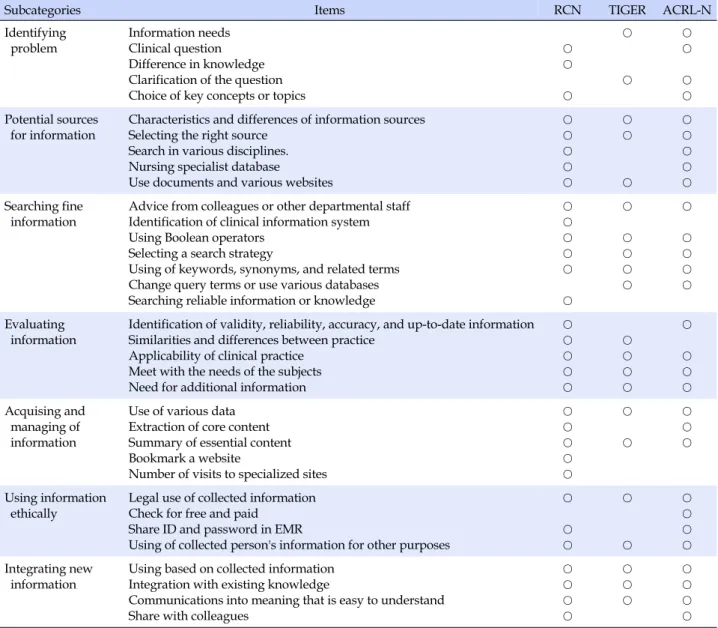
The conceptual framework of the instrument was com-posed of seven components, which was derived from three nursing information literacy competency frameworks: RCN information literacy competency framework [11], ACRL nursing information literacy competency standards [12], and TIGER nursing informatics competencies model [13] (Table 1). The RCN information literacy competency framework consists of seven competencies and 35 per-formance indicators: Competency 1 (3 indicators) is to iden-tify the reason why information is needed, Competency 2 (3 indicators) is to identify what information is needed, Competency 3 (5 indicators) is to perform information search to find information, Competency 4 (5 indicators) is to evaluate whether the collected information meets the requirements, Competency 5 (4 indicators) is to use in-formation and knowledge legally and ethically, and Com-petency 6 (5 indicators) is to manage information, and
Competency 7 (10 indicators) is to generate new informa-tion and knowledge [11].
In 2004, the TIGER group constructed the nursing in-formatics competencies model consisting of three parts: basic computer competencies, information literacy and in-formation management [13]. The second subdomain of this model, recommendations for information literacy com-petencies, consists of five components and 40 indicators; Component 1 (3 indicators) is determine the type and ex-tent of information needed; Component 2 (10 indicators) is to access needed information effectively and efficiently; Component 3 (11 indicators) is to evaluate information and potential sources for information critically and incorporate selected information into knowledge base and value sys-tem; Component 4 (8 indicators) is to use information ef-fectively to accomplish a specific purpose; Component 5 (8 indicators) is to evaluate outcomes of the use of informa-tion and capacity for informainforma-tion ethics [13].
ACRL nursing information competency standards con-sist of 5 standards and 23 performance indicators based on the information literacy competency of nurses developed by the Health Sciences Interest Group (HSIG). Standard 1 (5 indicators) includes competency to identify the scope and characteristics of information needed, and Standard 2
(five indicators) includes competencies about information retrieval, retrieval strategies, and extraction, recording and management of information and information sources for effective and efficient access to information. Standard 3 (7 indicators) includes the abilities to conduct the critical evaluation of information and information sources, in-tegration of information, comparison of new knowledge and existing knowledge, justification of understanding and interpretation of information, and evaluation of the whole process of generated information, while Standard 4
(3 indicators) included the ability to apply new informa-tion and existing informainforma-tion effectively and effectively communicate research results to effectively use informa-tion. Standard 5 (3 indicators) consisted of abilities to un-derstand economic, legal and social issues related to in-formation and inin-formation technology, and to use infor-mation ethically and legally [12].
The evaluation of the RCN information literacy petency framework [11], TIGER nursing informatics com-petencies model [13] and ACRL nursing information liter-acy competency standards [12] have shown that the core components of nursing information literacy competency consist of competencies to recognize the necessity for in-formation to solve nursing problems, determine and iden-tify the characteristics of necessary information, effec-tively and efficiently access necessary information to search
Table 1. Framework of Subcategories for Nursing Information Literacy Competency
Subcategories Items RCN TIGER ACRL-N
Identifying problem
Information needs Clinical question Difference in knowledge Clarification of the question Choice of key concepts or topics
○ ○ ○ ○ ○ ○ ○ ○ ○ Potential sources for information
Characteristics and differences of information sources Selecting the right source
Search in various disciplines. Nursing specialist database
Use documents and various websites
○ ○ ○ ○ ○ ○ ○ ○ ○ ○ ○ ○ ○ Searching fine information
Advice from colleagues or other departmental staff Identification of clinical information system Using Boolean operators
Selecting a search strategy
Using of keywords, synonyms, and related terms Change query terms or use various databases Searching reliable information or knowledge
○ ○ ○ ○ ○ ○ ○ ○ ○ ○ ○ ○ ○ ○ ○ ○ Evaluating information
Identification of validity, reliability, accuracy, and up-to-date information Similarities and differences between practice
Applicability of clinical practice Meet with the needs of the subjects Need for additional information
○ ○ ○ ○ ○ ○ ○ ○ ○ ○ ○ ○ ○ Acquising and managing of information
Use of various data Extraction of core content Summary of essential content Bookmark a website
Number of visits to specialized sites
○ ○ ○ ○ ○ ○ ○ ○ ○ ○ Using information ethically
Legal use of collected information Check for free and paid
Share ID and password in EMR
Using of collected person's information for other purposes
○ ○ ○ ○ ○ ○ ○ ○ ○ Integrating new information
Using based on collected information Integration with existing knowledge
Communications into meaning that is easy to understand Share with colleagues
○ ○ ○ ○ ○ ○ ○ ○ ○ ○ ○ RCN=royal college of nursing; TIGER=technology informatics guiding education reform; ACRL-N=association of college and research libraries-nursing.
for information, critically evaluate selected information, and use acquired information ethically and legally to in-tegrate it with existing knowledge. Based on these evalua-tions, the components of the instrument to assess nursing information literacy competency were identified as 7 com-ponents and 35 items: 5 items of 'competency for identify-ing problems', 5 items for 'competency for identifyidentify-ing po-tential sources for information', 7 items for 'competency for searching for information', 5 items for 'competency for evaluating information', 5 items for 'competency for ac-quiring and managing information', 4 items for 'compe-tency for using information ethically', and 4 items for 'com-petency for integrating new information' (Table 1). Com-ponent 1 'competency for identifying problems' is the
abil-ity to identify what information is needed to solve a nurs-ing problem by recogniznurs-ing and clarifynurs-ing the nursnurs-ing problem in a nursing situation, Component 2 'competency for identifying potential sources for information' is the ability to identify various information resources and select the best information source, Component 3 'competency for searching for information' is the ability to build infor-mation search strategies to search for the inforinfor-mation needed to solve a nursing problem and to perform in-formation search actually, Component 4 'competency for evaluating information' is the ability to evaluate the rele-vance and usefulness of collected information, Compo-nent 5 'competency for acquiring and managing infor-mation' is the ability to extract key knowledge and ideas
that meet the needs of nursing care recipients, Component 6 'competency for using information ethically' is the ability to use information legally and protect the personal in-formation of nursing care recipients, and Component 7 'competency for integrating new information is the ability to solve nursing problems by integrating acquired infor-mation. Each item is rated on a 5-point scale (1 - 'strongly disagree, 2 - disagree, 3 - neither agree nor disagree, 4 - agree, 5 - strongly agree). Higher scores indicates higher levels of nursing information literacy competency. 2) Verification of content validity and a pilot survey
According to Lynn [20], the appropriate number of ex-perts for content validity verification is 3 to 10 persons. For verification of the content validity, the developed instru-ment was evaluated by one nursing informatics professor, one nursing professor with a lot of experience in the re-search on evidence-based practice, and a head nurse with more than 10 years of clinical practice experiences. The content validity index (CVI) was calculated by dividing the sum of the scores of three experts for each item by the total score when each of the experts gave the highest score of 4 points. Regarding the content validity determination, an item was determined to have content validity if the CVI was 0.8 or higher [21]. Based on the experts' opinion, among 5 items with the CVI of 0.8 or less, 2 items of 'I use information data after checking if they are available for free or not,' and 'I search for reliable information or knowl-edge necessary for solving nursing problems.' The remain-ing 3 items with the CVI of 0.8 or less were modified by re-constructing, changing, and supplementing the contents as follows: The item 'I verify the gap between the knowl-edge required for solving nursing problems and the knowledge I possess' was modified into 'I recognize the gap between the knowledge required for solving nursing problems and the knowledge I possess'; the item 'I clarify general problems by changing them into concrete tions' was revised into 'I clarify vague and universal ques-tions to clarify specific quesques-tions in order to solve the nurs-ing problems'; the item 'I expand the search scope or change search terms to apply them to information search if there is not enough data for search' was modified into 'If the search data is insufficient to change search terms, or search using various databases' Then, the final 33 ques-tions of the preliminary instrument were determined by a professor in nursing informatics. Then, we conducted a pi-lot survey for nurses from three general hospital to exam-ine whether the preliminary instrument had overlapping items, whether each term was appropriately used, wheth-er each item was expressed in a way easy to undwheth-erstand
and how long it would take to complete the questionnaire. The time to complete the questionnaire was 8 minutes on average, and the instrument consisting of 7 components and 33 items was finalized.
3. Verification of validity and reliability
1) ParticipantsThe questionnaires were distributed among 330 nurses working in four general hospitals with 200~300 beds and 100 nurses working in one tertiary hospital in J and C Cities, 418 copies were collected (recovery rate of 97.2%), and a total of 382 copies were included in the analysis ex-cluding 36 copies with missing data. The appropriate sam-ple size required to validate the construct validity of the instrument is reported to be 5~10 times the number of questions, or 300 people or more [21]. According to the cri-terion, the appropriate sample size for validity verification in this study is 165~330 people, which corresponds to 5~10 times the number of 33 items of the preliminary instru-ment, or 300 people or more, so the sample size of this study was found to be a satisfactory level.
2) Instrument
For verifying criterion validity, the Evidence-based Practice Questionnaire (EBPQ) developed by Upton and Upton [22] was selected. The reason why the EBPQ was se-lected that it is widely used in most previous studies as an instrument to assess the capacity for evidence-based prac-tice among nurses [16,18,24,25]. Information literacy com-petency is reported to be crucially required for introduc-ing evidence-based practice [13] and as evidence-based practice competency is higher, nursing information liter-acy competency is higher [7,16]. The EBPQ consisted of 14 items about knowledge/skills about evidence-based prac-tice and 6 items about performance on a 7-point scale with scores ranging from 1 to 7 points. Higher scores indicates higher levels of knowledge/skills about evidence-based practice and higher levels of the performance of evi-dence-based practice in clinical practice. Cronbach's ⍺ in Upton and Upton [22] was .87 with .85 for the domain of knowledge/skills and .91 for the domain of performance. In Lim et al. [23], Cronbach's ⍺ was .87 for the total items, .93 for knowledge/skills, and .85 for performance. In this study, Cronbach's ⍺ was .94 for the total items, .93 for knowledge/skills, and .85 for performance.
3) Data collection
This study was conducted after obtaining approval from the Institutional Review Board (IRB) of Gyeongsang
National University (No. GIRB-A15-Y-0048). Study ipants were provided written information, and partic-ipation was voluntary. Informed consent was obtained from all participants. It took 8 to 10 minutes for partic-ipants to complete the questionnaire. After particpartic-ipants read and completed the questionnaires, the questionnaires were put in envelopes and sealed before collecting them. Small presents were given to the survey participants. 4) Data analysis
The collected data were analyzed using SPSS/WIN 21.0 program and AMOS 20.0. First, general characteristics of the participants were analyzed by calculating the frequen-cy, percentage, mean and standard deviation. Second, item analysis was conducted to examine the homogeneity of items, and the item-total correlation test was used to se-lect items with an item-total correlation coefficient of .30 or higher [26]. For verifying the construct validity, con-firmatory factor analysis was carried out instead of ex-ploratory factor analysis. Exex-ploratory factor analysis is a method to generate a model or structure by exploring the characteristics inherent in the data without special as-sumptions about the number or structure of factors. It is said that if the factor structure is already established, it is desirable to perform confirmatory factor analysis [27,28]. Confirmatory factor analysis is a method of verifying whether subordinate components are bundled together by assuming the relationships between variables beforehand based on previous studies, theories or experience [29]. Therefore, in this study, confirmatory factor analysis was performed to examine whether relationships between components and between items were statistically signifi-cant. Various fit indices were used to perform the model fit test. Among various fit indices, the x2 value shows how
closely the model and the actual data are matched. If the
p-value of x2 is larger than .05, it is considered desirable.
However, in general, if the sample size becomes large, a significant value of less than .05 is obtained, so it is diffi-cult to evaluate the model fit only with the x2 value. Thus,
the model fit test was carried out using various fit indices, such as the Root Mean Square Residual (RMR), Goodness of Fit Index (GFI), Comparative Fit Index (CFI), the Tur-ker-Lewis index (TLI), and the Root Mean Squared Error of Approximation (RMSEA), in addition to the x2 value.
Third, the test to verify convergent validity of the devel-oped tool was conducted based on the composite reli-ability (CR) of .70 or higher, average variance extracted (AVE) of .50 or higher, and standardized factor loading of .50 or higher [21]. Fourth, discriminant validity was veri-fied by comparing the squared value of the correlation
co-efficient between variables with the AVE value, and if the square of the correlation coefficient between variables is lower than the AVE value, it isjudged to indicate that the discriminant validity is secured [21]. Fifth, criterion val-idity was analyzed using Pearson's correlation coefficient [26]. Sixth, the reliability of the instrument was verified by calculating Cronbach's ⍺.
RESULTS
1. General Characteristics of Participants
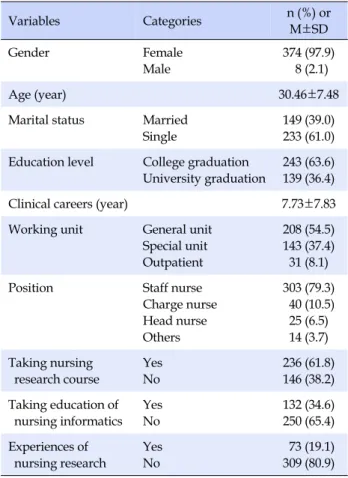
The participants of this study were a total of 382 people (374 women, 97.9%), and the mean age was 30.46 years. More than a half of them (233 people, 61.0%) were un-married and the largest proportion of them (243 people, 63.6.%) were college graduates. They had 7.73 years of clinical experience on average. Regarding work depart-ments, 208 people (54.5%) worked in general wards, and in terms of the position, 303 people (79.3%) were general nurses. 236 nurses (61.8%) completed nursing research, 132 nurses (34.6%) had experience in the education related to nursing informatics, and 73 nurses (19.1%) had experi-ence of research performance (Table 2).
2. Validity Verification
Before performing factor analysis, item analysis was conducted. The correlation coefficients between 33 items and the total items ranged from .30 to .68 and there were no items with the correlation coefficient less than .30. Thus, all the items were adopted.
1) Construct validity
Confirmatory factor analysis was performed to verify the relationships among 7 components of nursing infor-mation literacy competency (competency for identifying problems, competency for identifying potential sources for information, competency for searching for informa-tion, competency for evaluating informainforma-tion, competency for acquiring and managing information, competency for using information ethically, and competency for integrat-ing new information) and the items assigned to each component. Since the fitness of the model was low overall, the modification of the model was required. A total of 6 items with a standard factor load of .50 or more but not meeting the significance criteria were deleted. The deleted items were 1 item about the competency for identifying problems, 2 items about the competency for searching for information, 1 item about the competency for acquiring
Table 3. Goodness of Fit Indices of the Confirmatory Factor Analysis
Model x2 p CMIN/DF RMR GFI AGFI CFI TLI RMSEA
7 Factor model 718.07 <.001 2.37 .03 .88 .85 .91 .89 .06
Evaluation criteria - >.05 <3 <.08 ≥.80 ≥.85 ≥.90 ≥.90 ≤.07
CMIN/DF=chi-square minimum/degree of freedom; RMR=root mean square residual; GFI=goodness of fit index; AGFI=adjusted goodness of fit index; CFI=comparative fit index; TLI=Turker-Lewis index; RMSEA=root mean square error of approximation.
Table 2. General Characteristics of Participants (N=382)
Variables Categories n (%) or M±SD Gender Female Male 374 (97.9) 8 (2.1) Age (year) 30.46±7.48
Marital status Married Single
149 (39.0) 233 (61.0) Education level College graduation
University graduation
243 (63.6) 139 (36.4)
Clinical careers (year) 7.73±7.83
Working unit General unit
Special unit Outpatient
208 (54.5) 143 (37.4) 31 (8.1)
Position Staff nurse
Charge nurse Head nurse Others 303 (79.3) 40 (10.5) 25 (6.5) 14 (3.7) Taking nursing research course Yes No 236 (61.8) 146 (38.2) Taking education of nursing informatics Yes No 132 (34.6) 250 (65.4) Experiences of nursing research Yes No 73 (19.1) 309 (80.9)
and managing information, and 1 item about the compe-tency for integrating new information. Finally, as a result of the analysis of the fit of the modified model composed of 7 components and 27 items, the fit indices of CMIN/DF, RMR, GFI, AGFI, CFI, and RMSEA met the criteria and the fit index of TLI was close to the criterion, indicating an ap-propriate level of the fit of the model (Table 3).
2) Convergent validity
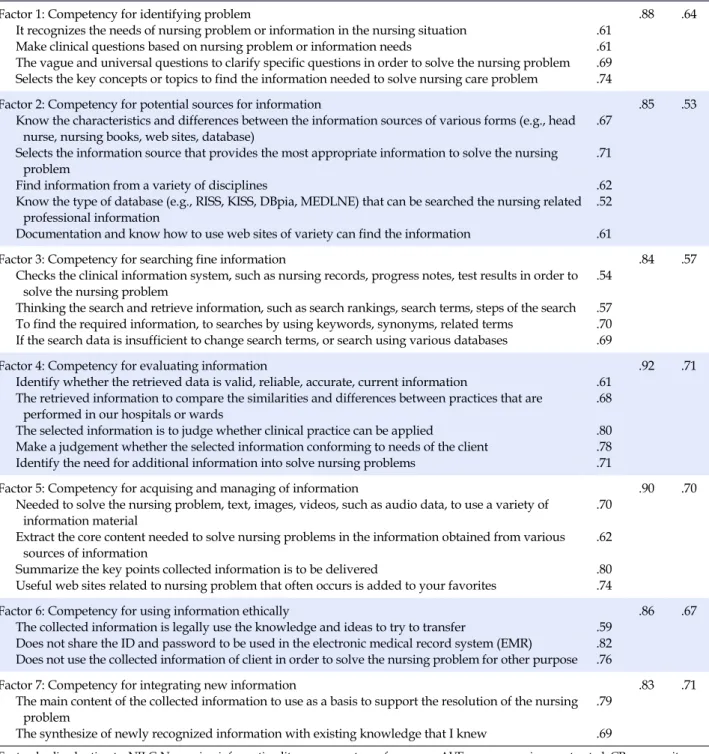
The results of verifying the convergent validity showed that the standardized factor loadings ranged from .52 to .82, and thus all the items met the conformity criteria of .50. In addition, the composite reliability (CR) ranged from .83 to .92, meeting the criterion value (≥.70), so the crite-rion of convergence validity was satisfied (Table 4). In the
sub-domains of nursing information utilization compe-tence, the AVE was estimated to be .64 for competency for identifying problems, .53 for competency for potential sources for information, .57 for competency for searching for information, .71 for competency for evaluating in-formation, .70 for competency for acquiring and managing information, .67 for competency for using information eth-ically, and .71 for competency for integrating new in-formation, thus all satisfying the criterion value of .50 or higher.
3) Discriminant validity
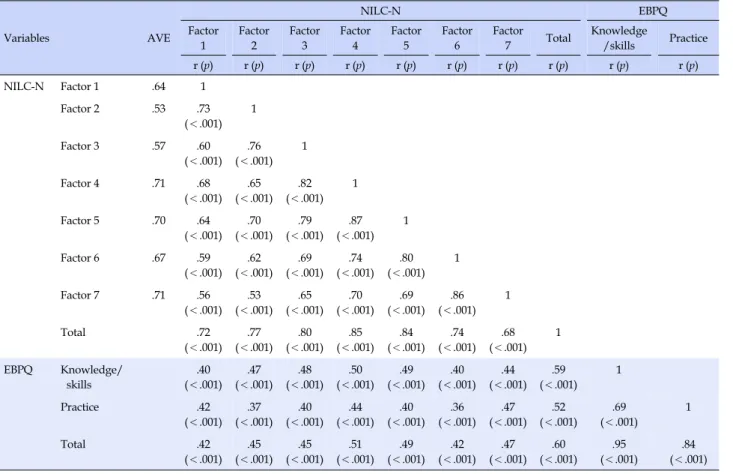
In order to verify the discriminant validity of the devel-oped tool, to see if the squared value of the correlation co-efficient between variables was lower than the AVE value of the subdomains of nursing information literacy com-petency, the values were compared. The squared value of the correlation coefficient between most of the subfactors of nursing information literacy competency was found to be lower than the AVE value, so the discriminant validity of the tool was secured. However, the squared value of the correlation coefficient between competency for potential sources for information and competency for searching for information, between competency for evaluating infor-mation and competency for acquiring and managing in-formation, and between competency for using informa-tion ethically and competency for integrating new infor-mation was higher than the AVE value, so discriminant validity was not completely secured (Table 5).
4) Criterion validity
The correlation between the EBPQ score and nursing in-formation literacy competency score was .60 (p<.001), showing a positive correlation, so criterion validity was verified. The subdomains of nursing information literacy competency, such as competency for identifying problems (r=.42, p<.001), competency for potential sources for in-formation (r=.45, p<.001), competency for searching for information (r=.45, p<.001), competency for evaluating information (r=.51, p<.001), competency for acquiring and managing information (r=.49, p<.001), competency for using information ethically (r=.42, p<.001), and
com-Table 4. Confirmatory Factor Analysis and Final Items of NILC-N
Items SE CR AVE
Factor 1: Competency for identifying problem
It recognizes the needs of nursing problem or information in the nursing situation Make clinical questions based on nursing problem or information needs
The vague and universal questions to clarify specific questions in order to solve the nursing problem Selects the key concepts or topics to find the information needed to solve nursing care problem
.61 .61 .69 .74
.88 .64
Factor 2: Competency for potential sources for information
Know the characteristics and differences between the information sources of various forms (e.g., head nurse, nursing books, web sites, database)
Selects the information source that provides the most appropriate information to solve the nursing problem
Find information from a variety of disciplines
Know the type of database (e.g., RISS, KISS, DBpia, MEDLNE) that can be searched the nursing related professional information
Documentation and know how to use web sites of variety can find the information
.67 .71 .62 .52 .61 .85 .53
Factor 3: Competency for searching fine information
Checks the clinical information system, such as nursing records, progress notes, test results in order to solve the nursing problem
Thinking the search and retrieve information, such as search rankings, search terms, steps of the search To find the required information, to searches by using keywords, synonyms, related terms
If the search data is insufficient to change search terms, or search using various databases
.54 .57 .70 .69
.84 .57
Factor 4: Competency for evaluating information
Identify whether the retrieved data is valid, reliable, accurate, current information
The retrieved information to compare the similarities and differences between practices that are performed in our hospitals or wards
The selected information is to judge whether clinical practice can be applied
Make a judgement whether the selected information conforming to needs of the client Identify the need for additional information into solve nursing problems
.61 .68 .80 .78 .71 .92 .71
Factor 5: Competency for acquising and managing of information
Needed to solve the nursing problem, text, images, videos, such as audio data, to use a variety of information material
Extract the core content needed to solve nursing problems in the information obtained from various sources of information
Summarize the key points collected information is to be delivered
Useful web sites related to nursing problem that often occurs is added to your favorites
.70 .62 .80 .74
.90 .70
Factor 6: Competency for using information ethically
The collected information is legally use the knowledge and ideas to try to transfer
Does not share the ID and password to be used in the electronic medical record system (EMR) Does not use the collected information of client in order to solve the nursing problem for other purpose
.59 .82 .76
.86 .67
Factor 7: Competency for integrating new information
The main content of the collected information to use as a basis to support the resolution of the nursing problem
The synthesize of newly recognized information with existing knowledge that I knew
.79 .69
.83 .71
SE=standardized estimate; NILC-N=nursing information literacy competency for nurses; AVE=average variance extracted; CR=composite reliability.
petency for integrating new information (r=.47, p<.001), showed a significant positive correlation with evidence- based practice (Table 5).
3. Reliability
The internal consistency coefficient (Cronbach's ⍺) for
the reliability was .93, showing a high level of reliability. In terms of sub-domains, Cronbach's ⍺ was .76 for com-petency for identifying problems, .76 for comcom-petency for identifying potential sources for information, .71 for com-petency for searching for information, .84 for comcom-petency for evaluating information, .80 for competency for acquir-ing and managacquir-ing information, .75 for competency for
us-Table 5. Correlations between NILC-N and EBPQ Variables AVE NILC-N EBPQ Factor 1 Factor 2 Factor 3 Factor 4 Factor 5 Factor 6 Factor 7 Total Knowledge /skills Practice r (p) r (p) r (p) r (p) r (p) r (p) r (p) r (p) r (p) r (p) NILC-N Factor 1 .64 1 Factor 2 .53 .73 (<.001) 1 Factor 3 .57 .60 (<.001) .76 (<.001) 1 Factor 4 .71 .68 (<.001) .65 (<.001) .82 (<.001) 1 Factor 5 .70 .64 (<.001) .70 (<.001) .79 (<.001) .87 (<.001) 1 Factor 6 .67 .59 (<.001) .62 (<.001) .69 (<.001) .74 (<.001) .80 (<.001) 1 Factor 7 .71 .56 (<.001) .53 (<.001) .65 (<.001) .70 (<.001) .69 (<.001) .86 (<.001) 1 Total .72 (<.001) .77 (<.001) .80 (<.001) .85 (<.001) .84 (<.001) .74 (<.001) .68 (<.001) 1 EBPQ Knowledge/ skills .40 (<.001) .47 (<.001) .48 (<.001) .50 (<.001) .49 (<.001) .40 (<.001) .44 (<.001) .59 (<.001) 1 Practice .42 (<.001) .37 (<.001) .40 (<.001) .44 (<.001) .40 (<.001) .36 (<.001) .47 (<.001) .52 (<.001) .69 (<.001) 1 Total .42 (<.001) .45 (<.001) .45 (<.001) .51 (<.001) .49 (<.001) .42 (<.001) .47 (<.001) .60 (<.001) .95 (<.001) .84 (<.001) NILC-N=nursing information literacy competency for nurses; EBPQ=evidence-based practice questionnaire; Factor 1=competency for identifying problem; Factor 2=competency for potential sources for information; Factor 3=competency for searching fine information; Factor 4=competency for evaluating information; Factor 5=competency for acquising and managing of information; Factor 6=competency for using information ethically; Factor 7=competency for integrating new information.
ing information ethically, and .75 for competency for in-tegrating new information. Thus, in all subdomains, Cron-bach's ⍺ was .70 or higher, so the reliability of the instru-ment was confirmed.
DISCUSSION
The Nursing Information Literacy Competency for Nurses (NILC-N) in this study was developed to measure nurses' information literacy competency to use informa-tion based on evidence by searching informainforma-tion from var-ious resources and evaluating information quality to solve the nursing problems encountered in clinical practice. The NILC-N is composed of 7 components and 27 items based on the RCN information literacy competency framework [11], ACRL nursing information literacy competency stan-dards [12], and TIGER nursing informatics competencies model [13]. Specifically, it consists of 4 items about com-petency for identifying problems, 5 items about competen-cy for potential sources for information, 4 items about
competency for searching for information, 5 items about competency for evaluating information, 4 items about competency for acquiring and managing information, 3 items about competency for using information ethically, and 2 items about competency for integrating new infor-mation. The validity and reliability of this instrument was verified using various methods to evaluate validity, such as construct validity, convergent validity, and criterion validity.
As a result of confirmatory factor analysis to verify the construct validity of the NILC-N, the nursing information literacy competency model consisting of 7 factors was found to be suitable. The instrument developed by Son et al.[18] to measure nursing information literacy competen-cy was composed of two subdomains of knowledge and utilization about computers and competency for searching for data. As for the competency of searching for data, spe-cifically, it was composed of the items about competency for e-library utilization, competency for reference data uti-lization, understanding and utilization of the database,
and utilization of the Internet and e-mail. The recognition of how to use documents and various websites in the com-petency for identifying potential sources of information of this study is related to the ability to use an e-library and the ability to utilize reference data, and competency for searching for information which enables individuals to ac-tually search for information using various search strat-egies is directly or indirectly related to the understanding and utilization of database and the utilization of the internet. In the instrument of Son et al.[18], computer liter-acy related to the knowledge and use of computers was separately classified as a sub-domain. However, the petency for potential sources for information and com-petency for searching for information of NILC-N could measure nursing information literacy competencies in a more concrete manner. In addition, it is expected to have high applicability because it includes essential competen-cies on information source identification and information search competency with fewer items.
The NICQ proposed by Staggers, Gassert and Curran [19] was developed to measure extensive nursing in-formation literacy competencies regarding three areas of computer skills, informatics knowledge, and informatics skills. However, competency for searching for information of NICQ which corresponds to part of the areas of nursing information literacy competency is partially included in the communication and data access areas of computer skills. Because the NICQ mainly deals with the concepts of informatization and computer knowledge and skills, it is difficult to measure the attributes of nurses' recognization of information needs, finding and evaluating necessary in-formation, and applying it to problem solving using the NICQ. In this regard, the NILC-N instrument has the ad-vantage that it can comprehensively measure a nursing in-formation literacy competency. Especially, 'the competen-cy for using information ethically' of the NILC-N has sig-nificant implications because it is an essential competency for nurses who are responsible for legally acquiring and protecting the personal information and health in-formation of nursing care recipients. In the 21st century, healthcare institutions are constantly accumulating a large number of health-related information and personal infor-mation. The results of this study are significant in that since nurses as professionals legally acquire the mation of healthcare consumers, protect personal infor-mation, and ensure personal information security, it is es-sential to cultivate sound ethical awareness among nurses. With respect to convergent validity, the standardized factor loadings of 27 items ranged from .51 to .82, all being higher than .50, and composite reliability ranged from .83
to .92, all being higher than .70, The AVE value ranged from .52 to .71, so it was also higher than .50 in all seven components. Therefore, convergence validity of the NILC- N was verified.
In terms of discriminant validity of the NILC-N, the squared value of the correlation coefficient between com-petency for identifying potential sources of information and competency for searching for information, between competency for evaluating information and competency for acquiring and managing information, and between competency for using information ethically and compe-tency for integrating new information was higher than the AVE value, so discriminant validity was not completely secured. In some standards and models, information sour-ce identification and information search and information acquisition and evaluation are not handled as separate sub-domains, but selection of information sources, con-struction of search strategies, and performance of infor-mation search are included in inforinfor-mation access and formation evaluation and information extraction and in-tegration are all included in the same component [12,13]. In the RCN information literacy competency framework, the legal and ethical aspects of information are dealt with together with information utilization [11]. It is thought that since some subdomains did not maintain their in-dependence for this reason, it may have affected discrim-inant validity.
The criterion validity of the NILC-N was verified by ex-amining correlations with the EBPQ. The correlations be-tween the EBPQ and competency for identifying potential sources of information and competency for using infor-mation ethically were rather lower than the correlation with other subdomains, but overall, there was a positive correlation between all subdomains of NILC-N and EBPQ. Finally, criterion validity was also verified. In the reli-ability test, Cronbach's ⍺ of the subdomains of NILC-N ranged from .70 to .84, and the overall instrument reli-ability was as high as .93. In general, it is said that internal consistency reliability is established if Cronbach's ⍺ is .70 or higher in the case of a newly developed instrument, and if it is .80 or more in the case of the developed and mature instrument [30]. Therefore, the NILC-N was shown to be a reliable instrument with internal consistency.
The components of the NILC-N were derived as seven subdomains of problem identification, information source identification, information search, information evaluation. information acquisition and management, information ethics, and information utilization. All attributes of the NILC-N includes seven competencies of the RCN in-formation literacy competency framework, five elements
of the TIGER nursing informatics competencies model, and five standards of ACRL nursing information literacy competency standards. In the NILC-N instrument, nurs-ing information literacy competency was defined as the competency for nurses to identify nursing problems, iden-tify information needed and information sources to solve problems, identify and evaluate appropriate information, use information ethically, and utilize information in prac-tice to perform the best nursing pracprac-tice.
The first factor 'competency for identifying problems' includes 4 items about recognition of nursing problems, recognition of information needs, and clarification of nurs-ing problems. It is the competency for recogniznurs-ing that in-formation is needed in a nursing situation and identifying a nursing problem by clarifying what information is need-ed to solve the nursing problem. Considering that it is the first step in the process of nursing problem solving to rec-ognize the needs of the nursing care recipient in a nursing situation and clarify what the nursing problem is, it can be seen that it is an important factor in nursing information literacy competency. The second factor 'competency for identifying potential sources of information' includes 5 items about identification of information sources, selec-tion of informaselec-tion sources, and understanding how to use information sources. It is the capacity to identify what information is needed to solve a nursing problem, identify various information sources, and select the best informa-tion source. After identifying a nursing problem accu-rately, identifying the sources of information available to resolve the identified nursing problem and selecting the best source of information is an important process that must be undertaken before performing information search and provides a method to deal with the needs or problems of nursing care recipients [11]. The third factor 'compe-tency for searching for information' includes 4 items about construction of search strategies, information search, and modification of search strategies. It is the competency to find reliable and useful information by building search strategies to access the selected information source and find useful information to solve nursing problems. The derivation of competency for searching for information is thought to be meaningful in that nurses should be able to search for information based on available information sources including colleagues, policies, and various types of literature to find useful information to solve the prob-lems of nursing care recipients [13]. The fourth factor 'competency for evaluating information' include 5 items about the identification of the reliable and accurate in-formation, appropriateness and applicability of selected information, and determination of the necessity for
addi-tional information. It is the capacity to determine whether the information acquired from information sources is ap-propriate for information needs and the solution of nurs-ing problems. The evaluation of the reliability, validity, ac-curacy, authority and timeliness of information to deter-mine whether collected information can be used as an ef-fective intervention to meet the needs of a nursing care re-cipient is an essential element in solving the nursing prob-lem using accurate information. The fifth factor 'compe-tency for acquire and manage information' includes 4 items of knowledge, information extraction, information use, and management of useful information sources. It is the capacity for a nurse to access information to determine what information is valuable in a particular situation and extract knowledge and information data suitable for solv-ing nurssolv-ing problems. The ability to summarize and ac-quire useful information that can be applied to actual problem solving is an important competence in that it is the ability for a nurse to understand the individual needs of a nursing care recipient and effectively solve a nursing problem. The sixth factor 'competency for using informa-tion ethically' consists of 3 items about the legal use of in-formation and protection of the inin-formation of the nursing care recipient. It is the competency related to legal, ethical and social problems encountered when nurses access in-formation sources, obtain necessary inin-formation and ac-tually use the information. The seventh factor 'compe-tency for integrating new information' consists of 2 items about information synthesis and application, and it is the competency to integrate and synthesize new information acquired with existing knowledge, select appropriate de-livery methods to meet the needs of nursing care recipi-ents and actually apply them to the solution of nursing problems.
Nurses are responsible for maintaining up-to-date knowledge and skills for continuous professional devel-opment. Nursing staff should improve clinical practice through assessment and supervision [11] and develop the ability to use the information system and information lit-eracy competency to improve the safety of care and qual-ity of nursing in a new healthcare environment [13]. Nurs-ing information literacy competency is an essential capacity needed to identify nursing problems to solve the nursing problems encountered in clinical practice, find necessary information, and apply the information that meets the needs of nursing care recipients in order to provide high quality nursing care to them [11]. As described above, since the NILC-N developed to measure the level of information literacy competency of nurses can accurately measure the current nursing information literacy competency of
nurs-ing workforce, it can be utilized in the field of nursnurs-ing practice such as the development of a curriculum to im-prove nursing information literacy competency by identi-fying strengths or weaknesses of nursing staff regarding the factors of nursing information literacy competency.
The significance of this study can be considered in terms of nursing theory, nursing research, and nursing practice as follows. First, since theories and models for nursing in-formation literacy competency have not been developed to date, the NILC-N instrument was developed based on the RCN information literacy competency framework [11], ACRL nursing information literacy competency standards [12], and TIGER nursing informatics competencies model [13]. Second, in terms of nursing research, it is necessary to accurately assess the information literacy competencies of nursing staff by using the NILC-N instrument to identify strong or weak points among the seven kinds of compe-tencies. Additionally, there is a need for a follow-up study to develop a customized nursing information literacy com-petency enhancement program based on the strengths and weaknesses regarding nursing information literacy com-petency of nursing workforce identified by the NILC-N in-strument and to verify the effects. Finally, in terms of nurs-ing practice, previously, it was not possible to accurately measure nursing information literacy competency among nurses because the information literacy competency meas-urement instrument developed for college students was used to measure nursing information literacy competency before this study. For improving the quality of nursing, it is necessary to evaluate the nursing information literacy competency by using the NILC-N.
Despite several significances, this study has some limi-tations. First, since the participants of this study were nurses working in one tertiary hospital and four medium- sized hospitals, it may be difficult to generalize our find-ings to the entire nursing workforce. Second, since the item of 'competency for integrating new information' were extracted as two items about the synthesis and application of information in the validity verification process of the NILC-N instrument through confirmatory factor analysis, it remains a question whether it can explain the attribute of information synthesis sufficiently. Therefore, we recom-mend that these aspects should be carefully reviewed in using the instrument.
CONCLUSION
This study is a methodological study to develop an in-strument to measure nursing information literacy compe-tency among nurses who can help solve nursing problems
by selecting the best information acquired through various sources and applying it to nursing care recipients. The NILC-N was developed through extensive reviews, the recommendations for nursing information literacy com-petency, and the verification of psychometric properties. The validity of the NILC-N was verified using construct validity, convergent validity, discriminant validity and criterion validity. As a result, the NILC-N instrument was developed as a 5-point Likert scale composed of 7 compo-nents and 27 items. It was proven to be a simple tool with validity and reliability which well reflects the character-istics of nursing information literacy competency.
Based on our findings, we recommend several sugges-tions. First, considering that nursing staffs should have nursing information literacy competency as the core com-petencies, follow-up research is needed to evaluate the nursing information literacy competency of nursing staff working in various fields of nursing practice in the future. Second, it is necessary to conduct a research on the devel-opment programs to enhance nursing information literacy competency using the NILC-N.
REFERENCES
1. Association of College and Research Libraries. Information literacy competency standards for higher education [Internet]. Chicago: Association of College and Research Libraries; 2000 [cited 2017 October 1]. Available from:
http://www.ala.org/acrl/sites/ala.org.acrl/files/content/ standards/standards.pdf
2. Society of College, National and University Libraries. The SCONUL seven pillars of information literacy. Core model for higher education [Internet]. London: Society of College, National and University Libraries; 2011 [cited 2017 April 26]. Available from:
http://www.sconul.ac.uk/sites/default/files/documents/ coremodel.pdf
3. Council of Australian University Librarians. Information lite-racy standards. First edition [Internet]. Canberra: Council of Australian University Librarians; 2001 [cited 2017 May 11]. Available from:
http://www.caul.edu.au/content/upload/files/caul-doc/ InfoLitStandards2001.doc
4. Australian and New Zealand Institute for Information Li-teracy. Australian and New Zealand information literacy framework: Principles, standards and practice. Second edition [Internet]. Adelaide: Australian and New Zealand Institute for Information Literacy; 2004 [cited 2017 May 11]. Available from: http://www.caul.edu.au/content/upload/files/info-literacy /InfoLiteracyFramework.pdf
5. Greiner AC, Knelbel E. Health professions education: A bridge to quality [Internet]. Washington: Institute of Medicine; 2003 [cited 2017 December 22]. Available from:
https://studentaffairs.ucsf.edu/sites/studentaffairs.ucsf.edu /files/migrate/PDF/WASC/Appendix%2015.%20%20Schoo l%20of%20Pharmacy-%20A%20Bridge%20to%20Quality.pdf 6. Ross J. Information literacy for evidenced-based practice in
perianesthesia nurses: Readiness for evidenced-based practice. Journal of Perianesthesia Nursing. 2010;25(2):64-70.
https://doi.org/10.1016/j.jopan.2010.01.007
7. Kim NY, Kim EA. Factors influencing of evidence-based prac-tice competency in nursing students. Journal of the Korean Data Analysis Society. 2014;16(5):2855-2868.
8. Baker KA, Ellett ML, Sharon DB. Evidence-based practices of gastroenterology nurses. Gastroenterology Nursing. 2010;33 (4):263-266. https://doi.org/10.1097/SGA.0b013e3181e7bbde 9. Leng CH, Lim SY, Siew WF. Are nurses ready for evidence-
based practice? A descriptive study of information literacy com-petency among clinical practicing registered nurses in a private hospital in Malaysia. Journal of International E-Journal of Sci-ence, Medicine and Education. 2016;10(1):10-16.
10. Forster M. Six ways of experiencing information literacy in nursing: The findings of a phenomenographic study. Nurse Education Today. 2015;35(1):195-200.
https://doi.org/10.1016/j.nedt.2014.06.005
11. Royal College of Nursing. RCN competences: Finding, using and managing information [Internet]. London: Royal College of Nursing ; 2011 [cited 2017 May 1]. Available from: http://www2.rcn.org.uk/__data/assets/pdf_file/0007/3570 19/003847.pdf
12. Association of College and Research Libraries. Information lit-eracy competency standards for nursing [Internet]. Chicago: Association of College and Research Libraries; 2013 [cited 2017 March 29]. Available from:
http://www.ala.org/acrl/standards/nursing
13. Technology Informatics Guiding Education Reform. The TIGER initiative. Information competencies for every practicing nurse: Recommendations from the TIGER collaborative [Internet]. Chicago: Technology Informatics Guiding Education Reform; 2009 [cited 2017 June 6]. Available from:
http://www.thetigerinitiative.org/docs/TigerReport_Infor maticsCompetencies.pdf
14. Ha YM, Lee M, Chae YJ. The effectiveness of nursing in-formation literacy competency enhancement program on evi-dence-based practice competencies and problem solving skills in nursing student. Journal of Digital Convergence. 2016;14 (11):347-356.
15. Jang KS, Kim EA, Kim NY. The mediating effect of information literacy in the relationship between critical thinking ability among senior nursing student. Journal of the Korean Data
Analysis Society. 2015;17(5):2823-2835.
16. Lee HJ. Relationships among information resources use, in-formation literacy competency and evidence-based practice in university hospital [master's thesis]. [Jinju]: Gyeongsang Na-tional University; 2015. 65 p.
17. Rhee HY, Nam TW. The study on undergraduates' infor-mation literacy scale development. Journal of the Korean Li-brary and Information Science Society. 2008;42(4):503-532. 18. Son YJ, Kim SH, Park YS, Lee SK, Lee YM. The influence of
information retrieval skill on evidence based practice com-petency in clinical nurses. Korean Journal of Adult Nursing. 2012;24(6):635-646. https://doi.org/10.7475/kjan.2012.24.6.635 19. Staggers N, Gassert CA, Curran C. Informatics competencies
for nurses at four levels of practice. The Journal of Nursing Education. 2001;40(7):303-316.
20. Lynn MR. Determination and qualification of content validity. Nursing Research. 1986;35(6):382-385.
21. Hair Jr JF, Black WC, Babin BJ, Anderson RE. Multivariate data analysis. 7th ed. Upper Saddle River, NJ: Pearson Prentice Hall; 2010. 816 p.
22. Upton D, Upton P. Development of an evidence-based practice questionnaire for nurses. Journal of Advanced Nursing. 2006; 53(4):454-458.
https://doi.org/10.1111/j.1365-2648.2006.03739.x
23. Lim KC, Park KO, Kwon JS, Jeong JS, Choe MA, Kim JH, et al. Registered nurses' knowledge, attitudes, and practice about evidence-based practice at general hospitals in Korea. Journal of Korean Clinical Nursing Research. 2011;17(3):375-387. 24. Koehen ML, Lehman K. Nurses' perceptions of evidence-based
nursing practice. Journal of Advanced Nursing. 2008;62(2): 209-215. https://doi.org/10.1111/j.1365-2648.2007.04589.x 25. Brown CE, Wickline MA, Ecoff L, Glaser D. Nursing practice,
knowledge, attitudes and perceived barriers to evidence-based practice at an academic medical center. Journal of Advanced Nursing. 2009;65(2):371-381.
https://doi.org/10.1111/j.1365-2648.2008.04878.x
26. Streiner DL, Norman GR. Health measurement scales: A prac-tical guide to their development and use. 4th ed. New York, NY: Oxford University Press; 2008.
27. Yu JP. Concept and understanding of structure equation mod-el: Amos 4.0-20.0. Seoul: Hannarae Academy; 2012. 568 p. 28. Kang H. A guide on the use of factor analysis in the assessment
of construct validity. Journal of Korean Academy of Nursing. 2013;43(5):587-597.
https://doi.org/10.4040/jkan.2013.43.5.587
29. Munro BH. Munro's statistical methods for health care research. 5th ed. Philadelphia, PA: Lippincott Williams & Wil-kins; 2005. 576 p.
30. Nunally JC. Psychometric theory. 2nd ed. New York, NY: Mc-Graw-Hill; 1978. 701 p.