Trends in Hospitalized Acute Myocardial Infarction Patients with
Heart Failure in Korea at 1998 and 2008
Heart failure (HF) complicating acute myocardial infarction (AMI) is common and is
associated with poor clinical outcome. Limited data exist regarding the incidence and
in-hospital mortality of AMI with HF (AMI-HF). We retrospectively analyzed 1,427 consecutive
patients with AMI in the five major university hospitals in Korea at two time points, 1998
(n = 608) and 2008 (n = 819). Two hundred twenty eight patients (37.5%) in 1998 and
324 patients (39.5%) in 2008 of AMI patients complicated with HF (P = 0.429). AMI-HF
patients in 2008 were older, had more hypertension, previous AMI, and lower systolic
blood pressure than those in 1998. Regarding treatments, AMI-HF patients in 2008
received more revascularization procedures, more evidence based medical treatment and
adjuvant therapy, such as mechanical ventilators, intra-aortic balloon pulsation compared
to those in 1998. However, overall in-hospital mortality rates (6.4% vs 11.1%, P = 0.071)
of AMI-HF patients were unchanged and still high even after propensity score matching
analysis, irrespective of types of AMI and revascularization methods. In conclusion, more
evidence-based medical and advanced procedural managements were applied for patients
with AMI-HF in 2008 than in 1998. However the incidence and in-hospital mortality of
AMI-HF patients were not significantly changed between the two time points.
Keywords:
Acute Myocardial Infarction; Heart Failure; Temporal Trend; Hospital Mortality
Jong-Chan Youn,
1* Suk Min Seo,
2*
Hye Sun Lee,
3Jaewon Oh,
1Min Seok Kim,
4Jin-Oh Choi,
5Hae-Young Lee,
6Hyun-Jai Cho,
6Seok-Min Kang,
1Jae Joong Kim,
4Sang Hong Baek,
7Eun-Seok Jeon,
5Hyun-Young Park,
8Myeong-Chan Cho,
8,9and Byung-Hee Oh
61Division of Cardiology, Severance Cardiovascular Hospital and Cardiovascular Research Institute, Yonsei University College of Medicine, Seoul; 2Cardiovascular Center and Cardiology Division, Incheon St. Mary’s Hospital, The Catholic University of Korea, Incheon; 3Department of Biostatistics, Yonsei University College of Medicine, Seoul; 4Heart Failure and Cardiac Transplantation Center, Asan Medical Center Heart Institute, University of Ulsan College of Medicine, Seoul; 5Cardiovascular Center and Cardiology Division, Samsung Medical Center, Sungkyunkwan University School of Medicine, Seoul; 6Cardiovascular Center and Cardiovascular Research Institute, Seoul National University College of Medicine, Seoul; 7Cardiovascular Center and Cardiology Division, Seoul St. Mary’s Hospital, The Catholic University of Korea, Seoul; 8Division of Cardiovascular and Rare Diseases, Center for Biomedical Sciences, Korea National Institute of Health, Cheongwon; 9Regional Cardiovascular Disease Center, Division of Cardiology, Department of Internal Medicine, Chungbuk National University Hospital, Cheongju, Korea
*Jong-Chan Youn and Suk Min Seo contributed equally to this work.
Received: 3 October 2013 Accepted: 4 February 2014 Address for Correspondence: Byung-Hee Oh, MD
Cardiovascular Center and Cardiovascular Research Institute, Department of Internal Medicine, Seoul National University Hospital, Seoul National University College of Medicine, 101 Daehak-ro, Jongno-gu, Seoul 110-744, Korea Tel: +82.2-2072-3345, Fax: +82.2-744-2819 E-mail: [email protected]
This study was supported by the Korea National Institute of Health (2010-E63003-00 and 2011-E63002-00).
http://dx.doi.org/10.3346/jkms.2014.29.4.544 • J Korean Med Sci 2014; 29: 544-549
INTRODUCTION
Heart failure (HF) is a health problem worldwide, especially in developed countries,
with a major cause of morbidity and mortality, leading to hospitalization (1, 2).
Coro-nary artery disease including acute myocardial infarction (AMI) is the most common
cause of HF, while HF is a common serious complication following AMI (3, 4).
In recent decades, introduction of new medical and interventional treatments, such
as primary percutaneous revascularization, antiplatelet agents,
renin-angiotensin-al-dosterone system (RAAS) antagonists, statins, and hemodynamic support system such
as intra-aortic balloon pulsation (IABP) and extracorporeal support system (ECS) have
been reported to decrease the rate of HF development and in-hospital mortality of AMI
patients (5-8). However, some other studies could not find any significant decrease in
trends, especially the incidence of HF after AMI (9, 10). Most studies about the trends
in the AMI with HF (AMI-HF) were based on data in western countries. However, there
are few data whether the improvements of AMI treatment have reduced the incidence
or short term in-hospital mortality of HF in Asian countries (11). Accordingly, we sought
to investigate temporal trends of AMI-HF in the clinical characteristics, treatment
meth-ods and in-hospital mortality in 1998 and 2008, respectively.
MATERIALS AND METHODS
Study design and population
We studied consecutive AMI patients who admitted in the five major university
hospi-tals in Korea at two time points, 1998 and 2008. First, we used the discharge codes as
coded by the International Classification of Disease, Tenth Revision, Clinical Mo dification
(ICD-10-CM). AMI was defined as I21. We recognized a total of
1,785 patients with this AMI code. Eligible AMI patients for this
study had any episodes of chest pain within two weeks of
admis-sion and a positive troponin test or electrocardiogra phic
chang-es (ST-segment deviation ≥ 0.1 mV or pathologic Q wave). A
total of 1,513 patients was selected for adopting these
diagnos-tic criteria of AMI. The exclusion criteria were as follows: chest
pain onset started two weeks prior to admission, underlying
heart failure, estimated life expectancy of less than 12 months.
Baseline characteristics and definition of heart failure
The records of clinical variables were retrieved from patients’
electronic medical record. Clinical variables included in the
analysis were: age, gender, cigarette smoking, vital sign, family
history of vascular disease, route of admission (emergent
de-partment, out-patient and in-hospital), co-existing conditions
such as hypertension, diabetes mellitus, cerebrovascular
acci-dent (CVA), history of AMI one month prior to admission, and
dyslipidemia. The location of infarction, treatment modality,
additional mechanical treatment, total admission duration,
dis-charge medication, and in-hospital death were also included.
Shock was defined as systolic pressure lower than 90 mmHg.
Conservative care of AMI was defined as no reperfusion
treat-ment such as thrombolysis, percutaneous coronary
interven-tion (PCI), and coronary artery bypass graft (CABG). Diagnostic
criteria of HF were defined as left ventricular ejection fraction
(LVEF) by echocardiography less than 40% or dyspnea with
congestion on radiograph.
Statistical analysis
Continuous variables were expressed as mean ± standard
devi-ation and are compared with the Student’s t-test. Discrete
vari-ables were expressed as percentages and compared with the
chi-square test or Fisher’s exact test. A multivariate logistic
re-gression analysis was performed in order to identify
indepen-dent predictors for AMI with HF. Variables which were
evaluat-ed in the multivariate logistic regression analysis includevaluat-ed
us-ing those with significant association (P < 0.05) in univariate
logistic regression analysis.
A propensity score matching analysis for the predicted
prob-ability of in-hospital mortality in each group was estimated
with the use of logistic regression model fit with 18 clinically
relevant factors. Age, gender, types of AMI (ST elevation MI),
underlying comorbidities such as diabetes, hypertension,
dys-lipidemia, CVA, previous MI and family history, smoking status,
systolic blood pressure, heart rate, revascularization methods
(PCI and CABG) and adjuvant therapy (ventilator, intra-aortic
balloon pump (IABP), inotropes and intensive care unit (ICU)
care). We created a propensity score matched by attempting to
match case patients and control patients (a 1:1 match). A
near-est-neighbor-matching algorithm with a “greedy” heuristic (one
that always implements the best immediate, or local, solution)
was used to match patients on the demographic characteristics.
All other analyses were 2-tailed, with clinical significance
de-fined as values of P < 0.05. All statistical analyses were done
with Statistical Analysis Software package (SAS version 9.1, SAS
Institute, Cary, NC, USA).
Ethics statement
The study protocol was approved by the institutional review
board (IRB) at each participating institution. IRB number of
Seoul National University Hospital was 1102-072-352 and that
of Severance Cardiovascular Hospital was 4-2011-0075.
In-formed consent was waived by the IRB.
RESULTS
Characteristics of the study populations
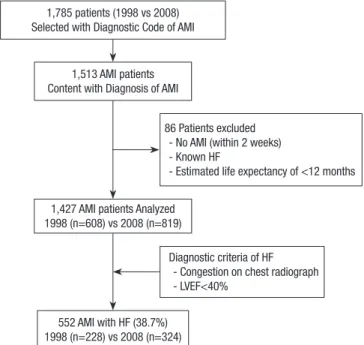
The flow chart was briefly presented to illustrate the selection
process of study population (Fig. 1). Of 1,785 patients to have
AMI coded with I21 (ICD-10-CM), we selected 1,513 subjects
who satisfied the diagnostic criteria of AMI. We excluded 86
pa-tients; and a total of 1,427 patients were finally selected in this
study. There were 608 (42.6%) patients with AMI at 1998 and
819 (57.4%) at 2008. Baseline demographic and clinical
charac-teristics are shown in Table 1. The patients of 2008 were older
and had high proportion of male patients, hypertension,
dys-lipidemia, and previous AMI but lower prevalence of
ST-eleva-tion MI (STEMI) and received more revascularizaST-eleva-tion
ments such as PCI and CABG and lower thrombolysis
treat-Fig. 1. Study flow chart. AMI, acute myocardial infarction; HF, heart failure; LVEF, left ventricular ejection fraction.
1,785 patients (1998 vs 2008) Selected with Diagnostic Code of AMI
1,513 AMI patients Content with Diagnosis of AMI
86 Patients excluded - No AMI (within 2 weeks) - Known HF
- Estimated life expectancy of <12 months 1,427 AMI patients Analyzed
1998 (n=608) vs 2008 (n=819)
Diagnostic criteria of HF - Congestion on chest radiograph - LVEF<40%
552 AMI with HF (38.7%) 1998 (n=228) vs 2008 (n=324)
Table 1. Comparison of baseline characteristics of AMI between 1998 and 2008 Characteristics 1998 (n = 608) 2008 (n = 819) P value Demographics
Male gender, No. (%) Age (yr) 438 (72.0) 60.8 ± 12.4 633 (77.4) 62.8 ± 12.4 0.021 0.002 Visit method, No. (%)
ER OPD In-hospital 543 (89.3) 60 (9.9) 5 (0.8) 759 (92.7) 57 (7.0) 3 (0.3) 0.021
Transfer from other hospital, No. (%) 176 (29.0) 288 (36.0) 0.006 Diagnostic criteria of AMI, No. (%)
Chest pain
Elevated cardiac enzyme ST elevation or Q wave STEMI 585 (96.5) 459 (77.9) 524 (86.8) 429 (70.6) 762 (93.6) 740 (90.5) 588 (72.8) 483 (59.0) 0.014 < 0.001 < 0.001 < 0.001 Vital sign
Systolic blood pressure (mmHg) Diastolic blood pressure (mmHg) Heart rate (/min)
Shock, No. (%) 128.7 ± 29.4 78.7 ± 19.0 77.6 ± 20.8 35 (5.9) 125.6 ± 28.5 76.4 ± 18.4 79.2 ± 20.3 52 (6.4) 0.052 0.019 0.148 0.692 Medical history, No. (%)
Diabetes mellitus Hypertension Dyslipidemia Smoking CVA Previous MI 161 (26.5) 257 (42.5) 84 (14.2) 332 (55.5) 41 (6.8) 30 (4.9) 245 (30.1) 438 (53.5) 156 (19.1) 467 (57.4) 51 (6.2) 105 (12.8) 0.140 < 0.001 0.016 0.430 0.679 < 0.001 Familial history, No. (%) 98 (16.7) 143 (18.2) 0.464 Location of AMI, No. (%)
Anteroseptal Inferolateral RV wall 326 (55.7) 332 (56.8) 23 (3.9) 441 (60.3) 436 (60.0) 59 (8.6) 0.093 0.239 0.001 LVEF (%) 47.0 ± 12.1 46.4 ± 13.7 0.503
Treatment method, No. (%) Thrombolysis PCI CABG Conservative care 150 (24.7) 329 (54.1) 35 (5.8) 202 (33.2) 18 (2.2) 633 (77.5) 73 (8.9) 105 (12.9) < 0.001 < 0.001 0.025 < 0.001 Admission duration (day) 11.8 ± 13.6 8.4 ± 9.6 < 0.001 Development of HF, No. (%) 228 (37.5) 324 (39.6) 0.429 ICU care duration (day) 5.9 ± 8.0 4.3 ± 6.8 < 0.001
In-hospital death, No. (%) 20 (3.3) 40 (4.9) 0.071
AMI, acute myocardial infarction; ER, emergency room; OPD, out-patient department; STEMI, ST elevation MI; CVA, cerebrovascular accident; MI, myocardial infarction; RV, right ventricle; LVEF, left ventricular ejection fraction; PCI, percutaneous coronary inter-vention; CABG, coronary artery bypass graft; HF, heart failure; ICU, intensive care unit.
ment and had shorter ICU care duration, compared to those in
1998.
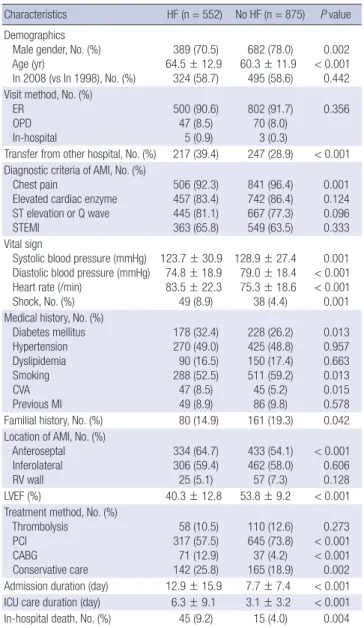
Characteristics of AMI patients with or without HF
Considering the definition of HF as LVEF less than 40% or
dys-pnea with congestion on chest radiograph, a total of 552 (38.7%)
patients had AMI with HF. The AMI patients with HF were more
female gender, older, and had a higher incidence of transfer
from other hospital, absence of chest pain at the initial
presen-tation, lower systolic blood pressure, diabetes mellitus,
smok-ing, CVA, family history and more anteroseptal MI, less
re-ceived PCI, more rere-ceived CABG, and longer admission and
ICU care duration (Table 2). Multivariate logistic regression
analysis showed that old age, transfer from other hospital,
ab-sence of chest pain, lower systolic blood pressure, increased
heart rate and anteroseptal MI were independent predictors for
AMI with HF (Table 3). In 1998, old age, transfer from other
hospital, increased heart rate and anteroseptal MI were
inde-pendent predictors for AMI-HF. In 2008, old age, transfer from
other hospital, absence of chest pain, lower systolic blood
pres-sure and anteroseptal MI were independently related to
AMI-HF (Table 4). The AMI patients with AMI-HF in 2008 were older, had
a higher prevalence of hypertension, previous AMI, and had
more active treatment such as adjuvant therapy (e.g. ventilator,
IABP, extracorporeal membrane oxygenation (ECMO) and
ino-tropics), medical therapy (e.g. antiplatelets, beta blocker, RAAS
antagonists, and statin) and lower systolic blood pressure
com-pared to those in 1998. However, there was no significant
differ-Table 2. Comparison of baseline characteristics with or without HF in AMICharacteristics HF (n = 552) No HF (n = 875) P value
Demographics Male gender, No. (%) Age (yr) In 2008 (vs In 1998), No. (%) 389 (70.5) 64.5 ± 12.9 324 (58.7) 682 (78.0) 60.3 ± 11.9 495 (58.6) 0.002 < 0.001 0.442 Visit method, No. (%)
ER OPD In-hospital 500 (90.6) 47 (8.5) 5 (0.9) 802 (91.7) 70 (8.0) 3 (0.3) 0.356 Transfer from other hospital, No. (%) 217 (39.4) 247 (28.9) < 0.001 Diagnostic criteria of AMI, No. (%)
Chest pain
Elevated cardiac enzyme ST elevation or Q wave STEMI 506 (92.3) 457 (83.4) 445 (81.1) 363 (65.8) 841 (96.4) 742 (86.4) 667 (77.3) 549 (63.5) 0.001 0.124 0.096 0.333 Vital sign
Systolic blood pressure (mmHg) Diastolic blood pressure (mmHg) Heart rate (/min)
Shock, No. (%) 123.7 ± 30.9 74.8 ± 18.9 83.5 ± 22.3 49 (8.9) 128.9 ± 27.4 79.0 ± 18.4 75.3 ± 18.6 38 (4.4) 0.001 < 0.001 < 0.001 0.001 Medical history, No. (%)
Diabetes mellitus Hypertension Dyslipidemia Smoking CVA Previous MI 178 (32.4) 270 (49.0) 90 (16.5) 288 (52.5) 47 (8.5) 49 (8.9) 228 (26.2) 425 (48.8) 150 (17.4) 511 (59.2) 45 (5.2) 86 (9.8) 0.013 0.957 0.663 0.013 0.015 0.578 Familial history, No. (%) 80 (14.9) 161 (19.3) 0.042 Location of AMI, No. (%)
Anteroseptal Inferolateral RV wall 334 (64.7) 306 (59.4) 25 (5.1) 433 (54.1) 462 (58.0) 57 (7.3) < 0.001 0.606 0.128 LVEF (%) 40.3 ± 12.8 53.8 ± 9.2 < 0.001
Treatment method, No. (%) Thrombolysis PCI CABG Conservative care 58 (10.5) 317 (57.5) 71 (12.9) 142 (25.8) 110 (12.6) 645 (73.8) 37 (4.2) 165 (18.9) 0.273 < 0.001 < 0.001 0.002 Admission duration (day) 12.9 ± 15.9 7.7 ± 7.4 < 0.001 ICU care duration (day) 6.3 ± 9.1 3.1 ± 3.2 < 0.001
In-hospital death, No. (%) 45 (9.2) 15 (4.0) 0.004
HF, heart failure; AMI, acute myocardial infarction; ER, emergency room; OPD, out-pa-tient department; STEMI, ST elevation MI; CVA, cerebrovascular accident; MI, myocar-dial infarction; RV, right ventricle; LVEF, left ventricular ejection fraction; PCI, percutane-ous coronary intervention; CABG, coronary artery bypass graft; ICU, intensive care unit.
Table 3. Independent predictors for AMI with HF in overall population (both 1998 and 2008)
Parameters OR 95% CI P value
Age (yr) 1.024 1.013-1.035 < 0.001
Male gender 0.846 0.610-1.174 0.317
Transfer from other hospital 1.688 1.303-2.185 < 0.001
Chest pain 0.500 0.276-0.906 0.022
Systolic blood pressure (mmHg) 0.992 0.987-0.996 < 0.001
Heart rate (/min) 1.019 1.013-1.026 < 0.001
Diabetes mellitus 1.249 0.954-1.635 0.105
Smoking 0.941 0.710-1.248 0.674
CVA 1.399 0.844-2.319 0.193
Familial history 0.932 0.676-1.285 0.667
Anteroseptal infarction 1.526 1.188-1.960 0.001
AMI, acute myocardial infarction; HF, heart failure; OR, odds ratio; CI, confidence in-terval; CVA, cerebrovascular accident.
Table 4. Independent predictors for AMI with HF in 1998 and 2008 respectively
Parameters 1998 2008
OR 95% CI P value OR 95% CI P value
Age (yr) 1.023 1.008-1.038 0.003 1.029 1.016-1.043 < 0.001
Transfer from other hospital 1.668 1.132-2.459 0.010 1.696 1.216-2.364 0.002
Chest pain 0.693 0.259-1.859 0.467 0.439 1.216-2.364 0.002
Systolic blood pressure (mmHg) 0.997 0.991-1.003 0.381 0.988 0.982-0.994 < 0.001
Heart rate 1.023 1.008-1.038 0.003 1.019 1.010-1.028 < 0.001
Anteroseptal infarction 1.564 1.089-2.246 0.015 1.335 0.961-1.856 0.085
AMI, acute myocardial infarction; HF, heart failure; OR, odds ratio; CI, confidence interval.
ence for the incidence and overall in-hospital mortality of
AMI-HF between the two time points (Table 5). To compare
in-hos-pital mortality properly considering the severity of AMI-HF
pa-tients, propensity score matching analysis was done with 18
relevant clinical variables. However in-hospital mortality was
not improved between the two time points irrespective of types
of AMI and revascularization methods (Supplementary Table
1-3).
DISCUSSION
The major finding of this study is that despite major advances
in the management of AMI, the incidence and in-hospital
mor-tality of AMI-HF remained unchanged and still high. During
the past few decades, advance of interventional treatment (e.g.
IABP, DES) and induction of new medical treatments such as
antiplatelet agents, beta-blocker, RAAS antagonists, and statins
have markedly improved long term prognosis of patients with
AMI (5-7, 12). In our study, while short term in-hospital
mortal-ity rate (3.3% vs 4.9%) was comparable to other previous studies
but it was not decreased from 1998 to 2008. Considering the
disparity in clinical severity between two time points in our
study, increased hospital accessibility and advanced salvage
treatments of high-risk AMI patients in recent time point may
contribute to these unchanged trends.
Regarding HF complicating AMI, Hellermann et al. (13)
show-ed that comparshow-ed to 1979, there was a 28% rshow-eduction in the
in-cidence of heart failure after AMI at 1994 in the Unites States. In
Framingham Heart Study, compared with the period 1970 to
1979, the investigators observed higher risk of heart failure and
lower risk of mortality rate in the period 1990 to 1999 (9).
Con-sistently, in Canada, 5 yr rate of HF development increased by
25%, whereas 5 yr mortality rate after MI decreased by 28% (10).
The incidence of AMI with HF did not change from 1998 to 2008
in our study, comparable to other studies (4). However, most
epidemiologic studies about the trends in the incidence of HF
after AMI have been conducted in Western countries. Recently,
the striking differences in outcomes after AMI were observed in
the different ethnic group studies. For instance, Chinese had
higher short-term mortality, compared with South Asian and
white patients (11). In our study, even after extensive
propensi-ty score matching analysis, in-hospital mortalipropensi-ty was not
im-proved between the two time points irrespective of types of
AMI and revascularization methods. Rather, in hospital
mortal-ity of AMI-HF seems to be higher in 2008 than in 1998 (11.1% vs
6.4%, P = 0.071), although it does not reach statistical
signifi-cance. Higher referral rate from other hospital (41.7% in 2008 vs
36.1% in 1998, P = 0.111), higher incidence of shock patients
(11.1% in 2008 vs 5.7% in 1998, P = 0.069) and higher incidence
of previous MI (13.0% in 2008 vs 3.1% in 1998, P < 0.001) might
contribute to this finding. However, nationwide large
prospec-tive study with non-selected AMI patients would clarify the
ac-tual temporal trends of in-hospital mortality. In addition, future
studies about the trends of HF following AMI in Asian region
might be followed to confirm the disparities between western
and East-Asian patients.
The studies to decipher the predictors for HF in AMI have
been conducted. Najafi et al. (4) showed that age, current
smok-er, hypertension, diabetes, Q-wave and anterior wall MI were
independent predictors of early-onset HF after MI. Ezekowitz
et al. (10) reported that male gender, hypertension, diabetes,
atrial fibrillation and CVA were associated with the risk for
de-veloping HF during hospitalization in MI. In HORIZONS-AMI
trial, multivariate predictors of new-onset HF following PCI in
STEMI were history of MI, LVEF, female and insulin-treated
di-analysis (Table 3). Most of them were related to hemodynamic
status (lower systolic blood pressure, increased heart rate) and
co-morbid medical conditions (e.g. hypertension, diabetes,
and CVA). AMI patients with HF in 2008 were older and, had a
higher prevalence of hypertension, previous AMI, adjuvant
therapy and lower systolic blood pressure than those in 1998.
Considering these lines of findings, older age, transfer from
other hospital, and lower systolic blood pressure at admission
were important risk factors for HF development following AMI
in Korea. Therefore more attentions and early treatments about
concomitant HF should be paid in AMI patients with low
sys-tolic blood pressure and underlying medical diseases.
This study has several limitations. First, although we sought
to analyze all consecutive AMI patients at two time periods,
se-lection of patients was dependent on ICD codes of medical
da-tabase without detailed clinical information such as laboratory
and angiographic findings. Even though utilizing an
adminis-trative database with established quality control, the absence of
validation of diagnosis and subsequent coding might be an
im-portant limitation. Though we excluded patients with
underly-ing heart failure, there are possibilities that patient with
asymp-tomatic LV dysfunction with no apparent heart failure symptom
(NYHA II) could be enrolled as a patient with HF complicated
AMI in this study. Second, because the data pertain only to one
city and two times of year, this result may not be applicable to
other nationwide patients. Third, the lack of long-term follow
up data after discharge might underestimate overall HF
inci-dence rates and prevent further analysis with long-term
mor-tality of AMI-HF. Lastly but most importantly, we could not
an-alyze the long-term outcome of AMI-HF patients. Therefore
further prospective studies are required to reveal whether
re-cent development of procedural managements and more
evi-dence-based practice might improve midterm as well as long
term survival after index admission of AMI-HF patients.
In conclusion, more evidence-based medical and advanced
procedural managements were applied with patients with AMI
in 2008 than in 1998, but there were no significant differences
in the incidence of HF during hospitalization and in-hospital
mortality following AMI between 1998 and 2008 in Korea.
DISCLOSURE
The authors declare no conflicts of interest.
ORCID
Jong-Chan Youn http://orcid.org/0000-0003-0998-503X
REFERENCES
1. McMurray JJ, Adamopoulos S, Anker SD, Auricchio A, Böhm M, Dick-Table 5. Comparison of baseline characteristics of AMI with HF in 1998 and 2008
Characteristics 1998 (n = 228) 2008 (n = 324) P value
Demographics Male gender, No. (%) Age (yr) STEMI, No. (%) 157 (68.9) 62.0 ± 13.1 159 (69.7) 232 (71.6) 65.0 ± 12.8 204 (63.0) 0.486 0.010 0.120 Vital sign
Systolic blood pressure (mmHg) Diastolic blood pressure (mmHg) Heart rate (/min)
Shock, No. (%) 128.0 ± 29.9 78.0 ± 19.0 83.8 ± 21.1 13 (5.7) 120.7 ± 31.4 72.5 ± 18.5 83.2 ± 23.1 36 (11.1) 0.006 0.001 0.770 0.067 Diagnostic criteria of HF LVEF < 40%, No. (%)
Congestion on radiograph, No. (%)
84 (45.9) 191 (90.1) 155 (56.0) 270 (83.9) 0.035 0.040 Adjuvant Therapy, No. (%)
Ventilator IABP ECMO Inotropics Gp IIb/IIIa inhibitor 23 (11.2) 20 (9.8) 0 (0.0) 43 (21.0) 62 (30.2) 89 (30.9) 57 (19.8) 10 (3.5) 124 (43.1) 89 (30.9) < 0.001 0.002 0.006 < 0.001 0.876 Medical history, No. (%)
Diabetes mellitus Hypertension Dyslipidemia Smoking CVA Previous MI 71 (31.1) 95 (41.9) 32 (14.3) 124 (54.9) 19 (8.4) 7 (3.1) 107 (33.2) 175 (54.0) 58 (18.0) 164 (50.8) 28 (8.6) 42 (13.0) 0.606 0.005 0.264 0.345 0.910 < 0.001 Familial history, No. (%) 33 (14.7) 47 (15.0) 0.927 Discharge medication, No. (%)
Aspirin Clopidogrel Ticlopidine Cilostazole Beta-blocker ACEI ARB CCB Digoxin Aldosterone antagonist Other diuretics Statin
Other lipid lowering agent ACEI/ARB+Beta-blocker 170 (86.3) 0 (0.0) 65 (33.0) 5 (2.6) 83 (42.1) 101 (51.3) 4 (2.0) 58 (29.4) 23 (11.7) 6 (3.0) 56 (28.4) 33 (16.8) 2 (1.0) 45 (23.0) 242 (86.1) 224 (79.4) 3 (1.1) 30 (10.6) 156 (55.3) 117 (41.8) 52 (18.5) 52 (18.4) 10 (3.5) 63 (22.3) 75 (26.6) 207 (73.4) 6 (2.1) 107 (38.1) 0.957 < 0.001 < 0.001 0.001 0.005 0.041 < 0.001 0.005 0.001 < 0.001 0.658 < 0.001 0.353 < 0.001 Number of anti-platelet, No. (%)
0 1 2 3 24 (12.3) 103 (52.8) 68 (34.9) 0 (0) 34 (12.1) 26 (9.3) 194 (69.3) 26 (9.3) < 0.001 Echocardiogram, No. (%) 189 (82.9) 277 (85.5) 0.407 LVEF (%) 41.4 ± 12.3 39.6 ± 13.0 0.129
Admission duration (day) 14.71 ± 18.68 11.69 ± 13.44 0.037 ICU care duration (day) 7.05 ± 9.79 5.82 ± 8.54 0.139 In-hospital death, No. (%) 13 (6.4) 32 (11.1) 0.071 AMI, acute myocardial infarction; HF, heart failure; STEMI, ST elevation MI; LVEF, left ventricular ejection fraction; IABP, intra-aortic balloon pump; ECMO, extracorporeal membrane oxygenation; Gp, glycoprotein; CVA, cerebrovascular accident; MI, myo-cardial infarction; ACEI, angiotension converting enzyme inhibitor; ARB, angiotensin II receptor blocker; CCB, calcium channel blocker; ICU, intensive care unit.
abetes (14). In one study in Korea, old age, female gender, high
serum creatinine and low LVEF were the predictors for
long-term mortality in acute coronary syndrome patients with left
ventricular systolic dysfunction (15). In consistent with these
findings, we could find many HF risk factors in multivariate
stein K, Falk V, Filippatos G, Fonseca C, Gomez-Sanchez MA, et al. ESC
guidelines for the diagnosis and treatment of acute and chronic heart failure 2012: the Task Force for the Diagnosis and Treatment of Acute and Chronic Heart Failure 2012 of the European Society of Cardiology: developed in collaboration with the Heart Failure Association (HFA) of the ESC. Eur Heart J 2012; 33: 1787-847.
2. Jessup M, Abraham WT, Casey DE, Feldman AM, Francis GS, Ganiats TG, Konstam MA, Mancini DM, Rahko PS, Silver MA, et al. 2009
fo-cused update: ACCF/AHA guidelines for the diagnosis and management of heart failure in adults: a report of the American College of Cardiology Foundation/American Heart Association Task Force on Practice Guide-lines: developed in collaboration with the International Society for Heart and Lung Transplantation. Circulation 2009; 119: 1977-2016.
3. Gheorghiade M, Bonow RO. Chronic heart failure in the United States:
a manifestation of coronary artery disease. Circulation 1998; 97: 282-9.
4. Najafi F, Dobson AJ, Hobbs M, Jamrozik K. Temporal trends in the
fre-quency and longer-term outcome of heart failure complicating myocar-dial infarction. Eur J Heart Fail 2007; 9: 879-85.
5. Krumholz HM, Wang Y, Chen J, Drye EE, Spertus JA, Ross JS, Curtis JP, Nallamothu BK, Lichtman JH, Havranek EP, et al. Reduction in acute
myocardial infarction mortality in the United States: risk-standardized mortality rates from 1995-2006. JAMA 2009; 302: 767-73.
6. Roger VL, Weston SA, Gerber Y, Killian JM, Dunlay SM, Jaffe AS, Bell MR, Kors J, Yawn BP, Jacobsen SJ. Trends in incidence, severity, and
out-come of hospitalized myocardial infarction. Circulation 2010; 121: 863-9.
7. Furman MI, Dauerman HL, Goldberg RJ, Yarzebski J, Lessard D, Gore JM. Twenty-two year (1975 to 1997) trends in the incidence, in-hospital
and long-term case fatality rates from initial Q-wave and non-Q-wave myocardial infarction: a multi-hospital, community-wide perspective. J
Am Coll Cardiol 2001; 37: 1571-80.
8. Sanfilippo FM, Hobbs MS, Knuiman MW, Hung J. Impact of new
bio-markers of myocardial damage on trends in myocardial infarction hos-pital admission rates from population-based administrative data. Am J Epidemiol 2008; 168: 225-33.
9. Velagaleti RS, Pencina MJ, Murabito JM, Wang TJ, Parikh NI, D’Agostino RB, Levy D, Kannel WB, Vasan RS. Long-term trends in the incidence of
heart failure after myocardial infarction. Circulation 2008; 118: 2057-62.
10. Ezekowitz JA, Kaul P, Bakal JA, Armstrong PW, Welsh RC, McAlister FA.
Declining in-hospital mortality and increasing heart failure incidence in elderly patients with first myocardial infarction. J Am Coll Cardiol 2009; 53: 13-20.
11. Khan NA, Grubisic M, Hemmelgarn B, Humphries K, King KM, Quan H.
Outcomes after acute myocardial infarction in South Asian, Chinese, and white patients. Circulation 2010; 122: 1570-7.
12. Ishihara M, Sato H. Thirty years trend in acute myocardial infarction
during coronary angiography at a tertiary emergency center in Japan. J Cardiol 2012; 59: 243-8.
13. Hellermann JP, Goraya TY, Jacobsen SJ, Weston SA, Reeder GS, Gersh BJ, Redfield MM, Rodeheffer RJ, Yawn BP, Roger VL. Incidence of heart
failure after myocardial infarction: is it changing over time? Am J Epide-miol 2003; 157: 1101-7.
14. Kelly DJ, Gershlick T, Witzenbichler B, Guagliumi G, Fahy M, Dangas G, Mehran R, Stone GW. Incidence and predictors of heart failure following
percutaneous coronary intervention in ST-segment elevation myocardial infarction: the HORIZONS-AMI trial. Am Heart J 2011; 162: 663-70.
15. Lee DH, Jeong MH, Rhee JA, Choi JS, Lee KH, Lee MG, Sim DS, Park KH, Yoon NS, Yoon HJ, et al. Predictors of long-term survival in acute
coronary syndrome patients with left ventricular dysfunction after per-cutaneous coronary intervention. Korean Circ J 2012; 42: 692-7.
Supplementary Table 1. Propensity score matching analysis for in-hospital mortality in AMI patients with HF between 1998 and 2008
Variables 1998 (n = 128) 2008 (n = 128) P value Gender Male Female 88 (68.75)40 (31.25) 90 (70.31)38 (29.69) 0.763 Age (yr) 62.37 ± 12.54 62.73 ± 12.94 0.791 STEMI, No. (%) Yes No 88 (68.75)40 (31.25) 91 (71.09)37 (28.91) 0.662 Hypertension Yes No 54 (42.19)74 (57.81) 58 (45.31)70 (54.69) 0.617 Diabetes mellitus Yes No 41 (32.03)87 (67.97) 42 (32.81)86 (67.19) 0.898 CVA Yes No 117 (91.41)11 (8.59) 117 (91.41)11 (8.59) > 0.999 Previous MI Yes No 3 (2.34) 125 (97.66) 2 (1.56) 126 (98.44) > 0.999 Dyslipidemia Yes No 20 (15.63) 108 (84.38) 19 (14.84) 109 (85.16) > 0.999 Smoking Yes No 63 (49.22) 65 (50.78) 64 (50.00) 64 (50.00) 0.891 Family history Yes No 18 (14.06) 110 (85.94) 21 (16.41) 107 (83.59) 0.728 SBP (mmHg) 124.47 ± 27.72 127.43 ± 29.73 0.426
Heart rate (/min) 82.31 ± 20.43 82.70 ± 20.56 0.877 PCI Yes No 79 (61.72)49 (38.28) 82 (64.06)46 (35.94) 0.668 CABG Yes No 115 (89.84)13 (10.16) 115 (89.84)13 (10.16) > 0.999 Ventilator Yes No 109 (85.16)19 (14.84) 110 (85.94)18 (14.06) > 0.999 IABP Yes No 113 (88.28)15 (11.72) 111 (86.72)17 (13.28) 0.845 Inotropics Yes No 33 (25.78)95 (74.22) 33 (25.78)95 (74.22) > 0.999 ICU care duration (day) 6.13 ± 8.14 6.07 ± 10.84 0.960 In-hospital mortality, No. (%)
Yes No 6 (4.69) 122 (95.31) 11 (8.59) 117 (91.41) 0.332 AMI, acute myocardial infarction; HF, heart failure; STEMI, ST elevation MI; CVA, cere-brovascular accident; MI, myocardial infarction; SBP, systolic blood pressure; PCI, percutaneous coronary intervention; CABG, coronary artery bypass graft; IABP, intra-aortic balloon pump; ICU, intensive care unit.
Supplementary Table 2. Propensity score matching analysis for in-hospital mortality in AMI patients with HF treated by PCI between 1998 and 2008
Variables 1998 (n = 71) 2008 (n = 71) P value Gender Male Female 51 (71.83)20 (28.17) 51 (71.83)20 (28.17) > 0.999 Age (yr) 60.23 ± 12.60 59.79 ± 12.87 0.813 STEMI, No. (%) Yes No 57 (80.28)14 (19.72) 56 (78.87)15 (21.13) > 0.999 Hypertension Yes No 29 (40.85)42 (59.15) 33 (46.48)38 (53.52) 0.505 Diabetes mellitus Yes No 21 (29.58)50 (70.42) 25 (35.21)46 (64.79) 0.346 CVA Yes No 66 (92.96)5 (7.04) 69 (97.18)2 (2.82) 0.453 Previous MI Yes No 0 (0.00) 71 (100.00) 0 (0.00) 71 (100.00) > 0.999 Dyslipidemia Yes No 13 (18.31) 58 (81.69) 11 (15.49) 60 (84.51) 0.839 Smoking Yes No 36 (50.70) 35 (49.30) 35 (49.30) 36 (50.70) 0.866 Family history Yes No 12 (16.90) 59 (83.10) 10 (14.08) 61 (85.92) 0.832 SBP (mmHg) 126.54 ± 25.36 125.30 ± 29.36 0.790
Heart rate (/min) 81.72 ± 18.63 80.44 ± 20.40 0.680 Ventilator Yes No 69 (97.18)2 (2.82) 67 (94.37)4 (5.63) 0.500 IABP Yes No 62 (87.32)9 (12.68) 63 (88.73)8 (11.27) > 0.999 Inotropics Yes No 14 (19.72)57 (80.28) 16 (22.54)55 (77.46) 0.832 ICU care duration (day) 4.11 ± 2.88 4.77 ± 9.31 0.567 In-hospital mortality, No. (%)
Yes No 1 (1.41) 70 (98.59) 3 (4.23) 68 (95.77) 0.500 AMI, acute myocardial infarction; HF, heart failure; PCI, percutaneous coronary inter-vention; STEMI, ST elevation MI; CVA, cerebrovascular accident; MI, myocardial in-farction; SBP, systolic blood pressure; IABP, intra-aortic balloon pump; ICU, intensive care unit.
Supplementary Table 3. Propensity score matching analysis for in-hospital mortality in patients with STEMI with HF treated with PCI between 1998 and 2008
Variables 1998 (n = 38) 2008 (n = 38) P value Gender Male Female 28 (73.68)10 (26.32) 28 (73.68)10 (26.32) > 0.999 Age (yr) 61.29 ± 11.52 61.29 ± 13.64 > 0.999 Hypertension Yes No 15 (39.47)23 (60.53) 16 (42.11)22 (57.89) 0.808 Diabetes mellitus Yes No 31 (81.58)7 (18.42) 10 (26.32)28 (73.68) 0.607 CVA Yes No 35 (92.11)3 (7.89) 35 (92.11)3 (7.89) > 0.999 Previous MI Yes No 38 (100.00)0 (0.00) 38 (100.00)0 (0.00) > 0.999 Dyslipidemia Yes No 5 (13.16) 33 (86.84) 4 (10.53) 34 (89.47) > 0.999 Smoking Yes No 24 (63.16) 14 (36.84) 25 (65.79) 13 (34.21) > 0.999 Family history Yes No 6 (15.79) 32 (84.21) 7 (18.42) 31 (18.58) > 0.999 SBP (mmHg) 126.95 ± 29.39 120.18 ± 27.37 0.286
Heart rate (/min) 80.03 ± 20.26 81.05 ± 25.46 0.842 Ventilator Yes No 32 (84.21)6 (15.79) 33 (86.84)5 (13.16) > 0.999 IABP Yes No 30 (78.95)8 (21.05) 30 (78.95)8 (21.05) > 0.999 Inotropics Yes No 11 (28.95)27 (71.05) 14 (36.84)24 (63.16) 0.549 ICU care duration (day) 4.74 ± 3.77 4.32 ± 5.17 0.711 In-hospital mortality, No. (%)
Yes No 2 (5.26) 36 (94.74) 3 (7.89) 35 (92.11) > 0.999 STEMI, ST elevation MI; HF, heart failure; PCI, percutaneous coronary intervention; CVA, cerebrovascular accident; MI, myocardial infarction; SBP, systolic blood pres-sure; IABP, intra-aortic balloon pump; ICU, intensive care unit.