INTRODUCTION
Von Willebrand disease (VWD) is the most common bleeding disorder resulting from quantitative and
qualita-tive abnormality of von Willebrand factor (VWF). VWF is synthesized from 8.8 kb transcript in endothelial cells and megakaryocytes and stored in Weibel-Palade bodies and -granules. Its precursor protein of 2813 amino acids contains 22 aa signal protein, 741 aa pre-peptide, and 2050 aa mature peptide and composed of four repeated domains, each of which possesses distinct functions in its own syn-thesis and hemostasis[1]. Many genetic defects were iden-tified recently and vast amount is enlisted in database dedicated to this bleeding disorder (http://mmg2.im.med. umich.edu)[2]. Most of them were identified in type 2 VWD and their association with each subtype of type 2
169 169
한국 von Willebrand병 환자의 von Willebrand 인자 유전자 돌연변이 조사
Investigation of von Willebrand Factor Gene Mutations in Korean von Willebrand Disease Patients
Jaewoo Song, M.D., Jong Rak Choi, M.D., and Kyung Soon Song, M.D.
송재우∙최종락∙송경순
연세대학교 의과대학 진단검사의학교실 169 169 접 수: 2007년 1월 8일 접수번호:KJLM2008 수정본접수: 2007년 2월 14일 게재승인일: 2007년 3월 6일 교 신저 자: 송 경 순 우 135-720 서울시 강남구 도곡동 146-92 연세의대 영동세브란스병원 진단검사의학과 전화: 02-2019-3531, Fax: 02-3462-9483 E-mail : [email protected]*This work was supported in part by Korean Hemophilia Foundation Research Fund and Yonsei University Research Fund of 2003.
Department of Laboratory Medicine, Yonsei University College of Medicine, Seoul, Korea
Background :We intended to find the mutations of von Willebrand factor (VWF) gene as the most important contributing factor of von Willebrand disease (VWD) in Korean patients.
Methods :In 40 known vWD patients mutations of vWF gene were sought by direct sequencing of PCR products targeting exons 18, 19, 20, 26, 28 and 52 frequently implicated as the locations of mutation. For factors other than VWF gene contributing to VWD phenotype, we tested ABO blood group and measured ADAMTS13 activity in VWD patients.
Results :Twenty-seven cases (67.5%) were type 1 vWD, 3 cases (7.5%) type 3, and 5 cases (12.5 %) type 2A. Three cases were type 2A or 2B (7.5%) and 2 cases were suspected to be type 2N (5.0 %). Among them six candidate missense mutations were found: V1279I, R1306W, R1308C, and V1316M were previously reported in type 2B and type 1 vWD, and C858W and T1477I were novel findings. All patients were heterozygotes. Blood group O was overly represented in VWD patients, while ADAMTS13 activity of the patients was not significantly different from that of normal control.
Conclusions :Mutation of VWF gene detected by genetic studies can significantly improve the diagnostic accuracy, especially in subtype assignment of VWD. Two novel mutations, C858W and T1477I associated with VWD were found and expected to contribute to the elucidation of its patho-physiology. (Korean J Lab Med 2007;27:169-76)
VWD is so specific as to endow the genetic study with diagnostic value. Furthermore the location of the muta-tions in each domain and corresponding derangement of the specific function of the domain is so well correlated that speculation of pathogenic mechanism of individual cases is not difficult in the majority of cases. On the con-trary, genetic studies in type 1 VWD were always com-pleted with low yield of mutation detection and a large part of its pathogenesis still remains uncovered[3-8]. Sig-nificant overlap of VWF level from type 1 VWD patients and general population obscures clear distinction between VWD and normal phenotype[9]. This may explain the mysterious genetic aspect of type 1 VWD to some extent. In Korea, despite the widespread appreciation of high pre-valence of VWD, there has rarely been an attempt of genetic study of this disease. Only one case of VWD with novel candidate mutation of VWF gene has been reported till now[10]. We supposed that overall the mutation asso-ciated with VWD in Korea would not be greatly differ-ent from those enlisted in database collected worldwide, although there may be an occasional novelty. So, we sc-reened the mutation of VWF gene in 40 patients with known VWD by PCR and direct sequencing method. Additionally, to evaluate ABO blood group and ADA-MTS13, VWF cleaving plasma metalloproteinase as the contributing factors other than VWF gene in the patho-genesis of VWD, we tested ABO blood group and mea-sured ADAMTS13 activity in VWD patients.
MATERIALS AND METHODS
1. Patients
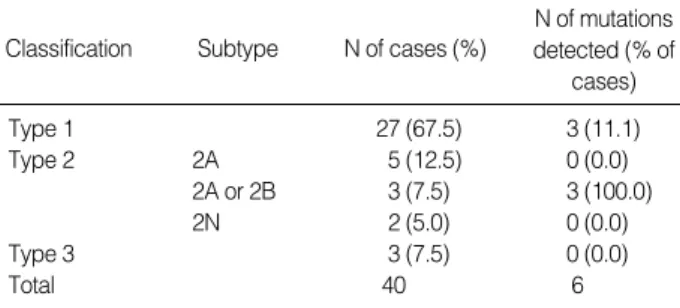
Forty patients were included who were previously diag-nosed with VWD in our and other institutions and referred then for related clinical tests to the department of labo-ratory medicine of our institution. At the time of the visit, whole blood collected in EDTA tube were obtained, ali-quoted, and frozen at -80℃ until the genetic studies were done. Twenty seven (67.5%) of them were previously classified as type 1 VWD, 5 (12.5%) as type 2A, 3 as type 2A or 2B (7.5%; absence of large multimers with-out the result of ristocetin induced platelet aggregation test), and 3 (7.5%) as type 3 according to the findings from VWF multimer study (Table 1). Two of them were
suspected to have VWD type 2N (decreased factor VIII: C with normal VWF:Ag and VWF activity in female patient or family member). Specimens for family study were available in five of them, in one of which was found a highly suspected candidate mutation of VWF gene as-sociated with VWD.
2. Measurement of VWF:Ag and VWF activity
We retested the VWF:Ag and VWF activity for eve-ry possible case for confirmatoeve-ry purpose. VWF:Ag and VWF activity were measured in citrate plasma drawn from patients by enzyme-linked immunosorbent assay (ELISA) methods using a VWF:Ag kit (Corgenix, Wes-tminster, CO, USA) and VWF activity kit (Axis-Shield Diagnostic, Dundee, UK) according to the procedure pro-vided by the provider. VWF activity assay detects a func-tional epitope of VWF and can be used in replacement of the conventional ristocetin cofactor activity assay using fixed platelet and aggregometer. For multimer analysis, non-reduced plasma samples were analyzed by sodium dodecyl sulfate (SDS)-agarose electrophoresis (0.7% and 1.2%) and detected after blotting using VWF anti-body, biotinylated secondary antianti-body, avidin horse radish peroxidase and bromophenol-blue. The factor VIII:C was measured by STA deficient VIII (Diagnostica STAGO, Paris, France). Ristocetin induced platelet aggregation (RI-PA) was measured in platelet rich plasma (PRP) using Chrono-Log aggregometer (Chrono-Log, Havertown, PA, USA) with ristocetin concentration of 1.0, 0.6 and 0.3 mg/mL.
3. Mutation screening
The genomic DNA was extracted from EDTA whole blood after thawing using QIAamp DNA blood Mini kit
Classification Subtype N of cases (%)
N of mutations detected (% of cases) Type 1 27 (67.5) 3 (11.1) Type 2 2A 5 (12.5) 0 (0.0) 2A or 2B 3 (7.5) 3 (100.0) 2N 2 (5.0) 0 (0.0) Type 3 3 (7.5) 0 (0.0) Total 40 6
Table 1.Number of each subtype among the VWD patients in-cluded and positive results of the mutation screening
(Qiagen, Valencia, CA, USA). The size (coding sequence of 8,439 bp) and complexity of VWF gene caused great difficulty in searching for candidate mutation. To save the time and resources consumed in searching for the muta-tions of VWF gene, we gave the investigational priority to the exons 12, 14, 16, 18, 19, 20, 24, 26, 27, 28 and 52, because they frequently appear in database as the loca-tions of known mutaloca-tions. The regions spanning each exon and exon-intron boundary was PCR amplified and direct sequencing was done on the purified PCR products. The presence of VWF pseudogene, which is located on chro-mosome 22 long arm and shows about 97% homology with exons 23 to 34 of VWF gene[11], further hampered the study necessitating the use of allele specific oligomers for PCR (For some of them the sequences were kindly presented by Dr. Baronciani of University of Milan, Italy and the others were designed separately). The sequences of primers can be given upon request. DNA sequence analysis was performed by the fluorescent dideoxy termi-nator method. In this study VWF cDNA was numbered from the first nucleotide in the ATG initiation codon.
4. Measurement of ADAMTS13 activity
Plasma ADAMTS13 activity was measured using fluo-rogenic substrate of ADAMTS13, FRETS-VWF73 (Pep-tide International, Louisville, KY, USA)[12]. Briefly, dilut-ed substrate was mixdilut-ed with citrate plasma obtaindilut-ed from normal healthy individuals as standard and each patient diluted in assay buffer (5 mmol/L Bis-Tris, 25 mmol/L CaCl2, 0.005% Tween-20, pH 6.0). Fluorescence was mea-sured by FLUOstar OPTIMA microplate reader (BMG LABTECH, Offenburg, Germany) and the enzyme ac-tivity was calculated by comparing the development of fluorescence versus time in patient sample with those of standards.
RESULTS
1. Mutation screening results
Forty patients with known von Willebrand disease were screened for mutation of von Willebrand factor gene. Over-all, 6 nucleotide substitutions with consequent amino acid substitutions were found in type 1 and type 2 VWD pa-tients. Small to large deletions or insertions known to be associated with type 1 or type 3 VWD were not found. Maybe PCR direct sequencing method we relied on was not appropriate for the detection of gross deletion or inser-tion occasionally associated with type 3 VWD. The results of screening are summarized in Table 2 with other labora-tory data. All the repeated measurements showed almost the same results as tested when they were diagnosed. Three of the 6 variations correspond to R1306W (3916 C>T), R1308C (3922 C>T) and V1316M (3946 G>A) were located in domain A1 and all previously reported in association with type 2B VWD[13-18]. Another was V1-279I (3835 G>A) reported in type 1 VWD[3]. All the nucleic acid substitutions in our study were found in het-erozygous state. Association of each of these mutations with VWD subtypes in the literature was reaffirmed in our cases. In these cases the association of each mutation with VWD seems clear, although thorough family studies were not available due to incompliance or follow up loss.
2. C858W and T1477I found in two unrelated VWD
patients
The other two variations, resulting in C858W and T1-477I amino acid substitutions have not been previously reported and we examined their prevalence in general po-pulation by studying 50 individuals (100 alleles) without known history of bleeding diathesis. Both C858W and
T1-Patient No. vWF:Ag (%) FVIII:C (%) vWF activity (%) Activity/Ag ratio Multimer
analysis Domain Past reports
Amino acid substitution (nucleotide substitution)
2 16 13 19 0.8 Type 1 V1279I (3835 G>A) Domain A1 Eikenboom et al. (1993)
4 30 11 27 0.4 Type 2A or 2B R1306W (3916 C>T) Domain A1 Cooney et al. (1991)
20 42 10 0.1 Type 2A or 2B R1308C (3922 C>T) Domain A1 Cooney et al. (1991)
35 74 17 - 0.2 Type 2A or 2B V1316M (3946 G>A) Domain A1 Cooney et al. (1991)
36 42 37 - 0.9 - T1477I (4430 C>T) Domain A1
-37 35 22 5 0.7 Type 1 C858W (2574 C>G) Domain D’
-Table 2.Laboratory data of the patients for whom candidate implicated mutations of VWF gene were found and past reports of each mutation
477I substitution were not found. A family study includ-ing the parents and sister was done for the patient with C858W substitution. Factor VIII:C activity of the patient was markedly decreased to 4%. The patient’s father also carried the same nucleotide substitution and his VWF:Ag and VWF activity were 21% and 8%, respectively, (35% and 22% for the patient), while those of his mother and sister who did not carry the substitution were 39%, 42% and 21%, 33%, respectively (Fig. 1A). His family mem-bers included in this study had no noticeable past medi-cal histories and did not complain of bleeding tendency. Amino acid sequences of VWF from other species (Ma-caca mulatta, Sus scrofa, Canis familiaris, Mus musculus, Rattus norvegicus) were aligned with that of human for comparison. Cysteine at the 858th amino acid of VWF is well conserved throughout the species while neighboring amino acids showed some degree of interspecies variation (Fig. 1B). This implies the importance of Cys858 for pro-per function of VWF, although the exact role of this resi-due cannot be unraveled to the structure level at this point. T1477I is also strictly conserved and expected to be
essen-tial for proper function or synthesis of VWF (Fig. 1C).
3. Factors other than VWF gene
Because mutation of VWF gene was found in only a small number of patients from a substantial size of patient group studied, we suspected that certain factors other than VWF itself has affected VWF activity. First, we reex-amined the sequencing data for the presence of polymor-phism Y1584C, which was recently reported to be preva-lent in type 1 VWD implicating the susceptibility to AD-AMTS13 as an important factor influencing the develop-ment of VWD[19, 20]. But there was not a case with C1584 allele among the forty patients. We examined the effect of blood group, especially blood group O, which is known to be associated with low VWF level[9, 21]. Amo-ng the VWD patients who were blood typed, the preva-lence of blood group O was significantly higher than it is known in general population (67% vs. 28%)[22]. This implies that along with other unknown factors, increased clearance of VWF in blood group O can reduce its level to the extent of VWD[21]. Next we also tested another factor related to VWF clearance, ADAMTS13. We mea-sured ADAMTS13 activity with recently described fluo-rogenic synthetic substance[12]. ADAMTS13 activity in VWD patients was not significantly different from that measured in normal healthy individuals (P=0.238; Fig. 2). Nor conld there be observed an apparent correlation bet-ween ADAMTS13 activity and VWF activity in plasma (data not presented).
ADAMTS13 (%) Patients Controls 150 125 100 75 50 25 0
Fig. 2.ADAMTS13 activity in VWD patients compared with normal controls. There was no significant difference between ADAMTS13 activity between VWD patients (n=38) and normal healthy control (n=38). A B Homo sapiens VWF activity 33% VWF:Ag 21% VWF activity 8% VWF:Ag 21% VWF activity 42% VWF:Ag 39% VWF activity 22% VWF:Ag 35% Macaca mulatta Canis familiaris Sus scrofa Mus musculus Rattus norvegicus C Homo sapiens Macaca mulatta Canis familiaris Sus scrofa Mus musculus Rattus norvegicus
*
*
Fig. 1.The probable role of the novel findings C858W and T1477I in causing VWD. The C858W segregated with decreased VWF activity within the family of the patient 37, while mildly decreased VWF:Ag was observed in all members of the family (A). The residues 858C and 1477T (indicated by asterisk) within VWF are more strictly preserved throughout several different mammalian species than other immediate neighboring residues, implying its essentiality for wholeness of VWF in regard to its synthesis, stability or function (B, C).
DISCUSSION
V1316M (3946 G>A), R1306W (3916 C>T), and R1-308C (3922 C>T) substitutions found in three sporadic cases in our study have been repeatedly described in asso-ciation with type 2B VWD[13-18]. Increased binding of VWF to platelet with subsequent consumptive clearance is the pathogenic mechanism with these mutations. Large multimers were absent in multimer study of patients 4 and 20 possessing R1306W and R1308C alleles. But due to unavailability of RIPA test in them, only the putative diagnosis of type 2A or 2B has been made. So, these are the cases where genetic tests have the determining role in subtype assignment. V1279I (3835 G>A) substitution has been reported as a genetic defect in type 1 VWD with recessive inheritance pattern[3]. Many cases of type 1 VWD showing recessive inheritance are known to be compound heterozygote (but the other genetic defect of patient 2 has not been found yet). Additional study tar-geting exons omitted in this study may reveal the other mutation. The amino acid substitution C858F is well kno-wn for its association with type 2N VWD[23-26]. Con-sidering its location in D’domain of VWF, which is in-volved in interaction with factor VIII, the association is quite expectable. Substitutions at other residues in the domain are also associated with type 2N subtype, among which R854Q was reported to be the most common, com-prising about 73% and the next R816F, about 10%. The association of C858W with decreased VWF activity per se is an unexpected finding in this context with restrict-ed structural information of the domain available at now. Confirmation with additional studies including factor VIII binding assay not included in this study and in vitro ex-pression study should be followed and would be of help in elucidating the association with functional aberration. Interestingly the patient’s family members who did not carry the C858W showed slightly decreased VWF:Ag levels. But VWF:Ag of these levels is known to be uncommonly associated with bleeding symptom and shows low heritability[27, 28]. Substitution of Cys858 with tryp-tophan might have influenced the protein structure to the level where the delicately balanced function of VWF is affected. The amino acid substitution T1477I has not been, previously reported either in association with type 1 VWD or as a neutral polymorphism. Linkage with VWD could not be fully evaluated because the family study was not
available. But the absence in general population and high degree of conservation throughout different species imply an important functional role in synthesis or stability of VWF. H1472 in proximity to T1477, where SNP (H14-72D) has been reported shows great interspecies diversi-ty as shown in Fig. 1C. The actividiversi-ty of the variant VWF does not seem to be significantly impaired considering the similarity between VWF activity/VWF:Ag ratios over 0.6. It can also be anticipated from the fact that the residue T1477 is located outside and between the functional do-mains D3 and A1. There exist very few reports of amino acid substitution related to type 1 VWD in contrast to its high prevalence. The majority of them are also located outside the functional domains. Some of them are substi-tutions of cysteine residue (C1130F, C1149R) involved in disulfide bond formation, resulting in gross structural alter-ations[5]. Another is in close proximity to those cysteine residues (T1156M)[7]. The other two amino acid substi-tutions V1229G and N1231T were reported in type 1 VWD showing apparent autosomal recessive pattern of inheritance[6]. In vitro expression study has been done in few cases and the exact mechanism of aberrant syn-thesis is not yet fully described. Such an approach can be tried for the further investigation of our case with limit-ed opportunity of thorough linkage study.
ADAMTS13 catalyzes the proteolysis of VWF between Y1584 and M1585 and consequently results in the clear-ance of large VWF multimers. Recently, it was reported that Y1584C substitution renders VWF susceptible to the action of ADAMTS13 and consequently results in incre-ased clearance of VWF from plasma[19]. Actually the corresponding allele was found to be overly represented in type 1 VWD patients and their families by 25% and 27% respectively, compared with about 1% in general population[20]. The frequency of C1584 allele in east Asians is nearly zero (Entrez SNP database) and accordingly the substitution Y1584C was not found among VWD patients included in our study. Blood group O VWF is by far more susceptible to the cleavage by ADAMTS13 than other blood groups[29]. It can explain the well known pheno-menon, a decreased plasma VWF level in blood group O individuals, which is also found in this study. Both the findings imply the significant role of ADAMTS13 activi-ty in determining plasma VWF level. It is a plausible hypothesis that increased ADAMTS13 activity facilitates the clearance of plasma VWF and consequently lowers
VWF level. Thus we further examined if ADAMTS13 activity is increased in VWD patients compared with nor-mal healthy individuals. It has long been suggested with-out definite evidence that factors other than VWF itself can be related with VWD[30, 31]. Probably that may ex-plain the paucity of reports of type 1 VWD related VWF gene mutation. But in this study there was no significant difference in ADAMTS13 activity between the patient and control groups. There was no correlation between ADAMTS13 activity and VWF activity, either. This is a quite different finding from that reported for type 3 VWD where ADAMTS13 activity was significantly in-creased in the patient group[32]. Despite our results con-tradicting the essential role of ADAMTS13 in determin-ing VWF level, the possibility of partial contribution of ADAMTS13 to the development of VWD cannot be en-tirely excluded. In regard to the unimpressive results of mutation screening in VWD, especially type 1, one should take into account the effect of variations in untranslated region of the VWF gene[33]. Enhancer and silencer se-quences as well as cell type-specific promoter region on VWF gene are being continuously revealed[34, 35]. But, the information implicating these regions with VWD is still insufficient. Examination targeting these regions can possibly reveal a new aspect of the pathophysiology of VWD. In conclusion, mutation of VWF gene detected by genetic study can significantly improve the diagnostic accuracy especially in subtype assignment of VWD, as well as providing contributory information for elucidating pathophysiology of the disease.
요 약
배경 : 한국인 폰 빌레브란트 병 환자를 대상으로 폰 빌레브란 트 병의 가장 중요한 발병인자인 폰 빌레브란트 인자 유전자의 돌 연변이를 조사하였다. 방법 : 폰 빌레브란트 병으로 진단된 40명의 환자를 대상으로 유전체 DNA를 추출하여, 중합효소연쇄반응 및 염기 서열 분석 방법을 통해 폰 빌레브란트 인자 유전자의 돌연변이를 조사하였 다. 돌연변이가 주로 발견되는 것으로 알려진 엑손 18, 19, 20, 26, 28 및 52를 대상으로 하였다. 또한 유전자 이상 외에 발병 요인 으로 작용할 수 있는 ABO 혈액형 및 ADAMTS13 활성을 측정 하였다. 결과 : 27명(67.5%)의 1형 폰 빌레브란트 병이었고, 3명(7.5 %)의 3형, 5명(12.5%)의 2A형을 대상으로 하였다. 그리고, 3명 (7.5%)은 2A 또는 2B 그리고, 2명(5.0%)은 2N형의 의심되었 다. 6개의 과오돌연변이를 발견하였으며 모두 이형접합체였다. V1-279I, R1306W, R1308C, V1316M은 2B형 및 1형 폰 빌레브란트 병에서 이미 보고되었으며, 1형에서 발견된 C858W와 T1477I는 아직 보고된 바가 없다. 결손이나 삽입은 발견되지 않았다. O 혈 액형군이 환자군에서 일반인에 비해 매우 높은 빈도로 발견되었 으며, ADAMTS13 활성은 정상인 대조군과 비교하여 의미 있는 차이를 보이지 않았다. 결론 : 폰 빌레브란트 유전자의 돌연변이 검사는 폰 빌레브란 트 병 아형 분류의 정확성을 향상시키는데 기여할 것으로 사료된 다. 또한 C858W와 T1477I는 아직 보고된 바가 없으며 폰 빌레 브란트 병의 병리 기전 규명에 기여할 것으로 생각된다.REFERENCES
1. Ruggeri ZM, Ware J, et al. eds. Von Willebrand factor. In: Loscalzo J. Schafer AI, eds. Thrombosis and hemorrhage. 3rd ed. Philadelphia: Lippincott Williams & Wilkins 2003:246-53.
2. Ginsburg D and Sadler JE. von Willebrand disease: a database of point mutations, insertions, and deletions. For the Consortium on von Willebrand Factor Mutations and Polymorphisms, and the Sub-committee on von Willebrand Factor of the Scientific and Standard-ization Committee of the International Society on Thrombosis and Haemostasis. Thromb Haemost 1993;69:177-84.
3. Eikenboom JC, Reitsma PH, Peerlinck KM, Briet E. Recessive inheri-tance of von Willebrand’s disease type I. Lancet 1993;341:982-6. 4. Kroner PA, Foster PA, Fahs SA, Montgomery RR. The defective
in-teraction between von Willebrand factor and factor VIII in a patient with type 1 von Willebrand disease is caused by substitution of Arg19 and His54 in mature von Willebrand factor. Blood 1996;87:1013-21. 5. Eikenboom JC, Matsushita T, Reitsma PH, Tuley EA, Castaman G, Briet E, et al. Dominant type 1 von Willebrand disease caused by mutated cysteine residues in the D3 domain of von Willebrand fac-tor. Blood 1996;88:2433-41.
6. Eikenboom JC, Castaman G, Vos HL, Bertina RM, Rodeghiero F. Characterization of the genetic defects in recessive type 1 and type 3 von Willebrand disease patients of Italian origin. Thromb Haemost 1998;79:709-17.
7. Casana P, Martinez F, Haya S, Espinos C, Aznar JA. Association of the 3467C>T mutation (T1156M) in the von Willebrand’s factor gene with dominant type 1 von Willebrand’s disease. Ann Hematol 2001; 80:381-3.
8. O’Brien LA, James PD, Othman M, Berber E, Cameron C, Notley CR, et al. Founder von Willebrand factor haplotype associated with type 1 von Willebrand disease. Blood 2003;102:549-57.
9. Gill JC, Endres-Brooks J, Bauer PJ, Marks WJ Jr, Montgomery RR. The effect of ABO blood group on the diagnosis of von Willebrand disease. Blood 1987;69:1691-5.
10. Song KS, Kim HK, Park YS. Detection of Novel C4517G (Ser743Trp) Mutation in a Family with Type 2A von Willebrand Disease. Kore-an J Hematol 2003;38:274-8.
11. Mancuso DJ, Tuley EA, Westfield LA, Lester-Mancuso TL, Le Beau MM, Sorace JM, et al. Human von Willebrand factor gene and pseu-dogene: structural analysis and differentiation by polymerase chain reaction. Biochemistry 1991;30:253-69.
12. Kokame K, Nobe Y, Kokubo Y, Okayama A, Miyata T. FRETS-VW-F73, a first fluorogenic substrate for ADAMTS13 assay. Br J Haema-tol 2005;129:93-100.
13. Hagiwara T, Inaba H, Yoshida S, Nagaizumi K, Arai M, Hanabusa H, et al. A novel mutation Gly 1672-->Arg in type 2A and a homozy-gous mutation in type 2B von Willebrand disease. Thromb Haemost 1996;76:253-7.
14. Cooney KA, Nichols WC, Bruck ME, Bahou WF, Shapiro AD, Bowie EJ, et al. The molecular defect in type IIB von Willebrand disease. Identification of four potential missense mutations within the puta-tive GpIb binding domain. J Clin Invest 1991;87:1227-33.
15. Donner M, Andersson AM, Kristoffersson AC, Nilsson IM, Dahlback B, Holmberg L. An Arg545----Cys545 substitution mutation of the von Willebrand factor in type IIB von Willebrand's disease. Eur J Haematol 1991;47:342-5.
16. Murray EW, Giles AR, Bridge PJ, Peake IR, Lillicrap DP. Cosegre-gation of von Willebrand factor gene polymorphisms and possible germinal mosaicism in type IIB von Willebrand disease. Blood 1991; 77:1476-83.
17. Randi AM, Rabinowitz I, Mancuso DJ, Mannucci PM, Sadler JE. Molecular basis of von Willebrand disease type IIB. Candidate muta-tions cluster in one disulfide loop between proposed platelet glyco-protein Ib binding sequences. J Clin Invest 1991;87:1220-6. 18. Casana P, Martinez F, Espinos C, Haya S, Lorenzo JI, Aznar JA. Search
for mutations in a segment of the exon 28 of the human von Wille-brand factor gene: new mutations, R1315C and R1341W, associated with type 2M and 2B variants. Am J Hematol 1998;59:57-63. 19. Bowen DJ and Collins PW. An amino acid polymorphism in von
Willebrand factor correlates with increased susceptibility to prote-olysis by ADAMTS13. Blood 2004;103:941-7.
20. Bowen DJ, Collins PW, Lester W, Cumming AM, Keeney S, Grundy P, et al. The prevalence of the cysteine1584 variant of von Willebrand factor is increased in type 1 von Willebrand disease: co-segregation with increased susceptibility to ADAMTS13 proteolysis but not clini-cal phenotype. Br J Haematol 2005;128:830-6.
21. Miller CH, Haff E, Platt SJ, Rawlins P, Drews CD, Dilley AB, et al.
Measurement of von Willebrand factor activity: relative effects of ABO blood type and race. J Thromb Haemost 2003;1:2191-7. 22. Choi SY, Kim SI, Cho HI. Study on gene frequencies of blood groups
in Koreans. Korean J Hematol 1984;19:63-75. (최성엽, 김상인, 조한익. 한국인의 혈액형 유전자 빈도에 관한 연구. 대한혈액학회지 1984;19:63-75.)
23. Kroner PA, Friedman KD, Fahs SA, Scott JP, Montgomery RR. Ab-normal binding of factor VIII is linked with the substitution of glu-tamine for arginine 91 in von Willebrand factor in a variant form of von Willebrand disease. J Biol Chem 1991;266:19146-9.
24. Jorieux S, Tuley EA, Gaucher C, Mazurier C, Sadler JE. The muta-tion Arg (53)----Trp causes von Willebrand disease Normandy by abolishing binding to factor VIII. Studies with recombinant von Wille-brand factor. Blood 1992;79:563-7.
25. Mazurier C and Meyer D. Factor VIII binding assay of von Wille-brand factor and the diagnosis of type 2N von WilleWille-brand disease--results of an international survey. On behalf of the Subcommittee on von Willebrand Factor of the Scientific and Standardization Com-mittee of the ISTH. Thromb Haemost 1996;76:270-4.
26. Meyer D, Fressinaud E, Gaucher C, Lavergne JM, Hilbert L, Ribba AS, et al. Gene defects in 150 unrelated French cases with type 2 von Willebrand disease: from the patient to the gene. INSERM Network on Molecular Abnormalities in von Willebrand Disease. Thromb Haemost 1997;78:451-6.
27. Vossen CY, Hasstedt SJ, Rosendaal FR, Callas PW, Bauer KA, Broze GJ, et al. Heritability of plasma concentrations of clotting factors and measures of a prethrombotic state in a protein C-deficient family. J Thromb Haemost 2004;2:242-7.
28. Castaman G, Eikenboom JC, Bertina RM, Rodeghiero F. Inconsis-tency of association between type 1 von Willebrand disease pheno-type and genopheno-type in families identified in an epidemiological inves-tigation. Thromb Haemost 1999;82:1065-70.
29. Bowen DJ. An influence of ABO blood group on the rate of prote-olysis of von Willebrand factor by ADAMTS13. J Thromb Haemost 2003;1:33-40.
30. Castaman G, Eikenboom JC, Bertina RM, Rodeghiero F. Inconsis-tency of association between type 1 von Willebrand disease pheno-type and genopheno-type in families identified in an epidemiological inves-tigation. Thromb Haemost 1999;82:1065-70.
31. Souto JC, Almasy L, Soria JM, Buil A, Stone W, Lathrop M, et al. Genome-wide linkage analysis of von Willebrand factor plasma levels: results from the GAIT project. Thromb Haemost 2003;89: 468-74.
32. Mannucci PM, Capoferri C, Canciani MT. Plasma levels of von Wille-brand factor regulate ADAMTS-13, its major cleaving protease. Br J Haematol 2004;126:213-8.
33. Harvey PJ, Keightley AM, Lam YM, Cameron C, Lillicrap D. A sin-gle nucleotide polymorphism at nucleotide -1793 in the von Wille-brand factor (VWF) regulatory region is associated with plasma VWF: Ag levels. Br J Haematol 2000;109:349-53.
34. Hough C, Cuthbert CD, Notley C, Brown C, Hegadorn C, Berber
E, et al. Cell type-specific regulation of von Willebrand factor expres-sion by the E4BP4 transcriptional repressor. Blood 2005;105:1531-9. 35. Wang X, Peng Y, Ma Y, Jahroudi N. Histone H1-like protein partic-ipates in endothelial cell-specific activation of the von Willebrand factor promoter. Blood 2004;104:1725-32.