© Korean Powder Metallurgy Institute 994 -1. Introduction
Al-Si alloys are used in many application areas such as automotive, electronics, and aerospace industries due to their good wear resistance and low coefficient of thermal expansion. Al-Si alloys are currently produced by casting and powder metallurgy methods. A relatively slow cooling rate, associated with the conventional casting process, produces coarse and segregated primary Si and/or eutectic Si in the Al-Si alloys [1]. It is common practice to increase the Si content to improve the wear resistance and mechanical strength. However, with increasing Si content, above the eutectic composition (12.6 wt % Si), primary Si crystals become coarse, resulting in poor mechanical properties of the Al-Si alloys. Thus, the distribution and size of the primary silicon particles, rather than the overall silicon content of the alloy, is important.
In this research, we chose the Al-20 wt% Si binary alloy, to avoid interference from ternary intermetallics in higher order alloy systems, to investigate the effect of powder particle size on the microstructure in the as-solidified powders, and on the microstructure, mechanical properties, and fracture behavior in the extruded condition.
2. Experimental and Results
The size distribution of the atomized Al-20Si powder
particles was measured by conventional mechanical sieving and the sieved powder with a specific size range of <26 µm and 45-106 µm were chosen for this investigation. Extrusion was carried out at a ram speed of 2.5 mm/s, using an extrusion ratio of 25:1 and at an extrusion temperature of 400 oC. Microstructural analysis of both the as-solidified powder and the extruded bars was conducted using a scanning electron microscope (SEM) or a transmission electron microscope (TEM) equipped with Energy Dispersive X-ray Spectrometers (EDS). Tensile specimens of the extruded alloy bars were machined according to the ASTM-A370 specification and tensile testing was performed using an Instron 4206 machine with a crosshead speed of 0.2 mm/min. Wear properties of the alloy bars were evaluated using an Ogoshi-type wear tester.
Fig. 1 shows SEM micrographs of the Al-20Si alloy extruded bars, with the particle sizes of <26 µm. Based on microstructural features alone, it is difficult to identify the extrusion direction in the micrograph because of the fine microstructure. Further, it is not easy to distinguish between the refined primary Si and eutectic Si due to the close similarity in their morphology and size. The size range of the primary and eutectic Si particles is between 100 and 200 nm and these are distributed homogeneously in the Al matrix.
2006 POWDER METALLURGY World Congress
PB01-W-10
Microstructure and Consolidation of Gas Atomized Al-Si Powder
S.J. Hong1,a, M.K. Lee2,b, C.K. Rhee3,c, B.S. Chun4,d 1
Division of Advanced Materials Engineering, Kongju National University, 275, Buedae-dong, Cheonan, Chungnam, 330-717, South Korea
2,3
Nuclear Nano Materials Development Lab. Korea Atomic Energy Research Institiute, 150 Dukjin-dong Yuseong-gu Daejeon 305-353, South Korea
4
Department of Metallurgical Engineering, Chnugnam National University, 220 Gungdong, Daejeon, 305-764, South Korea
a
[email protected] Abstract
The microstructure of the extruded Al-20Si bars showed a homogeneous distribution of eutectic Si and primary Si particles embedded in the Al matrix. The grain size of α-Al varied from 150 to 600 nm and the size of the eutectic Si and primary Si in the extruded bars was about 100 - 200 nm. The room temperature tensile strength of the alloy with a powder size <26 µm was 322 MPa, while for the coarser powder (45-106 µm) it was 230 MPa. With decreasing powder size from 45-106 µm to <26 µm, the specific wear of all the alloys decreased significantly at all sliding speeds due to the higher strength achieved by ultrafine-grained constituent phases. The fracture mechanism of failure in tension testing and wear testing was also studied.
© Korean Powder Metallurgy Institute 995
-Al-20Si alloy with fine powders (<26 µm: 322 MPa) exhibits a higher UTS value than the coarse (45-106 µm: 222 MPa) Al-20Si powder and also the Al-20Si-3Fe alloy (60-120 µm); the elongation has, however, not changed significantly. The different values of strengths can be explained by an aoservation of gracture surface of tensile tested specimens.
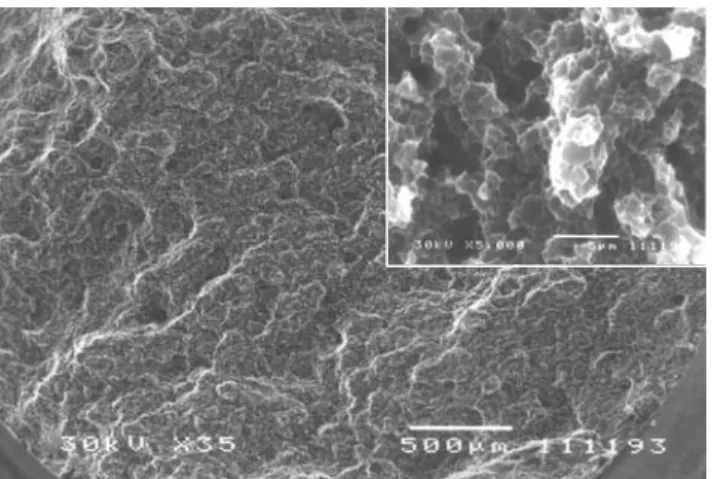
Fig. 2 shows SEM micrographs of the tensile fracture surfaces of the extruded Al-20Si alloy bars with <26 µm. Many dimples with ridges are seen in the extruded bars indicating ductility. The micrographs show a combination of cleavage fracture through the particle and ductile tearing of the matrix. The cleavage facets are then outlined by the ductile-torn-ridges of the Al matrix around the particles, giving the bright outlining to the facets. However, the microscopic fracture surface of the coarse powder showed rough tear ridges comprising a small population of the particle boundaries. Most of the primary Si particles in tensile tested spacimne were found to contain cracks and the fractured primary Si particles show clear cracks running through their centers. This indicates that the crack initiates in the primary Si particle, thus leading to typical brittle fracture. However, no such cracks were observed in the bars extruded from the fine powders.
The improved wear resistance of the Al-20Si (<26 µm) alloy may be explained on the basis of the following factors. During the wear test, a large number of primary Si particles will be in contact with the counterpart material if the primary Si size is small. Even though the total contact area of Si particles with the counterpart material is the same, irrespective of the size of the Si particle, the ultrafine particles formed in the Al-20Si (<26 µm) alloy contribute to an increase in the UTS and consequently this alloy will show a decrease in specific wear. This observation is similar to the report that hypereutectic Al-Si binary alloys show a high resistance to wear due to the presence of hard primary Si particles in the soft Al matrix [2].
Fig. 2 Fracture surface of extruded bar from fine powder.
The basic difference between the wear behavior of the Al-Si bars with the two sizes of the powders (<26 µm and 45-106 µm) is as follows. Since the bar with the fine powders is very hard and strong, the thickness of the deformed layer is small and the cracks were found to form more easily. But, the bar with the coarse powders was less hard and so the thickness of the deformed layer was larger; but, cracks (and voids) also were easily observed at the deformed layer. Further, boundary cracks between the matrix and the deformed layer were not observed. Thus, surface material removal in the softer material appears to be by a different mechanism.
3. Summary
The microstructure and fracture behavior of Al-20Si alloy were investigated as a function of the powder particle size. Fine Al-20Si alloy (<26 µm) exhibited higher UTS values than the coarse Al-20Si alloy (45-106 µm), while the elongation was not very different. Transverse microstructures of the tensile-tested Al-20Si alloy (45-106 µm) showed cracks in the primary Si particles, while Si particle boundary cracks were observed in the Al-20Si alloy (<26µm). The wear resistance of the Al-20Si alloy (<26 µm) was higher than the Al-20Si alloy (45-106 µm) at all sliding speeds.
4. References
1. S. Anand, T. S. Srivatsan, T. Wu, and E. J. Lavernia: J. Mater. Sci., vol. 32, pp. 2835-2848, (1997)
2. V.K. Kanth, B.N.P. Bai, and S.K. Biswas: Scripta Metall. Mater., vol. 24, pp. 267-271 (1990).
Extrusion direction
1µm
Fig. 1. SEM micrograph of extruded bar from fine powder.