C A S E R E P O R T
Open Access
Spontaneous remission of advanced
progressive poorly differentiated non-small
cell lung cancer: a case report and review
of literature
Hee-Young Yoon
1, Heae Surng Park
2, Min Sun Cho
2, Sung Shin Shim
3, Yookyung Kim
3and Jin Hwa Lee
1*Abstract
Background: Spontaneous remission (SR) of cancer is a very rare phenomenon of unknown mechanism. In
particular, SR of non-small cell lung cancer (NSCLC) has been scarcely reported. We present the case of a
74-year-old woman with advanced, poorly differentiated NSCLC (highly expressing programmed death ligand-1 [PD-L1])
that progressed despite multiple lines of chemotherapy but then spontaneously remitted.
CASE presentation: The patient presented with hemoptysis and was diagnosed with stage IIIA poorly differentiated
NSCLC via bronchoscopic biopsy. She had an unremarkable medical history and moderate performance status. The
initial treatment plan was surgery after neoadjuvant chemotherapy. Despite conventional chemotherapy, follow-up
chest computed tomography (CT) showed gradual tumor progression and she decided against further treatment after
fifth-line chemotherapy. However, the size of lung mass was markedly decreased on follow-up chest CT one year after
ceasing chemotherapy. Also, follow-up positron emission tomography images showed decreased metabolic activity in
the lung mass and a percutaneous biopsy specimen from the diminished lung mass revealed no viable tumor cells. A
diagnosis of SR of NSCLC was confirmed, and the patient was without tumor progression on follow-up nine months
later. Later, PD-L1 immunostaining revealed high positivity (> 99%) in initial tumor cells.
Conclusion: Our case showing SR of poorly advanced NSCLC refractory to multiple lines of chemotherapy suggested
the association between immunity and tumor regression.
Keywords: Advanced stage, Chemotherapy, Prognosis, Immunity, Disease progression
Background
Spontaneous remission (SR) of cancer is defined as
par-tial or complete disappearance of a malignant tumor
without any standard treatment or with inadequate
treatment for cancer control. Cole and Everson first
re-ported 47 cases of biopsy-confirmed SR of cancer,
pro-posing the term and criteria for SR in 1956 [
1
].
Although neuroblastoma, bladder cancer, and lymphoma
have shown relatively high incidences of SR [
2
], SR of
non-small cell lung cancer (NSCLC) is rare, with only a
few cases reported worldwide [
3
–
19
]. Here, we present a
case of a 74-year-old woman diagnosed with advanced
poorly differentiated NSCLC that spontaneously
remit-ted after failure of multiple courses of chemotherapy.
Case report
A 74-year-old woman was admitted to our institute with
a history of a lung mass on a chest x-ray performed at
another hospital for evaluation of recurrent hemoptysis.
She had no relevant past medical or family history and
was not taking any medication. She was a housewife and
never smoked. She did not complain of respiratory
symptoms except for hemoptysis. There was no history
of occupational or environmental exposure. At the time
of admission, her physical examination revealed
de-creased lung sounds in the left lower lung field.
© The Author(s). 2019 Open Access This article is distributed under the terms of the Creative Commons Attribution 4.0 International License (http://creativecommons.org/licenses/by/4.0/), which permits unrestricted use, distribution, and reproduction in any medium, provided you give appropriate credit to the original author(s) and the source, provide a link to the Creative Commons license, and indicate if changes were made. The Creative Commons Public Domain Dedication waiver (http://creativecommons.org/publicdomain/zero/1.0/) applies to the data made available in this article, unless otherwise stated.
* Correspondence:[email protected]
1Division of Pulmonary and Critical Care Medicine, Department of Internal
Medicine, College of Medicine, Ewha Womans University, Seoul25 Magokdong-ro 2-gil Gangseo-gu, Seoul 07804, Republic of Korea Full list of author information is available at the end of the article
Laboratory testing revealed no abnormal results except
for mild elevation of C-reactive protein (0.44 mg/dL,
ref-erence: 0–0.3 mg/dL). Initial chest x-ray and computed
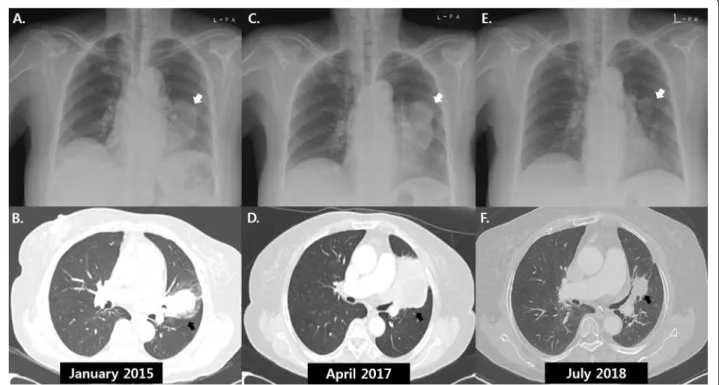
tomography (CT) scan revealed a 5.1 × 2.9 cm lung mass
in the left upper lobe with a surrounding halo of
ground-glass attenuation (Fig.
1
-a and b). There were
also tiny lung nodules in the right upper and lower lobes
that could not be ruled-out for malignancy and left hilar
lymph node enlargement (11 L). Positron emission
tomography/computed tomography (PET/CT) images
showed a left lung mass with increased metabolic uptake
(Figs.
2
-a and b).
Diagnostic bronchoscopy revealed a polypoid mass
with luminal obstruction of the left lingular inferior
seg-mental bronchus (Fig.
3
-a). Bronchoscopic biopsy of the
lung mass was performed without complication.
Histo-logic examination of an initial bronchoscopic biopsy
showed poorly differentiated carcinoma with many
tumor infiltrating lymphocytes (Fig.
4
a).
Immunohisto-chemical stains including cytokeratin (CK)-7, CK-20,
thyroid transcription factor-1, napsin A, p63, p40 and
CD56 were all negative. The initial pathological
diagno-sis was non-small cell carcinoma, not otherwise
speci-fied. The tumor was epidermal growth factor receptor
wild type. An assay for anaplastic large-cell lymphoma
kinase (ALK) rearrangement was not performed because
the ALK inhibitor was not available. The patient was
di-agnosed with lung cancer in January 2015, long before
the ALK inhibitor was approved for the treatment of
lung cancer. Retrospective programmed death-ligand 1
(PD-L1) immunostaining (Ventana PD-L1 SP263 assay,
Roche Diagnostics, Switzerland) showed high PD-L1
ex-pression with a tumor proportion score of 99% (Fig.
4
b).
After brain magnetic resonance imaging for cancer
staging, which revealed a non-metastatic lesion, a
tenta-tive diagnosis of lung cancer with T3N1M0 (stage IIIA
according to TNM seventh edition) was proposed. At
first, the patient planned to undergo surgery after two
cycles of paclitaxel plus carboplatin as neoadjuvant
chemotherapy, inducing a decrease in the size of the
lung mass from 5.1 × 2.9 cm to 4.1 × 1.5 cm. However,
the patient developed drug-induced hepatitis with
aspar-tate aminotransferase (AST) / alanine aminotransferase
(ALT) of 110 / 182 IU/L due to a self-prescribed herbal
medication, and the surgery schedule was delayed. For
two weeks, waiting for the AST / ALT levels to drop,
the lung mass slightly increased (4.1 × 2.6 cm), and she
hesitated to undergo surgery. So afterwards she received
additional two cycles of paclitaxel plus carboplatin,
which means that she received a total of four cycles of
paclitaxel plus carboplatin. However, the tumor still
pro-gressed, and fifth-line chemotherapy was sequentially
Fig. 1 Serial chest radiographs and computed tomography scans of a 74-year-old woman with spontaneous remission of non-small cell lung cancer. a: Radiograph in January 2015 showed a left lung mass (white arrow). b: A 5.1 × 2.9 cm lung mass in the left upper lobe (black arrow) was observed on computed tomography (CT) images at the time of initial chest radiograph (a). c and d: After fifth-line chemotherapy, follow-up radiograph (c) and CT scans (d) in April 2014 showed an increase in size of the left lung mass. e and f: One year after the discontinuation of chemotherapy, significant reduction in size of the lung mass was demonstrated on follow-up radiograph (e) and CT scans (f) in July 2018
administered until the fifth-line as follows: second-line
for 4 cycles of gemcitabine plus carboplatin, third-line
for 2 cycles of pemetrexed, fourth-line for 4 cycles of
weekly docetaxel, fifth-line for 1 cycle of weekly
vinorel-bine. After a vinorelbine monotherapy, the patient
re-fused further chemotherapy due to general weakness. At
4 months after discontinuation of chemotherapy, the size
of the tumor on follow-up chest x-ray (Fig.
1
-c) and CT
(Fig.
1
-d) was markedly increased (6.8 × 6.0 cm), directly
invading left main pulmonary artery, left atrium, and left
lower lobe. Thus, the patient again started irinotecan
plus carboplatin as sixth-line chemotherapy. Although
Fig. 2 Comparison of in18F-fluorodeoxyglucose positron emission tomography/computed tomography images before and after spontaneous remission of the left lung mass. a and b: A coronal positron emission tomography (PET) image in January 2015 revealed a mass with intense uptake (arrowhead) in the left lung (a) corresponding to a soft tissue density in a combined PET and CT fusion image (arrow). c and d: After the spontaneous remission, decreases in both size and uptake of the left lung mass were identified on a coronal PET image (c) and a combined PET and CT fusion image (arrow) (d) in October 2018Fig. 3 Comparison of bronchoscopic findings at the time of diagnosis of lung cancer and after spontaneous remission. a: On initial
bronchoscopy, a polypoid endobronchial mass almost completely blocked the bronchial orifice of the lingular segment. b: After the spontaneous tumor remission, the entrance of the bronchus was replaced with a cicatricial lesion
tumor size decreased after 4 cycles of chemotherapy, she
decided to stop chemotherapy due to poor general
con-dition and drug side effects and was scheduled for
regu-lar follow-up for tumor surveillance.
One year after discontinuation of treatment, a chest
x-ray showed that the lung mass had decreased in size
(Fig.
1
-e). The patient had been taking herbal medication
(Orostachys japonicus extracts) over the preceding few
months. Chest CT taken during admission for disease
status re-evaluation revealed the lung mass in the left
lingular segment to have decreased in size to 3.6 × 2.5
cm (Fig.
1
-f). PET/CT also demonstrated decreased size
and metabolic activity of the lung mass (Figs.
2
-c and d)
and hilar lymph node. For further treatment planning,
we performed bronchoscopy and intended repeat tumor
biopsy, but only found fibrotic scar blocking the ligular
segment instead of an endobronchial mass (Fig.
3
-b).
Histologic examination of the second bronchoscopic
bi-opsy revealed chronic inflammation with foamy
histio-cytic infiltration (Fig.
4
c). We subsequently conducted
fluoroscopy-guided lung biopsy of the left lung mass.
Percutaneous needle biopsy of the left lung lesion
showed marked deposition of collagen and elastic fibers
without tumor cells. (Fig.
4
d). The histopathologic
find-ings of second bronchoscopic biopsy and percutaneous
lung needle biopsy were suggestive of tumor regression.
A diagnosis of SR of NSCLC was made, and the
pa-tient was without cancer progression on outpapa-tient clinic
follow-up at 9 months after the detection of SR.
Discussion and conclusion
Our patient experienced SR of PD-L1-positive, poorly
differentiated, advanced NSCLC refractory to
con-ventional chemotherapy. SR of cancer is a unique
phenomenon and few studies on SR are available. SR
of cancer is estimated to occur in one in every 60,000
to 100,000 cancer patients according to the type of
cancer [
2
,
20
]. A review of the literature by Challis
and Stam, including 741 SR cases between 1900 and
1987, documented that nine types of cancer (kidney,
neuroblastoma, melanoma, choriocarcinoma, bladder,
retinoblastoma, lymphoma, leukemia, and breast
can-cer) accounted for 69% of all SR cases, while SR of
lung cancer only occurred in 2.6% of all patients with
SR [
20
]. Because of the very rare occurrence of SR in
lung cancer, only a few biopsy-confirmed NSCLC SR
cases have been reported (Table
1
).
The mechanism of SR remains unclear. Interestingly,
poorly differentiated cancer is common among the
re-ported cases of SR in patients with NSCLC. Light
mi-croscopy alone may be insufficient to diagnose poorly
differentiated carcinoma, which has been reported to
Fig. 4 Histopathological findings of the initial and second bronchoscopic biopsies. a: The initial bronchoscopic biopsy showed poorlydifferentiated carcinoma with many tumor infiltrating lymphocytes. b: On immunohistochemical staining, nearly all the tumor cells showed PD-L1 expression. c: The second bronchoscopic biopsy showed chronic inflammation with foamy histiocytic infiltration, suggesting tumor regression. d: The percutaneous lung needle biopsy revealed marked fibroelastosis without tumor cells, another histologic feature indicating tumor regression
have a poor prognosis [
21
,
22
]. The diagnosis of poorly
differentiated carcinoma depends substantially on
add-itional pathologist’s interpretation and adequate
speci-men size. The finding that many SR cases involved
tumors showing poorly differentiated features despite
testing with recently developed novel immunochemical
markers suggests that the cancers of origin might have
been misclassified. In addition, poorly differentiated
NCLC has higher fluorodeoxyglucose (FDG) uptake at
positron emission tomography and Ki-67 proliferation
index compared with well-differentiated NSCLC [
23
].
Also, there have been several cases of poorly
differenti-ated lung cancer accompanied by leukemoid reaction
[
24
–
26
]. Inflammation is physiologically self-limiting;
acute inflammation is terminated by activated
neutro-phils generating specialized pro-resolving mediators
(SPM), including lipoxins, resolvins, protectins, and
mar-esins, which are derived from essential fatty acids [
27
,
28
]. There is in vitro evidence that SPM controls both
innate
and
adaptive
immunity
by
reducing
the
production of inflammatory cytokines (e.g., tumor
ne-crosis factor-alpha and interferon-gamma) and memory
B-cell antibody production [
29
,
30
]. Considering the
as-sociation between cancer progression and inflammation,
increased cellular proliferation in poorly differentiated
carcinoma might paradoxically induce the suppression
of tumor growth via SPM, resulting in SR of cancer.
Unlike most other reported SR cases, which involved
smokers, our patient was a non-smoker. Several studies
recently reported superior efficacy of immunotherapy
in smokers compared with non-smokers but did not
clarify the mechanism of this effect [
31
]. Also, strong
PD-L1 positivity and presence of tumor infiltrating
lymphocytes (TIL), which are predictive biomarkers
for immunotherapy [
32
], were identified in this case.
Taken together, our findings and the results of
previ-ous studies support the association between immunity
and cancer control.
Our patient was taking herbal medication (Orostachys
japonicus extracts) after the discontinuation of
Table 1 Literature review of spontaneous remission of histologically confirmed non-small cell lung cancer
Reference Age/
Sex
Cell type Stage Smoking Comorbidities Treatment
Present study 74/F NSCLC, P/D III None None Herbal remedy after
ceasing multiple line chemotherapy
Matsui et al. 2018 [11]* 56/F SqCC, M/D III Smoker CTD-ILD and autoimmune
hepatitis
None
Ooi et al. 2018 [16] 77/M NSCLC, P/D III None none None
Marques et al. 2017 [10] 75/M AC, NA I Smoker COPD, heart failure None
Park et al. 2016 [17] 79/M SqCC, NA IV NA Hypertension, diabetes None
Chung et al. 2015 [5] 67/M SqCC, NA IV NA None Chemotherapy and
herbal remedy
Ogawa et al. 2015 [15] 65/M NSCLC, P/D IV Smoker none Radiotherapy
Menon et al. 2015 [12] 44/M NSCLC, P/D IV Smoker HIV None except HAART
on combined HIV infection
Lopez-Pastorini et al. 2015 [9] 76/M LC, P/D III Smoker hypertension None
Hwang et al. 2013 [8] 62/M NSCLC, P/D III Smoker IPF, diabetes None
Mizuno et al. 2011 [13] 62/M LC, NA IV NA None None after surgery for
initially stage I lung cancer
Furukawa et al. 2011 [6] 56/M SqCC, NA I Smoker COPD None
Gladwish et al. 2010 [7] 81/F SqCC, M/D III Smoker Hypothyroidism Herbal remedy (Essiac tea)
Nakamura et al. 2009 [14] 71/M AC, P/D III NA Anti-NY-ESO-1 immunity disease None
Pujol et al. 2007 [18] 75/F SqCC, NA I Smoker Anti-Hu antibody syndrome,
diabetes
None
Cafferata et al. 2004 [4] 68/M AC, P/D I Smoker COPD, ischemic heart disease None
Kappauf et al. 1997 [3] 61/M LC, P/D IV NA None None
Sperduto et al. 1988 [19] 61/M SqCC, NA IV Smoker COPD, basal cell cancer None
AC Adenocarcinoma, COPD Chronic obstructive pulmonary disease, CTD-ILD connective tissue disease related interstitial lung disease, F Female; HAART Highly active antiretroviral therapy, HIV Human immunodeficiency virus, IPF Idiopathic pulmonary fibrosis, LC Large cell carcinoma, M Male, M/D Moderate differentiation, NA Not applicable, SqCC Squamous cell carcinoma, P/D Poor differentiation
chemotherapy. Gladwish et al. reported the case of a
pa-tient with SR of stable IIB NSCLC after receiving an
herbal remedy (essiac tea) [
7
], which shows an
antiprolif-erative effect on cancer cells at high concentration
in vitro [
33
]. Chung et al. also reported the case of a
pa-tent with SR of NSCLC who took herbal medication
during and after chemotherapy [
5
].
Orostachys japonicus
is a flowering plant, containing several organic solvents
including ethyl acetate with anti-cancer effects on
hu-man gastric cancer cells [
34
]. An in vivo model study
also suggests the role of
Orostachys japonicus in
enhan-cing immunity by increasing immune cell propagation
and production of immunity-related cytokines [
35
]. In
our case, the tumor had many TIL and high PD-L1
ex-pression, indicating that the patient had an antitumor
immune response and had been eligible for treatment
with an immune checkpoint inhibitor. Although no data
are available to demonstrate the efficacy of
Orostachys
japonicus in humans, SR in our cases might be
influ-enced by
Orostachys japonicus intake.
Because our patient had received multiple cycles of
chemotherapy before the occurrence of SR, there was a
possibility of pseudo-progression or delayed response to
chemotherapy. However, the chemotherapy regimen had
changed several times, and tumor regression was
ob-served one year after the last treatment, suggesting a
high probability of SR. In addition, all of the
chemother-apeutic agents administered to our patient would be less
likely to show pseudo-progression because they are
con-ventional
drugs
rather
than
immune
checkpoint
inhibitors.
In conclusion, we document a case of SR in a patient
with advanced
NSCLC refractory to conventional
chemotherapy. Although the precise mechanism of SR
in this case is unknown, the alteration of immunity
might be an explanation. A single case cannot lead to a
definite conclusion; nevertheless, our case indicates the
importance of immunity in lung cancer control. Further
well-designed animal model studies are needed to
ex-plore these findings.
Abbreviations
CK:Cytokeratin; CT: Computed tomography; FDG: Fluorodeoxyglucose; NSCLC: Non-small cell lung cancer; PD-L1: Programmed death ligand-1; PET/ CT: Positron emission tomography/computed tomography; SR: Spontaneous remission
Acknowledgments Not applicable.
Authors’ contributions
J.H.L. had the conception of the work. H.Y.Y. drafted the manuscript. J.H.L. substantively revised it. Y.K.K. and S.S.S interpreted radiological findings and H.S.P. and M.S.C interpreted pathological findings. All authors approved the submitted version and agreed both to be personally accountable for the author’s own contributions and to ensure that questions related to the accuracy or integrity of any part of the work, even ones in which the author
was not personally involved, are appropriately investigated, resolved, and the resolution documented in the literature.
Funding
The corresponding author, J.H.R received National Research Foundation of Korea (NRF) grant funded by the Korea government (MSIT) (2010–0027945) for this study. The funders had no role in study design, data collection and analysis, decision to publish, or preparation of the manuscript.
Availability of data and materials
Any data generated and/or analysed during the current study are available from the corresponding author on reasonable request.
Ethics approval and consent to participate Not Applicable.
Consent for publication
A written informed consent was obtained from the patient for publication of this report and any accompanying images.
Competing interests
The authors declare that they have no competing interests. Author details
1
Division of Pulmonary and Critical Care Medicine, Department of Internal Medicine, College of Medicine, Ewha Womans University, Seoul25 Magokdong-ro 2-gil Gangseo-gu, Seoul 07804, Republic of Korea.
2Department of Pathology, College of Medicine, Ewha Womans University,
25 Magokdong-ro 2-gil Gangseo-gu, Seoul 07804, Republic of Korea.
3Department of Radiology, College of Medicine, Ewha Womans University, 25
Magokdong-ro 2-gil Gangseo-gu, Seoul 07804, Republic of Korea. Received: 3 July 2019 Accepted: 31 October 2019
References
1. Cole WH, Everson TC. Spontaneous regression of cancer: preliminary report. Ann Surg. 1956;144(3):366–83.
2. Cole WH. Efforts to explain spontaneous regression of cancer. J Surg Oncol. 1981;17(3):201–9.
3. Büschel G, Kaiser G, Kappauf H, Mittelmeier H-O, Birkmann J, Kraus J, Wünsch PH, Gallmeier WM. Complete spontaneous remission in a patient with metastatic non-small-cell lung cancer: case report, review of literature, and discussion of possible biological pathways involved. Ann Oncol. 1997; 8(10):1031–9.
4. Cafferata MA, Chiaramondia M, Monetti F, Ardizzoni A: Complete spontaneous remission of non-small-cell lung cancer: a case report. Lung cancer (Amsterdam, Netherlands) 2004, 45(2):263–266.
5. Chung C, Park DI, Kim SY, Kim JO, Jung SS, Park HS, Moon JY, Kim SM, Cho MJ, Jung SO, et al. Spontaneous regression of non-small cell lung cancer that progressed after multiple chemotherapies: a case report. Thoracic cancer. 2015;6(6):805–7.
6. Furukawa M, Oto T, Yamane M, Toyooka S, Kiura K, Miyoshi S. Spontaneous regression of primary lung cancer arising from an emphysematous bulla. Annals of thoracic and cardiovascular surgery : official journal of the Association of Thoracic and Cardiovascular Surgeons of Asia. 2011;17(6):577–9.
7. Gladwish A, Clarke K, Bezjak A: Spontaneous regression in advanced non-small cell lung cancer. BMJ case reports 2010, 2010:bcr0720103147. 8. Hwang ED, Kim YJ, Leem AY, Ji A-Y, Choi Y, Jung JY, Kim SK, Chang J, Park
JH, Park SC. Spontaneous regression of non-small cell lung cancer in a patient with idiopathic pulmonary fibrosis: a case report. Tuberculosis and respiratory diseases. 2013;75(5):214–7.
9. Lopez-Pastorini A, Plönes T, Brockmann M, Ludwig C, Beckers F, Stoelben E. Spontaneous regression of non-small cell lung cancer after biopsy of a mediastinal lymph node metastasis: a case report. J Med Case Rep. 2015;9:217.
10. Marques C, Queiroga H, Marques M, Moura C. Spontaneous regression of a pulmonary adenocarcinoma after core needle biopsy. Autopsy & case reports. 2017;7(3):20–5.
11. Matsui T, Mizuno T, Kuroda H, Sakakura N, Arimura T, Yatabe Y, Sakao Y. Spontaneous regression of lung squamous cell carcinoma with synchronous mediastinal progression: a case report. Thoracic cancer. 2018; 9(12):1778–81.
12. Menon MP, Eaton KD: Spontaneous Regression of Non–Small-Cell Lung Cancer in AIDS After Immune Reconstitution. J Thorac Oncol 2015, 10(1):e1-e2.
13. Mizuno T, Usami N, Okasaka T, Kawaguchi K, Okagawa T, Yokoi K. Complete spontaneous regression of non-small cell lung cancer followed by adrenal relapse. Chest. 2011;140(2):527–8.
14. Nakamura Y, Noguchi Y, Satoh E, Uenaka A, Sato S, Kitazaki T, Kanda T, Soda H, Nakayama E, Kohno S: Spontaneous remission of a non-small cell lung cancer possibly caused by anti-NY-ESO-1 immunity. Lung cancer (Amsterdam, Netherlands) 2009, 65(1):119–122.
15. Ogawa R, Watanabe H, Yazaki K, Fujita K, Tsunoda Y, Nakazawa K, Homma S, Kagohashi K, Satoh H, Hizawa N. Lung cancer with spontaneous regression of primary and metastatic sites: a case report. Oncol Lett. 2015;10(1):550–2. 16. Ooi KH, Cheo T, Soon GST, Leong CN: Spontaneous regression of locally
advanced nonsmall cell lung cancer: A case report. Medicine 2018, 97(31). 17. Park YH, Park BM, Park SY, Choi JW, Kim SY, Kim JO, Jung SS, Park HS, Moon
JY, Lee JE. Spontaneous regression in advanced squamous cell lung carcinoma. Journal of thoracic disease. 2016;8(3):E235–9.
18. Pujol JL, Godard AL, Jacot W, Labauge P. Spontaneous complete remission of a non-small cell lung cancer associated with anti-Hu antibody syndrome. Journal of thoracic oncology : official publication of the International Association for the Study of Lung Cancer. 2007;2(2):168–70.
19. Sperduto P, Vaezy A, Bridgman A, Wilkie L. Spontaneous regression of squamous cell lung carcinoma with adrenal metastasis. Chest. 1988; 94(4):887–9.
20. Challis GB, Stam HJ: The spontaneous regression of cancer. A review of cases from 1900 to 1987. Acta oncologica (Stockholm, Sweden) 1990, 29(5): 545–550.
21. Sun Z, Aubry MC, Deschamps C, Marks RS, Okuno SH, Williams BA, Sugimura H, Pankratz VS, Yang P. Histologic grade is an independent prognostic factor for survival in non-small cell lung cancer: an analysis of 5018 hospital-and 712 population-based cases. J Thorac Cardiovasc Surg. 2006;131(5): 1014–20.
22. Chung CK, Zaino R, Stryker JA, O'Neill M Jr, DeMuth WE Jr. Carcinoma of the lung: evaluation of histological grade and factors influencing prognosis. Ann Thorac Surg. 1982;33(6):599–604.
23. Vesselle H, Salskov A, Turcotte E, Wiens L, Schmidt R, Jordan CD, Vallières E, Wood DE. Relationship between non-small cell lung Cancer FDG uptake at PET, tumor histology, and Ki-67 proliferation index. J Thorac Oncol. 2008; 3(9):971–8.
24. Riesenberg H, Müller F, Görner M. Leukemoid reaction in a patient with adenocarcinoma of the lung: a case report. J Med Case Rep. 2012;6(1):211. 25. Shalom G, Sion-Vardy N, Dudnik J, Ariad S. Leukemoid reaction in lung cancer
patients. The Israel Medical Association journal : IMAJ. 2010;12(4):255–6. 26. Sreevatsa A, Babu S, Babu G, Suresh T. Hyperleukocytosis, an unusual paraneoplastic manifestation of lung cancer: case report and review of literature. J Cancer Res Ther. 2015;11(3):669.
27. Norling LV, Serhan CN. Profiling in resolving inflammatory exudates identifies novel anti-inflammatory and pro-resolving mediators and signals for termination. J Intern Med. 2010;268(1):15–24.
28. Zhang Q, Zhu B, Li Y. Resolution of Cancer-promoting inflammation: a new approach for anticancer therapy. Front Immunol. 2017;8:71.
29. Ramon S, Bancos S, Serhan CN, Phipps RP. Lipoxin a(4) modulates adaptive immunity by decreasing memory B-cell responses via an ALX/FPR2-dependent mechanism. Eur J Immunol. 2014;44(2):357–69.
30. Chiurchiu V, Leuti A, Dalli J, Jacobsson A, Battistini L, Maccarrone M, Serhan CN: Proresolving lipid mediators resolvin D1, resolvin D2, and maresin 1 are critical in modulating T cell responses. Science translational medicine 2016, 8(353):353ra111.
31. Li B, Huang X, Fu L. Impact of smoking on efficacy of PD-1/PD-L1 inhibitors in non-small cell lung cancer patients: a meta-analysis. OncoTargets and therapy. 2018;11:3691–6.
32. Yu H, Boyle TA, Zhou C, Rimm DL, Hirsch FR. PD-L1 expression in lung Cancer. Journal of thoracic oncology : official publication of the International Association for the Study of Lung Cancer. 2016;11(7):964–75. 33. Tai J, Cheung S, Wong S, Lowe C. In vitro comparison of Essiac and
flor-essence on human tumor cell lines. Oncol Rep. 2004;11(2):471–6.
34. Ryu DS, Lee HS, Lee GS, Lee DS. Effects of the ethylacetate extract of Orostachys japonicus on induction of apoptosis through the p53-mediated signaling pathway in human gastric cancer cells. Biol Pharm Bull. 2012;35(5): 660–5.
35. Lee HY, Park YM, Kim J, Oh HG, Kim KS, Kang HJ, Kim RR, Kim MJ, Kim SH, Yang HJ et al: Orostachys japonicus A. Berger Extracts Induce Immunity-Enhancing Effects on Cyclophosphamide-Treated Immunosuppressed Rats BioMed Research International 2019, 2019:9.
Publisher
’s Note
Springer Nature remains neutral with regard to jurisdictional claims in published maps and institutional affiliations.