Modifications of the MATRA Code for Various Fluids in Advanced Reactors
Kyong-Won Seo, Dae-Hyun Hwang, Chung-Chan Lee
Korea Atomic Energy Research Institute, P.O.Box 105, Yuseong, Daejeon, 305-600, Korea, [email protected]
1. Introduction
Subchannel analysis is old fashioned but it still has a main role in thermal-hydraulics analysis, in MDBNR searching and in design of advanced reactor cores although sophisticated CFD code experiments are growing and computing powers are being doubled. It is necessary to modify and improve the subchannel code to be applicable to the advanced reactors with different characteristics from the PWRs.
This work improved the subchannel code MATRA[1] for the application of a subchannel analysis to the GEN-IV reactors such as SCPWR and HTGCR. We added IAPWS-95[2,3] water and steam functions into the MATRA code for a supercritical pressure water condition. And we also added NIST Refprop[4] into the MATRA code to deal with non aqueous fluids such as Helium, CO2 and Freon and air.
We added property calculation options to build a property table by a function to accelerate the computing time in consideration of a code-coupling with another analysis code.
2. Code Modifications
The MATRA code uses a function, TAF and a subroutine STEAM for calculation of the water properties. The TAF builds a saturated water property table and calculates a property from another two properties (i.e., pressure and enthalpy). The STEAM builds a superheated water property table by an option. The TAF is limited to the operating conditions of PWRs and the STEAM is limited to water. One should write a saturated property table of fluid in the input deck to calculate a problem with non aqueous fluids. And a calculation for a superheated region is limited by the STEAM.
2.1. New Property functions for various fluids.
Advanced reactors, SCPWR(Supercritical Pressure Water Reactor), HTGR(High Temperature Gas Cooled Reactor), have many different characteristics with the PWRs. Modification of the MATRA code is necessary for the subchannel analysis of these new reactor cores.
Operating range of the SCPWR, one of the GEN-IV reactors, would be outside the applicable range of the TAF and the IAPWS-95 function was added into the MATRA code to deal with water properties in a wide range of pressure and temperature conditions including a supercritical pressure water.
In researches of phenomena in a supercritical pressure, carbon dioxide or Freon have been widely used instead
of water due to the relatively low supercritical pressure, and the MATRA code must deal with these fluids to analyze the results from the works with these fluids.
And the properties of Helium gas were also added into the MATRA code to be applicable to the HTGCR, one of the GEN-IV reactors, and the NIST Refprop was added into the MATRA code to deal with cryogens, Helium, CO2, and Freon, as a working fluid.
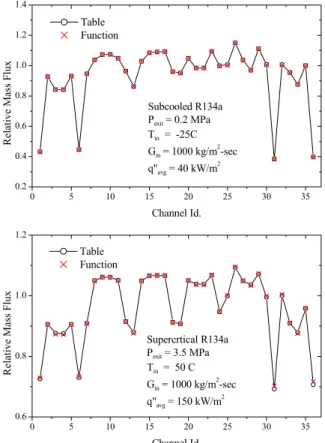
0 5 10 15 20 25 30 35 0.2 0.4 0.6 0.8 1.0 1.2 1.4 0 5 10 15 20 25 30 35 0.6 0.8 1.0 1.2 Table Function Subcooled R134a Pexit = 0.2 MPa Tin = -25C Gin = 1000 kg/m 2 -sec q"avg = 40 kW/m 2 R ela ti ve M as s F lux Channel Id. Relat iv e M ass F lux Channel Id. Supercrtical R134a Pexit = 3.5 MPa Tin = 50 C Gin = 1000 kg/m 2 -sec q"avg = 150 kW/m 2 Table Function
Fig. 1 Calculation results - properties calculated by the property table input and by the new function for Freon R134a.
Calculation results by the MATRA code are shown in Fig. 1 by the property table input option and by the new Refprop function option respectively. The calculations were conducted for the two cases of a subcooled and supercritical pressure and the results show a small error between the two options because the properties are monotonic in these conditions. The results show that the functions added into the MATRA code operated successfully. User should bear in mind, in pseudo-critical temperature the properties vary rapidly and the table input is not valid anymore.
Transactions of the Korean Nuclear Society Autumn Meeting Busan, Korea, October 27-28, 2005
2.2. Optimization of calculation time.
Nowadays a code-coupling among two or more separate codes is common to analyze a problem with complex phenomena. Subchannel anaylsis code may be coupled with a neutronics code or/and a system code. And an optimization of the calculation time of the MATRA code is important in a code-coupling. Calculation of the properties directly from the function, IAPWS-95 or NIST Refprop, consumes much cpu time, and we adopted an option to generate property table from the functions while reading the input deck. Calculation results by a property table input are as valid as those by a function as Fig.1. The calculation results by the MATRA code with the options of the property table input, property function, and property table generated by a function are summarized in Table 1. Table 1 Calculation times of the MATRA for each case
Option CPU time
per outer iteration
Table
only Function only Table by function
Subcooled Freon 0.116 4.892 0.128
Supercritical Freon 0.213 7.513 0.225
Although the table option is fast, calculation of the properties by a function is recommended due to the dramatic increase and decrease in the properties near the pseudo-critical temperature range.
2.3. Extension of heat transfer model and pressure drop boundary condition.
Ability to analyze the block type HTGCR core was already implemented and validated with the MATRA code. Inter-block conduction heat transfer and radiation heat transfer model[5] were added into the MATRA code and the inlet flow redistribution by a pressure drop at parallel multiple channels connected at only the upper and lower plenum model[6] has already been implemented.
3. Conclusion
Subchannel code MATRA was modified to deal with supercritical water, CO2, Freon, Helium which would
be the coolant of the advanced reactors. The code calculation time was shortened in consideration of the code-coupling with another code by optimizing the calculation algorithm and by building the property table from a property function. And the ability to analyze the HTGCR features was provided by the pressure drop boundary condition, an inter-block conduction and the radiation heat transfer.
From this work, the MATRA code shows possibility to be applicable to a subchannel analysis of the advanced reactors.
ACKNOWLEDGEMENTS
This study has been carried out under the R&D program sponsored by the Ministry of Science and Technology of Korea.
REFERENCES
[1] 유연종, 황대현, Development of a Subchannel Analysis Code MATRA (Ver. α), KAERI/TR-1033/98, KAERI, 1998. [2] K. Watanbe et al., Release on the IAPWS Formulation 1995 for the Thermodynamic Properties of Ordinary Water Substance for General and Scientific Use, The International Association for the Properties of Water and Steam, 1996. [3] NIST/ASME STEAM-NIST Standard Reference Database 10, v2.2.
[4] NIST REFPROP, Thermodyanmic and Transport Properties of Refrigerants and Refrigerant Mixtures – NIST Standard Reference Database 23, v6.01.
[5] Kyu-Hyun Han and Soon Heung Chang, “Thermal Hydraulic Analysis of Gas-Cooled Reactors with Annular Fuel Rods,” Proc. Of the Korean Nuclear Society String Meeting, Korea, 2005.
[6] 서경원 외, “평행 다수로 문제에 대한 부수로 해석
코드 MATRA 적용,” Proc. of the Korean Nuclear Society