© Korean Powder Metallurgy Institute 1331
-The Optimization of Hydrogen Reduction Process
for Mass Production of Fe-8wt%Ni Nanoalloy Powder
Sung-Soo Jung1,a, Yun-Sung Kang1,b, and Jai-Sung Lee1,c
1Department of Metallurgy and Materials Science, Hanyang University, Ansan 426-791, Korea
a[email protected], b[email protected], c[email protected] Abstract
The present investigation has attemped to optimize hydrogen reduction process for the mass production of Fe-8wt%Ni nanoalloy powder from ball milled Fe2O3-NiO powder. In-situ hygrometry study was performed to monitor the reduction
behavior in real time through measurement of water vapor outflowing rate. It was found that the reduction process can be optimized by taking into account the apparent influence of water vapor trap in the reactor on reduction kinetics which strongly depends on gas flow rate, reactor volume and reduction.
Keywords : Hydrogen Reduction, Nanopowder, Fe-8wt%Ni, Mass Production, Hygrometry
1. Introduction
Hydrogen reduction technique has been widely used to fabricate nano-sized metal powder from metal oxide powder [1,2]. It is essential to optimize hydrogen reduction process in order to produce the nanopowder with controlled powder characteristics [1,3-7]. It is known that the control kinetic of reduction process strongly depends on processing variables such as temperature, reduction time, particle size, packing shape and amount of oxide powder.
Conventionally, the measurement of hydrogen reduction process has been conducted by experimental kinetic-studies of thermogravimetry (TG) and differential thermal analysis (DTA) [1]. However, these experimental measurements are limited to a lab-scale study which can only monitor and check the evolution of reaction kinetic using a tiny volume of powder sample. Therefore, we introduce a new in-situ hygrometry measurement method which enables to investigate the outflowing behavior of water vapor generated during reduction of massive quantity of powder sample in real-time. As a target powder material system for mass production, Fe-8wt%Ni system from hydrogen reduction of Fe2O3-NiO powder was selected.
2. Experimental and Results
A powder mixture of Fe2O3-NiO with a final composition of Fe-8wt%Ni was prepared by blending-Fe2O3 (99.9%, 1m) and NiO (99.9%, 7m) powders. Ball milling was performed in a stainless steel attritor at a speed of 300 r.p.m. for 10h. The hydrogen reduction behavior was measured by means of the measurement techniques of weight loss (TG)
and water vapor rate (hygrometry). Reduction of oxide nanopowder was performed isothermally at different temperature condition of 450oC, 500oC and 550oC. The mean crystallite size of powder was calculated by the Scherrer formular based on the X-ray diffractometry (XRD) using full width at half the maximum (FWHM) of the peak [8]. Also, the microstructure of powders was observed by scanning electron microscopy (SEM).
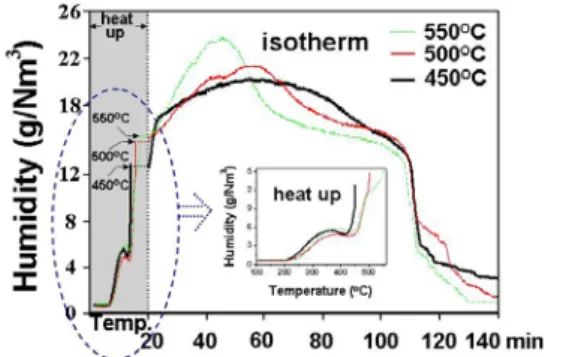
Fig. 1 represents the result of hygrometry study showing the removal behavior of water vapor during hydrogen reduction of Fe2O3-NiO nanopowder (30 g) at various reduction temperatures. As seen in the result, the reduction behavior in the initial stage seems reasonable and similar to lab scale reduction process in terms of temperature dependence. However, the reduction process was apparently completed within 140 min regardless of reduction temperature. This is basically different from the result of lab scale reduction experiment described avobe. The retardation of water vapor outflow by trapping of water vapor in the reactor is probably responsible for such phenomenon. The average particle size of the Fe-8wt%Ni nanoalloy powders produced under this condition was measured by 100 nm, 150 nm and 200 nm at 450oC, 500oC and 550oC, respectively.
In order to check the optimum reduction condition on the basis of the results described, the time for complete reduction was predicted assuming that the reduction of oxide powder is finished under the maximum removal rate condition of water vapor generated. Consequently, the time
for complete reduction was determined from the peak positions of Fig. 4 as 60 min for 450oC, 51 min for 500oC and 43 min for 550oC, respectively.
Fig. 2 shows the XRD patterns of the Fe-8wt%Ni 2006 POWDER METALLURGY
World Congress
© Korean Powder Metallurgy Institute 1332 -nanoalloy powders produced at the predicted condition for complete reduction described above. The calculation of phase volume on the basis of the XRD result represents that the oxide powder for all samples (three temperature conditions) was almost reduced to 95vol%-iron phase and 5vol%γ-FeNi phase in Fe-8wt%Ni nanoalloy powder.
Fig. 1 The removal of water vapor during heat-upa nd isothermal hydrogen reduction process of Fe2O3
-NiO at various reduction temperature conditions.
Fig. 2 XRD patterns of the Fe-8wt%Ni nanoalloy p owders reduced at a) 450oC for 70 min, b) 500oC fo
r 61 min and c) 550oC for 53 min.
Fig. 3 SEM micrographs of the Fe-8wt%Ni nanoallo y powders reduced at a) 450oC for 70 min, b) 500o
C for 61 min and c) 550oC for 53 min.
Fig. 3 shows the SEM micrographs of the Fe-8wt%Ni nanoalloy powders reduced at 450oC for 70 min, 500oC for 61 min and 550oC for 53 min. The mean size of primary Fe-8wt%Ni nanoalloy powder was 70 nm, 90 nm and 120 nm, respectively.
3. Summary
It was feasible to optimize the hydrogen reduction process for mass production of Fe-8wt%Ni nanoalloy powder by measuring water vapor outflowing rate in real-time. The reduction process for mass production from the hygrometry result obviously appeared to complete within 140 min regardless of reduction temperature. However, the Fe-8wt%Ni nanoalloy powders produced at the maximum removal rate of water vapor generated was reduced over 95%. Therefore, it was interpreted that the trapping of water vapor in the reactor was responsible for the retardation of water vapor outflow. Consequently, it was found that the reduction process, especially for the mass production, can be optimized by taking into account the apparent influence of water vapor trap in the reactor on reduction kinetics.
4. References
1. J.S. Lee and B.S. Kim, Mater. Trans., 42, 1607(2001). 2. J.S. Lee, T.H. Kim, J.H. Yu and S.W. Chung, Nanostr.
Mat., 9, 153(1997).
3. E. Breval, G. Dodds and C.G. Pantano, Mater. Res. Bull., 20, 1191(1991).
4. A.K. Khaund, P.S. Nicholson, J. Mater. Sci., 15, 177 (1980). 5. P. Lou, T.G. Nieh, A.J. Schwartz and T.J. Lenk, Mater. Sci.
Eng., A204, 59(1995).
6. X.Y. Qin, J.S. Lee and J.G. Kim, J. Appl. Phys., 86, 2146 (1999).
7. X.Y. Qin, J.S. Lee, J.G. Nam and B.S. Kim, Nanostr. Mater., 11, 383(1999).
8. B.D. Cullity: Elements of X-ray Diffraction (Prentice- Hall, INC., NJ 2001).