PGHN
Guideline
Received:November 29, 2018, Revised:December 11, 2018, Accepted:December 12, 2018
Corresponding author: Hye Ran Yang, Division of Pediatric Gastroenterology, Hepatology and Nutrition, Department of Pediatrics, Seoul National University Bundang Hospital, 82 Gumi-ro, 173beon-gil, Bundang-gu, Seongnam 13620, Korea. Tel: +82-31-787-7285, Fax: +82-31-787-4054, E-mail: [email protected]
This article has been published simultaneously in Pediatric Gastroenterology, Hepatology & Nutrition and Korean Journal of Pediatrics by the permission of editor-in-chief of two journals.
Copyright ⓒ 2019 by The Korean Society of Pediatric Gastroenterology, Hepatology and Nutrition
This is an openaccess article distributed under the terms of the Creative Commons Attribution NonCommercial License (http://creativecommons.org/licenses/by-nc/4.0/) which permits unrestricted noncommercial use, distribution, and reproduction in any medium, provided the original work is properly cited.
Clinical Practice Guideline for the Diagnosis and Treatment of
Pediatric Obesity: Recommendations from the Committee on
Pediatric Obesity of the Korean Society of Pediatric
Gastroenterology Hepatology and Nutrition
Dae Yong Yi, Soon Chul Kim*, Ji Hyuk Lee
†, Eun Hye Lee
‡, Jae Young Kim
§, Yong Joo Kim
∥,
Ki Soo Kang
¶, Jeana Hong**, Jung Ok Shim
††,‡‡, Yoon Lee
‡‡, Ben Kang
§§, Yeoun Joo Lee
∥∥,
Mi Jin Kim
¶¶, Jin Soo Moon***, Hong Koh
†††, JeongAe You
‡‡‡, Young-Sook Kwak
§§§,
Hyunjung Lim
∥∥∥, and Hye Ran Yang
¶¶¶,****
Department of Pediatrics, Chung-Ang University Hospital, Chung-Ang University, College of Medicine,
Seoul,*Department of Pediatrics, Chonbuk National University Hospital, Chonbuk National University Medical School, Jeonju, †Department of Pediatrics, Chungbuk National University College of Medicine, Chungju, ‡Department of
Pediatrics, Nowon Eulji Medical Center, Eulji University School of Medicine, Seoul, §Department of Pediatrics,
Gyeongsang National University Changwon Hospital, Changwon, ∥Department of Pediatrics, Hanyang University
College of Medicine, Seoul, ¶Department of Pediatrics, Jeju National University Hospital, Jeju, **Department of
Pediatrics, Kangwon National University School of Medicine, Chuncheon, ††Department of Pediatrics, Korea
University Guro Hospital, Seoul, ‡‡Department of Pediatrics, Korea University College of Medicine, Seoul, §§Department of
Pediatrics, School of Medicine, Kyungpook National University, Daegu, ∥∥Department of Pediatrics, Pusan National
University Children’s Hospital, Pusan National University School of Medicine, Yangsan, ¶¶Department of Pediatrics,
Samsung Medical Center, Sungkyunkwan University School of Medicine, ***Department of Pediatrics, Seoul National University Children’s Hospital, Seoul National University College of Medicine, †††Department of Pediatrics, Severance
Children’s Hospital, Yonsei University College of Medicine, ‡‡‡Department of Physical Education, College of Education,
Chung-Ang University, Seoul, §§§Department of Psychiatry, Jeju National University Hospital, Jeju, ∥∥∥Department of
Medical Nutrition, Kyung Hee University, Seoul, ¶¶¶Department of Pediatrics, Seoul National University Bundang
Hospital, Seongnam, ****Department of Pediatrics, Seoul National University College of Medicine, Seoul, Korea
The Committee on Pediatric Obesity of the Korean Society of Pediatric Gastroenterology, Hepatology and Nutrition newly developed the first Korean Guideline on the Diagnosis and Treatment of Obesity in Children and Adolescents to deliver an evidence-based systematic approach to childhood obesity in South Korea. The following areas were systematically reviewed, especially on the basis of all available references published in South Korea and worldwide,
and new guidelines were established in each area with the strength of recommendations based on the levels of evidence: 1) definition and diagnosis of overweight and obesity in children and adolescents; 2) principles of treatment of pediatric obesity; 3) behavioral interventions for children and adolescents with obesity, including diet, exercise, lifestyle, and mental health; 4) pharmacotherapy; and 5) bariatric surgery.
Key Words: Guideline, Obesity, Diagnosis, Treatment, Child
INTRODUCTION
The prevalence of childhood obesity is dramati-cally increasing in South Korea, which has been as-sociated with changes in lifestyle, such as Westernized high-calorie, high-fat diet with sugar-sweetened beverages, sedentary lifestyles, and decreased phys-ical activity [1]. In a recent report, the prevalence of obesity in children aged below 6 years increased from 1.4% in 2008 to 2.8% in 2015, and that in chil-dren and adolescents aged 7 to 18 years rapidly in-creased from 8.4% in 2008 to 14.3% in 2016 [1]. Accordingly, the prevalence of obesity-related phys-ical, psychosocial, and metabolic complications, such as metabolic syndrome and non-alcoholic fatty liver disease (NAFLD), is also increasing in Korean children and adolescents [2].
Childhood obesity may persist lifelong if not treat-ed properly; it can lead to adulthood obesity and a va-riety of metabolic and cardiovascular complications later in life. Thus, pediatric obesity is regarded as one of the priority health issues, and the treatment of childhood obesity and its complications may be one of the most effective strategies to reducing morbid-ities and mortalmorbid-ities and to saving hospital costs later in life.
Strict guidelines or consensus statements on the diagnosis and treatment of pediatric obesity have been published and updated in Western countries. However, to date, there are no evidence-based guide-lines on pediatric obesity in Asia, including South Korea. Therefore, the Committee on Pediatric Obesity of the Korean Society of Pediatric
Gastroen-terology, Hepatology and Nutrition (KSPGHAN) de-veloped an evidence-based guideline on the diag-nosis and treatment of obesity in children and ado-lescents, to deliver a systematic approach to child-hood obesity in South Korea.
METHODS
To develop the first evidence-based clinical prac-tice guideline on the diagnosis and treatment of obe-sity in children and adolescents in South Korea, the Committee on Pediatric Obesity of the KSPGHAN es-tablished a Guideline Task Force (TF) in March 2017. This TF was composed of pediatric gastroenterologists with an expertise in clinical nutrition, as well as pe-diatric neuropsychiatrists, clinical nutrition special-ists, and exercise specialists. Experts from these areas were designated to each TF subgroup accord-ing to their professional specialty.
A systematic protocol for the establishment of an evidence-based guideline for the diagnosis and treat-ment of obesity in children and adolescents was pre-pared and established through regular TF meetings. The basic format of the guideline was determined to encompass a total of eight topics within five different sections as follows:
1) Definition and diagnosis of overweight and obesity in children and adolescents
2) Principles of the treatment of pediatric obesity 3) Behavioral interventions for children and ado-lescents with obesity
(1) Diet (2) Exercise
(3) Lifestyle (4) Mental health
4) Pharmacotherapy in children and adolescents with obesity
5) Bariatric surgery in children and adolescents with obesity
Each TF working subgroup searched all references related to pediatric obesity in each assigned field through PubMed search using MeSH (Medical Subject Headings) terms, as well as all available ref-erences published in South Korea using appropriate systematic search strategies. These references in-cluded randomized controlled trials (RCTs), ob-servational studies (e.g., case-control studies, pro-spective and retropro-spective cohort studies, case series studies), meta-analyses, systematic reviews, and previous obesity guidelines or position papers or con-sensuses on both children and adults with obesity through the entire period using a last search date of September 30, 2018. Subsequently, each TF sub-group reviewed, analyzed, and summarized all re-lated documents and references in each field.
To establish a systematic evidence-based guide-line, the strength of evidence and grade of mendation were determined for each recom-mendation according to a previously adapted classi-fication system for evidence-based guidelines (Table 1) [3-5]. The strength of evidence was classified from level I to level V based on the value of the evidence in the literature, including systematic review, meta-analysis, and scientific papers: RCTs, well-de-signed trials, consensus studies, and opinions of re-search groups, respected authorities, and expert committees. Level I represents the strongest evidence.
The grade of recommendation was determined ac-cording to the strength of evidence and importance of the recommendation. Levels I to III evidence were decided to correspond to Grades A to C of mendations, which were regarded as highly recom-mended or recomrecom-mended, respectively. Levels IV and V recommendations for were basically regarded as Grade D; the final grade was decided through vot-ing consensus of the entire TF. A total of three
face-to-face meetings were held in Seoul and Jeju Island and 14 online video meetings to achieve con-sensus on all of the recommendations. All recom-mendations were voted on and accepted when 100% agreement was achieved.
1. Definition and diagnosis of overweight and obesity in children and adolescents 1-1. We suggest to use the Korean National Growth Charts body mass index (BMI) percentile to diag-nose overweight and obesity in children and ado-lescents over two years of age. (Strength of evi-dence, level III; grade of recommendation, C) 1-2. We suggest to diagnose overweight when the BMI is above the 85th but <95th percentile for age and sex, and obesity when the BMI is above the 95th percentile in children and adolescents >2 years of age. (Strength of evidence, III; grade of rec-ommendation, C)
1-3. We suggest that children <24 months of age be diagnosed as overweight if weight for height is above the 95th percentile on the Korean National Growth Charts, which introduced the World Health Organization (WHO) growth standards in this age group, as the Korean Society of Pediatrics accepts this basis as valid. (Strength of evidence, V; grade of recommendation, C, based on committee voting) 1-4. We recommend to assess comorbidities: NAFLD, dyslipidemia, hypertension, prediabetes, type II diabetes mellitus (DM), polycystic ovary syndrome, obstructive sleep apnea, and psychoso-cial problems. (Strength of evidence, V; grade of recommendation, A, based on committee voting)
1-1. We suggest to use the Korean National Growth Charts BMI percentile to diagnose over-weight and obesity in children and adolescents over two years of age. (Strength of evidence, level III; grade of recommendation, C)
The Korean National Growth BMI charts are ac-cepted as valid for Korean children and adolescents over two years of age and provide a means for
de-Table 1. The Strength of Evidence and the Grade of Recommendation in Support of the Recommendations Formulated and Established in the KSPGHAN Clinical Practice Guideline on the Diagnosis and Treatment of Pediatric Obesity [5]
Strength of evidence
Grade of recommendation
I Grade A Strong evidence from one or more systematic review(s) of well-designed RCTs
Highly recommended
II Grade B Strong evidence from one or more properly designed RCT(s) of appropriate size
Recommended
III Grade C Evidence from well-designed clinical trials without randomization, comparative study in a single group, cohort study, time series study or matched case-control studies
Recommended
IV Grade D Evidence from well-designed clinical trials, non-experimental studies from one or more center or research group
The consensus route would have to be adopted V Grade D Opinion of respected authorities, clinical evidence, descriptive
studies, or reports of experts committees
The consensus route would have to be adopted KSPGHAN: Korean Society of Pediatric Gastroenterology Hepatology and Nutrition, RCT: randomized controlled trial.
termining changes in pediatric obesity prevalence [6]. The 2017 Korean National Growth Charts are recommended for the evaluation of body size and growth of Korean children and adolescents to use in practice and in the public health sector in South Korea [6].
A systematic review by the United States Preventive Services TF reported that the BMI of children and adolescents correlate well to the per-centile of body fat [7]. In 1990s, an expert commit-tee recommended using BMI for screening over-weight in children and adolescents [8]. In the 2000 Centers for Disease Control (CDC) Growth Chart and 2011 United Kingdom (UK) Growth Chart (http://www.rcpch.ac.uk/growthcharts), the BMI chart is available for children and adolescents aged 2 to 20 years [9]. Meanwhile, a considerable proportion of boys and girls with relatively normal fat mass appear to be misclassified and may be at risk of being over-weight based on the BMI criteria in a Korean study using the Korea National Health and Nutrition Examination Survey; their findings indicated that body fat mass and fat-free mass would be helpful for complementary assessment [10]. Despite some limi-tations, BMI is currently the most reasonable meth-od for diagnosing overweight and obesity in children over two years old.
1-2. We suggest to diagnose overweight when the BMI is above the 85th but <95th percentile for age and sex, and obesity when the BMI is above the 95th percentile in children and adolescents >two years of age. (Strength of evidence, III; grade of rec-ommendation, C)
1-3. We suggest that children <24 months of age be diagnosed as overweight if weight for height is above the 95th percentile on the Korean National Growth Charts, which introduced the WHO growth standards in this age group, as the Korean Society of Pediatrics has accepted this standard as valid. (Strength of evidence, V; grade of recommendation, C, based on committee voting)
The Korean National Growth Chart recently re-vised the BMI cutoffs of obesity in children and adolescents. The criteria of obesity for children aged >2 years have changed from a BMI of ≥95th per-centile for age and sex or BMI ≥25 kg/m2 to a BMI of
≥95th percentile for age and sex [6]. When applying a new BMI cutoff and a recently developed Korean National Growth Chart, a study reported that the prevalence of obesity is 10.3% in South Korea [6]. These criteria, based on the BMI percentiles, are the same as those used in United States of America (US), based on the CDC Growth Chart, and in the UK (http://www.rcpch.ac.uk/growthcharts) [9,11]. We could not find any meta-analysis or systematic
re-Fig. 1. Stepwise assessment and treatment strategies for overweight and obesity child-ren and adolescents. BMI: body mass index, NAFLD: non- alcoholic fatty liver disease, DM: diabetes mellitus, CNS: central nervous system. view to justify applying the adult standards of BMI
≥25 kg/m2 to children, regardless of risk evaluations of comorbidities. In children aged under two years, the criteria of overweight were changed from weight for age to weight for height in a recent 2017 Korean Growth Chart after the introduction of the WHO Child Growth Standards [12].
Data suggest that severely obese children and ado-lescents have a worse risk factor profile compared with less obese children. In a large cross-sectional and longitudinal study in the US, 59% of children with BMI ≥99th percentile had at least two risk fac-tors, whereas 39% of children with BMI ≥95th per-centile had at least two risk factors [13]. Consequently, expert committees in the US and Italy have sug-gested BMI ≥99th percentile as severe obesity in older children [14,15]. In another proposed US guideline, extreme or class 2 obesity in children is de-fined as a BMI exceeding 120% of the 95th percentile or >35 kg/m2, and class 3 obesity to be BMI exceed-ing 140% of the 95th percentile or >40 kg/m2 [11]. WHO provides the values of BMI as ≥99th percen-tile and +3 standard deviations of Z scores [16]. The WHO definition for severe obesity differs between
age groups. The 99th percentile identifies “obesity” in the younger age group (0-5 years) and “severe obesity” in the older age group (5-18 years). This ap-proach takes into account the difference in growth process between younger and older children. Few data are available on the significance of the cutoffs for the upper end of the BMI in preschool-aged children. Moreover, the WHO cutoffs for severe obe-sity have not been assessed yet.
The Korean Growth Chart also provides the curves of BMI ≥99th percentile and +3 standard deviations of Z scores in its website (http://www.cdc.go.kr/).
1-4. We recommend to assess comorbidities: NAFLD, dyslipidemia, hypertension, prediabetes, type II DM, polycystic ovary syndrome, obstructive sleep apnea, and psychosocial problems. (Strength of evidence, V; grade of recommendation, A, based on committee voting)
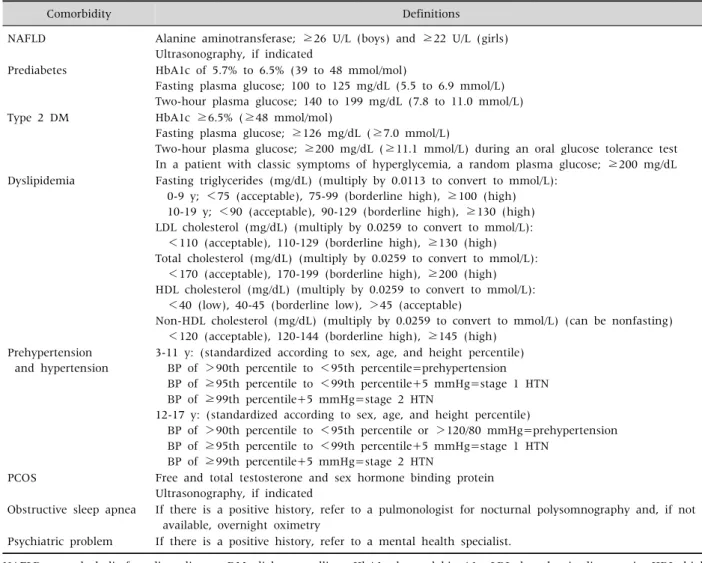
In obese children and adolescents, the assessment for comorbidities is recommended (Fig. 1). Table 2 lists the suggested obesity-related comorbidities and their corresponding screening tests [17-22].
Table 2.Lists of Obesity-Related Comorbidity and Corresponding Screening Tests
Comorbidity Definitions
NAFLD Alanine aminotransferase; ≥26 U/L (boys) and ≥22 U/L (girls) Ultrasonography, if indicated
Prediabetes HbA1c of 5.7% to 6.5% (39 to 48 mmol/mol)
Fasting plasma glucose; 100 to 125 mg/dL (5.5 to 6.9 mmol/L) Two-hour plasma glucose; 140 to 199 mg/dL (7.8 to 11.0 mmol/L) Type 2 DM HbA1c ≥6.5% (≥48 mmol/mol)
Fasting plasma glucose; ≥126 mg/dL (≥7.0 mmol/L)
Two-hour plasma glucose; ≥200 mg/dL (≥11.1 mmol/L) during an oral glucose tolerance test In a patient with classic symptoms of hyperglycemia, a random plasma glucose; ≥200 mg/dL Dyslipidemia Fasting triglycerides (mg/dL) (multiply by 0.0113 to convert to mmol/L):
0-9 y; <75 (acceptable), 75-99 (borderline high), ≥100 (high) 10-19 y; <90 (acceptable), 90-129 (borderline high), ≥130 (high) LDL cholesterol (mg/dL) (multiply by 0.0259 to convert to mmol/L): <110 (acceptable), 110-129 (borderline high), ≥130 (high) Total cholesterol (mg/dL) (multiply by 0.0259 to convert to mmol/L): <170 (acceptable), 170-199 (borderline high), ≥200 (high) HDL cholesterol (mg/dL) (multiply by 0.0259 to convert to mmol/L): <40 (low), 40-45 (borderline low), >45 (acceptable)
Non-HDL cholesterol (mg/dL) (multiply by 0.0259 to convert to mmol/L) (can be nonfasting) <120 (acceptable), 120-144 (borderline high), ≥145 (high)
Prehypertension and hypertension
3-11 y: (standardized according to sex, age, and height percentile) BP of >90th percentile to <95th percentile=prehypertension BP of ≥95th percentile to <99th percentile+5 mmHg=stage 1 HTN BP of ≥99th percentile+5 mmHg=stage 2 HTN
12-17 y: (standardized according to sex, age, and height percentile)
BP of >90th percentile to <95th percentile or >120/80 mmHg=prehypertension BP of ≥95th percentile to <99th percentile+5 mmHg=stage 1 HTN
BP of ≥99th percentile+5 mmHg=stage 2 HTN
PCOS Free and total testosterone and sex hormone binding protein Ultrasonography, if indicated
Obstructive sleep apnea If there is a positive history, refer to a pulmonologist for nocturnal polysomnography and, if not available, overnight oximetry
Psychiatric problem If there is a positive history, refer to a mental health specialist.
NAFLD: non-alcoholic fatty liver disease, DM: diabetes mellitus, HbA1c: hemoglobin A1c, LDL: low density lipoprotein, HDL: high density lipoprotein, BP: blood pressure, HTN: hypertension, PCOS: polycystic ovary syndrome.
2. Principles of the treatment of pediatric obesity
2-1. We recommend a treatment algorithm to help physicians determine the appropriate weight man-agement stage for each patient, on the basis of his or her age, BMI percentile, and comorbidities. (Strength of evidence, I; grade of recommendation, A)
2-2. We recommend a family-based, compre-hensive, multidisciplinary team approach to suc-ceed in behavioral interventions (active vigorous physical activity and reduction of inactivity, accom-panied with calorie-controlled diet) for the
treat-ment of obesity in children. (Strength of evidence, I; grade of recommendation, A)
2-3. We recommend that pharmacotherapy and bariatric surgery be considered only in patients with morbid obesity with major comorbidities after a formal program of intensive lifestyle modification has failed. (Strength of evidence, V; grade of recom-mendation, A, based on committee voting)
2-1. Treatment algorithm to help physicians de-termine the appropriate weight management stage for each patient, on the basis of his or her age, BMI percentile, and comorbidities (Strength of evidence, I; grade of recommendation, A)
Behavioral interventions for lifestyle modification represent the key principle recommended for the treatment of overweight and obesity in children and adolescents. The following are the staged treatment strategies for pediatric obesity according to age and BMI percentile [23]:
1) Children aged 2 to 5 years
(1) BMI 85th-94th percentile (overweight) The weight goal is weight maintenance until reaching a BMI below the 85th percentile or slowing of weight gain, as indicated by the downward deflection in the BMI curve. (2) BMI 95th-98th percentile (obesity)
The weight goal is weight maintenance until reaching a BMI below the 85th percentile; however, if weight loss occurs with healthy, adequate-energy diet, it should not exceed 0.5 kg/month. If greater weight loss is noted, monitor the patient for causes of excessive weight loss.
(3) BMI ≥99th percentile (severe obesity) The weight goal is gradual weight loss not ex-ceeding 0.5 kg/month. If greater weight loss occurs, monitor the patient for causes of ex-cessive weight loss.
2) Children aged 6-11 years
(1) BMI 85th-94th percentile (overweight) The weight goal is weight maintenance until reaching a BMI not exceeding the 85th per-centile or slowing of weight gain, as indicated by the downward deflection in the BMI curve. (2) BMI 95th-98th percentile (obesity)
The weight goal is weight maintenance until reaching a BMI of below the 85th percentile or gradual weight loss of approximately 0.5 kg/month. If greater loss is noted, monitor the patient for causes of excessive weight loss. (3) BMI ≥99th percentile (severe obesity)
The weight goal is weight loss not exceeding
the average of 0.9 kg/week. If greater weight loss is noted, monitor the patient for causes of excessive weight loss.
3) Adolescents aged 12-18 years
(1) BMI 85th-94th percentile (overweight) The weight goal is weight maintenance until reaching a BMI not exceeding the 85th per-centile or slowing of weight gain, as indicated by the downward deflection in the BMI curve. (2) BMI 95th-98th percentile (obesity)
The weight goal is weight loss until reaching a BMI below the 85th percentile, with no more than an average of 0.9 kg/week. If greater weight loss is noted, monitor the patient for causes of excessive weight loss.
(3) BMI ≥99th percentile (severe obesity) The weight goal is weight loss not exceeding the average of 0.9 kg/week. If greater weight loss is noted, monitor the patient for causes of excessive weight loss. Patients may warrant tertiary care evaluation to determine the next level of treatment.
2-2. We recommend a family-based, compre-hensive, multidisciplinary team approach to succeed in behavioral interventions (active vigorous physical activity and reduction of inactivity, accompanied with calorie-controlled diet) for the treatment of obesity in children. (Strength of evidence, I; grade of recommendation, A)
The interactions between parents and children and parenting styles strongly affect the unhealthy lifestyle habits of children [24]. Obese children are more likely to be bullied and have fewer friends or are less popular among classmates compared with thinner peers [25]. Parents, teachers, and friends have indicated that youths who are obese are easily isolated and have poorer social relationships com-pared with their counterparts [26]. Those with low self-esteem and higher BMIs are more likely to smoke and drink alcohol [27]. These children are al-so less athletic and are not expected to have romantic relationships. Thus, they tend to demonstrate teas-ing, worsening of self-esteem, feeling of loneliness,
depression, anxiety, and an introverted personality [28].
Data from 133 RCTs enrolling 30,445 patients through 16 systemic reviews presented an evidence profile for each intervention, including medication, surgery, and lifestyle or community-based interven-tions, in overweight or obese children or adolescents. Physical activity interventions decrease systolic blood pressure (BP) and fasting glucose (low to mod-erate quality of evidence). Dietary interventions with low-carbohydrate diets have shown an effect in terms of BMI reduction (moderate quality of evi-dence). Educational interventions reduce waist cir-cumference, BMI, and diastolic BP (low quality of evidence). Pharmacological interventions reduce BMI (metformin, sibutramine, and orlistat) and waist circumference (sibutramine and orlistat) as well as increase high-density lipoprotein cholesterol (sibutramine) but also raise systolic and diastolic BP (sibutramine). Surgical interventions (laparoscopic adjustable gastric banding, Roux-en-Y gastric by-pass, and sleeve gastrectomy) have shown the larg-est BMI reduction (moderate quality of evidence). Combined interventions consisting of dietary mod-ification, physical activity, behavioral therapy, and education significantly reduce systolic and diastolic BP, BMI, and triglycerides. Combined parent–child and parent-only interventions have similar effects on BMI (low quality of evidence) [29].
A school-based intervention reportedly reduces BP and body fat in young teenagers. Short-term car-diovascular health in children-targeted interventions showed successful results in demonstrating affected physiological variables according to increased time spent in moderate to vigorous physical activity at school (20 minutes per day in elementary schools, 30 minutes in middle schools) [30]. Both school-de-signed workout and adult supervision in physical ac-tivities affected the amount of physical activity of sixth to eighth graders participating in their free time [31].
A systemic analysis of 24 reports reviewing 15 studies showed strong evidence that reduced screen time and enhanced physical activity could prevent
obesity. Data from 11,000 preschool children 4 to 6 years of age linked increased caloric intake from snacks and sugar-sweetened beverages with in-creased screen time [32]. Another study revealed that decreasing screen time also decreases sedentary time [33]. A two-generation study associated in-creased BMI with two hours of screen time per day for both parents and offspring [34].
In a prospective cohort study in England of a fam-ily-based behavioral treatment in 33 families with severely obese children aged 8 to 13 years, the fami-lies were advised to practice self-monitoring, keep-ing daily food and activity records, goal settkeep-ing, pos-itive reinforcement, and stimulus control to modify the child’s eating and exercise behaviors. Foods were categorized into “traffic light” food colors of red, yel-low, and green foods; physical activity aspects were also advised. Severely obese children were reported to have lost 8.4% of BMI over three months, main-tained at the three-month follow-up. Self-esteem and depression also improved significantly [35].
A study concerning the relationship between pa-renting style and development of obesity in children showed that authoritarian parenting is highly asso-ciated with the risk of being overweight among young children [24].
Interviews performed in children with obesity and parents with obese children revealed that a lifestyle behavior improvement program benefits from pa-rental support and needs help from family, peers, and friends [36]. The studied children with obesity benefited from the persistent involvement of sup-portive persons in the maintenance of lifestyle be-havior changes. The respondents expected to achieve weight reduction by physical activity or eating healthy meals. The parents reported struggling with adopting new rules and insufficient support from family members. Children reported suffering from inconsistent parenting and low support from their parents. Their experience of bullying at school was an obstacle to their ability to achieve the necessary changes. Support from peers stimulated their progress. Parents identified that the general practitioner is re-quired to discuss overweight in a non-offensive
manner and to present interest in the process of weight reduction. The general practitioner should play a more supportive role [36].
The Oklahoma Chapter of the American Academy of Pediatrics Obesity Committee developed a re-source toolkit for pediatric primary care providers to be used in behavioral counseling of obese children. Eight topics were selected for the handouts: sug-ars-sweetened beverages, daily screen time, sleep, proper breakfast, family mealtime, physical activity, balanced meals, and food quality. The resource tool-kit sets four steps, utilizing motivational interview-ing techniques, to assist with facilitatinterview-ing behavior change: 1) obtaining patient history, 2) discussing health habits and the family’s reasons for changing habits, 3) setting a realistic goal for change, and 4) realizing goals. This handout also provides a patient questionnaire on health habits to assist with the identification of behaviors to be changed, eight pro-vider and parent handouts on healthy behaviors, and a motivational interviewing guide [37].
Behavioral interventions target lifestyle change (e.g., counseling on diet, increasing physical activity or decreasing sedentary behavior, and addressing behavior change) to limit weight gain or decrease weight [38]. Effective behavioral interventions clude parental support and the delivery of basic in-structive information on healthy nutrition and phys-ical activity. Additional components of the most ef-fective interventions include the following: 1) being conducted in a specialty setting; 2) targeting both children and their parents; 3) helping parents and children engage in stimulus control (e.g., limiting access to tempting foods and limiting screen time); and 4) assisting participants in identifying goals, self-monitoring, and problem solving to accomplish their selected goals. Other common components in-clude contingent use of rewards or reinforcement, motivational interviewing, teaching of coping skills, addressing body image, and the option of individual– family counseling to address family-specific issues. All of the effective studies have emphasized eating healthy foods and using moderate portions.
The distinguishing characteristics of
compre-hensive multidisciplinary interventions are in-creased intensity of behavioral change strategies, greater frequency of patient–provider contact, and involvement of specialists in the treatment. Formalized behavioral therapy and a multidisciplinary treat-ment team exceed the capacity of the services most primary care providers can supply.
Systematic evaluation of body measurements, di-etary intake, and physical activity should be con-ducted at baseline and at specific intervals through-out a program. For the implementation of a hensive multidisciplinary intervention, the compre-hensive treatment should be provided by a multi-disciplinary obesity care team, including a behav-ioral counselor (for example, social worker, psychol-ogist, other mental health care provider, or trained nurse practitioner), registered dietitian, and exercise specialist (physical activity specialist or another team member with training or a community pro-gram prepared to assist children with obesity).
2-3. We recommend that pharmacotherapy and bariatric surgery be considered only in patients with morbid obesity with major comorbidities after a for-mal program of intensive lifestyle modification has failed. (Strength of evidence, V; grade of recom-mendation, A, based on committee voting)
Pharmacotherapy should only be performed in ac-cordance with lifestyle modification [39]. The pre-scription of weight-reducing medicines used off-label to adolescents under 16 years of age should be dis-couraged for the following reasons: 1) the lack of Food and Drug Administration (FDA) approval, 2) in-sufficient number of safety and efficacy studies per-formed in children and adolescents with obesity, 3) limited efficacy for most agents, and 4) the problem of drug-induced adverse reaction related with potential obesity-related morbidity and mortality. For obese youth who are unable to achieve sufficient weight loss with lifestyle interventions alone, adjunctive use of more intensive treatments, including pharmacother-apy, may be appropriate. However, the search for obe-sity medications that are proved to be safe for long-term use, efficacious to promote sufficient weight
reduction, and have a good risk–benefit ratio remains fruitless. Nevertheless, there is great hope in the suc-cessful development of more effective, etiology-based anti-obesity therapies for children and adults.
FDA-approved pharmacotherapy for obesity should be administered only with a concomitant life-style modification program of the highest intensity available, and only by clinicians who are experienced in the use of anti-obesity agents and aware of their risk for adverse reactions [40]. Medication should be discontinued, and the patient evaluated, if the re-duction in BMI or BMI z score is less than 4% after an-ti-obesity medication for 12 weeks at full dosage [11]. In adolescents with extreme obesity, clinicians may consider bariatric procedures if the patient shows poor response to medical treatment for weight loss. Indications for bariatric surgery include BMI of >35 kg/m2, accompanying comorbidities of obesity such as type 2 DM, moderate-to-extreme sleep apnea, pseudotumor cerebri, debilitating or-thopedic problems, and non-alcoholic steatohepati-tis with advanced fibrosis. Another candidate profile for bariatric surgery is a BMI of >40 kg/m2 with mild comorbidities (hypertension, dyslipidemia, moder-ate orthopedic problems, mild sleep apnea, non-al-coholic steatohepatitis, and extreme psychological distress that is secondary to the obesity) [41,42]. 3. Behavioral intervention for children and
adolescents with obesity: Diet
3-1. We recommend the decrease in intake of sug-ar-sweetened beverages. (Strength of evidence, I; grade of recommendation, A)
3-2. We recommend the reduction in total energy intake. (Strength of evidence, I; grade of recom-mendation, A)
3-3. We suggest the use of small-sized plates or bowls. (Strength of evidence, III; grade of recom-mendation, C)
3-4. We suggest the decrease in consumption of fast food. (Strength of evidence, III; grade of recom-mendation, C)
3-1. We recommend the decrease in intake of sugar-sweetened beverages. (Strength of evidence, I; grade of recommendation, A)
The Korean National Health and Nutrition Examination Survey performed between 2008 and 2011 revealed that the mean amount of daily sug-ar-sweetened beverage consumption was 98.7 mL/day in school children, which tended to increase with age [43]. This Korean study revealed that over-weight and obesity are significantly associated with high sugar-sweetened beverage intake among boys aged 7 to 12 years (odds ratio, 1.72) [43]. A random-ized trial performed in adolescents aged 13 to 18 years demonstrated that BMI changes are sig-nificant between a sugar-sweetened beverage re-stricted group and a control group among subjects in the upper-baseline BMI percentile [44]. A more re-cent randomized trial that investigated the effects of an intervention designed to decrease consumption of sugar-sweetened beverages on weight gain showed significant differences in the BMI changes between the intervention group and control group at both one and two years among Hispanic adolescents [45]. Similar to the results from studies in older chil-dren, sugar-sweetened beverage consumption has been positively associated with BMI z scores in chil-dren at four and five years in a large-scale, longi-tudinal cohort study [46]. A recent systematic review revealed a significant positive association between sugar-sweetened beverage consumption and total adiposity among children under 12 years old [47]. A cross-sectional analysis of children’s dietary data re-ported that sugar-sweetened beverage intake is in-dependently associated with alterations in lipid pro-files, increased markers of inflammation, and in-creased waist circumference [48].
3-2. We recommend the reduction in total energy intake. (Strength of evidence, I; grade of recom-mendation, A)
Current evidence suggests that weight status can be improved in overweight or obese children and adolescents by a reduced-energy diet. However, the association between weight improvement and
mac-ronutrient distribution of a reduced-energy diet is controversial in children and adolescents [49].
In an adult systemic review, the overweight and obese population who consumed low glycemic index food lost more weight and showed better improve-ment in lipid profiles [50]. A pediatric systematic re-view comparing low glycemic index/low glycemic load with high glycemic index/high glycemic load di-ets did not reveal the effect of weight loss; however, it reported decreases in serum triglyceride and Homeostasis Model Assessment (HOMA) index [51].
Meanwhile, studies on the association between eating quickly and overweight/obesity have showed conflicting results. Several cohort studies conducted in Japan have demonstrated that eating quickly is significantly associated with overweight in girls [52,53]. A population-based study conducted in Portugal reported no significant association between eating quickly and overweight/obesity [54].
There is weak evidence regarding the association between breakfast intake and obesity [55-58]. Likewise, current evidence does not show that the consumption of fruits and vegetable is associated with overweight and obesity in children and adoles-cents [59,60]. In an adult study, energy density in-dependently affects energy intake; however, data are lacking for children and adolescents [61].
3-3. We suggest the use of small-sized plates or bowls. (Strength of evidence, III; grade of recom-mendation, C)
Systematic reviews in adults have consistently shown that energy intake increases with larger por-tion sizes [61]. A recent systematic review showed that children also consistently consume more food and drink when offered larger-sized portions, pack-ages, or tableware than when offered smaller-sized versions [62]. Total calorie consumption reportedly decreases in those receiving small portion sizes among children under six years of age [63,64]. A re-cent observational study revealed that reduced por-tion sizes are associated with BMI reducpor-tion after one and two years among children and adolescents [65].
3-4. We suggest the decrease in consumption of fast food. (Strength of evidence, III; grade of recom-mendation, C)
The intake of fast food has an effect on overweight and obesity in school children and adolescents. Composition data from leading fast food company websites show that fast foods have very high energy density [66,67]. A Korean nationwide observational study performed in 2001 reported contrasting results regarding the association between fast food intake and overweight and obesity [68]. However, a recent large-scale observational study performed in Jeju Island revealed that obese children had significantly higher rates of fast food consumption [69].
4. Behavioral intervention for children and adolescents with obesity: Exercise
4-1. We recommend physical activity, which is ben-eficial to all children and adolescents. (Strength of evidence, I; grade of recommendation, A)
4-2. We recommend moderate to vigorous levels of physical activity, including regular and steady ex-ercise, which is helpful in promoting a decrease in weight. The recommended duration of moderate tovigorous exercise is at least 20 minutes, with a goal of 60 minutes, five days per week. (Strength of evidence, I; grade of recommendation, A)
4-3. We recommend programmed exercises, which are helpful in reducing body fat in children and adolescents. (Strength of evidence, I; grade of rec-ommendation, A)
4-1. Physical activity is beneficial to all children and adolescents. (Strength of evidence, I; grade of recommendation, A)
Physical activity is especially effective in enhanc-ing cardiovascular fitness, decreasenhanc-ing body fat, and lowering risk factors for diabetes [70-73]. Apart from the benefits for maintaining weight and reducing health risks related to childhood obesity, physical
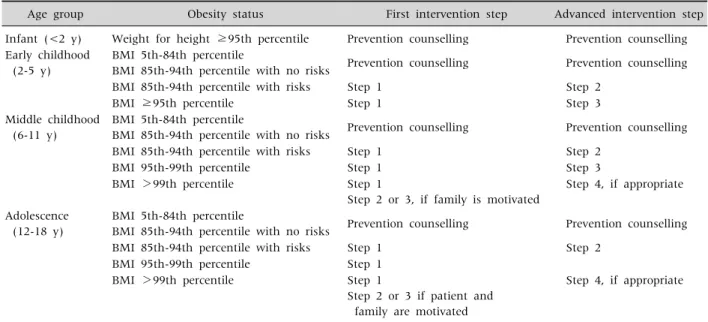
ac-Table 3.Stepwise Exercise Strategies according to Age and Obesity Status
Age group Obesity status First intervention step Advanced intervention step Infant (<2 y) Weight for height ≥95th percentile Prevention counselling Prevention counselling Early childhood
(2-5 y)
BMI 5th-84th percentile
BMI 85th-94th percentile with no risks Prevention counselling Prevention counselling BMI 85th-94th percentile with risks Step 1 Step 2
BMI ≥95th percentile Step 1 Step 3
Middle childhood (6-11 y)
BMI 5th-84th percentile
BMI 85th-94th percentile with no risks Prevention counselling Prevention counselling BMI 85th-94th percentile with risks Step 1 Step 2
BMI 95th-99th percentile Step 1 Step 3
BMI >99th percentile Step 1
Step 2 or 3, if family is motivated
Step 4, if appropriate
Adolescence (12-18 y)
BMI 5th-84th percentile
BMI 85th-94th percentile with no risks Prevention counselling Prevention counselling BMI 85th-94th percentile with risks Step 1 Step 2
BMI 95th-99th percentile Step 1 BMI >99th percentile Step 1
Step 2 or 3 if patient and family are motivated
Step 4, if appropriate
Step 1: Prevention plus management; Be physically active ≥1 hour each day. Young children: unstructured play in young children. Older children: should find physical activities that they enjoy.
Step 2: Structured weight management; Planned, supervised, physical activity or active play for 60 minutes per day.
Step 3: Comprehensive multidisciplinary management; Physical activity goal setting, and contingency management. Negative energy balance resulting from structured physical activity changes is planned. Multidisciplinary team with experience in childhood obesity including exercise specialist.
Step 4: Tertiary care management. BMI: body mass index.
tivity may prove to enhance aspects of children’s brain activation, including cognitive development [74,75]. Therefore, the WHO, American Alliance for Health, Physical Education, Recreation and Dance, British Association of Sport and Exercise Medicine, and Canadian Academy of Sport and Exercise Medicine recommend for children to participate in physical activities as early as possible. Guidelines that recommend suitable physical activities for each age group have also been formulated in developed countries.
1) Children and youth aged 5 to17 years should ac-cumulate at least 60 minutes of moderate- to vigo-rous-intensity physical activity daily.
2) Physical activity greater than 60 minutes in du-ration provide more health benefits.
3) Most of the daily physical activity should be aerobic. Vigorous-intensity activities should be in-corporated, including those that strengthen muscle
and bone, and performed at least three times per week.
4-2. Moderate to vigorous levels of physical activ-ity, including regular and steady exercise, are help-ful in promoting a decrease in weight. (Strength of evidence, I; grade of recommendation, A)
Regular exercises improve weight and BMI, as well as blood sugar and triglyceride levels [70, 76-78]. The degree of weight loss is maximized when exercise is combined with decreased calorie intake, which is also helpful in sustaining improved weight after weight loss. The degree of weight loss is mini-mal in the absence of calorie intake restriction.
Moderate exercise refers to exercise that causes mild increases in breathing and heart rate [71,74]. In other words, conversation is doable during moderate exercise, whereas singing is difficult to perform simultaneously. Brisk walking, cycling, and practice
in such sports as soccer, basketball, and badminton, are examples of moderate exercise. Meanwhile, con-versation is difficult and singing impossible during vigorous exercise, owing to significant increases in breathing and heart rate. Running fast, jump rope workout, inline skating, and playing a game of soc-cer, basketball, or badminton are examples of vigo-rous exercise. At least 20 minutes of moderate ex-ercise is recommended, with a goal of 60 minutes, five days per week, whereas vigorous exercise is ef-fective when done three times per week [75,79,80]. 4-3. Programmed exercises are helpful in reducing body fat in children and adolescents. (Strength of evidence, I; grade of recommendation, A)
The effect of exercise programs is maximized with the involvement of a specialist to instruct the activity or when friends or family members participate in to-gether [81-83]. The type, frequency, intensity, and duration of exercises should be included in the pre-scription of the program. Moreover, prepre-scriptions for resistance training programs should be in-dividualized to stimulate all of the major muscle groups and use all of the muscle groups [72].
In addition, exercise intensity should be adjusted stepwise according to age and BMI, rather than en-gaging in high-level exercise from the beginning [14]. Especially in patients with high-level obesity, weight-bearing exercise, such as excessive jump rope, should be avoided because repeated impact may be applied to parts such as knees, ankles, and hip joints (Table 3). However, according to a recent meta-analysis that investigated the impact of phys-ical education on obesity prevention in children, adolescents, and adults, although physical educa-tion has positive effects on obesity-related body in-dices and health status, its effect is statistically insignificant. Moreover, there is lack of evidence based on data [72].
5. Behavioral intervention for children and adolescents with obesity: Lifestyle
5-1. We recommend increasing physical activity and limiting sedentary time (non-academic screen time, digital activities) to one to two hours per day for weight reduction. (Strength of evidence, I; grade of recommendation, A)
5-2. We recommend maintaining adequate sleep duration for the prevention of obesity in children and adolescents. (Strength of evidence, I; grade of recommendation, A)
5-3. We recommend a family-centered approach, including parents, to prevent and treat children’s obesity effectively; parental obesogenic lifestyle habits are related to children’s obesity. (Strength of evidence, I; grade of recommendation, A)
5-4. We recommend the development of specific public health interventions as essential to over-weight and obesity control in children with lower socioeconomic status (SES). (Strength of evidence, I; grade of recommendation, A)
5-5. We recommend that obesity interventions be conducted in multiple key childhood environ-ments, including family, school, and community. (Strength of evidence, I; grade of recommendation, A)
5-1. We recommend increasing physical activity and limiting sedentary time (non-academic screen time, digital activities) to one to two hours per day for weight reduction. (Strength of evidence, I; grade of recommendation, A)
Obese children tend to commute to school by school bus rather than walk to school [84-86]. The sedentariness of obese children is higher than that in normally weighted children; the former have been shown to like to lie down when staying indoors and use the elevators more than stairs [84,87,88]. Obese children spend a high proportion of their day watch-ing television or uswatch-ing the personal computer com-pared with normally weighted children [84,89-91]. Increased television-viewing time decreases physical activity, and can increase the consumption of
high-calorie diet through being exposed to television commercials of high-calorie foods, such as fast food, snack, and soft drinks [84,92-96]. The effort to walk as much as possible and exercise regularly is sig-nificantly related to losing body weight [86].
5-2. We recommend maintaining adequate sleep duration for the prevention of obesity in children and adolescents. (Strength of evidence, I; grade of recommendation, A)
A school-based, cross-sectional study of 3,785 Korean adolescents in middle and high school be-tween the ages of 11 and 18 years showed the sig-nificant association of longer sleep duration on both week day and weekends with decreased BMI for both sexes [97]. A study using data of 489 adoles-cents aged 12 to 18 years from the Korean National Health and Nutrition Examination Survey from 2013 to 2014 showed that the risk of obesity decreases with increased sleep duration [98]. Researches in Canada, Japan, and China showed an inverse corre-lation between sleep duration and obesity in chil-dren [98-101].
Sleep restriction results in significant increases in caloric intake [102,103]. Short sleep is associated with decreased moderate to vigorous physical activ-ity and increased sedentary time [102,104]. A sig-nificant negative association has been observed be-tween sleep duration and screen time [102,105]. Short sleep is also associated with insulin resistance [102].
5-3. We recommend a family-centered approach, including parents, to prevent and treat children’s obesity effectively; parental obesogenic lifestyle habits are related to children’s obesity. (Strength of evidence, I; grade of recommendation, A)
According to a meta-analysis conducted with studies published between 2000 and 2009, the ma-jority of studies (70%) have shown statistically sig-nificant moderate to large effect size changes in child BMI after participation in a family-based inter-vention for weight loss. Of these, 50% reported stat-istically significant weight loss changes at six-
month, one-year, and two-year follow-up, albeit with small to moderate effect sizes [106].
In a study of Korean first-grade elementary school students and their parents, parental lifestyle habits were shown to induce children’s obesity [107]. Children of obese parents are more likely to be diag-nosed as overweight compared with children of nor-mal-weight parents. Among the paternal lifestyle habits, hours of watching television or computer us-age, and consumption frequency of soda, ice cream, cake, and chips are related to the children being overweight. Among the maternal lifestyle habits, hours of watching television or computer usage, fre-quency of eating breakfast, and frefre-quency of over-eating are related to the children being overweight. Parents’ lifestyle habits can affect children’s weight via an effect on the children’s lifestyle habits. The de-gree of obesity between parents and children tends to be similar because parents and children share not only genes but also the same family environment. Family environment plays an important role in forming children’s lifestyle, including eating habits and physical activity through parents’ lifestyles. As the mother tends to take the main role in rearing children, maternal obesogenic lifestyles have greater influence on children’s obesity.
5-4. We recommend the development of specific public health interventions as essential for over-weight and obesity control in children with lower SES. (Strength of evidence, I; grade of recom-mendation, A)
According to a study based on data of the Korea National Health and Nutrition Examination Survey 2007-2010 conducted by the Korea Centers for Disease Control and Prevention, SES does not affect the observed relationships of overweight or obesity in children aged 2 to 18 years [108]. However, recent published systematic reviews and meta-analyses have showed that children with lower SES have higher risks of being diagnosed with overweight and obesity [109,110]. Another systematic review and meta-analysis of studies published between 1990 and 2014 showed that low SES is associated with a
10% higher risk of overweight and a 41% higher risk of obesity in children aged 0 to 15 years [109]. In a subgroup analysis, this relationship was prominent in high-income countries and in more economic de-veloped areas, including North America, Europe, and Oceania [109]. Another systematic review to de-scribe the relationship between SES and child-hood/adolescent weight status in papers published in rich countries from 1990 through 2013 showed a predominantly inverse relationship [110].
Adolescents from areas with low SES more often skipped breakfast and more often ate snacks com-pared with adolescents from high SES areas [111,112]. SES has been positively associated with food frequency intake scores in both sexes. Adolescents with low SES tended to show an irregu-lar meal pattern [31,33]. High household SES is also associated with increased intakes of vegetables, fruits, and dietary fiber, and with decreased intakes of fat [111,113,114].
A study on the association among parental socio-economic level, overweight, and eating habits with diet quality in Korean sixth-grade school children showed that a lower SES (in terms of parental in-come or parental education level) relates to the con-sumption of significantly fewer fruits [111]. In the same study, the children in the lower socioeconomic group had a lower food habit score (high frequency of breakfast skipping and ramen noodle con-sumption), diet quality, and intake of nutrients com-pared with those in the higher socioeconomic group. Lower maternal education status is also associated with a higher risk for being overweight in girls. Specific public health interventions should support parents and children with lower SES to develop health-related behaviors that may prevent child-hood obesity.
5-5. We recommend that obesity interventions be conducted in multiple key childhood environments, including the family, school, and community. (Strength of evidence, I; grade of recommendation, A)
Most strategies for preventing or reducing child-hood obesity have focused on individual behavior
modification with limited success [115,116]. The en-vironment of children with obesity, including fam-ily, schools, after-school programs, and community, as well as the policy level, can be changed to promote healthier lifestyles through multi-level obesity inter-ventions [115,117]. The family represents the closest environment of children; thus, the family is im-portant to forming the healthy lifestyle of children [115,107]. School is the place where students spend most of their time beginning with the time they reach schooling age [115,118]. Children can main-tain and manage a healthy lifestyle through teacher– pupil interaction and peer interaction [115,118]. In the treatment or prevention of childhood obesity, a variety of support systems through parents, peers, and teacher relationships can induce changes in the overall environment surrounding children, thereby raising the effectiveness of any obesity intervention [115]. Multidisciplinary interventions can make obese children continue a healthy lifestyle [115]. Obesity in children and adolescents is linked to adult obesity and various diseases, leading to an increase in public medical expenses. Therefore, national poli-cy is needed in leading efforts to preventing obesity fundamentally and to establishing education and policy for health promotion.
6. Behavioral intervention for children and adolescents with obesity: Mental health 6-1. We recommend that obese children be moni-tored for psychological problems and screened for the need for psychiatric treatment. (Strength of evidence, I; grade of recommendation, A).
6-2. We recommend that physicians emphasize family functioning and let the family participate in the treatment of the obese child. (Strength of evi-dence, I; grade of recommendation, A).
6-3. We recommend cognitive behavioral therapy, which may be beneficial to treating child obesity. (Strength of evidence, III; grade of recom-mendation, C)
6-1. We recommend that obese children be moni-tored for psychological problems and screened for the need for psychiatric treatment. (Strength of evi-dence, I; grade of recommendation, A)
Obese children may be suffering from low self-es-teem, body shape dissatisfaction, depression, eating disorder, obesity stigma, teasing, or bullying by peers [119-125]. They also live with significantly lower health-related quality of life compared with normal weighing children, or several pediatric chronic dis-eases [126]. Obese children complain of a low quality of life associated with physical and psychosocial health, and emotional, social, and school function-ing [126,127].
Extremely obese adolescents have higher rates of mood, anxiety, somatoform, and eating disorders com-pared with a population-based control group [128]. The screening tools for psychological problems include the Korean-Child Behavior Checklist, Children’s Depression Inventory, Korean version of the Eating Attitude Test-26, somatotype drawings, and Pediatric Quality of Life Inventory [121-123,126,127].
6-2. We recommend that physicians emphasize family functioning and let the family participate in the treatment of the obese child. (Strength of evi-dence, I; grade of recommendation, A)
Poor family functioning is associated with in-creased risk of obesity and overweight [129,130]. The elements of poor family functioning related to obesity are poor communication, poor behavior con-trol, high levels of family conflict, and low family hi-erarchy values [130]. Although standardized family functioning measures are necessary, half of the iden-tified intervention studies reported a significant re-lationship between family functioning and changes in child weight [130]. Contrary to these reports, sev-eral studies have reported that family functioning is not associated with child obesity; rather, an over-weight mother is largely linked to child obesity [131,132]. Given the high correlation of parental or mother’s obesity with child obesity, parental behav-ior changes in the family should be considered [132,133]. Family-based treatment is crucial to
con-trol nip successfully child obesity.
6-3. We suggest cognitive behavioral therapy, which might be beneficial to treating child obesity. (Strength of evidence, III; grade of recommendation, C)
Cognitive behavioral therapy (CBT) is effective in treating childhood obesity [134-136]. The treatment goal is weight control by healthy changes in lifestyle rather than weight reduction. The key element of this therapy is self-regulation, with techniques in-cluding learning self-instructions (e.g., “stop and think”), self-observation, self-evaluation, and self- reward [136]. To train self-regulation skills, model-ing (showmodel-ing the copmodel-ing skills to the child), behavior rehearsal, and homework have been used [136]. Coping skills are taught for different stressful sit-uations (e.g., feeling alone) and relapse moments (e.g., feeling hungry) [134,135]. The progression of CBT is concentrated on one new small change in food and exercise behavior (e.g., drinking water instead of soft drinks, walking instead of taking the car) [135,136]. Self-monitoring—recording one’s behav-ior—is perhaps the most important component of be-havioral treatment. Patients keep detailed records of their food intake, physical activity, and body weight, which they review with their interventionist to iden-tify areas of success and for improvement [137].
Parents participate in CBT as helpers. For the stim-ulus control of the obese child, parents are taught the importance of ending restrictions on the places and times for eating. Motivation of the obese child is en-hanced by allowing his or her own choices in plan-ning the program and using a child-friendly ap-proach with respect to developmental demands; for example, providing activities involving cooking, moving, and playing [134,135]. Braet and Van Winckel [135] reported that in the long-term fol-low-up over 4.6 years, 71.6% subjects treated with CBT showed no further increase in percentage overweight.
Negative body image is a major concern of over-weight persons. CBT includes the information to change negative stereotypes of obesity, modification
of intrusive thoughts of body dissatisfaction and overvalued beliefs regarding physical appearance, exposure to avoided body image situations, and elimination of body checking. CBT has significantly improved the body image, psychological symptoms, self-esteem, overeating, and guilt eating in obese subjects [138].
7. Pharmacotherapy of children and adolescents with obesity
7-1. We recommend that pharmacologic treatment is not used as a primary treatment nor sole therapy mode in pediatric obesity. (Strength of evidence, I; grade of recommendation, A)
7-2. We recommend that the response and adverse reaction to pharmacologic treatment be monitored closely. The decision to continue or discontinue should be made by accounting for the monitoring result. (Strength of evidence, V; grade of recom-mendation, A, based on committee voting)
7-1. We recommend that pharmacologic treat-ment not be used as a primary treattreat-ment nor lone therapy method in pediatric obesity. (Strength of evidence, I; grade of recommendation, A)
Only a few studies have been conducted in phar-macologic treatment for childhood obesity. In a pre-pubertal age group (younger than 12 years old), the effectiveness and safety of pharmacologic treat-ment of obesity are low because of issues of appro-priate dosage, safety, adverse event, and ethical as-pects [139,140]. Research data on adolescents over the age of 12 years are not sufficiently accumulated as well. However, some weight loss effects could be expected [139-141]. Therefore, in case of primary treatment failure, an approved drug could be consid-ered added, along with behavioral intervention.
Orlistat, metformin, glucagon-like peptide 1 (GLP-1) agonists, and topiramate are available in adult obesity, and there have been a considerable number of efforts to use these agents in childhood obesity [142-146]. Orlistat is the only drug that the
FDA has approved for childhood obesity over the age of 12 years, but it is not recommended to use as a pri-mary nor single therapy [141,147]. Data on the sin-gle drug use of orlistat without behavioral therapy are not available. In case of concerns on side effects, only behavioral therapy is recommended, instead of adding drugs.
1) Orlistat
Orlistat, a fat absorption inhibitor, is the only agent that the Korea Food and Drug Administration had approved for long-term use (one year) for weight control in pediatric obesity [148]. It is the on-ly FDA-approved drug that can be prescribed three times a day for childhood obesity in children aged 12 to 16 years [142,147]. However, it is not recom-mended as a primary treatment for weight control in childhood obesity, especially between the ages of 2 and 11 years [140,149]. Orlistat inhibits lipid diges-tion by the suppression of pancreatic and gastric lipase. The decreased lipase activity in the gastro-intestinal tract hinders consumed fat to be absorbed as a form of fatty acids and monoglycerols. Fat thus remains in the stool in triglyceride form [150]. A pla-cebo controlled study of obese children aged 12 to 16 years showed a significant reduction in BMI com-pared with the controls, but also reported significant side effects. Another study among obese teenagers aged 14 to 18 years failed to show significant weight loss [151].
Orlistat should be taken with meals, which makes it difficult to prescribe to school-aged children. In some reports, orlistat interferes with the absorption of fat-soluble vitamins, such as vitamins E and D [141]. For many obesity-control drugs proven safe and effective for long-term use in adults, pediatric data are limited. Orlistat may cause adverse effects, such as steatorrhea, soiling, bloating, and increased number of bowel movement. Such adverse events have been reported in pediatric use. Younger pa-tients are recommended to take multivitamins be-cause orlistat can hinder the absorption of fat-solu-ble vitamins, such as vitamins A, K, and β-carotene. There have also been rare reports of hepatic and renal damage in adults, and of oxalate nephrolithiasis and
oxalate nephropathy with renal failure [152]. 2) Metformin
Metformin can be used safely in type 2 DM chil-dren over the age of 10 years and has been known to result in weight loss. It can be used at about 1,500 mg a day in children with type 2 DM between the ages of 12 to 14 years with BMI of 26 to 40 kg/m2 [153]. Although metformin can be used by type 2 DM chil-dren, it is not recommended as treatment for only obesity; indeed, it has not been FDA approved as an obesity treatment [154-156]. Metformin reduces hepatic glucose production, increases peripheral in-sulin sensitivity, and lowers appetite [157].
A study has shown BMI reduction after 6 to 12 months of use of metformin. A previous study re-ported that metformin has some effects in children with insulin resistance [158]. Although metformin could be used in the short term, along with behav-ioral therapy, it is not recommended as a single drug for obesity treatment because of the limited effect of weight control [11].
3) Liraglutide
Liraglutide is a GLP 1 analog that can be used for long-term treatment of adult obesity [11]. GLP-1 is the incretin hormone released by the ileal L-cells af-ter food consumption, inducing satiety by delaying gastric emptying and glucagon secretion. It also con-trols appetite and satiety in the hypothalamus [141,149]. In adult type 2 DM, GLP-1 is an effective primary therapy for controlling HbA1c and weight. For obesity in adolescents, a significant decrease in BMI has been observed after three months of use [11,142].
Liraglutide needs to be injected daily, which can be a limitation in pediatric application. Safety and phar-macokinetics have been tested in children with type 2 DM aged between 10 and 17 years: it has similar ef-fects as in adults. However, about half of the subjects experienced at least one side effect [159]. Among GLP-1’s side effects are nausea, vomiting, diarrhea, and low blood glucoses. However, rare but serious side effects have also been reported, such as kidney failure, suicidal impulse, pancreatitis, and gall-bladder disease [152]. Therefore, it is not
recom-mended to use liraglutide for childhood obesity treatment.
4) Topiramate
Topiramate is a gamma-aminobutyric acid re-ceptor antagonist that is known to be a treatment for epilepsy (for those aged 2 years and older) and mi-graine (for those aged 12 years and older). The weight loss effect of zonisamide (voltage-dependent sodium channels and T-type calcium blocker) was observed in the study of epilepsy, which might be re-lated with the serotonin effect [141,152,153]. Despite the weight control effect of topiramate and zonisamide, the findings of epilepsy studies cannot be directly generalized into simple treatment for childhood obesity [149].
No proven safety or efficacy data are available with combined therapy of phentermine-topiramate in diatric obesity [152]. The effect of zonisamide in pe-diatric obesity was reported in case reports of limited subjects [153]. Headache, nausea, vomiting, thirst, decreased appetite, abdominal pain, anxiety, speech disorders, attention and memory deficit, somno-lence, and diarrhea have been associated with top-iramate and zonisamide [143,144,146]. Serious side effects were reported in children using topiramate, such as glaucoma, stroke, metabolic acidosis, cogni-tive disorders, hyperammonianemia, encephalop-athy, and kidney stone [152]. Therefore, it is not rec-ommended to use topiramate for the treatment of childhood obesity.
7-2. We recommend that the response and ad-verse reaction of pharmacologic treatment be moni-tored closely. The decision to continue or dis-continue treatment should be made with consid-eration for the monitoring result. (Strength of evi-dence, V; grade of recommendation, A, based on commiitte voting)
Although cumulative data on the effectiveness of pharmacologic treatment of childhood obesity are insufficient, reports of adverse reactions related to those agents exist in many references, including adults’ studies [11,141,150,152,160]. Therefore, pharmacologic treatment of childhood obesity
should be taken cautiously, and careful observation and evaluation of its adverse reactions and effects are essential.
8. Bariatric surgery for children and adolescents with obesity
8-1. We recommend that bariatric surgery be an ap-propriate option to improve health when adoles-cents with a BMI >40 kg/m2 or >35 kg/m2 and
obesity-related comorbidities fail to respond to be-havioral interventions (with or without pharmaco-therapy) for sufficient weight loss to achieve tar-geted health outcome goals and when they attain Tanner 4 or 5 pubertal development and final or near-final adult height. (Strength of evidence, V; grade of recommendation, A, based on committee voting)
The timing for surgical treatment of extremely obese adolescents remains controversial and de-pends, in most cases, on the compelling health needs of the patient [82]. Physiologic maturation is gen-erally complete by sexual maturation (Tanner) stage 4. Bariatric surgery is considered only under the fol-lowing conditions: when the patient has attained Tanner 4 or 5 pubertal development and final or near-final adult height, BMI >35 kg/m2 with major comorbidities (type 2 DM, moderate to severe sleep apnea of apnea-hypotonia index >15, pseudotumor cerebri, and severe non-alcoholic steatohepatitis) or BMI >40 kg/m2 with other comorbidities (hyperten-sion, insulin resistance, glucose intolerance, dyslipi-demia, sleep apnea with apnea-hypopnea index >5, and substantially impaired quality of life or activities of daily living). Skeletal maturation (adult stature) is normally attained by the age of 13 to 14 years in girls and 15 to 16 years in boys. If uncertainty exists on whether adult stature has been attained, skeletal maturation (bone age) can be objectively assessed with a radiograph of the hand and the wrist. From this view, bariatric surgery would not be recom-mended for pre-pubertal adolescents [161,162].
Adolescent psychological development also im-pacts the ability to participate in surgical deci-sion-making and postoperative dietary compliance. Cognitive development refers to the development of the ability to think and reason [163].
CONCLUSION
This evidence-based clinical practice guideline on the diagnosis and treatment of pediatric obesity in children and adolescents in Korea was produced by all members of the Pediatric Obesity Committee of the KSPGHAN and experts from all related fields.
The most essential concept for the effective treat-ment of obesity in children and adolescents recom-mended in this guideline is a family-based, compre-hensive, multidisciplinary behavioral intervention focused on lifestyle modification, including calo-rie-controlled balanced diet, active vigorous physical activity and exercise, and reduction of sedentary habits, and support by the entire family, school, and community. Evidence for the effectiveness and safe-ty of most pharmacotherapy and bariatric surgery treatments remains limited in adolescents and in-sufficient in children.
For better outcomes, the prevention and treat-ment of obesity and obesity-related morbidity should be started from early in life to control and manage the risks for developing NAFLD, metabolic complications, and obesity-related physical and psy-chosocial comorbidities in childhood, and to reduce cardiovascular and metabolic morbidities and pre-mature mortality later in adulthood as well. As the disease burden of obesity on the overall health status has become a key issue of health care system world-wide, including South Korea, this guideline would be beneficial not only in clinical practice but also in establishing health care policies.
ACKNOWLEDGEMENTS
The authors are grateful to the Korean Society for Pediatric Gastroenterology, Hepatology and Nutrition for the support to develop and publish this guideline.
![Table 1. The Strength of Evidence and the Grade of Recommendation in Support of the Recommendations Formulated and Established in the KSPGHAN Clinical Practice Guideline on the Diagnosis and Treatment of Pediatric Obesity [5]](https://thumb-ap.123doks.com/thumbv2/123dokinfo/5071564.71684/4.892.101.802.218.442/recommendation-recommendations-formulated-established-guideline-diagnosis-treatment-pediatric.webp)