Bottom photoproduction measured using decays into muons in dijet events
in ep collisions at
冑
s
Ä318 GeV
S. Chekanov, M. Derrick, D. Krakauer, J. H. Loizides,aS. Magill, S. Miglioranzi,aB. Musgrave, J. Repond, and R. Yoshida Argonne National Laboratory, Argonne, Illinois 60439-4815, USA
M. C. K. Mattingly
Andrews University, Berrien Springs, Michigan 49104-0380, USA
P. Antonioli, G. Bari, M. Basile, L. Bellagamba, D. Boscherini, A. Bruni, G. Bruni, G. Cara Romeo, L. Cifarelli, F. Cindolo, A. Contin, M. Corradi, S. De Pasquale, P. Giusti, G. Iacobucci, A. Margotti, A. Montanari, R. Nania, F. Palmonari,
A. Pesci, G. Sartorelli, and A. Zichichi University of Bologna and INFN Bologna, Bologna, Italy
G. Aghuzumtsyan, D. Bartsch, I. Brock, S. Goers, H. Hartmann, E. Hilger, P. Irrgang, H.-P. Jakob, O. Kind, U. Meyer, E. Paul, J. Rautenberg, R. Renner, A. Stifutkin, J. Tandler, K. C. Voss, M. Wang, and A. Weber
Physikalisches Institut der Universita¨t Bonn, Bonn, Germany
D. S. Bailey, N. H. Brook, J. E. Cole, G. P. Heath, T. Namsoo, S. Robins, and M. Wing H.H. Wills Physics Laboratory, University of Bristol, Bristol, United Kingdom
M. Capua, A. Mastroberardino, M. Schioppa, and G. Susinno Calabria University, Physics Department and INFN, Cosenza, Italy
J. Y. Kim, Y. K. Kim, J. H. Lee, I. T. Lim, and M. Y. Pacb Chonnam National University, Kwangju, Korea
A. Caldwell,cM. Helbich, X. Liu, B. Mellado, Y. Ning, S. Paganis, Z. Ren, W. B. Schmidke, and F. Sciulli Nevis Laboratories, Columbia University, Irvington on Hudson, New York 10027
J. Chwastowski, A. Eskreys, J. Figiel, A. Galas, K. Olkiewicz, P. Stopa, and L. Zawiejski Institute of Nuclear Physics, Cracow, Poland
L. Adamczyk, T. Bołd, I. Grabowska-Bołd, D. Kisielewska, A. M. Kowal, M. Kowal, T. Kowalski, M. Przybycien´, L. Suszycki, D. Szuba, and J. Szuba
Faculty of Physics and Nuclear Techniques, AGH–University of Science and Technology, Cracow, Poland A. Kotan´ski and W. Słomin´ski
Department of Physics, Jagellonian University, Cracow, Poland
V. Adler, U. Behrens, I. Bloch, K. Borras, V. Chiochia, D. Dannheim, G. Drews, J. Fourletova, U. Fricke, A. Geiser, P. Go¨ttlicher,dO. Gutsche, T. Haas, W. Hain, S. Hillert,eB. Kahle, U. Ko¨tz, H. Kowalski,fG. Kramberger, H. Labes, D. Lelas,
H. Lim, B. Lo¨hr, R. Mankel, I.-A. Melzer-Pellmann, C. N. Nguyen, D. Notz, A. E. Nuncio-Quiroz, A. Polini, A. Raval, L. Rurua, U. Schneekloth, U. Sto¨sslein, G. Wolf, C. Youngman, and W. Zeuner
Deutsches Elektronen-Synchrotron DESY, Hamburg, Germany S. Schlenstedt
DESY Zeuthen, Zeuthen, Germany
G. Barbagli, E. Gallo, C. Genta, and P. G. Pelfer University of Florence and INFN, Florence, Italy
A. Bamberger, A. Benen, F. Karstens, D. Dobur, and N. N. Vlasov Fakulta¨t fu¨r Physik der Universita¨t Freiburg i.Br., Freiburg i.Br., Germany
M. Bell, P. J. Bussey, A. T. Doyle, J. Ferrando, J. Hamilton, S. Hanlon, D. H. Saxon, and I. O. Skillicorn Department of Physics and Astronomy, University of Glasgow, Glasgow, United Kingdom
I. Gialas
Department of Engineering in Management and Finance, University of Aegean, Greece
T. Carli, T. Gosau, U. Holm, N. Krumnack, E. Lohrmann, M. Milite, H. Salehi, P. Schleper, S. Stonjek,eK. Wichmann, K. Wick, A. Ziegler, and Ar. Ziegler
Hamburg University, Institute of Exp. Physics, Hamburg, Germany C. Collins-Tooth, C. Foudas, R. Gonc¸alo,gK. R. Long, and A. D. Tapper Imperial College London, High Energy Nuclear Physics Group, London, United Kingdom
P. Cloth and D. Filges
Forschungszentrum Ju¨lich, Institut fu¨r Kernphysik, Ju¨lich, Germany M. Kataoka,hK. Nagano, K. Tokushuku,iS. Yamada, and Y. Yamazaki
Institute of Particle and Nuclear Studies, KEK, Tsukuba, Japan A. N. Barakbaev, E. G. Boos, N. S. Pokrovskiy, and B. O. Zhautykov
Institute of Physics and Technology of Ministry of Education and Science of Kazakhstan, Almaty, Kazakhstan D. Son
Kyungpook National University, Center for High Energy Physics, Daegu, South Korea K. Piotrzkowski
Institut de Physique Nucle´aire, Universite´ Catholique de Louvain, Louvain-la-Neuve, Belgium
F. Barreiro, C. Glasman, O. Gonza´lez, L. Labarga, J. del Peso, E. Tassi, J. Terro´n, M. Va´zquez, and M. Zambrana Departamento de Fı´sica Teo´rica, Universidad Auto´noma de Madrid, Madrid, Spain
M. Barbi, F. Corriveau, S. Gliga, J. Lainesse, S. Padhi, D. G. Stairs, and R. Walsh Department of Physics, McGill University, Montre´al, Que´bec H3A 2T8, Canada
T. Tsurugai
Meiji Gakuin University, Faculty of General Education, Yokohama, Japan
A. Antonov, P. Danilov, B. A. Dolgoshein, D. Gladkov, V. Sosnovtsev, and S. Suchkov Moscow Engineering Physics Institute, Moscow, Russia
R. K. Dementiev, P. F. Ermolov, Yu. A. Golubkov,jI. I. Katkov, L. A. Khein, I. A. Korzhavina, V. A. Kuzmin, B. B. Levchenko, O. Yu. Lukina, A. S. Proskuryakov, L. M. Shcheglova, and S. A. Zotkin
Moscow State University, Institute of Nuclear Physics, Moscow, Russia
N. Coppola, S. Grijpink, E. Koffeman, P. Kooijman, E. Maddox, A. Pellegrino, S. Schagen, H. Tiecke, J. J. Velthuis, L. Wiggers, and E. de Wolf
NIKHEF and University of Amsterdam, Amsterdam, Netherlands N. Bru¨mmer, B. Bylsma, L. S. Durkin, and T. Y. Ling Physics Department, Ohio State University, Columbus, Ohio 43210
A. M. Cooper-Sarkar, A. Cottrell, R. C. E. Devenish, B. Foster, G. Grzelak, C. Gwenlan, S. Patel, P. B. Straub, and R. Walczak
Department of Physics, University of Oxford, Oxford, United Kingdom
A. Bertolin, R. Brugnera, R. Carlin, F. Dal Corso, S. Dusini, A. Garfagnini, S. Limentani, A. Longhin, A. Parenti, M. Posocco, L. Stanco, and M. Turcato
Dipartimento di Fisica dell’ Universita` and INFN, Padova, Italy E. A. Heaphy, F. Metlica, B. Y. Oh, and J. J. Whitmorek
Y. Iga
Polytechnic University, Sagamihara, Japan G. D’Agostini, G. Marini, and A. Nigro
Dipartimento di Fisica, Universita` ‘La Sapienza’ and INFN, Rome, Italy C. Cormack,lJ. C. Hart, and N. A. McCubbin
Rutherford Appleton Laboratory, Chilton, Didcot, Oxon, United Kingdom C. Heusch
University of California, Santa Cruz, California 95064, USA I. H. Park
Department of Physics, Ewha Womans University, Seoul, Korea N. Pavel
Fachbereich Physik der Universita¨t-Gesamthochschule Siegen, Germany H. Abramowicz, A. Gabareen, S. Kananov, A. Kreisel, and A. Levy
Raymond and Beverly Sackler Faculty of Exact Sciences, School of Physics, Tel-Aviv University, Tel-Aviv, Israel M. Kuze
Department of Physics, Tokyo Institute of Technology, Tokyo, Japan T. Fusayasu, S. Kagawa, T. Kohno, T. Tawara, and T. Yamashita
Department of Physics, University of Tokyo, Tokyo, Japan
R. Hamatsu, T. Hirose, M. Inuzuka, H. Kaji, S. Kitamura,m and K. Matsuzawa Tokyo Metropolitan University, Department of Physics, Tokyo, Japan
M. I. Ferrero, V. Monaco, R. Sacchi, and A. Solano Universita` di Torino and INFN, Torino, Italy
M. Arneodo and M. Ruspa
Universita` del Piemonte Orientale, Novara, and INFN, Torino, Italy T. Koop, J. F. Martin, and A. Mirea
Department of Physics, University of Toronto, Toronto, Ontario M5S 1A7, Canada
J. M. Butterworth,n R. Hall-Wilton, T. W. Jones, M. S. Lightwood, M. R. Sutton, and C. Targett-Adams Physics and Astronomy Department, University College London, London, United Kingdom
J. Ciborowski,oR. Ciesielski, P. Łuz˙niak,p R. J. Nowak, J. M. Pawlak, J. Sztuk,qT. Tymieniecka, A. Ukleja, J. Ukleja, and A. F. Zarnecki
Warsaw University, Institute of Experimental Physics, Warsaw, Poland M. Adamus and P. Plucinski
Institute for Nuclear Studies, Warsaw, Poland
Y. Eisenberg, L. K. Gladilin,r D. Hochman, U. Karshon, and M. Riveline Department of Particle Physics, Weizmann Institute, Rehovot, Israel
D. Kc¸ira, S. Lammers, L. Li, D. D. Reeder, M. Rosin, A. A. Savin, and W. H. Smith Department of Physics, University of Wisconsin, Madison, Wisconsin 53706, USA
A. Deshpande and S. Dhawan
S. Bhadra, C. D. Catterall, S. Fourletov, G. Hartner, S. Menary, M. Soares, and J. Standage Department of Physics, York University, Ontario M3J 1P3, Canada
共ZEUS Collaboration兲
共Received 23 December 2003; published 30 July 2004兲
The photoproduction of bottom quarks in events with two jets and a muon has been measured with the ZEUS detector at HERA using an integrated luminosity of 110 pb⫺1. The fraction of jets containing b quarks was extracted from the transverse momentum distribution of the muon relative to the closest jet. Differential cross sections for bottom production as a function of the transverse momentum and pseudorapidity of the muon, of the associated jet and of x␥jets, the fraction of the photon’s momentum participating in the hard process, are compared with MC models and QCD predictions made at next-to-leading order. The latter give a good description of the data.
DOI: 10.1103/PhysRevD.70.0120XX PACS number共s兲: 13.60.⫺r, 14.40.Lb, 12.38.Qk
I. INTRODUCTION
The production of bottom quarks in ep collisions at HERA is a stringent test for perturbative quantum chromo-dynamics 共QCD兲 since the large b-quark mass (mb
⬃5 GeV) provides a hard scale that should ensure reliable predictions. When Q2, the negative squared four-momentum exchanged at the electron vertex, is small the reaction e p
→e
⬘
bb¯ X can be considered as a photoproduction process in which a quasi-real photon, emitted by the incoming electron, interacts with the proton.For b-quark transverse momenta comparable to the b-quark mass, next-to-leading-order 共NLO兲 QCD calcula-tions in which the b quark is generated dynamically are ex-pected to provide accurate predictions for b photoproduction 关1兴. The corresponding leading-order 共LO兲 QCD processes are the direct-photon process, in which the quasi-real photon enters directly in the hard interaction, ␥g→bb¯, and the
resolved-photon process, in which the photon acts as a source of partons that take part in the hard interaction (gg
→bb¯ or qq¯→bb¯).
The bottom-production cross section has been measured in p p¯ collisions at the ISR关2兴, Spp¯S 关3兴 and Tevatron col-liders 关4兴, in␥␥ interactions at LEP关5兴 and in fixed-target
N 关6兴 and pN 关7兴 experiments. Apart from the Spp¯S data and the fixed-target experiments, the results were signifi-cantly above the NLO QCD prediction. The H1 measure-ment in ep interactions at HERA 关8兴 found a cross section significantly larger than the prediction. The previous ZEUS measurement关9兴 was above, but consistent with, the predic-tion.
This paper reports a measurement of bottom photoproduc-tion in events with two jets and a muon, e p→e
⬘
bb¯ X→e
⬘
j jX⬘
, for Q2⬍1 GeV2.II. EXPERIMENTAL SETUP
The data sample used in this analysis corresponds to an integrated luminosity L⫽110.4⫾2.2 pb⫺1, collected by the ZEUS detector in the years 1996 –1997 and 1999–2000. During the 1996 –1997 data taking, HERA provided colli-sions between an electron1 beam of Ee⫽27.5 GeV and a
proton beam of Ep⫽820 GeV, corresponding to a
center-of-mass energy
冑
s⫽300 GeV (L300⫽38.0⫾0.6 pb⫺1). In the years 1999–2000, the proton-beam energy was Ep ⫽920 GeV, corresponding to冑
s⫽318 GeV (L318⫽72.4 ⫾1.6 pb⫺1).A detailed description of the ZEUS detector can be found elsewhere 关10兴. A brief outline of the components that are most relevant for this analysis is given below.
Charged particles are tracked in the central tracking de-tector共CTD兲 关11兴, which operates in a magnetic field of 1.43 T provided by a thin superconducting solenoid. The CTD consists of 72 cylindrical drift chamber layers, organized in nine superlayers covering the polar-angle2 region 15°⬍ aAlso affiliated with University College London, London, UK.
bNow at Dongshin University, Naju, Korea.
cNow at Max-Planck-Institut fu¨r Physik, Mu¨nchen, Germany. dNow at DESY group FEB.
eNow at University of Oxford, Oxford, UK.
fOn leave of absence at Columbia University, Nevis Labs., NY, USA.
gNow at Royal Holloway University of London, London, UK. hAlso at Nara Women’s University, Nara, Japan.
iAlso at University of Tokyo, Tokyo, Japan. jNow at HERA-B.
k
On leave of absence at The National Science Foundation, Arling-ton, VA, USA.
lNow at University of London, Queen Mary College, London, UK.
mPresent address: Tokyo Metropolitan University of Health Sci-ences, Tokyo 116-8551, Japan.
nAlso at University of Hamburg, Alexander von Humboldt Fellow. oAlso at Ło´dz´ University, Poland.
pŁo´dz´ University, Poland. qŁo´dz´ University, Poland. rOn leave from MSU.
1Electrons and positrons are not distinguished in this paper and are both referred to as electrons.
⬍164°. The transverse-momentum resolution for full-length tracks is( pT)/ pT⫽0.0058pT丣0.0065丣0.0014/pT, with pT
in GeV.
The high-resolution uranium-scintillator calorimeter 共CAL兲 关12兴 consists of three parts: the forward 共FCAL兲, the barrel共BCAL兲 and the rear 共RCAL兲 calorimeters. Each part is subdivided transversely into towers and longitudinally into one electromagnetic section 共EMC兲 and either one 共in RCAL兲 or two 共in BCAL and FCAL兲 hadronic sections 共HAC兲. The smallest subdivision of the calorimeter is called a cell. The CAL energy resolutions, as measured under test-beam conditions, are (E)/E⫽0.18/
冑
E for electrons and(E)/E⫽0.35/
冑
E for hadrons, with E in GeV.The muon system consists of rear, barrel 共R/BMUON兲 关13兴 and forward 共FMUON兲 关10兴 tracking detectors. The B/RMUON consists of limited-streamer共LS兲 tube chambers placed behind the BCAL共RCAL兲, inside and outside a mag-netized iron yoke surrounding the CAL. The barrel and rear muon chambers cover polar angles from 34° to 135° and from 135° to 171°, respectively. The FMUON consists of six trigger planes of LS tubes and four planes of drift chambers covering the angular region from 5° to 32°. The muon sys-tem exploits the magnetic field of the iron yoke and, in the forward direction, of two iron toroids magnetized to⬃1.6 T to provide an independent measurement of the muon mo-mentum.
The luminosity was measured using the bremsstrahlung process e p→ep␥. The resulting small-angle energetic pho-tons were measured by the luminosity monitor 关14兴, a lead-scintillator calorimeter placed in the HERA tunnel at Z⫽ ⫺107 m.
III. DATA SELECTION
The data were selected online by requiring either a high-momentum muon reaching the external B/RMUON cham-bers or two jets reconstructed in the CAL. A dedicated trig-ger requiring two jets and a muon with looser jet and muon thresholds was also used in the last part of the data taking.
Muons were reconstructed offline using the following procedure: a muon track was found in the inner and outer B/RMUON chambers or crossing at least 4 FMUON planes, then a match in position and momentum to a CTD track was required. The angular acceptance of the F/B/RMUON and of the CTD, and the requirement that the muons reach the ex-ternal chambers, define three regions of good acceptance:
rear ⫺1.6⬍⬍⫺0.9, p⬎2.5 GeV;
barrel ⫺0.9⬍⬍1.3, pT⬎2.5 GeV; 共1兲
forward 1.48⬍⬍2.3, p⬎4 GeV, pT⬎1 GeV;
where, p, and pTare the muon pseudorapidity, momen-tum, and transverse momenmomen-tum, respectively.
The hadronic system 共including the muon兲 was recon-structed from energy-flow objects 共EFOs兲 关15兴 which com-bine the information from calorimetry and tracking, cor-rected for energy loss in dead material. A reconstructed four-momentum ( pXi , pYi , pZi,Ei) was assigned to each EFO.
Jets were reconstructed from EFOs using the kTalgorithm
关16兴 in the longitudinally invariant mode 关17兴. The E recom-bination scheme, which produces massive jets whose four-momenta are the sum of the four-four-momenta of the clustered objects, was used. Muons were associated with jets by the kT
algorithm: if the EFO corresponding to a reconstructed muon was included in a jet, then the muon was considered to be associated with the jet.
The event inelasticity y was reconstructed from the Jacquet–Blondel estimator yJB⫽(E⫺pZ)/(2Ee) 关18兴, where E⫺pZ⫽兺iEi⫺pZ
i
and the sum runs over all EFOs.
A sample of events with one muon and two jets was selected by requiring
共i兲 ⭓1 muon in one of the three muon-chamber regions defined in Eq.共1兲;
共ii兲 ⭓2 jets with pseudorapidity 兩jet兩⬍2.5, and trans-verse momentum pTjet⬎7 GeV for the highest-pTjet jet and pTjet⬎6 GeV for the second-highest-pTjetjet; 共iii兲 that the muon was associated with any jet with pTjet
⬎6 GeV and 兩jet兩⬍2.5. To assure a reliable p
T
rel mea-surement共see Sec. V兲, the residual jet transverse mo-mentum, calculated excluding the associated muon, was required to be greater than 2 GeV;
共iv兲 a reconstructed vertex compatible with the nominal interaction point;
共v兲 no scattered-electron candidate found in the CAL; 共vi兲 0.2⬍yJB⬍0.8.
The last two cuts suppress background from high-Q2events and from non-ep interactions, and correspond to an effective cut Q2⬍1 GeV2 and 0.2⬍y⬍0.8.
After this selection, a sample of 3660 events remained.
IV. ACCEPTANCE CORRECTIONS AND BACKGROUND SIMULATION
To evaluate the detector acceptance and to provide the signal and background distributions, Monte Carlo 共MC兲 samples of bottom, charm, and light-flavor共LF兲 events were generated, corresponding respectively to six, five, and three times the luminosity of the data. PYTHIA 6.2 关19,20兴 was used as the reference MC, and HERWIG6.1关21兴 for system-atic checks. The branching ratios for direct semi-leptonic b
→X decays and for indirect cascade decays into muons via charm, anti-charm, ⫾ and J/, were set to Bdir⫽0.106 ⫾0.002 and Bindir⫽0.103⫾0.007 关22兴, respectively. The dis-tribution of the decay-lepton momentum in the B-meson center-of-mass system from PYTHIA and HERWIG has been compared with measurements from e⫹e⫺collisions关23兴 and found to be in good agreement. The generated events were passed through a full simulation of the ZEUS detector based
with the Z axis pointing in the proton beam direction, referred to as the ‘‘forward direction,’’ and the X axis pointing left towards the center of HERA. The coordinate origin is at the nominal interaction point.
on GEANT 3.13关24兴. They were then subjected to the same trigger requirements and processed by the same reconstruc-tion programs as for the data.
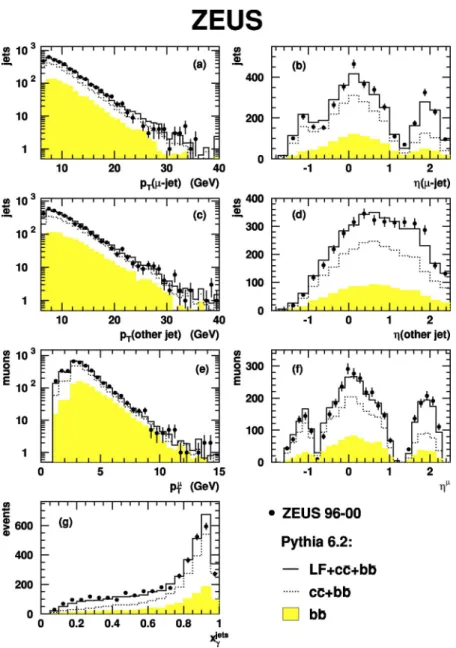
Figure 1 shows the kinematic distributions of pTjetandjet for the jet associated with the muon, as well as for highest-pT
jet that was not associated with a muon共other jet兲. The muon kinematic variables pTandare displayed, as well as x␥jets, the fraction of the total hadronic E⫺pZ carried by the two
highest-pTjets3 x␥jets⫽兺j⫽1,2共E jet⫺p Z jet兲 E⫺pZ . 共2兲
The data are compared in shape to the PYTHIAMC sample in which the relative fractions of bottom, charm, and LF were mixed according to the cross sections predicted by the simu-lation. The comparison shows that the main features of the dijet-plus-muon sample are well reproduced by this MC mix-ture. The PYTHIA MC predicts that the non-bb¯ background comprises 57% prompt muons from charmed-hadron decays and 43% muons from light-flavor hadrons, mostly due to in-flight decays of and K mesons, with a small amount 共⬃5% of the LF component兲 from muons produced in inter-actions with the detector material. The punch-through contri-bution is negligible. The HERWIGMonte Carlo共not shown兲 also gives a good description of the data.
The detector acceptance for the final cross sections was calculated using the bb¯ PYTHIA Monte Carlo, in which events were reweighted such that the transverse momentum distribution of the b quark agreed with that of the NLO cal-3x
␥ jets
is the massive-jets analogue of the x␥obs variable used for massless jets in other ZEUS publications关25兴.
FIG. 1. Distributions for the dijet-plus-muon sample 共points兲 compared to the predictions of the PYTHIAMonte Carlo共full line兲 normalized to the data. The shaded histogram shows the bottom component and the dotted line is the sum of charm and bottom. The plots show共a兲 the trans-verse momentum of the jet associated with the muon; 共b兲 its pseudorapidity; 共c兲 the transverse momentum of the highest-pT non--associated jet;共d兲 its pseudorapidity; 共e兲 the transverse mo-mentum of the muon;共f兲 its pseudorapidity; and
culations. The effect of this reweighting on the distributions in Fig. 1 was small.
V. SIGNAL EXTRACTION AND CROSS SECTION MEASUREMENT
Because of the large b-quark mass, muons from semi-leptonic B-hadron decays tend to be produced with large transverse momentum with respect to the direction of the jet containing the B-hadron. The bottom signal was extracted by exploiting the distribution of the transverse momentum of the muon with respect to the momentum of the rest of the associated jet, pTrel, defined as
pTrel⫽兩p
⫻共pjet⫺p兲兩
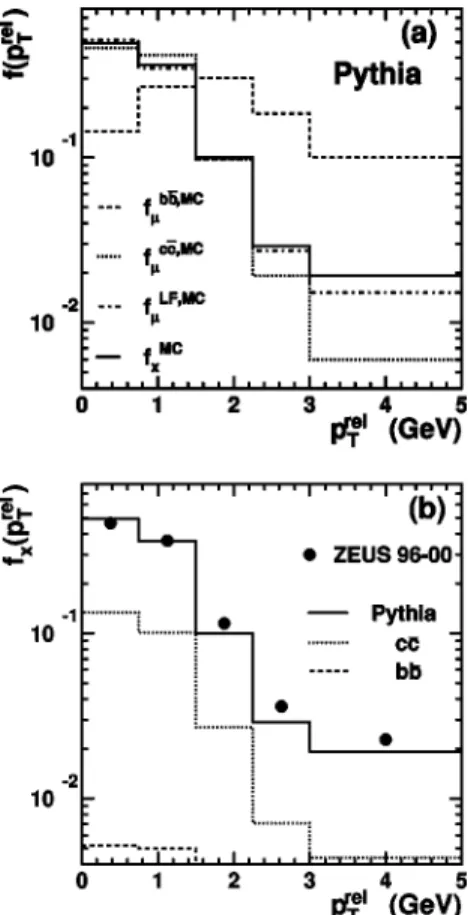
兩pjet⫺p兩 , 共3兲 where p is the muon and pjet the jet momentum vector. Figure 2共a兲 shows the distributions, normalized to unity, of the reconstructed muon pTrel as obtained from the PYTHIA
MC, for bottom ( fbb¯ ,MC), charm ( fcc¯ ,MC), and LF ( fLF,MC)
events. The pT rel
distribution for bottom peaks at⬃2 GeV and is well separated from those from charm and LF which are peaked close to zero. Since the shapes of fLF,MCand fcc¯ ,MC are very similar, the fraction of bottom (abb¯) and
back-ground (abkg) events in the sample was obtained from a two-component fit to the shape of the measured pT
rel
distribution fwith a bottom and a background component:
f⫽abkgf bkg⫹a
bb¯f bb¯
, 共4兲
where the pTrel distribution of bottom, fbb¯, was taken from the PYTHIA MC: fbb¯⫽ fbb¯ ,MC, and that of the background, fbkg, was obtained as explained below.
The distribution fbkgwas obtained from the sum of a LF, fLF, and a charm, fcc¯, distribution weighted according to the charm fraction r obtained from the charm and LF cross sec-tions given by PYTHIA:
fbkg⫽r fc cc¯
⫹共1⫺r兲fLF. 共5兲 The distribution fLFcan be obtained from the pTreldistribution of a sample of CTD tracks not identified as muons but ful-filling the same momentum and angular requirements applied to muons共called ‘‘unidentified tracks’’ in the following兲. The pT
rel
distribution for unidentified tracks, fx, is expected to be
similar to fLF, under the assumption that the probability for an unidentified track 共typically a or a K meson兲 to be identified as a muon, Px→, does not depend strongly on pTrel. This assumption is validated by the MC, since the MC distributions for the LF background, fLF,MC, and for the uni-dentified tracks, fxMC, are indeed very similar, as shown in Fig. 2a.
Figure 2共b兲 shows the fxdistribution obtained from a dijet
sample selected without muon requirements. The shape ob-tained from PYTHIA, fxMC, underestimates the tail 共for ex-ample, by 24% at 2.625 GeV兲. The pTrel shape of the LF background was therefore obtained as
fLF⫽ fx
fLF,MC
fxMC , 共6兲
where the ratio fLF,MC/ fxMC is a MC-based correction that accounts for possible differences between fLFand fxdue to a
residual pTreldependence of Px→and to the charm and
bot-tom contamination 共⬃28% and ⬃2% respectively兲 in the di-jet sample.
The data cannot be used to extract the distribution fcc¯. Two cases were therefore considered: the distribution given by the PYTHIA MC, fcc¯ ,MC, and the distribution obtained from the unidentified track sample, as in the case of the LF background: fxfmcc¯ ,MC/ fx
MC. The average of these two cases was then taken as the nominal fcc¯.
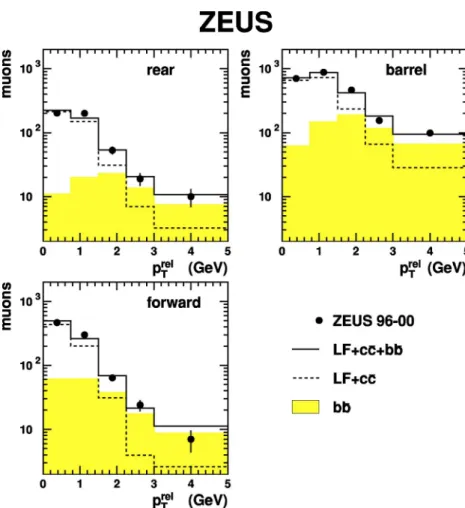
Figure 3 shows the result of the pTrelfit for muons in the rear, barrel, and forward regions. The sum of the two com-ponents reproduces the data reasonably well. The fraction of b in the total sample of dijet events with a muon is abb¯
FIG. 2. 共a兲 The pT rel
distribution as predicted by the PYTHIA
Monte Carlo for reconstructed muons from bottom ( fbb¯ ,MC, dashed histogram兲, charm ( fcc¯ MC, dotted histogram兲 and light-flavors ( fLF,MC, dash-dotted histogram兲, and for unidentified tracks ( fxMC, full-line histogram兲. The distributions are normalized to unity. 共b兲 The pT
rel
distribution of unidentified data tracks共points兲, compared to the prediction from PYTHIA 共full line兲. The charm and bottom
components are also shown as the dotted- and dashed-line histo-grams, respectively.
⫽0.224⫾0.017 共stat.兲. In the determination of the cross sec-tions, the fraction of beauty events in the data was extracted by a fit performed in each cross-section bin.
All the cross sections reported in Sec. VIII, with the ex-ception of that for b quarks, are inclusive muon 共or b-jet兲 cross sections, obtained by counting muons共or b-jets兲 rather than events. Muons coming from both direct and indirect b decays are considered to be part of the signal. The cross sections are given for dijet events passing the following re-quirements: Q2⬍1 GeV2, 0.2⬍y⬍0.8 and at least two hadron-level jets with pTjet1⬎7 GeV, p
T
jet2
⬎6 GeV and jet1,
jet2⬍2.5. These jets were defined using the k
Talgorithm on
stable hadrons, where the weakly decaying B hadrons were considered stable. For dijet events with a muon passing the cuts of Eq.共1兲, the acceptance varies from 10% at low pTto 20% at large pT.
The cross sections were measured from data collected at two different center-of-mass energies,
冑
s⫽300 GeV and冑
s⫽318 GeV. They were corrected to冑
s⫽318 GeV using the NLO QCD prediction. The effect of this correction on the final cross section is⬃2%.VI. THEORETICAL PREDICTIONS AND UNCERTAINTIES
The measured cross sections are compared to NLO QCD predictions based on the FMNR 关26兴 program. The parton distribution functions used for the nominal prediction were
GRVG-HO 关27兴 for the photon and CTEQ5M 关28兴 for the proton. The b-quark mass was set to mb⫽4.75 GeV, and the renormalization and factorization scales to the transverse mass,r⫽f⫽mT⫽
冑
1/2(( pTb
)2⫹(pT¯b)2)⫹mb2, where pTb(b¯ ) is the transverse momentum of the b (b¯ ) quark in the labo-ratory frame. Jets were reconstructed by running the kT
al-gorithm on the four momenta of the b and b¯ quarks and of the third light parton 共if present兲 generated by the program. The fragmentation of the b quark into a B hadron was simu-lated by rescaling the quark three-momentum 共in the frame in which pZb⫽⫺p¯Zb, obtained with a boost along Z兲 accord-ing to the Peterson 关29兴 fragmentation function with ⑀ ⫽0.0035. The muon momentum was generated isotropically in the B-hadron rest frame from the decay spectrum given by
PYTHIA, which is in good agreement with measurements
made at B factories关23兴.
To evaluate the uncertainty on the NLO calculations, the b-quark mass and the renormalisation and factorization scales were varied simultaneously, to maximize the change, from mb⫽4.5 GeV andr⫽f⫽mT/2 to mb⫽5.0 GeV and
r⫽f⫽2mT, producing a variation in the cross section
from ⫹34% to ⫺22%. The effect on the cross section of a variation of the Peterson parameter ⑀from 0.002 to 0.0055 关30兴 and of a change of the fragmentation function from the Peterson to the Kartvelishvili parametrization 共with ␣⫽13, as obtained from comparisons between NLO QCD and MC distributions兲 关31,32兴 was less than ⫾3%. The effects of
us-FIG. 3. The pT rel
distribution for events with muons in the rear, barrel and forward regions defined in Eq. 共1兲. The data 共points兲 are compared to the mixture of bot-tom and charm⫹LF background obtained from the pT
rel
fit 共full line兲. The shaded histogram repre-sents the beauty component while the dashed-line histogram is the background.
ing different sets of parton densities and of a variation of the strong coupling constant (⌳QCD(5) ⫽0.226⫾0.025 MeV) were all within ⫾4%.
The NLO cross sections, calculated for jets made of par-tons, were corrected for jet hadronization effects to allow a direct comparison with the measured hadron-level cross sec-tions. The corrections were derived from the MC simulation as the ratio of the hadron-level to the parton-level MC cross section, where the parton level is defined as being the result of the parton showering stage of the simulation. The average between the corrections obtained from PYTHIAand HERWIG
was taken as the central value and their difference as the uncertainty. The effect of the hadronization correction was largest in the rear region, where the cross section was re-duced by (20⫾6)% and smallest at large pT where it was reduced by (3.0⫾0.3)%.
The measured cross sections are also compared to the absolute predictions of two MC models, PYTHIA 6.2 and
CASCADE1.1. The predictions of PYTHIA6.2 were obtained
关20兴 by mixing direct- (␥g→bb¯) and resolved-photon (gg
→bb¯,qq¯→bb¯) flavor-creation processes calculated using
massive matrix elements and the flavor-excitation 共FE兲 pro-cesses (bg→bg,bq→bq), in which a heavy quark is ex-tracted from the photon or proton parton density. The FE processes contribute about 27% of the total bb¯ cross section. The small共⬃5%兲 contribution from gluon splitting in parton showers (g→bb¯) was not included. The parton density CTEQ4L关33兴 was used for the proton and GRVG-LO 关27兴 for the photon; the b-quark mass was set to 4.75 GeV and the b-quark string fragmentation was performed according to the Peterson function with⑀⫽0.0041 关34兴.
CASCADE 关35兴 is a Monte Carlo implementation of the
CCFM evolution equations关36兴. Heavy-quark production is obtained from the O(␣s) matrix elements for the process
␥g*→bb¯, in which the initial gluon can be off-shell. The
gluon density, unintegrated in transverse momentum (kT), is
obtained from an analysis of the proton structure functions based on the CCFM equations 关37兴; in the event generation the gluon density used corresponds to the set named ‘‘J2003 set 2.’’ The mass of the b quark was set to 4.75 GeV and␣s
was evaluated at the scale mT. As for PYTHIA, the b-quark
string fragmentation was performed according to the Peter-son function with ⑀⫽0.0041.
VII. SYSTEMATIC UNCERTAINTIES
The main experimental uncertainties are described below: 共i兲 The muon acceptance, including the efficiency of the muon chambers, of the reconstruction and of the MUON-CTD matching, is known to about 10% from a study based on an independent dimuon sample关38兴. 共ii兲 The uncertainty on the pTrelshape of the LF and charm
background was evaluated by
共a兲 varying the charm fraction in the background, r, by⫾20%. This range was obtained by fixing the absolute charm-MC normalization to a measure-ment of the charm dijet cross section 关39兴 and
using the PYTHIAor HERWIGMC to extrapolate to the kinematic range of the present measurement; 共b兲 varying the jet-track association in the
unidentified-track sample;
共c兲 extracting fLFfrom a sample of unidentified CTD tracks, reweighted with a MC-based parametriza-tion of Px→ depending on polar angle and
mo-mentum; 共d兲 varying the pT
relshape of the charm component of the background between the prediction from
PYTHIAand the value obtained from the
uniden-tified track sample;
共e兲 using HERWIG instead of PYTHIA to simulate the background.
The total uncertainty from these sources is about 10%. As a cross-check, a different definition of pTrelwas used to extract the beauty fraction, namely the transverse momentum of the muon with respect to the whole jet, including the muon it-self, as used in a previous ZEUS publication关9兴. The results were found to be in good agreement:
共iii兲 The 2% uncertainty on the direct-decay branching ra-tio Bdirintroduces a 2% uncertainty on the b-jet and on the b-quark cross sections while it has no effect on the visible muon cross sections. The 7% uncertainty on the branching ratio for indirect decays Bindir pro-duces an uncertainty of 1% on the measured cross sections.
共iv兲 The uncertainties on the dijet selection, on the energy scale, on the jet and yJB resolution and trigger effi-ciency add up to a 7% uncertainty on the cross sec-tions.
The uncertainty arising from the model dependence of the acceptance was evaluated as follows共the effect on the cross sections is shown in parenthesis兲:
共v兲 The Peterson fragmentation parameter ⑀ in the MC was varied from 0.002 to 0.006 as allowed by LEP and SLD measurements 关34,40,41兴. The Lund– Bowler fragmentation function was used as an alter-native, both with the default PYTHIA parameters and with parameters taken from OPAL measurements关34兴 共⫾2%兲.
共vi兲 Instead of using PYTHIA reweighted to the NLO pTb distribution it was reweighted as a function ofjetand pTjet to agree with the measured differential distribu-tions共⫺2%兲 or without reweighting 共⫹2%兲.
共vii兲 The fraction of flavor-excitation events in PYTHIAwas varied up and down by a factor of 2 共⫾4%兲, as al-lowed by comparisons to the x␥jetsdistribution of the data.
共viii兲 HERWIGwas used instead of PYTHIA共⫺2%兲.
The total systematic uncertainty was obtained by adding the above contributions in quadrature. A 2% overall normaliza-tion uncertainty associated with the luminosity measurement was not included.
VIII. RESULTS
All the cross sections reported below, except for the b-quark cross section, are given for dijet events with pTjet1,
pTjet2⬎7, 6 GeV, jet1, jet2⬍2.5, Q2⬍1 GeV2, and 0.2⬍y⬍0.8.
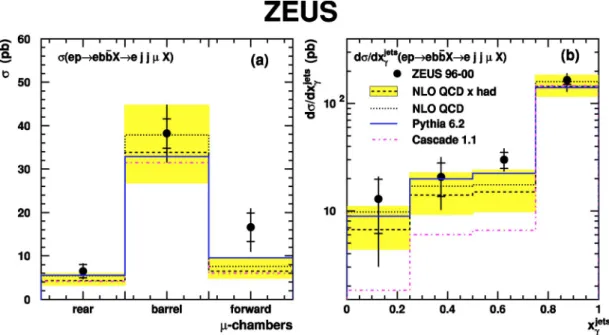
The first set of measurements are bottom cross sections for muons passing the cuts defined in Eq.共1兲. The results for the forward, barrel, and rear muon-chamber regions are shown in Fig. 4共a兲 and Table I and compared with the NLO prediction and MC models. Both the NLO and the MC mod-els are in reasonable agreement with the data.
Figure 4共b兲 and Table II show the differential cross-section d/dx␥jetsfor muons in the range defined by Eq.共1兲 in dijet events. The x␥jetsvariable corresponds at leading order to the fraction of the exchanged-photon momentum in the hard scattering process. It provides a tool to measure the relative importance of photon-gluon fusion,␥g→bb¯, which gives a peak at x␥jets⬃1, and of other contributions, such as
gluon-gluon fusion 共with a gluon coming from the photon兲 or higher-order diagrams, which are distributed over the whole x␥jets range. The sample is dominated by the high-x␥jets peak, but a low-x␥jetscomponent is also apparent. The NLO QCD prediction describes the distribution well. PYTHIAis also able to give a good description of the data due to the large con-tribution from flavor excitation at low x␥jets. CASCADE, which generates low-x␥jets events via initial-state radiation without using a parton density in the photon, tends to underestimate the cross section at low x␥jets.
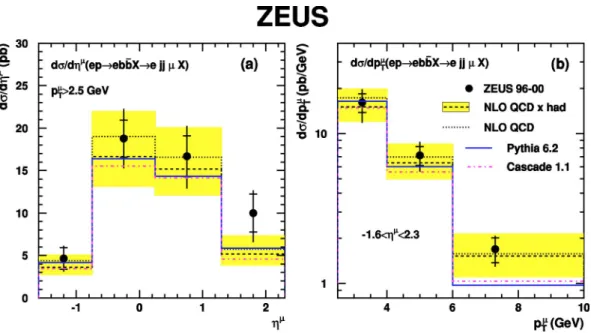
The differential cross sections in the muonic variables were measured for pT⬎2.5 GeV and ⫺1.6⬍⬍2.3. Fig-ure 5 and Table III show the differential cross sections d/d and d/d pT for muons in dijet events. The NLO QCD predictions and the MC models describe the distri-bution well. The pTdistribution is well reproduced by NLO
FIG. 4. Cross sections for muons coming from b decays in dijet events with pTjet1⬎7, p
T jet2
⬎6 GeV, jet1
, jet2⬍2.5, 0.2⬍y⬍0.8, Q2 ⬍1 GeV2 passing the selection of Eq. 共1兲. 共a兲 The cross section for the forward, barrel and rear regions 关defined in Eq. 共1兲兴. 共b兲 The differential cross section as a function of x␥jets. The data共points兲 are compared to the predictions of NLO QCD 共dotted line: parton-level jets; dashed line: jets corrected to the hadron level兲. The full error bars are the quadratic sum of the statistical 共inner part兲 and systematic uncertainties. The band around the NLO prediction represents the variation on the theoretical predictions obtained by varying the b-quark mass,randf, as explained in the text. The data are also compared to the predictions of the PYTHIA共solid line histogram兲 and CASCADE
共dot-dashed line histogram兲 Monte Carlo models.
TABLE I. For each muon-chamber region defined in Eq.共1兲 the columns show the number of selected muons; the beauty fraction
abb¯ obtained from the pT rel
fit; the measured bottom cross section with the statistical and systematic uncertainties; the NLO QCD pre-diction corrected to the hadron level with the theoretical uncertainty and the hadronization correction. For further details see the caption to Fig. 4.
-chambers Muons abb¯ ⫾stat.⫾syst.
共pb兲 NLO⫻C had 共pb兲 Chad rear 484 0.15 6.5⫾1.5⫺1.1⫹1.0 4.3⫺1.0⫹1.6 0.80 barrel 2316 0.25 38.2⫾3.4⫺5.8⫹5.7 33.9⫺7.0⫹11.0 0.89 forward 868 0.21 16.6⫾3.3⫺4.6⫹2.9 6.5⫺1.6⫹2.8 0.86
TABLE II. Differential muon cross section as a function of x␥jets. The multiplicative hadronization correction applied to the NLO pre-diction is shown in the last column. For further details see the caption to Fig. 4.
x␥jetsrange d/dx␥jets⫾stat.⫾syst. 共pb兲 Chad 0.00, 0.25 12.9⫾6.7⫺7.2⫹4.2 0.68 0.25, 0.50 20.8⫾7.2⫺7.7⫹8.2 0.83 0.50, 0.75 30.0⫾5.2⫺4.1⫹6.4 0.86 0.75, 1.00 165⫾14⫺34⫹22 0.90
QCD while the pTslope tends to be too soft in CASCADEand PYTHIA.
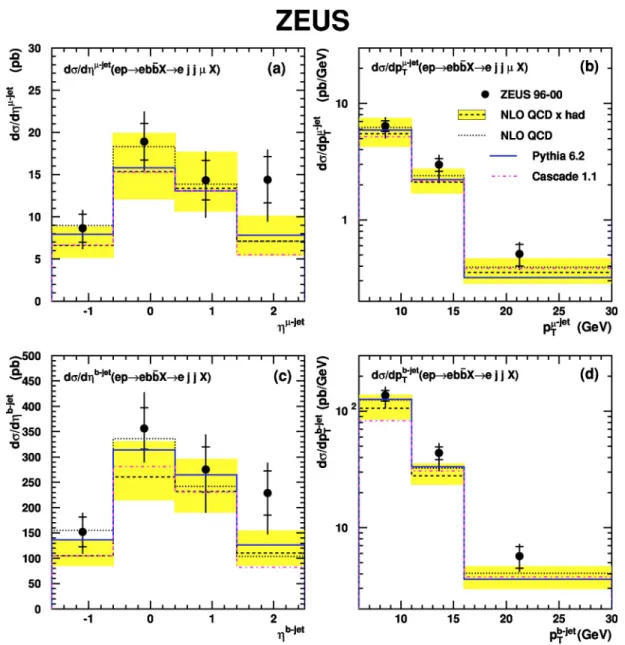
The jet associated with the muon共or-jet兲 reproduces the kinematics of the b 共or b¯) quark to a good approximation. The -jet is defined as the jet containing the B hadron that decays into the muon. Figures 6共a兲 and 6共b兲 and Table IV show the differential cross section for the jet associated with a muon passing the cuts of Eq. 共1兲 as a function of the jet pseudorapidity, d/d-jet, and transverse momentum, d/d pT-jet, for-jet⬍2.5 and pT-jet⬎6 GeV. The-jet dis-tributions are well reproduced by the NLO and by the MC models.
The-jet cross sections have been corrected to obtain the
cross sections for b-jets in dijet events: (e p→e
⬘
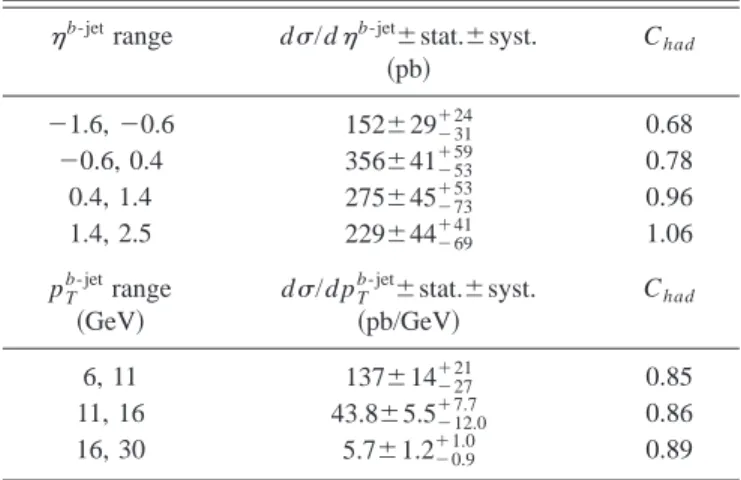
j jX). A b-jet is defined as a jet containing a B共or an anti-B兲 hadron. This correction was performed using PYTHIA and accounts for the b→ branching ratio, including direct and indirect decays, and for the full muon phase space. Figures 6共c兲 and 6共d兲 and Table V show the differential cross-sections d/db-jetand d/d pT
b-jet. The level of agreement of b jets
with the NLO QCD and MC predictions is similar to that found for thejets. It should be noted that the hadronization corrections in the first two b-jetbins are large共⬃⫺20%兲.
To compare the present result with a previous ZEUS mea-surement given at the b-quark level, the NLO QCD predic-tion was used to extrapolate the cross secpredic-tion for dijet events with a muon to the inclusive b-quark cross section. The b-quark differential cross section as a function of the quark transverse momentum, d(e p→bX)/dpTb, for b-quark pseudo-rapidity in the laboratory frame兩b兩⬍2 共correspond-ing to a rapidity in the ep center of mass of ⫺3.75⬍Ycmsb ⬍0.25), for Q2⬍1 GeV2 and 0.2⬍y⬍0.8, was obtained from the dijet cross section for events with a -jet within 兩-jet兩⬍2 using the NLO prediction corrected for hadroni-zation. The b¯ quark was not considered in the definition of the b-quark cross section. As a cross-check, the measurement was corrected to the b-quark level using the PYTHIA MC, giving a result in agreement within 6%. The result, shown in Fig. 7 and Table VI, is compared to the previous ZEUS mea-surement 关9兴 of the b-quark cross section for pTb⬎pTmin ⫽5 GeV and 兩b兩⬍2, translated into a differential cross
sec-tion using the NLO predicsec-tion and plotted at the average b-quark transverse momentum,
具
pTb典
, of the accepted events taken from the Monte Carlo:FIG. 5. Differential cross sections as a function of 共a兲 the muon pseudorapidity and 共b兲 transverse momentum pT, for pT
⬎2.5 GeV and ⫺1.6⬍⬍2.3, for muons coming from b decays in dijet events with p T jet1⬎7, p
T
jet2⬎6 GeV, jet1, jet2⬍2.5, 0.2⬍y ⬍0.8, Q2⬍1 GeV2
. The data共points兲 are compared to the predictions of NLO QCD 共dotted line: parton-level jets; dashed line: corrected to hadron-level jets兲. The full error bars are the quadratic sum of the statistical 共inner part兲 and systematic uncertainties. The band around the NLO prediction represents the variation on the theoretical predictions obtained by varying the b-quark mass andrandfas explained in the text. The data are also compared to the predictions of the PYTHIA共solid line histogram兲 and CASCADE共dot-dashed line histogram兲 Monte
Carlo models.
TABLE III. Differential muon cross section as a function of and pT. For further details see the caption to Fig. 5.
range d/d⫾stat.⫾syst. 共pb兲 Chad ⫺1.6, ⫺0.75 4.6⫾1.3⫺0.9⫹0.8 0.83 ⫺0.75, 0.25 18.8⫾2.2⫺2.7⫹2.7 0.88 0.25, 1.30 16.7⫾2.4⫺2.9⫹2.7 0.92 1.30, 2.30 10.0⫾2.3⫺2.6⫹1.4 0.91 pTrange 共GeV兲 d/dpT⫾stat.⫾syst. 共pb/GeV兲 Chad 2.5, 4.0 16.1⫾2.3⫺3.7⫹2.9 0.87 4.0, 6.0 7.1⫾1.0⫺1.2⫹1.3 0.92 6.0, 10.0 1.69⫾0.32⫺0.24⫹0.22 0.97
冉
d d pTb冊
具p T b典 ⫽冉
d NLO d pTb冊
具p T b典 共pT b⬎p T min兲 NLO共p T b⬎p T min 兲.The two independent measurements are consistent and in agreement with the NLO QCD predictions.
IX. CONCLUSIONS
Bottom production identified by semi-leptonic decay into muons has been measured in dijet events with Q2 ⬍1 GeV2. Differential cross sections for the reaction e p
→e
⬘
bb¯ X→e⬘
j jX⬘
have been measured as a function ofthe pseudorapidity and transverse momentum of the muon and of x␥jets. Differential cross sections for the production of b-jets were also measured.
The results were compared to MC models and to a NLO QCD prediction combined with fragmentation and B-hadron decay models. This prediction is in good agreement with the data in all the differential distributions. The PYTHIA MC model is also able to give a reasonable description of the differential cross sections. The CASCADE MC model also gives a reasonable description of the data, except for the low-x␥jetsregion.
The large excess of the first measurement of bottom pho-toproduction over NLO QCD, reported by the H1
collabora-FIG. 6. Differential cross sections as a function of 共a兲 the pseudorapidity -jet and 共b兲 the transverse momentum pT-jet of the jet associated to the muon, for pT-jet⬎6 GeV, -jet⬍2.5, for muons passing the selection of Eq. 共1兲 and coming from b decays; differential cross sections as a function of共c兲 the pseudorapidityb-jetand共d兲 the transverse momentum pT
b-jet
of the jet containing a B hadron. All the cross sections are evaluated for dijet events with pTjet1⬎7, p
T jet2
⬎6 GeV, jet1
, jet2⬍2.5, 0.2⬍y⬍0.8, Q2⬍1 GeV2. The data共points兲 are
compared to the predictions of NLO QCD共dotted line: parton level; dashed line: corrected to hadron level兲. The full error bars are the quadratic sum of the statistical共inner part兲 and systematic uncertainties. The band around the NLO prediction represents the uncertainty on the theoretical prediction corrected for hadronization. The data are also compared to the predictions of the PYTHIA共solid line histogram兲 and
tion 关8兴, is not confirmed. The present result is consistent with the previous ZEUS measurement using semi-leptonic B decays into electrons关9兴. Beauty photoproduction in ep col-lisions is reasonably well described both by NLO QCD and by a MC model that includes a substantial flavor excitation component.
ACKNOWLEDGMENTS
We thank the DESY Directorate for their strong support and encouragement. The remarkable achievements of the HERA machine group were essential for the successful completion of this work and are greatly appreciated. We are grateful for the support of the DESY computing and network services. The design, construction, and installation of the ZEUS detector have been made possible owing to the inge-nuity and effort of many people who are not listed as authors. It is also a pleasure to thank S. Frixione and H. Jung for help with theoretical predictions and useful conversation. IG-B was partly supported by Polish Ministry of Scientific
Re-search and Information Technology, Grant No. 2P03B 122 25. JS was partly supported by the Israel Science Foundation and the Ministry of Science, and Polish Ministry of Scientific Research and Information Technology, Grant No. 2P03B12625. AK was supported by the Polish State Com-mittee for Scientific Research, Grant No. 2 P03B09322. BBL was partly supported by the Russian Foundation for Basic Research, Grant No. 02-02-81023. RC was supported by the Polish State Committee for Scientific Research, Grant No. 2 P03B07222. J. S. 共Warsaw University兲 was supported by the KBN Grant No. 2P03B12925. TT and AU were sup-ported by German Federal Ministry for Education and Re-search共BMBF兲, POL 01/043. JU was supported by the KBN Grant No. 2P03B12725. LKG was partly supported by Uni-versity of Wisconsin via the U.S.-Israel BSF. McGill Univer-sity, University of Toronto, and York University were sup-ported by the Natural Sciences and Engineering Research Council of Canada 共NSERC兲. Physikalisches Institut der Universita¨t Bonn, and the Institute of Exp. Physics at Ham-burg University were supported by the German Federal Min-istry for Education and Research 共BMBF兲, under Contract Nos. HZ1GUA
FIG. 7. Differential cross section for b-quark production as a function of the b-quark transverse momentum pT
b
for b-quark pseudorapidity 兩b兩
⬍2 and for Q2⬍1 GeV2, 0.2⬍y⬍0.8. The filled points show the ZEUS results from this analysis and the open point is the previous ZEUS mea-surement in the electron channel关9兴. The full er-ror bars are the quadratic sum of the statistical
共inner part兲 and systematic uncertainties. The
dashed line shows the NLO QCD prediction with the theoretical uncertainty shown as the shaded band.
TABLE IV. Differential cross section for jets associated with a muon as a function of-jetand pT-jet. For further details see the caption to Fig. 6.
-jetrange d/d-jet⫾stat.⫾syst.
共pb兲 Chad ⫺1.6, ⫺0.6 8.6⫾1.7⫺1.8⫹1.4 0.73 ⫺0.6, 0.4 18.9⫾2.2⫺2.7⫹2.8 0.84 0.4, 1.4 14.3⫾2.3⫺3.8⫹2.5 0.97 1.4, 2.5 14.4⫾2.7⫺4.2⫹2.3 1.00 pT-jetrange 共GeV兲 d/dpT-jet⫾stat.⫾syst. 共pb/GeV兲 Chad 6, 11 6.41⫾0.67⫺1.24⫹1.00 0.88 11, 16 2.98⫾0.37⫺0.82⫹0.52 0.88 16, 30 0.51⫾0.11⫺0.08⫹0.08 0.90
TABLE V. Differential cross section for b-jets as a function of
b-jet and pT
b-jet
. For further details see the caption to Fig. 6.
b-jet
range d/db-jet⫾stat.⫾syst.
共pb兲 Chad ⫺1.6, ⫺0.6 152⫾29⫺31⫹24 0.68 ⫺0.6, 0.4 356⫾41⫺53⫹59 0.78 0.4, 1.4 275⫾45⫺73⫹53 0.96 1.4, 2.5 229⫾44⫺69⫹41 1.06 pT b-jet range 共GeV兲 d/dpT b-jet⫾stat.⫾syst. 共pb/GeV兲 Chad 6, 11 137⫾14⫺27⫹21 0.85 11, 16 43.8⫾5.5⫺12.0⫹7.7 0.86 16, 30 5.7⫾1.2⫺0.9⫹1.0 0.89
2, HZ1GUB 0, HZ1PDA 5, and HZ1VFA 5. Weizmann In-stitute, Rehuvut, Israel was supported by the MINERVA Ge-sellschaft fu¨r Forschung GmbH, the Israel Science Founda-tion, the U.S.-Israel Binational Science Foundation and the Benozyio Center for High Energy Physics. Tel. Aviv Univer-sity was supported by the German-Israeli Foundation and the Israel Science Foundation. Calabria University Physics De-partment and Dipartimento di Fisica dell’ Universita`, Univer-sita` ‘La Sapienza,’ Universita di Torino, and UniverUniver-sita` del Piemonte Orientale were supported by the Italian National Institute for Nuclear Physics 共INFN兲. The Institute of Par-ticle and Nuclear Physics, Meiji Gakvin University, Poly-technic Institute, Tokyo Institute of Technology, University of Tokyo, and Tokyo Metropolitan University were sup-ported by the Japanese Ministry of Education, Culture, Sports, Science and Technology 共MEXT兲 and its grants for Scientific Research. Chonnan National University and Kyungpook National University were supported by the Ko-rean Ministry of Education and Korea Science and Engineer-ing Foundation. NIKHEF and University of Amsterdam were supported by the Netherlands Foundation for Research on Matter 共FOM兲. The Institute of Nuclear Physics, Cracow, was supported by the Polish State Committee for Scientific Research, Grant No. 620/E-77/SPB/DESY/P-03/DZ 117/ 2003-2005. Moscow Engineering Institute was partially sup-ported by the German Federal Ministry for Education and
Research共BMBF兲. Moscow State University was partly sup-ported by the Russian Ministry of Industry, Science and Technology through its grant for Scientific Research on High Energy Physics. Universidad Autonoma de Madrid was sup-ported by the Spanish Ministry of Education and Science through funds provided by CICYT. H. H. Wills Physics Laboratory at University of Bristol, the Department of Phys-ics and Astronomy at the University of Glasgow, the High Energy Nuclear Physics Group at Imperial College London, University of Oxford, Rutherford Appleton Laboratory, Uni-versity College London were supported by the Particle Phys-ics and Astronomy Research Council, UK. Argonne National Laboratory, Ohio State University, University of California—Santa Cruz, University of Wisconsin, and Yale University were supported by the U.S. Department of En-ergy. Nevis Laboratories at Columbia University and the Pennsylvania State University were supported by the US Na-tional Science Foundation. AGH–University of Science and Technology, Cracow, was supported by the Polish State Committee for Scientific Research, Grant No. 112/E-356/ SPUB/DESY/P-03/DZ 116/2003-2005, 2 P03B 13922. War-saw University, Institute of Experimental Physics and Insti-tute for Nuclear Physics were supported by the Polish State Committee for Scientific Research, Grant No. 115/E-343/ SPUB-M/DESY/P-03/DZ 121/2001-2002, 2 P03B 07022.
关1兴 S. Frixione et al., Nucl. Phys. B454, 3 共1995兲; M. Cacciari, S.
Frixione, and P. Nason, J. High Energy Phys. 03, 006共2001兲.
关2兴 M. Basile et al., Lett. Nuovo Cimento Soc. Ital. Fis. 31, 97 共1981兲.
关3兴 UA1 Collaboration, C. Albajar et al., Phys. Lett. B 256, 121 共1991兲; erratum 262, 497 共1991兲; Z. Phys. C 61, 41 共1994兲. 关4兴 CDF Collaboration, F. Abe et al., Phys. Rev. Lett. 71, 500
共1993兲; 71, 2396 共1993兲; 75, 1451 共1995兲; Phys. Rev. D 53,
1051 共1996兲; CDF Collaboration, P. Acosta et al., ibid. 65, 052005共2002兲; DØ Collaboration, S. Abachi et al., Phys. Rev. Lett. 74, 3548 共1995兲; DØ Collaboration, B. Abbott et al., Phys. Lett. B 487, 264 共2000兲; Phys. Rev. Lett. 84, 5478
共2000兲; 85, 5068 共2000兲.
关5兴 L3 Collaboration, M. Acciarri et al., Phys. Lett. B 503, 10 共2001兲.
关6兴 WA78 Collaboration, M. Catanesi et al., Phys. Lett. B 202,
453 共1988兲; E672/E706 Collaboration, R. Jesik et al., Phys. Rev. Lett. 74, 495共1995兲.
关7兴 E771 Collaboration, T. Alexopoulos et al., Phys. Rev. Lett. 82,
41共1999兲; D. M. Jansen et al., ibid. 74, 3118 共1995兲; HERA-B Collaboration, I. Abt et al., Eur. Phys. J. C 26, 345共2003兲.
关8兴 H1 Collaboration, C. Adloff et al., Phys. Lett. B 467, 156 共1999兲; Erratum 518, 331 共2001兲.
关9兴 ZEUS Collaboration, J. Breitweg et al., Eur. Phys. J. C 18, 625 共2001兲.
关10兴 ZEUS Collaboration, U. Holm 共ed.兲, The ZEUS Detector.
Sta-tus Report 共unpublished兲, DESY 共1993兲, available on http:// www-zeus.desy.de/bluebook/bluebook.html.
关11兴 N. Harnew et al., Nucl. Instrum. Methods Phys. Res. A 279,
290 共1989兲; B. Foster et al., Nucl. Phys. Proc. Suppl. B 32, 181 共1993兲; B. Foster et al., Nucl. Instrum. Methods Phys. Res. A 338, 254共1994兲.
cross-section d/dpT-jetrestricted to兩-jet兩⬍2, the corresponding hadronization correction and the average
b-quark transverse momentum,具pT b典
, as obtained from the PYTHIAMC. The b-quark differential cross section
d/dpT b
for兩b兩⬍2, evaluated at具p T b典
, is shown in the last column. For further details see the caption to Fig. 7. pT-jetrange 共GeV兲 d/dpT-jet⫾stat.⫾syst. (兩-jet兩⬍2) 共pb/GeV兲 Chad 具pT b典 共GeV兲 d/dpT b⫾stat.⫾syst. 共pb/GeV兲 6, 11 6.22⫾0.63⫺1.04⫹0.91 0.87 8.5 70⫾7.2⫺14⫹13 11, 16 2.74⫾0.36⫺0.74⫹0.47 0.88 13.6 14.4⫾1.9⫺4.3⫹3.1 16, 30 0.43⫾0.10⫺0.06⫹0.07 0.88 21.25 1.37⫾0.32⫺0.37⫹0.39
关12兴 M. Derrick et al., Nucl. Instrum. Methods Phys. Res. A 309,
77共1991兲; A. Andresen et al., ibid. 309, 101 共1991兲; A. Cald-well et al., ibid. 321, 356共1992兲; A. Bernstein et al., ibid. 336, 23共1993兲.
关13兴 G. Abbiendi et al., Nucl. Instrum. Methods Phys. Res. A 333,
342共1993兲.
关14兴 J. Andruszko´w et al., preprint DESY-92-066, DESY, 1992;
ZEUS Collaboration, M. Derrick et al., Z. Phys. C 63, 391
共1994兲; J. Andruszko´w et al., Acta Phys. Pol. B 32, 2025 共2001兲.
关15兴 ZEUS Collaboration, J. Breitweg et al., Eur. Phys. J. C 1, 81 共1998兲; G. M. Briskin, Ph.D. thesis, Tel Aviv University 共1998兲, DESY-THESIS-1999-036.
关16兴 S. Catani, Yu. L. Dokshitzer, and B. R. Webber, Phys. Lett. B
285, 291共1992兲.
关17兴 S. D. Ellis and D. E. Soper, Phys. Rev. D 48, 3160 共1993兲. 关18兴 F. Jacquet and A. Blondel, Proceedings of the Study for an ep
Facility for Europe, edited by U. Amaldi, Hamburg, Germany 共1979兲, p. 391. Also in preprint DESY 79/48.
关19兴 T. Sjo¨strand et al., Comput. Phys. Commun. 138, 238 共2001兲. 关20兴 E. Norrbin and T. Sjo¨strand, Eur. Phys. J. C 17, 137 共2000兲. 关21兴 G. Marchesini et al., Comput. Phys. Commun. 67, 465 共1992兲. 关22兴 Particle Data Group, K. Hagiwara et al., Phys. Rev. D 66,
010001共2002兲.
关23兴 Belle Collaboration, K. Abe et al., Phys. Lett. B 547, 181 共2002兲; Babar Collaboration, B. Aubert et al., Phys. Rev. D 67,
031101共2003兲.
关24兴 R. Brun et al.,GEANT3, Technical Report CERN-DD/EE/84-1, CERN, 1987.
关25兴 ZEUS Collaboration, M. Derrick et al., Phys. Lett. B 348, 665 共1995兲.
关26兴 S. Frixione et al., Nucl. Phys. B412, 225 共1994兲.
关27兴 M. Gluck, E. Reya, and A. Vogt, Phys. Rev. D 46, 1973 共1992兲. 关28兴 CTEQ Collaboration, H. L. Lai et al., Eur. Phys. J. C 12, 375
共2000兲.
关29兴 C. Peterson et al., Phys. Rev. D 27, 105 共1983兲. 关30兴 P. Nason and C. Oleari, Nucl. Phys. B565, 245 共2000兲. 关31兴 V. G. Kartvelishvili, A. K. Likhoded, and V. A. Petrov, Phys.
Lett. B 78, 615共1978兲.
关32兴 M. Cacciari and P. Nason, Phys. Rev. Lett. 89, 122003 共2002兲. 关33兴 H. L. Lai et al., Phys. Rev. D 55, 1280 共1997兲.
关34兴 OPAL Collaboration, G. Abbiendi et al., Eur. Phys. J. C 29,
463共2003兲.
关35兴 H. Jung and G. P. Salam, Eur. Phys. J. C 19, 共2001兲; H. Jung,
Comput. Phys. Commun. 143, 100共2002兲.
关36兴 M. Ciafaloni, Nucl. Phys. B296, 49 共1998兲; S. Catani, F.
Fio-rani, and G. Marchesini, Phys. Lett. B 234, 339共1990兲.
关37兴 M. Hansson and H. Jung, preprint hep/ph0309009.
关38兴 M. Turcato. Ph.D. thesis, Padova University, 共2002兲,
DESY-THESIS-2003-039.
关39兴 ZEUS Collaboration, S. Chekanov et al., Phys. Lett. B 565, 87 共2003兲.
关40兴 ALEPH Collaboration, A. Heister et al., Phys. Lett. B 512, 30 共2001兲.
关41兴 SLD Collaboration, K. Abe et al., Phys. Rev. D 65, 092006 共2002兲; Erratum 66, 079905 共2002兲.