Consumers’ Responses to Smart Home Services:
The Role of Self-Regulation Systems
Moon-Yong Kim
1, Heayon Cho
2*1
Professor, College of Business, Hankuk University of Foreign Studies, Seoul, Korea
2Assistant Professor, Dept. of Interior Design, Konkuk University, Chungju, Korea
1
[email protected],
2[email protected]
Abstract
In the new era of IoT, a deeper and richer understanding of consumer characteristics is required to accelerate the acceptance and popularization of different types of smart home services (e.g., hedonic or utilitarian smart home services). In the current research, self-regulation systems are considered one of the consumer characteristics. Therefore, this research examines the role of consumers’ regulatory focus (promotion focus vs. prevention focus) in their responses to smart home services, particularly when they are not familiar with the services. Specifically, this research examines whether consumers’ attitudes toward utilitarian/hedonic smart home services differ according to their regulatory focus, particularly when they are not familiar with the services. The results indicate that consumers who are not familiar with smart home services have more favorable attitudes toward hedonic smart home services when they are promotion-focused (vs. prevention-focused). In contrast, there is no significant difference in their attitudes toward utilitarian smart home services between promotion- and prevention-focused consumers. Our findings imply that regulatory focus may be an effective marketing and segmentation tool in promoting new smart home services and facilitating low-familiarity consumers’ receptiveness to the services.
Keywords: Self-Regulation, Hedonic Smart Home Service, Utilitarian Smart Home Service, Attitude
1. INTRODUCTION
A smart home is defined as a residence equipped with smart technologies that facilitate monitoring of residents and/or promote independence and increase residents’ quality of life [1, 2]. That is, a smart home provides various intelligent home services that promote productivity and enhance living experience by utilizing IT [3]. With the emergence of the IoT (Internet of Things) society, interest in smart home services is increasing from both consumer and producer sides, and smart home services have come to the forefront as part of the growing market for the IoT [4]. Smart home services are all-in-one remote-control services that can handle all equipment and devices installed in a home; these include home applications, facilities, utilities such as electricity and water supply, and air conditioning, boilers, refrigerators, and TVs [5]. Recently, the concept of smart home services is being expanded to a variety of smart devices located at the home and that can be self-automated or remote-controlled through mobile phones or PCs from outside the home [6].
Most previous smart home research has explored the technical challenges of delivering smart domestic environments [7]. The majority of this work has given little consideration to users. Recently, however, there has been growing interest in the users of smart homes [8], and smart home service providers are encouraged
IJACT 21-3-5
Manuscript received: January 29, 2021/ revised: February 25, 2021 / accepted: March 2, 2021 Corresponding Author: Heayon Cho
to plan and develop user-oriented services and marketing communications [6]. Since smart home services were introduced, they have been expected to grow rapidly [4]. However, contrary to optimistic expectations for future market growth, smart homes are at an early stage of diffusion despite their broad range of potential and benefits [9]. To accelerate the acceptance and popularization of smart home services, thus, it is very important to understand consumers’ responses to different types of smart home services and identify factors affecting acceptance and usage of smart home services. Moreover, when it comes to providing such a variety of smart home services, it is critical to understand the characteristics of consumers as these tend to motivate consumers to adopt smart home services. However, despite the significant influence of smart home services in the information and communication technology industry and society, few studies have examined consumers’ attitudes and behaviors concerning the adoption of smart home services and how service providers can improve consumer acceptance and consequently promote the smart home market [9, 10]. In addition, scant research has identified consumer characteristics influencing their acceptance and usage of smart home services [11, 12].
In the current research, self-regulation systems are considered as one of the consumer characteristics. Therefore, this research examines the role of consumers’ regulatory focus (promotion focus vs. prevention focus) in their responses to smart home services. That is, this research examines whether consumers’ attitudes toward utilitarian/hedonic smart home services differ according to their regulatory focus. In particular, given that smart homes are new technologies generally unfamiliar to consumers [13-15], we only focus on consumers who are not familiar with smart home services. More importantly, product unfamiliarity can present a barrier to new product adoption [16-18]. Thus, focusing primarily on consumers with low familiarity may be a more efficient way to get them to adopt and use the smart home services. Specifically, we find that consumers who are not familiar with smart home services have more favorable attitudes toward hedonic smart home services when they are promotion-focused (vs. prevention-focused), whereas there is no significant difference in their attitudes toward utilitarian smart home services between promotion- and prevention-focused consumers.
2. THEORETICAL BACKGROUND AND HYPOTHESES DEVELOPMENT
2.1 Smart Home Services
Recently, most studies on smart home services have examined the effects of one or other of the particular characteristics of the services on the users’ perceptions, adoption, usage intention, and resistance [4, 9, 19-28]. However, few studies have examined consumers’ responses to smart home services and how service providers can easily make consumers accept the services [9, 10]. Moreover, in an attempt to identify consumer characteristics influencing their acceptance and usage of smart home services, only some studies have focused primarily on several technical skills associated with the operating objects connected to the Internet [11, 12].
2.2 Self-Regulation
Higgins’ self-regulation theory [29] provides an advanced understanding of self-regulatory goals that underlie approach-avoidance motivation and elaborates on the means people employ for self-regulation during goal pursuit. Higgins’ theory distinguishes between two basic types of self-regulatory orientations that adhere to goal pursuits: promotion focus and prevention focus. A promotion focus emphasizes the “ideal” self, as reflected in the person’s hopes and aspirations, and favors strategic means that are eagerness-oriented. By contrast, a prevention focus emphasizes the “ought” self, as reflected in the person’s duties and obligations, and supports strategic means that are vigilance-oriented.
A basic assertion of regulatory focus theory is that individuals are more concerned with information that is relevant for the activated regulatory focus and that they place greater weight on attributes compatible with that focus [30]. Consistent with this view, prior marketing and consumer behavior studies have found that the consumer’s regulatory focus plays important roles in processes related to persuasion, self-regulation,
categorization, judgment, and choice. For example, Aaker and Lee [31] indicated that when information in advertising is presented in a way that is compatible with individuals’ regulatory focus, people are more easily persuaded and have better recollection of the advertising claims. Zhao and Pechmann [32] found that antismoking advertisements are most persuasive when the viewers’ regulatory focus and the message’s valence (positive or negative) are congruent. Chernev [33] provided evidence of the impact of goal-attribute compatibility on brand preferences. According to him, prevention-orientated individuals ascribe greater weight to utilitarian attributes than promotion-orientated individuals, who are found to place more weigh on hedonic product attributes.
In other consumer research, applications of regulatory focus theory have emphasized the importance of regulatory fit [34-36]. The regulatory fit effect occurs when the manner of goal pursuit matches or sustains one’s regulatory orientation. That is, when people adopt strategies that are consistent with their regulatory goals, they experience heightened motivation and a feeling of ‘fit’ [34]. Specifically, in the context of marketing, promotion-focused individuals experience regulatory fit if a product has promotion-relevant features, and prevention-focused individuals do so if a product has prevention-relevant features. Regulatory fit produces the experience of “feeling right,” which transfers onto the object of evaluation and intensifies reactions [37, 38]. Regulatory fit can enhance persuasion and opinion ratings on the topic advocated in the message [37], lead consumers to form stronger preferences toward the product [38], and create greater assigned monetary value for a product [35]. For instance, Aaker and Lee [34] found that participants had a more favorable attitude towards a product when features that matched their regulatory goals were highlighted (e.g., teeth whitening for promotion individuals versus prevention of tooth decay for prevention individuals).
Recent research that has built on this finding has focused on varying marketing situations or cues that can activate the promotion or prevention focus. For example, Chitturi et al. [39] found that the consumption of utilitarian products (those with predominantly functional features, which satisfy the needs of consumers) fulfills prevention-relevant goals, while the consumption of hedonic products (those with predominantly experiential features, which satisfy the wants of consumers) fulfills promotion-relevant goals in consumers. Micu and Chowdhury [40] demonstrated that advertising utilitarian products with prevention-focused messages and hedonic products with promotion-focused messages created a regulatory-fit effect. Additionally, Thongpapanl et al. [41] proposed that consumers with a promotion focus are more oriented toward hedonic shopping values whereas consumers with a prevention focus have a greater inclination toward utilitarian shopping values.
2.3 Familiarity
Consumer familiarity with a product or service has received attention from various marketing researchers because familiarity can play a vital role in consumers’ decision-making processes [16, 42, 43]. Prior studies have shown that familiarity can influence decision making by reducing the amount of cognitive effort required and modifying cognitive structures [42, 44]. The Elaboration Likelihood Model (ELM) was proposed to explain the process of changes in consumer attitudes toward messages [45]. They claimed that the ELM has dual routes, the central route and the peripheral route, and that whether individuals process though the central route or peripheral route is based on the depth of their cognitive information processing and degree of elaboration. If a person has motivation and the ability to process a message, individuals can engage in effortful cognitive activity through the central route. Because the central route or systematic processing is thought to be more cognitively taxing, it may require message recipients to have greater ability and motivation to process the communication than is the case in peripheral or heuristic processing. However, when individuals lack either the motivation or ability to process detailed information, persuasion comes from the peripheral route so they tend to rely on peripheral cues or mental heuristics rather than focal messages.
In a similar vein, familiarity is associated with the ability to process information. Consumers with high familiarity can draw upon prior experience and knowledge to scrutinize and evaluate carefully all of the
information. It is clear that such message processing demands a considerable amount of cognitive resources, but consumers with high familiarity have enough cognitive resources to perform this kind of information processing. However, the opposite applies to consumers with low familiarity. According to the constructive preference view, when people’s processing capacity is limited, they may be more likely to use heuristic (selective) processes for information processing [46]. That is, people may be more likely to attend selectively to information that addresses their goals or regulatory concerns when their level of familiarity is relatively low. Familiarity is highly associated with the cues that consumers use to assess the quality of products or services [47]. As consumers become more familiar with a product, they accumulate knowledge about it, which enables them to evaluate product quality based on previous experiences. However, having no or little familiarity with a product means consumers have few core cues to evaluate quality because they lack prior experiences. Thus, consumers with less familiarity with products or services are more likely to consider peripheral cues [42].
The present study applies familiarity to the setting of smart home services. With the increased prominence of smart home services and the heightened customer expectations from such services, it is important to study the role of familiarity. Given that smart homes are new technologies with which most consumers have little familiarity [13-15], we primarily focus on consumers who are not familiar with smart home services. More importantly, product unfamiliarity can present a barrier to new product adoption for consumers [17, 18]. Thus, focusing primarily on consumers with low familiarity may be a more efficient way to get them to adopt and use the smart home services. If consumers do not know a new product and have no incumbent products that may serve as a reference for comparison, then the new product is unlikely to be part of those consumers’ product consideration set. Research on new product adoption has pointed to the importance of product familiarity and comprehension as factors contributing to the ease of adoption [16]. This result is consistent with the findings of other innovation researchers—that is, familiarity with a product reduces consumers’ resistance to its adoption and increases consumers’ favorable attitudes toward and their purchase (behavior) of the product [48, 49]. Therefore, it is assumed that when consumers are not familiar with smart home services, their responses to the services are more affected by the value of hedonic aspects.
2.4 Research Hypotheses
It is widely acknowledged that most products satisfy two important needs: hedonic needs and utilitarian needs [50]. Chitturi et al. [39] viewed utilitarian benefits as practical, instrumental, and functional, and hedonic benefits as enjoyable, experiential, and aesthetic. Using the two hedonic/utilitarian dimensions, various products of smart home services can be classified. As an example, home security services (e.g., security control services with security business enterprises) can be seen as highly utilitarian, whereas TV game services (e.g., game applications via smart TV) might include more hedonic attributes. A number of researchers have shown that consumer attitudes towards products, brands, and advertisements differ based on this dichotomy [39, 50, 51]. Of consumer responses to smart home services, in particular, we focus on their attitudes toward the services, given that attitude has been shown to have an influence on intention to adopt IoT devices or services in several studies [28, 52, 53].
It is estimated that approximately half of consumers are chronically promotion focused, and the other half are prevention focused [29, 54]. As stated earlier, there has been substantial evidence that evaluations are more positive when the situation fits consumers’ regulatory goals [34-36, 38]. For example, hedonic and utilitarian smart home services are compatible with the promotion and prevention foci, respectively [33, 39, 40]. Chernev [33] explored the relationship between product attributes and regulatory focus, finding that individuals with promotion focus preferred products with distinct hedonic attributes, and those with prevention focus preferred products with utilitarian attributes.
Moreover, research has indicated that familiarity and hedonic and utilitarian theory are also closely aligned. For example, Ha and Jang [55] found that when considering customers’ familiarity level with a
certain product or service, hedonic aspects more effectively induced positive satisfaction and behavioral intentions in the low-familiarity group. Hence, when consumers are not familiar with smart home services, their responses to the services can be expected to be more affected by the value of hedonic aspects. Building on these findings, we predict the occurrence of regulatory fit effect in the context of hedonic smart homes services. That is, we predict that consumers with low familiarity will have more favorable attitudes toward hedonic smart home services when they are promotion-focused (vs. prevention-focused). On the other hand, utilitarian aspects were found to be more influential in terms of the satisfaction and behavioral intentions of the high-familiarity group in Ha and Jang’s study [55]. Thus, we predict this regulatory fit effect will be less likely in the context of utilitarian smart home services. That is, we predict that low-familiarity consumers’ responses to the services would be less influenced by the value of utilitarian aspects, regardless of their regulatory focus. Accordingly, we hypothesize:
H1: Consumers who are not familiar with smart home services have more favorable attitudes toward
hedonic smart home services when they are promotion-focused (vs. prevention-focused).
H2: For consumers who are not familiar with smart home services, there is no significant difference in
their attitudes toward utilitarian smart home services between the promotion- and prevention-focused consumers.
3. METHOD
In this study, 180 undergraduate business-major students (81 females, 99 males) at a mid-sized university participated in the first part of our survey. The first part of the survey focused on respondents’ overall familiarity with smart home services and their demographic characteristics (e.g., age, gender, academic major) to screen out those who were familiar with smart home services. Specifically, first, all the respondents were asked to assess their overall familiarity with smart home services on a 7-point Likert-type scale. The overall familiarity was measured with a single item because the use of a single-item measure is suitable when the construct is concrete and singular [56-58]. The respondents were split into two groups, low- and high-familiarity groups, by using median split. Because the median of the respondents’ familiarity was 4 (on a 1-7 scale) and 4 means neutral (i.e., not familiar or not unfamiliar), respondents who evaluated their familiarity as 4 were excluded. Then, respondents with familiarity levels of 1–3 were assigned to the low-familiarity group and those with familiarity levels of 5–7 were assigned to the high-familiarity group. Thus, respondents in the high-familiarity group were also excluded, and only 126 respondents (i.e., the low-familiarity group) were included in the final sample.
The final sample of 126 undergraduates (56 females, 70 males) completed the second part of the survey. Their ages ranged from 18 to 28 years (mean = 20.71, SD = 2.15). The second part of the survey contained items measuring the respondents’ regulatory focus and their overall attitudes toward each smart home service. Specifically, the regulatory focus scale has been validated in previous research [54]. The scale had 18 items, half of which measured promotion focus and the other half of which measured prevention focus. Using a 7-point scale, respondents indicated the extent to which they endorsed items relevant to a promotion focus and items relevant to a prevention focus. The responses were averaged (α = .856 for promotion focus, and α = .758 for prevention focus). Following previous research [37, 54, 59, 60], a measure of dominant regulatory focus was created by subtracting the prevention focus score from the promotion focus score. That is, high scores reflected relative stronger promotion focus than prevention focus. All the respondents were classified as either promotion-focused (n = 68) or prevention-focused (n = 58) on the basis of a median split (Mdn = 1.000). As with the overall familiarity with smart home services, the overall attitude toward the smart home service was measured using a single item [61]. In previous research [56-58], for doubly concrete constructs, single-item measures demonstrated predictive validity equal to that of multiple-item measures. Moreover, researchers may decide to opt for single-item measures in light of their manifold practical advantages [62].
Before conducting the main study, we ran a pretest to test the degree to which respondents perceived the smart home services as hedonic or utilitarian [63]. A total of 35 undergraduate students (23 females, 12 males) participated in the pretest. Their ages ranged from 18 to 25 years (mean = 20.66, SD = 1.88). We
asked them to read definitions and examples of hedonic and utilitarian products/services in order to ensure that they had a clear understanding of these terms and their meanings. They were asked to rate all eight smart home services (i.e., home theater, smart TV, AV system, smart speaker, automatic lighting, home appliance remote control, in-home monitoring, and robotic vacuum) on a single-item seven-point scale anchored by “utilitarian” and “hedonic”. Lower numbers indicate that a service is perceived as more utilitarian, while higher numbers indicate that a service is perceived as more hedonic. The pretest results showed that four smart home services (i.e., home theater, smart TV, AV system, and smart speaker) were perceived as significantly more hedonic than the neutral midpoint of the scale (Mhome theater = 5.54, SD = 1.79, t(34) = 5.105,
p = .000; Msmart TV = 5.60, SD = 1.70, t(34) = 5.564, p = .000; MAV system = 5.54, SD = 1.42, t(34) = 6.422, p = .000; Msmart speaker = 4.71, SD = 1.54, t(34) = 2.735, p = .010), whereas the other four smart home services (i.e., automatic lighting, home appliance remote control, in-home monitoring, and robotic vacuum) were perceived as significantly more utilitarian than the neutral midpoint (Mautomatic lighting = 2.94, SD = 1.73, t(34) = -3.613, p = .001; Mhome appliance remote control = 2.20, SD = 1.61, t(34) = -6.634, p = .000; Min-home monitoring = 2.31, SD = 1.43, t(34) = -6.973, p = .000; Mrobotic vacuum = 2.37, SD = 1.78, t(34) = -5.402, p = .000).
4. RESULTS
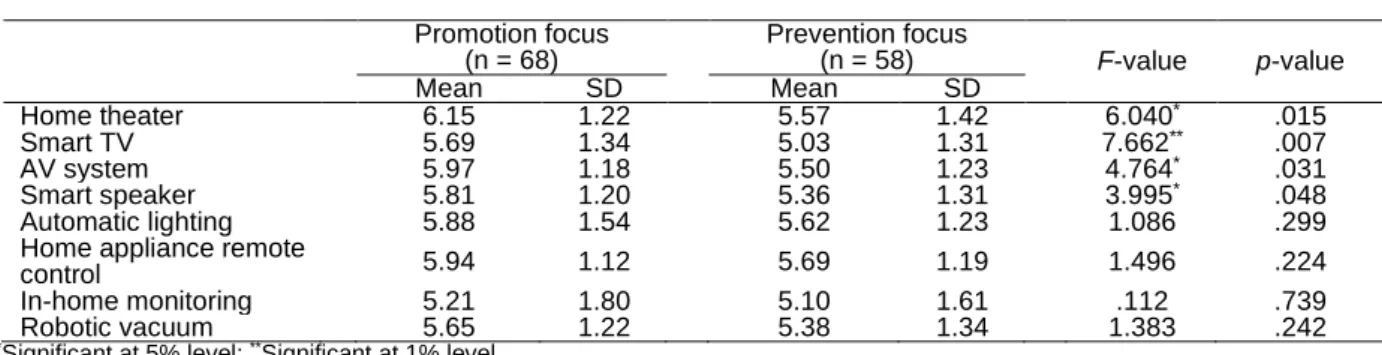
ANOVA was performed to test our hypotheses. The results are summarized in Table 1. For the attitude toward the smart home service, respondents with a promotion (vs. prevention) focus reported significantly more favorable attitudes toward hedonic smart home services. Specifically, for the home theater, overall attitude score was significantly higher in the promotion- (vs. prevention-) focused respondents (Mpromotion = 6.15, SD = 1.22 vs. Mprevention = 5.57, SD = 1.42; F(1, 124) = 6.040, p = .015). For the smart TV, overall attitude score was significantly higher in the promotion- (vs. prevention-) focused respondents (Mpromotion = 5.69, SD = 1.34 vs. Mprevention = 5.03, SD = 1.31; F(1, 124) = 7.662, p = .007). For the AV system, overall attitude score was significantly higher in the promotion- (vs. prevention-) focused respondents (Mpromotion = 5.97, SD = 1.18 vs. Mprevention = 5.50, SD = 1.23; F(1, 124) = 4.764, p = .031). For the smart speaker, overall attitude score was significantly higher in the promotion- (vs. prevention-) focused respondents (Mpromotion = 5.81, SD = 1.20 vs. Mprevention = 5.36, SD = 1.31; F(1, 124) = 3.995, p = .048). Thus, hypothesis 1 is supported.
Conversely, there was no significant difference in attitude toward utilitarian smart home services between the promotion- and prevention-focused respondents. Specifically, for the automatic lighting, there was no significant difference in overall attitude score between the promotion- and prevention-focused respondents (Mpromotion = 5.88, SD = 1.54 vs. Mprevention = 5.62, SD = 1.23; F(1, 124) = 1.086, p = .299). For the home appliance remote control, there was no significant difference in overall attitude score between the promotion- and prevention-focused respondents (Mpromotion = 5.94, SD = 1.12 vs. Mprevention = 5.69, SD = 1.19; F(1, 124) = 1.496, p = .224). For the in-home monitoring, there was no significant difference in overall attitude score between the promotion- and prevention-focused respondents (Mpromotion = 5.21, SD = 1.80 vs. Mprevention = 5.10, SD = 1.61; F(1, 124) = .112, p = .739). For the robotic vacuum, there was no significant difference in overall attitude score between the promotion- and prevention-focused respondents (Mpromotion = 5.65, SD = 1.22 vs. Mprevention = 5.38, SD = 1.34; F(1, 124) = 1.383, p = .242). Thus, hypothesis 2 is supported.
Table 1. Overall attitude toward the smart home services
Promotion focus (n = 68) Prevention focus (n = 58) F-value p-value Mean SD Mean SD Home theater 6.15 1.22 5.57 1.42 6.040* .015 Smart TV 5.69 1.34 5.03 1.31 7.662** .007 AV system 5.97 1.18 5.50 1.23 4.764* .031 Smart speaker 5.81 1.20 5.36 1.31 3.995* .048 Automatic lighting 5.88 1.54 5.62 1.23 1.086 .299
Home appliance remote
control 5.94 1.12 5.69 1.19 1.496 .224
In-home monitoring 5.21 1.80 5.10 1.61 .112 .739
Robotic vacuum 5.65 1.22 5.38 1.34 1.383 .242
5. CONCLUSION
The present research examines whether consumers’ attitudes toward utilitarian/hedonic smart home services differ depending on their regulatory focus (promotion focus vs. prevention focus), particularly when they are not familiar with the services. Specifically, we predict the occurrence of regulatory fit effect in the context of hedonic smart homes services—that is, low-familiarity consumers will have more favorable attitudes toward hedonic smart home services when they are promotion-focused (vs. prevention-focused) (hypothesis 1). On the other hand, we predict that this regulatory fit effect will be less likely in the context of utilitarian smart home services—that is, there will be no significant difference in their attitudes toward utilitarian smart homes services between the promotion- and prevention-focused consumers (hypothesis 2). Consistent with hypotheses 1 and 2, the findings indicate that consumers who are not familiar with smart home services have more favorable attitudes toward hedonic smart home services when they are promotion-focused (vs. prevention-focused). In contrast, it is found that there is no significant difference in attitude toward utilitarian smart home services between the promotion- and prevention-focused consumers.
Both theoretical and practical implications can be drawn. In a theoretical perspective, this research extends previous findings by demonstrating the role of consumers’ regulatory focus in the context of utilitarian/hedonic smart home services. In a practical perspective, the present findings have important implications for issues like product development, segmentation, targeting, product positioning, and marketing communications. Depending on the marketers’ assessment of the target consumers who purchase their smart home service products (e.g., whether they are more promotion-focused or prevention-focused), they may decide that one strategy is more effective than the other. Specifically, our findings imply that regulatory focus may be an effective marketing and segmentation tool in promoting new smart home services and facilitating low-familiarity consumers’ receptiveness to the services. The application of regulatory focus to new smart home services may be particularly appealing to managers because of implementation ease. Since regulatory focus may be induced, marketers of hedonic smart home services can frame communications to encourage promotion focus, which may favorably affect consumers’ attitudes and, subsequently, purchase likelihood. In the context of new smart home services, even a small increase in evaluation and purchase likelihood may have significant financial implications. This research also contributes to the development, positioning, and communication of various smart home services based on the characteristics of consumers (i.e., consumers’ regulatory focus). In addition, service providers and related industry can develop ideas for improving the current smart home services based on our findings. Moreover, this research makes it possible for consumers to make better choices by identifying the factors influencing their evaluation and selection process.
Although this study provides theoretical and practical implications, it is not without limitations. First, two separate studies needs to be conducted with individuals’ chronic regulatory focus being measured and manipulated. Second, instead of student samples, a more representative sample could enhance the generalizability of the findings. Third, it would be good for future research to examine if the findings are applicable to other smart home service products. Fourth, to extend this research, future research needs to consider consumers’ level of familiarity (low vs. high) and examine the effects of consumers’ regulatory focus and familiarity on their responses to smart home services. Fifth, future research should measure both consumers’ choice of hedonic and utilitarian smart home services in order to contrast whether consumers’ choice is in agreement with their attitudes or not. Finally, future research should consider other potential factors that can affect consumers’ attitudes toward smart home services and their acceptance of smart home services.
ACKNOWLEDGEMENT
REFERENCES
[1] J.C. Augusto and C.C. Nugent, “Smart Homes Can Be Smarter”, in J.C. Augusto and C.D. Nugent (Eds.), Designing Smart Homes, LNCS (LNAI), Vol. 4008 (pp. 1-15), Heidelberg: Springer, 2006.
DOI: https://doi.org/10.1007/11788485_1
[2] D. Marikyan, S. Papagiannidis, and E. Alamanos, “A Systematic Review of the Smart Home Literature: A User Perspective,” Technological Forecasting and Social Change, Vol. 138, pp. 139-154, 2019.
DOI: https://doi.org/10.1016/j.techfore.2018.08.015
[3] B. Zhang, P.P. Rau, and G. Salvendy, “Design and Evaluation of Smart Home User Interface: Effects of Age, Tasks and Intelligence Level,” Behaviour & Information Technology, Vol. 28 No. 3, pp. 239-249, 2009.
DOI: https://doi.org/10.1080/01449290701573978
[4] A. Hong, C. Nam, and S. Kim, “What Will Be the Possible Barriers to Consumers’ Adoption of Smart Home Services?” Telecommunications Policy, Vol. 44, No. 2, pp. 1-15, 2020. DOI: https://doi.org/10.1016/j.telpol.2019.101867
[5] M.R. Alam, M.B.I. Reaz, and M.A.M. Ali, “A Review of Smart Homes—Past, Present, and Future,” IEEE Transactions on Systems Man and Cybernetics Part C (Applications and Reviews), Vol. 42, No. 6, pp. 1190-1203, 2012.
DOI: https://doi.org/10.1109/tsmcc.2012.2189204
[6] S. Kim and J. Yoon, “An Exploratory Study on Consumer’s Needs on Smart Home in Korea”, in A. Marcus (Ed.), Design, User Experience, and Usability: Technological Contexts, DUXU 20 16, Lecture Notes in Computer Science, Vol. 9748 (pp. 337-345), Cham: Springer, 2016. DOI: https://doi.org/10.1007/978-3-319-40406-6_32
[7] D.J. Cook, “How Smart is Your Home?” Science, Vol. 335, No. 6076, pp. 1579-1581, 2012. DOI: https://doi.org/10.1126/science.1217640
[8] C. Wilson, T. Hargreaves, and R. Hauxwell-Baldwin, “Smart Homes and Their Users: A Systematic Analysis and Key Challenges,” Personal and Ubiquitous Computing, Vol. 19, No. 2, pp. 463-476, 2015.
DOI: https://doi.org/10.1007/s00779-014-0813-0
[9] I. Mashal, “What Makes Jordanian Residents Buy Smart Home Devices? A Factorial Investigation Using PLS-SEM,” Kybernetes, Vol. 48, No. 8, pp. 1681-1698, 2019.
DOI: https://doi.org/10.1108/k-01-2018-0008
[10] H. Bao, A.Y.L. Chong, K.B. Ooi, and B. Lin, “Are Chinese Consumers Ready to Adopt Mobile Smart Home? An Empirical Analysis,” International Journal of Mobile Communications, Vol. 12, No. 5, pp. 496-511, 2014.
DOI: https://doi.org/10.1504/ijmc.2014.064595
[11] P.S. De Boer, A.J. van Deursen, and T.J. van Rompay, “Accepting the Internet-of-Things in Our Homes: The Role of User Skills,” Telematics and Informatics, Vol. 36, pp. 147-156, 2019. DOI: https://doi.org/10.1016/j.tele.2018.12.004
[12] J. Kowalski, C. Biele, and K. Krzyszyofek, “Smart Home Technology as a Creator of A Super-Empowered User,” in W. Karwowski and T. Ahram (Eds.), Intelligent Human Systems Integration 2019 (IHSI 2019) Advances in Intelligent Systems and Computing, Vol. 903, Cham: Springer, 2019.
DOI: https://doi.org/10.1007/978-3-030-11051-2_27
[13] N. Balta-Ozkan, R. Davidson, M. Bicket, and L. Whitmarsh, “Social Barriers to the Adoption of Smart Homes,” Energy Policy, Vol. 63, pp. 363-374, 2013.
DOI: https://doi.org/10.1016/j.enpol.2013.08.043
[14] N. Balta-Ozkan, O. Amerighi, and B. Boteler, “A Comparison of Consumer Perceptions Towards Smart Homes in the UK, Germany and Italy: Reflections for Policy and Future
Research,” Technology Analysis & Strategic Management, Vol. 26, No. 10, pp. 1176-1195, 2014.
DOI: https://doi.org/10.1080/09537325.2014.975788
[15] N. Balta-Ozkan, B. Boteler, and O. Amerighi, “European Smart Home Market Development: Public Views on Technical and Economic Aspects Across the United Kingdom, Germany and Italy,” Energy Research & Social Science, Vol. 3, pp. 65-77, 2014.
DOI: https://doi.org/10.1086/208990
[16] E.J. Johnson and J.E. Russo, “Product Familiarity and Learning New Information,” Journal of Consumer Research, Vol. 11, No. 1, pp. 542-550, 1984.
DOI: https://doi.org/10.1086/208990
[17] R.W.Jr. Veryzer, “Factors Affecting Evaluation of Discontinuous New Products,” Journal of Product Innovation Management, Vol. 15, No. 2, pp. 136-150, 1998.
DOI: https://doi.org/10.1111/1540-5885.1520136
[18] E. von Hippel, “Horizontal Innovation Networks—By and For Users,” Industrial and Corporate Change, Vol. 16, No. 2, pp. 293-315, 2017.
DOI: https://doi.org/10.1093/icc/dtm005
[19] A. Shuhaiber and I. Mashal, “Understanding Users’ Acceptance of Smart Homes,” Technology in Society, Vol. 58, p. 101110, 2019.
DOI: https://doi.org/10.1016/j.techsoc.2019.01.003
[20] P. Baudier, C. Ammi, and M. Deboeuf-Rouchon, “Smart Home: Highly-Educated Students’ Acceptance,” Technological Forecasting and Social Change, Vol. 153, p. 119355, 2018.
DOI: https://doi.org/10.1016/j.techfore.2018.06.043
[21] J. Byun, B. Jeon, J. Noh, Y. Kim, and S. Park, “An Intelligent Self-Adjusting Sensor for Smart Home Services Based on Zigbee Communications,” IEEE Transactions on Consumer Electronics, Vol. 58, No. 3, pp. 591-596, 2012.
DOI: https://doi.org/10.1109/tce.2012.6311320
[22] W. Gu, P. Bao, W. Hao, and J. Kim, “Empirical Examination of Intention to Continue to Use Smart Home Services,” Sustainability, Vol. 11, No. 5213, pp. 1-12, 2019.
DOI: https://doi.org/10.3390/su11195213
[23] S. Nikou, “Factors Driving the Adoption of Smart Home Technology: An Empirical Assessment,” Telematics and Informatics, Vol. 45, p 101283, 2019.
DOI: https://doi.org/10.1016/j.tele.2019.101283
[24] E. Park, S. Kim, Y. Kim, and S.J. Kwon, “Smart Home Services as the Next Mainstream of the ICT Industry: Determinants of the Adoption of Smart Home Services,” Universal Access in the Information Society, Vol. 17, No. 1, pp. 175-190, 2018.
DOI: https://doi.org/10.1007/s10209-017-0533-0
[25] D.W. Seo, H. Kim, J.S. Kim, and J.Y. Lee, “Hybrid Reality-Based User Experience and Evaluation of A Context-Aware Smart Home,” Computers in Industry, Vol. 76, No. 2, pp. 11-23, 2016.
DOI: https://doi.org/10.1016/j.compind.2015.11.003
[26] J. Shin, Y. Park, and D. Lee, “Who Will Be Smart Home Users? An Analysis of Adoption and Diffusion of Smart Homes,” Technological Forecasting and Social Change, Vol. 134, pp. 246-253, 2018.
DOI: https://doi.org/10.1016/j.techfore.2018.06.029
[27] X. Wang, T.J. McGill, and J.E. Klobas, “I Want It Anyway: Consumer Perceptions of Smart Home Devices,” Journal of Computer Information Systems, pp. 1-11, 2018.
DOI: https://doi.org/10.1080/08874417.2018.1528486
[28] H. Yang, H. Lee, and H. Zo, “User Acceptance of Smart Home Services: An Extension of the Theory of Planned Behavior,” Industrial Management & Data Systems, Vol. 117, No. 1, pp. 68-89, 2017.
[29] E.T. Higgins, “Beyond Pleasure and Pain,” The American Psychologist, Vol. 52, No. 12, pp. 1280-1300, 1997.
DOI: https://doi.org/10.1037/0003-066x.52.12.1280
[30] E.T. Higgins, “How Self-Regulation Creates Distinct Values: The Case of Promotion and Prevention Decision Making,” Journal of Consumer Psychology, Vol. 12, No. 3, pp. 177-191, 2002.
DOI: https://doi.org/10.1207/s15327663jcp1203_01
[31] J.A. Aaker and A.Y. Lee, “‘I’ Seek Pleasure and ‘We’ Avoid Pain: The Role of Self-Regulatory Goals in Information Processing and Persuasion,” Journal of Consumer Research, Vol. 28, No. 1, pp. 33-49, 2001.
DOI: https://doi.org/10.1086/321946
[32] G. Zhao and C. Pechmann, “The Impact of Regulatory Focus on Adolescents’ Response to Antismoking Advertising Campaigns,” Journal of Marketing Research, Vol. 44, No. 4, pp. 671-687, 2007.
DOI: https://doi.org/10.1509/jmkr.44.4.671
[33] A. Chernev, “Goal-Attribute Compatibility in Consumer Choice,” Journal of Consumer Psychology, Vol. 14, No. 1/2, pp. 141-150, 2004.
DOI: https://doi.org/10.1207/s15327663jcp1401&2_16
[34] J.A. Aaker and A.Y. Lee, “Understanding Regulatory Fit,” Journal of Marketing Research, Vol. 43, No. 1, pp. 15-19, 2006.
DOI: https://doi.org/10.1509/jmkr.43.1.15
[35] T. Avnet and E.T. Higgins, “How Regulatory Fit Affects Value in Consumer Choices and Options,” Journal of Marketing Research, Vol. 43, No. 1, pp. 1-10, 2006.
DOI: https://doi.org/10.1509/jmkr.43.1.24
[36] J. Wang and A.Y. Lee, “The Role of Regulatory Focus in Preference Construction,” Journal of Marketing Research, Vol. 43, No. 1, pp. 28-38, 2006.
DOI: https://doi.org/10.1509/jmkr.43.1.28
[37] J. Cesario, H. Grant, and E.T. Higgins, “Regulatory Fit and Persuasions: Transfer from “Feeling Right”,” Journal of Personality and Social Psychology, Vol. 86, No. 3, pp. 388-404, 2004. DOI: https://doi.org/10.1037/0022-3514.86.3.388
[38] E.T. Higgins, L.C. Idson, A.L. Freitas, S. Spiegel, and C. Molden, “Transfer of Value from Fit,” Journal of Personality and Social Psychology, Vol. 84, No. 6, pp. 1140-1153, 2003. DOI: https://doi.org/10.1037/0022-3514.84.6.1140
[39] R. Chitturi, R. Raghunathan, and V. Mahajan, “Delight by Design: The Role of Hedonic versus Utilitarian Benefits,” Journal of Marketing, Vol. 72, No. 3, pp. 48-63, 2008.
DOI: https://doi.org/10.1509/jmkg.72.3.048
[40] C.C. Micu and T.G. Chowdhury, “The Effect of Message’s Regulatory Focus and Product Type on Persuasion,” Journal of Marketing Theory and Practice, Vol. 18, No. 2, pp. 181-190, 2010. DOI: https://doi.org/10.2753/mtp1069-6679180206
[41] N. Thongpapanl, A. Ashraf, L. Lapa, and V. Venkatesh, “Differential Effects of Customers’ Regulatory Fit on Trust, Perceived Value, and M-Commerce Use among Developing and Developed Countries,” Journal of International Marketing, Vol. 26, No. 3, pp. 22-44, 2018. DOI: https://doi.org/10.1509/jim.17.0129
[42] J.W. Alba and J.W. Hutchinson, “Dimensions of Consumer Expertise,” Journal of Consumer Research, Vol. 13, No. 4, pp. 411-453, 1987.
DOI: https://doi.org/10.1086/209080
[43] K.K. Desai and W.D. Hoyer, “The Descriptive Characteristics of Memory-Based Consideration Sets: Influence of Usage Occasion Frequency and Usage Location Familiarity,” Journal of Consumer Research, Vol. 27, No. 3, pp. 309-323, 2000.
DOI: https://doi.org/10.1086/317587
Choice Process on Consumer Decision Processes: A Protocol Analysis,” Journal of Consumer Research, Vol. 7, No. 3, pp. 234-248, 1980.
DOI: https://doi.org/10.1086/208812
[45] R.E. Petty and J.T. Cacioppo, “The Elaboration Likelihood Model of Persuasion”, in L. Berkowitz (Ed.), Advances in Experimental Social Psychology, Vol. 19 (pp. 123-205), New York: Academic Press, 1986.
DOI: https://doi.org/10.1016/s0065-2601(08)60214-2
[46] J.W. Payne, J.R. Bettman, and E.J. Johnson, “Behavioral Decision Research: A Constructive Processing Perspective,” Annual Review of Psychology, Vol. 43, pp. 87-131, 1992.
DOI: https://doi.org/10.1146/annurev.ps.43.020192.000511
[47] A.R. Rao and K.B. Monroe, “The Moderating Effect of Knowledge on Cue Utilization in Product Evaluations,” Journal of Consumer Research, Vol. 15, No. 2, pp. 253-264, 1988. DOI: https://doi.org/10.1086/209162
[48] H. Choo, J.‐E. Chung, and D.T. Pysarchik, “Antecedents to New Food Product Purchasing
Behavior Among Innovator Groups in India,” European Journal of Marketing, Vol. 38, No. 5/6, pp. 608-625, 2004.
DOI: https://doi.org/10.1108/03090560410529240
[49] P.W. Turnbull and A. Meenaghan, “Diffusion of Innovation and Opinion Leadership,” European Journal of Marketing, Vol. 14, No. 1, pp. 3-33, 1980.
DOI: https://doi.org/10.1108/eum0000000004893
[50] R. Batra and O.T. Ahtola, “Measuring the Hedonic and Utilitarian Sources of Consumer Attitudes,” Marketing Letters, Vol. 2, No. 2, pp. 159-170, 1991.
DOI: https://doi.org/10.1007/bf00436035
[51] R. Dhar and K. Wertenbroch, “Consumer Choice Between Hedonic and Utilitarian Goods,” Journal of Marketing Research, Vol. 37, No. 1, pp. 60-71, 2000.
DOI: https://doi.org/10.1509/jmkr.37.1.60.18718
[52] C.-L. Hsu and J.C.-C. Lin, “An Empirical Examination of Consumer Adoption of Internet of Things Services: Network Externalities and Concern for Information Privacy Perspectives,” Computers in Human Behavior, Vol. 62, pp. 516-527, 2016.
DOI: https://doi.org/10.1016/j.chb.2016.04.023
[53] Y. Kim, Y. Park, and J. Choi, “A Study on the Adoption of IoT Smart Home Service: Using Value-Based Adoption Model,” Total Quality Management Business Excellence, Vol. 28, No. 9-10, pp. 1149-1165, 2017.
DOI: https://doi.org/10.1080/14783363.2017.1310708
[54] P. Lockwood, C.H. Jordan, and Z. Kunda, “Motivation by Positive or Negative Role Models: Regulatory Focus Determines Who Will Best Inspire Us,” Journal of Personality and Social Psychology, Vol. 83, No. 4, pp. 854-864, 2002.
DOI: https://doi.org/10.1037/0022-3514.83.4.854
[55] J. Ha and S. Jang, “Perceived Values, Satisfaction, and Behavioral Intentions: The Role of Familiarity in Korean Restaurants,” International Journal of Hospitality Management, Vol. 29, pp. 2-13, 2010.
DOI: https://doi.org/10.1016/j.ijhm.2009.03.009
[56] L. Bergkvist, “The Nature of Doubly Concrete Constructs and How to Identify Them,” Journal of Business Research, Vol. 69, No. 9, pp. 3427-3429, 2016.
DOI: https://doi.org/10.1016/j.jbusres.2016.02.001
[57] L. Bergkvist and J.R. Rossiter, “The Predictive Validity of Multiple-Item versus Single-Item Measures of the Same Constructs,” Journal of Marketing Research, Vol. 44, No. 2, pp. 175-184, 2007.
DOI: https://doi.org/10.1509/jmkr.44.2.175
[58] J.R. Rossiter, “The C-OAR-SE Procedure for Scale Development in Marketing,” International Journal of Research in Marketing, Vol. 19, No. 4, pp. 305-335, 2002.
DOI: https://doi.org/10.1016/s0167-8116(02)00097-6
[59] L.C. Idson, N. Liberman, and E.T. Higgins, “Distinguishing Gains from Nonlosses and Losses from Nongains: A Regulatory Focus Perspective on Hedonic Intensity,” Journal of Experimental Social Psychology, Vol. 36, No. 3, pp. 252-274, 2000.
DOI: https://doi.org/10.1006/jesp.1999.1402
[60] J. Keller and H. Bless, “Regulatory Fit and Cognitive Performance: The Interactive Effect of Chronic and Situationally Induced Self-Regulatory Mechanisms on Test Performance,” European Journal of Social Psychology, Vol. 36, No. 3, pp. 393-405, 2006.
DOI: https://doi.org/10.1002/ejsp.307
[61] M.-Y. Kim and H. Cho, “The Influence of Regulatory Focus on Consumer Responses to Smart Home Services for Energy Management,” The Journal of Advanced Smart Convergence(IJASC), Vol. 9, No. 3, pp. 221-226, 2020.
DOI: http://dx.doi.org/10.7236/IJASC.2020.9.3.221
[62] U. Böckenholt and D.R. Lehmann, “On the Limits of Research Rigidity: The Number of Items in a Scale,” Marketing Letters, Vol. 26, No. 3, pp. 257-260, 2015.
DOI: https://doi.org/10.1007/s11002-015-9373-y
[63] E.M. Okada, “Justification Effects on Consumer Choice of Hedonic and Utilitarian Goods,” Journal of Marketing Research, Vol. 42, No. 1, pp. 43-53, 2005.